
Introduction
A duct is a protective tube installed underground to form a pathway for cables. In outside plant fiber work, the word usually points to a plastic tube product, very often made from high density polyethylene, that is placed in a trench, pulled through a bore, or drawn into an existing larger tube, and that later receives fiber cable, or smaller tubes that hold fiber cable.
Level 8 studies the underground pathway piece by piece. Lesson 4 introduced conduit at a first level. This lesson goes deeper on one piece: duct as a named product, with a material, a size system, a wall designation, printed markings, and joints. Lessons 145, 146, and 147 then take up the smaller tubes inside duct and the grouped arrangements duct can join.
What This Lesson Gives You
- Read the printed marking on a length of duct and name its material, its nominal size, and its wall designation.
- Explain how duct and conduit overlap as words, and state which product the project documents call for.
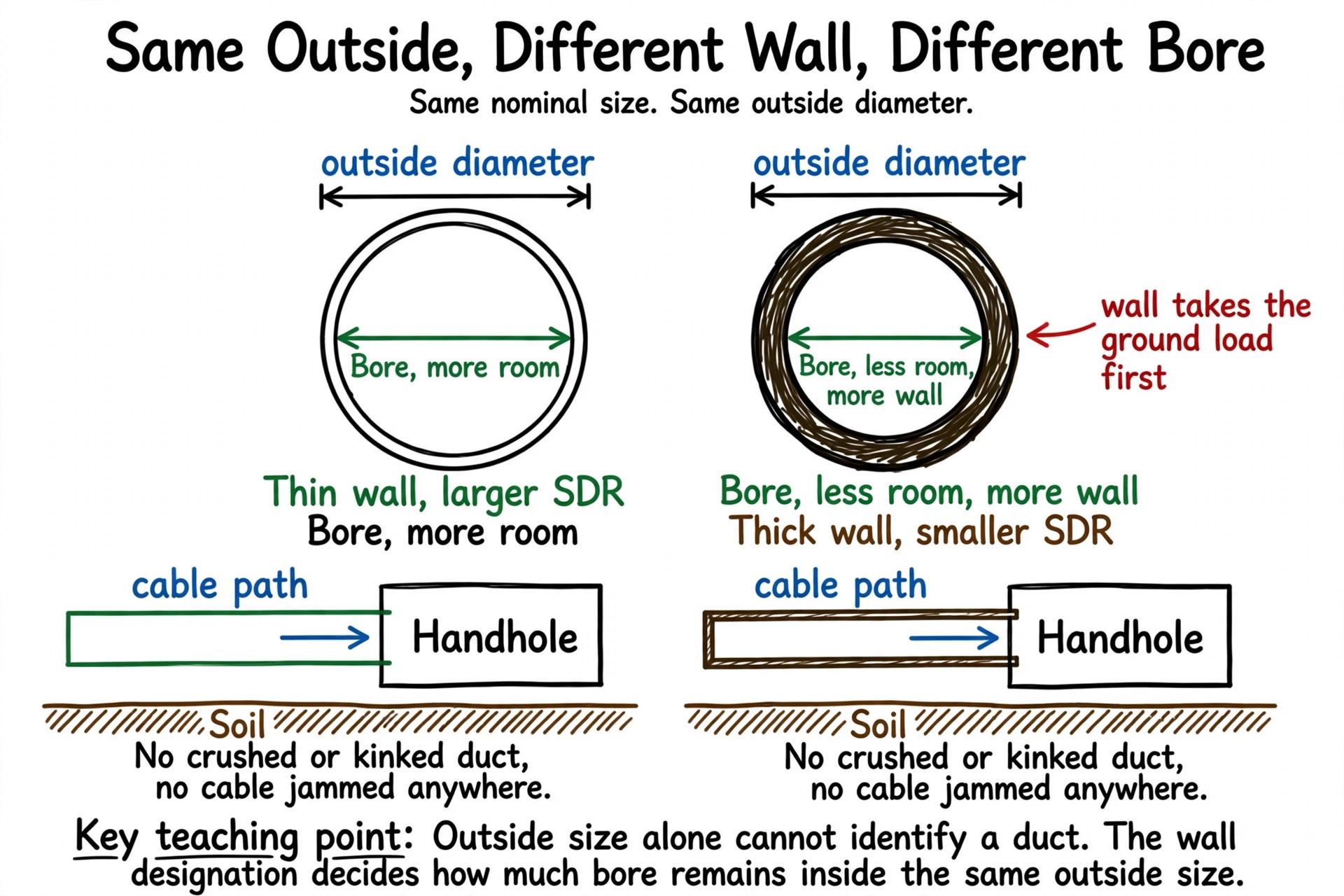
- Use the standard dimension ratio idea to explain why two ducts with the same outside size leave different room inside.
- Tell a continuous, round, correctly joined duct run from a run that will fight cable placement.
- State what duct protects, what duct leaves exposed, and where recognition ends and qualified installation work begins.
Start With the Basics
Think of a garden hose lying empty in a yard. Its wall gives it a round shape and shields the open center from being stepped flat. Its open center is the passage that will carry water later. A thicker wall on the same size hose resists flattening and kinking better, and that thicker wall also leaves a smaller open center.
Duct works through the same three parts. The wall is a solid ring of plastic that gives the tube its shape and takes the pressure and rubbing of the ground. The open center, called the bore in the sections below, is the passage that will carry cable later. The relationship between outside size and wall thickness decides how strongly the wall resists being flattened and how much open room remains inside.
One difference matters right away. A garden hose is handled by hand, and a damaged section is cheap to replace. Duct is buried, bored, or pulled into place once, and the ground closes over it. A wall choice, a joint, or a damaged section that goes into the ground wrong stays wrong underground, where reaching it again means excavation or a new bore.
What Is It?
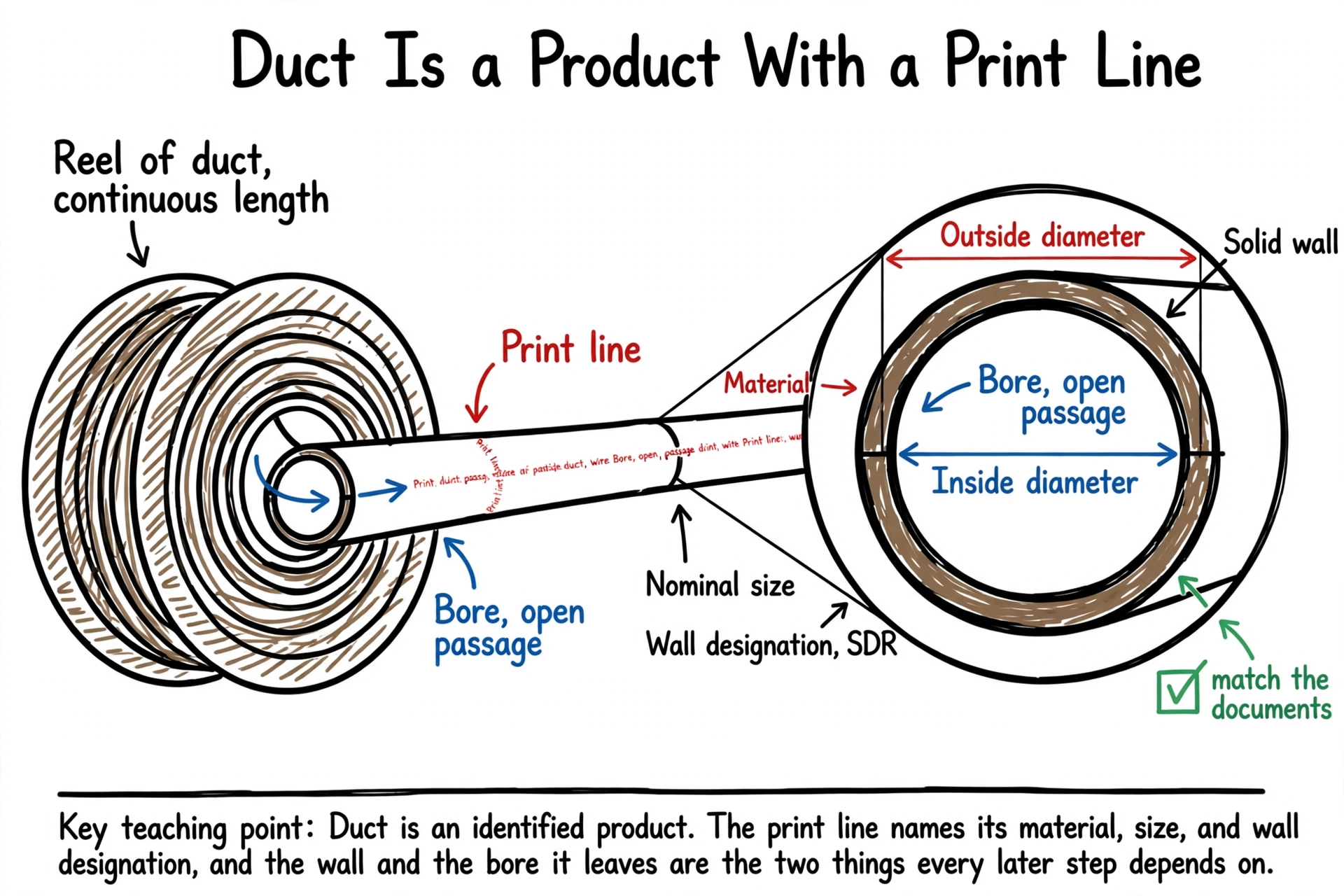
Duct, defined as a product. In this course, duct means a tube manufactured and sold as a cable pathway product, with a stated material, a stated size, a stated wall type, and printed identification along its length. ASTM F2160, the standard specification for solid wall high density polyethylene conduit based on controlled outside diameter, uses the words conduit, duct, and innerduct together for the same family of products, and covers material, dimensional, workmanship, and performance requirements for that family in nonpressure use, protecting fiber optic and power cables. A duct carries no water pressure in service and moves no fluid. Its whole job is to surround cable with a protective passage.
Duct and conduit, the overlap. Lesson 4 taught that a conduit is a protective tube that holds and protects cables, and that the word duct is often used to mean the same thing. The standards reflect that overlap. The Plastics Pipe Institute, called PPI in this lesson, describes high density polyethylene conduit as the preferred material to house and protect electrical power and telecommunications cables, and lists innerduct among conduit types. Industry references likewise define conduit as plastic pipe used to protect fiber and other cable, also known as duct. In field speech, crews move between the two words freely, and context tells a listener whether a speaker means the pathway in general or a specific tube product on the reel. A practical distinction helps a reader of project documents. Conduit often names the pathway function: the protective route between two access points. Duct often names the product that fills that function on a given job: this reel, this material, this size, this wall type. Project documents settle the question on any real job, since the plan legend, the material list, and the specifications name the product to install.
The material: HDPE. HDPE is high density polyethylene, a tough plastic resin widely used for underground duct and conduit. PPI describes HDPE conduit as flexible, durable, and resistant to corrosion and chemical attack, and as available in long reel lengths that reduce joints. HDPE conduit bends and flexes without breakage, including during ground heave or shift, and it resists brittleness from aging or cold weather while retaining impact resistance. HDPE is also nonconducting, and PPI states that it does not suffer corrosion from soil or water contact.
The second material in the FOA picture: PVC. The Fiber Optic Association, called the FOA in this lesson, describes main ducts made from PVC, meaning polyvinyl chloride, a rigid plastic pipe material, with smaller ducts for individual cables installed inside them. Level 8 centers on HDPE duct, the flexible, reel supplied product. Material is always a project document question, and the marking on the delivered product has to match the call.
The bore. The bore of a duct is the hollow inside space of the tube, the passage the cable or a smaller tube will travel through. An open, round, continuous bore lets placement proceed. A narrowed, blocked, or offset bore makes placement pay for the defect.
Nominal size. A nominal size is the name size of a duct, the label used to order and identify it within a sizing system. The name alone leaves the actual room inside undecided, since the same nominal size can be made with different wall thicknesses. A complete product call pairs the nominal size with the sizing system and the wall designation.
Outside diameter and inside diameter. The outside diameter, shortened to OD, is the distance across the outside of the tube, from outer wall surface to outer wall surface. The inside diameter, shortened to ID, is the distance across the open bore, from inner wall surface to inner wall surface. The wall sits between those two measurements. For a fixed OD, a thicker wall produces a smaller ID. One of those two measurements is usually the controlled one in a sizing system, and the other follows from the wall.
Controlled outside diameter. ASTM F2160 duct is based on controlled outside diameter, meaning the standard holds the OD to stated dimensions and tolerances, and the wall and the ID follow from the wall type selected. OD control also supports joint formation with external couplers, since a coupler has to fit over a predictable outside surface. The standard also covers ID controlled product in some types.
Iron Pipe Size. IPS is Iron Pipe Size, a sizing system that borrows its outside diameters from iron pipe dimensions. ASTM F2160 states that HDPE conduit meeting the standard shall be made with IPS sizing. Two ducts with the same IPS nominal size in the SDR and Schedule types share the same nominal OD, even when their walls differ.
Standard dimension ratio. The standard dimension ratio, shortened to SDR, is the ratio of the nominal outside diameter divided by the minimum wall thickness. PPI states the definition in that form, with the working rule that follows from the arithmetic: a larger SDR means a thinner wall, and a smaller SDR means a thicker wall. PPI also states that smaller SDR numbers carry higher tensile strength and greater resistance to deflection than a comparable product with a higher number, and that OD combined with SDR defines the ID and the space available for cables. The project documents select which SDR a job requires. This lesson names no required SDR for any job.
Wall types named in the standards. ASTM F2160 lists IPS wall and sizing types that include SDR 9, SDR 11, SDR 13.5, DR 15.5, Schedule 40, Schedule 80, True-sized, and SIDR dimensions. Schedule 40 and Schedule 80 are wall designations borrowed from pipe schedules, where Schedule 80 has the thicker wall of the pair at a given size. SIDR is the standard inside dimension ratio, the ratio of inside diameter to wall thickness, used for ID controlled product. NEMA TC 7, the standard for smooth wall coilable electrical polyethylene conduit, organizes comparable wall types under EPEC designations, pairing EPEC numbers with SDR and Schedule equivalents, including EPEC 11 for SDR 11 and EPEC 13.5 for SDR 13.5. A marking or a plan legend can use either family of names, and the reader’s job is to match the delivered designation to the specified designation exactly.
Forms of the product. Duct reaches a job in several physical forms:
- Smoothwall duct, a duct with a smooth outside surface and a smooth inside surface, the typical outside plant form described by PPI.
- Ribbed duct, a duct with longitudinal ribs inside, outside, or in both places. PPI describes ribbed product as having lines running in the longitudinal direction, and FOA notes that inner grooves in HDPE ducts are designed to reduce friction and help cable pulling or blowing.
- Duct with a coextruded lining, where a low friction layer is formed inside the HDPE wall during manufacture. Dura-Line describes its lining as a slick, permanent interior lining, and FOA notes that HDPE ducts are typically manufactured with inner features designed to reduce friction.
- Duct with preinstalled pull tape or cable, where the manufacturer places a pulling tape inside the duct, or installs cable at the factory. PPI lists cable in conduit among HDPE conduit types.
- Duct with a tracer wire, where a copper conductor is carried with the duct so the buried pathway can be located later. PPI lists tracer wire conduit among its HDPE conduit types. Lesson 153 covers tracer wire on its own.
What lives inside duct. A duct bore can receive fiber cable directly, and a duct bore can also receive smaller tubes that subdivide the space. FOA describes a main duct holding smaller ducts for individual cables, and standard HDPE ducts serving as subducts inside larger ducts. Lesson 145 covers innerduct. Lesson 146 covers microduct. This lesson names those tubes only to place duct in the family.
What Does It Look Like?
A beginner meets duct in a small number of repeatable sights:
- A large reel or coil of plastic tubing dominates the first sight. PPI states that HDPE conduit is supplied in long coils on spools or reels, compact for shipping, and that long coil lengths install with fewer joints. FOA likewise describes standard HDPE ducts supplied in coils and joined with connectors.
- A cut end shows the structure plainly: a single solid ring of plastic wall around an open round center. A thicker wall on the same outside size is visible at the cut face as a narrower open center.
- In an open trench, duct lies as a long tube along the trench bottom, following the trench line with gradual curves. PPI states that HDPE conduit follows trench contours and can be installed around obstacles underground.
- At a bore entry or a structure entry, duct curves in a long sweep and ends at the wall of a handhole or vault, with the bore opening into the structure space so cable can pass through.
Color. Manufacturers offer HDPE duct in a wide range of colors, with optional stripes. Dura-Line lists colors for its smoothwall conduit that include blue, orange, green, brown, grey, white, red, black, and several others. PPI states that various colors or stripes can identify the network operator or the type of cable in the conduit, giving telecommunications in orange and power in red or black with a red stripe as examples. Orange duct is therefore a common sight on fiber work. Color still answers to the project documents, and a reader should treat color as a supporting clue that the marking and the documents must confirm.
Color has a second, separate job that a reader should keep apart from duct color itself. The American Public Works Association Uniform Color Code assigns orange to communication, alarm, or signal lines, cables, or conduit for the temporary marking of underground facilities, meaning paint and flags placed on the surface during locating. One system is a marking convention. The other is a manufactured product color.
Printed markings. Dura-Line states that permanent marking along its conduit includes the material, the relevant standards, production information, and sequential feet or meter markings. A reader can therefore expect a repeating print line along the tube that names the product and counts length along the run. The print line is the fastest reliable identification on site. Reading it takes a few seconds: find the print, read the material, read the size, read the wall designation, and compare all three against the plan or the material list.
Joints in view. Where two lengths of duct meet, a reader may see:
- A coupling, also called a coupler, a short fitting that joins two duct ends. On HDPE duct, mechanical couplings fit over the outside of both ends, which is one reason OD control matters.
- A fused joint, where the two ends have been heated and joined so the joint shows as a continuous section of tube, sometimes with a small raised bead around the outside at the joint line.
- A straight connector on coiled standard duct, which FOA names as the joining method for the coiled HDPE ducts it describes.
A sound joint reads as aligned and continuous: the tube line runs straight through the joint, and no gap or step shows at the meeting point.
Ovality in view. Ovality is the condition of a tube cross section that has departed from round, so the bore measures wider in one direction and narrower in the other. ASTM F2160 subjects conduit to ovality testing, and coiled product can carry some oval shape from its time wound on a reel. A slightly oval end is visible at a cut end, by comparing the vertical and horizontal openings. Ovality matters because the narrow direction decides how much room a cable or an inner tube actually has.
What Does It Do?
Duct forms the passage before the cable exists. Pathway construction and cable placement are separate operations, often done by different crews weeks apart. Duct is installed first, as an empty passage, and cable is placed later by pulling or by blowing through the finished run. FOA states that underground cables are installed in ducts by pulling or by blowing and jetting. The duct run therefore has to be complete and usable on its own, before any cable tests it.
The wall protects by taking the ground loads first. Soil presses on a buried tube from every side, rocks and roots push at points, and ground can heave or shift. The solid wall spreads load around the ring and holds the bore open against that pressure. PPI describes HDPE conduit stiffness as able to withstand crush forces at the calculated level for buried applications, while its flexibility lets it bend and flex without breakage during ground heave or shift. SDR states the balance in one number: a smaller SDR pairs a thicker wall with greater resistance to deflection.
The wall protects against contact damage over time. Buried plant lives in soil and water for a long service life. PPI states that HDPE resists chemical attack from corrosive chemicals and aggressive soils, does not suffer corrosion from soil or water contact, and provides no host nutrients for bacterial or fungal growth. PPI also states that the material resists brittleness due to aging. The cable inside benefits directly: its jacket meets a stable plastic bore instead of wet soil, sharp rock, and shifting ground.
The smooth bore lowers friction during placement. Pulling and blowing both move cable by overcoming friction between the cable jacket and the duct interior, along the full length of the run and through every curve. PPI states that the coefficient of friction of HDPE conduit can be 30 percent lower than PVC raceway, and that longer pull lengths become possible as a result. Manufacturers push the same mechanism further with coextruded low friction linings and with internal ribs that reduce contact surface.
Continuity preserves replaceability. A duct run that stays continuous and open after burial holds an option open for the life of the pathway. Cable can be removed and new cable placed through the same duct, and spare duct installed empty can receive cable years later with no new excavation. PPI states the point directly: the product provides a permanent pathway that simplifies future cable repairs or replacement.
Duct organizes growth. A single duct bore can carry one cable, and a set of ducts placed together in one trench or one bore can carry a network: some ducts occupied now, some held empty for later cables, some holding innerduct or microduct bundles that multiply the number of separate cable channels. FOA describes the pattern at the main duct scale, with smaller ducts for individual cables installed inside a larger duct. Lesson 147 covers the duct bank as its own subject.
Where Does It Fit?
Duct sits inside the underground pathway sequence that Level 8 now studies in order:
- During design, the route is chosen, and the project documents name the duct product for each segment: material, nominal size, wall designation, and color where specified.
- During delivery, duct arrives on reels, in coils, or in straight lengths, and the delivered marking is checked against the material list.
- During pathway construction, duct is placed by the method the segment calls for. ASTM F2160 names horizontal directional drilling, plowing, and open trench among the installation methods for HDPE conduit. FOA adds that ducts can be pulled into existing larger ducts.
- During placement, runs are joined end to end, ends are protected against soil and water entry, and duct is terminated into handholes, vaults, and other structures.
- Before cable placement, the run is checked for continuity and openness. Lesson 158 covers continuity as its own subject.
- During cable placement, fiber cable is pulled or blown through the duct, directly or through innerduct or microduct already placed inside it.
- After construction, the duct stays in the ground as the permanent pathway, and records identify each duct by route, size, and occupancy.
Duct also fits between two neighbors in the pathway family. Above duct in size sits the larger conduit or main duct that can hold several ducts inside it. Below duct in size sit innerduct and microduct, covered in Lessons 145 and 146. Around duct sit the structures it connects and the couplings, fittings, pull line, and tape products covered later in this level.
What Is at Stake
The bore is the asset. A buried duct run has value only while its bore stays open, round, and continuous. Every failure in this lesson ends at the same place: a bore that cable cannot pass, or a bore that passes cable once and damages it in the passing.
Wrong product, buried. A duct with the wrong wall designation can share the nominal size and the outside diameter of the specified product while leaving a different inside diameter and a different strength margin. Installed and buried, the error hides. Discovery usually arrives during cable placement, when correction means new construction. Reading one print line before burial is the cheap control for an expensive error.
Placement damage. Cable damaged during a pull or a blow through a defective duct can fail testing and require removal. A stepped joint, an oval section, a bead ridge inside a fused joint, or debris inside the bore each raise placement force or cut at the cable jacket. The duct defect is small and local. The cable consequence runs the length of the segment.
Schedule. Pathway defects surface when the cable crew is mobilized. A blocked or undersized run stops placement, and the repair choice is excavation, a new bore, or a reroute, each measured in days.
Future capacity. Networks grow through the pathways earlier crews left behind. A spare duct buried empty, correctly sized, and recorded is future construction already finished. A spare duct buried with the wrong wall, a blocked bore, or no record is capacity a later crew cannot use.
Records and locating. A duct that cannot be found cannot be used or protected. Tracer wire, accurate route records, and correct occupancy notes let later locators mark the pathway and later crews trust the spare.
What Does Good Look Like?
- The print line on the delivered duct matches the project documents on material, nominal size, and wall designation, confirmed before the duct is staged.
- Duct runs are continuous over long lengths, and each joint is aligned, fully joined, and smooth through the bore.
- The bore stays round along the run, with no visible flattening, kinking, gouging, or oval section severe enough to narrow the passage.
- Duct ends awaiting connection or cable are capped, plugged, or taped, keeping soil and water out of the bore.
- Duct enters structures cleanly, terminates where the documents show, and leaves the bore opening clear into the structure space.
- Color and stripe, where the documents assign them meaning, match the assignment for each run, and parallel runs stay distinguishable.
- Each duct on the segment is recorded by size, wall designation, route, and occupancy, with spare ducts installed to the same product standard as occupied ducts.
- Tracer wire, where the documents call for it, runs with the duct and remains accessible at structures for later locating.
From the Field
Picture a bore crew staging material for a road crossing segment. The plan legend calls for a duct identified by nominal size and a wall designation, and the material list repeats the same call. Two reels stand at the staging area, carrying duct of the same nominal size, the same color, and the same outside diameter. The print line on the first reel matches the plan call exactly.
A crew member walking the second reel reads its print line out of habit and stops. The material matches. The nominal size matches. The wall designation differs from the plan call, naming a thinner wall for the same outside size. The difference is invisible from across the staging area, since the outside of the two ducts looks identical.
Here is the decision point. The segment is a road crossing, placed by directional bore, and the wall designation in the plan was selected for that installation method and for the bore space the cable plan counts on. Sending the thinner wall duct through the bore would give the segment less resistance to deflection and less inside room than the documents intend. The error would surface, if it surfaced at all, after the crossing was complete and the ground was restored.
The foreman holds the second reel out of the segment. The crew confirms the first reel carries enough length for the crossing, sets the mismatched reel aside with its print line noted, and records the refusal in the segment notes. The crossing goes in with the specified duct.
The rule to carry is plain: match the duct to the documents by material, nominal size, and wall designation before the duct goes into the ground, and hold any reel whose print line disagrees with the call, since the outside of the tube cannot tell you which wall you are burying.
What Can Go Wrong?
Wrong wall designation installed. Duct is staged with a wall designation that differs from the plan call, at the same nominal size and outside diameter. The run installs normally and delivers a different inside diameter and strength margin from the design. Correction after burial means new construction.
Kinked duct. Flexible duct bent past the limit the manufacturer states for the product can fold at the bend, pinching the bore closed at that point. Cable placement finds the hidden kink as a hard stop. Bend limits are product specific values stated by the manufacturer.
Oval bore. Coiled duct that stays oval, or duct flattened by load, presents a bore narrower than its nominal size in one direction. Cable that should fit by the size name hangs up or forces through with added friction.
Stepped or gapped joints. A coupling seated short, a fused joint made out of alignment, or a joint that separates under soil movement leaves a step or a gap inside the bore. Cable catches at the step, and soil and water enter at the gap. PPI guidance summarized in industry references notes that a butt fusion joint produces an internal bead that can restrict the bore and interfere with cable placement.
Crushed duct. Loads beyond the wall capacity for the installation, from equipment crossing a shallow run or rock pressure at a point, flatten a section of duct. A crushed empty duct offers no passage.
Open ends and debris. Duct ends left open during construction admit soil, gravel, and water, and debris settles in low points of the run. FOA names end caps among the basic duct accessories, and describes end cap installation as crucial to keeping water out during construction.
Solvent cement used on HDPE. HDPE resists chemical attack and does not join with the solvent cements and glues used on PVC. A joint attempted with the wrong joining chemistry has no fused or mechanical hold and can separate in the ground. HDPE duct joins by heat fusion methods or by mechanical fittings, performed under manufacturer procedures.
Color trusted over print. A crew stages duct by color alone, and a same color reel with a different size or wall joins the segment. Color is a supporting clue. The print line and the documents carry the product identity.
What Should Someone Notice in the Field?
- Read the print line on any duct you are asked to describe, and name the material, nominal size, and wall designation from the print rather than from the color.
- Compare the print line against the plan legend or the material list for the segment, and report any mismatch before the duct is placed.
- Look into cut ends and structure entries, and judge whether the bore reads round and open or oval, narrowed, or blocked.
- Follow any visible joint with your eye for alignment: the tube line should run straight through the joint, with no step, gap, or crooked entry.
- Note duct ends that stand open without a cap, plug, or tape, especially at staging areas and structures.
- Note visible damage on staged or placed duct: kinks, flattened sections, gouges, and crushed spots.
- Check that parallel runs stay distinguishable by the color or stripe the documents assign.
- Confirm spare duct is present where the plan shows it, with its ends protected and its identity recorded.
- Know the boundary: reading print lines, comparing product against documents, noticing damage, and reporting a mismatch are observer tasks this lesson teaches. Selecting duct, fusing or coupling joints, placing duct, and accepting a run belong to qualified people working under the project documents and manufacturer procedures. Reading this lesson qualifies no one to perform that work, and no one should enter a trench, a bore pit, or a structure to inspect duct without proper training, equipment, and authorization.
Key Terms
Duct: A protective tube manufactured as a cable pathway product, with a stated material, size, wall type, and printed identification, installed underground to hold cable or smaller tubes.
Conduit: A protective tube that holds and protects cables. In fiber work the words conduit and duct overlap heavily, and project documents name the product a job requires.
HDPE: High density polyethylene, a tough, flexible, corrosion resistant plastic widely used for underground duct, supplied in long coils and reels.
PVC: Polyvinyl chloride, a rigid plastic pipe material used for main ducts and other pathway products.
Bore: The hollow inside space of a duct, the passage cable or a smaller tube travels through.
Nominal size: The name size of a duct within a sizing system, used to order and identify the product.
Outside diameter (OD): The distance across the outside of the tube.
Inside diameter (ID): The distance across the open bore.
Standard dimension ratio (SDR): The ratio of nominal outside diameter divided by minimum wall thickness. A larger SDR means a thinner wall. A smaller SDR means a thicker wall.
IPS: Iron Pipe Size, a sizing system that gives a nominal size a defined outside diameter borrowed from iron pipe dimensions.
Coupling: A short fitting that joins two duct ends, keeping the tube line aligned and the bore continuous.
Ovality: The condition of a tube cross section that has departed from round, wider in one direction and narrower in the other.
Innerduct: A smaller tube placed inside a larger duct, dividing the bore into separate channels. Covered in Lesson 145.
Microduct: A very small tube used with small diameter fiber cables, often grouped inside a larger duct. Covered in Lesson 146.
Check Your Understanding
- Two ducts share the same nominal size and the same outside diameter. One carries a smaller SDR number than the other. Which duct has the thicker wall, which duct leaves more room in its bore, and why?
Answer: The duct with the smaller SDR has the thicker wall, since SDR is the outside diameter divided by the minimum wall thickness, and a smaller result means the wall takes a larger share of the same outside size. The duct with the larger SDR leaves more room in its bore, since its thinner wall leaves a larger inside diameter.
- A plan legend calls for duct by material, nominal size, and wall designation. A staged reel matches on material and size, and its color matches the other reels on site. Its wall designation differs from the legend. What should happen before that reel is placed, and what carries the product identity on site?
Answer: Placement of that reel should hold until the mismatch is resolved against the project documents. The print line and the documents carry the product identity. Color is a supporting clue and cannot settle size or wall.
- In the From the Field scenario, why did the wall designation mismatch matter for a road crossing placed by directional bore, even though both reels looked identical from outside?
Answer: The two ducts shared nominal size, color, and outside diameter, so the difference hid in the wall. The thinner wall duct would have given the crossing less resistance to deflection during installation and less inside room than the plan counted on, with the error buried under a restored road surface. The foreman held the mismatched reel, used the matching reel, and recorded the refusal.
- Name three mechanisms by which duct protects and serves the cable that will live inside it.
Answer: Any three of the following count. The solid wall takes soil load and ground movement first, holding the bore open around the cable. The wall material resists corrosion and chemical attack, so the cable jacket meets a stable plastic bore over time. The smooth, low friction interior lowers the force needed to pull or blow cable through the run. The continuous passage preserves replaceability, so cable can be replaced without new excavation.
- A cut end of coiled duct shows a bore that measures visibly wider side to side than top to bottom. What is that condition called, and why does it matter for cable placement?
Answer: The condition is ovality, a cross section that has departed from round. The narrow direction decides the room a cable or an inner tube actually has, so a run can hang up even when its nominal size appears sufficient on paper.
Lesson Takeaway
Duct reads as a product now, with an identity a reader can verify. The print line names the material, the size, and the wall. The wall designation decides the inside room and the strength margin, and the bore is the asset everything else protects. A reel of duct invites three questions before any ground opens: does the print match the documents, does the bore read round and open, and will the run stay continuous from structure to structure.
Sources and Technical References
ASTM International, ASTM F2160-22, Standard Specification for Solid Wall High Density Polyethylene (HDPE) Conduit Based on Controlled Outside Diameter (OD). Covers requirements for polyethylene conduit, duct, and innerduct for nonpressure protection of fiber optic and power cables, IPS sizing types, installation methods, and elongation, impact, and ovality testing: https://store.astm.org/f2160-22.html
Plastics Pipe Institute, Power and Communications Division, About HDPE Conduit. Covers flexibility, toughness, corrosion and chemical resistance, long reel lengths, friction, conduit types, colors for identification, and sizing systems with the dimension ratio defined as nominal outside diameter divided by minimum wall thickness: https://www.plasticpipe.org/EnergyPipingSystems/PowerCommunications/About-HDPE.aspx
Plastics Pipe Institute, HDPE Conduit Sizing Frequently Asked Questions, summarized from PPI Handbook of PE Pipe, Chapter 14, Duct and Conduit. Defines SDR and SIDR, states the wall thickness rules that follow from each ratio, and states that OD combined with SDR defines the ID and the space available for cables: https://blog.unitedpolysystems.com/blog/hdpe-sizing-frequently-asked-questions-and-resources?hs_amp=true
Fiber Optic Association, Fiber Optic Ducts and Microducts, by Vladimir Grozdanovic. Covers main PVC duct holding smaller ducts, standard HDPE ducts and subducts, microducts, installation by pulling or blowing, coiled supply with straight connectors, friction reducing inner features, and end caps: https://foa.org/tech/ref/install/Ducts.pdf
Dura-Line, Standard Smoothwall HDPE Conduit technical data. Covers flexible HDPE construction, specifications, installation types, colors with optional stripes, permanent markings including material, standards, production information, and sequential feet or meter markings, and a coextruded low friction lining: https://duraline.com/-/ods/Resource/151/3008/Original/DL_Smoothwall_8.24.pdf?version=1723221563
National Electrical Manufacturers Association, NEMA TC 7-2016, Smooth-Wall Coilable Electrical Polyethylene Conduit. Covers HDPE conduit wall types providing a protective raceway for electrical and communication cables buried underground or encased in concrete, with EPEC wall types paired to SDR and Schedule dimensions: https://webstore.ansi.org/preview-pages/NEMA/preview_NEMA+TC+7-2016.pdf
American Public Works Association, Uniform Color Code, Guidelines for Uniform Temporary Marking of Underground Facilities. Assigns orange to communication, alarm, or signal lines, cables, or conduit for temporary surface marking: https://www.apwa.org/wp-content/uploads/Uniform-Color-Code.pdf
Plastics Pipe Institute, Handbook of PE Pipe, Chapter 14, Duct and Conduit, joining guidance summarized in How To Properly Join HDPE Conduits In The Field. Covers joints made by heat fusion, electrofusion, or mechanical fittings, and the internal bead produced by butt fusion that can restrict the bore: https://outsideplantcabling.com/how-to-properly-join-hdpe-conduits-in-the-field/
Previous lesson: Lesson 143: Is the Site Actually Ready for Construction? |
Back to Level 8 hub |
Next lesson: Lesson 145: What Is Innerduct?