
Introduction
Innerduct is a smaller duct placed inside a larger duct or conduit to divide one open pathway into separate channels, so each cable can sit in its own channel and can be installed, removed, or replaced without disturbing cables already in place. The Fiber Optic Association, called FOA, describes the same idea in plain terms: innerduct inside the conduit separates the cables and provides easier pulling of cables.
Level 8 studies the underground pathway piece by piece. Lesson 144 taught duct, the protective tube that carries cable underground. This lesson teaches the divider inside that tube. Lesson 4 introduced conduit as the raceway cables are pulled through. Innerduct turns one shared raceway into an organized set of pathways with a future built into it.
What This Lesson Gives You
- Look into an open structure and tell whether the pathway is one open duct or a duct subdivided by innerduct, and name each channel you see.
- Name the common forms of innerduct, rigid plastic and fabric, and state what each form does differently inside the same outer duct.
- Explain why a second cable pull into an open shared duct risks the cable already in service, and why a separate empty channel changes that risk.
- Check an innerduct end for the signs that matter before a pull: correct channel, pull tape present, no crush, kink, or blockage visible, and identification that matches the record.
- State the hold decision when every channel is occupied, damaged, or unidentified, and name what must be resolved before any new cable enters the pathway.
Start With the Basics
Picture a wide kitchen drawer. Loose utensils tossed into one open drawer slide together, tangle, and hide the tool at the bottom. A drawer divider changes the same space. Each tool gets its own slot, a hand can lift one tool without moving the rest, and an empty slot waits for the next tool. The drawer stays the same size. The divider makes the space usable more than once.
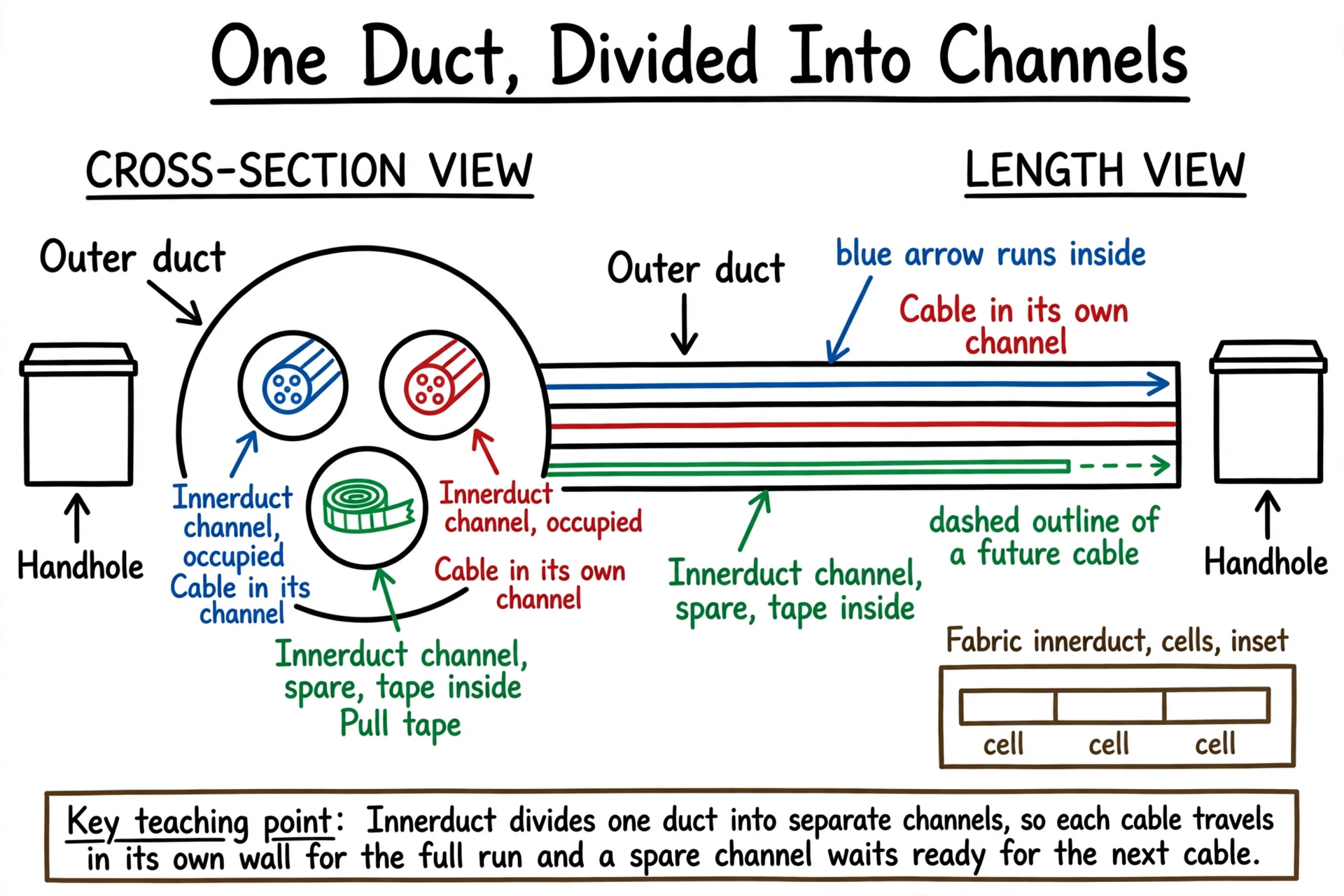
Innerduct works through the same mechanism inside a duct. The outer duct provides the protected space and the route. Innerduct divides that space into channels. Each channel holds its own cable, keeps that cable apart from its neighbors, and gives the next crew a clear place to work. An empty channel is reserved capacity already built, already routed, and already protected by the outer duct around it. The difference matters: a utensil can be lifted straight up, while a cable must travel the full length of its channel, around every bend, without rubbing against another cable for that whole distance. Separation along the entire run is the point.
What Is It?
Innerduct is a pathway inside a pathway. The definitions below build the picture in order, from the outer structure inward.
Duct and conduit, recalled. A duct is a tube, usually plastic in modern fiber work, that protects underground cable and provides its route. Conduit is a rigid or flexible metal or nonmetallic raceway through which cables can be pulled. Lesson 144 covered duct and Lesson 4 covered conduit. This lesson uses duct for the larger underground tube that receives the innerduct.
Innerduct defined. Innerduct, also called subduct in FOA and manufacturer material, is a smaller duct used to subdivide a larger duct. FOA states the purpose directly: subducts subdivide conventional conduit originally designed for single, large diameter metallic conductor cables into multiple channels for smaller optical cables. A large conduit built for one big cable is a poor fit for several small fiber cables sharing one open bore. Innerduct reshapes that bore into channels sized and separated for the cables the network actually carries.
Channel and cell. A channel is one separate pathway inside the subdivided duct, sized for one cable or one cable group as the project documents direct. In fabric products the channel is usually called a cell, one compartment in a joined strip of compartments. Both words describe a bounded space that belongs to one cable, with a wall between that space and the next cable.
Pull tape. Pull tape is a flat woven tape installed inside a channel so a crew can draw a cable or a stronger pulling line through the channel. FOA notes that conduit can be purchased with innerducts installed, generally with pulling tapes also, and that where a channel has no tape, a line may be blown through to pull a stronger tape through. Dura-Line data sheets describe factory preinstalled pull tape as a standard option, and fabric specifications describe a pull tape or rope inside each cell. A channel without a usable tape needs extra work to establish a pulling path first.
Occupied and spare channels. An occupied channel already holds a cable. A spare channel is an empty channel left in place for a future cable, deliberate in the design on many jobs. The project documents state channel count, current assignments, and which channels stay empty. A spare has value only while it stays empty, open, identified, and fitted with a usable pull tape.
Forms of innerduct. Innerduct reaches the field in two families, rigid plastic tubes and flexible fabric cells. Project documents and manufacturer instructions govern which form, size, and count a given duct receives.
- Smooth wall innerduct. A rigid high density polyethylene, called HDPE, tube with a smooth outside and a smooth inside. The smooth interior gives the cable a plain sliding surface for the full length of the pull.
- Ribbed interior innerduct. An HDPE tube with lengthwise ribs formed on the inside wall. Dura-Line describes its Smooth Out and Ribbed In product in direct terms: internal longitudinal ribbing reduces friction during cable placement. The ribs reduce contact area between cable and wall as the cable travels.
- Corrugated innerduct. An HDPE tube with a wavy, ridged wall profile that flexes readily. That flexibility suits retrofit work in existing conduit and short run work, and the project documents and the manufacturer data sheet for the selected product govern where it may be used. Trade listings group wall types as smooth over smooth, smooth over ribbed, ribbed over ribbed, and corrugated, so the record should name the exact type.
- Low friction lined innerduct. Some HDPE products carry a coextruded interior lining made to lower friction. Dura-Line describes its SILICORE ULF lining as a slick, permanent interior lining coextruded inside the HDPE wall, with a coefficient of friction lower than standard HDPE conduit in the manufacturer test method stated on its data sheets. A lining claim belongs to the specific product and its data sheet, so field staff confirm the product on the reel matches the documents.
- Fabric innerduct. A flexible innerduct made from woven textile, formed into one or more cells joined along a continuous seam, with a pull tape or rope inside each cell. The MaxCell specification sheet describes standard outdoor woven fabric innerduct as single or multi-cell polyester and nylon fabric, cells joined along a continuous seam, footage markings on the exterior cell, and a pull tape or rope in each cell. Fabric innerduct lies flat on the reel, opens into cells inside the duct, and conforms to the space available, including space beside a cable already in place in some manufacturer described applications.
Sizing in plain terms. FOA material gives the working picture: optical cable is usually placed in a subduct placed into an existing larger diameter communications conduit, and many communications conduits can be fitted with three or four subducts. Those sentences describe common practice. They set no rule for a given job. Count and size for a specific duct come from the design, the cable diameter, the duct inside diameter, and the manufacturer instructions for the products selected.
Fill, and where fill limits come from. Fill is the share of the inside area of a duct or channel that the cables or innerducts inside it occupy. A crowded space raises pulling tension and leaves no room for the next step the design promised. No single field number governs innerduct fill on every job. Cabling Design guidance states that no industry standard or code governs innerducts in conduits in the way NEC Chapter 9 governs electrical cables, and that manufacturers recommend different fill ratios, with judgment shaped by bends, run length, and conduit material. Manufacturer guidance for a specific product can be exact: MaxCell publishes a recommended maximum fill ratio of 45 percent for its fabric innerduct, with a marked increase in pulling tensions above that level in its testing. That figure belongs to that product. Field staff take the fill limit from the manufacturer instructions for the product installed and from the project documents.
Standards that touch the product. Dura-Line data sheets state that its HDPE conduit dimensions meet or exceed one or more of ASTM F2160, ASTM D3350, ASTM D3485, NEMA TC-7, UL 651A, and UL 1990, depending on the product. A standard applies to a product because the manufacturer certifies that product to it and the project documents call for it, so field staff verify the marking on the tube and the submittal for the job instead of judging compliance from memory.
What Does It Look Like?
A beginner meets innerduct on the reel, at the open end of a duct in a structure, and in the record. Each place shows different evidence.
On the reel and at staging:
- Colored plastic tubes wound on a reel, with pull tape ends visible where the product carries factory preinstalled tape.
- Tube colors that differ from channel to channel, so each channel can be told apart at both ends of a run. Color on a given job follows the project documents and the owner identification scheme.
- Printed markings along the tube. Dura-Line data sheets describe permanent marking with material, relevant standards, production information, and sequential feet or meter markings.
- A flat strip of woven fabric on a reel where fabric innerduct is the selected form, with visible seams dividing the strip into cells and colored stitching or markings that identify the cells.
- Pull tape ends visible at the tube or cell end, secured so the tape stays with its channel.
At the open end of a duct:
- The round mouth of the larger duct, with the documented number of smaller tube ends inside it, each end cut and dressed so its opening stays round and clear.
- One cable leaving one tube end toward the splice case or next structure, while neighboring empty tube ends sit capped or sealed, with pull tape ends secured and labeled.
- Color, stripe, or label differences that let a reader match each tube end to the same channel in the next structure.
- Fabric cells appearing as soft compartments gathered at the duct mouth, each cell holding its own cable or its own pull tape, with the flat strip continuing into the duct.
- A duct mouth with a single cable and open space around it, and no tubes or cells at all. That sight means the pathway was never subdivided, and the next cable added will share open space with the cable in service.
Condition signs a beginner can read without touching cable:
- A tube end crushed flat, kinked sharply, or split, so the channel behind it may be pinched or blocked.
- A tube that snakes in tight waves where visible. American Polywater technical material explains that flexible duct tends to snake because of reel memory, and that snaking makes cable pulling harder even with lubricant.
- Pull tape missing from an empty channel, frayed at the end, or pulled back inside the tube where no hand can reach it.
- Mud, water, or grit sitting inside an open tube end that was left unsealed.
- Tube ends cut at uneven lengths with no labels, so the channel map in the record cannot be matched to the tubes in front of the reader.
- A fabric strip twisted at the mouth, so cell order at this end may no longer match cell order at the far end.
What Does It Do?
Innerduct earns its place through four mechanisms. Each mechanism follows from the wall that a channel puts around one cable for the full length of the run.
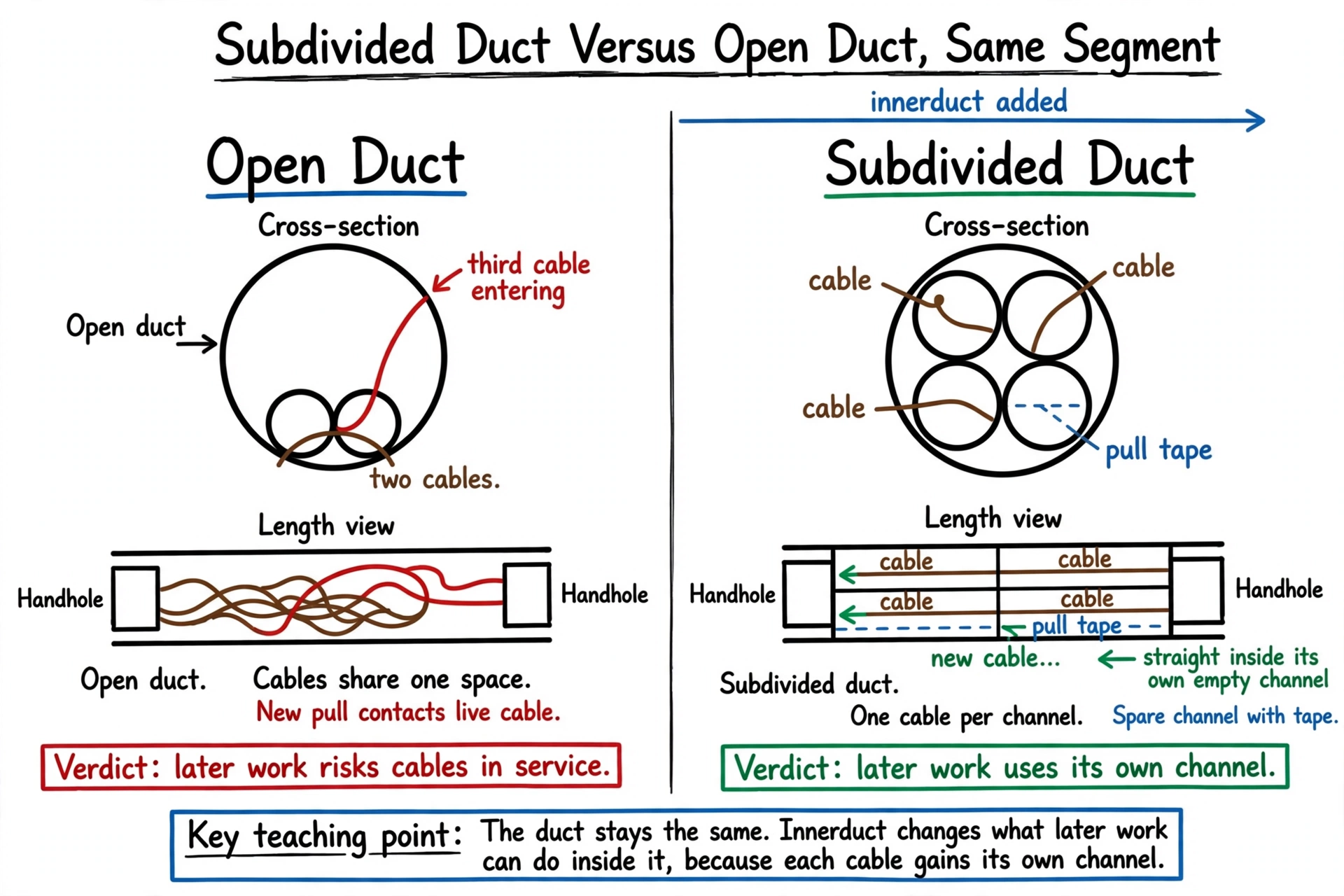
Subdivision turns one space into counted capacity. An open duct holds volume. A subdivided duct holds channels. A crew can count channels, assign each channel a purpose, record occupied and spare status, and plan the next cable against a known empty channel. FOA states the underlying capacity point: unless innerducts are installed in a conduit, only one cable can be installed in the conduit unless all the cables are pulled together. Read that sentence carefully, because it carries the whole lesson. In an open duct, cables added at different times interfere with each other. In a subdivided duct, each cable has an assigned channel, and later cables use later channels.
Separation protects the cable already in service. A cable being pulled travels under tension and can wrap, rub, or ride over a cable lying loose in the same open space. Fabric innerduct literature describes the same hazard: the innerduct segregates cables into compartments, prevents cable against cable friction, and provides a tape or rope inside each compartment for pulling. A rigid tube wall does the same separation work with plastic. The wall takes the contact, and the in-service cable sits untouched by the pull one channel over. Separation also runs in reverse: a cable can be pulled out of its own channel while neighboring cables stay in place, a point fabric innerduct material states when it notes that cables can be installed, removed, and reinstalled at any time.
A dedicated channel lowers and steadies pulling friction for its own cable. Friction inside a channel comes from contact between the cable jacket and the channel wall, and contact grows worse where a loose cable in an open duct presses or spirals around another cable. A smooth, ribbed, or lined interior gives the cable one predictable surface. Dura-Line attributes reduced friction to the ribbing on its ribbed interior product and a lower coefficient of friction to its coextruded lining, each claim tied to that product and its data sheet. Polywater guidance identifies keeping the duct straight as a primary factor in reducing pulling tension, because reel memory snaking adds contact along the whole pull. The channel gives the cable a single surface, a single path, and no neighboring cable to climb over.
Reserved channels make future work a pull instead of a project. A spare channel is a finished pathway waiting for a cable. The route is already dug, bored, and documented, so the future job becomes: open the structures, confirm the channel and its tape, pull the cable, splice and test. In an open duct, adding a cable later means pulling alongside a live cable, pulling every cable together again, or building a new pathway. Capacity added during initial construction, while the trench or bore is open and the crew is mobilized, costs a tube and tape. Capacity added years later costs a construction project. That difference is why designers order spare channels where growth is expected.
Identification turns channels into a managed system. Colors, stripes, printed markings, cell stitching colors, and labels let crews refer to a specific channel in speech, records, and work orders. A direction such as place the new cable in the blue channel can be executed and verified only when the channel keeps one identity along the run and at both ends.
Where Does It Fit?
Innerduct sits between the duct build and the cable pull, and its channels then serve every later phase of the network life.
- Design. The designer selects duct size, channel count and size, form, and channel assignments. Fill and sizing decisions live here, governed by the standards, manufacturer instructions, and owner requirements in the design documents.
- Duct construction. Crews place the outer duct by trench, plow, or bore. Innerduct can arrive preinstalled inside conduit from the supplier, as FOA notes, or crews can pull innerduct into a placed duct as its own step. Either way, the subdivided pathway must exist and be proven before cable placement begins.
- Cable placement. Each cable goes into its assigned channel, pulled with the tape in that channel, under the cable manufacturer limits for that cable. This lesson sets the pathway condition that pulling depends on: one cable, one channel.
- Splicing and activation. At each structure, the cable leaves its channel and enters the splice case or equipment. The channel record tells the splicer which cable came from which channel and direction, and spare channels pass through ready for the next phase.
- Growth and restoration. A new service, a capacity upgrade, or a replacement for a damaged cable uses a spare channel or frees a channel by removing the old cable from its own tube. Work on one channel leaves the other channels undisturbed.
- Records. The as-built record carries the channel map: structure to structure, channel count, color or cell identity, occupied or spare status, and tape status. A channel that exists in the ground and appears in no record will be rediscovered the hard way, usually during an urgent job.
- The neighboring lessons. Lesson 146 teaches microduct next, a much smaller duct system built around small tubes and microcables. Size, cable type, and installation method separate microduct from the standard size subduct family this lesson teaches.
What Is at Stake
Damage to a live cable during a later pull. The highest stake is a working cable damaged by work unrelated to its service. A pull through a shared open duct can rub, wrap, or crush the cable already inside. A subdivided pathway removes that contact. Where subdivision was skipped during construction, every later addition carries this risk for the life of the duct.
Capacity that exists on paper only. Channels crushed during placement, blocked by debris, missing tapes, or installed in a different count than the record claims leave less capacity than the plan shows. The shortage surfaces years later, during a sold job with a due date. Proving channels at acceptance is cheap. Discovering a false spare during a customer install is expensive in schedule, rework, and trust.
Pulling tension and cable damage in a poor channel. A kinked, snaked, or grit filled channel raises friction, and higher friction raises pulling tension. Tension beyond the cable manufacturer limit damages the cable the pull was meant to deliver. Channel condition is therefore a cable quality issue, in addition to a convenience issue.
Identification errors. Two channels swapped in the record send a crew to pull into an occupied channel, or to remove a cable believed spare that is actually in service. Color and label discipline at both ends, matched to the record, is the control. The cost of a swap ranges from a wasted pull to an outage.
Money spent twice on the same route. A route built without spare channels and later rebuilt for capacity pays mobilization, excavation or bore, restoration, and permitting costs twice for one corridor. A route built with spares pays for tube and tape once.
Safety around structures and pulls. Opening structures, handling reels, and pulling cable carry hazards covered by the safety lessons in this course. Innerduct adds decisions that must stay inside qualification limits, covered in the field checklist at the end of this lesson.
What Does Good Look Like?
- Every duct matches the plan for channel count, size, and form, and the count at this structure matches the count at the next structure.
- Each channel carries one identity, by color, stripe, cell position, or label, reading the same at both ends and matching the as-built record.
- Occupied channels hold one cable each as the documents direct, with the cable entering and leaving cleanly at each structure, free of sharp bends at the tube mouth.
- Spare channels sit empty, open, and sealed against mud and water, each with a usable pull tape secured and recorded as spare.
- Tube ends are cut square and dressed, openings stay round, and no end shows crush, kink, split, or heat damage.
- Fabric cells lie in order without a twist between structures, each cell holds its tape, and cell identification matches at both ends.
- No channel shows grit, pooled mud, or debris at its mouth, and caps or plugs close the ends the plan leaves empty.
- The segment record names each channel, its status, and its assignment, and a reader at the open structure can verify the record against the tubes in view.
From the Field
Picture a two structure segment on a feeder route, built several years earlier with one large duct between a vault and a handhole. The original build placed three rigid innerduct channels in the duct. Two channels carry cables in service. The third was left spare, with its pull tape recorded in the as-built.
A new order directs the crew to add one cable through the same segment. At the vault, the crew opens the duct mouth and finds the three tube ends the record promised. The two occupied tubes match their labels. The spare tube tells a different story at its mouth. The end is pinched partway closed, the pull tape end is missing, and grit sits inside the opening where an unsealed end faced the vault floor.
The crew lead feels two pressures at once. The order carries a due date, and a second duct in the structure, an open duct with one live cable inside, looks empty enough to invite a shortcut. Pulling the new cable beside the live cable would finish the segment today, and the space appears sufficient at the mouth.
The lead stops and works the problem in the order this lesson teaches. The open duct option puts a pulling cable in contact with a live cable for the full length of the run, which is the exact failure subdivision exists to prevent. The damaged spare channel is the correct pathway, and its condition is a repair question first. The crew attempts to prove the spare channel, working only within their assignment and qualification: they check whether a tape or line can be established through the channel and whether the pinch at the mouth is only an end defect that a proper repair under the project documents can correct, and they report the channel condition with photographs before any cable enters it.
The proof fails. Resistance along the channel shows the pinch is part of a longer deformation, and no line passes cleanly. The lead records the segment as having no usable spare channel, reports the damage for a repair decision by the responsible supervisor, and holds the new cable out of both ducts.
The live cables never carried the risk of a contact pull, the new cable was never forced through a deformed channel, and the owner gained a true record: the spare on this segment is failed, not available.
The rule to carry is simple: a new cable belongs in its own proven channel, and when no channel can be proven, the job holds for a pathway decision instead of borrowing space beside a live cable or forcing a damaged tube.
What Can Go Wrong?
Pulling a new cable into an open duct beside a live cable. The moving cable rubs and can wrap around the cable in service. Jacket damage and a possible service failure follow. FOA guidance against installing a fiber optic cable in a duct that already contains cabling states the safe default.
Forcing a cable through a crushed or kinked channel. The pinch concentrates friction and pressure on the jacket. The pull may stall, the cable may be damaged at the pinch, or the tube may split and trap the cable mid-run.
Trusting a spare that was never proven. Records can claim a spare that construction never installed, or that later work crushed or filled. Every unproven spare is a schedule risk waiting for the job that depends on it.
Losing the pull tape in a spare channel. An unsecured tape end can slip back into the tube. The channel stays open and becomes practically unusable until a crew establishes a new line.
Twisting fabric cells during installation. A twisted strip changes cell order between ends. Records built from one end then misidentify cables at the other, and a crew can work on the wrong cell with confidence in a wrong map.
Overfilling a channel or a duct. Packing cables or innerducts beyond the fill guidance in the manufacturer instructions or project documents raises pulling tension and can jam a pull mid-run. Fill guidance varies by product and source, and no single field number governs every job.
Mixing identities between ends. Relabeled colors, misread stripes, or labels replaced without a record update break the one channel, one identity rule. Later work inherits the error, usually during restoration.
Leaving ends unsealed. Open tube ends collect water, mud, and grit. A sound channel can become a blocked channel by neglect, one structure at a time.
Treating innerduct as permission to skip outer duct checks. A collapsed duct, a separated joint, or a flooded structure harms every channel inside at once. Innerduct organizes a good duct. Innerduct cannot rescue a failed one.
What Should Someone Notice in the Field?
- Count the channels at the duct mouth and compare count, sizes, and form against the plan and the as-built record.
- Match each channel identity, by color, stripe, cell position, or label, to the record, and confirm the same identity at the far structure before assigning any pull.
- Note which channels are occupied and which are spare, and check that each occupied channel holds its assigned cable.
- Check every spare channel for an open round mouth, a sealed end where the plan requires one, and a pull tape end present, sound, and secured.
- Look for crush, kink, split, or heat damage at each tube end, and for twist, tear, or disordered cells in fabric innerduct.
- Look inside each open end as far as light allows for mud, grit, water, or debris, and record any channel that cannot be seen clear.
- Check the cable exit at each occupied channel for a smooth path with no sharp bend or edge pressure at the tube mouth.
- Photograph the duct mouth and channel ends, and record any mismatch with the record before closing the structure, naming the channel by its identity.
- Hold any addition or removal when every channel is occupied, damaged, or unidentified, and report the condition for a pathway decision instead of sharing an open duct with a live cable or forcing a damaged channel.
- Know the boundary: recognizing innerduct, counting and identifying channels, and reporting condition are tasks covered by this lesson. Designing pathway capacity, selecting products, directing duct repairs, entering confined spaces under a permit program, and pulling cable with powered equipment belong to qualified people under the project documents and their training. Reading this lesson qualifies no one for that work, and no one should open a structure, reach into a duct, or join a pull beyond their assignment, training, and authorization.
Key Terms
Innerduct: A smaller duct placed inside a larger duct or conduit to subdivide the pathway into separate channels. Also called subduct.
Subduct: Another name for innerduct, for a smaller duct placed inside a larger conduit.
Channel: One separate pathway inside a subdivided duct, bounded by its own wall for the full run.
Cell: One compartment in fabric innerduct, formed by woven textile joined along seams, holding one cable and its pull tape.
Pull tape: A flat woven tape inside a channel or cell, used to draw a cable or a stronger pulling line through that channel.
Spare channel: An empty channel reserved for a future cable, kept open, sealed, identified, and fitted with a usable pull tape.
Fabric innerduct: A flexible innerduct of woven textile formed into one or more cells, lying flat on the reel and opening into compartments inside the duct.
Fill: The share of the inside area of a duct or channel that cables or innerducts occupy, judged against the manufacturer instructions or project documents for the job.
Check Your Understanding
- What does innerduct do to a large duct, and what problem from the history of conduit does that solve?
Answer: Innerduct subdivides the large duct into separate channels. FOA material explains that subducts subdivide conventional conduit originally designed for single, large diameter metallic conductor cables into multiple channels for smaller optical cables.
- A duct has no innerduct and holds one live cable. A new cable must be added on a later day. What does FOA guidance say about the options, and why?
Answer: FOA states that unless innerducts are installed in a conduit, only one cable can be installed unless all the cables are pulled together. A later pull into the open duct puts the moving cable in contact with the live cable for the full run. The sound options are a proven spare channel, or a pathway decision from the responsible supervisor where no channel exists.
- Name the four mechanisms by which innerduct protects cables and capacity, in the order this lesson teaches them.
Answer: Subdivision turns one open space into counted, assignable channels. Separation puts a wall between cables so a pull in one channel never touches a cable in another. A dedicated channel gives each cable one predictable interior surface, which lowers and steadies pulling friction for that cable. Reserved spare channels make future work a pull through a finished pathway instead of a new construction project.
- In the From the Field scenario, why did the crew lead refuse to pull the new cable through the separate open duct beside the live cable, even though space appeared sufficient at the mouth?
Answer: Space at the mouth says nothing about contact along the run. A cable pulled through a shared open duct can rub, wrap, and load the live cable for the full length of the segment, which is the failure subdivision exists to prevent. The lead tried to prove the correct pathway, the recorded spare channel, found it deformed beyond the mouth, and held the job for a pathway decision with the damage documented.
- A spare fabric cell and a spare rigid tube both look empty at the handhole. Name two checks that apply to each form before either spare is assigned to a new cable.
Answer: Any two checks per form count. Rigid tube: round mouth with no crush or kink, usable pull tape present and secured, interior clear of mud and grit as far as light allows. Fabric cell: identity matching the record at both ends with no twist, pull tape present and secured, fabric free of tears at the mouth. Both forms require identity and spare status to match the as-built record.
Lesson Takeaway
An open duct is one decision made once. A subdivided duct is a set of decisions that stay available for years. After this lesson, a duct mouth reads as an inventory: channels counted, identities matched, occupied and spare status proven, tape and condition checked. A reader who sees a pathway that way protects live cables from later pulls, refuses to borrow space beside a cable in service, and treats an unproven spare as a finding to report while the fix is still cheap.
Sources and Technical References
Fiber Optic Association, The FOA Reference for Fiber Optics, Fiber Optic Installation, Outside Plant Fiber Optic Cable Plant Installation. Covers conduit with preinstalled innerduct and pulling tapes, innerduct separating cables and easing pulls, and the rule that without innerduct only one cable can be installed unless all cables are pulled together: https://www.thefoa.org/tech/ref/OSP/install.html
Fiber Optic Association, FOA Reference material on standard ducts and on fiber optic cable. Covers optical cable usually placed in a subduct in a larger communications conduit, three or four subducts fitted in most communications conduits, and subducts subdividing conventional conduit designed for single large diameter metallic conductor cables into multiple channels for smaller optical cables, as carried in the FOA cable and OSP construction reference pages.
Dura-Line, HDPE Conduit Technical Data Sheet, Smooth Out and Ribbed In. Covers flexible HDPE construction, listed ASTM and NEMA standards, subdivided conduit installation, and the SILICORE ULF lining: https://www.duraline.com/-/pdf/US/en/1084/US/en/Smooth Out_Ribbed In 1 1_4″ SCH 80.pdf
Dura-Line, HDPE Conduit Technical Data Sheet, Corrugated. Covers flexible HDPE construction, existing conduit and short run installation, colors, markings, and preinstalled pull tape: https://www.duraline-latam.com/-/pdf/Latam/en/1140/Latam/en/Corrugated 1 1_4″.pdf
Dura-Line, Smoothwall product literature. Covers smoothwall HDPE conduit and factory preinstalled pull tape options. The data sheet for the specific product governs tape ratings and reel packaging for that product: https://media.distributordatasolutions.com/23/ai_product_creation/5f64e1a9ca1c360c26f054d934013ca0c1b0b784.pdf
MaxCell Fabric Innerduct Specification Sheet, TVC. Covers single or multi-cell polyester and nylon fabric innerduct, cells joined along a continuous seam, footage markings, and a pull tape or rope in each cell: https://shared.tvcinc.com/downloads/lit60_200831_MaxCell_CSI_Spec_Sheet.pdf
MaxCell Innerduct, Frequently Asked Questions. Covers the manufacturer recommended 45 percent maximum fill ratio for that product, middle cell first cable placement in a three cell product, occupied conduit placement, and cable removal and reinstallation: https://www.maxcellinnerduct.eu/faq.aspx?lang=eng
Creek Plastics, Common Terminology. Defines innerduct as a smaller duct used to subdivide a larger duct, and conduit and duct in the HDPE pipe manufacturer usage: https://creekplastics.com/monthly-updates/common-terminology/
Cabling Design, Innerducts in a Conduit. Covers the absence of a governing code for innerduct fill comparable to NEC Chapter 9, differing manufacturer fill recommendations, and judgment by bends, run length, and material: https://www.cabling-design.com/interaction/tips/30Dec20051.shtml
American Polywater, Keep Innerduct Straight to Ease Cable Pulling. Covers reel memory snaking, harder pulls through snaking innerduct, and keeping duct straight to reduce pulling tension: https://www.cablinginstall.com/cable/fiber/article/16465305/keep-innerduct-straight-to-ease-cable-pulling
Premier Conduit and Innerduct material. Covers multiple raceways within an existing system, preventing damage to new or existing cables during installation or removal, and wall type codes: https://dependonpremier.com/files/sales_sheets/conduit_innerduct.pdf
Previous lesson: Lesson 144: What Is Duct? |
Back to Level 8 hub |
Next lesson: Lesson 146: What Is Microduct?