
Introduction
A site readiness verdict is a single go or hold decision for one defined piece of work, made after every preparation check that applies to that piece of work has been run and has passed. The verdict answers one question in plain words: may construction start here, on this segment, in this phase, today, under the documents and conditions that exist right now.
Level 7 taught each preparation check on its own, from the preconstruction meeting in Lesson 128 through the emergency plan in Lesson 142. This lesson combines those checks into the verdict that closes the level. A site can pass fourteen checks and still be unready, because the one failed check is often the one that controls the risk for the work about to start.
What This Lesson Gives You
- Run a combined readiness review for one segment and one phase, gate by gate, against the project documents instead of against memory.
- Give a go verdict, a hold verdict, or a limited partial verdict that names exactly which work may start and which work stays held.
- Build a readiness record a second crew, an inspector, or a manager can read later and understand on its own.
- Name who holds the authority to declare a segment ready, using the project documents as the source for that answer.
- Recognize the changes that void a verdict already given, and re-run the affected gates before work continues.
Start With the Basics
Think about a pilot running a preflight check before takeoff. The pilot walks a fixed list: fuel, controls, instruments, weather, flight plan. The airplane leaves only when every item passes. A strong engine does not excuse a failed control check. Good weather does not excuse low fuel. A single failed item holds the airplane on the ground until the item is fixed and checked again.
A jobsite readiness verdict works through the same logic. Each Level 7 lesson is one line on the list. Prints, permits, locates, materials, equipment, traffic control, environmental controls, work limits, and the emergency plan each answer a different question, and a pass on one line says nothing about the next line. A crew that treats a strong pass on materials as a reason to overlook a failed locate check has stopped running a checklist and started running on confidence, and the failures that hurt people usually sit in the one gate nobody rechecked.
One difference matters. An airplane is a single machine, and its verdict covers the whole machine. A fiber job is built in pieces. A route divides into segments, and the work divides into phases, so the verdict divides with it. One segment can be ready while the next segment is held, and one phase can be ready while a later phase on the same segment still waits on a permit condition or a control. Giving the verdict at the right size is the skill this lesson teaches.
What Is It?
A site readiness verdict is a comparison with a decision, run segment by segment and phase by phase against the governing documents for the job. Two terms carry the whole lesson, so they need plain definitions first.
A segment is a defined length or area of the route treated as one unit for checking and for work, such as the ground between two handholes, one road crossing, or one street block. Project documents, plan sheets, or the crew plan define where one segment ends and the next begins. A phase is a stage of the work with its own start and finish, such as clearing, pathway construction, cable placement, splicing, or restoration. Controls, permits, and locates often attach to a phase, so a segment can be ready for one phase and unready for the next.
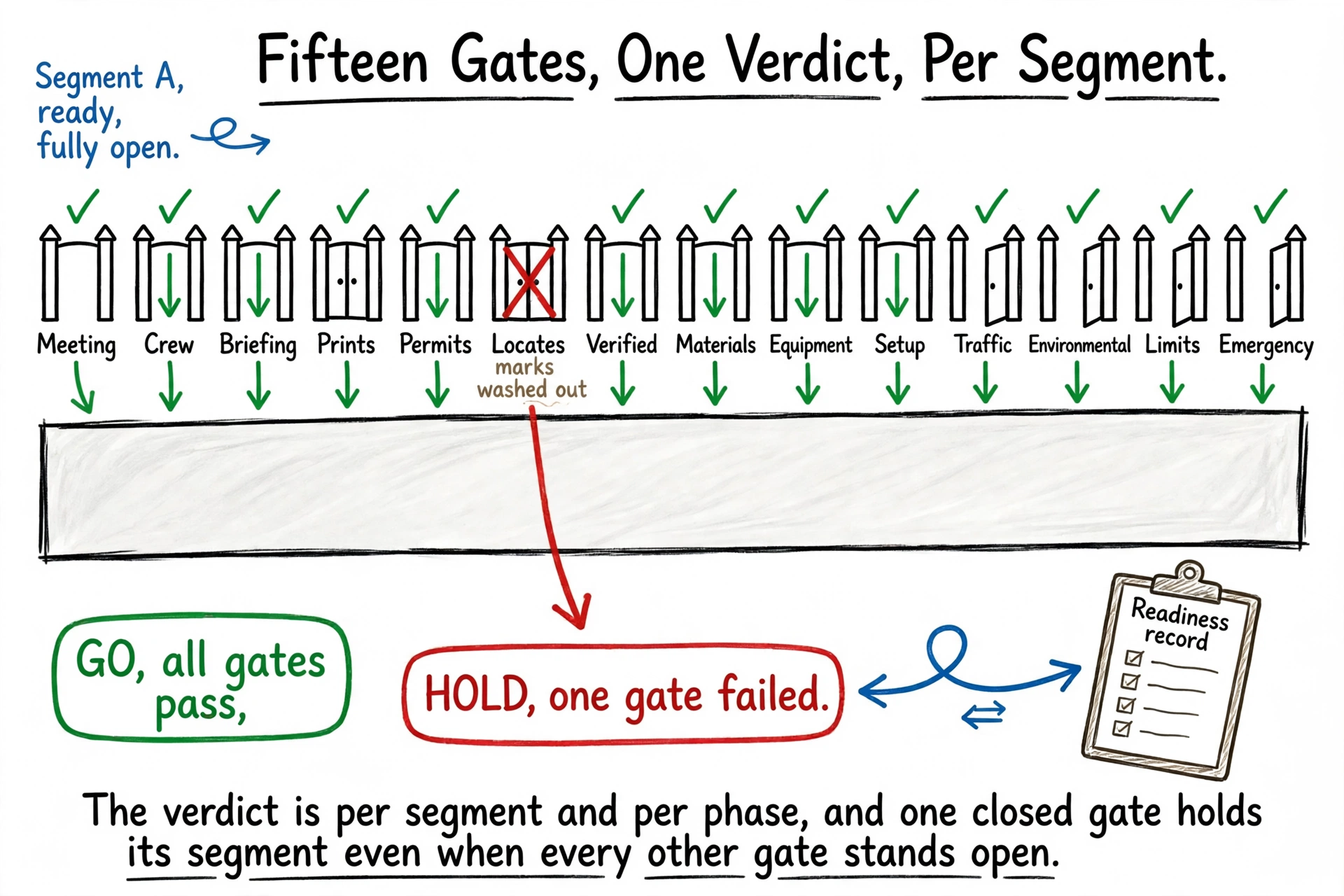
A gate is one preparation check that must pass before the verdict can be go. A gate either opens or stays shut. A gate that is almost open, or expected to open later today, is still shut for the work in front of the crew right now. The verdict is go when every applicable gate has passed. The verdict is hold when any applicable gate has failed, is incomplete, or cannot be verified from the documents and field evidence available at the time of the check.
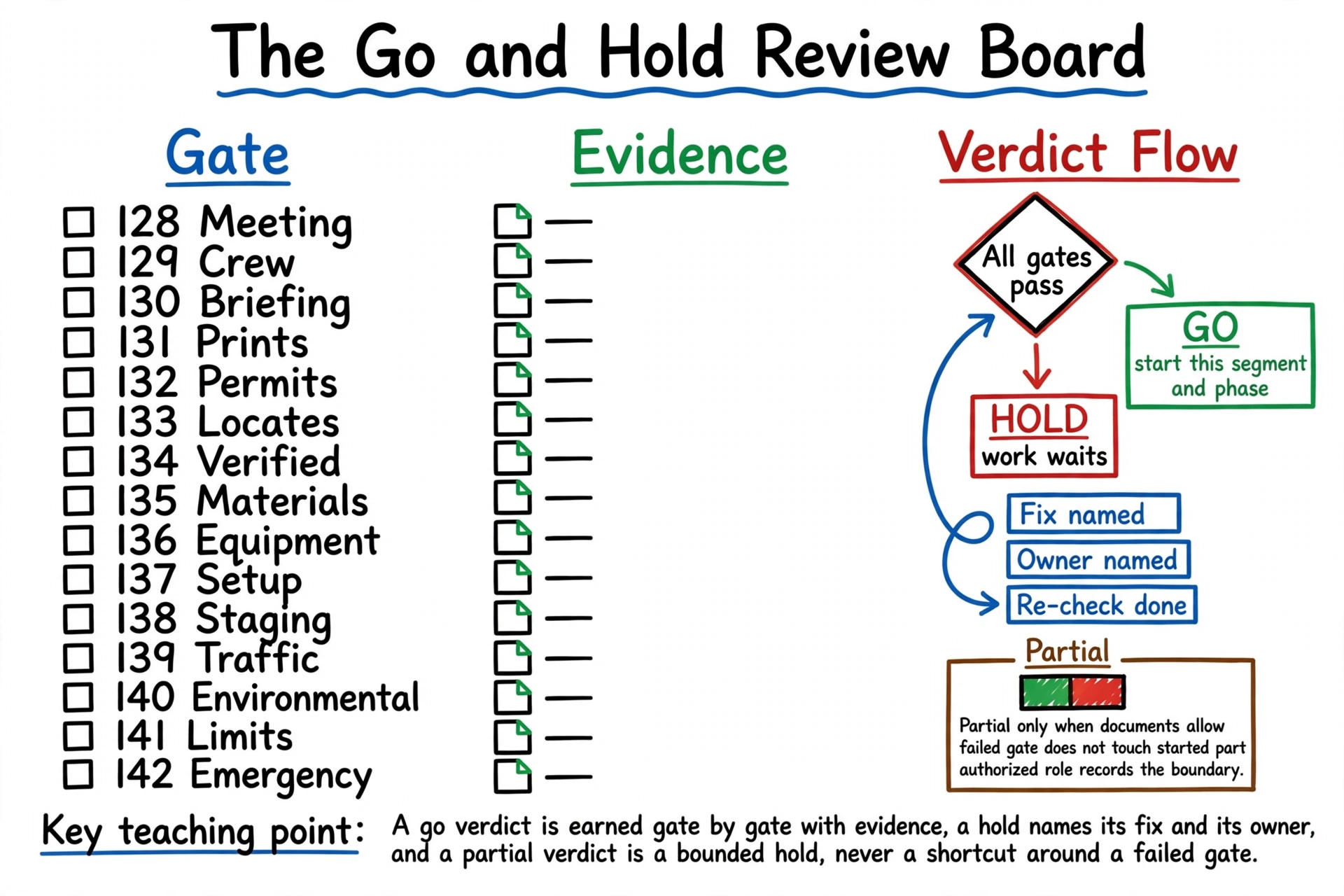
The gates for this verdict are the fifteen preparation subjects Level 7 taught, in curriculum order:
- Lesson 128, preconstruction meeting held and decisions recorded. A preconstruction meeting is a meeting before construction starts where the parties named in the project documents review the plans, schedule, permit conditions, and open questions. The gate passes when the required meeting has happened, its decisions are recorded, and no open decision blocks the segment and phase.
- Lesson 129, crew knowledge confirmed. The gate passes when the people assigned to the segment know the scope, the governing documents, the named hazards, and the limits of their assignments, and when any training or qualification the project documents require is current for the people doing that work.
- Lesson 130, job briefing held for this work. A job briefing is a discussion before work starts, covering hazards, work procedures, special precautions, energy source controls where they apply, and required personal protective equipment. That subject list follows the federal job briefing rule at 29 CFR 1926.952, which by its terms covers electric power transmission and distribution construction. Project documents and company procedures set the briefing the job requires where that rule does not apply. The gate passes when the briefing for this segment, phase, and crew has been held and the crew can state the plan in their own words.
- Lesson 131, correct prints on site and current. A construction print is the drawing set showing what will be built, where, and under which notes and details. The gate passes when the set at the segment is the current revision, the segment sheets are present and legible, and no field change waits on a required approval.
- Lesson 132, required permits on site and valid for this work. A permit is the written authorization for the work, with conditions the project must follow. The gate passes when each required permit is in hand, covers the location and the type of work planned, and sits within any dates or conditions the permit itself states.
- Lesson 133, locates complete for this segment. A locate is the marking of an existing underground utility in the field, placed after a request through the one call system for the state where the work sits. The gate passes when a request covers the segment, the state response process is complete, the marks are present and readable, and the ticket is still valid under the state law and ticket terms for the job.
- Lesson 134, existing utilities verified where the work requires it. Verification here means confirming a marked utility position by a method the project documents or the applicable rules require, such as exposing the utility by careful digging where the work crosses it or runs close. The gate passes when the required verifications are done and recorded, and any conflict between marks and field evidence is resolved or has stopped the affected work.
- Lesson 135, materials ready. The gate passes when the materials the phase needs are on site or staged as the plan directs, match the bill of materials and the specifications, have passed any receiving check the project requires, and are stored so they stay usable.
- Lesson 136, equipment ready. The gate passes when each machine and tool the phase needs is on site or confirmed for delivery before its step, has passed its required inspection, and matches the ground, the access, and the task.
- Lesson 137, equipment setup areas confirmed. The gate passes when the setup ground is identified, fits the equipment and the work, respects the work limits and utility positions, and gives the operator room to work and shut down safely.
- Lesson 138, material staging set. Material staging is the planned placement of materials, spoil, and support items in defined places for the work. The gate passes when staging sits where the plan puts it, outside protected areas and protected travel paths, with room for delivery and handling.
- Lesson 139, traffic control ready. Temporary traffic control is the signs, channelizing devices, barriers, and people used to move road users through or around a work area while protecting road users and workers. The gate passes when the devices and people the traffic control plan calls for are on site, in working condition, and set or ready to be set per the plan and the Manual on Uniform Traffic Control Devices framework.
- Lesson 140, environmental controls ready. The gate passes when the erosion controls, sediment controls, pollution prevention items, and protected area markings the permit and plan require are installed and working by the time the phase that needs them begins, as Lesson 140 taught in detail.
- Lesson 141, work limits known and marked. Work limits are the boundaries inside which the project has permission to work, set by the right of way, easements, permits, and the plan. The gate passes when the crew can point to the limits in the field, the limits match the documents, and staging, setup, spoil, and travel sit inside them.
- Lesson 142, emergency plan ready. An emergency action plan is the plan stating the designated actions employers and employees must take to keep employees safe during a fire or another emergency. Where 29 CFR 1926.35 applies, the plan is written and kept at the workplace for employee review, and employers with 10 or fewer employees may communicate it orally. The gate passes when the plan covers the segment, the crew knows the reporting method, escape routes and route assignments, the procedure to account for everyone after evacuation, any duties for employees who remain to operate critical operations before evacuating, rescue and medical assignments, and the named contact for questions about the plan, and the plan sits at the workplace for employee review where a written plan is required.
Three ideas govern how the gates combine, and each one corrects a common shortcut.
Readiness is per segment and per phase. A verdict names its segment and its phase in its first line. A go verdict for pathway construction on one street says nothing about the next street, and nothing about cable placement on the same street next week. Permits are written for locations and work types, locates are requested for defined areas, and environmental controls are installed for the ground a phase will disturb. The verdict has to attach to the same place and stage, or it claims more than the checks support.
A single failed gate holds the segment. The gates protect against different failures, so a pass cannot substitute for a different pass. Ready materials cannot repair a permit that no longer covers the work. A complete traffic control setup cannot repair faded locate marks. When one applicable gate fails, the verdict for the work that gate protects is hold, and the record names the failed gate, the evidence, the fix required, and the owner of the fix. Work resumes after the fix is in place and the gate is checked again.
Partial readiness is a limited verdict with strict conditions. Partial readiness means part of the planned work may start while another part stays held. It is legitimate only when three conditions hold at the same time. First, the documents allow the division, so the started part is a complete and permitted piece of work on its own. Second, the failed gate truly does not touch the started part, judged by location, drainage, travel path, utility position, and every other physical connection. Third, the authorized person makes the call and records it, with the boundary stated in plain words. When any condition is missing, the verdict is a full hold. Convenience, schedule pressure, and crew availability are absent from the list on purpose.
Authority comes from the project documents. The readiness authority is the project role the project documents name as the role that may declare work ready, accept a fix, or grant a partial verdict. Contracts, permits, and company procedures name that role differently from job to job. One project may assign the call to a construction manager. Another may assign it to a superintendent, with the owner representative accepting certain gates. This lesson sets no universal title rule, because no universal rule exists in the sources. A verdict from a person the documents never authorized carries no weight when a reviewer or an inspector later asks who cleared the work to start.
The readiness record is part of the verdict. A readiness record is the written record of one verdict, holding the segment and phase, the date and time, the result at each gate with its evidence, each failed item with its fix and owner, the verdict, and the name and role of the person who gave it. A verbal go with no record cannot be checked later, cannot be handed to the next crew, and cannot prove the order in which checks and work happened.
Conditions change, and a verdict expires with its conditions. A go verdict describes the segment at the moment of the check. A new segment, a new phase, weather affecting ground or marks, a locate ticket reaching the end of the validity the state law or the ticket sets, a revised print, a changed permit condition, or a crew change that removes the people the briefing covered can each void part or all of the verdict. The response is a re-check of the affected gates, recorded the same way as the first check. Lesson 130 carries the parallel rule for briefings: where the OSHA job briefing rule for electric power construction work applies, additional briefings are required when significant changes occur during the work that might affect the safety of employees.
Lesson 115, Is This Site Actually Ready to Build, closed Level 5 with a constructability judgment. Constructability asks whether the route as designed can be built at all, judged during planning while design changes are still cheap. Lesson 143 asks a narrower and later question: given an accepted design, are the documents, permissions, marks, materials, equipment, controls, limits, and emergency arrangements for this segment and phase in place right now. A site can be fully constructable and still fail this verdict on a given morning, because a ticket reached the end of its validity, a device never arrived, or rain washed the marks away. Passing one lesson never substitutes for passing the other.
What Does It Look Like?
A beginner can follow a combined readiness review by watching for these signs:
- The checker works from the project documents and a gate list, naming each gate out loud before judging it, instead of giving a general impression at the end.
- The print set carries the current revision, checked against the document list for the job, and permit copies sit with the prints, read for location, work type, and conditions.
- Locate marks are visible and readable in the field, the ticket record is in hand, and the response status for each utility the state process covers is confirmed before the gate is judged.
- Verification records for the required crossings and close runs are present, with exposed positions noted. Materials sit staged in the planned places in the types and quantities the bill of materials names, and equipment sits inspected, with setup areas clear and inside the work limits.
- Traffic control devices are on site and counted against the traffic control plan, and environmental controls for the ground the phase will disturb are installed and working.
- Work limit lines can be pointed to in the field, by flagging, fencing, paint, or fixed features the plan names, and the crew can state them without opening the prints.
- The emergency plan sits at the workplace, and crew members can state the reporting method, the escape route, the meeting point, and the plan contact without prompting.
- The review ends with a written verdict for the segment and phase, signed by the authorized role, with any failed gate written down with its fix and its owner.
What Does It Do?
Each single gate catches the failure it was built to catch. The combined verdict catches the gap between gates, where every individual check looked reasonable and the job was still unready.
The verdict forces the checks to happen at the same moment, for the same ground. Gates checked on different days, by different people, for slightly different boundaries can each pass while describing different jobs. The print check on Monday covered three streets. The locate check on Wednesday covered two. The material check counted for the whole route. Combined into one review for one segment, the boundaries line up, and the street the locate request missed becomes visible as a failed gate instead of staying hidden inside passing reports about larger areas.
The verdict converts scattered evidence into a decision somebody owns. Before the review, readiness exists as fragments: a ticket in an email, a permit in a trailer, a foreman who remembers a meeting. Nobody can tell which fragment is missing. The review gathers the evidence gate by gate, and the verdict assigns the decision to a named role, so a later question has a record to land on.
The per segment size keeps a local failure local. Without segment verdicts, a project faces two errors. The first stops the whole route for a problem on one street, wasting ready work and teaching crews to hide problems. The second starts the whole route because the route is ready on average, sending a crew into the one street where the marks are gone. Segment verdicts avoid both. The failed gate holds its segment, and ready segments proceed under their own verdicts where the documents allow the division.
The hold protects the cheapest moment to fix the problem. A remark costs a request and a wait. The same missing marks discovered after a strike cost an emergency response, a damaged facility, a report, and possibly an injury investigation. A traffic device delivered before setup costs a truck run. The same device missing after the lane closes costs an exposed crew and a noncompliant work zone. The verdict moves discovery to the moment when the fix is still a task instead of an incident.
The re-check rule keeps the verdict honest over time. Conditions decay. Paint fades, tickets reach the end of their validity, weather moves soil and devices, and revisions replace prints. A verdict with no re-check rule quietly claims that Tuesday morning still describes Friday afternoon. The triggers break that claim into honest pieces: the verdict stands until a listed change occurs, and then the affected gates get checked again.
Where Does It Fit?
The combined verdict sits at the end of jobsite preparation, at the start of each segment and phase, and at every point where conditions change enough to void an earlier verdict:
- During planning, Lesson 115 closed Level 5 with the constructability judgment: the route can be built as designed, judged while design changes are still cheap.
- During Level 6, the project gathered permission to build: rights, easements, and permits, with their conditions and work limits.
- During Level 7, Lessons 128 through 142 each prepared one layer of the jobsite and produced evidence: meeting and briefing records, prints, permits, tickets and marks, verification records, staged materials, inspected equipment, controls, marked limits, and a reviewed emergency plan.
- Immediately before work starts on a segment and phase, this lesson gathers that evidence into one review and one verdict. Go releases that segment and phase. Hold stops it with named fixes. A partial verdict releases only the part the documents allow and the failed gate does not touch.
- During construction, the verdict repeats. Each new segment gets its own review, each new phase on a worked segment gets its own review, and each listed change triggers a re-check of the affected gates.
- Later levels assume the verdict happened. Level 8 teaches the underground pathway the verdict releases work into, and the levels that follow build, place, splice, test, restore, and document work this verdict released. A weak verdict passes its cost forward into every one of those levels.
What Is at Stake
Worker and public safety. Several gates exist because the failure they prevent can injure people. Work over unverified utilities, inside a traffic setup that was never completed, or under an emergency plan the crew has never heard can turn a routine task into an emergency with no prepared response. The verdict is the last planned moment to catch those gaps while catching them is still easy.
Utility damage and service loss. A locate gate that fails on marks, response status, or ticket validity leaves the crew digging with an incomplete picture of what sits underground. Damage to a buried facility can cut service to homes and businesses, release gas or water, expose workers to electric contact, and trigger reporting and repair duties that stop the job. The Common Ground Alliance Best Practices Guide is a consensus reference for damage prevention, and state law sets the enforceable duties on each job.
Permit and legal standing. Starting without a required permit, outside a permit condition, or beyond the work limits can bring stop work direction, enforcement by the issuing authority, and a compliance record that follows the contractor. Starting after a locate ticket has reached the end of its validity can place the excavation outside the protection the state damage prevention law gives a compliant excavator. The verdict is where the crew confirms the job sits inside the duties the state law, the permit, and the project documents set, before ground opens.
Schedule and cost. A hold before work starts costs the time the fix takes, at planned prices. A failure found after work starts costs the fix plus cleanup, reporting, reinspection, rescheduling, and, after a strike or a failed inspection, emergency labor, third party repair bills, and possible contract exposure. Crews sometimes resist a hold because the hold feels like the delay. The record usually shows the early hold was the shortest delay available.
Trust and the record. Owners, inspectors, utilities, and neighbors judge a contractor by whether the job starts in control. A segment that opens with documents in hand, marks on the ground, controls installed, and a signed verdict reads as a controlled job. A segment that opens on confidence and stops on the first question reads as a careless one. When a later dispute asks what the crew knew and when, the record answers with dates and evidence, and memory answers with opinions.
What Does Good Look Like?
- The verdict names one segment and one phase, and every applicable gate carries a pass backed by a document or a field observation a second person could repeat.
- The gate list matches Lessons 128 through 142, with any gate judged not applicable carrying a written reason tied to the project documents.
- Each failed gate is written down with its evidence, its required fix, its owner, and the re-check that will clear it.
- Any partial verdict states its boundary in field terms, cites the document language allowing the division, and confirms the failed gate does not touch the started part.
- The person giving the verdict holds the role the project documents name, and the record carries that role and name.
- The record is filed where the next crew and the inspector can find it, and the crew has heard the verdict and its conditions in the job briefing for the shift.
- Re-check triggers are named in the record, and the crew can state which changes send the affected gates back for review.
From the Field
Picture a two crew fiber job building pathway along a route the plan divides into three street segments. The first two carry go verdicts and are already built. The third is a short residential street where the bore will cross a water line and a gas line, pass one storm inlet, and set up partly inside a lane that needs traffic control under the plan.
The review runs on the morning the crew plans to start there. Prints are current. Permits cover the street and the lane work. Materials are staged inside the work limits. The drill has passed inspection, the setup area fits, and spoil and staging sit where the plan puts them. Traffic control devices are counted against the plan. Environmental controls are installed, including inlet protection at the storm inlet. The emergency plan has been reviewed, and the job briefing is complete.
The locate gate fails. Overnight rain has washed the paint for the water and gas lines down to faint traces along the crossing area, and flags at two spots are down. The ticket record is still within the validity the state law and the ticket set, and the response record shows the utilities responded. The marks the crew would dig by can no longer be read with confidence at the crossings where the bore path passes both lines, and the verification exposures planned at the crossings depend on readable marks to choose safe exposure points.
The drill operator suggests boring the first half of the street, where the route runs clear of the crossings, while a remark is requested. The suggestion gets tested against the partial readiness conditions. The bore is one continuous operation for the phase. The drill would enter from the setup area, pass the clear ground, and reach the crossing area in the same run, with tracking tied to the crossing locations. Stopping the bore mid street while a remark happens is a division the plan and the permits never describe, and the failed gate touches the bore path directly.
The person holding readiness authority under the project documents gives a hold verdict for the segment and phase. The record names the locate gate, the washed marks, the remark request as the required fix, and the owner of that fix. The crew moves to the second segment to complete restoration work already released under a separate verdict for that phase, so the day still produces finished work without touching the held ground.
The remark arrives, the marks are readable again, and the verification exposures at the crossings confirm the positions before the bore starts. The re-check covers the locate gate and the verification gate, the record gains a second entry, and the segment starts with a go verdict one working cycle later than the crew first hoped.
The rule to carry is plain: a segment is ready only when every gate that applies to it passes at the same time, for the same ground, and a single failed gate holds the work it protects, even when fourteen other gates pass and the failed item looks small.
What Can Go Wrong?
Averaging the gates. The review counts fourteen passes and one failure and calls the segment mostly ready. Readiness has no average, and the failed gate guards the failure most likely to happen next on that segment.
Giving one verdict for the whole route. A go verdict written for the project claims checks were run on ground nobody walked. Failures hide inside the large boundary, and the crew that finds one has no record that speaks to its street.
Treating a partial verdict as a favor. Work starts on the held side of an unstated boundary because the crew and equipment are already there. The first undocumented crossing converts the partial verdict into a full start nobody authorized.
Declaring readiness without authority. A crew member, a scheduler, or a customer contact announces the segment ready, and work starts on that announcement. The announcement came from a role the documents never gave the decision to, and the verdict cannot be defended later.
Letting a verdict outlive its conditions. The ticket reaches the end of its validity, a revision replaces the prints, rain washes the marks, and work continues under a verdict written for conditions that no longer exist. The record says go. The field says the basis for go is gone.
Checking gates against memory instead of documents. The checker recalls that permits were fine on the last job and that the emergency plan was reviewed at some point. Each memory may be true and still describe a different job. The gate question is always about this segment, this phase, and this set of documents.
Recording the verdict without the failures. A record showing only the final go hides the holds that came before it, and hides the pattern that shows where the preparation system is weak.
Confusing constructability with readiness. The team points to the Level 5 judgment and treats the morning verdict as a formality. The formality is where the failed ticket and the missing device get caught.
Starting the phase the verdict never covered. A go verdict for pathway construction gets treated as permission for cable placement or restoration on the same segment. A verdict stretched across phases releases work nobody checked.
What Should Someone Notice in the Field?
- Name the segment and the phase out loud before checking anything, and write both at the top of the record.
- Work the gate list in curriculum order, Lessons 128 through 142, and give each gate a pass, a fail, or a written not applicable reason tied to the project documents.
- Hold the current prints, permits, locate ticket and response record, and verification records in hand, and judge each gate from those documents plus the field evidence in front of you.
- Walk the segment and confirm the field half of the verdict: marks readable, limits pointable, staging and setup inside the limits, traffic devices counted against the plan, and environmental controls installed and working.
- Ask two crew members to state the briefing points, the work limits, and the emergency reporting method and meeting point in their own words.
- For any failed gate, write the evidence, the fix, the owner, and the re-check that will clear the gate, before discussing schedule.
- For any partial verdict, state the boundary in field terms, confirm the documents allow the division and the failed gate does not touch the started part, and record all three points.
- Confirm the person giving the verdict holds the role the project documents name, and record the role and name with the verdict.
- Name the re-check triggers for the segment, including a new phase, a document revision, a ticket reaching the end of its validity, weather that changes ground or marks, and any crew change the briefing no longer covers.
- Know the boundary: running a readiness review, reporting a failed gate, and holding work under the process the project documents set are tasks this lesson covers. Declaring readiness outside the authority the documents grant, judging permit compliance for the issuing authority, verifying utilities beyond the methods and qualifications the project requires, designing traffic control, and directing emergency response belong to the roles and qualified people those documents and rules name. Reading this lesson qualifies no one for regulated or hazardous work, and no one should enter traffic, excavate to expose a utility, or direct an emergency response without the proper training, equipment, and authorization.
Key Terms
Site readiness verdict: A single go or hold decision for one segment and one phase, made after every applicable preparation check has passed.
Segment: A defined length or area of the route treated as one unit for checking and for work, with boundaries set by the project documents or the crew plan.
Phase: A stage of the work with its own start and finish, such as pathway construction, cable placement, or restoration.
Gate: One preparation check that must pass before a verdict can be go. A failed, incomplete, or unverifiable gate holds the work it protects.
Partial readiness: A limited verdict allowing a defined part of the work to start while another part stays held, granted only when the documents allow the division, the failed gate does not touch the started part, and the authorized role records the boundary.
Readiness record: The written record of one verdict, holding the segment, phase, gate results with evidence, each failure with its fix and owner, the verdict, and the role and name of the person who gave it.
Readiness authority: The project role the project documents name as the role that may declare work ready, accept a fix, or grant a partial verdict.
Job briefing: A discussion before work starts covering hazards, work procedures, special precautions, energy source controls where they apply, and required personal protective equipment. That subject list follows 29 CFR 1926.952, which covers electric power transmission and distribution construction.
Emergency action plan: The plan stating the designated actions employers and employees must take to keep employees safe during a fire or another emergency. Where 29 CFR 1926.35 applies, the plan is written and kept at the workplace for employee review, and employers with 10 or fewer employees may communicate it orally.
Constructability: The planning judgment, covered in Lesson 115, that a route as designed can be built with the access, ground, utilities, and methods available. It differs from the day of work readiness verdict in this lesson.
Check Your Understanding
- A segment passes fourteen gates. The traffic control devices for the lane setup are still on a truck at the yard. What is the verdict for work that needs that lane setup, and why?
Answer: Hold. A single failed gate holds the work it protects, and passes at other gates cannot substitute. The lane work waits until the devices are on site, set per the plan, and the gate is checked again.
- State the three conditions that must all hold before a partial readiness verdict is legitimate.
Answer: The project documents allow the division, so the started part is a complete and permitted piece of work on its own. The failed gate truly does not touch the started part, judged by location, drainage, travel path, utility position, and every other physical connection. The authorized person makes the call and records it with the boundary stated in plain words.
- Who may declare a segment ready, and where does a checker find that answer?
Answer: The project role the project documents name for that decision. The checker finds the answer in the contract, the permits, and the company procedures for the job. No universal title rule exists, and a verdict from an unauthorized role carries no weight when the start is later questioned.
- In the From the Field scenario, why did the proposed partial start fail the partial readiness test, even though the first half of the street ran clear of the two crossings?
Answer: The bore was one continuous operation for the phase, reaching the crossing area in the same run, with tracking tied to the crossing locations. The plan and permits described no division that would stop and hold the bore mid street, and the failed locate gate touched the bore path directly. With two conditions unmet, the verdict was a full hold until the remark and re-check cleared the gate.
- Name four changes that should trigger a re-check of affected gates after a go verdict has been given.
Answer: Any four count. Work moves to a new segment. A new phase starts. Weather changes ground, drainage, marks, or traffic control. A locate ticket reaches the end of its validity. A revised print or changed permit condition replaces the relied on documents. A crew change removes people the briefing covered.
Lesson Takeaway
Ready is a verdict, and a verdict has a size, an owner, and a record. After this lesson, a jobsite reads as a set of segments and phases, each waiting for its own gate by gate decision: documents current, permissions in hand, marks readable, utilities verified, materials and equipment set, controls working, limits pointable, and the emergency plan known by the crew who will need it. One failed gate reads as a hold for the work it protects, and that discipline lets a crew start with confidence that can be shown, in writing, to anyone who asks.
Sources and Technical References
Fiber Done Right Academy, Master Curriculum Register. Establishes the Level 5 sequence ending with Lesson 115 and the Level 7 sequence, Lessons 128 through 143, with the exact titles and order this lesson combines. Cited as curriculum context for sequence and titles only: ~/workspace/fiber-done-right/academy-library/curriculum-register.md
Occupational Safety and Health Administration, 29 CFR 1926.952, Job briefing, Subpart V, Electric Power Transmission and Distribution construction. Requires a job briefing before each job covering hazards, work procedures, special precautions, energy source controls, and personal protective equipment requirements, and additional briefings when significant changes occur during the work that might affect the safety of employees: https://www.osha.gov/laws-regs/regulations/standardnumber/1926/1926.952
Occupational Safety and Health Administration, 29 CFR 1926.35, Employee emergency action plans. Sets the minimum elements of an emergency action plan where a plan is required, including escape procedures and route assignments, procedures to account for all employees after evacuation, rescue and medical duties, the preferred means of reporting emergencies, and contact names or job titles, and requires the written plan to be kept at the workplace for employee review: https://www.osha.gov/laws-regs/regulations/standardnumber/1926/1926.35
Federal Highway Administration, Manual on Uniform Traffic Control Devices, 11th Edition, Part 6, Temporary Traffic Control. States that control of all road users through a temporary traffic control zone shall be an essential part of highway construction and utility work, and that the primary function of temporary traffic control is to facilitate movement of road users through or around the zone while protecting road users, workers, responders, and equipment: https://mutcd.fhwa.dot.gov/pdfs/11th_edition/part6.pdf
Common Ground Alliance, Best Practices Guide. A consensus reference for damage prevention covering one call notification, white lining, positive response, preserving locate markings, tolerance zone practices that vary by state, and verification of facility location by careful exposure. State law sets the enforceable duties and any locate ticket validity period for a given job: https://commongroundalliance.com
U.S. Environmental Protection Agency, 2022 Construction General Permit, Part 2.1.3. Requires operators covered by that permit to complete installation of stormwater controls by the time each phase of construction activity begins. Authorized states issue their own permits, and the permit and plan for the job control the details on a given site: https://yosemite.epa.gov/oa/eab_web_docket.nsf/Attachments%20By%20ParentFilingId/933D378326E7F2DB85258A850050315C/%24FILE/Attachment%20F%20-%20Construction%20General%20Permit.pdf
Previous lesson: Lesson 142: What Is the Emergency Plan? |
Back to Level 7 hub |
Next lesson: Lesson 144: What Is Duct?