
Introduction
A utility cabinet is a weather resistant outdoor enclosure, larger than a pedestal, that houses cable connections, fiber splitters, cross connections, or powered equipment and gives authorized technicians a controlled place to work on them. It usually stands on a concrete pad or on a pole in the right of way, and it marks the spot where many buried cables meet.
Level 2 teaches you to read the surface of a jobsite before work starts, and a cabinet is one of the strongest clues on that surface. This lesson teaches you to identify a cabinet, to tell the three common kinds apart, and to recognize the one kind you must never open. One safety line runs through everything that follows: what is inside a cabinet decides the risk, and the cabinet belongs to its owner.
What This Lesson Gives You
- Tell a cabinet from a pedestal by size and by the job it does, and know why the catalog label does not settle the question.
- Name the three kinds of cabinet a fiber crew is likely to meet, and state what each kind does.
- Read the outside of a cabinet, its doors, vents, labels, pad, and grounding, and report its condition in plain words.
- Spot the outside clues that point to a powered cabinet, and stop at recognition every time.
- Explain why many buried cables converge under a pad you cannot see into, and what that means for boring or trenching nearby.
Start With the Basics
Picture a neighborhood street. Near the corner, on a flat concrete pad in the grass strip between the sidewalk and the property line, stands a light colored metal box. It is taller than a mailbox and wider than a trash can. It has two doors on the front with small latches, a few vent slots low on the sides, and a label on the door. No one is standing at it. Nothing appears to move.
That box is a utility cabinet. Cabinet is the general word used in this course for a larger above grade enclosure that protects connections or equipment and gives authorized technicians a place to work on them. Above grade means above the surface of the ground.
Compare it to the smaller enclosure you may already know. A pedestal is a narrow above grade enclosure, usually serving a smaller number of connections at one local point. A cabinet is larger, holds more connections or more equipment, and usually serves a wider area. The line between a large pedestal and a small cabinet is not the same in every catalog, and manufacturers use the words in overlapping ways. Do not argue about the label on a given job. Use the size and the job the enclosure does. If it stands on a pad or a pole, has full doors, and gathers many cables together at one point, treat it as a cabinet for field recognition.
Three ideas carry the whole lesson:
- A cabinet is a meeting point. Cables that run long distances meet cables that fan out to many homes or businesses at that one place.
- What is inside decides the risk. A passive fiber cabinet and a powered cabinet can look similar from the sidewalk, and they are very different to open.
- The cabinet belongs to someone else until your project paperwork says otherwise. A fiber crew protects cabinets in its work area, works around them with care, and reports damage. A cabinet is never a workbench, a step, a storage shelf, or a place to lean material.
What Is It?
A utility cabinet is a weather resistant outdoor enclosure, larger than a typical pedestal, that houses cable connections, fiber splitters, cross connections, or powered equipment, protects them from weather and from unauthorized access, and provides a controlled access point for authorized technicians.
Each part of that definition matters.
Weather resistant means the shell, doors, and seals are built to shed rain and limit dust and insects. It does not mean waterproof in every condition, and it does not mean a cabinet can sit in standing water without harm. Manufacturers describe outdoor cabinets with different construction and protection designs, so the rating and the limits of the cabinet in front of you come from its maker and its owner.
Outdoor enclosure means the whole box, not just the parts inside. The shell gives mechanical protection. The doors give access. The locks and latches limit who can open it. The base or mounting gives it a stable position in wind and in normal ground movement.
Houses connections or equipment means the cabinet is a working part of the network. Inside, cables end, connect, split, or pass through in an organized way, or electronic equipment processes a signal. The organization inside is the point. Without a cabinet, those same connections would have to be buried, placed in a smaller closure with less room to work, or run much longer distances to a building.
A utility cabinet sits on one of two common mountings:
- Pad mounted means the cabinet is bolted to a concrete pad at ground level. The pad is the flat concrete slab built for the cabinet.
- Pole mounted means the cabinet is attached to a utility pole above the ground.
Smaller fiber cabinets are commonly offered in pole mount form, and large cabinets that a technician needs to work in at ground level are commonly pad mounted. The mounting on a given job is set by the design, the owner, and local rules.
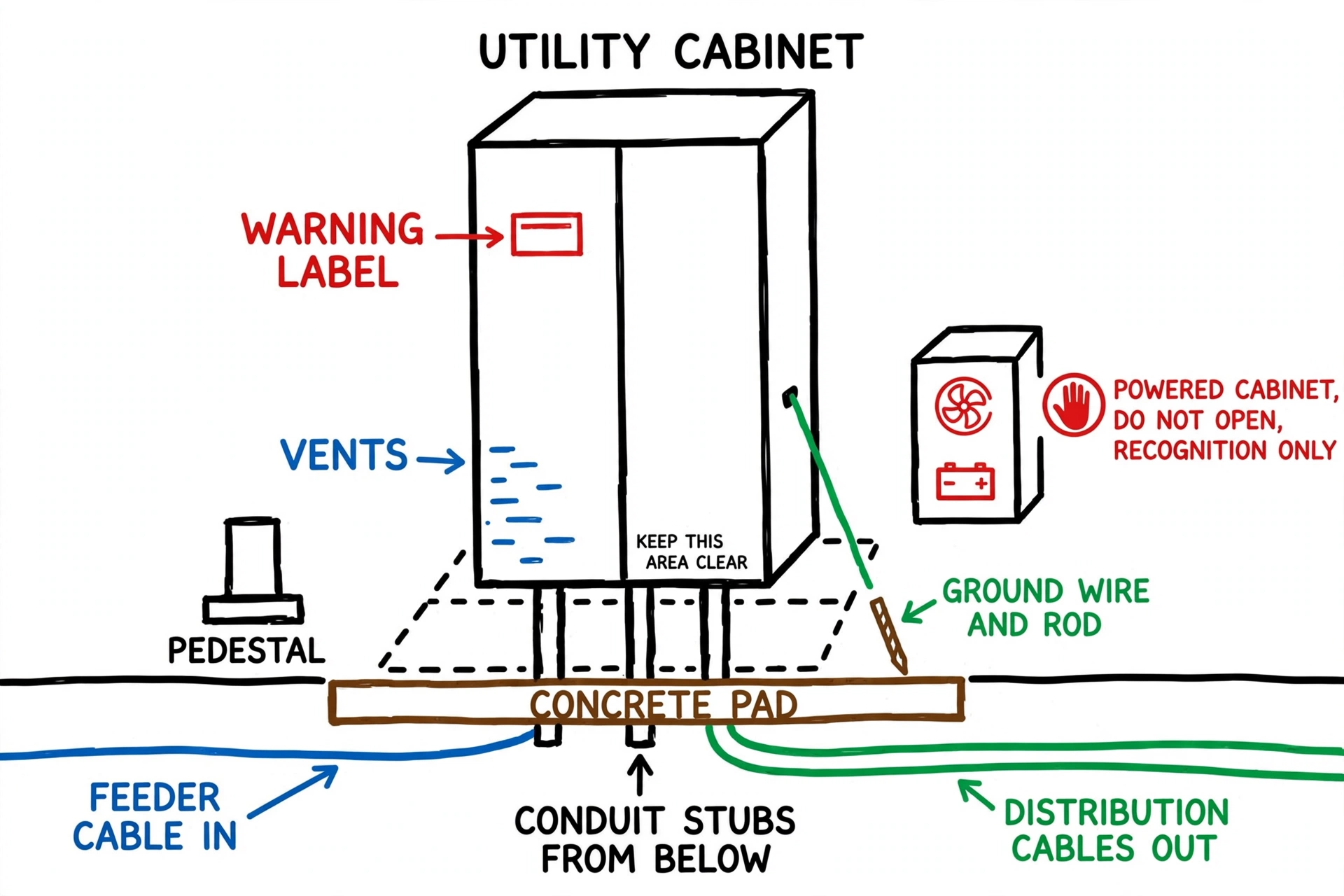
Many cabinets share a below ground secret that matters more than the box itself. The cables do not usually enter through the side wall above ground. They enter from below. A conduit is a tube or pipe that protects cables on their underground path. A conduit stub is the short end of a conduit that rises up through or beside the pad and ends where the cabinet will sit, so the cable can pass from the underground conduit into the bottom of the cabinet. When you see a pad mounted cabinet, assume several conduits and several cables converge under that pad even if you can see none of them. The cabinet is the visible tip of a buried concentration.
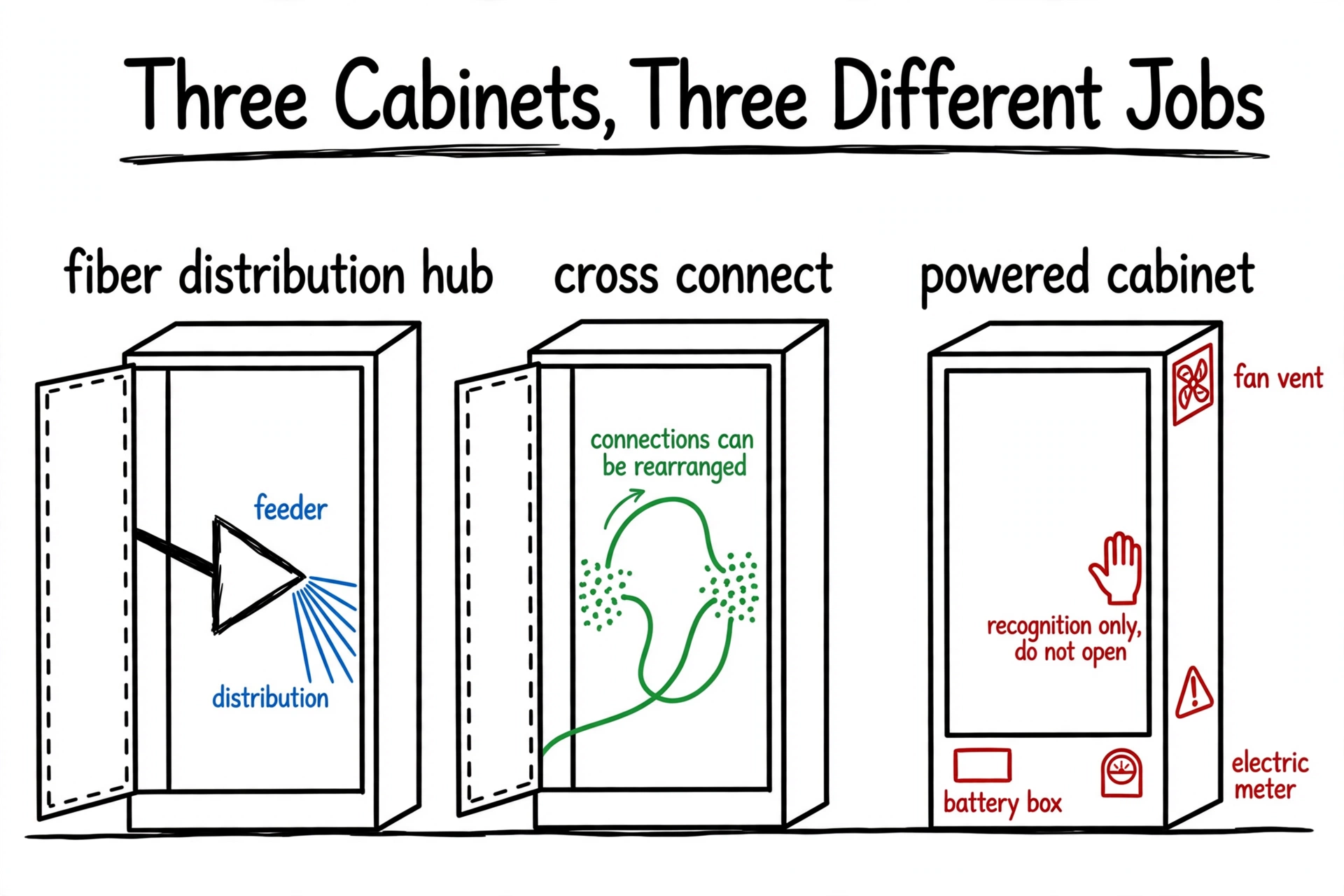
In fiber work, three broad kinds of cabinet cover most of what you will meet. Learn to separate them.
- Fiber distribution hub cabinet, usually shortened to FDH. A fiber distribution hub is an outdoor cabinet that provides the connection point between feeder fiber coming from a central office or headend and distribution fiber going out to homes and businesses, and that holds passive optical splitters inside. A central office is the provider building where network equipment connects the local network to the wider network. A headend serves a similar starting point role in some cable based networks. A passive optical splitter is a device that divides the light signal from one incoming fiber into multiple outgoing fibers, or combines signals in the other direction, without needing electrical power at the splitter itself. The network design that uses this pattern is called a passive optical network, shortened to PON. CommScope and Clearfield both describe the FDH in these same basic terms, as the outside plant connection point between feeder cables and splitters and the distribution network. Outside plant means the part of the network built outdoors, including cables, poles, cabinets, and closures, as opposed to equipment inside a building.
- Cross connect cabinet. Cross connect means connecting an incoming cable or fiber to a chosen outgoing cable or fiber by a patch cord, a jumper, or a termination field inside the enclosure, so connections can be changed, tested, and rearranged. A termination is the organized ending of a cable or fiber on a connector or block where it can be connected to something else. A cross connect cabinet may have no splitter at all. Its job is orderly interconnection and test access between the feeder side and the distribution side. In active Ethernet style designs and in older or mixed networks, a cabinet can act mainly as a passive cross connect rather than as a splitter hub. The word passive still applies to the fiber connections themselves, and you must still confirm whether that specific cabinet also contains powered equipment before anyone authorized opens it.
- Powered cabinet, sometimes called an active cabinet. Active means the equipment inside uses electrical power to do its work. A powered cabinet may hold electronics that convert or amplify signals, power supplies that change incoming electric power into the form the electronics use, and batteries that keep the equipment running for a period when normal power fails. Battery backup in this setting means stored electrical energy held ready for an outage. It does not mean harmless. Batteries, power supplies, and electric service conductors can injure an unqualified person, and electric utility cabinets in particular may contain high energy equipment. Fans, larger vent systems, warning labels about electrical hazard, a separate electric meter or service nearby, heavy battery compartments, and audible alarms or humming can all be clues that a cabinet is powered. No single clue proves it, and the absence of a clue does not prove a cabinet is passive. Treat every unfamiliar cabinet as unknown until the owner identifies it. Power presence, cooling design, and access rules for a powered cabinet stay with the owner and the equipment documents. This lesson never teaches opening one or working inside one.
Other utilities use cabinets too. Electric, telephone, traffic signal, water, and gas systems all place cabinets or similar large enclosures in the right of way. The right of way is the strip of land reserved for roads and utilities along a street. A green, gray, or tan box near a fiber cabinet is not automatically a fiber cabinet. Color alone does not identify the owner or the contents. Labels, owner records, and the project plan identify it.
What Does It Look Like?
Start with size and posture. A typical pad mounted fiber cabinet stands upright on its pad like a small refrigerator or a wide mailbox, with its doors facing the street, the sidewalk, or another access side chosen in the design. Pole mounted cabinets sit higher, fastened to the pole, with doors facing outward for a technician working from a ladder or bucket where that work is authorized. Exact dimensions vary widely by maker, capacity, and network design. This lesson gives no standard size, because no single size is standard. A cabinet serving a small rural cluster and a cabinet serving a dense subdivision will not match.
Look for these features, in order:
- The pad or the pole. A concrete pad should look flat, level, and sound, with the cabinet centered and anchored on it. Some designs use a riser, a short base section that raises the cabinet above the pad and gives room for cables to enter from below. Clearfield describes pad, pole, and vault mounting options for its FDH cabinets, with risers in some configurations, as one manufacturer example. Other makers offer different bases. A cracked, tilted, undermined, or flooded pad is a finding.
- The shell and roof. Cabinet shells are commonly metal, such as aluminum or steel with a protective coating, and some enclosures use nonmetallic materials. Many have a sloped, crowned, or otherwise shaped top that sheds water rather than holding it. Look for dents, rust or corrosion, peeling coating, bent corners, and doors that no longer sit flush. A shell that has been struck often shows damage low on one side, scrape marks, or a cabinet leaning off its anchors.
- The doors. Work cabinets commonly have one or two full doors, front access only on some models and front and rear access on others. Doors have hinges, latches, and a provision for a lock. Some use a special key or tool rather than a common padlock. Door restraints or stays, which hold a door open against wind on some designs, matter because a loose large door in wind can injure a technician and damage fibers inside. From the outside, your recognition job is simpler. Doors should be closed, latched, and undamaged. A door ajar, a broken latch, a missing lock, or a door tied shut with wire is a reportable condition.
- Vents and cooling features. Louvers are angled slats that let air pass while shedding rain. Screens behind vents keep insects out on many designs. Passive fiber cabinets may have modest venting or a solar shield, an outer panel or roof feature that reduces direct sun heating. Powered cabinets need more deliberate cooling because electronics make heat, so they may have larger vents, fans, heat exchangers, or in some designs air conditioning units. A fan is a powered device that moves air. If you can hear a fan running, see fan blades turning behind a vent, or feel warm air leaving a cabinet, you have strong evidence the cabinet contains powered equipment. Stop at recognition. Do not open it to confirm.
- Labels and markings. Expect some combination of owner name, cabinet identification number, address or location code, fiber or circuit markings, and warning signs. Under the federal RUS housing specification at 7 CFR 1755.910, a buried cable warning sign is to be securely attached to the outside of each covered housing, with permanent lettering, and for a serving area interface cabinet the sign placement on the door is specified in that rule. That is a federal specification that applies to RUS financed plant and to housings it covers. It is not a promise that every cabinet from every owner in every place carries the same sign in the same place. In the field, read whatever label is present, record the identification exactly as shown, and never remove, paint over, or obscure a warning label during your work.
- Cable entry and grounding clues. At the base, conduits may be hidden inside the pad and the cabinet bottom, so you may see nothing at all where the cables enter. Around the cabinet you may see a ground wire, a ground rod, or a bonding connection. Grounding, in this setting, means connecting metal parts and cable shields to the earth through an approved path so fault current and lightning related energy have a controlled route, and bonding means connecting metal parts together so they stay at the same electrical potential. The RUS specification above also sets bonding and grounding requirements for covered housings, including that individual cable ground connections can be lifted for testing without removing the grounding of other cables. Ground wire size, rod details, and connection methods are set by the applicable code, the owner standard, and the project design. If a ground wire is cut, loose, stolen, or disconnected, report it. Do not repair electrical grounding unless that work is in your assigned, qualified, and authorized scope.
- The ground around it. A cabinet needs clear working room in front of its doors so an authorized technician can open them fully and work. That clear area is sometimes called access clearance or working space. The required amount is not one universal number in this lesson, because it is set by the owner standard, the equipment maker, applicable electrical or safety rules for powered equipment, and local requirements. What you can recognize without a number is blockage. Vehicles, stored material, soil piles, snow, overgrown brush, fences, and new structures placed tight against the doors all block access.
Color helps only a little. Fiber cabinets are often light gray, off white, tan, or green, and electric equipment is often green or gray, but owners and cities vary colors for blending, branding, and local rules. Never identify a cabinet by color alone.
What Does It Do?
A cabinet does four jobs. It connects, it organizes, it protects, and it gives access.
As a connection point, an FDH cabinet joins the two sides of the access network you met in Lessons 13 and 14. Lesson 13 covered feeder fiber, the higher capacity cable that carries signals from the central office toward a neighborhood area. Lesson 14 covered distribution fiber, the cables that carry signals from that local point out toward individual streets and premises. The cabinet is where feeder ends and distribution begins for the customers that cabinet serves. Inside an FDH, feeder fibers connect to splitter inputs. Splitter outputs connect to distribution fibers. One feeder fiber can therefore serve multiple distribution fibers.
Think of a plumbing manifold in a utility room. One pipe from the street enters the manifold, and many smaller lines leave for the rooms. The manifold has no pump of its own. The pressure comes from the street supply, and the manifold only divides the flow. A passive splitter works the same way with light. The signal energy comes from the central office, and the splitter only divides it among the outgoing fibers. That is why the splitter needs no power at the cabinet. Manufacturers and industry guides describe common PON examples in which a single feeder fiber is split to serve 32 or 64 distribution strands, and splitter products are offered in ratios such as 1 by 8, 1 by 16, and 1 by 32. Those numbers are examples of product and design choices that vary by network. They are not a requirement for any cabinet, and you must never assume the split count inside a cabinet you meet. The design records state it.
As an organizer, the cabinet gives every fiber a known place. Splice trays hold splices, which are permanent joints between two fibers. Adapter panels hold connectors in rows. Slack storage holds a controlled amount of extra fiber length so a connector can be moved or reworked. Bend radius protection, meaning guides and routing paths that keep fiber from bending too sharply, matters because glass fiber loses signal and can break when bent beyond the limit its maker states. Good organization is why a technician can find one customer fiber among hundreds without disturbing the rest.
A cross connect cabinet organizes a different choice. Instead of a splitter dividing one input among many outputs, cross connection lets an authorized technician assign an incoming fiber to an outgoing fiber with a patch cord or jumper and change that assignment later. That flexibility is useful for testing, for restoring service by a different path, and for networks that do not use a centralized splitter at that point.
A powered cabinet does additional work. Its electronics may convert an optical signal, provide service to a smaller remote node, or support equipment for another utility. Its power supply and batteries keep that work going through a normal power interruption for the backup time the owner designed. That backup time varies by design and battery condition. This lesson states no standard backup time, because none can be assumed from the outside.
As protection, the cabinet shields connections and equipment from rain, dust, sun, casual contact, and many animals, and it slows down tampering with locks and sturdy doors. Protection is a matter of degree. A cabinet does not protect fibers from a vehicle strike, from flood water above its base, or from a determined person with tools. That is why placement, pads, barriers where the design calls for them, and prompt damage reporting matter.
As an access point, the cabinet lets authorized technicians test, connect new customers, rearrange assignments, and find faults without digging up cable or entering a building. That access value is lost if doors are blocked, labels are missing, or the inside has been disturbed by unauthorized entry.
Where Does It Fit?
Place the cabinet in the fiber network first. The order from the provider core to the customer is this. The central office or headend originates the service. Feeder fiber carries it out to the local serving area. The cabinet, most often an FDH in a PON design, splits or cross connects it. Distribution fiber carries it from the cabinet toward the neighborhood. A smaller terminal or pedestal may then connect a drop, which is the final cable to one building. The building equipment converts the light signal for customer use. Not every network uses every step in exactly this form, and splitters can also be placed in smaller closures or pedestals in a distributed design. The cabinet version is the centralized version, where many splits or connections for one area are gathered in one enclosure.
Place the cabinet in the street picture next. It usually sits in the right of way or in a utility easement. An easement is a legal right to use a defined part of another person’s land for a stated purpose, such as placing and maintaining utilities. Cabinets share that space with poles, pedestals, handholes, transformers, traffic equipment, and other utilities. A cabinet on a corner may serve cables running in two street directions. A cabinet mid block may serve the lots around it. Its position follows the cable plan.
Place the cabinet in the construction sequence next. The pad and conduit stubs are built before the cabinet is set. Underground crews place conduits so their ends rise in the right window inside the future cabinet footprint. The pad is formed and poured or a precast pad is set, level and at the design location. The cabinet is set and anchored. Cables are pulled or blown through the conduits into the cabinet. Splicing and termination work finishes the inside. Restoration of soil and surface around the pad completes the site. If the conduit stubs are in the wrong place, the cabinet cannot sit correctly over them. If the pad is out of level, doors may not seal or latch correctly. Early work errors become cabinet problems.
Place the cabinet in your daily field survey last. In Level 2 you are learning to read the surface before work starts. A cabinet is one of the strongest surface clues on a route. It tells you that feeder and distribution cables converge there, that drops or distribution runs leave in more than one direction, that locate marks should show a cluster rather than a single line, and that excavation or boring near the pad needs the locate and potholing process your project requires. It also tells you a service area boundary may be near. Customers on one side of a street may be served from this cabinet and customers on the other side from another.
What Is at Stake
A cabinet concentrates value and concentrates risk in the same small footprint.
- Service. Many customers depend on one cabinet. A single damaged feeder connection, a disturbed splitter, water inside the cabinet, or heat failure in a powered cabinet can interrupt service for a whole serving area rather than for one house. The exact number of customers varies by design and is in the owner records. Never quote a customer count from the size of the box.
- Construction safety. What converges above ground also converges below ground. Boring or trenching beside a pad without accounting for every conduit leaving it is a classic way to strike your own new cable, an existing fiber cable, a copper cable, or another utility that shares the corridor. The cabinet makes the convergence visible. The locate process and field verification make the buried paths known well enough to work.
- Other workers. Cabinets are revisited for years. Installers, splicers, maintenance technicians, locators, and emergency repair crews all need to find the cabinet, read its identification, park without blocking traffic where possible, open its doors fully, and work with their tools and test sets. Soil piled against the doors, a vehicle parked tight in front, or landscaping planted over the pad steals that access and can delay restoration during an outage.
- Owner cost. The cabinet and its contents cost far more than the metal box suggests. Splitters, connectors, spliced fibers, electronics, and batteries represent material cost and many hours of skilled labor. Replacing a struck cabinet can require rebuilding connections fiber by fiber and retesting customers. Preventing one strike or one flood loss pays for a great deal of careful field observation.
- The public. Cabinets sit where people walk and drive. A leaning cabinet, a door that will not latch, a damaged powered cabinet with exposed parts, or a cabinet blocking a sidewalk creates a public hazard and a public complaint. A fiber crew that notices and reports those conditions promptly protects people who have nothing to do with the project.
What Does Good Look Like?
- The cabinet sits plumb and level on a sound pad, anchored as designed, with no lean, no rocking, and no gap that shows the pad or base has settled unevenly. Plumb means vertical.
- The pad is intact, not cracked through, not undermined by erosion, and not buried by soil or mulch piled against the cabinet.
- Grade around the pad slopes so normal rain runs away from the base rather than ponding against it. Grade means the surface level of the ground.
- The shell is clean enough that labels can be read, coating is intact, and there are no dents that distort a door, no rust streaks that suggest a seal has failed, and no holes that were not part of the design.
- Doors close fully, sit evenly in their frames, latch securely, and carry the locks the owner uses.
- Vents and screens are present and not plugged with paint, mud, nests, or vegetation. On a powered cabinet, any exterior cooling features are undamaged and unobstructed.
- Labels are present and legible. The cabinet identification matches the plan and the locate records. Warning signs required by the owner or by an applicable specification are in place and readable.
- A grounding or bonding connection, where visible by design, is intact and undisturbed.
- The area in front of the doors is clear for the access the owner requires. No material is stored on the pad. No vehicle is parked against the cabinet. Brush is cut back enough that doors can open and a technician can stand and work.
- Conduit stubs for future use, where they exist outside a set cabinet, are capped and protected rather than open, crushed, or filled with soil.
Inside, which only authorized people assess, good looks like labeled fibers, connectors seated in the correct adapters, splitter modules secured, splice trays closed, slack stored in its guides, bend radius protected, and doors that close without pinching a fiber. You learn that picture so you can recognize a report of interior disorder for what it is. You do not open a cabinet on your own initiative to check it.
From the Field
Picture a bore crew preparing to run a new distribution cable along the front of six houses on a residential street. The plan shows the cable passing a pad mounted FDH cabinet on the corner lot, then continuing to a pedestal mid block.
During the morning walk, the crew leader stops at the cabinet before any equipment is set up. The labels identify it as the provider’s FDH for that street, matching the plan number. The design records the foreman holds say the cabinet is passive. The crew still does not open it, because opening it is not part of their assigned work that day. They note the pad is level, both doors are latched, and the warning and identification labels are readable.
The surface picture changes their bore plan in two ways. First, orange locate marks run from the cabinet in three directions, toward the feeder route on the side street, along the front of the houses, and across the street. Their planned bore line crosses two of those runs close to the pad. The project process calls for potholing at those crossings to confirm position before the bore passes, so they add both potholes to the day’s plan instead of treating the cabinet area like an ordinary straight run.
Second, the only flat place to stage extra conduit is directly in front of the cabinet doors. They stage it across the driveway apron instead, with the homeowner’s permission through the project contact process, so the cabinet stays reachable if the provider needs it during the day.
Later, a delivery driver clips the corner of the pad with a tire and knocks a vent screen loose, without striking the cabinet itself. The crew does not push the screen back in and forget it. They photograph the pad corner and the screen from the sidewalk, record the cabinet identification and the time, and report both through the project process. The cabinet kept working. The report is what lets the owner inspect the base seal and the pad before a small impact becomes a water entry problem.
The crew did no splicing and no cabinet work that day. Their field job was reading, access, and reporting. Carry this rule: read every cabinet as a map of buried convergence before you dig, keep its doors and working room clear while you work, and report any impact the day it happens, however small it looks.
What Can Go Wrong?
- Vehicle strike. Cabinets sit near roads, driveways, and parking areas. A strike can crush the shell, tear the cabinet from its anchors, sever or bend cables entering from below, disturb every connection inside, and, in a powered cabinet, damage batteries and power equipment in ways that remain hazardous after the vehicle leaves. Even a low speed strike that only dents a door can misalign seals and let water in for months afterward. Any strike, including one with no visible interior damage, must be reported to the owner through the project process. Do not straighten a struck powered cabinet, reach inside it, or move damaged battery equipment.
- Blocked access. Material stockpiles, portable toilets, dumpsters, parked trailers, fences built after the cabinet, and homeowner landscaping can all close in around a cabinet until doors cannot open. The cabinet still works until the day a technician needs it urgently, and then the blockage becomes part of the outage time. Crews cause this failure when they treat the clear area in front of a cabinet as convenient storage.
- Flooding and water entry. Water ponding against the pad, a pad set in a low spot that collects runoff, flood water rising into the base, and seals damaged by age or impact can let moisture reach splices, connectors, and electronics. In a passive fiber cabinet, water and the dirt it carries can contaminate connector end faces and corrode metal parts. In a powered cabinet, water plus electrical equipment is a serious hazard and a shutdown risk. A cabinet that has been submerged is an owner inspection item, not a wipe it dry and leave it item.
- Tampering and unauthorized entry. Graffiti and pry marks, stolen locks, stolen grounding wire, and disturbed fibers all occur at unattended roadside enclosures. A door found open, a lock cut, or fresh pry damage means the inside cannot be trusted until the owner checks it. Report it, record the cabinet identification and the time, and do not touch interior parts. In a powered cabinet, tampering can leave exposed energized parts. Keep people away and report it as urgent through the project process.
- Heat. Electronics generate heat and lose life or shut down when cooling fails. Blocked vents, failed fans, direct sun load, and debris or nests in vent paths raise interior temperature. Batteries also age faster in high heat, a general principle their manufacturers state in product literature, and the life figures for a specific battery come only from that battery’s maker and the owner maintenance records. A cabinet alarm, a fan that no longer runs on a cabinet that normally has fan noise, or a cabinet unusually hot to the touch on its sun side together with a service alarm are findings to report. You do not open a powered cabinet to improve its airflow.
- Pests, corrosion, and slow wear. Ants and other insects nest in warm enclosures and contaminate connections. Rodents damage cable jackets where entry seals are poor. Corrosion grows where dissimilar metals and moisture meet, a risk that housing material standards address for covered plant. Doors left unlatched after legitimate work let wind slam them, bending hinges and breaking fibers. Vegetation hides the cabinet from locators, and mowers strike its base. Each failure starts as a small visible condition that a field observer can report early.
- Damage from construction itself. A bore that passes too close under a pad can undermine it. A trench that cuts a conduit stub destroys a future cable path. Soil and rock piled on the pad add load and block doors. Paint overspray can obscure labels. Protecting the cabinet is part of doing the underground work correctly.
What Should Someone Notice in the Field?
Work through the same check each time you meet a cabinet on a route, whether it is yours or another owner’s.
- Identify it. Read the owner name and cabinet identification from the labels without opening anything. Note whether the design and the plan call it an FDH, a cross connect cabinet, a powered cabinet, or another utility’s equipment. If the identification does not match the plan, stop and resolve the mismatch before work that depends on it.
- Classify the risk. Look and listen for powered cabinet clues from outside. An electric meter or service equipment nearby, electrical warning labels, fan noise, humming, alarm lights or sounders, battery or high voltage warnings, and heavy venting all point toward powered. No clues does not equal passive. If the kind is unknown, treat it as unknown and keep it closed.
- Check the structure. Is the cabinet plumb and secure? Is the pad cracked, settled, eroded, or flooded? Is there strike damage, a lean, a bent door, or a door that will not latch? Are vents clear? Are labels legible? Is any visible grounding connection intact?
- Check the approaches. Count the directions in which locate marks, conduits, or cable paths leave the cabinet area. Expect convergence. If the marks show only one line at a cabinet that should gather many cables, ask why before digging. Check that door swing and working room are clear, and that your own crew has not blocked them and will not block them with vehicles, spoil, or material. Spoil means soil removed from an excavation.
- Check drainage and surroundings. Does water pond at the pad? Has grade changed so runoff now runs toward the cabinet? Is vegetation hiding the cabinet or growing into vents and door seams? Is there graffiti, pry damage, a cut lock, or a door standing open? Is there any smell, sound, heat, smoke, or exposed wiring that suggests a powered cabinet fault? For smoke, exposed energized parts, or a person at risk, move people away and follow the project emergency process and the owner’s reporting route. Do not investigate with your hands.
- Record and report. A useful report names the cabinet identification exactly as labeled, the location, the condition in plain words, a photograph taken from a safe public position where the project allows photographs, and the time you saw it. It separates what you saw from what you guess. Door dented on the street side, lock missing, no fan noise heard, is observation. Cabinet is probably fine inside, is a guess. Report observations.
- Hold the safety boundary. Recognizing a cabinet never qualifies you to open one. Opening, servicing, or working inside any cabinet belongs to its owner and to people the owner has trained and authorized for that specific equipment. A powered cabinet is recognition only for an unqualified person: notice it, keep clear of its hazards, report it, and leave it closed.
Key Terms
- Utility cabinet: A larger above grade outdoor enclosure that houses cable connections, splitters, cross connections, or powered equipment and provides controlled access for authorized technicians.
- Pedestal: A smaller above grade enclosure serving a more local connection point, with fewer connections than a typical cabinet.
- Pad mounted: Set and anchored on a concrete pad at ground level.
- Pole mounted: Attached to a utility pole above the ground.
- Conduit stub: The short end of an underground conduit that rises through or beside a pad to deliver cables into the bottom of a cabinet.
- Fiber distribution hub (FDH): A passive outdoor cabinet that connects feeder fiber to distribution fiber and holds optical splitters in a PON design.
- Passive optical splitter: A device that divides one incoming fiber signal among multiple outgoing fibers, or combines them in reverse, without needing electrical power at the splitter.
- Passive optical network (PON): A network design in which passive splitters between the provider and customers let one feeder fiber serve multiple premises.
- Feeder fiber: Higher capacity fiber carrying signals from the central office or headend toward a local serving area and its cabinet.
- Distribution fiber: Fiber carrying signals from the cabinet out toward streets, terminals, and premises.
- Cross connect cabinet: A cabinet whose main job is orderly, changeable interconnection and test access between incoming and outgoing cables or fibers, often without a splitter.
- Powered or active cabinet: A cabinet containing equipment that uses electrical power, such as electronics, a power supply, and often batteries for backup.
- Grounding and bonding: Connecting metal parts to earth and to each other through an approved path so fault and lightning energy have a controlled route and metal parts stay at the same potential.
- Access clearance: The clear working room in front of and around a cabinet that an authorized technician needs to open doors and work, set by the owner, the maker, and applicable rules for that site.
Check Your Understanding
- How is a utility cabinet different from a pedestal, and why should you not argue about the label on a job?
- Name the three broad kinds of cabinet a fiber crew is likely to meet, and state the main job of each.
- Why does a pad mounted cabinet tell you there are many buried cables nearby even when you cannot see any cable at all?
- A cabinet has fan noise, an electrical warning label, and a separate electric meter nearby. What do those clues mean, and what should a fiber crew member do and not do?
- In the From the Field story, the crew changed its plan twice after reading the cabinet area, and later reported a minor impact instead of fixing it themselves. Name the two plan changes, the surface evidence behind each one, and what the crew reported.
Answer Key
- A cabinet is larger, holds more connections or equipment, and usually serves a wider area, often standing on a pad or pole with full doors. A pedestal is smaller and serves a more local point. Catalog words overlap, so field recognition relies on size and function, not on winning a naming argument.
- An FDH cabinet connects feeder to distribution fiber and holds passive splitters. A cross connect cabinet provides changeable interconnection and test access between incoming and outgoing fibers, often with no splitter. A powered or active cabinet holds electronics, a power supply, and often batteries, and does powered network work.
- Because cables enter from below through conduit stubs that rise through the pad. Feeder, distribution, and often other cables converge under the pad to reach the cabinet, so the visible box marks a buried concentration.
- Together they strongly suggest a powered cabinet containing electrical equipment and possibly batteries. A crew member should recognize it, keep it closed, keep people from tampering with it, and report any damage or fault through the project process. They must not open it or try to confirm the contents by looking inside.
- First change: the crew added potholing at two crossings to the day’s plan, because orange locate marks ran from the cabinet in three directions and their bore line crossed two of those runs close to the pad. Second change: they staged extra conduit across the driveway apron instead of in front of the cabinet doors, because that flat spot was the cabinet’s working room and the cabinet had to stay reachable. The report: a delivery driver clipped the pad corner and knocked a vent screen loose. The crew photographed the pad corner and the screen, recorded the cabinet identification and the time, and reported both through the project process so the owner could inspect the base seal and pad.
Lesson Takeaway
A utility cabinet is the visible meeting point of a buried network. Read it before you work near it. Identify the owner and the kind of cabinet, assume many cables converge below the pad, keep its doors and working room clear, protect it from your own operation, and report damage, flooding, tampering, and blockage the day you see them. Above all, separate passive from powered in your mind every time. A passive fiber cabinet is still the owner’s equipment, to leave closed unless your assignment says otherwise. A powered cabinet is a recognition only subject for an unqualified person. You notice it, you keep clear of its hazards, and you never open it.
Sources and Technical References
- CommScope, CommScope Definitions: What is a Fiber Distribution Hub? The FDH as an outdoor cabinet providing the connection between fiber optic cables and interchangeable passive optical splitters in the outside plant, serving as a test and reconfiguration point, placed on concrete pads or utility poles. https://www.commscope.com/Blog/CommScope-Definitions-What-is-a-Fiber-Distribution-Hub/
- Clearfield, What Is a Fiber Distribution Hub (FDH)? The FDH as a weatherproof outdoor cabinet connecting feeder cable from a central office or headend to the distribution network, with passive splitters dividing one feeder fiber into multiple distribution fibers. Split counts of 32, 64, or more are given there as typical PON examples, not as requirements. https://www.seeclearfield.com/newsroom/what-is-a-fiber-distribution-hub-fdh.html
- Clearfield, StreetSmart Pre-Assigned FDH Cabinet product information. Pad, pole, and vault mounting options, splitter modules loaded as 1 by 32 in that product line, distribution capacity up to 288 fibers in that product, roof and venting features. All figures are that manufacturers product examples and vary by design. https://www.seeclearfield.com/fiber-optic-distribution-cabinets/passive-cabinets/streetsmart-preassigned-fdh-cabinet.html
- Clearfield and ISE Magazine, FieldSmart Fiber Distribution Hub 96-Port PON Cabinet. A pole mounted FDH example with front and rear access doors and bottom cable entry and exit, designed and tested to Telcordia GR-3125 in that product line. https://www.isemag.com/directory/fttx/product/14285173/clearfield-inc-fieldsmart-fiber-distribution-hub-fdh-96-port-pon-cabinet
- Hexatronic, Cabinets and Pedestals. Cabinets and pedestals used as distribution or cross connect points in fiber access networks, FDH cabinets incorporating splitters for PON, and pedestals as the more compact alternative offering similar functions at smaller scale. https://www.hexatronic.com/en-us/fiber-solutions/products?category=cabinets-and-pedestals
- Fiber Broadband Association, Fiber Broadband 101 Series: Introduction to Passive Optical Network Splitter Architectures. Centralized FDH configuration, splitters located in a cabinet away from the optical line terminal, and distributed split alternatives in closures or pedestals. https://fiberbroadband.org/wp-content/uploads/2025/03/FBA-050C_FB101_Series_SpiltterArch_lv1.pdf?utm_campaign=13249852-Membership%20Retention%20%26%20Engagement&utm_source=hs_email&utm_medium=email&_hsenc=p2ANqtz-_R82ab-_8GmRUqjxQQCFk4e8cEzPEL1LH8tb90YzIO5bVYCQBsaeg8moBCerLIh3uQdfw8C1OloLi4pZNPFQ
- Lightwave, Fiber cabinets protect and connect. The FDH as an interconnection point between feeder fiber from the central office, headend, or origination point and distribution fiber downstream to customer premises, and PLC splitter use in PON cabinets versus passive cross connect use in active Ethernet designs. https://www.lightwaveonline.com/fttx/pon-systems/article/16649621/fiber-cabinets-protect-and-connect
- Charles Industries, Fiber Cross-Connect Pedestals. Cross connect enclosures as an interconnect and testing point between the feeder network and the distribution field, presented there as a compact alternative to metallic fiber distribution cabinets at local convergence points. https://www.charlesindustries.com/product/fiber-cross-connect-pedestals-cfxc/
- United States Code of Federal Regulations, 7 CFR 1755.910, RUS specification for outside plant housings. Bonding and grounding arrangements for covered housings, including lifting individual cable ground connections for testing without removing grounding of other cables, and a permanent buried cable warning sign attached to the outside of each housing with specified placement for pedestals and for serving area interface cabinets. This is a federal specification for RUS covered plant, not a universal rule for every owner. https://codes.findlaw.com/cfr/title-7-agriculture/cfr-sect-7-1755-910.html
- New York State DOT specification for a fiber optic cross connect cabinet, Item 04680.9714 M. A contract specification example showing cabinet construction, gasketed double doors, door restraints, a ground bar, cable entry sealing, and bend radius limiters in one agency’s requirements. Figures and ratings in that document are that contract example only and must not be carried to other jobs. https://www.dot.ny.gov/spec-repository/680.9714–04.pdf
Previous lesson: Lesson 41: What Is a Utility Pedestal? |
Back to Level 2 hub |
Next lesson: Lesson 43: What Is a Manhole?