
Introduction
A utility pedestal is a small outdoor enclosure, mounted at or above ground level, that houses connections for utility cables that run underground. For communications plant, it is the above grade access point where buried distribution cables come up out of the ground, so the splices, splitters, and terminals inside can be reached at standing height while the cables themselves stay buried and protected.
Level 2 teaches you to read the physical environment before work starts, and the pedestal belongs in that surface survey. It announces a buried system underneath, it marks a point where buried cables converge from more than one direction, and it has a lookalike that changes the safety picture completely: the electric pedestal. This lesson teaches recognition only. It does not qualify you to open any pedestal, work inside one, or splice or terminate fiber.
What This Lesson Gives You
- Read a pedestal from the outside and state what it marks: buried cables converging under it, entering and leaving in more than one direction.
- Tell a pedestal from a handhole and from a terminal at a glance, and say why work planned at one structure cannot be carried out at another.
- Sort a pedestal into communications, electric, or unknown from its markings, and treat every unknown as electric.
- Match orange locate marks to the pedestals they serve, and raise a mismatch as a finding before digging.
- Protect a pedestal through the work and leave it upright, locked, and documented when the crew moves on.
Start With the Basics
Walk down a residential street in a neighborhood with buried utilities and look along the lot lines. Every few houses you will see a small green or tan box standing above the grass, knee high or a little taller, with a lid or a dome on top. It is a utility pedestal, a small above grade cabinet where buried cables come up out of the ground so technicians can reach the connections inside without digging.
Think about why a provider would want that. The main cable feeding the street is buried, which protects it from weather, poles, and accidents. But buried cable still needs places where technicians can reach it: to join cable sections together, to split off service to a house, to store the spare length called slack that future repairs need, and to connect a drop cable, which is the cable that runs from the network to one customer. A pedestal is that access point. It brings the work zone above the ground. The cables still enter from below, from the buried route, and everything inside stays protected from rain, sun, dirt, and curious hands by the enclosure and its lock.
A pedestal works the way the breaker panel in a house works. The wiring in a house runs hidden inside the walls, and the runs come to one panel where the connections can be reached and worked on without tearing the walls open. A pedestal does the same job outdoors. The cables run hidden underground, and they come to the pedestal, the one planned place where the connections can be reached without digging the yard open. The panel also teaches the limit. The inside of either box belongs to people trained and authorized for what is inside it.
Three ideas carry the whole lesson.
- First, a pedestal is above grade equipment on a below grade system. It marks the spot where buried cable comes up for access, so buried cables converge under and around it.
- Second, a pedestal holds the connection work. For fiber, that usually means splices, splice trays, splitters, and terminals, and for older copper or coax plant it can mean terminal blocks and taps. It does not contain amplifiers or powered equipment in most simple pedestals.
- Third, lookalikes exist and the difference matters. Communications pedestals and electric pedestals stand in the same neighborhoods and look alike at a glance. The communications pedestal is a planned work point for qualified telecom technicians. The electric pedestal is energized equipment that only the electric utility opens.
What Is It?
A utility pedestal is a small outdoor enclosure, mounted at or above ground level, that houses connections for utility cables that run underground. The word pedestal describes its shape and job. It stands like a small post over the buried plant and gives workers a place to reach those cables. For communications, a pedestal is where buried distribution cables, the cables that carry service along a street or neighborhood, are joined, divided, and connected to the drops that serve individual buildings.
Beginners sometimes hear the word pedestal and picture a solid base under something else, like the base under a statue. In outside plant, the pedestal is the whole above grade box itself. The enclosure is the working container. Its lower part extends below the surface into the soil or sits on a buried base, so the buried cables can enter it from underneath, protected from the weather the whole way.
A fiber optic pedestal is the communications version this course cares about. Manufacturer descriptions from companies like Clearfield and Charles Industries describe it the same way across product lines. It is an above ground enclosure built to house, protect, and give access to fiber optic splices, splice trays, splitters, and termination points in outside plant networks. The terms name the work inside:
- A splice is the permanent joint between two fiber ends.
- A splice tray is the shallow holder that organizes and protects finished splices.
- A splitter is a passive optical device that divides one fiber signal into multiple paths, so one feeder fiber can serve several homes. Passive means the device has no electrical power of its own.
- Termination means the point where fiber ends at a connector, ready to plug in.
The fiber pedestals in this lesson typically hold passive connection hardware: splices, splice trays, splitters, and termination points, with no powered electronics of their own. That describes this type of pedestal. It promises nothing about the next pedestal a crew meets, and it is never a reason to open one.
The pedestal is one member of a family of access structures, and each member has a different shape for a different need:
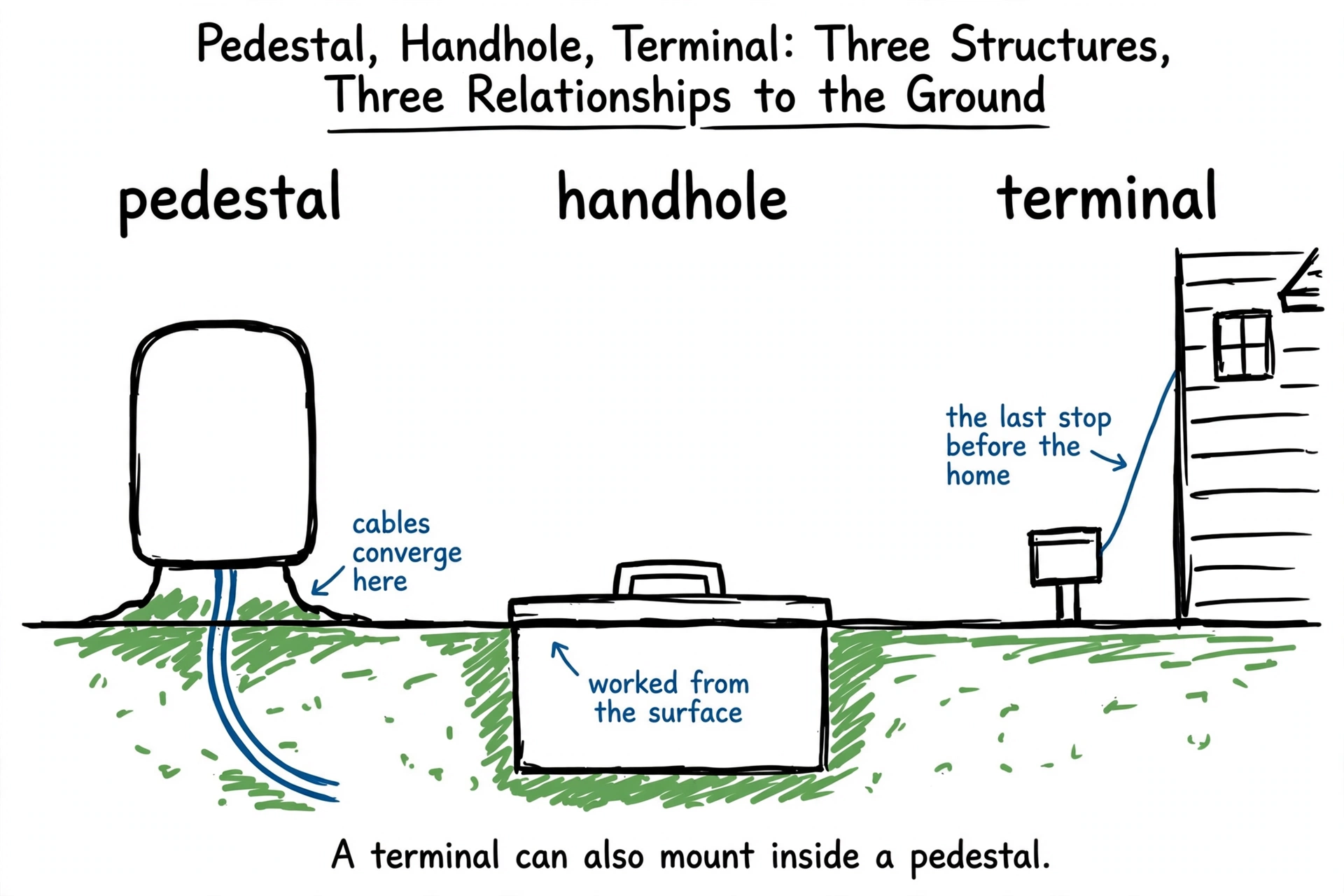
- A handhole is a box set flush with the ground with a lid at grade, covered in earlier lessons, where cables pass or branch at or below the surface.
- A pedestal stands above the grade, which makes its contents easier to reach without opening a lid at ground level and without digging.
- A splice closure is the sealed inner container that holds the splices themselves, and it often sits inside the pedestal or inside a handhole.
- A terminal is the connection point where individual drops connect near the customer. In a common layout it is a smaller separate enclosure at the end of the line, covered in Lesson 9, but a terminal can also be mounted inside a pedestal, and some pedestals provide the drop connection panel themselves.
In a common layout, the distribution cable is spliced inside a pedestal, drops leave that pedestal or a nearby terminal toward the homes, and a handhole elsewhere on the same street gives pulling or branching access below grade. They are different tools for different points of the same network.
The federal and industry paperwork recognizes this family. RUS, the Rural Utilities Service of the U.S. Department of Agriculture, sets specifications for outside plant housings and serving area interfaces under 7 CFR 1755.910, where buried distribution pedestals are grouped by housing type, and its splicing standard 7 CFR 1755.200 describes pedestal types historically used in copper plant. Telcordia GR-13 sets generic requirements for pedestal terminal closures intended to house passive telecommunications components in outside plant, covering copper and fiber optic passive distribution equipment, including provisions for bonding and grounding the cables inside. GR-771 sets the requirements for fiber optic splice closures, including closures placed above ground in pedestals. These documents are the standards layer behind the lesson. They set what the equipment must do. What any crew does at a pedestal is set by the project plan and the owning utility.
An electric pedestal is the lookalike that changes everything. Electric utilities place small pedestals over buried electric cable too, for secondary electric connections and for underground service points. At a glance, a small electric pedestal and a small communications pedestal can look nearly identical: a box on the grass, a lid on top. Lyon Rural Electric Cooperative describes its underground high voltage pedestals as containing wires that can be energized at 7200 volts to ground, warns that damaged units expose wires in a very dangerous condition, and directs people to report damage immediately, stay away, and never try to put the pedestal back in place. The rule for every fiber crew member is simple. You cannot tell from a safe distance whether the box in front of you is communications or electric, and you do not need to. Recognize the box, note its markings and color, and treat any pedestal as off limits unless your work plan and the owning utility give you a clear, specific reason to be near it. This lesson teaches you to read the pedestal. It never teaches you to open one.
What Does It Look Like?
From the surface, a communications pedestal is a small cabinet standing in grass, mulch, or a landscape bed, usually along a property line, near a sidewalk, or at the edge of a right of way. Expect these features, with the understanding that designs vary by manufacturer and by era:
- Shape and material. The shape is usually a short rectangular cabinet or a rounded dome, often knee high or a bit taller, sometimes waist high on larger splice pedestals. Metallic pedestals, commonly galvanized steel, look like squared cabinets with a front cover that lifts or pulls off. Non metallic pedestals, commonly high density polyethylene or PVC, often look like a rounded dome or a tapered post over a base. Both types stand over a below grade base that the buried cables enter through.
- Split base. A split base design, found on many fiber pedestals, is a two piece base that technicians can set around cable bundles already in the ground, which also lets pedestals be added around existing cables during network upgrades.
- Lid, dome, and access. The lid or dome is the working access. Many domes lift off to give technicians open access to the inside from all sides, which manufacturers call 360 degree access. Metallic cabinets often have a front cover with wrench fasteners or a security lock instead of a lift off dome.
- Locks. Locks vary by manufacturer, and common patterns include a special hex head bolt that takes a 216 pattern tool, which is a utility key the public does not carry. If a pedestal has a special lock you do not have the tool for, that is information. The pedestal is locked, and you are not the one who opens it.
- Base installation mark. Some pedestal bases carry an installation mark or are specified to be buried to a set depth. That mark or specification is an installation guide for the base only. It is not a measurement of how deep the cables run, and it must not be used to estimate cable depth.
- Vents. Some pedestals are described by their maker as free breathing, a design the maker says helps condensation and internal moisture dissipate. Others are sealed or flood proof. Vent style varies by product and is not a reliable way to identify the owner or the contents.
- Color and marking. Communications pedestals are often green, tan, or brown to blend into landscaping. They may carry the name or logo of the telecom or cable company, a warning or ownership tag, or nothing at all. Older copper pedestals sometimes have a faded phone company name from an era when telephone plant dominated buried routes. Electric pedestals are also often green, which is why color alone is never the test. Electric boxes often carry a lightning bolt symbol or a high voltage warning, but labels fade, lids get replaced, and a pedestal that looks unmarked may simply be old. Treat markings as clues, not proof.
What makes a pedestal different from a handhole at a glance is height. A handhole lid sits at grade, flat with the ground. A pedestal stands above it. What makes a pedestal different from a terminal is size and role. A terminal is the connection point where drops connect near the customer, in a common layout a smaller separate enclosure, though it can also be mounted inside a pedestal. A pedestal is the larger access point up the network where splicing, slack storage, and splitting happen, and it may also hold the terminal.
Illustration coming soon.
What Does It Do?
A communications pedestal does three jobs for buried plant. It gives access, it protects, and it organizes.
- It gives access. As an access point, the pedestal is where buried distribution cables come up from the ground to be worked on. Technicians open the pedestal to splice new cable sections into the network, to join a branch cable that feeds another street, or to connect drops that run to homes and businesses. Because the cables enter from below and the work happens at standing height, a technician can do careful fiber work without kneeling in a pit and without digging up the yard. This is why fiber networks in buried subdivisions put pedestals at planned intervals. Each pedestal is a future work point as well as a present one, and the spare cable stored inside is there so a later repair or a new drop has enough length to work with.
- It protects. As protection, the pedestal is the weather and security layer. The FOA reference material describes splice closures placed in pedestals as the outdoor containers for finished splices, sealed to keep moisture off the splices and built to be re-entered for repair or re-routing. The pedestal is the next layer out. It sheds rain, blocks sun, keeps out dirt and insects, and resists impact from lawn equipment and animals. It locks, so only authorized technicians get in. The security matters for a real reason. Fiber connections are fragile at the connector and splice level, and an open or damaged pedestal lets weather, insects, and tampering reach them. Manufacturers build pedestals to industry tests for this reason. Clearfield lists its Splice Only fiber pedestal as RUS listed and designed to comply with Telcordia GR-13. GR-771 is the separate Telcordia document for fiber optic splice closures, including closures placed inside a pedestal. Charles Industries notes its BDO pedestal line is built from non metallic PVC that resists corrosion, rust, fire, and impact. These are manufacturer claims about their products, stated here to explain why the enclosure exists at all. They are not field rules.
- It organizes. As an organizer, the pedestal holds the connection work in a readable layout. Inside, you would expect splice trays holding the finished splices, a bracket or panel for splitters in networks that use them, slack storage for spare cable length, and grounding and bonding connections for any metallic cable shields or strength members. The FOA notes that finished splices go into splice trays and that closures must be sealed and designed for re-entry. Splice tray capacity varies by product, with common trays holding 12 or 24 single fiber fusion splices, so the tray in front of a technician is read from its manufacturer specification, not assumed. Bonding and grounding is the electrical connection of metallic cable parts to a ground system so stray voltage has a safe path, and GR-13 includes provisions for bonding incoming cables inside pedestal closures. RUS rules for fiber plant require the metallic shields and strength members to be bonded at splice locations with accepted connectors and a minimum size grounding conductor. That work belongs to qualified technicians under the project plan. For the crew reading the ground, the practical point is that a pedestal is not an empty box. It is a working junction of the buried network, with organized, protected, and grounded connections inside.
For the fiber project as a whole, the pedestal is also a surface clue to the buried route. Cables enter the pedestal from below, and those cables had to get there from somewhere. A pedestal usually sits on or near the buried cable path, and more than one cable can enter one pedestal from different directions. That makes every pedestal a small convergence point. The buried cables around it run in more than one direction, and a bore or trench planned near a pedestal must account for that.
Where Does It Fit?
Level 2 teaches you to read the physical environment before you touch it. Earlier lessons read the right of way, surface features, and utility endpoints like meters and cleanouts. The pedestal belongs in that same surface survey. It is one of the small above grade features, along with electric pedestals, handholes, terminals, and markers, that announce a buried system underneath.
In the fiber network picture, the order from the central office to the customer is roughly this. Feeder cables leave the central office toward neighborhoods. At distribution points, the cable is split and spliced so smaller cables serve smaller areas. Pedestals sit at points along that distribution plant where technicians need access. Drops leave the network from pedestals or from nearby terminals and run to individual buildings, where the drop connects to the inside wiring and the equipment the customer uses. A pedestal is the mid level work point, the access point where the buried distribution cable is opened up for splicing, splitting, and slack storage. The big aggregation points, cabinets and hubs, sit above it in the network, and the last few feet of a drop sit beyond it toward the customer.
In the construction picture, the pedestal helps in three stages, the same three stages as other surface clues:
- At the desk stage, as built drawings and prior locate tickets may show pedestal locations, and each pedestal on the drawings predicts a buried cable path coming to it and leaving it. Treat the drawings as a lead, not as proof.
- At the locate stage, the 811 or one call ticket should produce orange marks for communications facilities, orange being the APWA Uniform Color Code color for telecommunications, and the pedestals are the surface check on that locate. If orange marks run to a pedestal, the picture makes sense. If a pedestal is present with no orange marks serving it, or orange marks run to a place with no pedestal, that mismatch is a finding to resolve before digging.
- At the construction stage, the pedestal is protected equipment. No wheel, track, spoil pile, or bore pit goes on or against it, and the bore or trench plan must account for the buried cables converging under it in more than one direction.
The pedestal also fits against the handhole and the terminal, so learn to tell them apart in the plan. A handhole gives below grade access at a lid. A terminal gives the drop connection point near the customer. A pedestal gives above grade access to the distribution cable for splicing and splitting. On a buried subdivision street, you will often see all three on the same route, each doing its own job.
What Is at Stake
- A distribution strike is a neighborhood outage. A pedestal is a point where the buried network is reachable, which means it is also a point where the buried network is vulnerable. The cables converging under a pedestal run in several directions, and a bore or trench planned past a pedestal without locating around it risks cutting a distribution cable, which affects many customers, not just one house. Striking a distribution cable at a pedestal is one of the expensive mistakes in buried fiber work, because the repair means splicing many fibers and restoring service to everyone downstream. The pedestal told you the junction was there for free, at the surface, before any of it happened.
- Damage to the box travels inside it. Pedestals get hit. Lyon Rural Electric Cooperative reports several of its high voltage pedestals struck by tractors and vehicles each year. Telecom pedestals face the same risk from mowers, string trimmers, snow plows, and delivery trucks, plus flooding that can fill a pedestal and reach the connections, wasps and rodents that move into the sheltered space, and tampering or vandalism when locks are broken. A damaged pedestal is not just a cosmetic problem. A crushed dome lets water and dirt reach the splices and connectors inside. A pedestal knocked off its base can pull on the buried cables entering from below and damage the splices inside. A missing or broken lock invites entry that can turn into a service outage or a safety problem. Finding and reporting pedestal damage before work starts protects the project record as well as the network.
- A pedestal fixes one point; the path between points stays approximate. A pedestal teaches the same limits of a surface clue that the water meter taught. Beginners want the buried cable to run in a straight line from one pedestal to the next. Real cable routes bend around obstacles, follow the right of way, and were sometimes installed before the current sidewalk, tree, or driveway existed. The pedestal fixes one point with certainty. The buried path between pedestals stays approximate until it is located and, where needed, exposed. Respecting that difference is the core habit this lesson is building, and the pedestal is one of the clearest places to practice it, because its cables radiate in more than one direction.
- The lookalike can be energized. The communications pedestal is a work point for qualified telecom technicians. The electric pedestal is energized equipment for the electric utility only. Because the two can look alike, the safe rule is to treat every pedestal as recognition only until the markings, the locate marks, the project plan, and the owning utility say otherwise. A fiber crew never opens a pedestal to check what is inside. It reads the pedestal from the outside, protects it during work, and calls the right party when something is wrong with it.
What Does Good Look Like?
Good pedestal work on a fiber project looks located, protected, and documented from end to end:
- Every pedestal on the route is found before work starts. Each is recorded by address and by position relative to the curb, the sidewalk, and the property line, with its markings and condition noted. Pedestals that drawings predicted but the walk did not find, and pedestals found that the drawings did not show, are both raised as questions, never treated as proof about the buried plant.
- Orange communications marks are checked against the pedestals. Marks that run to a pedestal and onward in the expected directions make a consistent picture. A pedestal with no orange marks serving it, or orange marks with no pedestal where the route suggests one, is a mismatch reported before digging, not explained after a strike.
- Pedestals that could be electric are treated as recognition only. Green boxes with a lightning bolt, high voltage warnings, or an electric company name are logged as electric plant and left alone. Any pedestal that cannot be identified from its markings is treated as electric until the project process confirms otherwise. Nobody on a fiber crew opens a pedestal to resolve the question.
- Pedestals are protected while work passes. Wheels, tracks, spoil, and backfill stay clear of them. No handhole, vault, or bore pit is set so it undermines a pedestal base or pulls on its buried cables. Lids and domes that were locked stay locked. Nothing is leaned on, tied to, or stacked against a pedestal.
- Condition is photographed before and after work. Pedestals already leaning, cracked, flooded, unlocked, or missing a lid are in the record before disturbance, so preexisting damage is not charged to the crew and new damage is not hidden by the crew.
- No crew member opens any pedestal, works inside one, or uses it as an anchor, a step, or a tie off. Damage, flooding, unlocked lids, insect nests that affect safe access for the next qualified worker, and any pedestal that looks electric and damaged go through the project process at once, and electric damage also goes to the electric utility and to 811 or the local emergency process as the project plan and state rules direct.
A route can have pedestals standing in the way and still be good work. Good means every pedestal the route passed was found, matched to its marks, protected from the work, and left intact, locked, and upright when the crew moved on.
From the Field
Picture a fiber crew placing buried fiber along a residential street where the existing telephone plant is also buried. Before the bore starts, the crew lead walks the block with the prints and the locate marks. The prints show pedestals at every third lot along the north side. On the walk, the lead finds most of them, green domes in the grass near the side lot lines, each marked with the name of the telephone company.
At one lot, the print shows a pedestal, but the grass is empty. At another lot, a green cabinet stands near the curb with a faded lightning bolt symbol and no company name the lead can read. Orange marks run along the north side and turn in toward the domes. Red marks run near the cabinet.
The lead records questions, not conclusions. The missing pedestal goes in the log as a drawing mismatch to resolve, because an empty lawn does not prove the cable is gone. The cabinet with the lightning bolt goes in the log as a probable electric pedestal, treated as electric and off limits. The crew does not open it to check. The lead photographs every pedestal as found, including one dome that is leaning after a mower strike, and reports the damage through the project process so it is on record before work starts.
With the picture now honest, the planned bore path is checked. Orange marks run from dome to dome along the lot lines, but at one corner lot the marks bend around a large oak and approach the pedestal from the side, not on the straight line the crew would have guessed between the two domes. The bore crossing point near that pedestal sits within the tolerance zone of the marked run, so under the project plan the crew potholes at the crossing before the bore. The pothole finds the cable a short distance to the side of the paint center line, which is normal, because locate marks are approximate, and at a position the bore plan can now cross with the clearance the project specifies, by the method the plan directs. The crew also notes that two cables leave one pedestal in different directions on the marks, so the plan accounts for both, not just the straight run.
During the bore, the operator watches the pit for anything that does not belong. None appears. Near the leaning dome, the crew keeps the bore pit well clear of the pedestal base and keeps spoil off the dome. At the cabinet with the lightning bolt, nobody touches it, nobody stages material against it, and the crew lead confirms through the project channel that it is electric plant owned by the power company, so the locate ticket and the plan handle it as electric.
At restoration, every pedestal is left as found or better. The domes are upright where the crew worked near them, lids locked where they were locked, and the area around each base is clear of spoil and sod so the next technician can find and open the working pedestals. The leaning dome is still the utility problem it was in the morning, reported and photographed, not fixed by the fiber crew. The daily record names, for each lot, the pedestal location, its condition before and after, where the cable was potholed, and the two findings, a drawing mismatch at the empty lawn and a probable electric pedestal at the curb, with the times they were reported.
The pedestals did not slow the job down. They told the crew where the buried network converges, where the marks could not be trusted alone, and which box was never to be touched. Carry the rule out of this walk: read every pedestal as a junction to plan around, log what you cannot resolve as a question, and let the locate, the pothole, and the project process settle it before the bore does.
What Can Go Wrong?
Pedestal problems on fiber jobs are usually ordinary assumptions meeting a live network or energized equipment.
- Assuming the cable runs straight between pedestals. A crew draws a straight line in its head from one pedestal to the next, bores across a yard a few feet to the side of that imagined line, and cuts a distribution cable that jogged around an old tree or followed the right of way. The pedestals were real. The straight line was invented.
- Assuming one pedestal means one cable in one direction. A crew locates the run between two pedestals and bores on the far side of the second one, cutting a branch cable that left the same pedestal in another direction. A pedestal is a convergence point. Its cables radiate.
- Driving or parking on a pedestal. A mower, a truck, or a mini excavator clips a pedestal that sits low in the grass. The dome cracks or the cabinet tilts, water and dirt get in, and the shift can pull on the buried cables and damage the splices inside. The damage is charged as construction damage.
- Burying or undermining a pedestal in restoration. Spoil, backfill, or sod covers the base or raises the grade around it, or a bore pit undermines the soil holding its base. A buried pedestal cannot be found or opened by the next technician. An undermined one leans and pulls its cables.
- Cutting the wrong box. A crew working near a pedestal strikes buried cable that turned out to feed a different pedestal than the one the marks seemed to serve, because the marks were approximate and the route bent. The tolerance zone around locate marks exists because marks are not exact, and the width of that zone is set by state rules, so this lesson names no single width as universal.
- Opening a pedestal that is not yours. A curious or hurried worker pries a lid or works a latch to see what is inside. Even a communications pedestal opened without authorization is a problem. Connections get disturbed, weather gets in, and the next outage investigation starts with your fingerprints on the lock. Only qualified technicians under the project plan open pedestals.
- Treating an electric pedestal as a telecom box. A worker opens or leans into a green pedestal that turns out to be electric. Lyon Rural Electric Cooperative states its damaged underground pedestals can expose wires energized at 7200 volts to ground and warns people to stay away and never try to reset the box. The lesson is absolute. Electric pedestals are never opened by a fiber crew, and a damaged electric pedestal is an emergency report, not a repair project.
- Ignoring a flooded or wasp filled pedestal. Standing water inside a pedestal can reach the connections and the grounding hardware. Wasps and other insects build nests in the sheltered space, which is a known field hazard when any qualified worker later opens the box. Both conditions get reported so the owning utility handles them. A fiber crew does not pump out, spray, or open the pedestal itself.
- Confusing a pedestal with a handhole in the plan. The plan calls for work at a handhole, and the crew sets up at a pedestal instead, or the plan protects the pedestal while the actual buried work point was a handhole at grade a few feet away. Pedestal, handhole, and terminal are different structures. The work must happen at the structure the plan names.
These failures share one root. The pedestal was treated as street furniture. It is a working junction of the buried network, and in its electric form it is energized equipment. It is field information. It marks where buried cables converge, where qualified technicians work, and where the wrong touch can hurt someone.
What Should Someone Notice in the Field?
Notice the pedestal the way a locator and the utility will need it described, from the outside, without opening anything. You are observing, describing, and reporting. You are not opening pedestals, working inside them, or certifying a crossing as clear.
- Find and name every pedestal on the route. Walk each lot frontage and the right of way your work crosses. Note each pedestal by address and by position relative to the curb, the sidewalk, and the property line. Note its type at a glance, dome or cabinet, its color, and any name, logo, or warning on it. Note lots where the drawings predicted a pedestal and you found none, and say so as a question, not as a conclusion that no cable is there.
- Record the condition before work. Upright or leaning. Lid or dome present, locked, unlocked, or missing. Cracks, mower damage, or a base that has shifted. Standing water or insect activity visible from outside. Photograph each pedestal on your path before disturbance, with the address or location tied to the photo by your project method.
- Separate communications from electric by marking, then treat the uncertain ones as electric. A lightning bolt symbol, a high voltage warning, or an electric company name means electric. A telecom or cable company name means communications. A pedestal with no readable marking, a faded marking, or any marking you cannot confidently read is treated as electric until the project process says otherwise. Write down what the marking says, exactly, rather than guessing the owner.
- Read the marks against the pedestal. Confirm orange communications marks serve the pedestal and note the directions the marks run from it, toward the street, along the lot line, toward a building, or in more than one direction. Note red electric marks near a pedestal that reads as electric, since red is the APWA color for electric power. Flag any mismatch, a pedestal with no marks, marks with no pedestal, or marks that run in a direction the drawings did not show.
- Look for convergence, not just a box. At each pedestal, note the directions cables appear to enter and leave based on the marks and the drawings. Where your bore or trench will cross near a pedestal, confirm the locate is current, respect the tolerance zone the governing state rules set around the marks, and pothole where the project process requires proof before the bore passes.
- Protect the pedestal during work. Keep wheels, tracks, spoil, and backfill clear of it. Do not set a handhole, vault, or bore pit so it undermines the base or pulls on its buried cables. Do not lean tools, tie off to, or stack material against a pedestal. Leave locked lids locked and report any lock you found broken.
- Report damage and surprises at once. A leaning, cracked, flooded, or unlocked pedestal, a pedestal found destroyed before your work, insect nests visible at the openings, or any strike or nick on cable near a pedestal each goes through the project process immediately. A damaged electric pedestal also goes to the electric utility and to 811 or the local emergency process as your project plan and state rules direct. Describe the location by address and by position to the curb and property line, because that wording routes the response.
Safety and limits, plainly. Recognizing a utility pedestal does not qualify you to open any pedestal, work on splices, splitters, terminals, or bonding and grounding inside one, decide that a cable is abandoned, or touch an electric pedestal for any reason. Abandoned plant exists, but only the owning utility records and the utility can confirm that a given pedestal and its cables are abandoned and safe to treat as dead. A pedestal with a missing lid, an empty looking cabinet, or cables that show no activity can each still connect to a live network or energized equipment. Treat every pedestal as live plant until the utility, in its own records and words, says otherwise, and treat every electric pedestal as energized, always.
Key Terms
- Utility pedestal. A small outdoor enclosure, mounted at or above ground level, that houses utility cable connections for cables that run underground. The enclosure stands over a below grade base that the buried cables enter from underneath.
- Fiber optic pedestal. A pedestal built for fiber plant, housing fiber splices, splice trays, splitters, and termination points. It is the above ground access point where buried distribution fiber is spliced, split, and connected.
- Distribution cable. A cable that carries service along a street or neighborhood, between the larger feeder plant and the individual drops. Pedestals give technicians access to it.
- Drop cable, or drop. The cable that runs from the network to one customer building. Drops often leave the network at a pedestal or at a nearby terminal.
- Splice. A permanent joint between two fiber ends. Singlemode fiber is usually joined by fusion splicing, which melts the fiber ends together.
- Splice tray. A shallow holder that organizes and protects finished splices inside a closure or pedestal.
- Splice closure. The sealed inner container that holds finished splices, built to keep moisture out and to be re-entered for repair. It often sits inside a pedestal or a handhole.
- Splitter. A passive optical device that divides one fiber signal into multiple paths, so one feeder fiber can serve several customers. Passive means it needs no electrical power.
- Termination. The point where a fiber ends at a connector, ready to plug in. A terminal, covered in Lesson 9, is the enclosure where drops connect near the customer.
- Slack. Spare cable length stored inside a pedestal or closure so future repairs and new connections have enough length to work with.
- Handhole. A box set flush with the ground with a lid at grade, giving below grade access where cables pass or branch. A pedestal stands above grade. They are different structures.
- Bonding and grounding. The electrical connection of metallic cable parts, such as shields and strength members, to a ground system, so stray voltage has a safe path. RUS rules require metallic cable parts to be bonded at splice locations.
- RUS. The Rural Utilities Service of the U.S. Department of Agriculture, which sets specifications for outside plant housings and construction practices on systems built with its funding.
- Telcordia GR-13 and GR-771. Industry requirement documents. GR-13 covers pedestal terminal closures for passive telecommunications equipment in outside plant. GR-771 covers fiber optic splice closures, including closures placed in pedestals.
- 216 tool. A special utility key pattern used on many pedestal locks. If a pedestal needs a key you do not carry, it is not yours to open.
- APWA orange and red. In the APWA Uniform Color Code, orange marks telecommunications and fiber, and red marks electric power. Blue marks potable water. Marks are approximate and locate coverage must be confirmed.
- Electric pedestal. A pedestal over buried electric cable. It can look like a communications pedestal and may be energized. It is recognized and reported, never opened, by a fiber crew.
Check Your Understanding
- In plain words, what is a utility pedestal, and why do providers place them above the ground along buried cable routes instead of keeping every connection underground?
- A green box stands in the grass with a faded lightning bolt symbol and no readable company name. A trainee says it is probably a phone pedestal and wants to open it to check. What is wrong with that plan, and what should the crew do instead?
- List three things a fiber optic pedestal typically contains, and explain in one sentence each what that thing does in the network.
- A crew plans to bore between two pedestals and draws a straight line between them on the print as the cable path. Identify two errors in that plan, and state what the crew should do before the bore crosses near either pedestal.
- How does a pedestal differ from a handhole and from a terminal, and why does that difference matter when the work plan names one of them?
Answer key
- A utility pedestal is a small outdoor enclosure standing at or above ground level over buried utility cables, housing the connection points where those cables are joined, divided, and connected to customers. Providers put them above ground so technicians can reach splices, splitters, terminals, and slack storage at standing height without digging, while the enclosure protects the connections from weather, dirt, insects, impact, and unauthorized entry. The cables still enter from below, from the buried route.
- The plan is wrong in three ways. First, a lightning bolt symbol suggests electric plant, which can be energized, and Lyon Rural Electric Cooperative notes its underground pedestals can carry 7200 volts to ground. Second, an unreadable marking proves nothing, and a pedestal that cannot be identified is treated as electric until the project process confirms otherwise. Third, no one on a fiber crew opens any pedestal to resolve the question. The crew should log it as a probable electric pedestal by address and position, photograph it, keep all work clear of it, confirm its ownership through the project process, and report any damage to the electric utility at once.
- Any three of these, in the trainee own words. Splices, the permanent joints between fiber ends that join cable sections together. Splice trays, the holders that organize and protect the finished splices. Splitters, passive devices that divide one fiber signal into multiple paths so one fiber can serve several customers. Termination points, where fibers end at connectors ready to plug in. Slack storage, spare cable length kept for future repairs and connections. Bonding and grounding connections, which give metallic cable parts a safe path for stray voltage.
- First error, treating the buried path as a straight line between surface points. Real cable routes bend around obstacles and follow the right of way, and the pedestal fixes only the endpoint. Second error, ignoring convergence. A pedestal can have cables entering and leaving in more than one direction, so a straight run assumption misses branch cables. Before boring near either pedestal, the crew should confirm the locate is current, match the orange marks to each pedestal, respect the tolerance zone the state rules set around the marks, and pothole where the project process requires proof before the bore passes.
- A pedestal stands above grade and gives access to distribution cable for splicing and splitting. A handhole sits flush with the ground with a lid at grade and gives below grade access where cables pass or branch. A terminal is the connection point where individual drops connect near the customer, in a common layout a smaller separate enclosure, though it can also be mounted inside a pedestal. The difference matters because the work plan, the locate marks, and the protection rules apply to a specific structure. Setting up at a pedestal when the plan called for a handhole, or protecting the terminal while the bore crosses at the pedestal, puts the work at the wrong point of the network.
Lesson Takeaway
A utility pedestal is a small above grade cabinet over buried cable, and it is one of the most useful surface clues on a buried route. For communications, it is the working access point where buried distribution fiber comes up from the ground so qualified technicians can reach the splices, splice trays, splitters, terminals, and slack storage inside, all protected by the enclosure and its lock. It stands over a below grade base that the cables enter from underneath, and because those cables come to it and leave it, every pedestal is a convergence point. Its cables can run in more than one direction. From the surface, expect a dome or a cabinet, knee high or taller, often green, tan, or brown, with a lift off dome or a locked front cover, sometimes with vents, and some bases carry an installation mark that guides how the base is set, which is not a cable depth. It is different from a handhole, which sits flush at grade, and from a terminal, which is the drop connection point near the customer, in a common layout a smaller separate enclosure, though it can also be mounted inside a pedestal. Its lookalike is the electric pedestal, which can be energized, and the rule is absolute. A fiber crew recognizes pedestals, matches them to orange locate marks, protects them from wheels, spoil, and burial, reports damage at once, and never opens any pedestal for any reason. The pedestal marks where the buried network converges. Reading it keeps the bore away from the junction and keeps the crew away from the hazard.
Sources and Technical References
- Clearfield, Fiber Optic Pedestals and Inserts. Describes a fiber optic pedestal as an above ground enclosure designed to house, protect, and provide access to fiber optic splices, splitters, and termination points in outside plant networks, built from non metallic high impact polymer or PVC, with split base design, internal splice tray holders, grounding provisions, and installation on concrete bases or driven stakes. Used for the definition, materials, and access role. http://www.seeclearfield.com/fiber-optic-pedestals-and-inserts.html
- Clearfield, Fiber Delivery Point Splice Only Pedestal. Lists the product as RUS listed and designed to comply with Telcordia GR-13, with galvanized steel construction, a single point self locking cover, and capacity up to 144 splices in up to 16 splice trays. Used for RUS acceptance, GR-13, and splice capacity as a manufacturer example. Dimensions and capacities there are that product line, not field requirements. https://www.seeclearfield.com/fiber-optic-pedestals-and-inserts/splice-only-pedestal.html
- Charles Industries, BDO Series Fiber Pedestal for Fiber Access Terminals. Describes buried distribution pedestals in non metallic PVC construction that resists corrosion, rust, fire, and impact, with a two piece expanded capacity split base, a lift off dome giving 360 degree access, and a self locking 216 hex head bolt lock. Used for materials, split base, dome access, and lock pattern. https://www.charlesindustries.com/product/bdo-series-for-fiber-access-terminals/
- Charles Industries, BDO Fiber Interconnect Pedestals. Describes BDO pedestals as providing a drop side interconnect panel with SC adapter bulkheads for connectorized drops in FTTH networks, with flood proof domes and 360 degree access to internal splicing areas. Used for the interconnect and drop connection role of pedestals in FTTH. https://www.charlesindustries.com/product/bdo-fiber-interconnect-pedestals-for-sc-connectorized-drops/
- FOA, Outside Plant Fiber Optic Network Design reference. States that finished splices are placed in a splice tray and in a splice closure outdoors, that closures are available for placement above ground in a pedestal, buried underground, or mounted on a pole, and that outdoor terminations are sometimes housed in pedestals or equipment housings. Used for the pedestal as a splice closure location and for termination housing. http://www.foa.org/tech/ref/OSP/design.html
- FOA, Fiber Optic Installation reference. States that cables terminated in pedestals or vaults do not carry the NEC requirement to transition to indoor rated cable within a short distance of building entry, that most OSP singlemode fiber is fusion spliced with splices placed in a splice closure, and that splice trays generally hold twelve single fiber fusion splices. Used for the splice and splice tray description. https://www.thefoa.org/tech/ref/OSP/install.html
- Telcordia GR-13, Generic Requirements for Pedestal Terminal Closures, product page. States the document covers pedestal terminal closures intended to house passive telecommunications components in an outside plant environment, including copper terminal blocks, coaxial taps, and passive fiber optic distribution equipment, and provides for bonding and grounding incoming cables. Used for the standards role and the bonding provision. https://telecom-info.njdepot.ericsson.net/site-cgi/ido/docs.cgi?ID=17321987441D000077&KEYWORDS=Fiber Media and Components&TITLE=&DOCUMENT=&DATE=&CLASS=PS32&COUNT=1000
- Telcordia GR-771, Generic Requirements for Fiber Optic Splice Closures, product page. States the document covers fiber optic splice closures and terminals in outside plant applications with functional design criteria and mechanical and environmental requirements. Used for the closure standards layer. https://telecom-info.njdepot.ericsson.net/site-cgi/ido/docs.cgi?ID=17388437727D000548&KEYWORDS=Distribution Components Poles, Towers, Huts, Vaults, Repeaters, etc.&TITLE=&DOCUMENT=&DATE=&CLASS=PS34&COUNT=1000
- 7 CFR 1755.200, RUS standard for splicing copper and fiber optic cables. Describes pedestal types used in RUS plant and requires that fiber optic cable metallic shields and strength members be bonded at each splice location with accepted shield bond connectors, using stranded or braided tinned copper conductors of at least No. 6 AWG. Used for the bonding requirement and pedestal type history. https://codes.findlaw.com/cfr/title-7-agriculture/cfr-sect-7-1755-200/
- 7 CFR 1755.910, RUS specification for outside plant housings and serving area interface systems. Lists buried distribution pedestal housing designations and minimum volumes by type. Used to show the federal specification layer for pedestal housings. https://www.law.cornell.edu/cfr/text/7/1755.910
- Lyon Rural Electric Cooperative, High Voltage Pedestals. States that several of its underground high voltage pedestals are hit by tractors and vehicles each year, that damaged pedestals contain high voltage wires terminated at 7200 volts to ground, and directs people to report damage immediately, stay away, and never try to put the pedestal back in place. Used for electric pedestal hazard, vehicle damage frequency, and the never touch rule. https://www.lyonrec.coop/high-voltage-pedestals
- Members First Electric Cooperative, Pad Mount Transformer Safety. States to keep a safe distance, report open doors, dents, leaks, or damage without approaching, and that only trained cooperative line workers are authorized to unlock or service the equipment. Used for the qualified persons only rule on electric enclosures. https://www.membersfirst.coop/pad-mount-transformer-safety
- Phillips 66, Safe Digging, APWA color summary. States the APWA Uniform Color Code including orange for telecommunication and fiber, red for electric power, blue for potable drinking water, and purple for reclaimed water and irrigation. Used for the orange and red mark colors in this lesson. https://www.phillips66.com/pipeline-safety/safe-digging/
- Mike Holt electrical forum, Seasonal Safety Tip on wasps and hornets. Notes from electrical professionals that opening outdoor enclosures and fixtures can release wasps, and that wasp spray is carried as standard practice before opening such equipment. Used for the insect nest field hazard at pedestals, stated as a known field condition, not as a treatment instruction for a fiber crew. https://forums.mikeholt.com/threads/seasonal-safty-tip-wasps-and-hornets.64172/
Previous lesson: Lesson 40: What Does a Water Meter Tell You? | Back to Level 2 hub | Next lesson: Lesson 42: What Is a Utility Cabinet?