
Introduction
A manhole is an underground access chamber, large enough for a person to enter and work inside, that gives access to buried ducts and the cables inside them. In current industry language the same structure is also called a maintenance hole. The older word manhole remains the common word on covers, on prints, and on job sites, and it is the word this lesson uses.
This lesson sits in Level 2, where you learn to read the physical environment before work starts. Lesson 5 introduced the handhole, the small enclosure worked from the surface. This lesson covers the personnel entry structure of the underground duct system: how to recognize it, what it does for the network, and where the hard safety boundary at its cover sits. Reading this lesson qualifies you to recognize a manhole and protect it. Entry into one belongs to trained and authorized crews working under a confined space program.
What This Lesson Gives You
- Tell a manhole apart from a handhole and a vault on sight, and name the deciding question that separates them
- Read a cover and its lettering as a clue about the system and owner, and know where that clue stops being reliable
- Name the parts of the structure from the cover down to the chamber floor, in order
- Sort the covers on one street by system, so a sewer or electric structure is never mistaken for a telecom one
- Hold the boundary at an open or damaged manhole: guard it, report it, and keep every part of your body out of the opening
Start With the Basics
Walk down almost any older street and look at the pavement. Sooner or later you will see a heavy round lid set into the road, flush with the surface, often dark iron, often with raised letters cast into it. Cars drive over it all day, and passersby rarely give it a second thought.
Under that lid is a room. The room is small, and nobody lives or works in it full time. It is a real underground chamber with walls, a floor, and a ceiling, built so a trained and authorized worker can go down into it and reach the underground cables that pass through it. Ducts enter through its walls. Cables run through those ducts, cross the chamber, and leave through ducts on another wall. Some of those cables are spliced inside the chamber. That is a manhole.
Think of the cover as the front door of a house and the chamber as the rooms behind it. The door tells you an address exists and hints at who owns the house. The door tells you nothing reliable about the condition of the rooms, and a door you are not authorized to open stays closed. The cover works the same way. It marks the structure and hints at the system. It says nothing about the air, the water, or the cables below it.
Now compare the manhole with the box from Lesson 5. A handhole is a smaller underground enclosure that a worker reaches into from the surface. Nobody climbs into a handhole. The work is done from above, with the worker’s hands and arms in the box and the worker’s body outside it. A manhole is the opposite arrangement. The work is done from inside, by a person who has entered the chamber. That single difference, entered versus reached into, drives almost everything else in this lesson: the size of the structure, the kind of access it needs, and above all the safety rules that surround it.
Three ideas carry the whole lesson:
- The cover at the surface is only the door. The structure is the chamber below it, and the network runs through that chamber whether anyone ever opens the door or not.
- Manholes belong to specific systems and specific owners. A telecom manhole, an electric manhole, and a sewer manhole can sit in the same street, look similar from above, and have nothing to do with each other inside.
- The feature that makes a manhole useful, a person can get inside it, is the feature that makes it dangerous. Air inside a closed underground chamber can become unsafe without any visible sign. Water can enter it. In an electric manhole, energized equipment can be present. None of those hazards can be judged from the surface by looking, and none of them are yours to judge as a beginner.
What Is It?
A manhole is an underground access chamber, large enough for a person to enter and work inside, that gives access to buried ducts and the cables inside them.
Define the key words before going further:
- A duct is a pipe or tube, usually one of several grouped together, that carries and protects underground cables.
- A duct bank is a group of ducts installed together as one unit. A cable that runs underground in this system normally runs inside a duct, rather than loose in the soil.
- A splice is a permanent joint between two cables, or between sections of the same cable, where the individual fibers inside are joined.
- A splice closure is the sealed protective case that holds and protects a splice.
- Racking is the system of supports, usually uprights and arms fastened to the chamber walls, that holds cables and closures neatly along the walls instead of letting them lie on the floor.
A manhole sits at a point along a duct bank where people will need to get to the cables, rather than just pass them through the ground. Typical reasons a designer places one, stated in general terms, include these:
- A place where cables will be spliced
- A place where the duct route changes direction or splits toward different destinations
- A place where a lateral route branches off the main route
- A pulling point where cable is fed into or pulled through the ducts during installation
How far apart manholes are placed, how large each one is built, and exactly where each one goes are design decisions set by the owner of the system and the contract documents for that job. No single spacing, size, or layout can be stated as universal, and you should not carry a dimension from one owner’s standard into another owner’s system.
Construction varies:
- Many manholes are precast concrete, meaning the chamber was cast in a factory in sections, delivered to the site, and set into an excavation.
- Others are cast in place, meaning concrete was poured into forms at the site.
- Older systems include brick or block construction.
The material and the age matter for condition. They do not change the basic identity. If a person is expected to enter a structure to work, confined space rules apply to that entry, whatever the structure is called and whatever it is built from. Whether an entered chamber is called a manhole or a vault depends on the owner’s usage for that system, so confirm the name and the entry status from the project documents.
Keep three related structures separate in your mind:
- A handhole is a smaller enclosure worked from the surface. A person does not enter it. It was covered in Lesson 5.
- A manhole is a chamber a person enters to work inside. Entry is confined space work, covered below.
- A vault is a larger underground room, often used where equipment as well as cables must be housed or where a large amount of plant comes together. The word vault is used less consistently than the other two. Depending on the owner and the region, it may describe a large personnel entry chamber, an equipment room under a building or sidewalk, or a structure for electric equipment such as transformers. Because the word varies, never assume what a vault is, or whether anyone may enter it, from the word alone. Read the project documents and ask the owner.
That last warning applies to all three words. Names on old prints can be loose, and one owner’s handhole can be close in size to another owner’s small manhole. The deciding question is never the label by itself. The deciding question is whether a person is expected to enter the structure to do the work. If the answer is yes, confined space rules apply to that entry, whatever the structure is called.
What Does It Look Like?
From the surface, in most cases, you will see only one thing: the cover.
The cover is the heavy lid that closes the opening at the top of the manhole. In paved streets it is most often round and made of cast iron or ductile iron, set in a matching frame so its top sits flush with the pavement. Round is common for a practical reason you can reason out yourself: a round cover cannot fall through a round opening smaller than itself, no matter how it is turned. Covers in sidewalks, grass, or other surfaces may be rectangular, may be made of other rated materials, and may look more like the lid of a large box. Do not rule a manhole out because the lid is round or rectangular, iron or another material. The material, shape, and load rating of a cover are set by the owner’s standard and by where the cover sits, since a cover in a traveled roadway must carry traffic loads that a cover in grass never sees. This lesson states no cover size or rating as standard, because none is universal.
Many covers carry raised lettering cast into the metal. That lettering commonly names the owner, the system, or both. Depending on the city and the utility, you may see wording that refers to these systems:
- Telephone or communications
- Electric
- Sewer
- Storm drainage
- Water
- Traffic signals
- A company name
The exact wording varies widely from place to place and from era to era, and older covers may carry the name of a company that no longer exists under that name. A local owner’s specification sets the wording cast into its covers, as the City of Rogers, Arkansas manhole frame and cover specification shows for its sewer system. Treat cover lettering as a strong clue about which system the chamber belongs to, and then confirm it against records, prints, and locates. Never treat lettering as proof of everything inside, and never treat a cover with no readable lettering as an unowned or safe structure. A cover can also have been replaced with a cover from a different system during past repairs, which is one more reason the letters are a clue with limits. When cover lettering and the project records disagree, that mismatch is a finding to report. The mismatch is never a detail to resolve on your own.
Look at the setting as well as the lid. A cover that sits flush and stable, with the surrounding pavement sound, is the normal picture. Each of these is a finding:
- A cover that is raised, sunken, tilted, rocking, or cracked
- A cover surrounded by broken and patched pavement
- A cover that has been paved over, buried under soil or gravel, or hidden under parked equipment or stored material
A buried or blocked cover means the next crew may not find the structure at all, and an owner cannot maintain a chamber it cannot open.
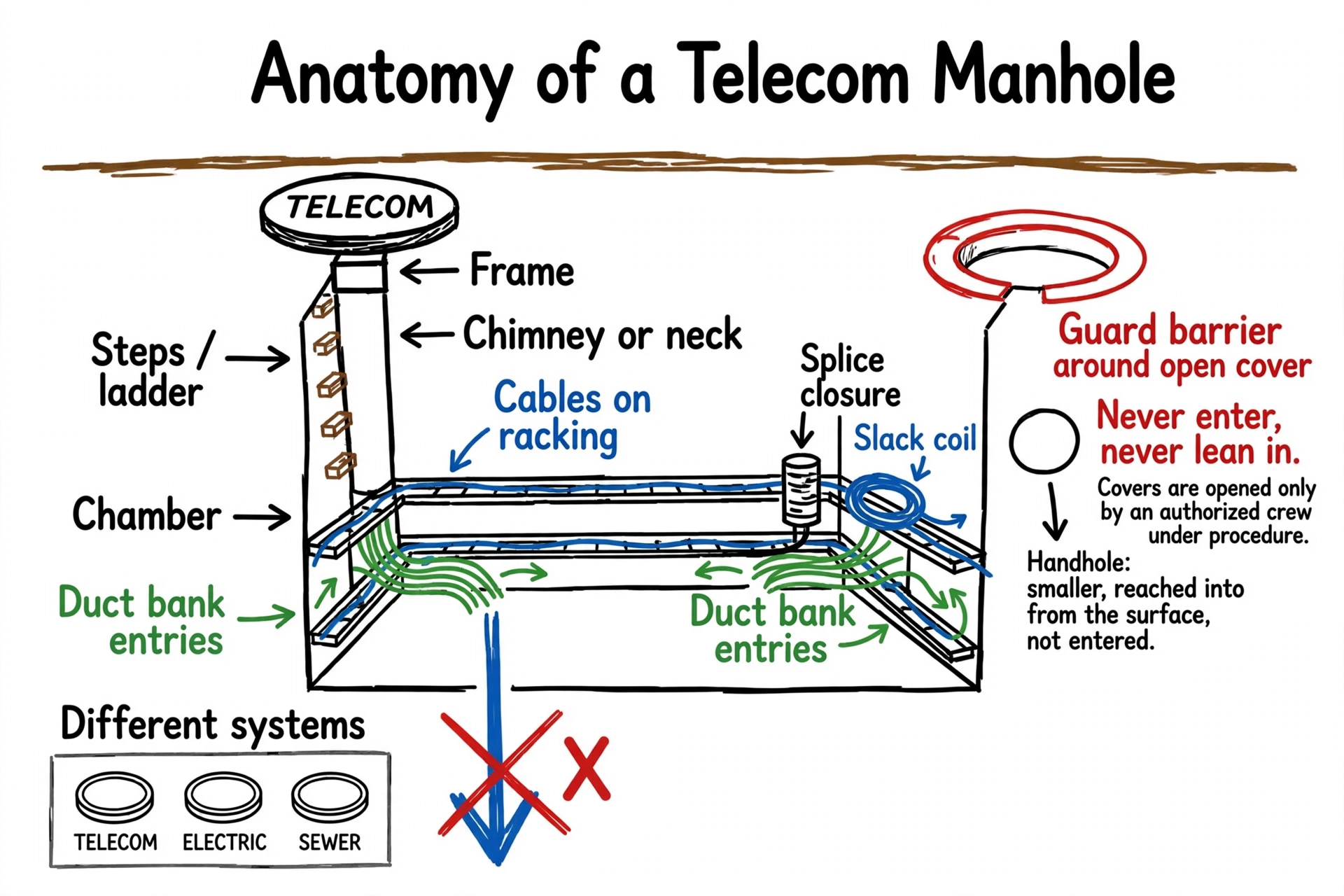
Below the surface, which you will normally only see in photographs, on prints, or during authorized work you are observing from the surface, the structure is arranged like this, from top to bottom:
- The frame is the ring or collar that holds the cover and transfers traffic load into the structure below and the ground around it.
- The chimney, also called the neck, is the short vertical section between the frame and the roof of the chamber. It is narrower than the chamber itself. It may be built from concrete rings, brick, or grade adjustment sections, and its job is to bring the opening up to finished surface level, called grade, and to allow that level to be adjusted when pavement is resurfaced. When a street is repaved and a cover ends up too low or too high, the chimney area is usually where the correction is made.
- The chamber is the room itself, with walls, a floor, and a roof or ceiling. Ducts enter and leave through openings in the walls. Those openings are often called duct entries or duct windows. Where a duct bank enters, you may see several ducts arriving together in a group, with their ends finished at the wall so cables can pass in and out without sharp edges.
- Inside the chamber, cables are supported on racking along the walls. Splice closures are commonly mounted on the racking or on the wall, and extra cable, called slack, is coiled and supported there too, so a closure can be taken down and worked on later and so a repair has cable to work with. Federal telephone plant rules have long described underground splices and cable slack stored on hooks and racks fastened to the manhole wall (7 CFR 1755.200), and that picture, cables carried on wall supports rather than lying in the floor, is still the picture of an orderly chamber.
- Some manholes have steps built into the wall of the chimney or chamber, or a fixed ladder, to assist entry and exit. Some do not, and entry is made with portable equipment by the authorized crew. Never assume steps or a ladder are present, and never treat their presence as an invitation. Steps and ladders in older chambers can be corroded or damaged, and judging them is part of an authorized entry evaluation, rather than a surface observation.
- Some chambers have a low spot or sump in the floor where water collects so it can be pumped out by an authorized crew. Owner standards describe sumps as part of their own manhole designs, as the University of Missouri telecom standard does for its system. Do not assume a sump is present in any specific chamber. Standing water in a chamber is common and is one of the reasons a chamber can present an engulfment or electrical hazard, explained below. You cannot judge the depth or the safety of water in a chamber by looking down into it, and you should not be looking down into an open chamber at all unless you are part of the authorized work and positioned as that work requires.
One more appearance warning matters a great deal. A telecom manhole and a sewer manhole can look almost identical from the surface: a round iron cover in the pavement. Underneath, they are completely different systems. A sewer manhole gives access to a sewer pipe carrying wastewater, and it is normally an open channel at the bottom, rather than a chamber full of racked cables. Its air can contain gases produced by sewage. It belongs to the sewer owner, it sits outside your fiber route, your ducts do not run through it, and it is never a shortcut, a pulling point, or a place to look for your cable. The same caution applies in the other direction: an electric manhole may contain energized cables and equipment, and a communications worker has no business opening it. When the letters on the cover name a system that is yours to leave alone, the correct action is to leave the cover exactly as you found it and work through your project process.
What Does It Do?
A manhole does four jobs for an underground fiber network.
First, it is an access point. Underground cable would be almost impossible to install, splice, rearrange, or repair if it could only be reached by digging it up. The manhole is a permanent, reusable opening into the duct system at a planned location, so authorized workers can reach the cables again and again over the life of the network without excavating the street each time.
Second, it is a pulling point. Installing cable in ducts is done in sections, from one access point to the next. Cable is fed into a duct at one structure and pulled through to the next, using pulling equipment set up at the structures. The manhole gives the crew a place to stand equipment, feed cable, and bring the section in. How long a section can be pulled, and what force is acceptable, depend on the cable, the duct route, and the manufacturer’s instructions and project specifications for that job. This lesson states no pulling distance or tension as a rule, because those limits belong to the cable and the job, rather than to the structure.
Third, it is a splicing and storage location. Where two cable sections join, or where a branch cable splits off toward another route, the splice often lives in a manhole. The closure sits on the racking, the cables are supported along the walls, and slack is stored in supported coils so the closure can be brought to a work position for later repair or rearrangement. Fiber splicing itself is normally done in a clean, controlled work area, often a splicing trailer or vehicle at the surface, with the finished closure then placed in the chamber. The Fiber Optic Association, usually shortened to FOA, describes that practice in its outside plant references: extra cable length is brought up to the splicing vehicle, the splice is made and tested there, and the closure and slack are then placed and mounted in the structure. A manhole that holds splices is therefore a point where the network can be changed, tested, and repaired, and damaging its contents can cut service to everything passing through it.
Fourth, it is a route junction. Duct banks from different streets or different directions can meet in one chamber, which lets a designer turn a route, split a route, or connect a lateral to a main line in an organized way, with each duct and cable supported and identifiable. Good racking and clear arrangement inside the chamber are what keep that junction usable years later, when a crew that did not install it has to find one specific cable among many.
Notice what a manhole leaves to other parts of the system. The ducts do the protecting between structures; the manhole itself adds access, rather than protection. The cables inside a chamber stay hands-off for an unauthorized reader. Cables in a telecom chamber may sit near, or share a street with, electric facilities in separate structures, and a chamber can contain damaged cable, standing water, or unsafe air. A manhole also leaves the exact path of the duct bank between structures unmarked. Two manholes fix two points. The duct bank between them can curve, change depth, or have been repaired along a different line, and its position must be located through the normal locate process, rather than guessed from the covers.
Where Does It Fit?
Level 2 teaches you to read the physical environment before work starts. The manhole belongs to the underground half of that reading. Earlier Level 2 lessons read the surface: right of way, easements, property lines, curbs, sidewalks, ditches, and drainage. Lesson 5 introduced the handhole, the small surface worked enclosure. This lesson takes you one step deeper, to the personnel entry structures of the underground duct system, and later lessons will build on it when they cover duct banks, pulling, and splicing in more detail.
In the underground network picture, the order is this. A main duct bank runs along a street or easement, carrying the backbone and distribution cables for an area. Manholes are set into that duct bank at planned points. Between manholes, the cables run inside ducts, protected and out of sight. At each manhole, cables can be pulled in, spliced, branched, or stored with slack. Lateral duct banks leave a manhole to serve side streets, buildings, cabinets, and smaller structures such as handholes, and from those smaller structures the plant continues toward the customer. When you stand at a manhole cover, you are standing at a node of that network, a place where several decisions about the route come together underground.
In the planning picture, a manhole helps at three stages, and it can mislead at all three if you trust it too far:
- At the desk stage, prints and utility records show manhole locations and the duct banks between them. Records can be old, structures can have been rebuilt or relocated during road work, and a cover in the field is your check that the recorded structure is really there.
- At the locate stage, the one call or 811 ticket should produce marks for the buried facilities that ticket covers, and the manhole covers along the route are surface evidence you can compare with those marks. A recorded manhole with no cover found, or a cover found with no record, is a mismatch to resolve before construction, rather than after.
- At the construction stage, manholes become work locations: pulling setups, splicing locations, and access points, each one planned under the project’s confined space and traffic control procedures where entry or opening is involved.
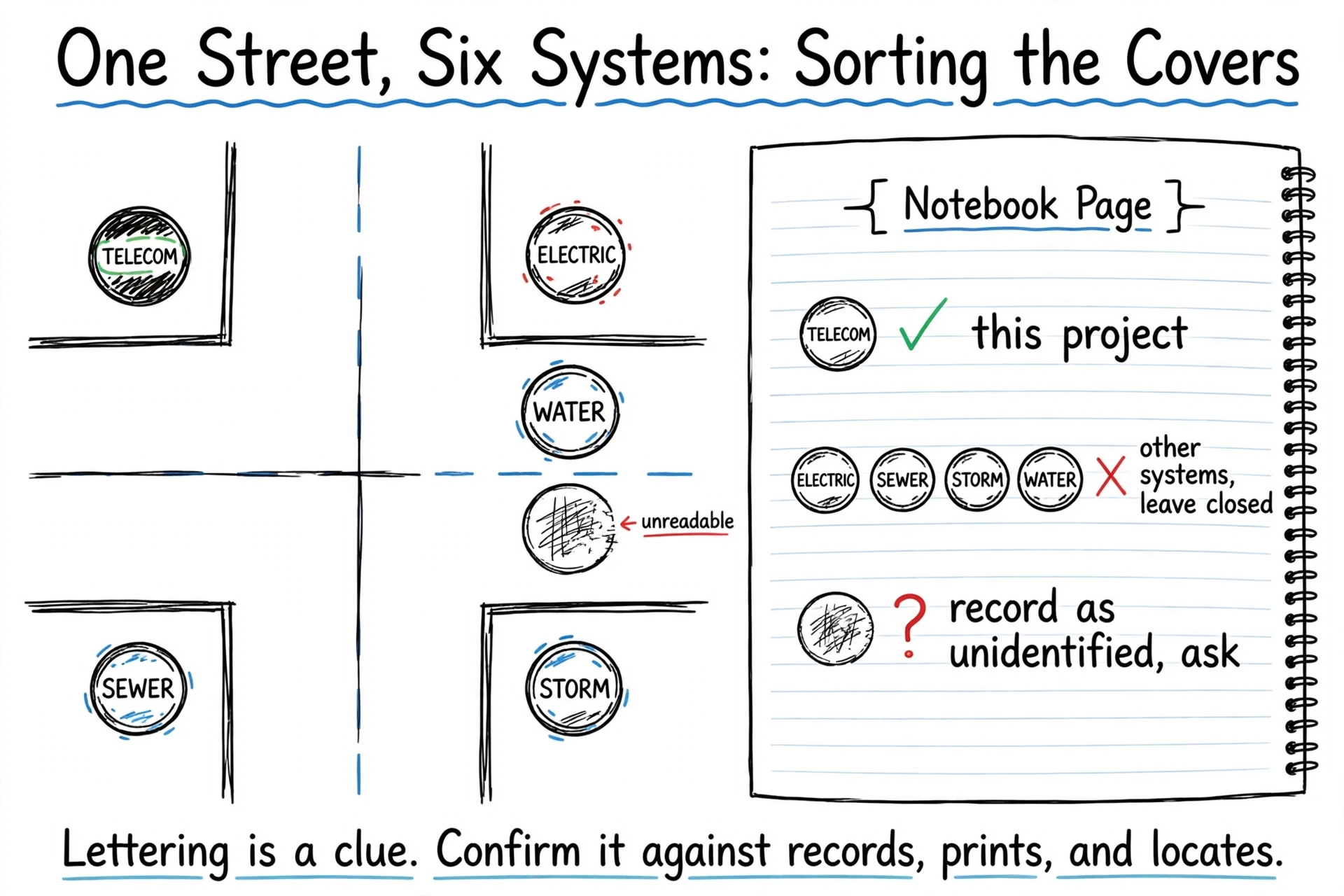
In the street picture, a manhole is also one cover among many. A single intersection can hold telecom manholes, electric manholes, sewer manholes, storm drain structures, water valves, and handholes, each belonging to a different system and owner. Reading a street well means sorting those covers by system, using lettering, records, and locates together, and keeping each system’s structures separate in your notes and photographs. Confusing one system’s structure for another’s goes well beyond a paperwork error. It can send a crew to open the wrong owner’s chamber, and in the case of sewer and electric structures, it can put people in front of hazards that have nothing to do with fiber work.
What Is at Stake
For the network, the manhole is where underground plant stays maintainable. A duct system without access points would have to be dug up for every splice, every rearrangement, and every repair. Manholes concentrate that access at planned, documented locations, hold the splices and slack that repairs depend on, and let a network built decades ago keep being changed by crews who were not there when it went in. Protecting the structure, its cover, and its contents is protecting the owner’s ability to maintain everything that passes through it.
For damage prevention, a manhole is both a warning and a facility. As a warning, a cover tells you a duct bank serves that structure and runs onward from it, so boring, trenching, or excavating nearby must account for that duct bank through the locate process. As a facility, the structure itself can be damaged by the work around it. Heavy equipment over a structure rated below that load, excavation that undermines its walls or chimney, spoil or backfill piled over its cover, and restoration that leaves the cover raised, sunken, or buried all create problems for the owner, for traffic, and for the next crew. A cover left out of level with the pavement is a hazard to vehicles, bicycles, and pedestrians, well beyond an eyesore.
For safety, the manhole carries the highest stakes of any structure in this level, and the next sections treat that in full. The short version belongs here too. The chamber that makes underground work possible can hold air that will not support life, water that can rise, and, in electric systems, energized equipment. Those hazards have killed workers who entered without evaluation, testing, and a permit where one was required, and they have killed coworkers who went in after them to attempt a rescue without training and equipment. Every rule in the safety sections below exists because of that history. A beginner who learns to recognize a manhole and to respect the boundary at its cover has learned the most valuable part of this lesson.
For the customer and the public, an open or damaged manhole in a street or sidewalk is an immediate physical hazard. A missing, displaced, or broken cover leaves a hole a person can fall into and a vehicle can strike. That is why an open manhole is never left unguarded, why a damaged cover you discover is reported promptly through your project process and to the owner, and why you never walk or drive away from an opening you created or found unprotected.
What Does Good Look Like?
Good, for a manhole you are observing from the surface as part of a fiber project, looks like this:
- The cover is present, closed, seated properly in its frame, and flush with the surrounding surface, with no rocking, cracking, or broken edges, and the pavement or ground around the frame is sound.
- The cover lettering is readable and matches the system and owner shown in the project records for that structure. Any mismatch has been noted and reported, rather than assumed away.
- The cover is free of burial, paving, stored material, parked equipment, and overgrowth. The owner can find it and open it, and a locating crew can see it.
- The structure’s location is documented in the project record with photographs taken before work nearby, showing the cover, its lettering, and its condition, so preexisting damage is on record and new damage can be recognized.
- Where authorized work at the structure is underway, the work area follows the project’s traffic control plan, the opening is guarded whenever the cover is off, an attendant is present where the entry procedure requires one, and no one enters or leans into the chamber outside that procedure.
- Records, locates, and the field picture agree: the structure on the print is the structure in the street, its ducts are accounted for in the locate marks, and any abandoned, rebuilt, or relocated structure discovered in the field has been reported so the record can be corrected.
What good looks like inside a chamber is a judgment for the authorized crews who enter it, rather than for a beginner at the surface. In general terms, an orderly chamber has cables supported on intact racking, closures mounted and identifiable, slack coiled and supported, duct entries sealed or finished as the owner’s standard requires, and no debris or damage left behind. If you are ever shown photographs of a chamber interior as part of your project, that is the picture to compare against. Describing interior condition from the surface, or from leaning over an opening, is outside your job and is an unsafe way to gather information.
From the Field
Picture a fiber crew preparing a bore along a residential street to place a new lateral duct. The prints show a telecom manhole in the side street near the corner, with a duct bank running along the crew’s planned path. During the surface walk, the crew member doing the survey finds the round iron cover in the pavement, photographs it, and reads lettering that names the communications system the project expects. That matches the print, and the locate marks for the duct bank run structure to structure in a way that lines up with the covers found on the street.
Two other covers in the same intersection carry lettering for sewer and electric systems. The survey notes list all three separately, with photographs, and mark the sewer and electric structures as outside this project and closed to the crew. The crew leaves both covers exactly as found.
The same survey finds a problem. The telecom cover sits slightly sunken, and the pavement at one edge of the frame is broken. The survey records the condition with photographs before any project work begins and reports it to the project supervisor, who passes it to the owner through the project process. Because the preexisting damage is documented, the owner can schedule its repair, and the fiber crew’s own restoration work later will carry a clean record for damage that was already there.
The project plan calls for entry into this manhole zero times. The new lateral will be pulled between other access points, and splicing is planned in a trailer at the surface. So the manhole’s role in this job stays at recognition and protection: the bore path is planned from the locate marks and, where the project process requires it, confirmed by potholing at the crossing; equipment is kept off the structure; spoil is kept off the cover; and the sunken frame area is protected from further damage by the work.
If the plan changed and entry became necessary, that work would leave this beginner’s task list at that moment. It would move to an authorized entry crew working under the employer’s confined space program, with the evaluation, permit, testing, attendant, rescue arrangements, and traffic control that program requires, and the beginner’s job would be support work outside the opening, exactly as assigned by the entry supervisor.
Carry the decision rule out of this story: verify the cover against the print and the locates, document damage before your work begins, sort every other system’s structure out of your job, and arrange the plan so nobody enters a confined space for work that can be done without entry.
What Can Go Wrong?
Things go wrong at manholes in two families: damage to the plant and the structure, and harm to people. The second family is worse, and it is the one beginners most underestimate.
Damage and plant problems include:
- A struck or undermined duct bank. A bore, trench, or excavation strikes or undermines the duct bank entering the manhole, or undermines the chamber or chimney itself, cracking the structure or collapsing soil into it.
- A broken or displaced cover or frame. Equipment breaks a cover or frame, paving or grading displaces one, or a cover is left raised or sunken so it becomes a traffic hazard and lets surface water and debris pour into the chamber.
- A buried structure. Backfill, spoil, or new pavement buries the cover, or the structure is paved over entirely, so the owner loses access and the next project works from wrong records.
- Water and debris inside. Water, mud, and road debris enter through a damaged or poorly seated cover and accumulate around cables and closures, accelerating damage and making later authorized work harder and more hazardous.
- The wrong structure opened. A crew opens or enters a sewer or electric manhole mistaken for a telecom manhole, because the covers looked alike and the lettering and records went unchecked. The crew then faces a system it does not own, hazards it did not plan for, and an owner who was never notified.
- Damaged contents. Splices, slack, or racking inside are damaged by careless work at the structure, cutting or degrading service for every customer whose cable passes through that chamber.
Harm to people is the serious family, and you need to understand the mechanisms behind the rule:
- Hazardous atmosphere. Air in a closed underground chamber can become unsafe as gases accumulate, as decaying material or sewage nearby produces toxic or flammable gases, as gases from the surrounding soil or from a leaking facility migrate in, or as oxygen is displaced or consumed. Some dangerous gases have no odor, and some deaden the sense of smell, so smell serves as no test at all. A worker can lose consciousness in such air very quickly, sometimes within a few breaths, with no chance to climb out. This is the hazard most often behind confined space deaths, and it is invisible from the surface.
- Engulfment. Engulfment means the surrounding and effective capture of a person by a liquid or a finely divided, flowable solid substance, in a way that can fill or plug the respiratory system or exert enough force on the body to cause death by strangulation, constriction, crushing, or suffocation. In a manhole the realistic form is water: a chamber connected to drainage or sewer systems, or in low ground, can take on water from a storm, a broken water line, or a surcharged sewer while a worker is inside, and a worker can be trapped or drowned. Standing water already in a chamber is a warning sign of that connection.
- Electrical hazards. Electric manholes can contain energized cables and equipment, and damaged electric cable can fault violently. Telecom chambers are separate structures, and a worker who opens the wrong cover, or who assumes every underground chamber is a low voltage communications space, can be exposed to lethal energy. Damaged or deteriorated cable in any chamber can also present hazards that only an evaluation can identify.
- Falls and falling objects. An open manhole is a hole in the street. Workers, pedestrians, and vehicles can fall or drop tools and material into it, onto anyone inside. That is why openings are guarded promptly and never left unattended and unprotected.
- Traffic. Many manholes sit in traveled lanes. Work at them exposes the crew to moving vehicles, and poor traffic control turns a routine access point into a struck-by hazard for the crew and for drivers.
- Failed rescue. When a worker collapses in a confined space, the instinct to climb in and help is strong and has repeatedly been fatal. Federal safety guidance on confined spaces stresses planned rescue by trained and equipped rescuers, with non-entry rescue methods preferred where they can be used, precisely because unplanned entry rescue kills rescuers (OSHA 3849). As a beginner, your rescue role is to summon help, give the location and what you know, and keep others out. Entry for rescue stays with trained and equipped rescuers.
What Should Someone Notice in the Field?
Your field job at a manhole is surface observation, documentation, and protection. Work through it in this order:
- Find the cover and identify the system. Read the lettering. Note the owner or system it names, and compare it with the project records and prints for that location. Photograph the cover and its lettering.
- Sort the street. Look for the other covers nearby and sort them by system in your notes: telecom, electric, sewer, storm, water, and other. Keep each system’s structures separate. If you cannot tell which system a cover belongs to, record it as unidentified and ask. Guessing and opening a cover to find out are both off the list.
- Check the condition of what you can see. Is the cover present, closed, seated, and flush? Is it cracked, rocking, raised, or sunken? Is the surrounding pavement sound? Is the cover buried, paved over, or blocked? Record and report damage, displacement, or a missing cover promptly. A missing cover is an emergency hazard to the public, well beyond a routine note.
- Connect the cover to the locate. Compare the structure with the locate marks for the duct bank that serves it. A manhole with no located duct bank, or located marks running to a place with no structure, is a mismatch to resolve before digging or boring nearby.
- Plan around it. Your project work should treat the structure and its duct entries as facilities to protect: keep equipment loads off structures rated below them, keep spoil and material off the cover, keep excavation clear of the chimney and walls so they stay supported, and restore the surface around the frame to grade when your work is done.
- Stop at the boundary of your role when opening or entry is planned. Opening and entry happen only under the owner’s authorization and the employer’s confined space procedure, with a trained and equipped crew, an evaluation and any required permit, atmospheric testing and ventilation as that procedure requires, an attendant and a rescue plan where required, and traffic control in place. If you do not see those elements, hold the work and raise it through your supervisor and project process.
- Treat any open manhole as a guarded hazard. If the cover is off, the opening must be promptly guarded with a railing, barrier, temporary cover, or other protection under the applicable rules and the traffic control plan, and it must stay attended or protected at all times. State telecom rules give one example of that guarding duty: Washington’s rule for manholes and street openings requires removed covers to be promptly guarded by a railing, temporary cover, or other barrier (WAC 296-32-23528). If you find an open, unguarded manhole outside active authorized work, keep people away from it as you safely can, keep every part of your body clear of the opening, and report it immediately.
- Recognizing is where your qualification ends. Never do any of the following: enter the chamber; lean into the opening so any part of your body breaks the plane of the opening; lift, slide, or pry the cover on your own, outside an authorized crew operation under the owner’s authorization and the employer’s confined space procedure; reach into a chamber for a dropped tool or material; or enter to help a collapsed worker. Summon emergency help and your supervisor instead, and keep others out.
A note on the phrase breaks the plane. For a permit-required confined space, OSHA defines entry as the action by which any part of a person passes through an opening into the space, and entry is considered to have occurred as soon as any part of the body breaks the plane of the opening (29 CFR 1910.146). Your head can be in unsafe air while your feet are still on the street. Because you cannot tell from the surface whether a given manhole is a permit space, the rule for a beginner is simple and total: no part of you goes over or into the opening.
Key Terms
- Manhole (maintenance hole): An underground access chamber large enough for a person to enter and work inside, giving access to buried ducts and cables.
- Handhole: A smaller underground enclosure worked from the surface by reaching in. A person does not enter it.
- Vault: A larger underground room, often for equipment as well as cables. The word is used inconsistently, so its meaning and entry status must be confirmed for each system.
- Cover: The heavy lid, often round cast or ductile iron in pavement, that closes the top opening of a manhole. Many covers carry lettering cast into the metal that names the owner or system.
- Frame: The ring or collar that holds the cover and transfers load into the structure and ground.
- Chimney (neck): The short vertical section between the frame and the chamber roof that brings the opening up to grade and allows level adjustment.
- Grade: The finished level of the ground or pavement surface.
- Duct: A pipe or tube that carries and protects underground cables.
- Duct bank: A group of ducts installed together as one unit.
- Duct entry (duct window): An opening in a manhole wall where a duct or duct bank enters or leaves the chamber.
- Racking: The wall mounted supports, uprights and arms, that hold cables and splice closures neatly along a manhole wall.
- Splice closure: The sealed protective case that holds and protects a splice, which is a permanent joint between cables or cable sections.
- Slack: Extra cable stored in supported coils so a closure can be worked on or a repair can be made later.
- Confined space: A space that (1) is large enough and so configured that an employee can bodily enter it, (2) has limited or restricted means for entry and exit, and (3) is not designed for continuous employee occupancy. All three conditions together make a confined space. The general industry standard words the first condition as bodily enter and perform work.
- Permit-required confined space (permit space): A confined space that has one or more of these characteristics: it contains or has the potential to contain a hazardous atmosphere; it contains a material that has the potential for engulfing an entrant; it has an internal configuration such that an entrant could be trapped or asphyxiated by inwardly converging walls or by a floor which slopes downward and tapers to a smaller cross-section; or it contains any other recognized serious safety or health hazard. A permit under the employer’s program is required before entry.
- Hazardous atmosphere: An atmosphere that may expose a worker to the risk of death, incapacitation, impairment of ability to self-rescue (escape unaided from a permit space), injury, or acute illness. Causes listed in the OSHA definition include flammable gas, vapor, or mist, combustible dust, oxygen that is too low or too high, an airborne substance above its allowed exposure limit, or any other atmospheric condition that is immediately dangerous to life or health, each as defined in the applicable OSHA standard.
- Engulfment: The surrounding and effective capture of a person by a liquid or a finely divided, flowable solid substance, in a way that can fill or plug the respiratory system or exert enough force on the body to cause death by strangulation, constriction, crushing, or suffocation. In a manhole, rising or standing water is the common form to respect.
- Attendant: The individual stationed outside one or more permit spaces who assesses the status of authorized entrants, continuously maintains an accurate count of them, communicates with them, and summons rescue when needed. While serving as attendant, the attendant remains outside the space until relieved by another attendant and stays out of the space.
- Entry supervisor: The qualified person responsible for determining if acceptable entry conditions are present at a permit space where entry is planned, for authorizing entry and overseeing entry operations, and for terminating entry when required.
- Competent person: In the construction confined space standard, a person who is capable of identifying existing and predictable hazards in the surroundings or working conditions which are unsanitary, hazardous, or dangerous to employees, and who has authorization to take prompt corrective measures to eliminate them. Under that standard, a competent person identifies the confined spaces and permit spaces employees may enter.
Check Your Understanding
- What is the single deciding difference between a manhole and a handhole?
- A round iron cover in a street carries lettering naming the sewer system. Your fiber route passes this street. What is that structure to your project, and what should you do about it?
- Name three hazards that can make a manhole a permit-required confined space, and explain why none of them can be ruled out by looking at the closed cover.
- A coworker says the cover lettering proves exactly what is inside a manhole and which cables run through it. Give two reasons that claim fails.
- In the From the Field story, the crew found a sunken telecom cover with broken pavement at its frame before any work began, and the project plan called for no entry into that manhole. What two decisions did the crew make, and why does each one matter?
Answer key
- A person enters a manhole and works inside it. A handhole is worked from the surface by reaching in, and a person does not enter it. That difference is why manhole entry is confined space work.
- It is a sewer structure belonging to a different system and owner. It sits outside your fiber route, your ducts do not run through it, and you leave it closed and alone, record it separately in your notes, and work through your project process. Opening or using it is never an option.
- Any three of: a hazardous atmosphere, an engulfment hazard such as water entering the chamber, an internal configuration that could trap an entrant, and another recognized serious hazard such as electrical energy. None can be ruled out from the surface because the air, water, and equipment conditions are inside a closed chamber and can change over time. Only an evaluation, with testing where required, by qualified people can classify the space.
- First, lettering varies by city, owner, and era, covers can carry the name of a former company, and a cover can have been replaced with one from another system during past repairs. Second, even correct lettering names only the system or owner. The lettering stays silent about which ducts and cables are inside, their condition, and the condition of the air, all of which come from records, locates, and an authorized evaluation.
- First, the crew documented the sunken cover and broken pavement with photographs and reported the condition through the project process to the owner before any project work began, so the owner could schedule the repair and the preexisting damage stayed on record, clear of the crew’s later restoration work. Second, the crew kept the job at recognition and protection: the manhole stayed closed, equipment and spoil stayed off the structure, and the plan used other access points for pulling and a surface trailer for splicing. That arrangement kept every worker out of a confined space for work that could be done without entry, which is always the preferred outcome. Had entry become necessary, the work would have moved to an authorized entry crew under the employer’s confined space program.
Lesson Takeaway
A manhole is a personnel entry underground chamber where duct banks meet, cables are pulled and spliced, and slack and closures are stored on racking. You recognize it at the surface by its heavy cover and the owner or system lettering cast into it. A handhole is reached into from the surface, and neither word swaps with a sewer or electric structure that happens to look the same from above. Because a person can enter a manhole, it is a confined space, and a given manhole may be permit-required, a classification nobody can make from the surface. Your job as a beginner is recognition, documentation, and protection from the surface: identify the system, sort it from the other covers on the street, record its condition, protect it and its duct bank during your work, guard and report any open or damaged structure, and keep entry, opening, and testing with the authorized, permitted, trained crews who own that work.
Sources and Technical References
Federal requirements (United States, OSHA):
- OSHA, Confined Spaces in Construction, 29 CFR 1926 Subpart AA, including 1926.1201 Scope, which lists manholes for sewer, storm drain, electrical, communication, and other utilities as locations where confined spaces may occur, and 1926.1205 Permitting process. https://www.osha.gov/laws-regs/regulations/standardnumber/1926/1926.1205 and the scope text at https://www.law.cornell.edu/cfr/text/29/1926.1201
- OSHA, Protecting Construction Workers in Confined Spaces, OSHA 3825. General guidance on the construction standard, including manholes among confined spaces found on construction sites. https://www.osha.gov/sites/default/files/publications/OSHA3825.pdf
- OSHA, Is 911 Your Confined Space Rescue Plan?, OSHA 3849. Fact sheet on rescue and emergency services under 1926.1211, including that not all emergency responders are trained and equipped for confined space rescue and that rescue must be planned for the specific space and its hazards. https://www.osha.gov/sites/default/files/publications/OSHA3849.pdf
- OSHA, Permit-Required Confined Spaces, 29 CFR 1910.146 (general industry). The general industry standard that applies where that body of rules governs the work, with the definitions of confined space, permit-required confined space, hazardous atmosphere, and engulfment used in this lesson. Text reproduced at https://www.lawserver.com/law/country/us/cfr/29_cfr_1910-146
State rules (examples only, rather than national requirements):
- Washington Administrative Code 296-32-23528, Manholes, street openings and vaults. A state telecommunications safety rule requiring removed covers to be promptly guarded by a railing, temporary cover, or other barrier, and requiring atmospheric testing and forced air ventilation for entry in that state program. Cited here as an example of a state rule; your state’s rules and your employer’s program govern your work. https://www.law.cornell.edu/regulations/washington/WAC-296-32-23528
Industry and owner references:
- Fiber Optic Association (FOA), Reference Guide to Fiber Optics, Outside Plant Splicing and Termination. Describes splicing in a clean, controlled environment such as a splicing trailer rather than inside a manhole, with the finished closure and slack then placed in the structure. https://www.thefoa.org/tech/ref/OSP/term.html
- 7 CFR 1755.200, federal telephone plant construction rules long used in rural telephone systems, describing underground splices and cable slack stored on cable hooks and racks fastened to the manhole wall. https://codes.findlaw.com/cfr/title-7-agriculture/cfr-sect-7-1755-200/
- University of Missouri, Telecom Service Construction Standards, Section on Telecom Manholes. An owner standard used here only as an example of how an owner specifies its own manholes, racking, sump, pulling eyes, and covers. Owner standards vary and the standard for the system you are working on governs. https://www.umsystem.edu/sites/default/files/media/documents/general/338000%20MU%20Telecom%20Service%20Construction%20Standards.pdf
- Chaoqian Tech, Manhole, Handhole, and Vault: What Is the Difference? A supplier overview distinguishing personnel entry manholes from surface accessed handholes and noting that vault is used less precisely. Used only for the general distinction, rather than for any dimension or requirement. https://www.chaoqian.com/manhole-handhole-and-vault-whats-the-difference/
- City of Rogers, Arkansas, Specifications for Manhole Frames and Covers (Rogers Water Utilities, sewer system). A local specification used here only as an example that cover lettering is set by the local owner’s specification, including wording cast into the lid. Wording on covers in your area will differ. https://www.rwu.org/wp-content/uploads/2019/10/03-04-CIManholes.pdf
Previous lesson: Lesson 42: What Is a Utility Cabinet? |
Back to Level 2 hub |
Next lesson: Lesson 44: What Can You Learn From a Utility Pole?