
Introduction
A preconstruction meeting is a formal meeting held after a contract is awarded and before construction work begins, where the parties who will build, oversee, and be affected by the work sit down together to confirm the scope, the documents, the schedule, and the rules for working together. Agencies also call it a preconstruction conference. The Florida Department of Transportation manual states the timing plainly: the conference is scheduled and conducted after receipt of the Notice of Award and prior to any work beginning.
Level 6 covered permission to build: the approvals, the prints, and the permit conditions that govern a segment. Level 7 turns to preparing the jobsite itself. This lesson opens the level because the preconstruction meeting is where permission, documents, and people meet in one room, and where gaps among them can still be closed on paper before a crew, a rig, and a traffic pattern depend on the answers.
What This Lesson Gives You
- Place a preconstruction meeting in the sequence: after award, before work begins, and separate from both a pre-bid meeting and a daily job briefing.
- Read an agenda and name what each item is there to settle: scope, prints, permits, utilities and locates, schedule, traffic control, safety, submittals, and points of contact.
- Tell the difference between what a contract or an agency manual requires for a given project and what is common practice across projects.
- Use meeting minutes and an action list to carry decisions out of the room and into the job file, with an owner and a due point for each open item.
- Recognize a meeting that ended with a critical question still open, and hold the affected work until that question gets a written answer.
Start With the Basics
Think about a wedding rehearsal. The rehearsal happens after the venue is booked and before the ceremony. The couple, the officiant, the wedding party, and the venue coordinator walk the actual sequence, confirm who stands where, check the timing, and surface small problems while fixing them costs nothing: a missing reading, a processional that runs long, a microphone nobody tested. Nobody learns the ceremony at the rehearsal. The rehearsal aligns people who already have roles, so the real event runs without improvisation.
A preconstruction meeting works in a similar way. The contract is the booking. The prints, permits, and schedule are the ceremony plan. The meeting is the rehearsal: the parties walk the sequence together, confirm who does what, and surface gaps while the correction is still a conversation and a revised page.
A second picture helps with the paperwork side. Think about a pilot and copilot running a preflight checklist together before takeoff. Each item gets spoken, checked, and confirmed out loud, and the flight waits on any item that fails the check. A preconstruction meeting gives a construction project the same habit at project scale: critical items get named, confirmed in front of everyone who depends on them, and recorded, and the affected work waits on any item that stays open.
What Is It?
A preconstruction meeting is a scheduled, agenda driven meeting between the parties to a construction job, held to review project requirements and administrative details before field work starts. The Iowa Department of Transportation Construction Manual describes the core form: after award of the contract and prior to starting work on the project, a meeting between the contractor staff and the project engineer staff is generally conducted to discuss project requirements and administrative details.
Key terms for the meeting itself:
- Owner is the party that commissions the work and holds the contract with the builder. On a fiber job the owner may be a network operator, a cooperative, a municipality, or a prime contractor passing work to a subcontractor.
- Contractor is the party that agrees to build the work under the contract. A subcontractor is a party the contractor engages to perform part of that work.
- Notice of Award is the written notice that a bid or proposal has been accepted and the contract will move forward. The Florida manual keys the conference schedule to receipt of this notice.
- Notice to Proceed is the written direction that authorizes the contractor to begin work, often with a stated start date or a start window. Some contracts bar on site work until the notice is received and listed prerequisites are met.
- Agenda is the written list of items the meeting will cover, prepared in advance and shared with attendees. The Florida manual requires the project administrator to prepare an agenda, and the Oregon guidance described in the sources requires an agenda copy for each attendee.
- Minutes are the written record of what the meeting discussed, decided, and assigned. Minutes turn spoken agreements into a project record that later work can be checked against.
- Submittal is a document, plan, schedule, or sample the contractor must deliver for review or approval under the contract, such as a proposed work schedule, a traffic control plan, or a quality control plan. Florida lists required submittals that the notice to the contractor must name, and states that listed plans must have written approval before construction activities begin where the specifications require it.
- Point of contact is the named person, with a working phone number, who speaks for one party on one subject, such as traffic control, utility coordination, or inspection scheduling.
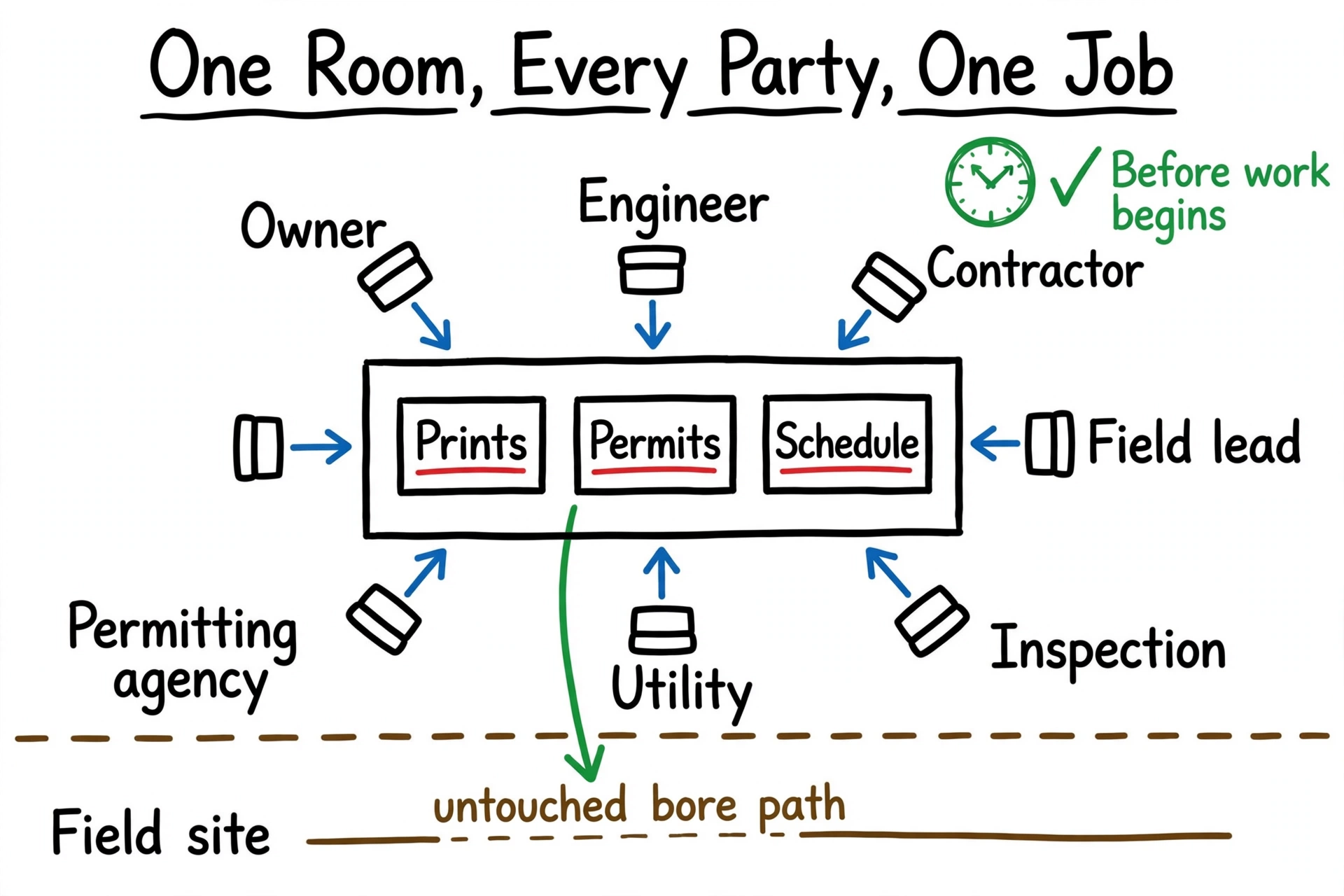
Who calls and who attends depends on the contract and the owner. No universal law fixes one attendee list for every construction job in the country. The sources show three layers, and a reader keeps them separate:
- Contract requirements. The contract documents for the job state whether a conference is required, who must attend, and what must happen before work begins. A standard project meetings specification in the sources requires authorized representatives of the owner, the owner’s commissioning authority, the architect and their consultants, the contractor and its superintendent, major subcontractors, suppliers, and other concerned parties to attend, with participants familiar with the project and authorized to conclude matters relating to the work. On a fiber job the corresponding design seat is held by the design engineer for the project, named in the contract documents for that job.
- Agency requirements. A public agency manual adds its own rules for its own projects. Florida sends the conference notice to parties known to have an interest in the project, a list that can include utility companies, the city and county, the Federal Highway Administration, law enforcement, environmental agencies, contractor and subcontractor representatives, suppliers, the engineer of record, any agency with permitting authority, railroad representatives, and emergency medical personnel. Iowa notes that attendance of utilities and law enforcement personnel at preconstruction meetings can be highly beneficial, and directs the project engineer to make extra effort to secure that attendance and open communication.
- Common practice. Across public and private work, the room commonly holds the owner representative, the project engineer or designer, the contractor project manager and field superintendent or foreman, key subcontractors, inspection staff, and representatives of utilities and agencies whose facilities or permits the work touches. Common practice guides who gets invited on a small private job with no agency manual behind it. Common practice alone binds nobody. The contract and any governing agency procedure bind the parties named in them.
The agenda follows the same pattern. Agencies publish agenda guidance for their projects, and the items repeat across systems because the risks repeat. Florida makes a core set of agenda items mandatory for all of its contracts, and Iowa publishes a comprehensive topic list while noting that the list includes topics that may not apply to every contract. A typical agenda for outside plant fiber work covers:
- Project description and scope. Which segments, which facilities, and which limits the contract covers, stated in plain terms at the start of the record.
- Lines of authority and points of contact. Names and emergency telephone numbers for the contractor, the owner, and the engineer, plus how issues escalate when the field cannot resolve them.
- Prints and contract documents. Which print set governs, how revisions reach the field, and any known errors, omissions, or ambiguities in the documents. Florida asks the contractor before the conference to submit a list of plan errors, omissions, or ambiguities that need discussion, and the agenda carries that review as a standing item.
- Permits and permit conditions. Which approvals are in hand, which conditions govern the segments, and which approvals or written plan approvals must arrive before specific activities begin.
- Utilities, locates, and conflicts. Status of utility coordination and relocation, known conflicts with existing facilities, and how the work sequence handles them. Florida holds a separate utility coordination meeting with the contractor and all utility companies as soon as possible after the Notice of Award to determine relocation progress and status.
- Schedule. Proposed starting dates, the contractor proposed work schedule, work sequence, shifts and hours, and how schedule updates and progress meetings will run.
- Traffic control. Review of the traffic control plan, called a maintenance of traffic plan in Florida usage, shortened to MOT plan. Florida states that the plan must have written approval before construction activities begin where the specifications require it.
- Safety and environmental controls. Contractor safety responsibilities under federal and state occupational safety and health law, the erosion control and storm water pollution prevention plan, environmental permits, and project commitments made before construction. Iowa requires the contractor erosion control implementation plan and schedule for water pollution control to be submitted before the preconstruction meeting.
- Submittals and administration. Which submittals are due before the meeting, at the meeting, and before specific work begins, plus subcontracting, materials sources, payment procedures, and record handling.
- Emergency and site matters. Emergency and evacuation planning, staging and contractor furnished sites with their own clearances, right of way limits beside private property, and railroad agreements and flagging where the work touches railroad property.
One boundary matters for the rest of Level 7. A preconstruction meeting is a project level event that happens once at the front of a job, with added sessions for complex phases on some projects. A job briefing is a crew level event held before each job, covering the hazards, work procedures, special precautions, energy source controls, and personal protective equipment for the work in hand. Where the work in a day or shift is repetitive and similar, at least one briefing before the first job of that day or shift satisfies the timing rule, and added briefings are required when significant changes occur. Federal regulation at 29 CFR 1926.952 requires that briefing for electric power transmission and distribution construction work. Lesson 130 covers the job briefing on its own. The preconstruction meeting sets the project framework. The job briefing puts that framework in front of the crew doing the work that day. One never replaces the other.
What Does It Look Like?
A reader who walks into a preconstruction meeting, or reviews one in the job file afterward, can recognize it by these traces:
- A written notice or invitation stating the project, the date, the time, and the location of the meeting, sent to the parties with an interest in the project.
- A printed or shared agenda, with the mandatory items for that owner or agency plus the project specific items added for this job.
- A sign in or attendance record naming the people present and the party each person represents.
- The governing print set, the permits, and the draft schedule physically or digitally on the table, open to the segments under discussion.
- A submittal list, with due points, and a clear statement of which plans need written approval before construction activities begin.
- Named points of contact exchanged in the room, including emergency numbers, rather than company names alone.
- Open items spoken out loud as open items, with a named owner and a follow up path, instead of a general assurance that the item will work out.
- Minutes issued after the meeting, sent to all attendees and other interested parties. Florida requires its minutes in typewritten form as soon as practical, sent within fourteen calendar days, with a request that errors and omissions be returned to the writer within fourteen calendar days. That timing belongs to Florida procedure. The habit of prompt written minutes with a correction window is the wider practice the example teaches.
- On some agency jobs, a recording of the meeting retained as part of the project records. Florida records project level meeting dialogue and retains the recording in its electronic document system. Recording is an agency requirement where it applies, and a reader checks the governing procedure rather than assuming it.
Venues vary with the job. Iowa describes the range: a project with no detailed coordination needs may hold its meeting on the project site just before work begins, with the contractor and inspection personnel involved, while a complex project that needs advanced coordination of the schedule gets an earlier meeting with a wider group. Size changes the room. Size changes nothing about the purpose.
What Does It Do?
It aligns scope before the field prices a misunderstanding. Each party arrives holding a version of the job: the owner holds the intent, the engineer holds the design, the contractor holds a build plan and a bid. The meeting forces the three versions into one conversation while the only cost of a mismatch is talk. Errors, omissions, and ambiguities in the contract documents get named in the record, with a route to resolve them, instead of surfacing at a bore pit with a crew standing by.
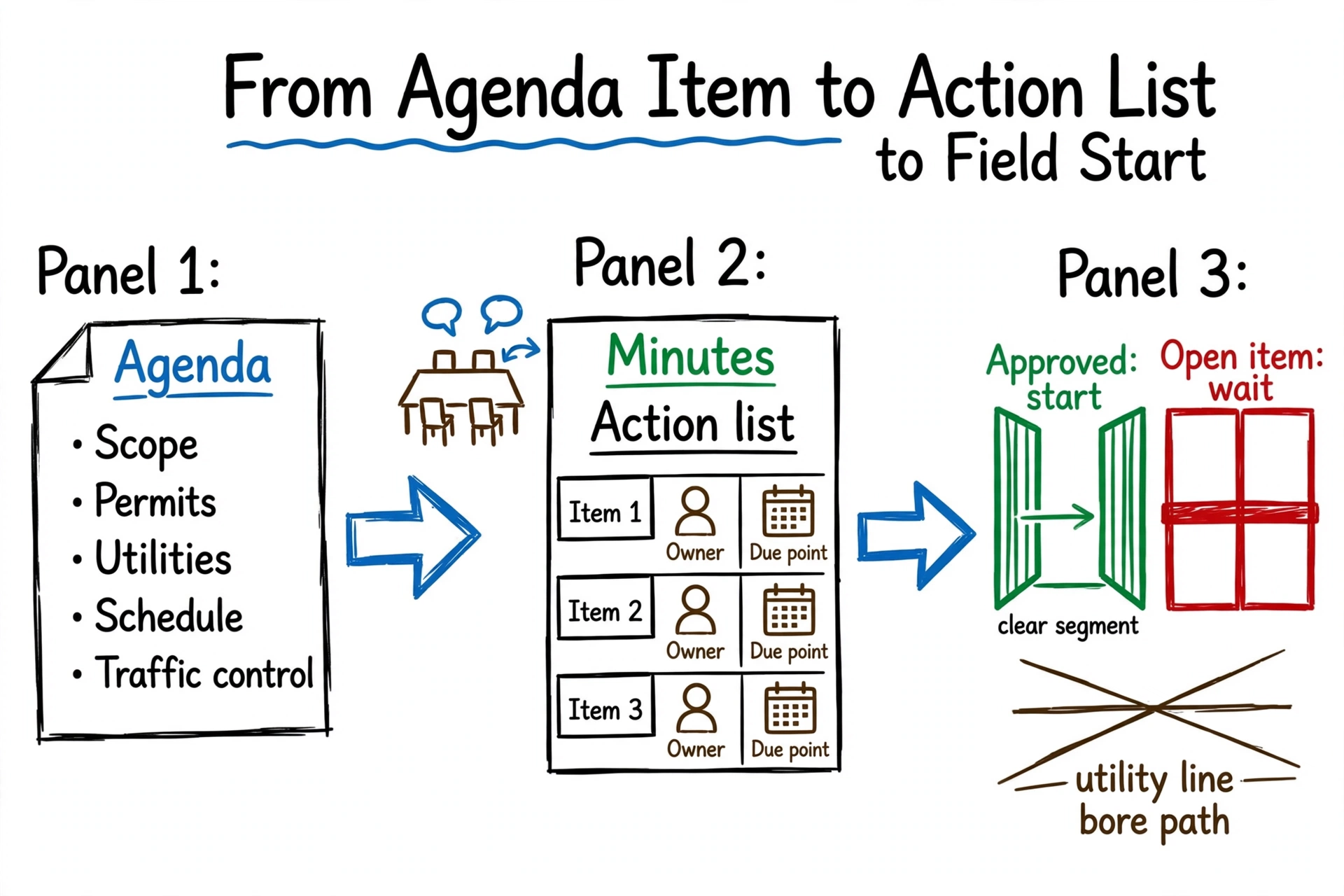
It converts documents into assignments. A permit condition, a plan approval, or a schedule milestone sitting in a file folder changes no field behavior. The meeting attaches a name and a due point to each one: who submits the traffic control plan, who confirms the utility relocation status, who schedules the inspection, and by when. The minutes then carry those assignments as a record every party received.
It sequences permission ahead of work. Where the contract or the specifications require written approval of a plan before construction begins, the meeting is where that gate gets stated in front of everyone, with the current approval status on the record. Crews learn at the table that construction activities wait for the required written approvals, and they learn which specific work, if any, the contract or the engineer has authorized in writing as severable, instead of learning at the work face from an inspector.
It builds the communication network the job will actually use. Field problems travel through people. The meeting establishes lines of authority, signature authority for changes where the contract provides for it, escalation steps for issues the field cannot settle, and the regular progress meeting rhythm for the job. Oregon guidance lists identifying key personnel and channels of communication, and reviewing the project work schedule with utilities, among the objectives the conference must accomplish.
It surfaces third party dependencies early. Utility relocations, railroad coordination, law enforcement support for traffic operations, and permitting agencies each run on their own clocks. The meeting puts those clocks next to the construction schedule in the same room, so a relocation that lags the first segment becomes a schedule conversation at the start rather than a shutdown in the middle.
It creates the baseline record. Minutes, the attendance record, the reviewed schedule, and the documented list of known document issues form the starting record of the job. Later questions about who agreed to what, and when an issue was first raised, get answered from that record rather than from memory.
Where Does It Fit?
The meeting sits in a fixed place in the life of a job:
- Bidding and award come first. A pre-bid meeting, where one is held, belongs to the bidding period and serves bidders pricing the work. The preconstruction meeting belongs after selection. A project meetings specification in the sources places the conference before starting construction and no later than fifteen days after execution of the agreement for that specification system. That number belongs to that specification. The sequence, award before conference and conference before construction, is the general rule across the sources.
- Prerequisites gather around it. Some contracts list conditions that must be satisfied before on site work begins. One state specification system in the sources lists receiving the Notice to Proceed, filing the required bond, an accepted project work schedule, an approved traffic control plan, an approved pollution control plan, an approved erosion and sediment control plan, meeting with the agency at the required preconstruction conference, and having materials, equipment, and labor assembled or reasonably assured. The list belongs to that system. The structure teaches the wider point: the conference is one gate among several, and passing one gate clears nobody past the others.
- Submittals flow through it. Documents due before the conference get checked at the conference. Documents due after it get named owners and due points. Iowa requires the source of materials list returned no later than the preconstruction conference, and the erosion control plan submitted prior to the meeting.
- Mobilization follows it. Crews, equipment, staging, and traffic control setup belong after the meeting and after each written approval the contract requires. The rest of Level 7 works through that readiness one subject at a time: crew knowledge, job briefings, prints, permits, locates, verified utilities, materials, equipment, setup, staging, traffic control, environmental controls, work limits, and the emergency plan.
- Progress meetings continue its work. The conference sets the schedule for recurring construction conferences during the job, where progress, working days, and new issues get reviewed against the baseline the first meeting set.
For a small private fiber job with no agency manual behind it, the same meeting still fits the same place, scaled down: after the work is agreed, before ground opens, with the owner representative, the builder field lead, and any utility or permitting party whose answer the first week depends on.
What Is at Stake
The first weeks of the schedule. A relocation conflict, a missing plan approval, or a print ambiguity found at the conference costs a revised page and a rescheduled segment. The same item found after mobilization costs standby time, a demobilized crew, and a traffic pattern torn down and rebuilt.
Money and payment standing. Administrative items carry payment consequences when they slide. Iowa requires weekly payroll submittals, and its manual directs the project engineer to withhold progress estimates if payrolls fall more than two weeks behind schedule. The manual also treats extra work performed before agreement on price as work that cannot be considered for payment. A meeting that walks the payment, subcontracting, and change procedures at the start protects the builder cash flow and the owner audit trail at the same time.
Safety planning. The conference is where project level safety responsibilities, site hazards known before construction, emergency planning, and the contractor safety program get spoken in front of every party. That conversation sets the framework the daily job briefings later apply. Skipping the framework conversation leaves each crew to invent its own version of the project safety expectations.
Traffic and the public. The traffic control review decides how the traveling public, pedestrians, and residents meet the work for the first segment. A plan reviewed at the table, with law enforcement and the permitting agency aware of it, protects travelers and crew members together. A plan first tested by live traffic has already failed its purpose.
Legal and record standing. Minutes are a project record. Agreements, assignments, and known document issues captured in minutes guide later decisions and later disputes. A decision made in the room and never written down competes with every memory in the room, and memory loses value with every week the job runs.
Relationships with neighbors and agencies. Right of way adjoins private property, and Iowa reminds all parties that infringement on private property creates liability for the party involved and damages public relations the project depends on. The conference is where access, staging, and work limits beside private property get agreed before a tire crosses a line nobody discussed.
What Does Good Look Like?
- A written agenda reaches attendees before the meeting, covering scope, authority and contacts, prints and known document issues, permits, utilities and locates, schedule, traffic control, safety and environmental controls, submittals, and emergency planning.
- Every party whose approval, facility, or crew the first phase depends on sits in the room or on the call, represented by a person familiar with the project and able to conclude matters for that party.
- The governing print set and revision status get confirmed out loud, and known errors, omissions, and ambiguities enter the record with a named route to written answers.
- Each required submittal and each required written plan approval shows a status and a named owner, and everyone hears which activities wait for which approval.
- Utility relocation and locate status gets stated segment by segment, with conflicts named and sequenced against the construction schedule.
- Points of contact with emergency numbers get exchanged and recorded, along with lines of authority and the escalation path for field issues.
- Open items leave the room as a written action list, each item with one owner and one due point, and nobody describes an open item as settled.
- Minutes go out promptly to every attendee and interested party, state decisions and assignments accurately, and invite corrections within a stated window.
- The field lead can repeat, after the meeting, the start conditions for the first segment: which approvals are in hand, which work may begin, and which work waits.
From the Field
Picture a project team preparing the first underground segment of a fiber build that crosses under a state highway and continues along a county road shoulder. The contract is awarded. The preconstruction meeting convenes with the owner representative, the project engineer, the contractor project manager and field lead, the inspection staff, and a utility representative whose existing line runs inside the first segment.
The agenda reaches the utility and traffic items in order. The traffic control plan review goes smoothly, with written approval confirmed on the record. The schedule review follows, built on the assumption that the utility relocation inside the first segment finishes before the bore crew arrives.
The utility representative then corrects the assumption in the room. The relocation crew has slipped, and the existing line will still occupy the planned bore path during the first week on the current relocation schedule. The representative states the revised relocation window and offers a firm status check on a named date before mobilization.
The room now holds a decision the lesson has already taught: a schedule built on an unverified third party date is an open item, and open items get owners, due points, and a sequence change on paper rather than hope in the field. The contractor and the engineer resequence the work at the table. A later segment with no utility conflict moves first. The highway crossing segment moves behind the relocation window. The action list records the utility status check, its owner, and its date, and the minutes carry the revised sequence to every attendee.
Mobilization follows the revised sequence. The bore crew opens the clear segment, production holds, and the crossing segment starts after the relocation clears and the status check confirms the path. No crew idles at a blocked bore path, and no one improvises a new path around a live existing line.
The decision rule is direct: treat every schedule date that depends on another party as unverified until that party confirms it in the meeting or in writing, resequence on paper at the table, and record the change, the owner, and the check date in the minutes.
What Can Go Wrong?
Holding the meeting after mobilization. A conference held with crews already on the ground ratifies decisions the field already made. Print issues, approval gates, and utility conflicts surface as field problems with an audience of idle equipment.
A room missing the party who owns the critical answer. A schedule agreed without the utility, the permitting agency, or the inspector in the room is a schedule built on guesses about the clocks other parties run on. The missing party later answers on its own timeline, and the job absorbs the gap.
An agenda that covers introductions and skips gates. Pleasant meetings that never state which plans need written approval, which permits remain open, and which segments carry conflicts send crews out with confidence the documents never earned.
Decisions without minutes. Spoken agreements fade and diverge. Weeks later, each party remembers the version that favors its position, and the job has no baseline record to settle the question.
Open items described as settled. An action list that records a relocation, a permit, or a plan approval as handled, when the item only got discussed, teaches the field to mobilize against work that is still blocked.
Treating common practice as a requirement, or a requirement as optional. A small job copied from a large agency agenda can drown in items that never applied. The reverse error cuts deeper: a contract required conference, submittal, or approval skipped because past jobs ran without it leaves the work outside the contract terms.
Confusing the conference with the job briefing. A project level meeting in an office never briefs a crew on the hazards of a specific bore, trench, or aerial task. Crews still need the job briefing before the work, with the subjects the applicable standard requires. One meeting at the front of the job covers none of that daily ground.
Letting the meeting amend the contract by conversation. Discussion can clarify the documents and assign follow up. Changes to scope, price, or time follow the contract change procedure, with written agreement through the channel the contract names. A handshake in the conference room that skips that channel creates the dispute it was trying to avoid.
What Should Someone Notice in the Field?
- Confirm the meeting happened before mobilization for this job, and find the minutes and attendance record in the job file.
- Read the action list from the minutes and name every open item, its owner, and its due point, then check which items the first segment depends on.
- Confirm the governing print set and revision the meeting adopted, and compare the set in the field truck against that record.
- Name the points of contact for the owner, the engineer, inspection, traffic control, and each affected utility, with phone numbers, from the meeting record rather than from memory.
- State which plans and permits the meeting recorded as approved, which remain pending, and which activities the pending items hold back.
- Check the first segment against the utility and locate status the meeting recorded, and flag any segment where field conditions no longer match that record.
- Confirm the progress meeting rhythm and the escalation path the conference set, and use that path for the first field issue instead of improvising a new one.
- Know the boundary: attending or reading the minutes of a preconstruction meeting is project orientation and record keeping. The meeting qualifies no one to perform excavation, boring, aerial work, traffic control installation, electrical work, or any other regulated or hazardous duty. Only qualified and authorized people perform that work, under the briefings and procedures that govern it. Reading this lesson qualifies no one to perform regulated or hazardous work.
Key Terms
Preconstruction meeting: A formal meeting after contract award and before construction begins, where the parties review scope, documents, schedule, and working rules and record decisions and assignments. Also called a preconstruction conference.
Notice of Award: The written notice that a bid or proposal has been accepted, starting the path toward contract execution and the preconstruction meeting.
Notice to Proceed: The written direction authorizing the contractor to begin work, often with a stated start date or window and prerequisites that must be met first.
Agenda: The written list of items a meeting will cover, prepared in advance and shared with attendees so each party arrives ready to settle its items.
Minutes: The written record of a meeting discussions, decisions, and assignments, distributed to attendees and kept as part of the project record.
Submittal: A document, plan, schedule, or sample the contractor must deliver for review or approval under the contract, such as a work schedule, a traffic control plan, or a quality control plan.
Point of contact: The named person, with a working phone number, who speaks for one party on one subject for the project.
Job briefing: A crew level briefing before a job covering hazards, work procedures, special precautions, energy source controls, and personal protective equipment for the work in hand. The five-subject federal rule at 29 CFR 1926.952 applies to construction of electric power transmission and distribution lines and equipment; other work follows the briefing requirement in its contract and employer procedure. A preconstruction meeting never replaces a job briefing.
Check Your Understanding
- Place the preconstruction meeting in sequence, and name the two meetings it gets confused with.
Answer: The meeting happens after contract award and before construction work begins. It gets confused with the pre-bid meeting, which belongs to the bidding period before selection, and with the job briefing, which is a crew level event held before each job, covering hazards and procedures for the work in hand, with at least one briefing before the first job of a day or shift allowed only where the work is repetitive and similar and added briefings required when significant changes occur.
- A builder on a private fiber job says no law requires a preconstruction meeting, so holding one is a waste of a morning. Evaluate that claim using the three layers from the lesson.
Answer: The claim mixes the layers. No universal law fixes one conference format and attendee list for every job. A contract can require the conference, and an agency manual can require it for that agency projects, and either source binds the parties it governs. Where neither source requires a formal conference, common practice still favors the meeting because the work it does, aligning scope, documents, approvals, utilities, schedule, and contacts before mobilization, protects the schedule and the record. Skipping the conversation saves a morning and risks the first weeks.
- Which items must a reader check before treating a traffic control plan as ready for the first segment, based on the Florida procedure in the lesson?
Answer: The reader checks whether the contract specifications require written approval of the plan before construction activities begin, whether that written approval is in hand and on the record, and whether the meeting reviewed the plan with the parties whose roads and permits the work touches. Florida states the gate plainly: listed plans must have written approval before any construction activities begin per the specifications requirements.
- In the From the Field scenario, which assumption failed, who corrected it, and what did the room change before mobilization?
Answer: The schedule assumed the utility relocation inside the first segment would finish before the bore crew arrived. The utility representative corrected that assumption in the meeting and gave a revised relocation window with a firm status check date. The room resequenced the work on paper, moving a clear segment first and the crossing segment behind the relocation window, and recorded the status check, its owner, and its date in the action list and minutes.
- The minutes of a meeting show a permit listed as handled. In the field, the permit has only been applied for. Why does that single word matter, and what should happen next?
Answer: The word matters because the field mobilizes against the minutes. A permit recorded as handled teaches crews to plan work the approval does not yet allow, and the baseline record then misstates the job starting conditions. The record gets corrected in writing to every party who received the minutes, the item returns to the action list with a named owner and due point, and any work the permit governs waits for the approval.
Lesson Takeaway
A preconstruction meeting is the rehearsal that keeps a job from improvising its first weeks. After this lesson, a set of minutes reads as a working tool: scope confirmed, gates named, third party dates verified in the room, open items owned and dated, and a field lead who knows exactly which work may begin and which work waits.
Sources and Technical References
Florida Department of Transportation, Construction Project Administration Manual, Topic No. 700-000-000, Section 3.1, Preconstruction Conference, covering scheduling after Notice of Award and prior to any work beginning, notice recipients, submittals required before the conference with written approval of listed plans before construction where the specifications require it, agenda preparation, minutes in typewritten form sent to all attendees within fourteen calendar days with a fourteen day correction window, and the sample agenda in Guidance Document 3-1-A with mandatory items including project description, lines of authority and emergency numbers, proposed starting dates, errors and omissions, maintenance of traffic plans, construction schedule, erosion control and storm water pollution prevention plan, environmental permits, and quality control plan. Procedure and timings belong to Florida: https://fdotwww.blob.core.windows.net/sitefinity/docs/default-source/construction/manuals/cpam/newcleanchapters/chapter3s1.pdf?sfvrsn=c4289fff_24
Iowa Department of Transportation, Construction Manual, Section 2.10 and 2.11, Preconstruction Conference, revised April 18, 2023, describing the meeting after award and prior to starting work to discuss project requirements and administrative details, scheduling scaled to project complexity including on site meetings for simple projects and earlier wider meetings for complex projects, the comprehensive discussion topic list covering contract documents, subcontracting, project supervision, right of way, safety under federal and state occupational safety and health acts, water pollution and erosion control submittal before the meeting, source of materials list due no later than the conference, traffic control contacts, environmentally sensitive areas, and railroad agreements and flagging, plus the note that utility and law enforcement attendance can be highly beneficial. Guidance belongs to Iowa DOT: https://www.iowadot.gov/erl/archiveoct2023/CM/content/CM%202.10.htm
Oregon Department of Transportation construction guidance, Chapter 11, Before On-Site Work Can Begin, as reproduced in the source copy, describing the preconstruction conference held before any work is performed, objectives including identifying key personnel and channels of communication, reviewing the project work schedule, and sharing the schedule with utilities for relocation and conflict information, attendee categories including contractor and subcontractor key personnel, agency project and inspection staff, FHWA on full federal oversight projects, affected utility and railroad representatives, design personnel, and labor compliance staff, a written agenda for each attendee, a recorded meeting with a written summary of pertinent points, agreements, and assignments, and a list of prerequisites before on site work including Notice to Proceed, an accepted schedule, approved traffic control, pollution control, and erosion control plans, and the conference itself. Procedures and timings belong to that agency system: https://1library.net/document/q7e1d6vz-chapter-before-on-site-work-can-begin.html
Standard project meetings specification, General Conditions of the Contract for Construction, Section on Project Meetings as reproduced in the source copy, requiring a preconstruction conference before starting construction, attended by authorized representatives of the owner, architect, and consultants, the contractor and its superintendent, major subcontractors, suppliers, and other concerned parties, with participants familiar with the project and authorized to conclude matters relating to the work, agenda items covering responsibilities and personnel assignments and items that could affect progress, and minutes recorded by the entity conducting the meeting and distributed to everyone concerned. Specification language belongs to projects that adopt it: https://1library.net/article/project-meetings-general-conditions-contract-construction.q29oj32z
Federal regulation, 29 CFR 1926.952, Job briefing, requiring the employer to provide the employee in charge with available information on existing characteristics and conditions, and to ensure a job briefing before each job covering hazards associated with the job, work procedures involved, special precautions, energy source controls, and personal protective equipment requirements, with at least one briefing before the first job of each day or shift for repetitive similar work and added briefings when significant changes occur. Cited here to mark the boundary between the project level preconstruction meeting and the crew level job briefing: https://www.osha.gov/laws-regs/regulations/standardnumber/1926/1926.952
North Carolina Department of Transportation, Construction Manual, Section 108-2 and 108-3, Progress Schedule and Preconstruction Conference, stating that after award the contractor submits a progress schedule no later than seven days prior to the preconstruction conference, with a time scale diagram of major contract items and milestone dates and a narrative of construction sequence. Timing belongs to North Carolina procedure: https://connect.ncdot.gov/projects/construction/Pages/ConstMan.aspx?Method=CM-01-108
Previous lesson: Lesson 127: Why Does Permission Matter Before Construction Starts? |
Back to Level 7 hub |
Next lesson: Lesson 129: What Should the Crew Know Before Starting?