
Introduction
Crew knowledge before starting is the shared set of facts every person on a segment holds before ground opens or equipment moves: what work is authorized, where it may happen, which documents control it, which hazards sit inside it, and what to do when conditions change. A crew shares knowledge when each member can state the same scope, the same limits, and the same stop point without guessing.
Level 7 turns from permission on paper to preparation on the ground. Lesson 128 covered the preconstruction meeting where project leaders align. This lesson covers the crew level version of that alignment: the facts that must travel from the meeting, the print, and the permit package into the hands and heads of the people who will actually build the segment.
What This Lesson Gives You
- Walk a segment before work starts and confirm the scope, the start and end points, and the work for the day against the current print.
- Check the print revision, the permit package, and the locate status for a segment and name which item is missing or out of date when one is.
- State the tolerance zone rule for a marked utility and explain why marks alone do not finish verification.
- Name the hazards and controls for the day, the traffic control setup, the work limits, and the emergency steps in plain words.
- State who leads the work, who holds stop-work authority, and what each crew member does when a fact on the ground disagrees with a fact on paper.
Start With the Basics
Think about a flight crew before takeoff. The pilots and cabin crew share one flight plan: destination, route, fuel, weather, and the procedure for an emergency. A pilot who knows the route and a cabin crew member who knows a different destination cannot work as one crew, even when each person knows a job well. The shared briefing puts the same facts in every seat before the aircraft moves.
A fiber crew works in a similar way. The foreman is the crew member who leads the work on the segment, assigns tasks, and answers for the sequence during the shift. The foreman holds one set of project documents. Each crew member holds a task. Crew knowledge is the bridge between the two: the foreman states the facts that govern the segment, each member connects a personal task to those facts, and questions surface while the crew still stands on undisturbed ground.
A second picture helps. Think about a recipe card on a kitchen counter. The card lists ingredients, amounts, and the order of steps. A cook who reads the card before lighting the stove learns that an ingredient is missing while a trip to the store still solves the problem. A cook who reads the card halfway through the dish learns the same fact when the fix costs far more. Reading governing facts before starting works the same way on a jobsite. The facts cost minutes at the tailgate. The same facts cost hours, rework, or an injury when the crew learns them after the ground opens.
What Is It?
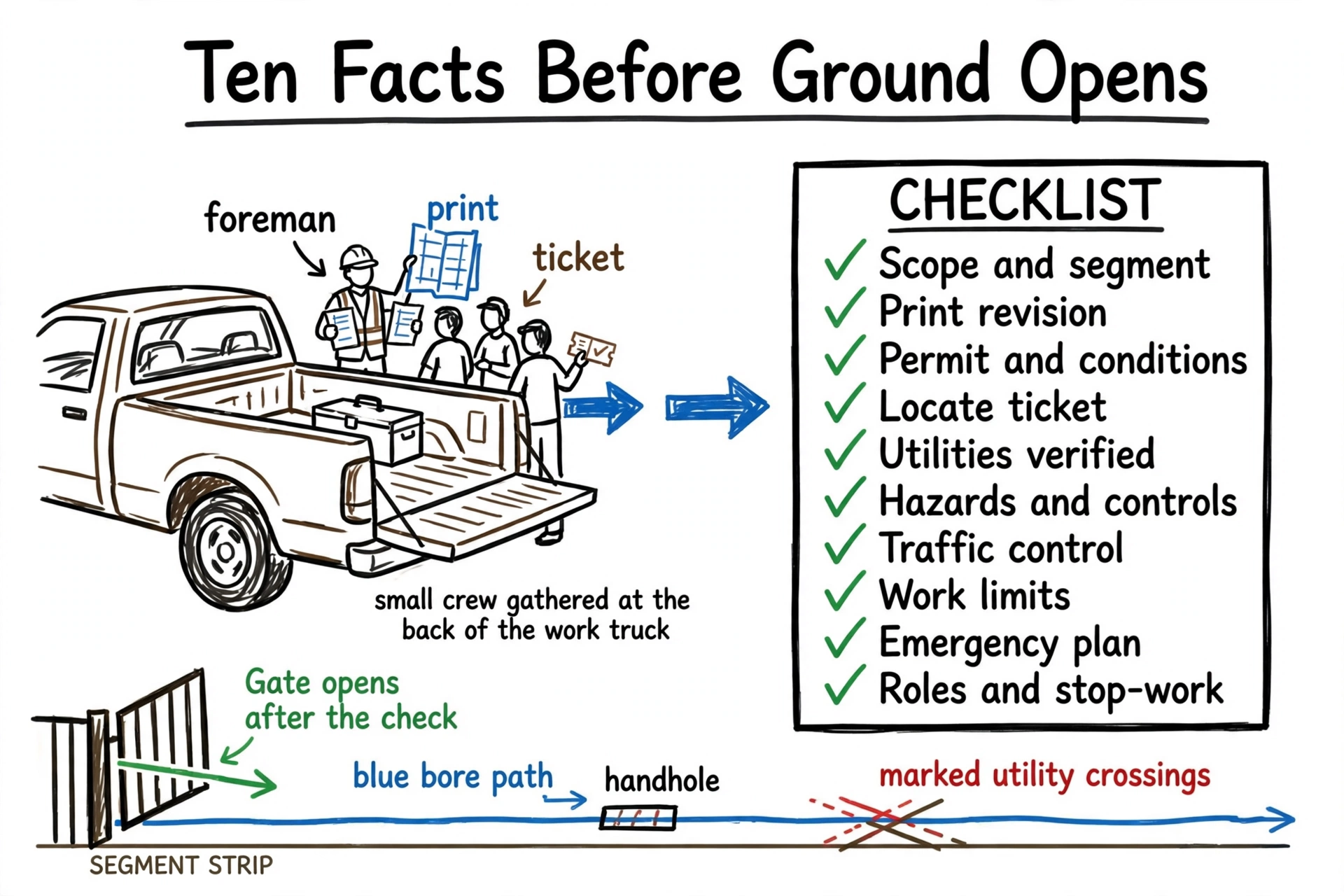
Crew knowledge before starting is a verified shared picture of ten subjects. Each subject answers a question the crew will face during the shift. A subject counts as known when a named document or a field check supports it, and when the crew heard it in a form each member understood.
The ten subjects are not one federal form. They are the crew-level checklist this program builds from separate duties: federal training and emergency-plan rules, the MUTCD traffic control principles, state one-call law, and the permit and print controls for the project. The employer and the project adopt the checklist as the start-of-work standard for the segment, and the crew treats a failed check as a hold on the work that check governs.
- Scope and segment. Scope is the work the project authorizes for this crew on this day, stated as tasks included and tasks excluded. A segment is one defined piece of the build with a start point, an end point, and a described path between them. The crew knows the segment identifier, the start and end points, the installation method for the day, and the point where the day ends even when the segment continues tomorrow.
- Prints and revision. A print is the construction drawing that shows the designed facility: the path, structures, crossings, and details for the segment. A revision is a numbered or dated update to a print that replaces earlier pages. The crew knows which revision sits in the foreman hands, which pages changed, and where the superseded pages went. A print carried from an earlier revision can show a path the design team already moved.
- Permits and conditions. A permit is the written approval from an issuer that allows described work in a described place. Permit conditions are the enforceable requirements attached to that approval, covered in full in Lesson 125. The crew knows the issuer, the segment the approval covers, the expiration date, and the conditions that touch the day: allowed hours, notice duties, inspection hold points, and restoration duties.
- Locate status. A locate request is the notice an excavator sends through the state one-call center, reached nationally by dialing 811, asking utility owners to mark underground facilities in the work area. A locate ticket is the record of that request, with its dates and its list of notified utilities. Positive response is the system a utility uses to report its status back, such as marked, clear, or no facilities in the area, where the state system provides one. The crew knows the ticket covers the ground the crew will open, the ticket dates remain current, and every notified utility has responded or has been followed up through the one-call process the state prescribes.
- Existing utilities verified. Marks show an approximate horizontal location. Verification in this lesson means confirming a facility position by a careful exposure method the state law and the project documents allow, such as hand digging or vacuum excavation, before powered equipment works near the facility. The industry word for a small careful exposure dug to confirm a facility is a pothole. The crew knows which marked facilities cross or run beside the path, which ones the plan verifies by exposure, and which ones remain unverified when work starts near them.
- Hazards and controls. A hazard is a condition or activity that can injure a person, damage a facility, or harm property. A control is a measure that removes a hazard, separates people from a hazard, changes the method, or protects people who remain near a hazard. Personal protective equipment, shortened to PPE, is gear a person wears for protection, such as head, eye, and high visibility protection where the job requires it. Federal construction rules require the employer to instruct each employee in recognizing and avoiding unsafe conditions and in the rules that apply to the work environment, under 29 CFR 1926.21(b)(2). The crew knows the hazards for the specific ground and tasks ahead, the control assigned to each hazard, and the PPE the day requires. Where hazardous chemicals sit on site, the federal hazard communication rule for construction at 29 CFR 1926.59, which applies the standard at 29 CFR 1910.1200 to construction work, requires the employer to provide information and training on those chemicals, including where the written program and the safety data sheets, shortened to SDS, can be found.
- Traffic control. Temporary traffic control, shortened to TTC, is the set of signs, devices, and people that guide vehicles, bicycles, and pedestrians through or around a work area. An approved traffic control plan shows that setup for a location where the permit or the project requires an approved plan. Part 6 of the Manual on Uniform Traffic Control Devices, shortened to MUTCD, sets the national framework, and its fundamental principles state that a TTC plan, in detail appropriate to the complexity of the work project or incident, should be prepared and understood by all responsible parties before the site is occupied. The crew knows the setup for the day, who sets and checks the devices, and which crew member holds flagging duty where flagging applies, with the training that duty requires.
- Work limits. Work limits are the boundaries inside which work, access, staging, parking, and storage may occur on the segment, covered as a subject in Lesson 126 and again in Lesson 141. The crew knows the lateral limits, the allowed access points, where spoil and material may sit, and which ground stays off limits, such as private property outside the authorized area or an environmental exclusion the permit names.
- Emergency plan and contacts. An emergency action plan is the plan, kept in writing at the workplace unless the employer has 10 or fewer employees and communicates it orally, that tells the crew how to report an emergency, how to evacuate and which routes to use, what employees who must operate critical operations do before they evacuate, how the crew accounts for every person after evacuation, who performs rescue or medical duties where the plan assigns them, and the name or job title of the person to contact for more information about the plan. When a federal standard requires an emergency action plan for construction work, 29 CFR 1926.35 sets its required elements. The general industry rule at 29 CFR 1910.38 lists the same core elements and applies in general industry when a Part 1910 standard requires a plan. A related construction rule at 29 CFR 1926.50 requires provisions for prompt medical attention to be made before the project starts, first aid supplies that stay accessible, and a way to transport an injured person or reach ambulance service. The crew knows the reporting method and the contact names the plan lists, and it knows the project details the plan adds for this segment: the assembly point where the crew accounts for every person, the site address or location description a caller gives a dispatcher, and the first aid supplies location.
- Roles and stop-work authority. A role is the task set and responsibility assigned to one crew member for the shift. A competent person is a person the employer designates who can identify existing and predictable hazards in the surroundings or working conditions and who holds authorization to take prompt corrective action, under the definition at 29 CFR 1926.32(f). Federal rules at 29 CFR 1926.20(b)(2) require the employer accident prevention program to provide for frequent and regular inspections of the job site, materials, and equipment by competent persons the employer designates. Stop-work authority on this project is the standing permission the employer and the project give every crew member to pause the affected work and raise a concern when a condition looks unsafe or unauthorized, with that work staying paused until a person with authority addresses the concern. Federal rules give specific halt and correction authority to specific roles, including the competent person under 29 CFR 1926.32(f) and the person responsible for temporary traffic control under the MUTCD. The any-member pause in this lesson is the project rule the crew works under, and it sits on top of those role authorities. The crew knows who leads, who the competent person is for the tasks that require one, who calls for help, and that any member can call a pause.
Two rules govern the whole list. Knowledge must be current: a fact from last week segment, last month ticket, or an earlier print revision describes a different job. Knowledge must be shared: a fact that lives only in the foreman notebook protects nobody standing at the bore pit.
What Does It Look Like?
A crew that knows before starting leaves visible traces before any ground opens:
- A short gathering at the start of the shift where the foreman works through scope, hazards, and the emergency steps, and crew members ask questions and repeat back their tasks.
- The current print open at the segment, with the revision marked, and superseded pages removed from the field set.
- The permit package or a site copy present where the permit conditions require one, with the expiration date and hold points the foreman can point to.
- The locate ticket for the segment in hand, with the notified utility list checked against responses, and paint and flags on the ground matching the ticket area.
- Marked facilities inside the work area in the APWA uniform colors, with white marking showing the proposed excavation area where the state process uses white lining.
- Verification exposures planned or completed at the crossings the plan names, with the exposed facility position noted against the print.
- Traffic devices staged to the traffic control plan for the location, with signs and cones ready before the work area opens to traffic exposure.
- Work limit edges visible in the field: the crew can point to where work may go, where equipment may set up, and where staging and spoil may sit.
- The emergency facts posted or carried where the crew can reach them: reporting method, assembly point, site location description, and contact names.
- Each crew member able to answer three questions without hesitation: what am I building today, what can hurt me or the public here, and what do I do first when something goes wrong.
Field appearance also shows gaps. A crew that cannot produce the ticket, holds a print nobody can date, or splits on the answer to where the segment ends carries a preparation gap that a supervisor can spot in minutes.
What Does It Do?
It turns documents into shared direction. A permit, a print, and a ticket each answer a different question. Crew knowledge joins the three answers at the point of work. The print says where the design goes. The permit says whether the work may occupy the ground and under which conditions. The ticket and the marks say which existing facilities share the ground. A member who holds all three answers makes field choices that agree with the project. A member who holds one answer guesses at the other two.
It places hazard recognition before exposure. Federal training duties point the same direction. Section 1926.21(b)(2) requires instruction in recognizing and avoiding unsafe conditions tied to the work environment. A pre-start review names the hazard while the crew can still change the method, add a control, move a setup, or resequence a task on paper. The same hazard named after exposure leaves the crew managing an event rather than preventing one.
It protects existing facilities. Section 1926.651(b) requires the estimated location of underground installations to be determined before an excavation opens, utility owners to be contacted and asked to establish locations, and the exact location to be determined by safe and acceptable means when excavation approaches the estimated location. Crew knowledge carries that sequence to the ground: ticket checked, responses confirmed, marks respected, tolerance zone observed, and verification completed before powered work near a facility. A tolerance zone is the band on each side of a marked facility where state law requires careful exposure methods. State law sets the width, so the crew reads the width from the state rule and the ticket instructions for the job in hand.
It keeps work inside its authorization. Scope, limits, and permit conditions describe the work the issuer and the owner approved. A crew that knows those boundaries notices drift early: a pit creeping outside the limits, a staging pile growing onto private ground, a task added in the field that the scope never included. Early notice keeps a small correction small.
It makes the emergency response fast. An emergency compresses decision time. A crew that already knows the reporting method, the assembly point, and the site location description spends the first minutes helping rather than searching. Section 1926.50(b) requires provisions for prompt medical attention to be made before the project commences, and crew knowledge is how those provisions reach the people who will use them.
It gives stop-work authority a factual base. A pause call works when the crew shares the facts the pause protects. A member who knows the ticket expired, the revision changed, or the mark sits inside the bore path can name the fact, and the crew can check the fact together. Shared facts turn a pause from an argument into a verification step.
Where Does It Fit?
Crew knowledge sits after project level preparation and before the first production task, and the crew renews it whenever the job changes.
- At the preconstruction meeting in Lesson 128, project leaders align on scope, documents, and responsibilities. That meeting produces facts the crew still needs in field form.
- During mobilization, the foreman assembles the field set: current print, permit package, locate ticket, traffic control plan, and emergency contacts for the segment.
- At the start of the shift, the crew reviews the ten subjects together. Lesson 130 covers the job briefing as its own subject. This lesson defines the content that briefing and every other start of shift check must cover.
- Lessons 131 through 143 then test each preparation subject one at a time: prints in Lesson 131, permits in Lesson 132, locates in Lesson 133, verification of existing utilities in Lesson 134, materials and equipment in Lessons 135 and 136, setup and staging in Lessons 137 and 138, traffic control in Lesson 139, environmental controls in Lesson 140, work limits in Lesson 141, the emergency plan in Lesson 142, and overall readiness in Lesson 143.
- During the shift, new facts reopen the review: a changed condition, a new crew member, a moved work area, a utility found where no mark sat, or a revised page arriving midday. The crew updates the shared picture before the affected work continues.
- At handoff to the next shift or the next crew, the shared picture travels with the segment: work completed, verifications done, open questions, and any conflict waiting on written direction.
Crew knowledge also sits beside competence. A crew can know the facts for a segment and still lack a person qualified for a regulated task inside that segment. Knowledge tells the crew what the job holds. Qualification decides who may perform each part of the job.
What Is at Stake
Life and health. Traffic exposure, excavation near existing utilities, equipment movement, and hazardous materials each carry injury risk. A hazard the crew never named has no assigned control, and a control nobody heard about protects nobody. The pre-start review is the last cheap moment to attach a control to a hazard.
Existing utility damage. A strike on a gas, electric, water, or communication facility can injure people, cut service to a neighborhood, and create repair and liability costs that dwarf the segment value. Locate status, tolerance zone discipline, and verification exist to prevent the strike. Skipping the crew level check removes the final review before the machine reaches the facility.
The authorization to build. Work outside the permit conditions, outside the work limits, or beyond the approved scope sits outside the approval. Consequences can include correction, stoppage, restoration duties, and the remedies the approval and its rules describe. A crew that knows the boundaries rarely crosses them by accident.
Schedule and cost. A missing notice, an expired ticket, a superseded print, or a hold point discovered late stops a crew that already mobilized. Each stop burns labor, equipment time, and traffic control time. Ten minutes of shared review at the start protects the production hours that follow.
Records and trust. What the crew knows and checks gets recorded: briefing attendance where the employer keeps it, ticket numbers, verification notes, and inspection results where the governing rule or project document requires them. Those records show an owner, an issuer, or an investigator that preparation happened before production.
New and transferred crew members. A member who joins at midday or transfers from another segment carries facts from a different job. Without an update to the shared picture, that member works to the wrong scope, the wrong limits, or the wrong emergency steps with complete confidence.
What Does Good Look Like?
- Every crew member can state the segment, the start and end points, the method for the day, and where the day ends.
- The field print carries a current revision the foreman can name, and no superseded page remains in the field set.
- The permit package for the segment sits in the job file, the expiration date sits in the future, and the foreman can state the conditions that touch the day.
- The locate ticket covers the ground the crew will open, the ticket remains current, and every notified utility shows a response or a documented follow up through the state process.
- The crew can name each marked facility in the work area, state the tolerance zone rule from the state instructions for the job, and point to the verifications completed or planned before powered work nearby.
- Hazards for the day are named with a control for each one, required PPE is on hand and worn, and SDS access is known where chemicals sit on site.
- Traffic control for the location matches the traffic control plan, and the crew knows who sets, checks, and flags.
- The crew can walk the work limits, the access points, and the staging and spoil areas without disagreement.
- Every member knows the emergency reporting method, the assembly point, the site location description, the first aid supplies location, and the contact names.
- Every member can name the foreman, name the competent person where the work requires one, and describe how to call a pause and who resolves it.
From the Field
Picture a three person underground crew starting a segment that runs along a county road shoulder and crosses two marked facilities before reaching a handhole. The foreman opens the shift at the truck with the print, the permit package, and the locate ticket. The crew walks the ten subjects in order, and each member states a task for the day.
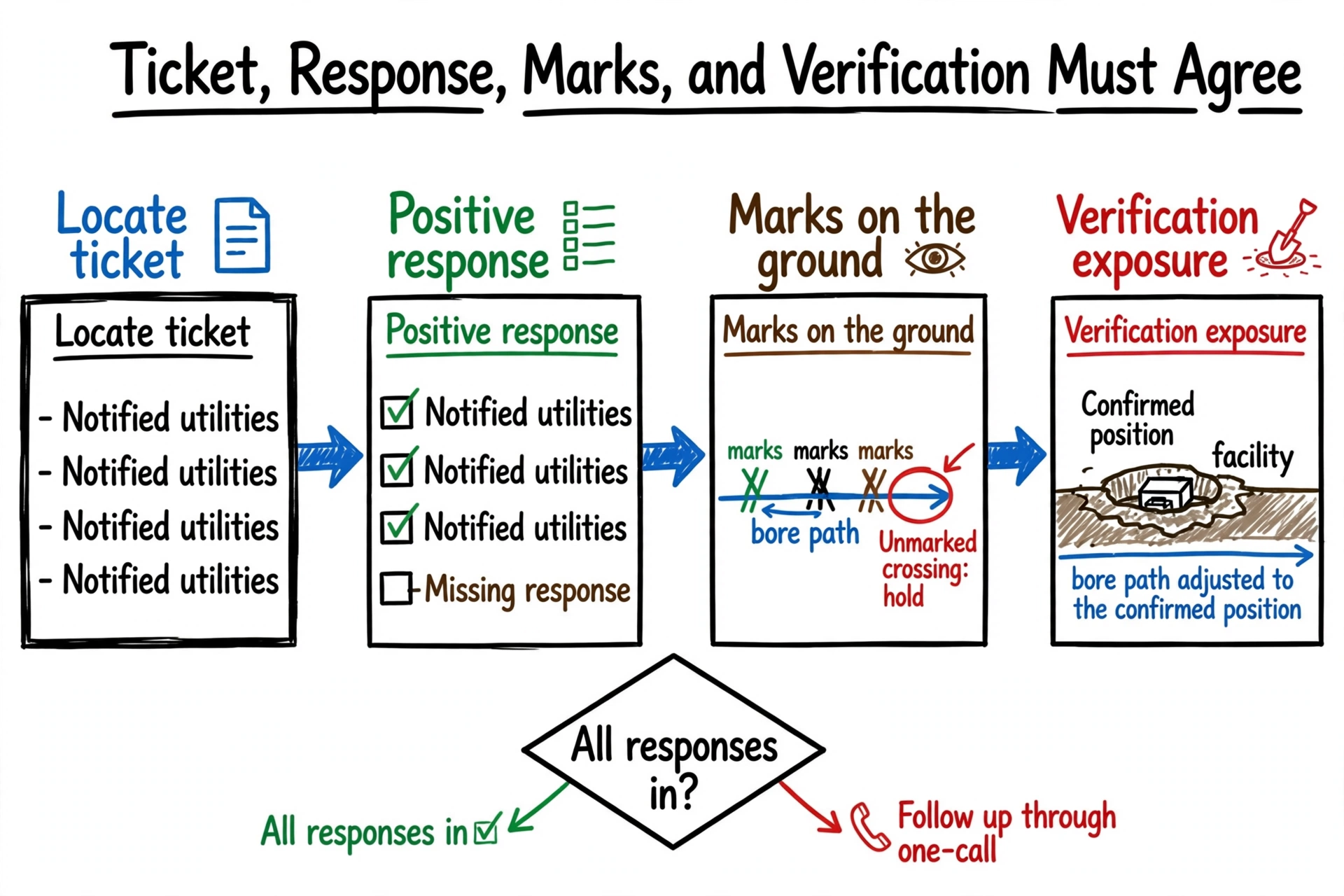
The locate check slows the group down. The ticket lists four notified utilities. Positive response shows three utilities marked or clear. The fourth utility, a communication line that the print shows crossing the bore path, shows no response in the system the state provides. Paint on the ground matches that gap: three sets of marks appear, and the crossing area carries no orange marks where the print suggests a line may run.
One crew member proposes starting the bore and watching carefully at the crossing, since the other three utilities responded and the schedule for the day is full. The foreman holds the ground disturbing work at the crossing. The crew resequences the morning instead: traffic control goes in to the plan, the handhole excavation outside the crossing area gets prepared where the responded locates cover the ground, and material staging moves inside the work limits.
The foreman contacts the one-call center through the process the state prescribes and reports the missing response for follow up with the utility. The crew treats the unmarked crossing as occupied ground. State damage-prevention law for the job governs what a missing response allows, and on this segment the print shows a facility crossing the bore path, so the crew holds ground-disturbing work at the crossing, follows up through the state one-call process, and resumes there only when the utility marks the facility or reports clear through the system, or when the state process for a non-response and the project documents both clear that ground in writing. Nobody guesses a depth or a clear path from the print alone, since the print shows design intent and a locate response reports the facility owner status for the actual ground.
Later in the shift the utility locator marks the communication line across the bore path, offset from the line the print suggested. The crew adjusts the bore plan to the marked position, observes the tolerance zone the state instructions set for the job, and plans verification exposure at the crossing before the bore reaches the facility.
The decision rule is direct: before starting, the crew confirms every subject on the list with a document or a field check, and any subject that fails its check holds the work that subject governs while work the check clears continues inside its own limits.
What Can Go Wrong?
Starting on scope from memory. A crew that worked a similar segment last week carries last week limits, methods, and end points in mind. Memory describes a different job. The current segment scope lives in the current documents.
Building from a superseded print. A revision moves a structure, a crossing, or a path. A field set that keeps old pages beside new pages invites the crew to build the version a member happens to grab. The fix is a clean field set with superseded pages removed at the start.
Treating a filed permit as a known permit. A permit package can sit complete in the job file while no crew member can state its hours, hold points, or expiration date. Filing completes storage. Briefing completes knowledge. The conditions bind the work either way, as Lesson 125 teaches.
Reading marks as a complete locate check. Paint shows where locators marked facilities. Paint alone does not show whether every notified utility responded, whether the ticket still covers the date and the ground, or whether a private facility sits outside the one-call system. The ticket, the response record, and the ground must agree before excavation starts.
Skipping verification near a marked facility. Marks give an approximate horizontal location and give no depth the crew can rely on for powered excavation inside the tolerance zone. A crew that treats the paint line as the exact facility position risks a strike at the moment the machine reaches the real position.
Naming hazards in general words. A warning to be careful around traffic or to watch out underground assigns no control to any specific hazard. A hazard named with its location, its task, and its control changes behavior. A general warning changes nothing a member can act on.
Setting traffic control from habit. A setup that worked on a quiet street can fail the plan for a busier road, a school frontage, or a different lane pattern. The MUTCD principle controls here: the plan for this location, understood before the site is occupied, governs the setup for this location.
Learning the emergency plan during the emergency. A crew that first hears the assembly point, the site address, or the reporting method after an injury spends critical minutes searching and asking. Section 1926.50 requires provisions made before the project starts. Crew knowledge delivers those provisions to the people on the ground.
Silence about stop-work authority. A member who spots an expired ticket, an unmarked facility, or a condition outside the limits and stays quiet removes the protection the authority exists to provide. A pause that nobody calls protects nobody, and a culture that punishes pause calls teaches silence.
Adding a new member without an update. A member who arrives mid-shift and goes straight to a task works from assumption. The segment facts take minutes to transfer, and the transfer must happen before the task, every time membership changes.
What Should Someone Notice in the Field?
- State the scope and segment aloud: tasks included, tasks excluded, start point, end point, method, and the stopping point for the day.
- Open the field print, name its revision, and confirm superseded pages are out of the field set.
- Open the permit package, name the issuer and expiration date, and list the conditions that touch the day, including hours, notices, and hold points.
- Hold the locate ticket for the exact ground to open, confirm the ticket dates cover the day, and check every notified utility for a marked or clear response, with follow up through the state process for any missing response.
- Walk the marks, name each facility in the work area by its marks and the ticket, and note any facility the print shows that carries no mark.
- State the tolerance zone rule from the state instructions for the job, and confirm which facilities get verification exposure before powered work nearby and which exposures are already complete.
- Name the hazards for the specific tasks and ground ahead, the control for each hazard, and the PPE and SDS access the day requires.
- Compare the traffic control in place against the traffic control plan for the location, and name who sets, checks, and flags.
- Walk the work limits, access points, staging areas, and spoil areas, and flag any setup that sits outside them.
- Recite the emergency steps: reporting method, assembly point, site location description for a dispatcher, first aid supplies location, and the contact names on the plan.
- Name the foreman, name the competent person where the work requires one, and confirm every member knows how to call a pause and who resolves it.
- Know the boundary: reviewing facts, checking documents, walking marks, and reporting a gap are recognition and support tasks. Only qualified and authorized people may perform excavation, boring, traffic control setup and flagging, electrical work, and other regulated or hazardous duties the segment includes, and only a competent person designated by the employer may carry the inspection and corrective duties that role holds. Reading this lesson qualifies no one to perform regulated or hazardous work.
Key Terms
Scope: The work authorized for a crew on a segment and day, stated as tasks included and tasks excluded.
Segment: One defined piece of a build with a start point, an end point, and a described path between them.
Print: The construction drawing that shows the designed facility, its path, structures, crossings, and details.
Revision: A numbered or dated update to a print that replaces earlier pages.
Locate ticket: The record of a locate request through the one-call center, listing the work area, the dates, and the utilities notified.
Positive response: The system a utility uses to report its locate status back, such as marked or clear, where the state system provides one.
Tolerance zone: The band on each side of a marked facility, set by state law, where careful exposure methods are required before and during work near the facility.
Verification: Confirming a facility position by a careful exposure method allowed by state law and project documents before powered equipment works near the facility.
Competent person: A person designated by the employer who can identify existing and predictable hazards in the surroundings or working conditions and who holds authorization to take prompt corrective action.
Emergency action plan: The plan, kept in writing at the workplace unless the employer has 10 or fewer employees and communicates it orally, that tells a crew how to report an emergency, how to evacuate and which routes to use, what employees who must operate critical operations do before they evacuate, how the crew accounts for every person after evacuation, who performs rescue or medical duties where the plan assigns them, and the name or job title of the person to contact for more information about the plan.
Stop-work authority: The standing permission the employer and the project give any crew member to pause the affected work and raise a concern when a condition looks unsafe, and to stop and escalate to the foreman before continuing when work appears to sit outside the permit, the print, or the work limits. Safety pauses stay in place until a person with authority addresses the concern. The duty to pause for an unsafe condition and the procedure for an out-of-authorization concern come from the employer program and the project documents for the job, which the crew confirms at the start of the segment.
Traffic control plan: A plan showing how vehicles, bicycles, and pedestrians will be guided through or around a work area, approved where the permit or project requires approval.
Check Your Understanding
- Name five of the ten subjects a crew must know before starting, and state the question each one answers.
Answer: Any five: scope and segment answers what work and where the piece begins and ends; prints and revision answers which drawing version controls; permits and conditions answers whether the work may occupy the ground and under which requirements; locate status answers whether the one-call process covers the ground and every notified utility responded; existing utilities verified answers which facilities were confirmed by careful exposure; hazards and controls answers what can cause harm and which measure addresses each hazard; traffic control answers how road users and the crew get protected at the location; work limits answers where work, access, and staging may occur; emergency plan and contacts answers what happens first when something goes wrong; roles and stop-work authority answers who leads, who inspects, and how any member pauses work.
- What does 29 CFR 1926.651(b) require before and during excavation near underground installations?
Answer: The estimated location of underground installations must be determined before an excavation opens. Utility owners must be contacted within established or customary local response times and asked to establish the location of their installations. When excavation approaches the estimated location, the exact location must be determined by safe and acceptable means. While the excavation is open, underground installations must be protected, supported, or removed as necessary to safeguard employees. Section 1926.651(b)(2) also addresses a utility that cannot respond in time or cannot establish the exact location, allowing the employer to proceed only with caution and with detection equipment or other acceptable means used to locate the installations, subject to any longer period state or local law requires.
- A foreman holds a complete permit package in the job file and a current print. No crew member can state the permit expiration date, the allowed hours, or the hold point for the segment. Evaluate the crew readiness on the permit subject.
Answer: The crew fails the permit subject. Filing completes storage, and briefing completes knowledge. Permit conditions bind the work whether or not the crew read them, and a hold point or expiration date the crew cannot state cannot shape the sequence. The foreman reviews the conditions that touch the day with the crew before work starts.
- In the From the Field scenario, which subject failed its check, how did the crew spot the failure, and what did the foreman hold and allow?
Answer: Locate status failed its check. The crew spotted the failure by comparing the ticket and positive response record against the ground: four utilities were notified, three responded, and the communication line crossing the bore path showed no response and no marks where the print suggested a line. The foreman held ground disturbing work at the unmarked crossing and followed up through the state one-call process, while allowing work the check cleared: traffic control setup to the plan, handhole preparation where responded locates covered the ground, and staging inside the work limits.
- A crew member notices the locate ticket dates ended yesterday. The foreman says the marks still look fresh and the crew should finish the last bore today. What should happen?
Answer: Ground disturbing work pauses until a current ticket covers the ground through the state process. Fresh looking paint does not extend a ticket, and only the process the state prescribes can renew the locate status. The crew reports the gap, requests the update, and resequences to work that opens no ground until the current ticket and responses are in hand.
Lesson Takeaway
A segment starts well when every crew member holds the same verified facts: scope, current print, permit conditions, locate status, verified facilities, hazards and controls, traffic control, work limits, emergency steps, and roles with stop-work authority. After this lesson, a start of shift reads as a check of ten subjects against documents and ground, with any failed check holding the work that subject governs.
Sources and Technical References
Occupational Safety and Health Administration, 29 CFR 1926.20, General safety and health provisions, including accident prevention responsibilities at paragraph (b), requiring the employer to initiate and maintain a safety program and providing for frequent and regular inspections of job sites, materials, and equipment by competent persons designated by the employer: https://www.osha.gov/laws-regs/regulations/standardnumber/1926/1926.20
Occupational Safety and Health Administration, 29 CFR 1926.21, Safety training and education, including the employer duty at paragraph (b)(2) to instruct each employee in recognition and avoidance of unsafe conditions and the regulations applicable to the work environment: https://www.osha.gov/laws-regs/regulations/standardnumber/1926/1926.21
Occupational Safety and Health Administration, Clarification of Competent and Qualified Person as it relates to Subpart P, February 21, 1986, restating the definition at 29 CFR 1926.32(f): a competent person can identify existing and predictable hazards in the surroundings or working conditions and holds authorization to take prompt corrective measures, and distinguishing a qualified person under 29 CFR 1926.32: https://www.osha.gov/laws-regs/standardinterpretations/1986-02-21
Occupational Safety and Health Administration, 29 CFR 1926.50, Medical services and first aid, requiring availability of medical personnel for advice and consultation, provisions made prior to commencement of the project for prompt medical attention in case of serious injury, a person with a valid first aid certificate available at the worksite where no infirmary, clinic, hospital, or physician is reasonably accessible, first aid supplies that stay easily accessible in a weatherproof container and get checked before each job and at least weekly, and proper equipment for prompt transportation or a communication system for contacting ambulance service: https://www.osha.gov/laws-regs/regulations/standardnumber/1926/1926.50
Federal regulation, 29 CFR 1910.38, Emergency action plans, listing the minimum elements used in this lesson for reporting, evacuation, accounting for employees after evacuation, rescue and medical duties, and contact names, with the construction counterpart at 29 CFR 1926.35: https://www.govinfo.gov/content/pkg/CFR-2024-title29-vol5/pdf/CFR-2024-title29-vol5-sec1910-38.pdf
Occupational Safety and Health Administration, Emergency Preparedness and Response: Getting Started, summarizing emergency action plan requirements across general industry at 29 CFR 1910.38 and construction at 29 CFR 1926.35, including reporting procedures, escape procedures and route assignments, procedures to account for all workers after evacuation, and contact names, titles, and telephone numbers: https://www.osha.gov/emergency-preparedness/getting-started
Occupational Safety and Health Administration, Hazard Communication standards, 29 CFR 1926.59 and 29 CFR 1910.1200, requiring employers to provide information and training on hazardous chemicals in the work area, including the requirements of the standard, operations where hazardous chemicals are present, and the location and availability of the written hazard communication program, the list of hazardous chemicals, and safety data sheets. Section 1926.59 provides that the requirements applicable to construction work are identical to those at 1910.1200: https://www.osha.gov/laws-regs/regulations/standardnumber/1910/1910.1200
Secondary training summary: Underground Utilities and 811 training summary based on OSHA 29 CFR 1926 Subpart P, covering 29 CFR 1926.651(b) duties to determine the estimated location of underground installations before opening an excavation, contact utility owners, and determine the exact location by safe and acceptable means when excavation approaches, plus the 811 process, white lining, positive response, private lines, APWA uniform color code, and the tolerance zone concept with hand tools or vacuum excavation and potholing inside the zone. Positive response, ticket life, private facilities, and tolerance zone widths rest on state one-call law and state guides for the job in hand, and state law sets waiting periods and tolerance zone widths for the job in hand: https://www.excavationtrenchingshoring.com/free-training/underground-utilities-811/
American Public Works Association, Uniform Temporary Marking guide, stating the APWA Uniform Color Code for temporary marking of underground facilities, including orange for communication lines and white for proposed excavation: https://www.apwa.org/wp-content/uploads/APWA-Guide_UniformTempMarkingsNEW-V1-02-25-22.pdf
Federal regulation, 29 CFR 1926.651, Specific excavation requirements, including the paragraph (b) duties to determine the estimated location of underground installations before opening an excavation, contact utility companies or owners, determine the exact location by safe and acceptable means when excavation approaches the estimated location, and protect, support, or remove installations as necessary while the excavation is open: https://www.law.cornell.edu/cfr/text/29/1926.651
Federal Highway Administration, Manual on Uniform Traffic Control Devices, Chapter 6B, Fundamental Principles of Temporary Traffic Control, stating that a TTC plan in detail appropriate to the complexity of the work project or incident should be prepared and understood by all responsible parties before the site is occupied, that changes to the plan should be approved by an official knowledgeable in proper TTC practices, that persons whose actions affect TTC zone safety should receive training appropriate to the decisions each person must make, and that the individual responsible for TTC should hold authority to halt work until remedial safety measures are taken: https://mutcd.fhwa.dot.gov/htm/2009r1r2/part6/part6b.htm
Previous lesson: Lesson 128: What Is a Preconstruction Meeting? |
Back to Level 7 hub |
Next lesson: Lesson 130: What Is a Job Briefing?