
Introduction
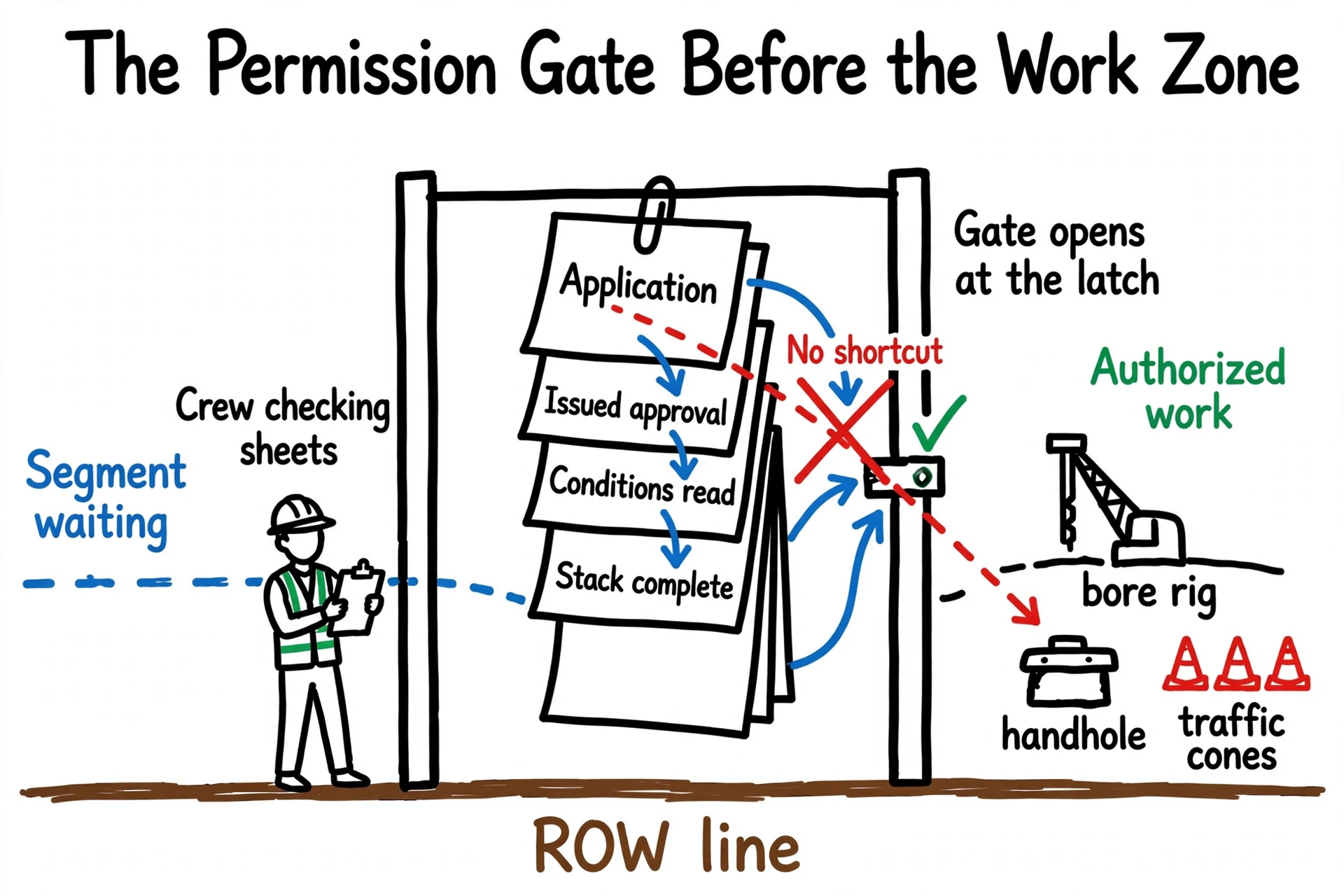
Permission before construction means the written approval for described work in a described place exists, is in force, and has been read before a crew enters the ground, occupies the space, or changes the site. An application filed, a verbal assurance given, and an approval expected next week each describe a different state from an approval issued. Only the issued approval authorizes the work it describes.
Level 6 built this subject one permission at a time: public right of way, private property, easements, municipal and state DOT approvals, railroad and crossing approvals, environmental approvals, pole attachment rights, permit conditions, and work limits. This closing lesson puts the sequence itself under study, because the order carries legal and practical weight. Review first, then build, is the mechanism that lets every earlier lesson in this level do its work.
What This Lesson Gives You
- State, for any segment, whether the segment is authorized to start, using the issued approval rather than the application, the schedule, or a verbal assurance.
- Lay out the full permission stack for a segment and name every separate approval, consent, agreement, and verification the segment needs before ground opens.
- Explain what a preconstruction review can still change on paper, and why that same change costs removal, exposure, or rework once the facility sits in the ground.
- Separate a permission from a permission-adjacent step, including the 811 locate ticket, and state what each document does and does not authorize.
- Apply the hold decision when one segment in a multi-segment job lacks permission: build the authorized work, hold the unauthorized work, and route the gap to the issuer.
Start With the Basics
Think about renting an apartment. A signed lease names the tenant, the unit, the term, and the rules for using the space. The key changes hands after the lease is signed. A person who moves furniture into the unit before signing holds no right to be there, even when the landlord has said the application looks strong and approval seems likely. The signed lease creates the right to occupy. The friendly conversation predicts a right. The two states differ, and the difference decides whether the occupant belongs in the unit or must leave it.
Fiber construction on ground the builder does not own works on the same mechanism. A right of way, shortened to ROW, is land set aside for transportation or utility use. An issuer is the agency, owner, or authority that grants an approval and sets its terms. A permittee is the person, company, or agency named on an approval as the party receiving the permission and accepting its conditions. The application and the preconstruction conversation match the rental conversation. The issued approval matches the signed lease. Ground disturbance, occupancy, staging, and attachment each begin only after the document that authorizes that act exists and covers that act.
A second, shorter picture helps with timing. A starting gate at a race opens for every runner at the same signal, and a runner who leaves early gets called back even when the runner finishes well. Permission works as that signal for a segment. Good workmanship after an early start answers a quality question. The early start itself answers an authorization question, and the authorization question gets asked first.
What Is It?
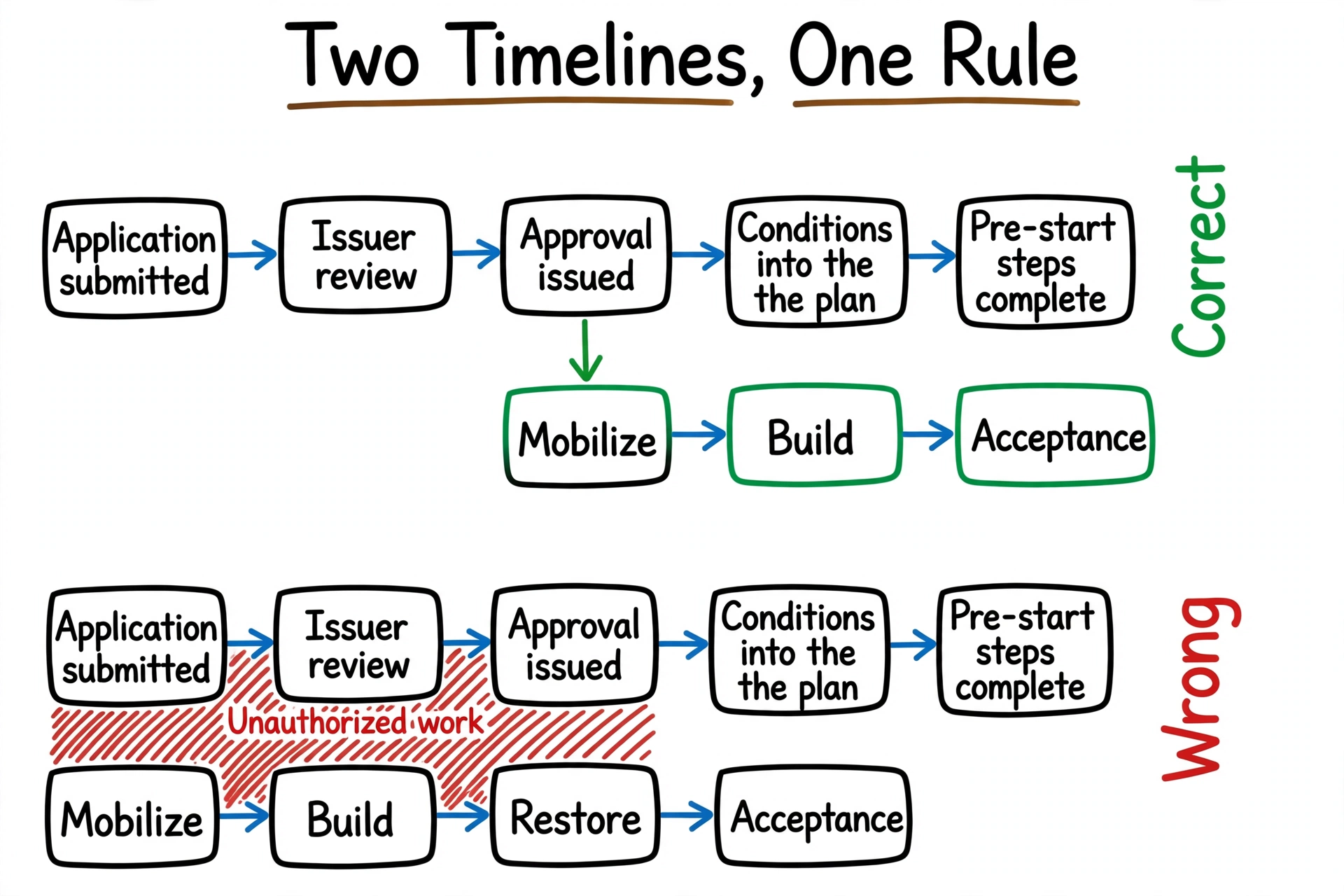
Permission before construction is a sequence and a state. As a sequence, the steps run in a fixed order: propose the work, submit the proposal to each authority whose ground, facility, or regulated resource the work touches, let each authority review the proposal against the rules that authority enforces, receive each written approval with its conditions, read the full package, convert the conditions into the segment plan, complete every separate pre-start step the approvals and the law require, and only then mobilize. As a state, the segment sits in one of two conditions at any moment. The segment is authorized, because every required approval covering the planned act exists and remains in force. The segment is unauthorized, because at least one required approval is missing, pending, expired, denied, or written for different work, a different place, or a different party.
Federal regulation states the before requirement plainly for highway ROW. Section 645.211(d) provides that all utility installations made on highway ROW shall be subject to written approval by the state transportation department, with a narrow carve-out where the use and occupancy agreement itself provides otherwise for matters such as facility maintenance, service connections on highways other than freeways, or emergency operations. A use and occupancy agreement is the document (a written agreement or permit) by which the state transportation department approves the use and occupancy of highway ROW by a utility facility or a private line, setting the terms under which the utility may cross or otherwise occupy the ROW. A utility accommodation policy is the state written policy that controls how utilities may use highway ROW. Iowa states the same order in its own accommodation rule: a utility facility owner shall not place facilities in, on, above, or below the primary highway ROW, attach facilities to a primary highway structure, or adjust existing facilities occupying the ROW without first obtaining permission from the department, and that permission takes the form of a utility accommodation permit issued to the facility owner. Iowa adds that an agreement by itself does not constitute a permit and does not grant permission to occupy, and the facility owner is responsible for obtaining a permit prior to commencing work within the ROW.
The permission for one segment is usually a stack, and each layer answers to a different authority:
- ROW occupancy approval. The city, county, or state authority that controls the ROW grants the right to occupy that ROW for described work, under a municipal approval, a DOT approval, or a similar instrument from the controlling authority.
- Private property right. An easement is a legal right to use a defined portion of another party’s land for a stated purpose, within the boundaries and terms of the document or other legal basis that creates it. The easement a fiber segment relies on should be a written instrument in the job file, recorded where the parties record it. Work on private land outside a public ROW needs the property right that covers the entry and the installation, such as an easement or a written consent from the party holding the right to grant it.
- Railroad and crossing permission. Work on railroad property or across a railroad follows the railroad agreement or crossing approval for that crossing, covered in Lessons 121 and 122.
- Environmental authorization. Work in regulated waters or wetlands follows the environmental approval or verification for that footprint, covered in Lesson 123. Where a Nationwide Permit, shortened to NWP, requires a pre-construction notification, shortened to PCN, the prospective permittee submits the notification and does not begin construction until either the Corps notifies the permittee in writing that the activity may proceed, or 45 days have passed after the Corps received the complete notification without written notice from the Corps. Where notice was required for endangered species or historic properties, where a waiver is required, or where the Corps requires an individual permit, the activity does not begin until the written notice or permit that requirement calls for has been received.
- Pole attachment right. Attaching to a pole follows the attachment agreement and any make-ready process the pole owner requires, covered in Lesson 124. A ROW approval covering the street grants no right to attach to a pole standing in that street.
- Conditions and work limits. Permit conditions are the enforceable requirements attached to an approval, covered in Lesson 125. Work limits are the boundaries of place, time, method, and activity inside which the approval authorizes work, covered in Lesson 126. Both belong to the approval itself, and both get read before mobilization.
One layer never substitutes for another layer, because each authority controls a different interest. A city can authorize occupancy of city ROW. A city holds no power to grant an easement over private land, waive a railroad agreement, verify an environmental authorization, or grant attachment rights on a pole the city does not own. The stack is complete only when every layer the segment touches exists in writing.
Permission also has a time edge at both ends. An approval pending is an approval missing, and work performed during the pending window sits outside any authorization. An approval expired has ended under its own terms, and work performed after expiration sits in the same unauthorized state until the issuer renews or reissues the approval through its process. Section 645.211(c)(5) adds the review edge: a state transportation department may deny a request to occupy highway ROW based on state law, regulation, ordinance, or department policy. Denial is a real outcome of review, and a schedule built on assumed approval carries that risk openly.
A separate step often gets mistaken for a layer of the stack. 811 is the national three-digit number that reaches the state one-call center, where an excavator files a locate request so member utility operators can mark their underground facilities before digging. State one-call law requires notice before excavation, and the ticket that follows carries its own start window and validity period under state law. The ticket is a damage prevention step. The ticket grants no right to occupy ROW, grants no easement, and satisfies no permit condition unless an approval states otherwise in writing. City programs state the pairing directly: Gunnison, Colorado, requires an approved and signed city ROW permit prior to beginning any excavation in city ROW, and separately requires utility locates under the state dig law through 811. A segment needs both steps, in their own order, and holding one document proves nothing about the other.
What Does It Look Like?
A segment with permission secured before construction has visible, checkable features before the first machine arrives:
- An issued approval package in the job file for the segment, with the approval number, the permittee name, the segment description, the term, and the conditions, matching the work about to start.
- A stack checklist for the segment with every layer marked present: ROW approval, private property right where the alignment leaves public ROW, railroad or crossing approval where tracks are involved, environmental authorization where regulated ground is involved, and attachment agreement where poles are involved.
- Conditions already converted into the segment plan: notices calendared, inspection and witnessing hold points placed, traffic control staged to the approved plan, and access, staging, and storage set inside the work limits.
- A traffic control plan prepared and understood before the site gets occupied. Part 6 of the Manual on Uniform Traffic Control Devices, shortened to MUTCD, carries the temporary traffic control standards, and its planning guidance states that a temporary traffic control plan, in detail appropriate to the complexity of the work, should be prepared and understood by all responsible parties before the site is occupied, and that any changes in the plan should be approved by an official who is knowledgeable (for example, trained and/or certified) in proper TTC practices.
- A valid 811 ticket for the dig area, with marks in the field and the ticket start window open, filed as a damage prevention record beside the approvals rather than in place of an approval.
- A calendar that shows the approval term covering the planned work dates, with renewal steps started early where the schedule runs close to expiration.
A segment missing permission also has visible features, and a trained eye reads them as stop signs:
- An application receipt, a submitted stamp copy, or a tracking number offered as evidence that work may start.
- A verbal assurance from a meeting, a phone call, or a tailgate conversation offered in place of an issued document.
- One approval from the stack presented as though the approval covers the whole segment, while the alignment crosses private land, a railroad, regulated ground, or poles the approval never mentions.
- Equipment staged and a crew briefed for a start date that sits before the approval date or outside the approval term.
- A locate ticket with fresh marks presented as the only pre-start document in the file.
What Does It Do?
It lets review happen while the work still exists on paper. Review is the issuer testing a proposal against law, policy, and the conditions of the ground: location against ROW lines and clear zones, method against the accommodation policy, traffic handling against the traffic control standards, and footprint against environmental limits. On paper, a failed test produces a moved alignment, a changed method, an added condition, or a denial. Each outcome costs edits. In the ground, the same failed test produces a facility in a place the issuer never approved, built by a method the issuer never accepted, and the correction costs excavation, removal, restoration, and a second installation.
It fixes the authorized description before anyone builds to a different one. The issued approval describes the facility, the location, the method, and the limits. Section 645.213 requires the written arrangement to include or incorporate by reference the department standards, a general description of the size, type, nature, and extent of the facility, adequate drawings showing the facility location against the highway and the ROW lines, liability for future adjustment, the action for noncompliance, and other provisions needed for legal compliance. That written description becomes the yardstick for inspection and acceptance. Work built before the description exists gets measured later against a description the builder never saw.
It sequences every dependent step. Notices precede starts. Hold points sit inside the build sequence. Traffic control planning precedes occupancy of the work zone. The environmental verification precedes entry into regulated ground where a PCN is required. The 811 ticket window precedes excavation. Permission first is the master sequence that holds every smaller sequence in place, because each dependent step hangs from an approval that defines where, when, and how the step applies.
It protects the property rights under the alignment. Trespass is entering another party’s land without permission, or causing an object or another person to enter that land without permission. Cornell’s Legal Information Institute states the basic form: trespass to land involves a physical invasion of another party’s real property without permission, and the owner need not prove actual damage for a claim to exist. A crew that trenches, bores under, stages on, or attaches within private land without the covering property right commits the entry the easement process exists to prevent. The bore path counts here: a facility passing under private land occupies that land even when no crew member stands on the surface.
It keeps the public review functions ahead of the public exposure. Traffic passes the work zone from the first hour of occupancy. Drainage, existing utilities, railroad operations, and regulated waters meet the work at the ground, in real time. The permit review is where the controlling authority examines those interfaces in advance and writes conditions for them. Starting before review puts the traveling public, the neighboring facilities, and the regulated resource into an arrangement no authority examined.
It preserves the value of the finished work. An authorized facility, built inside its conditions, can be inspected, accepted, recorded, and maintained under the approval. An unauthorized facility carries its defect forward: the issuer holds the remedies its system provides, the owner holds a record problem, and every later entry for maintenance or adjustment inherits the question of whether the facility belongs there at all.
Where Does It Fit?
Permission sits at the hinge between design and construction, and Level 6 as a whole occupies that hinge:
- During planning and design, the alignment gets drawn and the permission stack gets identified: every authority whose ground, facility, or regulated resource the alignment touches enters the permit list.
- During application, the applicant submits the proposal, drawings, and traffic control material each issuer requires. In the Illinois system, statements and schematics in the application are material conditions of the permit, so accuracy at this stage is a field concern.
- During review, each issuer tests the proposal and may approve, approve with added conditions, request changes, or deny. The construction schedule treats this stage as real time, because review duration belongs to the issuer.
- At issuance, the authorized state begins for the work the approval describes. The permittee reads the full package and converts conditions and work limits into the segment plan before mobilization.
- During preconstruction, the remaining pre-start steps complete in order: required notices, the traffic control plan in place, the 811 locate process finished for the dig area, and any verification or witnessing arrangement confirmed.
- During construction, the approval governs daily choices, and changes to the described work go back to the issuer for approval through the issuer process before the changed work proceeds. Iowa states that pattern in its accommodation rule: changes in the work as described in the original permit require the prior approval of the department, and, separately, the utility owner must submit an as-built plan or a letter certifying that placement matches the permit within 90 days after completion of construction.
- After construction, restoration, as-built delivery, and acceptance close the approval, and the facility remains in place under the rights the approval and the property documents grant.
Level 7 picks up exactly here. The preconstruction lessons that follow ask whether prints, permits, locates, materials, equipment, traffic control, and environmental controls stand ready. That readiness check has value only when the permission underneath the segment already exists. A site can hold staged material, a briefed crew, and fresh locate marks, and still lack the one thing that makes starting lawful: an issued approval covering the work.
What Is at Stake
The right to keep the facility in place. Work built without permission can face removal under the system that controls the ground. Washington State states the consequence set for its state highways in RCW 47.44.060: constructing or maintaining a facility on a state highway without first obtaining and keeping in full force a franchise or permit is a misdemeanor under Washington law, with each day of violation a separate offense; a civil penalty applies under the notice structure the statute sets; and where the owner does not apply for a permit or franchise within 45 days after that notice, or the state determines the facility would not be granted a permit or franchise, the state may order the facility removed within a time period the state specifies and, if the facility is not removed, may remove the facility at the owner’s expense. Penalty amounts, notice periods, and removal procedures in that paragraph belong to Washington. Other states and other issuers write their own consequence sets, and the issued documents and the controlling law for the segment state which set applies.
Revocation and sanctions where an approval does exist. Building outside an approval, or building ahead of one approval while holding another, exposes the permittee to the remedies the approval and its rules describe. Section 645.213(e) requires every use and occupancy arrangement to state the action for noncompliance. Illinois carries the idea through its sanctions subpart: failure to comply with department directions can trigger sanctions, and the department may direct removal, relocation, or modification of a facility and may perform the work and bill the permittee when satisfactory arrangements fail to follow written notice. A revoked or sanctioned approval can also require the segment to stop mid-build, with the ground open and the crew standing by.
Private claims for unauthorized entry. Entry onto private land without the covering right exposes the builder to a trespass claim from the property holder, and the claim needs no proof of physical damage to the land under the basic trespass form described in the Cornell source. Damage, where entry or staging harms the property, adds a property damage claim on top of the entry claim. An easement or written consent obtained after an entry authorizes only the entry and work it describes, from the time and on the terms it states, unless the property holder also releases or settles the earlier entry in writing. Whether the earlier entry remains actionable is decided by state law and by what the later document says.
Schedule, in both directions. Review skipped at the front reappears as stoppage in the middle: a stop direction from an issuer, a property holder requiring a crew to leave, an environmental verification still pending while equipment sits staged. Each stoppage costs standby time, remobilization, and rescheduling of dependent steps such as inspections, traffic control windows, and locate ticket validity. The review time a schedule saves by starting early returns with interest, charged at field rates rather than at office rates.
Money already spent. A facility ordered removed or relocated returns no value for its installation cost, and restoration of the disturbed ground gets owed on top of removal. Correction of work built to an unreviewed method, exposure of covered work that an inspector never witnessed, and re-performance of restoration to a standard the crew never read each price the skipped review a second time.
Acceptance and records. An inspector measures finished work against an approval. Work with no approval has no yardstick and no acceptance path. The as-built record for an unauthorized facility documents a facility whose right to occupy the ground remains unresolved, and the network owner’s asset record inherits that unresolved status.
Future applications. Noncompliance follows the permittee in documented ways. In Illinois, a history of failing to comply with Department directives or conditions of other utility permits is listed as a type of poor performance that can require a surety bond for later work. Illinois separately lists grounds for denying an application and grounds for revocation and sanctions. A start made without permission creates exactly that kind of compliance history, with the consequences the controlling rules state.
What Does Good Look Like?
- Every segment carries a completed permission stack in the job file before mobilization, with each layer issued, in force, and matched to the permittee, the alignment, the method, and the dates of the planned work.
- The start date for each segment sits after the latest issuance date in its stack and inside every approval term that governs the segment.
- No segment relies on an application receipt, a submitted copy, a verbal assurance, or an expected approval as its authority to start.
- Conditions and work limits from every approval in the stack appear on the segment plan as sequenced tasks, hold points, and boundaries the crew can point to in the field.
- The traffic control plan stands prepared, understood by the responsible parties, and approved where the approval requires approval, before the crew occupies the work zone.
- A valid 811 ticket and field marks cover each dig area as a damage prevention step, filed beside the approvals, with no crew member treating the ticket as occupancy permission.
- A change to described work travels back to the issuer and returns as written approval before the changed work proceeds.
- When one segment in a job lacks a layer of its stack, the job resequences to authorized segments and the incomplete segment waits, with the gap and the issuer response tracked in writing.
From the Field
Picture a project coordinator laying out a week of underground work across three segments. Two segments carry complete files: issued ROW approvals, conditions already converted into the segment plans, traffic control arranged, and locate tickets ready to open. The third segment crosses a stream bank at its far end, and the environmental file for that segment holds a submitted pre-construction notification with no verification returned yet (and the 45-day period after a complete notification had not run).
The schedule pressure points at the third segment. The bore crew has an open day, the material for all three segments already sits in the yard, and the third segment carries the longest footage. A suggestion surfaces in the planning conversation: start the third segment from the near end, keep the crew away from the stream bank, and let the verification catch up while the easy ground gets built.
The coordinator checks the file rather than the suggestion. The approval package for the third segment describes one segment with one alignment, and the environmental authorization for the footprint near the stream remains incomplete. The ROW approval in the file covers occupancy of the road ROW. The ROW approval grants no environmental authorization, and no document in the file separates the near end of the segment from the segment the application described.
The coordinator holds the third segment and resequences the week. The bore crew takes the second authorized segment, which had been scheduled later, and the coordinator confirms the new order keeps every approval term and locate window valid for the swapped dates. The third segment moves to the end of the week, behind the two authorized segments, with a note that the segment starts only when the verification arrives in writing.
The verification arrives before the resequenced start date. The coordinator reads the full document, adds its conditions to the segment plan, and releases the segment. The crew builds the third segment last, inside a complete stack, with no stoppage and no ground opened ahead of its authorization.
The decision rule is direct: a segment starts when its complete permission stack exists in writing and covers the work, and a segment with any layer pending waits while authorized work proceeds in its place.
What Can Go Wrong?
Starting on an application. A submitted application proves a request exists. The application grants nothing. Work performed while review runs sits unauthorized for the whole pending window, and review can end in added conditions, changed alignment, or denial under Section 645.211(c)(5), each outcome landing on ground already disturbed.
Treating one approval as the whole stack. A ROW approval presented at a private property boundary, a railroad property line, a regulated stream bank, or a pole each fails at that boundary, because the issuer held no power to grant the right the boundary requires. The failure surfaces at the worst point in the sequence: mid-segment, with the crew mobilized and the path behind them already built.
Confusing the locate ticket with permission. A crew holding a valid 811 ticket and fresh marks holds a damage prevention clearance for the dig area. The crew holds no occupancy right from the ticket. Ground opened on ticket authority alone is ground opened without permission wherever a permit, an easement, or another approval governs the entry.
Building during a gap in the term. An approval that expired yesterday and a renewal still in process leave the segment unauthorized today. The paper in the truck looks identical to valid paper. The dates decide, and work inside the gap carries the same exposure as work with no approval.
Letting the schedule argue the authorization question. An idle crew, staged material, and a customer deadline each describe cost. None of the three describes a right to occupy ground. A start justified by schedule pressure converts a waiting cost into removal exposure, sanction exposure, and claim exposure, each larger than the wait.
Assuming approval will follow the work. An issuer reviews a proposal. A facility already in the ground confronts the issuer with a finished fact, and the issuer response can run through the remedies its system provides, including correction, revocation in systems that provide for revocation, and removal at the permittee expense in systems that provide for removal. Washington and Illinois each publish versions of that removal path in the sources for this lesson. Approval after construction is a hope. Approval before construction is a document.
Changing the work without returning to the issuer. A field change that moves the alignment, swaps the method, or extends the limits leaves the issued description behind. The changed portion stands outside the approval until the issuer approves the change in writing, under the pattern the Iowa rule states for its permits.
Skipping the review value and paying for it in the ground. Review exists to catch conflicts while catching costs little: an existing facility conflict, a traffic handling gap, a regulated resource inside the footprint, a property line the alignment crosses without a right. Each conflict found after mobilization gets solved at field prices, under time pressure, with the public and the neighboring facilities already exposed to the work.
What Should Someone Notice in the Field?
- State the authorization status of the segment out loud before work starts: every layer of the stack present and in force, or the specific layer still missing.
- Match each approval in the file against the work about to happen: permittee, segment, alignment, method, and term, and flag any mismatch before mobilization.
- Check the calendar at both edges: no start before the latest issuance in the stack, and no planned work past any expiration date in the stack.
- Confirm that conditions and work limits from every approval appear on the segment plan as tasks, hold points, and boundaries, including traffic control arranged to the approved plan.
- Confirm the environmental status of any regulated ground inside the footprint, including whether a required verification has arrived in writing.
- Confirm the property right for any portion of the alignment, the bore path, the staging area, or the access route that sits on private land.
- Keep the 811 ticket and the approvals in separate mental boxes: ticket valid and marks present for digging, approvals issued for occupying, and neither document offered as proof of the other.
- Raise any missing layer, expired term, or described-work mismatch to the project lead the same day, in writing, and hold the affected segment while authorized segments proceed.
- Know the boundary: checking a permission stack, reading conditions, and holding an unauthorized segment are recognition and support tasks. Only an issuer can grant, amend, extend, or deny its own approval, only a property holder or a court process can supply a missing property right, and only qualified and authorized people may perform the excavation, boring, aerial work, traffic control, and other regulated or hazardous duties the approvals describe. Reading this lesson qualifies no one to perform regulated or hazardous work.
Key Terms
Permission before construction: The rule and the practice that every required written approval for described work in a described place exists, is in force, and has been read before entry, occupancy, or ground disturbance begins.
Issuer: The agency, owner, or authority that grants an approval and sets its conditions, such as a city, a state DOT, a railroad, an environmental agency, or a pole owner.
Permittee: The person, company, or agency named on an approval as the party receiving the permission and accepting its conditions.
Use and occupancy agreement: The document (a written agreement or permit) by which the transportation department approves a utility facility or private line to cross or otherwise occupy highway right of way, and that sets the terms for that use.
Utility accommodation policy: The state written policy, meeting the requirements of 23 CFR 645.211 on Federal-aid highways, that controls how utilities may use highway right of way in that state.
Easement: A legal right to use a defined portion of another party’s land for a stated purpose, within the boundaries and terms the instrument or other legal basis creating it sets.
Trespass: Entering another party’s land without permission, or causing an object or another person to enter that land without permission.
Pre-construction notification: A notice a prospective permittee submits to the Corps district engineer before starting an activity where a Nationwide Permit requires the notice. The activity does not begin until the Corps gives written notice that it may proceed or 45 days pass after the Corps receives the complete notice without written notice, subject to the endangered species, historic properties, waiver, and individual permit exceptions that require written notice.
811 ticket: The record of a locate request filed through the state one-call system, carrying the dig area, the start window, and the validity period state law sets. The ticket supports damage prevention and grants no occupancy right.
Work limits: The boundaries of place, time, method, and activity inside which an approval authorizes work on a segment.
Check Your Understanding
- A coordinator holds an application receipt, a meeting note recording a verbal assurance that approval looks likely, and a schedule showing a start date three days away. The issued approval has not arrived. What is the authorization status of the segment, and why?
Answer: The segment is unauthorized. An application proves a request exists, and a verbal assurance predicts an outcome. Neither document grants a right to occupy ground or disturb it. Section 645.211(d) subjects utility installations on highway ROW to written approval by the state transportation department, and Iowa states the order as obtaining permission in permit form prior to commencing work. The segment starts when the issued approval exists and covers the work.
- Name the layers of a complete permission stack for a segment that runs along a state highway ROW, leaves the ROW across private land, attaches to one pole, and crosses regulated ground at a stream.
Answer: The stack holds a state DOT ROW occupancy approval, a private property right such as an easement covering the entry, the installation, and the bore path across the private land, a pole attachment right under the pole owner’s agreement for the attachment, and an environmental authorization or verification covering the stream footprint, with the conditions and work limits of every approval read into the segment plan. A railroad or crossing approval joins the stack where tracks are involved. Each layer comes from the authority that controls that interest, and no layer substitutes for another.
- A crew holds a valid 811 ticket, fresh marks across the dig area, and no ROW approval yet. The foreman proposes opening ground because the locates are complete. Evaluate the proposal.
Answer: The proposal fails. The 811 ticket is a damage prevention step under state one-call law. The ticket grants no right to occupy ROW and satisfies no permit requirement unless an approval states otherwise in writing. City programs such as Gunnison pair the two steps separately: an approved ROW permit prior to excavation, and locates through 811. The crew waits for the issued ROW approval and keeps the ticket valid for the revised start.
- In the From the Field scenario, which layer of the stack was incomplete, which document was offered as schedule pressure to start anyway, and what did the coordinator do instead?
Answer: The environmental layer was incomplete: a pre-construction notification had been submitted and no verification had returned. No document authorized an early start; the pressure came from the open crew day, the staged material, and the segment footage. The coordinator held the segment, resequenced the bore crew to an authorized segment after confirming the swap kept approval terms and locate windows valid, moved the held segment behind the authorized work, and released the segment only after the verification arrived in writing and its conditions entered the segment plan.
- A facility gets built without a required state highway permit, and the owner argues the work should stand because the construction quality is high and an application is now on file. Using the Washington example from this lesson, describe the exposure the owner faces.
Answer: Under Washington RCW 47.44.060, constructing or maintaining a facility on a state highway without first obtaining and keeping in full force a franchise or permit is a misdemeanor under Washington law, with each day of violation a separate offense, and a civil penalty applies under the statute notice structure. Where the owner does not apply for a permit or franchise within 45 days after that notice, or the state determines the facility would not be granted a permit or franchise, the state may order the facility removed within a time period the state specifies and, if the facility is not removed, may remove the facility at the owner’s expense. Construction quality answers a workmanship question. The missing permit leaves the authorization question unanswered, and the pending application changes neither the earlier construction nor the removal exposure. Amounts and procedures in this answer belong to Washington.
Lesson Takeaway
Permission is a gate with a document behind it. After this lesson, a start date reads as a claim that can be checked: every approval in the stack issued, in force, matched to the work, and read into the plan before the ground opens. A segment that fails that check waits, and the waiting happens on paper, where waiting costs the least.
Sources and Technical References
Federal regulation, 23 CFR 645.211, State transportation department accommodation policies, requiring state standards for regulating utility use and occupancy of highway ROW, providing at subsection (c)(5) that a state transportation department may deny a request to occupy highway ROW, and providing at subsection (d) that all utility installations made on highway ROW shall be subject to written approval by the state transportation department, with approval not required where the use and occupancy agreement so provides for matters such as maintenance, service connections on highways other than freeways, or emergency operations: https://www.law.cornell.edu/cfr/text/23/645.211
Federal regulation, 23 CFR 645.213, Use and occupancy agreements (permits), requiring the written arrangements to include or incorporate by reference the transportation department standards, a general description of the size, type, nature, and extent of the facility, adequate drawings showing the facility location against the highway and the ROW lines, the extent of liability for future adjustment, the action to be taken in case of noncompliance, and other provisions needed to comply with laws and regulations: https://www.law.cornell.edu/cfr/text/23/645.213
Federal Highway Administration, Information memorandum, Utility Accommodation and Other Uses of Highway Right-of-Way, June 28, 2017, summarizing the Part 645 framework. Its statement that an occupancy, use, or reservation must be consistent with the continued use, operation, maintenance, and safety of the facility appears in its discussion of FHWA determinations for right-of-way use agreements under 23 CFR 710.405: https://www.fhwa.dot.gov/utilities/170628.cfm
Iowa Administrative Code, Chapter 761-115, Utility Accommodation, Section 115.4(1), stating that a utility facility owner shall not place, attach, adjust, improve, relocate, or replace facilities in, on, above, or below the primary highway ROW without first obtaining permission from the department in the form of a utility accommodation permit, and Section 115.4(2), stating that an agreement by itself does not constitute a permit nor grant permission to occupy, and that the facility owner is responsible for obtaining a permit prior to commencing work within the ROW. Rule 761-115.8(6) provides that changes in the work as described in the original permit require the prior approval of the department; rule 761-115.8(8) separately requires an as-built plan or certifying letter within 90 days after completion of construction. Requirements belong to Iowa: https://www.Legis.Iowa.gov:443/docs/iac/chapter/02-19-2025.761.115.pdf
Revised Code of Washington, Section 47.44.060, Penalties, the Washington consequence set used in this lesson: constructing or maintaining listed facilities on a state highway without having first obtained and kept in full force a franchise or permit is a misdemeanor with each day of violation a separate offense, a civil penalty applies under the statute notice structure, and where the owner does not apply for a permit or franchise within 45 days after that notice, or the state determines the facility would not be granted a permit or franchise, the state may order the facility removed within a time period the state specifies and, if the facility is not removed, may remove the facility at the owner’s expense. All amounts, periods, and procedures belong to Washington: http://apps.leg.wa.gov/rcw/default.aspx?cite=47.44.060
Illinois Administrative Code, Title 92, Part 530, Accommodation of Utilities on Right-of-Way, including the obligation to remove, relocate, or modify at Section 530.310, under which the department may give written notice requiring removal, relocation, or modification, may undertake the action and bill the permittee when satisfactory arrangements are not made within the period the section states, and failure to comply with department directions may cause the sanctions in Subpart H to be imposed. Section numbers and periods belong to Illinois: https://ilga.gov/agencies/JCAR/EntirePart?titlepart=09200530
Cornell Law Institute, Wex, Trespass, defining trespass as knowingly entering another owner property or land without permission, and trespass to land as a physical invasion of another party real property, or causing an object or a third party to invade it, where the owner need not prove actual damages for a claim to lie. General legal background; state law governs individual claims: https://www.law.cornell.edu/wex/trespass
U.S. Army Corps of Engineers, Seattle District, Nationwide Permits guidebook page, describing the pre-construction notification review process: the Corps determines whether the activity meets the federal criteria and applicable regional conditions for authorization under an NWP, the applicant shall not proceed to construction until written notice that the activity may proceed or until the passage the page describes has run without notice, with written Corps notice required before starting where endangered species or historic properties notification applies, and any required water quality certification or coastal zone consistency decision obtained prior to project construction. District guidance summarizing the nationwide general conditions: https://www.nws.usace.army.mil/Missions/Civil-Works/Regulatory/Permit-Guidebook/NWPs/
City of Gunnison, Colorado, Public Works page, stating that all excavation within city ROW requires an approved and signed city ROW permit prior to beginning any excavation activities, and that utility locates are required under the Colorado dig safely law through 811, the paired and separate pre-start steps used in this lesson. Program details belong to Gunnison: https://www.gunnisonco.gov/departments/public_works/index.php
Federal Highway Administration, Manual on Uniform Traffic Control Devices, 11th Edition, Part 6, Temporary Traffic Control, the national standard for temporary traffic control, whose planning provisions call for a temporary traffic control plan to be prepared and understood by all responsible parties before the site is occupied, and for any changes in the plan to be approved by an official who is knowledgeable (for example, trained and/or certified) in proper TTC practices: https://mutcd.fhwa.dot.gov/pdfs/11th_edition/part6.pdf
Previous lesson: Lesson 126: What Are Work Limits? |
Back to Level 6 hub |
Next lesson: Lesson 128: What Is a Preconstruction Meeting?