
Introduction
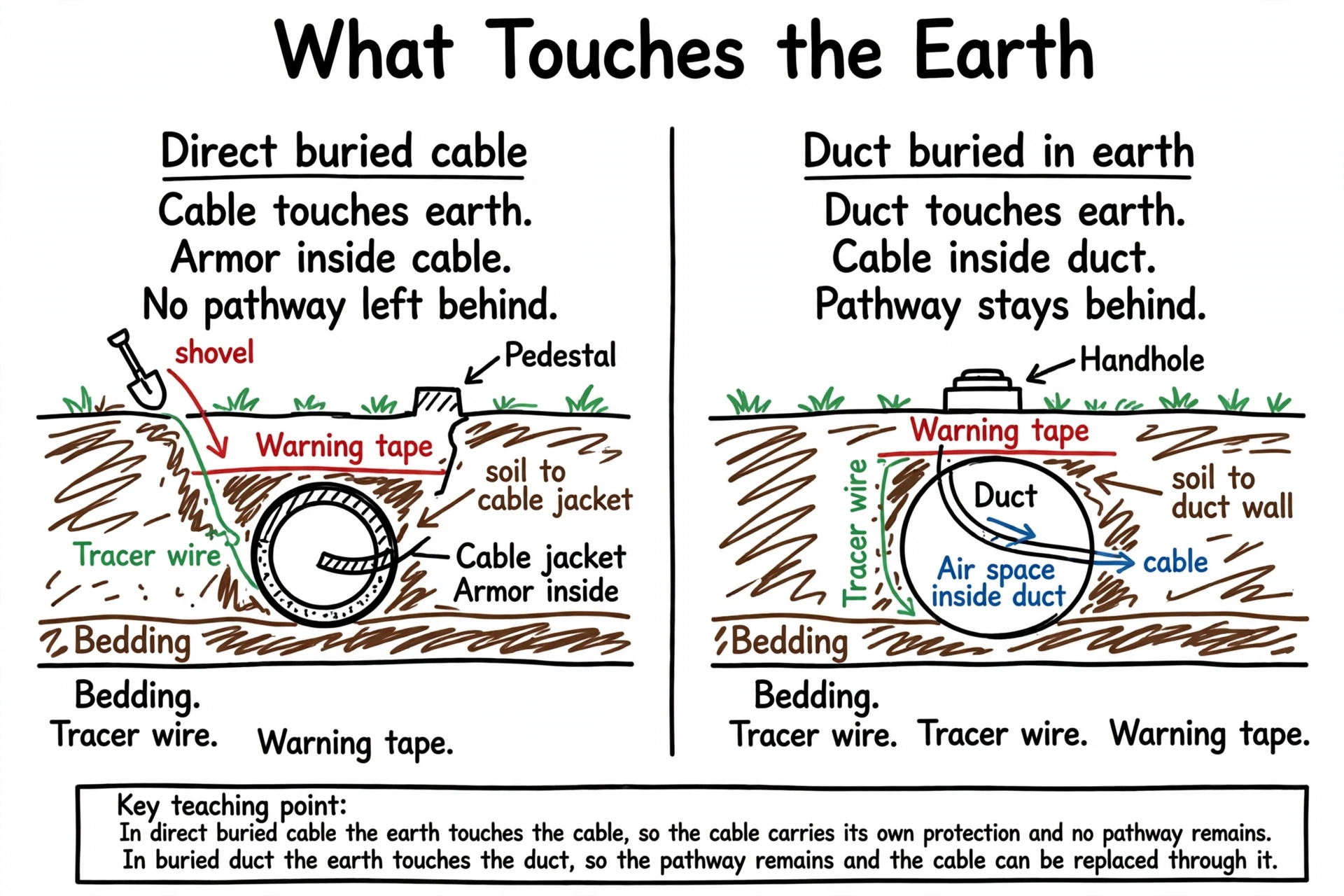
Direct-buried construction is an underground placement method where a cable itself sits directly in the earth, with no duct or conduit around it and no additional encasement structure. The Fiber Optic Association, called FOA, states the definition in plain terms: direct buried cable is placed underground without conduit. A buried duct is a different arrangement: the duct itself sits in the earth, and the cable lives inside that duct, so the cable never touches the earth at all.
Level 8 studies the underground pathway piece by piece. Lesson 144 taught duct, Lesson 145 taught innerduct, Lesson 146 taught microduct, and Lesson 147 taught the duct bank. This lesson teaches the placement method that puts the cable itself straight into the ground, and it teaches the reader to tell direct burial apart from buried duct every time, because repair, replacement, and risk work differently in each arrangement.
What This Lesson Gives You
- Look at a plan, a record, or an open trench and state which arrangement is present: a cable buried directly in earth, or a duct buried in earth with a cable inside it.
- Explain why a direct-buried cable leaves no empty pathway behind, and why replacement of that cable means excavation, while cable in a buried duct can in principle be removed and replaced through the duct.
- Name the parts of a direct-buried cable that carry its protection: armor where the design calls for it, jacket, and water blocking, and state why an ordinary outdoor cable rating alone does not make a cable a direct-buried cable.
- Read bedding, backfill, and spoil for the signs that protect or threaten a buried cable: selected fine material against the cable, angular rock and debris kept away from it.
- State what makes buried plant findable later: a locatable element where the cable or duct is nonmetallic, warning tape where the documents call for it, markers where the design places them, and an accurate as-built record.
- State the hold decision when a record cannot say which arrangement is buried, where it runs, or how it can be located, and name what must be resolved before digging or replacement work proceeds.
Start With the Basics
Picture two ways to get a garden hose across a yard for good. In the first way, the hose itself is buried in a shallow trench and covered with soil. The hose works, and the yard looks clean. Years later, when the hose fails, the only way to reach it is to dig along its path, lift it out, and bury a new one. In the second way, a pipe is buried in the trench first, and the hose slides through the pipe. When that hose fails, a worker can pull the old hose out of the pipe and slide a new hose in, while the pipe stays in the ground.
The comparison runs through the same two arrangements. A direct-buried cable follows the hose pattern. The cable itself touches the earth, and the earth closes around the cable. A buried duct follows the pipe pattern. The duct touches the earth, and the cable touches only the inside of the duct. The difference looks small on the day of construction. The difference controls every repair and replacement decision for the life of the route. One arrangement leaves a pathway behind. The other arrangement leaves only the cable itself.
What Is It?
Direct-buried construction means placing a cable directly in the earth, with no duct or conduit around it. FOA uses the term that way: direct buried cable is placed underground without conduit. A duct buried in the earth is a different arrangement, and this lesson teaches the two side by side as a contrast, because confusing them leads to wrong cable selection and wrong repair plans.
Direct-buried construction defined. Direct-buried construction places a cable or a duct directly in the earth, with the earth itself as the surrounding material, and with no added encasement structure such as a concrete envelope around it. Crews place the cable or duct by trenching, which means opening a cut in the ground, placing the plant, and backfilling, or by plowing, which means a machine opens a narrow slot in the ground and feeds the cable or duct into the slot in one pass. FOA describes plowing as the desirable and economical placement method in open or rural areas with fewer obstacles, and trenching as the method with advantages in urban and suburban areas where underground utilities, sidewalks, and road crossings crowd the route. A third placement method, directional boring, advances a bore underground and pulls duct back through it. Bored duct is covered in its own lessons in this level. This lesson centers on cable and duct placed in direct contact with the earth through trench and plow work.
The subject itself: direct-buried cable. A direct-buried cable is a cable built and rated by its manufacturer for direct contact with the earth, placed underground with no duct or conduit around it. FOA states the condition plainly: the cable must be designed to withstand the rigors of being buried in dirt. The cable carries its own protection in its construction, described below, because no tube wall stands between the cable jacket and the soil, the rocks, and the moisture around it.
The contrasting arrangement: duct placed in earth. A buried duct is a duct, covered in Lesson 144, placed directly in a trench, a plowed slot, or a bore, with the earth closed around the duct. The duct is the pathway. The cable inside the duct never touches the earth. Crews pull or blow the cable into the duct after the duct is placed and proven, and a later crew can in principle pull that cable out and pull a replacement cable in, using the same duct. The duct in this arrangement is buried plant, and the cable inside it is still not a direct-buried cable. Calling it one is wrong, and the error matters, because the cable inside a duct was selected for duct installation and relies on the duct for the protection a direct-buried cable must carry in its own build.
Armor. Armor is a protective layer inside the cable, usually metallic and sometimes hard plastic, placed under the outer jacket. FOA describes armor resisting crushing loads and preventing rodent penetration, and the FOA civil works guidance states that on direct-buried installations armored cable provides both crush protection and prevention of rodent penetration. Corning product specifications for a single-armored loose tube cable describe corrugated steel tape armor providing rodent resistance for direct-buried applications, with the application listed as aerial, direct buried, and duct. Armor belongs to a specific cable design and its data sheet. A cable has armor because the manufacturer built it in, and field staff confirm armor from the cable marking and the submittal, never from the look of a jacket alone.
Loose tube construction and water blocking. Outside plant cables are generally loose tube cables, where fibers sit inside small plastic tubes that isolate the fibers from tension and handling. FOA explains that loose tubes can be filled with water-blocking materials to prevent moisture entry, and that outdoor cables use gel or absorbent tape or powder to keep water from entering the cable and harming the fibers. Corning specifications for armored direct-buried cable describe a gel-free design that is fully waterblocked using water-swellable materials. Water blocking is the material system inside a cable that stops water that enters at a jacket opening from traveling along the cable. In direct burial the cable sits in damp earth for its whole service life, so water blocking is part of the protection the cable carries in place of a duct.
Jacket. The jacket is the outermost layer of the cable. FOA notes that outdoor cables generally use black polyethylene, called PE, which resists moisture and sunlight exposure. Some outdoor cables carry double jackets with armor between them. The jacket is the surface the earth touches in direct burial, so jacket material and condition carry weight they never carry inside a duct.
Bedding and backfill. Bedding is the material placed in the bottom of a trench under the cable or duct, giving it an even seat. Backfill is the material returned to the trench to cover the plant and fill the cut. Selected material is bedding or backfill chosen for its fine, granular character, free of the rocks and sharp material in raw excavated soil. The NEC rule for underground electrical installations, at section 300.5(F), states the principle for its own scope. In summary, 300.5(F) bars backfill containing large rocks, paving materials, cinders, large or sharply angular substances, or corrosive material where it may damage raceways, cables, conductors, or other substructures, prevent adequate compaction of fill, or contribute to corrosion, and it requires protection in the form of granular or selected material, or other approved means, where necessary to prevent physical damage. That NEC section governs electrical wiring within its scope. Fiber project documents apply the same physical principle through their own specifications, and the documents for the job state the bedding and backfill the cable or duct receives.
Tracer wire and warning tape. A tracer wire, also called locating wire, is a continuous conductive wire buried alongside a nonmetallic cable or duct so a locator can place a signal on the wire and follow the route from the surface. Industry guidance on tracer wire explains the underlying problem in direct terms: nonmetallic pipe and conduit do not conduct electricity, so without a tracer wire there is no reliable way to locate the utility from the surface after backfill, and the wire must be continuous from its access point to the far end to carry the signal. Warning tape is a wide, printed plastic tape buried above the buried plant, where the project documents call for it, so a later excavator uncovers a visible warning before reaching the cable or duct. FOA civil works guidance places warning tape above the direct-buried cable, and FOA underground construction guidance describes conductive marker tape buried above conduit where the conduit and cable are dielectric, to assist future location and to warn anyone digging nearby. Tape warns a digger who is already digging carefully. Tracer wire and records find the route before digging starts. The two tools do different work.
Depth, and where depth values come from. Cover is the distance from the top of the buried cable or duct up to finished grade. This lesson states no universal cover number for fiber plant, because no such universal field number exists. Cover for a job comes from the project documents, the permit or wayleave, the owner standard, and any code or regulation that applies to that plant in that place. Readers will hear numbers quoted from other scopes, and each number belongs to its document. One example shows the pattern. A United States regulation for Rural Utilities Service borrowers, 7 CFR 1755.505, covers buried service wire and cable at customer access locations, and it states that buried service wire or cable shall be plowed or trenched to a depth of 12 inches or greater where practicable in soil, 36 inches in ditches, or 3 inches in rock. That sentence governs the narrow class of buried services in that regulation. It sets no depth for a fiber trunk route, a duct bank, or any other job. NEC Table 300.5 works the same way in its own scope: it lists minimum cover values for electrical conductors and raceways, arranged by wiring method and location. A value read out of a table without its scope is a number without a rule behind it, and field staff take cover from the documents for the job in front of them.
What Does It Look Like?
A beginner meets direct-buried construction during placement, at a splice point or structure, and later at the surface after the ground has closed. Each place shows different evidence.
At the open trench or the plow slot:
- A single cable lying on bedding at the bottom of a narrow trench, with earth as its only surround and no tube around it. That sight is direct-buried cable.
- A plastic duct lying in the trench or feeding into the plow slot, with the cable absent or arriving later by pulling or blowing. That sight is the contrasting arrangement, a pathway being buried, with cable placement still ahead.
- A cable reel feeding cable directly into a plow chute, or a duct reel feeding duct, with an observer watching feed, depth against the documents, and route.
- Bedding material visible under the plant, and a separate pile or a screened portion of spoil held for the first cover over the plant, where the documents call for selected material.
- A tracer wire running alongside a nonmetallic cable or duct where the documents call for one, and warning tape staged to go in above the plant during backfill.
- Spoil piled beside the trench. Angular rock, broken pavement, and debris visible in the spoil warn the reader what must stay away from the cable during backfill.
At a splice point, pedestal, or structure:
- A direct-buried cable rising out of the earth into a pedestal, or entering a buried splice closure, with no duct sleeve around the buried run behind it.
- FOA notes that splices on direct buried cables can be stored above ground in a pedestal or buried underground, and that sufficient excess cable is needed to allow splicing in a controlled environment, usually a splicing trailer. Stored slack at the splice point is therefore part of the visible design.
- A buried duct entering a handhole or vault with a cable inside it, capped spare ducts beside it, and duct ends that can be opened for later cable work. That sight belongs to the contrasting arrangement.
- Cable identification and route records at the structure that state the form in words: direct-buried cable, or cable in duct, with the duct identified.
At the surface after restoration:
- A restored trench line or plow line, sometimes visible as a seam in soil or a line of settled ground following the route.
- Route markers at the surface where the design places them, and locate paint or flags from a recent locate request, in the APWA color for telecommunications where that color code is used.
- A pedestal or a flush structure as the only standing evidence of a run that otherwise leaves nothing to see, which is why records and locatable elements carry the findability of this form of plant.
Condition signs a beginner can read before backfill closes the work:
- Cable lying directly on angular rock or trench bottom rubble, with no bedding under it.
- A jacket cut, scrape, or kink visible on a cable waiting to be buried, damage that the earth will hide within the hour.
- Rocky spoil already returned against a cable, with sharp stones in contact with the jacket.
- Tracer wire cut, spliced with an unprotected joint, or left out of a segment where the documents call for it, breaking the continuity a locate depends on.
- Warning tape missing from a segment where the documents call for it, or tape placed beside the route instead of above the plant.
- A duct end left uncapped at a structure, open to mud and water before any cable enters it.
What Does It Do?
Direct-buried construction does its work through placement economics, cable construction, and the earth itself. Each mechanism below follows from putting the cable or the duct in direct contact with the ground.
Placement is simple, and simple is the economic case. FOA civil works guidance states the case directly: on paper, direct burial is fairly simple and very cost-effective, because the crew digs a trench, installs the cable, and reinstates the ground. Plowing sharpens the same case in open country, placing cable in one continuous pass. No duct material is purchased for a direct-buried cable, no duct proofing step follows, and no cable pull follows placement. The cable is in service position the moment the ground closes.
The cable construction replaces the duct wall. In duct construction, the tube carries crush resistance, rodent resistance, and a dry, smooth surround, and the cable inside can be a lighter build. In direct-buried cable construction, armor carries crush and rodent protection, the PE jacket faces moisture and soil contact, and water blocking guards the fibers if the jacket is breached. Protection moved from a separate structure into the cable itself. That transfer explains the product rule of this lesson: a cable goes into direct earth contact only when its manufacturer rates that exact cable for direct burial, and an outdoor rating by itself states no such thing.
The earth becomes the support and the surround. Bedding gives the cable or duct an even seat, backfill holds it in place, and compacted earth carries the surface loads above it. Earth also presses back. Settlement, shifting soil, and rocks in the fill all act on whatever touches them. With a direct-buried cable that contact lands on the cable jacket and armor. With buried duct it lands on the duct wall, and the cable inside rides inside the duct bore, isolated from soil pressure and moisture by the duct around it.
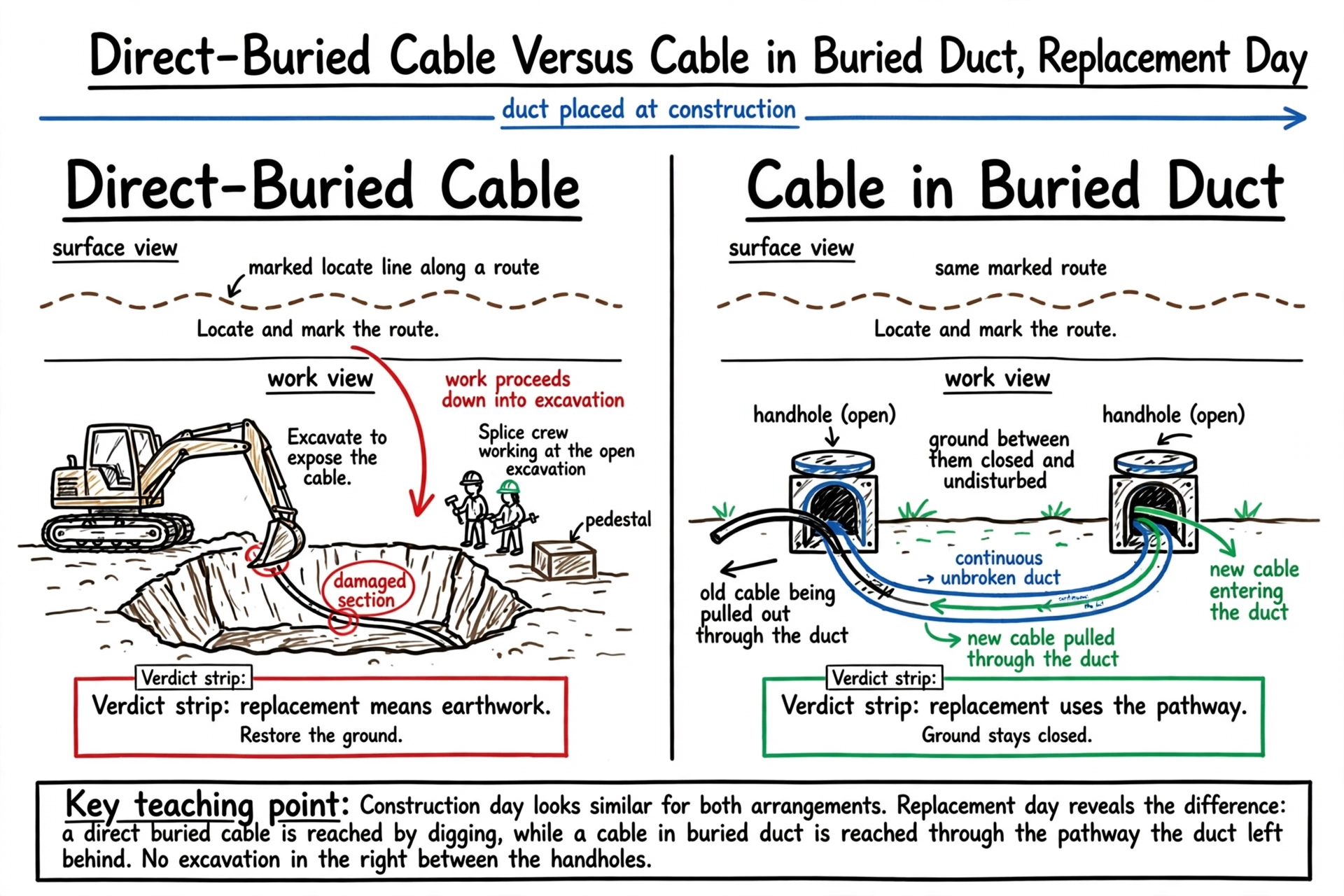
Buried duct preserves a future operation that direct burial gives up. A buried duct is an empty, reusable route. A crew can remove a cable from a duct and install a replacement through the same pathway, add a cable where a spare duct exists, and prove the pathway before committing a cable to it. A direct-buried cable offers none of those operations. The cable and its route are one fixed object. Any change to the cable means new earthwork along the route, and FOA states the consequence without softening it: direct-buried plant is perhaps more susceptible to damage from unrelated digging than cable in a duct, and it is difficult to access and repair.
Locating systems replace the visibility a structure would give. A duct run can often be found at its structures, and its ends announce the route. A direct-buried cable disappears completely at backfill. Findability therefore has to be built during construction: a continuous tracer wire or a metallic armor element that a locator can energize where the design provides one, warning tape above the plant, surface markers where the design places them, and an as-built record that states the route, the form, and the cover as built. A locate is the surface process of marking the approximate position of buried plant before excavation, requested through the one call system, called 811 in the United States, before digging. State damage prevention programs describe the same flow: the excavator contacts 811, facility operators mark their lines with paint or flags, and digging proceeds around the marks. A direct-buried route that cannot be located cannot be protected, and a route that was never recorded cannot be located with confidence.
Where Does It Fit?
Direct-buried construction is one placement choice among the underground methods in this level, selected at design and executed before splicing and activation.
- Design. The designer selects the form route by route: direct-buried cable, buried duct, bored duct, or a structure system. Ground conditions drive the choice. FOA notes that direct burial is generally limited to areas where the ground is mostly soil with few rocks down to the depth required, so trenching or plowing in cable is easily accomplished. Rocky ground, crowded utility corridors, road crossings, and routes expecting growth or frequent change push the design toward duct.
- Cable and duct selection. Direct burial requires a cable the manufacturer rates for direct burial, with armor and water blocking as the design specifies. Buried duct requires duct selected under Lesson 144, with the cable selected for duct installation. The submittal and the cable marking settle which product arrived on the reel.
- Placement. Crews trench or plow the cable or duct at the cover the project documents state, on the bedding the documents state, with tracer wire and warning tape placed where the documents call for them. FOA guidance adds a verification step for plowed cable: each section, after plowing in, is checked with an OTDR, an optical time domain reflectometer that sends a light pulse down the fiber and reads reflections to show breaks and damage, so placement damage is found while the crew and equipment are still on the route.
- Splicing and activation. Direct-buried cables splice in a pedestal above ground or in a buried closure, with excess cable stored for splicing in a controlled environment, as FOA describes. Cable in buried duct splices at structures in the pattern covered by the duct lessons.
- Operations and later work. Restoration, repair, and upgrade expose the core difference for the rest of the route life. Duct plant supports cable removal and replacement through the pathway. Direct-buried plant supports repair by excavation: locate the route, expose the cable, splice in a replacement section with stored or added slack, and restore the ground.
- Records. The as-built record for direct-buried work carries the route, the form in explicit words, the cable or duct identity, the cover as built, tracer wire and tape placement, splice point locations, and stored slack locations. For this form of plant the record is a working tool, because the ground shows later crews nothing.
- The neighboring lessons. Lesson 144 covered duct as a product, Lesson 146 covers microduct, and the boring and trenching lessons in this level cover the placement machines and methods in depth. This lesson covers the construction form itself: what touches the earth, and what that contact decides.
What Is at Stake
Damage from later digging. FOA names this stake first for direct-buried plant: once in the ground, it is perhaps more susceptible to damage from unrelated digging activities than cable in a duct. A backhoe or a trencher reaches a direct-buried cable with no duct wall to strike first and no empty tube to warn by feel. Accurate records, a working locate, warning tape, and markers are the standing defenses, and each defense exists only if construction installed and recorded it.
Repair cost and outage time. A damaged cable in a duct can often be pulled out and replaced through the pathway, with earthwork limited to the structures. A damaged direct-buried cable requires excavation to expose the damage, room to work, a splice, and restoration. The same cut therefore costs more time, more surface damage, and a longer outage on a direct-buried route.
Damage sealed in at backfill. A cable buried against angular rock or under rocky backfill carries that pressure for its whole life, and settlement works the jacket against the stone. The failure can arrive months or years after acceptance, at a point no one can see. Bedding and selected material around the cable are cheap on the day of construction and impossible to add afterward without digging the route again.
A route no one can find. A nonmetallic direct-buried cable with a missing or broken tracer wire, no usable armor locate path, and a weak record is effectively invisible. Later work near it proceeds blind, which converts a records failure during construction into a damage event during someone else’s project.
The wrong cable in the ground. An outdoor cable without a direct burial rating, placed in direct earth contact, can fail early from moisture, crush, or rodent damage its construction was never built to resist. The error is buried with the cable and surfaces as a route that fails young, with replacement priced as new excavation.
Form confusion in the record. A record that calls cable in buried duct direct-buried, or the reverse, sends later crews out with the wrong plan. A crew expecting a duct finds solid earth around a cable. A crew expecting to excavate a direct-buried cable may instead cut a duct they believed was cable. The record must name the form exactly, segment by segment.
Safety around excavation. Every repair and replacement on direct-buried plant begins with digging, and digging carries the hazards covered by the safety lessons in this course: striking other buried utilities, trench wall failure, and equipment work near the public. A construction form that requires excavation for every intervention multiplies exposure to those hazards across the life of the route.
What Does Good Look Like?
- The plan, the submittal, and the cable marking agree: the cable placed in direct earth contact is a cable its manufacturer rates for direct burial, with armor and water blocking as the design specifies.
- The record and the field agree on the form, segment by segment: direct-buried cable where the cable touches earth, cable in buried duct where a duct touches earth.
- The cable or duct sits on bedding as the documents direct, at the cover the documents state for that segment, with no sharp rock in contact with the cable jacket.
- Backfill against and over the cable is selected material as the documents direct, free of large rocks, paving material, cinders, and sharp debris, with general fill placed above that zone.
- Tracer wire runs continuous alongside nonmetallic plant where the documents call for it, with protected splices and an accessible connection point, and a locate signal follows the route end to end.
- Warning tape sits above the plant where the documents call for it, on the route line, placed during backfill at the position the documents state.
- Splice points hold the excess cable the splicing plan requires, stored neatly in the pedestal or closure, with the location recorded.
- Plowed sections carry an OTDR check after placement, with results filed before the route is accepted.
- The as-built record states route, form, cable or duct identity, cover as built, locate elements, tape, splice points, and slack storage, and a reader can follow that record to the plant with a locator.
From the Field
Picture a crew closing a trench on a direct-buried feeder segment across open ground. The cable is in place on its bedding. The armored cable matches the submittal, the tracer wire runs beside it, and the first length of trench already holds its selected material ready for the cover layer over the cable.
The spoil pile beside the remaining trench tells a different story. The ground on this stretch carries angular rock, and the pile shows sharp stones mixed through the soil the excavator plans to push back into the trench. The operator is ready to backfill the whole cut with that spoil in one pass, which would finish the segment before the weather turns.
The inspector stops the pass and works the problem in the order this lesson teaches. Armor gives the cable crush protection and rodent protection, and the inspector names that protection accurately. Armor is a layer inside the cable. Armor was never a promise that sharp rock can sit against the jacket under settling earth for the life of the route, and the project documents for this segment call for selected material against and over the cable before general fill.
The crew changes the sequence instead of arguing about the stone. Selected material goes in around and over the cable first, placed by hand and light equipment near the cable. The rocky spoil goes back above that zone, where its sharp edges bear on soil instead of on the jacket. The inspector photographs the cover layer in place before the trench closes, and the as-built notes the stretch of rocky ground by station so a later crew digging there knows what the ground holds.
The segment finishes later that day, a short time behind the one pass plan. The cable enters service resting in material that will not work against its jacket as the ground settles, and the record shows the condition of the one stretch where the earth itself was the hazard.
The rule to carry is simple: armor protects the cable, and bedding and selected backfill protect the armor and the jacket. A crew that buries a direct-buried cable in sharp rock has used the cable protection as an excuse to skip the earthwork protection, and the route pays for that shortcut underground, out of sight, on a delay.
What Can Go Wrong?
Burying a cable that carries no direct burial rating. An outdoor jacket alone does not equip a cable for earth contact. Moisture, crush load, and rodents act on a construction that was built for a duct or a pole line, and early failure follows, buried where no inspection can reach it.
Treating duct plant and direct-buried plant as the same record entry. The two arrangements repair differently, replace differently, and locate differently. A merged or vague record guarantees a wrong plan on a later job, in one direction or the other.
Backfilling with rocky spoil against the cable. Large rocks, paving material, cinders, and sharply angular substances in contact with the cable damage the jacket under load and settlement. NEC 300.5(F) bars that material against electrical cables and raceways in its scope for exactly this physical reason, and fiber project documents apply the same control through their bedding and backfill specifications.
Skipping bedding on a rough trench bottom. A cable resting on trench bottom rubble carries point loads at every stone. The damage mechanism runs silently under restored ground.
Breaking the locate path. A tracer wire cut during backfill, joined with an unprotected splice, or omitted on one segment leaves a gap a locator cannot cross. The plant in that gap is unfindable by signal, and the gap usually sits exactly where memory of the route is weakest.
Omitting warning tape or placing it off the route. Tape warns only the excavator who uncovers it. Tape placed beside the line, or left out, gives a later digger no warning at the moment a warning could still change the dig.
Placing plant at cover taken from memory. A depth remembered from another job, another code table, or another class of plant has no authority on the route being built. Shallow plant meets later digging sooner, and plant buried far off its recorded cover defeats the locate and the record at the same time.
Storing too little slack at a direct-buried splice point. FOA notes that direct buried splices need sufficient excess cable for splicing in a controlled environment. A repair crew that finds no slack at the closure must excavate further or add a second splice point, lengthening the outage.
Assuming a direct-buried cable can be pulled free and replaced. Earth grips the cable along its full length, and pulling on a buried cable loads the cable without moving it as a duct pull moves a cable. Replacement on this form means excavation, planned as excavation from the first hour.
What Should Someone Notice in the Field?
- State the form out loud before any other observation: cable in direct earth contact, or duct in direct earth contact with cable inside it, and check that the record uses the same words for the segment.
- Read the cable marking and the submittal for any cable touching earth, and confirm a direct burial rating from the manufacturer for that exact product, with armor present where the design calls for armor.
- Look at the trench bottom before placement: bedding present as the documents direct, bottom free of angular rock and rubble where the cable or duct will rest.
- Watch the backfill sequence: selected material against and over the cable first, general fill above it, and no large rock, paving material, cinder, or sharp debris in the zone that touches the cable.
- Follow the tracer wire with your eyes along the open trench where the documents call for one: continuous, alongside the plant, splices protected, connection point accessible.
- Confirm warning tape placement during backfill where the documents call for it: above the plant, on the route line, at the position the documents state.
- Check cover against the project documents for the segment, measured as built, and record the measured value rather than a planned value.
- At splice points, confirm stored excess cable matches the splicing plan and that the pedestal or closure location appears in the record.
- Photograph the open trench, the bedding, the cover layer, and the locate elements before backfill hides them, and file the photographs with the as-built record.
- Hold the work and report it when the form, the cable rating, the cover, or the locate path cannot be confirmed from the documents and the field together, instead of letting backfill bury an open question.
- Know the boundary: recognizing direct-buried construction, telling the two arrangements apart, reading bedding and backfill, and reporting condition are tasks covered by this lesson. Designing burial systems, directing excavation and plowing, operating trenching and plowing equipment, entering trenches under an excavation safety program, and performing locates for excavation belong to qualified people under the project documents, the applicable regulations, and their training. Reading this lesson qualifies no one for that work, and no one should dig, enter an excavation, or run placement equipment beyond their assignment, training, and authorization.
Key Terms
Direct-buried construction: Placement of a cable directly in the earth, with no duct or conduit around it and no added encasement structure. Distinct from buried duct, where a duct is placed in the earth and the cable lives inside the duct.
Direct-buried cable: A cable built and rated by its manufacturer for direct contact with the earth, placed underground with no duct or conduit around it.
Buried duct: A duct placed directly in a trench, a plowed slot, or a bore, holding the cable inside it so the cable never touches the earth and can in principle be removed and replaced through the duct.
Armor: A protective layer inside a cable, usually metallic, that resists crushing loads and rodent penetration.
Water blocking: Material inside a cable, gel or water-swellable tape or powder, that stops water entering at a jacket opening from traveling along the cable.
Bedding: Material placed in the bottom of a trench under the cable or duct to give it an even seat.
Selected material: Fine, granular bedding or backfill chosen to sit against a cable or raceway, free of large rocks and sharp material that could damage it.
Tracer wire: A continuous conductive wire buried alongside nonmetallic plant so a locator can place a signal on it and follow the route from the surface.
Warning tape: A wide printed plastic tape buried above buried plant, where the project documents call for it, to warn a later excavator before the excavator reaches the plant.
Cover: The distance from the top of the buried cable or duct up to finished grade, taken for a job from the project documents and any code or regulation that applies to that plant.
Check Your Understanding
- A plan note reads direct-buried for two segments. On the first segment a cable lies in the trench with no tube around it. On the second segment a duct lies in the trench and the cable will be pulled in later. State the form of each segment in exact words, and state the replacement consequence that follows from each form.
Answer: The first segment is direct-buried cable: the cable itself touches the earth, no empty pathway remains, and replacement means locating the route and excavating to expose and replace the cable. The second segment is duct placed directly in earth: the duct is the pathway, the cable inside never touches earth, and the cable can in principle be removed and replaced through the duct without digging the route again.
- A cable on the reel is marked for outdoor use, and a crew member proposes burying it in direct earth contact to save the cost of duct. What must be confirmed before that proposal can proceed, and what settles the question?
Answer: The manufacturer rating for that exact cable must confirm direct burial. FOA requires the cable to be designed to withstand the rigors of being buried in dirt, generally a more rugged and armored construction, and an outdoor rating alone states nothing about earth contact. The cable data sheet and the project submittal settle the question.
- A supervisor quotes a burial depth from memory and applies it to a fiber route. Using the RUS example in this lesson, explain what is wrong with that move and where the cover for the route actually comes from.
Answer: The quoted number belongs to whatever document it came from, with a scope attached. The 12 inch, 36 inch, and 3 inch values in 7 CFR 1755.505 govern buried service wire and cable at customer access locations for RUS borrowers, and they set no depth for a fiber route. Cover for the route comes from the project documents, the permit or wayleave, the owner standard, and any code or regulation that applies to that plant in that place.
- In the From the Field scenario, why did the inspector stop the one pass backfill even though the cable was armored, and what sequence replaced the stopped pass?
Answer: Armor provides crush protection and rodent protection inside the cable construction, and the inspector treated armor as one layer of protection rather than as permission to bury the cable in sharp rock. The project documents called for selected material against and over the cable. The crew placed selected material around and over the cable first, then returned the rocky spoil above that zone, photographed the cover layer, and recorded the rocky stretch in the as-built.
- A nonmetallic direct-buried cable has been in the ground for years, and a new project will dig across its route. Name the built-in elements that let the cable be found and protected, and name the failure that leaves the route effectively invisible.
Answer: A continuous tracer wire that a locator can energize from an access point, warning tape above the plant, surface markers where the design placed them, and an accurate as-built record stating route, form, and cover, with the 811 locate process marking the line before digging. The route is effectively invisible when the tracer wire is missing or broken, no other locatable element exists, and the record is too weak to follow.
Lesson Takeaway
Direct-buried construction asks the reader to answer one question before every other question: what touches the earth, the cable or a duct? That single answer decides how the plant is protected, how it will be found, and how it will be repaired. After this lesson, an open trench reads as a set of decisions with lifelong consequences: a cable rated for the contact it is about to receive, bedding and selected backfill standing guard around it, a locate path built in before the ground closes, and a record that names the form exactly, because the ground will show the next crew nothing at all.
Sources and Technical References
Fiber Optic Association, The FOA Reference for Fiber Optics, Outside Plant Fiber Optic Cables. Covers direct buried cable placed underground without conduit, rugged armored construction against rodent chewing and the pressures of dirt and rocks, ground mostly soil with few rocks as the condition for direct burial, splices in a pedestal or buried with excess cable for splicing in a controlled environment, loose tube water blocking, armor against crushing and rodent penetration, and polyethylene jackets: https://www.thefoa.org/tech/ref/OSP/cable.html
Fiber Optic Association, FOA Reference for Fiber Optics, Outside Plant Construction, Underground Construction. Covers direct-buried installations as simple and cost-effective on paper while more susceptible to damage from unrelated digging and difficult to access and repair, plowing in open or rural areas and trenching where obstacles crowd the route, armored cable for crush protection and prevention of rodent penetration, warning tape above the cable, conductive marker tape above dielectric conduit, OTDR checks after plowing, and call before you dig practice: https://www.thefoa.org/tech/ref/OSP_Construction/Underground_Construction.html
Fiber Optic Association, The FOA Reference for Fiber Optics, Fiber Optic Installation. Covers outside plant installation categories, direct burying cable by plowing, and buried cables designed for resisting moisture and rodent damage: https://www.foa.org/tech/ref/basic/install.html
Corning ALTOS Lite Loose Tube, Gel-Free, Single-Jacket, Single-Armored Cable specifications, as published for part 288EUC-T4101D20. Covers application listed as aerial, direct buried, and duct, corrugated steel tape armor providing rodent resistance for direct-buried applications, gel-free waterblocking with water-swellable tape, polyethylene outer jacket, and design and test criteria ANSI/ICEA S-87-640: https://www.alldataresource.com/Corning-288EUC-T4101D20-ALTOS-Lite-Loose-Tube-Gel-Free-Single-Jacket-Single-Armored-Cable_p_261570.html
Encore Wire, Codes and Standards guidance on direct burial bedding, quoting NEC 300.5(F) Backfill. Covers the NEC rule for its scope, summarized in this lesson, that backfill containing large rocks, paving materials, cinders, large or sharply angular substances, or corrosive material is barred where it may damage raceways, cables, conductors, or other substructures, and that protection shall be provided in the form of granular or selected material, or other approved means, where necessary: https://www.ajbsales.com/wp-content/uploads/2020/12/SoilCompactionLetter2020.pdf
7 CFR 1755.505, Buried services, Rural Utilities Service, USDA, as reproduced in the Code of Federal Regulations. Covers buried service wire and cable at customer access locations for RUS borrowers, including the scoped placement depths of 12 inches or greater where practicable in soil, 36 inches in ditches, or 3 inches in rock, cited in this lesson only as an example of a depth value bound to a named document and a narrow scope: https://codes.findlaw.com/cfr/title-7-agriculture/cfr-sect-7-1755-505/
Ramcorp Wire, Tracer Wire Guide. Covers tracer wire as a continuous conductor buried alongside nonmetallic underground utilities including fiber optic conduit, the inability of nonmetallic pipe and conduit to carry a locating signal on their own, continuity from access point to far end, and the APWA color code with orange for telecommunications and fiber optic lines: https://ramcorpwire.com/resources/tracer-wire-guide/
Pennsylvania Public Utility Commission, PA One Call, 811. Covers the state damage prevention flow used as the example in this lesson: contact 811 before digging, facility owners are alerted and mark their buried lines, and the markings guide excavators away from underground facilities: https://www.puc.pa.gov/pipeline-safety/damage-prevention-enforcement/pa-one-call-811/
Previous lesson: Lesson 147: What Is a Duct Bank? |
Back to Level 8 hub |
Next lesson: Lesson 149: What Is a Conduit Sweep?