
Introduction
A conduit sweep is a curved section of conduit that changes the direction of a run gradually, spreading the turn over a long arc instead of concentrating it in a short, tight corner. Conduit suppliers describe a sweep in direct terms: a long radius elbow designed to make cable pulling easier, carrying the same turn angles as a standard elbow and a much larger radius.
Level 8 studies the underground pathway piece by piece. Earlier lessons taught duct, conduit, and innerduct, the straight tubes that carry cable between structures. This lesson teaches the piece that turns the pathway, because every turn in a run shapes how hard the cable pull will be and how much pressure the cable takes at that turn for the life of the installation.
What This Lesson Gives You
- Tell a sweep apart from a standard elbow at staging and in an open trench, using radius and shape rather than the name on a delivery ticket.
- Explain how a sweep lowers sidewall pressure on a cable at a turn, and why the total turn angle still matters even when the radius is generous.
- Name the places sweeps belong in a run: direction changes, rises into structures, and transitions from buried conduit to above ground.
- Check a sweep before it is covered for kink, flattening, joint alignment, and match against the radius and angle the project documents call for.
- State the hold decision when the specified sweep is missing or damaged and a tight fitting is offered as a substitute, and name what must be resolved before the run is built or covered.
Start With the Basics
Picture a garden hose pulled around the corner of a house. Dragged around a sharp corner of the foundation, the hose kinks at the corner, the flow slows, and the hose wall takes a crease that stays in the hose afterward. Led around a wide curve, with a coiled loop or a gentle arc away from the wall, the same hose keeps its round shape and the water keeps moving. The hose changed direction by the same amount in both cases. The difference was how sharply it was forced to turn.
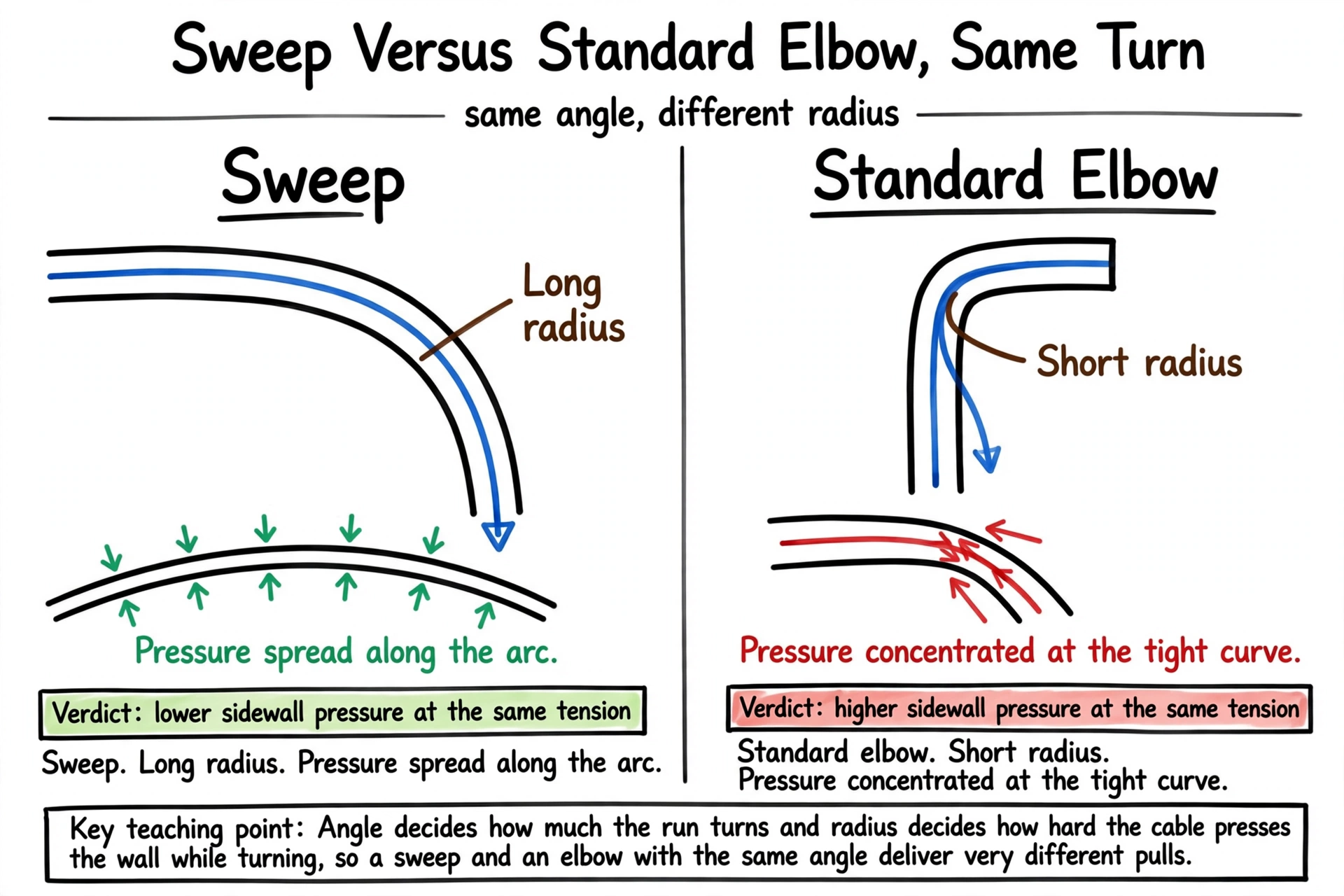
A cable inside conduit faces the same geometry. The cable must follow every turn the pathway makes. A tight turn concentrates the direction change into a short length of cable, presses the cable hard against the inside wall of the fitting, and can bend the cable tighter than its maker allows. A sweep spreads the same direction change over a longer arc. The cable follows a gentler curve, presses against the wall with less force per unit of length, and keeps a rounder, safer path through the turn. The analogy has one limit worth naming: a hose carries water and forgives a crease, while a fiber cable carries glass, and a bend forced too tight can damage the cable in ways that only show up later in testing or in service.
What Is It?
A sweep is one member of the family of fittings and formed sections that turn a conduit run. The definitions below build the picture in order, from the turn itself to the parts of the sweep a reader can check.
Conduit and duct, recalled. Conduit is a rigid or flexible metal or nonmetallic raceway through which cables can be pulled. Duct is a tube, usually plastic in modern fiber work, that protects underground cable and provides its route. Lessons 4 and 144 covered those subjects. This lesson uses conduit for the pathway the sweep turns, and the same sweep ideas apply inside duct runs built for fiber.
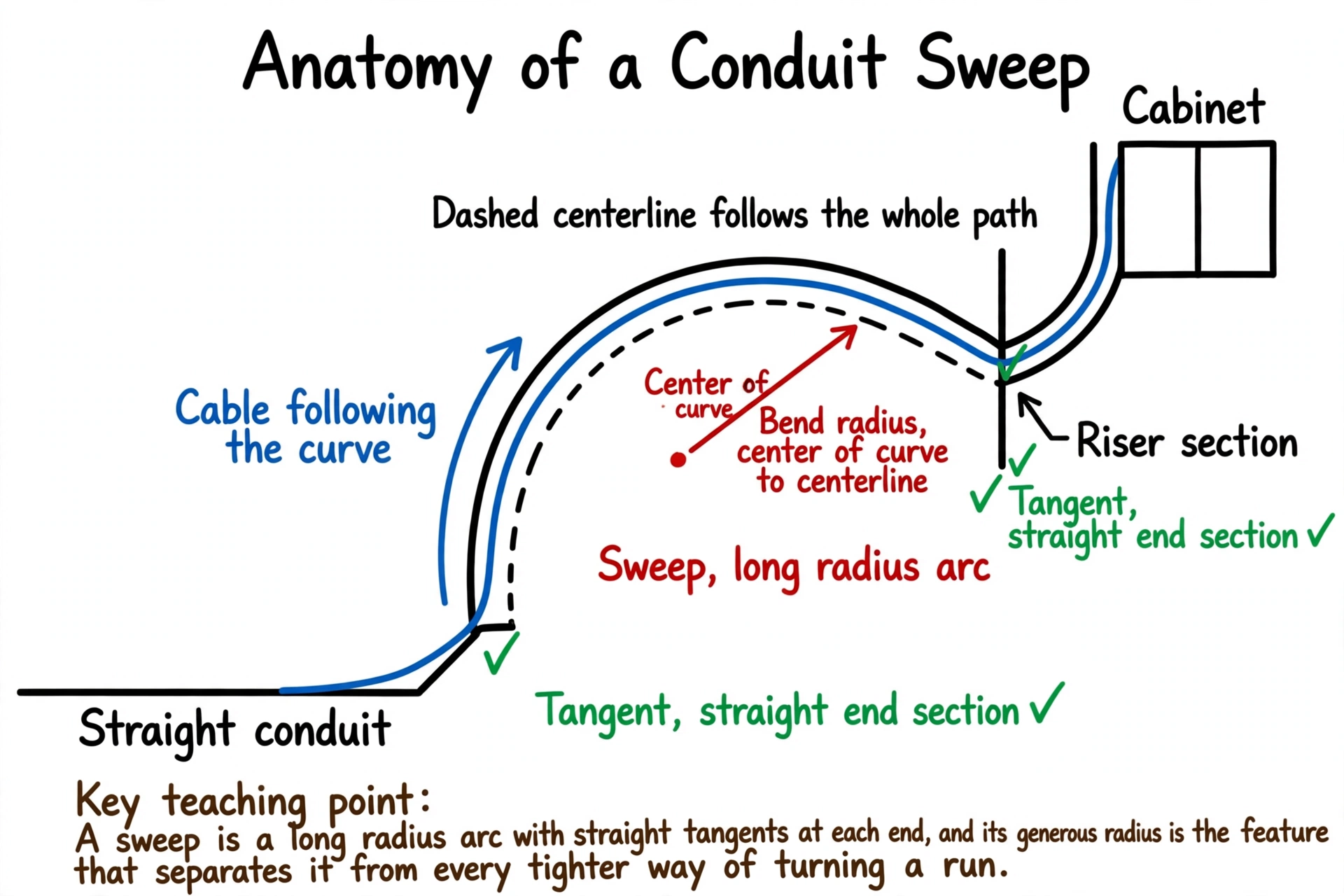
Bend radius. Bend radius is the distance from the center of the curve a conduit or cable follows to the centerline of that conduit or cable. A larger bend radius describes a wider, gentler curve. A smaller bend radius describes a tighter curve. Radius is the single measurement that separates a sweep from a standard elbow, and the project documents state the radius a given turn requires.
Sweep defined. A sweep is a long radius curved section of conduit, factory formed or supplied as a fitting, that changes the direction of a run gradually. Central Conduit, a conduit supplier working with manufacturers including JM Eagle and Atkore, states the trade usage plainly: a sweep is a long radius elbow designed to make cable pulling easier, it carries the same angles as a standard elbow with a much larger radius, and all sweeps are elbows while only long radius elbows earn the name sweep. Sweeps are manufactured to standards that apply to the product, and Central Conduit lists the PVC conduit used for its sweeps as manufactured to meet or exceed NEMA TC-2 and UL 651, and PVC fittings and elbows themselves are covered by NEMA TC 3 and UL 651.
Standard elbow, for contrast. An elbow is a factory made fitting at a fixed angle with a standard, relatively tight radius. The elbow turns the run in a short distance, which suits tight spaces in some work. In an underground fiber pathway, that short radius is the problem the sweep exists to solve: the cable rounds the same total angle in a much shorter length, against a much smaller radius.
Bend angle. The bend angle is the amount of direction change a fitting or formed section produces, stated in degrees. Supplier catalogs list sweeps and elbows at the same common angles, including 90 degrees, 45 degrees, 30 degrees, 22.5 degrees, and 11.25 degrees. Angle and radius are separate choices. A 90 degree sweep and a 90 degree standard elbow turn the run by the same angle, and the radius decides how gradually the cable makes that turn.
Tangent. A tangent is a short straight section at each end of a sweep, where the curved section meets the straight conduit and where the joint is made. Tangents give the joint a straight, round seat, and they give a reader a visible check: a sweep installed correctly flows from straight conduit into the curve and back out to straight conduit with no offset step at either joint.
Riser sweep. A riser sweep is the sweep that turns a buried run upward so the conduit rises out of the ground or into a structure, pole, or cabinet. Utility specifications describe this piece directly. Ameren Illinois conduit specifications assign the customer the conduit run up to and including the 90 degree sweep out of the ground at a terminal pole riser. When a cable is pulled into a structure, the riser sweep is the final turn it makes on that pull, and its condition decides how the cable enters the vertical section.
Materials and form. Sweeps reach the field in the same material families as the conduit they join, including PVC in Schedule 40 and Schedule 80 and HDPE conduit products, as supplier catalogs for power, utility, and fiber work list them. A sweep can arrive as a separate factory formed fitting with a bell end or socket for joining, or as a curved section formed from conduit. The material, schedule, size, angle, and radius for a given turn come from the project documents and the manufacturer product selected, and the marking on the piece is the evidence a reader checks.
Field bends and owner rules. Some owners govern how a turn may be made. Rocky Mountain Power Policy 242, an underground conduit standard for that utility, carries a sweep specifications table and states that field bends are not permitted on work under that policy. That rule belongs to that utility and its projects. The general lesson travels: whether a turn must be a factory sweep, and what radius it must carry, is set by the project documents and the owner standards the job cites, and a crew reads those documents instead of deciding from habit.
The electrical bend total, correctly scoped. Readers will hear a figure of 360 degrees quoted as a limit on bends between pull points. That figure comes from the National Electrical Code, called NEC, raceway articles for electrical conductors, such as NEC 352.26 for rigid PVC conduit (2020 and earlier editions; the rule sits at 352.24(B) in the 2023 NEC), which limit a raceway run to the equivalent of four quarter bends between pull points. The NEC rule governs electrical raceways within its scope. Fiber duct design takes its bend requirements from the project documents, the cable manufacturer limits, and the owner standards for the job. A reader who quotes the 360 degree figure on a fiber build should name it as an electrical raceway rule and check which documents actually govern the pathway in front of them.
What Does It Look Like?
A beginner meets a sweep at staging, in the open trench or bore path before cover, and at the base of a riser. Each place shows different evidence.
At staging and on the delivery:
- A long, gradual arc of conduit, visibly wider and more open than the compact corner shape of a standard elbow in the same size.
- Printed or molded markings naming the material, size, angle, and the standards the product carries, matching the submittal or the project documents.
- A bell end or socket on a factory sweep, ready to join straight conduit, with the tangent sections at each end straight and round.
- Standard elbows staged nearby for comparison, with a noticeably tighter curve in the same trade size. The visual gap between the two shapes is the fastest field check a beginner has.
In the trench or at the structure, before cover:
- The run changing direction through a smooth arc, with straight conduit entering and leaving the curve in line with the tangents.
- A riser sweep curving up out of the buried run toward a pole, cabinet, or structure wall, with the vertical section rising plumb from the top of the curve.
- Joints at each tangent seated fully, with the conduit lines on both sides of the joint pointing along the same path the curve intends.
- Support and bedding under the curve that hold the sweep at its formed shape, with no point load pressing the arc out of round.
Condition signs a beginner can read without touching cable:
- A crease or sharp fold anywhere along the arc. That defect is a kink, a localized collapse of the round shape where the curve was forced instead of formed.
- A section of the arc pressed oval or flat, so the opening inside is smaller than the conduit on either side. Plastics Pipe Institute material on HDPE conduit ovality warns that excessive ovality can restrict the installation of cables into installed conduit.
- A joint where the straight conduit meets the tangent at a visible angle or offset, so the cable will meet a step or an edge at that joint on every pull.
- A tight elbow sitting where the plan shows a sweep, in the trench or at a riser base, with its short radius visible against the sweep shape the neighboring runs show.
- Cracks, whitening, or heat damage along the curve, signs the piece was stressed or formed with heat in the field rather than supplied as a formed sweep.
What Does It Do?
A sweep does one job, turning the pathway, and it does that job through three mechanisms that protect the cable and the pull.
Spreading the turn lowers sidewall pressure. Sidewall pressure is the sideways force a tensioned cable exerts against the inside wall of a bend as it rounds that bend, expressed as force per unit length of the bend. The Southwire Power Cable Installation Guide gives the relationship for a single cable: sidewall pressure equals the pulling tension leaving the bend divided by the bend radius. Tension divided by radius carries the whole teaching point. At the same tension, a larger radius produces lower sidewall pressure, and a smaller radius produces higher sidewall pressure. A standard elbow and a sweep can deliver the same cable at the same tension, and the cable in the elbow presses the wall harder because the radius in the denominator is smaller. Excessive sidewall pressure can damage cable, and Southwire describes it as the most restrictive factor in many installations. The sweep earns its place by enlarging that denominator at every planned turn.
The total angle still multiplies tension. A sweep changes radius. A sweep leaves the total bend angle in the run unchanged, and angle carries its own cost. American Polywater explains pulling tension through a bend with the capstan equation: the tension leaving a bend equals the tension entering the bend multiplied by a factor that grows with the friction between cable and conduit and with the bend angle. Each bend multiplies the tension that arrives at it, so bends placed late in a long pull multiply a larger starting tension. Two consequences follow for a reader. First, a generous sweep never makes the angle free, and a run with several large angle turns still builds tension bend by bend. Second, friction control still matters at a sweep, through clean conduit and the lubricant and pulling practices the cable manufacturer directs. The sweep controls the pressure at the wall and the curvature the cable must follow. Angle and friction control the multiplication.
Gentle curvature protects the cable bend radius. Every fiber cable carries a minimum bend radius, the smallest radius the cable may be bent to without risking damage, set by the cable manufacturer for that cable. The Fiber Optic Association, called FOA, teaches that all fiber optic cables have specifications that must stay unexceeded during installation, covering pulling tension, minimum bend radius or diameter, and crush loads, and that bending a cable at too small a curvature can damage it. A pathway turn forces the cable to follow the pathway curvature. A sweep with a radius comfortably larger than the cable minimum lets the cable round the turn inside its limit. A tight elbow can force the cable against a radius smaller than its limit at the exact moment the cable is under its highest local pressure. The pathway fitting and the cable specification meet at the turn, and the sweep is how the pathway holds up its side of that meeting.
A formed sweep holds its shape under load and cover. A factory formed sweep arrives with its radius built in and its wall round along the arc. Installed with bedding and support that preserve that shape, the sweep presents the same curve to the first pull and to a replacement pull years later. A turn forced in the field, by bending straight conduit past its formed limit or by heating and reshaping a section, can spring back, flatten, or kink, and each of those shape failures narrows the pathway at the turn. Shape at the turn is a permanent property of the pathway, recorded once and inherited by every later crew.
Where Does It Fit?
Sweeps sit at every planned change of direction in the underground pathway, and the decisions about them happen in a fixed order.
- Design. The designer routes the run and sets each turn: location, angle, radius, material, and whether the turn is a factory sweep or a formed section. Cable manufacturer limits for bend radius, tension, and sidewall pressure shape those choices, and the drawings carry the result.
- Procurement and staging. Sweeps are ordered and delivered as named pieces, with size, angle, and radius on the marking. A missing sweep discovered at staging is a paperwork problem. A missing sweep discovered with the trench open becomes the pressure that produces substitutions, which is why staging checks matter.
- Duct and conduit construction. Crews set each sweep as the run is built, seat the joints at the tangents, bed and support the arc, and prove the pathway after the run is complete. The sweep becomes permanent at cover, so verification happens while the curve is still visible.
- Cable placement. The pulling crew inherits the turns the builders set. Pull planning accounts for each bend angle, its position in the run, and the friction conditions, and the cable rounds each sweep under the tension and sidewall pressure the geometry produces.
- Risers and terminations. At poles, cabinets, and building entries, the riser sweep turns the run vertical and delivers the cable to the above ground section or the structure interior. Damage or substitution at this single turn affects every cable that will ever enter through it.
- Records. The as-built record names each sweep location, angle, and radius as installed. A substitution made in the field and left out of the record hands later crews a pathway map that understates the pressure and curvature at that turn.
- The neighboring lessons. Lesson 147 taught the duct bank and Lesson 148 taught direct-buried construction, two pathway forms this level builds on. This lesson teaches the turn between straight runs and structures. Later lessons in this level take up proving, pulling, and restoring the completed pathway.
What Is at Stake
Cable damage at the turn, hidden until testing or service. A cable forced around a radius smaller than its manufacturer minimum, or pressed against a bend wall past its sidewall pressure limit, can carry damage under an intact looking jacket. FOA warns that exceeding cable specifications during installation can cause irreparable damage. The turn is where tension, pressure, and curvature peak together, so the turn is where installation damage concentrates.
Every later pull pays for a bad turn. A kinked, flattened, or substituted turn raises friction and pressure for the cable being placed today and for every replacement or added cable pulled through that pathway afterward. The original crew may never meet the cost. The restoration crew on a night outage inherits it in full.
A stalled or failed pull. A turn that narrows the pathway can stop a pull partway, with cable under tension in the ground and the schedule collapsing around it. Pulling harder against a geometric problem risks the cable the job exists to deliver. The cheap moment to fix a turn is before cover, while the sweep is visible and reachable.
Records that understate the pathway. A tight elbow buried in place of a sweep, with the record still showing the sweep, corrupts pull planning for the life of the pathway. Later tension calculations assume a radius the ground does not contain, and the error surfaces as unexplained tension or damaged cable on a future job.
Money spent rebuilding a covered turn. Correcting a wrong fitting after backfill and restoration means reopening the route, replacing the piece, and restoring the surface again. A wrong fitting stays cheap to replace only while the trench is open. Once the route is covered, reaching the buried sweep is the hard part.
Safety around excavation and pulling. Open trenches, structures, and powered pulling equipment carry hazards covered by the safety lessons in this course. Sweep decisions add one boundary of their own, covered in the field checklist at the end of this lesson: recognizing a wrong or damaged turn is a reporting task, and redesigning or rebuilding a pathway belongs to qualified people under the project documents.
What Does Good Look Like?
- Every turn in the run matches the drawings for location, angle, radius, and material, and the piece in the trench is a sweep wherever the documents call for a sweep.
- Each sweep shows a smooth, even arc with a round opening along its full length, free of kink, crease, flattening, cracks, or heat damage.
- Joints at both tangents are seated fully, with straight conduit aligned into and out of the curve and no visible offset or angle at either joint.
- The riser sweep turns the run upward in one smooth curve, and the vertical section rises in line from the top of the sweep.
- Bedding and support hold the arc at its formed shape, with no rock, lump, or point load pressing against the curve.
- Markings on each installed sweep match the submittal and the record, and any field change from the drawings is written into the as-built before cover.
- The completed pathway proves clear through each turn, so a proving device passes the full run without hanging at a bend.
From the Field
Picture a conduit crew building a feeder run between two handholes, with a 90 degree turn where the route rounds a property corner and a riser sweep where the run rises into a cabinet at the far end. The drawings call for long radius sweeps at both turns, with the radius stated on the plan.
The crew opens the staged material on the morning the trench reaches the corner. The corner sweep is on the pallet and matches the plan. The riser sweep is missing. In its place sits a standard elbow in the correct size, delivered in the same shipment, and the trench schedule for the day has the cabinet pad crew arriving behind this crew.
A crew member proposes the practical fix: set the standard elbow at the riser base, keep the day moving, and let the record show the run as built. The elbow fits the conduit, the angle matches, and the cabinet will hide the fitting from view once the work is complete. The difference is only the radius, and radius is hard to see once the ground is closed.
The crew lead stops the substitution and works the decision in the order this lesson teaches. The riser turn is the final bend on every pull into that cabinet, so each cable will round it under the tension built up over the full run. Sidewall pressure at that turn is the leaving tension divided by the radius, and the elbow cuts that radius down, raising the pressure on every cable at the point where tension is highest. The elbow also forces the cable around a tighter curve than the sweep the designer selected against the cable limits. The fitting would fit, and the pathway would be wrong in a way no later inspection could see from the surface.
The lead sets the corner sweep as planned, builds the run up to the riser location, and holds the riser turn open. The lead reports the missing sweep with the delivery record, records the segment as incomplete at the riser, and keeps the trench section accessible until the correct sweep arrives and is set, photographed, and entered in the as-built.
The schedule lost part of a day. The cabinet gained a riser turn that every future pull can round at the pressure and curvature the design intended, and the record matches the ground.
The rule to carry is simple: a fitting that matches in size and angle can still be the wrong fitting, and when the specified sweep is missing or damaged, the turn holds for the correct piece instead of accepting a tighter radius that every later pull will pay for.
What Can Go Wrong?
Substituting a standard elbow for a specified sweep. The run gains a tight turn where the design placed a gradual one. Sidewall pressure rises at that turn for every pull, the cable rounds a smaller radius than the designer allowed, and the substitution stays invisible after cover unless the record tells the truth about it.
Kinking a sweep during handling or placement. Forcing a curved section into place, dropping it, or bending it further to meet a misaligned trench can crease the arc. The kink narrows the pathway and concentrates pressure at one point on every pull.
Flattening or ovalizing the arc under bedding or backfill. Point loads and poor support press the curve out of round. Plastics Pipe Institute guidance on HDPE conduit notes that excessive ovality can restrict cable installation, and a flattened sweep restricts the pathway exactly where the cable needs room to turn.
Misaligning the joints at the tangents. Straight conduit entering a sweep at an angle or offset leaves a step inside the pathway. The cable meets that step under tension at the entrance to the turn, and jacket wear and hang-ups follow.
Forcing a field bend where the documents require a formed sweep. Heating or overbending straight conduit to improvise a turn can thin, whiten, or collapse the wall and produce a radius nobody specified or recorded. Owner standards such as Rocky Mountain Power Policy 242 prohibit field bends outright on their work, and the project documents govern the job in front of the reader.
Counting angle as free because the radius is large. A sweep lowers pressure at the wall, and the capstan effect still multiplies tension by bend angle and friction. A run designed with several large turns can exceed cable tension limits even with correct sweeps at every turn, when pull direction and friction are ignored.
Burying a damaged sweep and recording the plan instead of the ground. A cracked or creased sweep that goes under cover unreported becomes a permanent restriction with no record. Later crews plan pulls against a pathway that does not exist.
What Should Someone Notice in the Field?
- Compare every turn in the open run against the drawings: location, angle, radius, and material, naming any turn where the piece in the trench differs from the piece on the plan.
- Look along each sweep for a smooth, even arc, and flag any kink, crease, flattening, oval shape, crack, or whitening before the piece is covered.
- Check both tangent joints for full seating and straight alignment into and out of the curve, with no offset step a cable would meet.
- Confirm the riser sweep at each pole, cabinet, and structure entry turns the run upward in one smooth curve, with the vertical section rising in line from the sweep.
- Check bedding and support under each arc for rocks or lumps pressing on the curve, and confirm the sweep holds its formed shape.
- Read the markings on staged sweeps and elbows before installation, and keep standard elbows physically separate from sweeps so a tight fitting cannot be grabbed in place of a long radius piece.
- Photograph each turn before cover and record the installed angle and radius in the as-built, including any approved change from the drawings.
- Hold any turn where the specified sweep is missing, damaged, or replaced by a tighter fitting, and report the condition for a materials or design decision instead of burying the substitution.
- Know the boundary: recognizing a sweep, telling it from a standard elbow, and reporting a damaged or substituted turn are tasks covered by this lesson. Designing pathway geometry, selecting radii and products, directing excavation or pulling work, and approving substitutions belong to qualified people under the project documents and their training. Reading this lesson qualifies no one for that work, and no one should enter an excavation, open a structure, or join a pull beyond their assignment, training, and authorization.
Key Terms
Sweep: A long radius curved section of conduit that changes the direction of a run gradually, spreading the turn over a longer arc than a standard elbow.
Elbow: A factory made fitting at a fixed angle with a standard, relatively tight radius, turning a run in a short distance.
Bend radius: The distance from the center of a curve to the centerline of the conduit or cable following that curve. Larger radius means a gentler turn.
Bend angle: The amount of direction change a fitting or formed section produces, stated in degrees.
Sidewall pressure: The sideways force per unit length that a tensioned cable exerts against the inside wall of a bend, equal to the tension leaving the bend divided by the bend radius.
Tangent: A short straight section at each end of a sweep, where the curve meets straight conduit and the joint is made.
Riser sweep: The sweep that turns a buried run upward out of the ground or into a structure, pole, or cabinet.
Kink: A localized crease or fold in a conduit or sweep where the round shape has collapsed at one point along a curve.
Check Your Understanding
- What separates a sweep from a standard elbow when both carry the same angle and fit the same conduit size?
Answer: Radius. A sweep is a long radius elbow designed to make cable pulling easier, spreading the turn over a longer arc. A standard elbow turns the run at a standard, relatively tight radius in a short distance. Size and angle can match exactly while the radius, and therefore the pressure and curvature the cable meets, differ.
- A pull leaves a bend at a given tension. What happens to sidewall pressure when the same turn is built with a sweep instead of a standard elbow, and what relationship decides it?
Answer: Sidewall pressure falls. The Southwire Power Cable Installation Guide gives sidewall pressure as the tension leaving the bend divided by the bend radius. The sweep enlarges the radius in that relationship, so the same tension produces less sideways force per unit length against the bend wall.
- A run has correct sweeps at every turn, and a planner still worries about total pulling tension. Name the two factors, besides radius, that multiply tension through the bends.
Answer: Bend angle and friction. American Polywater explains bend tension with the capstan equation: tension leaving a bend equals tension entering multiplied by a factor that grows with bend angle and with the coefficient of friction between cable and conduit. A sweep controls pressure and curvature at the wall, and the total angle in the run still multiplies tension bend by bend.
- In the From the Field scenario, why did the crew lead refuse the standard elbow at the riser base even though the size and angle matched the missing sweep?
Answer: The riser turn is the final bend on every pull into the cabinet, so cables round it under the tension built over the full run. The elbow would cut the bend radius at that point, raising sidewall pressure by the tension divided by radius relationship and forcing the cable around a tighter curve than the designer selected. The lead held the turn open, reported the missing sweep, and recorded the segment as incomplete until the correct piece was set.
- A reader quotes a limit of 360 degrees of bends between pull points as the governing rule for a fiber duct build. What is wrong with that claim as stated?
Answer: The 360 degree figure is an NEC rule for electrical raceways within the NEC scope, found in raceway articles such as 352.26 for rigid PVC conduit (2020 and earlier editions; 352.24(B) in the 2023 NEC). Fiber duct bend requirements come from the project documents, the cable manufacturer limits, and the owner standards for the job. The figure may inform a conversation, and it governs the fiber build only where a governing document actually adopts it.
Lesson Takeaway
A turn is a permanent decision about pressure. After this lesson, a reader looks at a bend in a pathway and sees two numbers working: the angle, which multiplies tension, and the radius, which divides sidewall pressure. A sweep is how a builder gives every future cable the larger radius. A reader who can tell a sweep from an elbow, check an arc for kink and flattening, and hold a turn when the specified piece is missing protects cables that have not been ordered yet, on pulls that have not been scheduled yet.
Sources and Technical References
Central Conduit, Custom Radius PVC Sweeps. Defines a sweep as a long radius elbow designed to make cable pulling easier, with the same angles as a standard elbow and a much larger radius, distinguishes standard elbows by their relatively tight radius, and lists the PVC conduit used for its sweeps as manufactured to meet or exceed NEMA TC-2 and UL 651 by manufacturers including JM Eagle and Atkore, with PVC fittings and elbows covered by NEMA TC 3 and UL 651: https://centralconduit.com/custom-radius-pvc-sweeps/
Central Conduit, Power and Utility Conduit. Covers long radius sweeps matched to duct bank layouts so cable pulls stay within tension limits, sweeps at vault approaches, risers, and transitions, and HDPE conduit used for fiber and directional drilling runs: https://centralconduit.com/power-utility/
Southwire, Power Cable Installation Guide. Gives sidewall pressure for a single cable as the tension coming out of the bend divided by the bend radius in feet, and describes excessive sidewall pressure as the most restrictive factor in many installations: https://overheadtransmission.southwire.com/medias/PowerCableInstallGuidepdf.pdf?context=bWFzdGVyfGluc3RhbGxhdGlvbi1tYW51YWxzfDIzMjgwNzh8YXBwbGljYXRpb24vcGRmfGluc3RhbGxhdGlvbi1tYW51YWxzL2gyOS9oYjYvODg4NzY3NjE0MTU5OC5wZGZ8MDYzNWE5YWE3NWMzMmNmMmNlZWM1NWU3ZTdiNTY5Mzg5MDg2MTEzOTY0ZjcyMDc2MjU4MzQ4YzFhMWIzZTlhZg
American Polywater, Coefficient of Friction in Cable Pulling Tension from Conduit Bends. Explains the capstan equation for conduit bends, where tension leaving a bend equals tension entering multiplied by a factor set by the coefficient of friction and the bend angle: https://www.polywater.com/en/knowledge-hub/coefficient-of-friction-in-cable-pulling-part-3/
Fiber Optic Association, The FOA Reference for Fiber Optics, Installing Fiber Optic Cable, Bend Radius. Covers cable specifications that must stay unexceeded during installation, including pulling tension, minimum bend radius or diameter, and crush loads, and damage from bending at too small a curvature: https://www.thefoa.org/tech/ref/install/bend_radius.html
Fiber Optic Association, The FOA Reference for Fiber Optics, Outside Plant Fiber Optic Cable Plant Installation. Covers conduit and innerduct installation practice for outside plant fiber cable placement: https://www.thefoa.org/tech/ref/OSP/install.html
Ameren Illinois, Specifications for Customer Installed Underground Distribution Facilities. Assigns the conduit run at a terminal pole riser up to and including the 90 degree sweep out of the ground, as an example of a utility specification naming the riser sweep directly: https://www.ameren.com/-/media/Illinois-Site/Files/construction-services/ConduitSpecifications.pdf
Rocky Mountain Power, Policy 242, Underground Conduit Systems for Primary and Secondary Conductors. Carries conduit and sweep material and installation sections, a sweep specifications table, riser and transition requirements, and the statement that field bends are not permitted under that policy: https://www.rockymountainpower.net/content/dam/pcorp/documents/en/pp-rmp/electric-service-requirements/underground-conduit-system-installation/242_ext.pdf
Plastics Pipe Institute, TN-61, Coilable HDPE Conduit Ovality and Coil-set, as announced by PPI. Covers causes of ovality in HDPE conduit and the warning that excessive ovality could restrict the installation of cables into installed conduit: https://injectionmouldingworld.com/new-hdpe-conduit-ovalitytechnical-document-available/
National Electrical Code bend limit summaries for raceways. Summarize the NEC rule limiting raceway runs to the equivalent of four quarter bends, 360 degrees total, between pull points, with NEC 352.26 covering rigid PVC conduit, and note that newer NEC editions renumber the same provisions: https://www.bendmate.com/guides/conduit-360-degree-rule
Previous lesson: Lesson 148: What Is Direct-Buried Construction? |
Back to Level 8 hub |
Next lesson: Lesson 150: What Is a Conduit Coupling?