
Introduction
An emergency plan for a jobsite, called an emergency action plan in the federal construction rules, is the set of decisions made before an emergency that tells every person on the site how an emergency gets reported, how people leave or take shelter, where they gather, how the crew proves everyone is accounted for, and who holds each duty when minutes matter. On a fiber job the plan is site specific. The plan names the alarm method for that site, the evacuation routes and assembly point for that ground, the site address or location information a caller gives to responders, the first aid arrangements for that crew, and the person who calls for help.
Level 7 prepares a jobsite before construction starts. Earlier lessons in this level confirmed prints, permits, locates, materials, equipment, traffic control, and environmental controls. This lesson covers the human readiness layer of the same preparation. A site can have every physical control in place and still be unready, because nobody on the crew can say how an injury, a fire, a damaged gas line, or a tornado warning would be handled in the first minutes. The readiness question is direct: can the crew confirm, before work starts, that the plan for this site is real, current, and known?
What This Lesson Gives You
- Read a jobsite emergency plan, name its required parts, and check each part against the ground the plan claims to cover.
- Confirm the alarm method, the evacuation routes, the assembly point, and the accounting method before work starts, and say what a gap in any one of them means.
- State the site address or location information a 911 caller will use, and name who holds the calling duty under the plan for the job.
- Check first aid readiness the way the construction rule frames readiness: trained person, supplies, transport or communication, and posted location information.
- Hold the start of work when the plan is missing, generic, or unknown to the crew, and name the specific gap that must close first.
Start With the Basics
Picture the play sheet a quarterback wears on a wristband. The plays on that sheet were chosen in a quiet meeting room, with time to think. During the game, with noise and pressure and a clock running, nobody invents a play from nothing. The quarterback reads a decision that was already made well and calls the play. The sheet works because the thinking happened before the pressure arrived.
A jobsite emergency plan works through the same mechanism. An emergency compresses time and raises noise, smoke, weather, and fear all at once. Decisions made in that moment are slow and uneven. Decisions written down in advance, reviewed with the crew, and matched to the actual site are fast, because the crew reads a plan rather than inventing one. Who calls for help, which way people move, where they gather, and how the headcount happens are choices the plan makes on a calm morning so nobody has to make those choices during the worst minutes of the job.
What Is It?
An emergency action plan is a prewritten decision set for emergencies, held by the employer, reviewed with every covered employee, and built for one workplace. The federal construction rule for the plan is 29 CFR 1926.35, titled Employee emergency action plans, in Subpart C. A second construction rule, 29 CFR 1926.50, titled Medical services and first aid, in Subpart D, governs the medical side of readiness: trained help, supplies, transport, and posted location information. A real emergency uses both rules at once, so this lesson teaches both together.
Scope and written form. Section 1926.35(a) states that the section applies to all emergency action plans required by a particular OSHA standard, and covers the designated actions employers and employees must take to ensure employee safety from fire and other emergencies. A plan duty can also arise from another standard, a state plan, the contract, or the employer program, and the plan for the job must satisfy whichever duties apply. A plan that covers only fire leaves a serious injury, a damaged gas facility, severe weather, and a vehicle incident outside the document the crew will reach for. Section 1926.35(a) requires the plan to be in writing. Section 1926.35(e)(3) requires the written plan to be kept at the workplace and made available for employee review, and allows an employer with 10 or fewer employees to communicate the plan orally and skip the written plan. The exception changes the form, and the exception changes nothing else. An oral plan still needs every element, an alarm, evacuation types, and training.
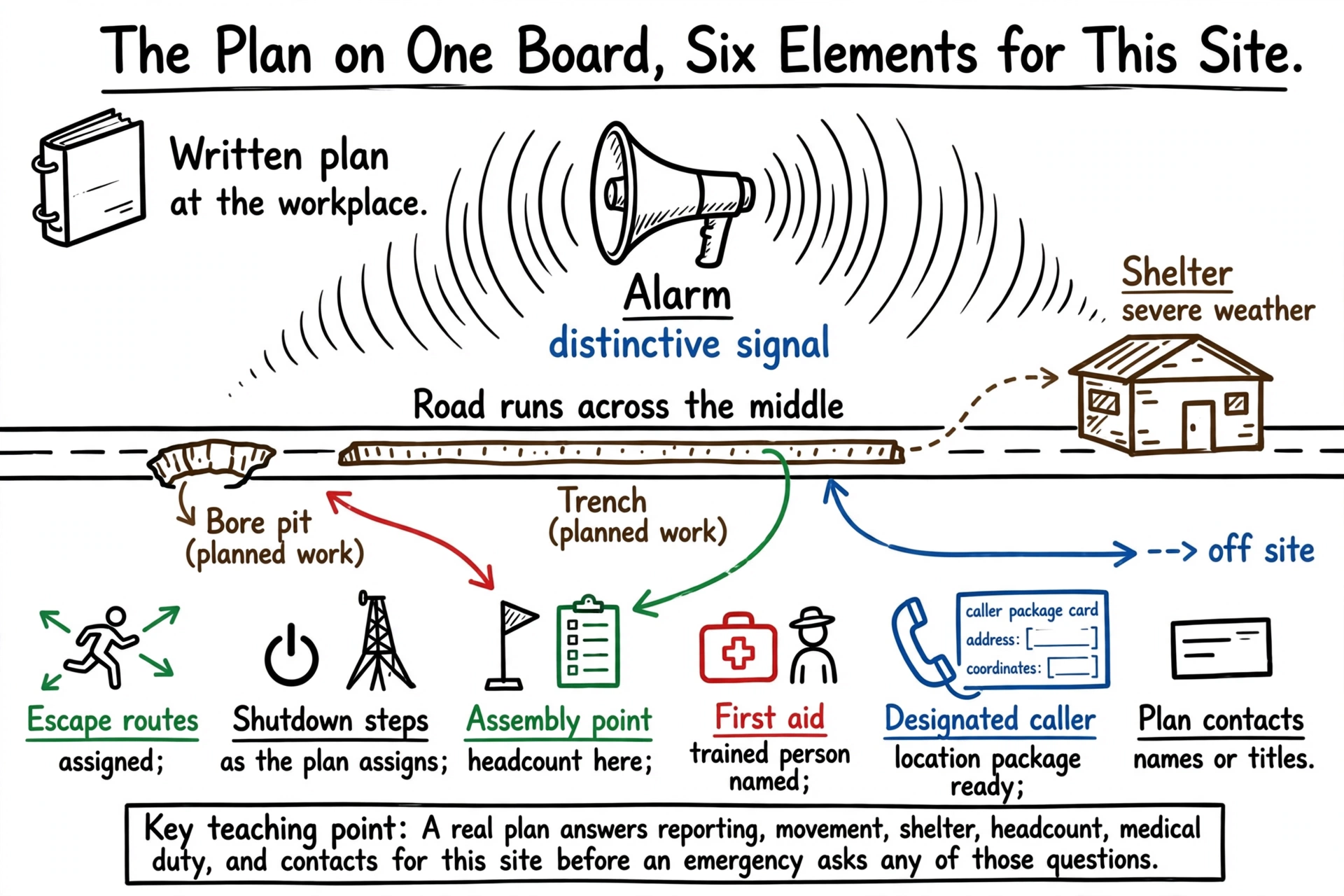
The six required elements. Section 1926.35(b) states the elements that, at a minimum, shall be included in the plan:
- Emergency escape procedures and emergency escape route assignments, under 1926.35(b)(1): the routes people use to leave the work area, the trench, the bore pit, or the structure and reach the assembly point.
- Procedures for employees who remain to operate critical plant operations before they evacuate, under 1926.35(b)(2): any shutdown step the plan assigns to a named person before that person leaves. Where the plan assigns no such step, the crew answer is that everyone leaves.
- Procedures to account for all employees after emergency evacuation has been completed, under 1926.35(b)(3): the headcount system, covering where people gather, who counts, and how a missing person gets reported.
- Rescue and medical duties for those employees who are to perform them, under 1926.35(b)(4): duties assigned to named or titled people, such as the trained first aid person under 1926.50, and never to the whole crew by default.
- The preferred means of reporting fires and other emergencies, under 1926.35(b)(5): the reporting path the plan selects for this site, such as the alarm, the call, or a radio channel.
- Names or regular job titles of persons or departments who can be contacted for further information or explanation of duties under the plan, under 1926.35(b)(6): a named human to ask before an emergency, and a contact for responders during one.
The alarm system. Section 1926.35(c)(1) requires the employer to establish an employee alarm system, meaning the method that warns everyone on the site that emergency action is required, and the system must comply with 29 CFR 1926.159, the construction employee alarm rule the plan rule points to. Section 1926.35(c)(2) adds that if the alarm system is used for alerting fire brigade members or for other purposes, a distinctive signal shall be used for each purpose. One sound cannot mean two different actions. The plan states which method this site uses, such as an air horn pattern or a radio call on a named channel, and states what each signal means. Direct voice warning counts as the alarm procedure only where the small workplace condition in the alarm guidance is met, with 10 or fewer employees in the workplace and every employee able to hear the warning. OSHA guidance on employee alarm systems explains the working test: the alarm provides warning for the emergency action the plan calls for, or reaction time for safe escape, and the alarm must be capable of being perceived by the employees who need the warning. A signal nobody can hear over a bore rig fails that test in practice.
Types of evacuation. Section 1926.35(d) requires the employer to establish in the plan the types of evacuation to be used in emergency circumstances. The plural matters. A fire or a gas release calls for leaving the area and gathering at an outdoor assembly point away from the hazard. A tornado calls for moving to shelter, a different destination and often a different direction. OSHA evacuation guidance makes the same point: a plan identifies the conditions under which an evacuation is necessary, and a plan may specify different actions for different emergencies, such as gathering in one area during a tornado and evacuating to an exterior location during a fire.
Training and review. Section 1926.35(e)(1) requires the employer, before implementing the plan, to designate and train a sufficient number of persons to assist in the safe and orderly emergency evacuation of employees. Section 1926.35(e)(2) requires review of the plan with each covered employee initially when the plan is developed, whenever the employee responsibilities or designated actions under the plan change, and whenever the plan is changed. Section 1926.35(e)(3) requires review with each employee upon initial assignment of the parts of the plan the employee must know to protect himself or herself in an emergency. A new face on the crew, a new segment, or a changed calling duty each reopen the review duty.
The medical side, under 1926.50.
- Medical advice. Section 1926.50(a) requires the employer to insure the availability of medical personnel for advice and consultation on matters of occupational health.
- Provisions before the project starts. Section 1926.50(b) requires provisions to be made prior to commencement of the project for prompt medical attention in case of serious injury.
- The trained first aid person. Section 1926.50(c) provides that in the absence of an infirmary, clinic, hospital, or physician that is reasonably accessible in terms of time and distance to the worksite and available for treatment of injured employees, a person who holds a valid certificate in first aid training from the U.S. Bureau of Mines, the American Red Cross, or equivalent training that can be verified by documentary evidence shall be available at the worksite to render first aid. The condition turns on reasonable accessibility in time and distance, judged for the worksite, and the credential must be valid and verifiable on paper. The rule states no headcount ratio and no number of minutes, and this lesson invents neither.
- First aid supplies. Section 1926.50(d)(1) requires first aid supplies to be easily accessible when required. Section 1926.50(d)(2) requires the contents of the first aid kit to sit in a weatherproof container with individual sealed packages for each type of item, and requires the employer to check the kit before the kit is sent out on each job and at least weekly on each job, so expended items get replaced. Section 1926.50(d) sets no contents list for the kit. The employer program for the job states what the kit for this work must contain.
- Transport or communication. Section 1926.50(e) requires proper equipment for prompt transportation of the injured person to a physician or hospital, or a communication system for contacting necessary ambulance service, to be provided. The plan states which route this site uses.
- Posted numbers and posted location. Section 1926.50(f)(1) provides that in areas where 911 emergency dispatch services are unavailable, the telephone numbers of the physicians, hospitals, or ambulances shall be conspicuously posted. Section 1926.50(f)(2) covers areas where 911 services are available and an employer uses a communication system to contact emergency medical service. The employer must ensure the system is effective in contacting the service. Where the system does not automatically supply the caller latitude and longitude to the 911 dispatcher, the employer must post in a conspicuous location at the worksite either the latitude and longitude of the worksite, or other location identification information that communicates the worksite location effectively to employees. The paragraph carries an exception for worksites with readily available telephone land lines whose 911 service automatically identifies the caller location. On a linear fiber job with no building address, this posting duty is the difference between a caller who can place responders and a caller who can only describe a ditch near a bend.
- Wash facilities. Section 1926.50(g) provides that where the eyes or body of any person may be exposed to injurious corrosive materials, suitable facilities for quick drenching or flushing of the eyes and body shall be provided within the work area for immediate emergency use. The duty follows the exposure.
Caller package and roles. The plan pulls the 1926.50(f) posting, the site address from the project documents, and the segment location into one caller package. A jobsite address on a fiber job may be a street address, an intersection, a mile marker, a structure number, or latitude and longitude, and the plan states the form responders will receive for this segment, together with the access point where a responder vehicle can reach the crew. The plan also assigns the roles an emergency needs. The person in charge holds authority to order an evacuation or a move to shelter and to direct a shutdown where the plan calls for one; OSHA evacuation guidance describes this coordinator as a responsible individual who leads and coordinates the plan and the evacuation, assesses whether an emergency exists, oversees the procedures, and notifies and coordinates with outside emergency services. The designated caller calls 911 or the emergency number for the area, gives the location package, and stays available as dispatch directs, with a named backup caller behind the assignment. The accounting person takes the headcount at the assembly point or shelter, holds the roster for the day, and reports the names and last known locations of anyone unaccounted for. The trained first aid person under 1926.50(c), where that paragraph applies, holds the medical duties with the first aid supplies under 1926.50(d). The evacuation assistants designated and trained under 1926.35(e)(1) help move people, including visitors and anyone who needs assistance, along the assigned routes. A fiber segment also hosts people a roster can miss: inspectors, landowners, delivery drivers, utility representatives, and crews from other employers. OSHA evacuation guidance calls for a method to account for non-employees and for procedures to assist visitors during evacuation, so the readiness check asks how a stranger who arrived twenty minutes ago would hear the alarm, learn the assembly point, and appear in the headcount.
Severe weather inside the plan. The types of evacuation under 1926.35(d) include the weather movements for the region and the season. OSHA tornado preparedness guidance describes planning that identifies a place to take shelter, uses familiarity with the community warning system, and establishes procedures to account for individuals. The same guidance states that an underground area, such as a basement or a storm cellar, provides the best protection from a tornado, and that where an underground shelter is unavailable, a small interior room or hallway on the lowest floor is the fallback the guidance describes, with flat wide span roof spaces avoided. A tornado watch means tornadoes are likely to occur in the watch area, and people should be ready to act quickly and take shelter. A tornado warning means a tornado has been sighted in the area or indicated by radar, and people take shelter immediately. For lightning, National Weather Service guidance is direct: when thunder roars, go indoors, meaning get into a fully enclosed building or a hardtop vehicle at the first rumble of thunder, and wait 30 minutes after the last sound of thunder before going back outdoors. The 30 minute wait is National Weather Service guidance, stated here as guidance. No paragraph of 1926.35 sets a wind speed, a lightning distance, or a shelter construction standard, and this lesson invents none.
Utility strike response at awareness level. Earlier Level 7 lessons covered locates and verification. The emergency plan covers the minutes after contact or damage happens, at awareness level: recognition and first movements only. Signs of a damaged gas facility can include a hissing sound, blowing dirt or water, and, where the gas is odorized, the rotten egg odor added to distribution gas so leaks can be smelled. Gas in a transmission line may carry no added odor, so a missing odor never rules out a leak. The plan response follows a fixed order: stop work, warn others, move people away from the area and upwind where the plan directs, keep ignition sources away from the release area, and from a safe location call 911 where the damage endangers people or property and notify the facility owner and the one call center as state law and the plan require. Utility and one call guidance states the same core: a person who smells gas contacts 911 and the local gas company, and nobody attempts to repair a damaged gas facility. Repair, valve operation, and reentry belong to the facility owner and to responders. For a damaged electric facility, the plan response is to keep people clear, treat the facility as energized, and call 911 and the owner from a safe location. The distances people move, the isolation steps, and the reentry decision belong to the plan, the facility owner, and the responders on scene. This lesson states no fixed footage, because no source in the lesson references sets one distance for every strike.
Hazardous substance releases and the limit of this plan. Section 29 CFR 1926.65, the construction rule for hazardous waste operations and emergency response, called HAZWOPER, covers defined operations listed in 1926.65(a)(1), including clean up operations required by a governmental body at uncontrolled hazardous waste sites, corrective actions involving clean up operations at sites covered by the Resource Conservation and Recovery Act, voluntary clean up operations at sites recognized by a governmental body as uncontrolled hazardous waste sites, operations involving hazardous wastes at treatment, storage, and disposal facilities regulated under the Resource Conservation and Recovery Act, and, under 1926.65(a)(1)(v), emergency response operations for releases of, or substantial threats of releases of, hazardous substances without regard to the location of the hazard, subject to the exposure limit in the opening language of 1926.65(a)(1). OSHA states that the construction HAZWOPER rule at 1926.65 is identical to the general industry rule at 29 CFR 1910.120. The jobsite plan under 1926.35 organizes reporting, evacuation, accounting, and first aid, and the jobsite plan confers no HAZWOPER qualification. A crew member who finds an unknown drum, contaminated soil, or a chemical release beyond a small release the employer program defines as incidental follows the plan by withdrawing, warning others, and notifying the designated contacts.
The general industry comparison, stated once and precisely. Readers who search for emergency plan rules will meet 29 CFR 1910.38, titled Emergency action plans, in Subpart E of Part 1910. Part 1910 carries the general industry standards. Part 1926 carries the construction standards, and 1926.35 is the construction counterpart that governs a fiber construction jobsite. The two rules differ in text. Section 1910.38(c) lists reporting procedures first, at (c)(1), while 1926.35(b) lists escape procedures first and reporting at (b)(5). Section 1910.38(d) requires an alarm system complying with 29 CFR 1910.165, the general industry alarm rule, while 1926.35(c)(1) points a construction alarm to 1926.159. Section 1910.38(b) states the written plan and the oral option in one paragraph, while 1926.35 states the writing duty in (a) and the oral option in (e)(3). A template built on 1910.38 paragraph letters will mislabel a construction plan even where the underlying practice is sound, so the readiness check cites the construction paragraphs for a construction site.
What Does It Look Like?
A beginner can confirm an emergency plan by looking for physical and spoken evidence on the site:
- The written plan, where the employer maintains a written plan, sits at the workplace and is available for review, in the job trailer, the foreman truck, or the location the employer program names, and a crew member can produce the plan without a search.
- A posted sheet or plan page shows the emergency numbers for the area, the site address or location information for this segment in the form 1926.50(f) requires where that paragraph applies, the assembly point, the shelter location, and the names or titles for the roles the plan assigns.
- The assembly point is a real place a beginner can walk to and point at, clear of the work area, the travel lanes, and the hazard the evacuation escapes, with room for the whole crew and a route that crosses no trench, pit, or live lane without a controlled crossing.
- The shelter location for severe weather is a named place, identified before any weather arrives, with a route short enough to use under warning conditions as the plan judges for this ground.
- The alarm method for the site is present and known: the horn, radio channel, or voice procedure the plan names, with each signal meaning stated, and crew members can repeat the meaning without guessing.
- The first aid kit sits where the plan says, in a weatherproof container, easily accessible, with sealed packages and evidence of the check the rule requires, with no empty slots where expended items were used and never replaced.
- The trained first aid person for the day is present or the accessible facility the plan relies on is identified, and crew members can name the person or the facility without help.
- The roster for the day exists in a form the accounting person can carry to the assembly point, covering employees and the visitors or other crews expected on the segment.
- Crew members, asked one at a time, give the same answers for the alarm meaning, the assembly point, the shelter, the caller, and the site address. Matching answers are the visible sign of the reviews 1926.35(e) requires.
- The plan matches the segment under construction today: current access point and current assembly and shelter choices, rather than a copy carried over from a finished segment.
What Does It Do?
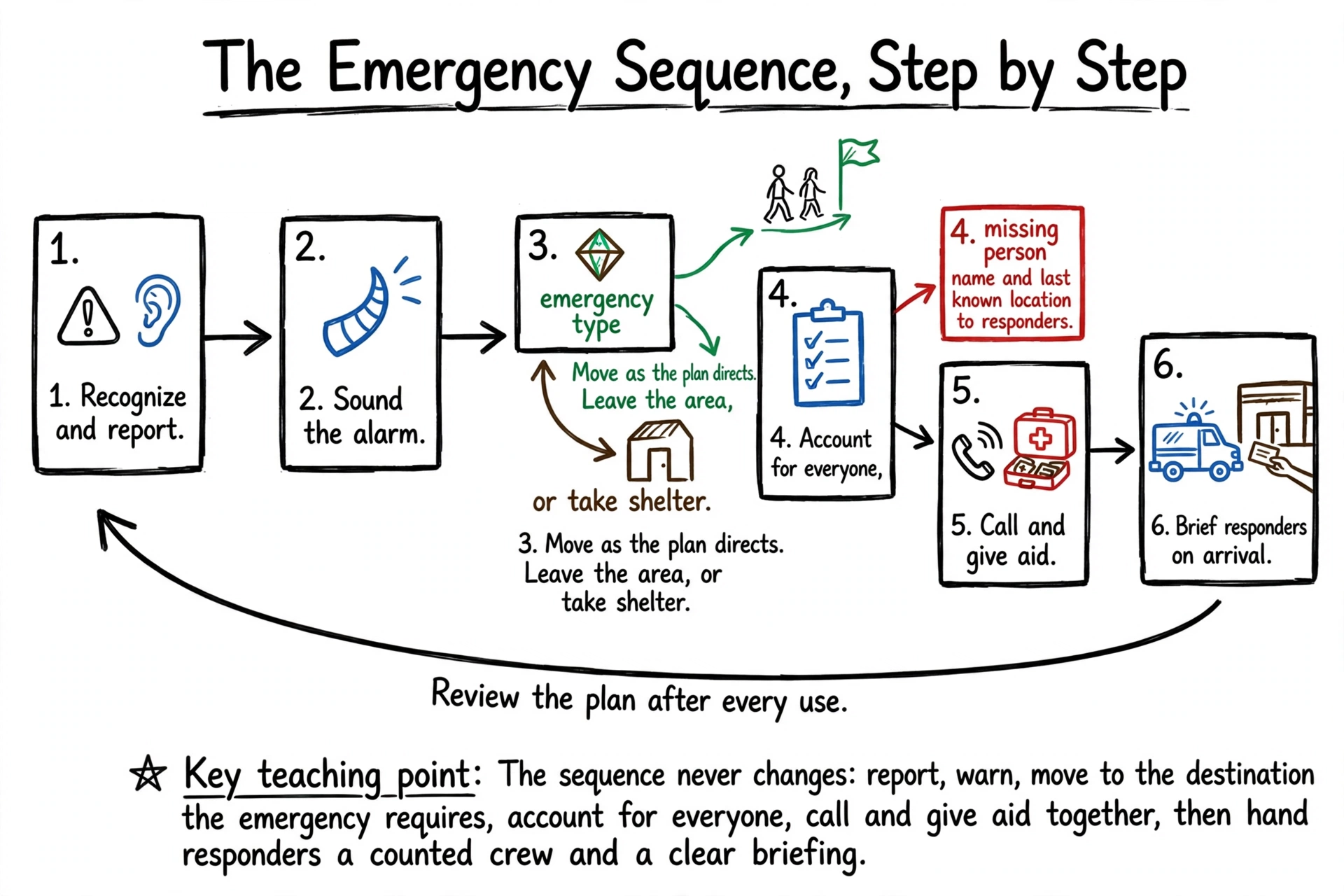
The plan converts panic decisions into assigned steps. An emergency presents simultaneous questions. Who calls? Who helps the injured person? Which way do people move? Where do they gather? Who checks the pit and the far end of the segment? An unplanned crew answers by shouting, duplicating some tasks, and skipping others. A planned crew answers from assignment. The designated caller calls, the trained person renders aid, the assistants move people, and the accounting person counts.
Reporting starts treatment and response at the same time. The preferred means of reporting under 1926.35(b)(5), joined with the communication or transport provision under 1926.50(e), sets two clocks running together. One clock brings outside help toward the site. The other clock starts first aid at the site. A posted location package under 1926.50(f) shortens the call itself, because the caller reads an address or coordinates instead of composing a description under stress.
The alarm buys reaction time. Evacuation and shelter movements only help people who start moving early. The alarm system under 1926.35(c) exists to start everyone at once, including the worker at the far end of the segment, the operator inside a cab with hearing protection, and the visitor who does not know the crew voices. A distinctive signal also prevents confusion: a warning that sounds like a routine horn blast gets filtered out as background noise, while a signal reserved for emergency action, with a separate signal for any second purpose under 1926.35(c)(2), reads as an order to move.
Escape routes and assignments prevent route invention. Under stress, people retrace the path they arrived on, even when that path crosses the hazard. Assigned routes under 1926.35(b)(1), matched to the types of evacuation under 1926.35(d), replace habit with a chosen path: away from a release and upwind where the plan directs, toward shelter for a tornado, out of a trench or pit by the access the plan names. Assignments also settle the far end problem on a linear segment that stretches beyond shouting distance.
Accounting turns an evacuation into information. The headcount under 1926.35(b)(3) produces the fact responders need after location: whether anyone is missing, and where that person was last known to be. Without an accounting procedure, responders receive a guess, and a guess can send a rescue effort to the wrong place. With a roster, an assembly point, and a named accounting person, the crew hands responders a name and a last known location, and the crew also learns quickly when everyone is safe.
Assigned medical duties keep aid inside qualification. Section 1926.35(b)(4) ties medical duties to the employees who are to perform them, and 1926.50(c) ties first aid at a site without reasonably accessible care to a person with a valid, verifiable certificate. Together the rules create a chain: the plan names the duty holders, the credential rule verifies the holders, and everyone else holds supporting roles such as calling, guiding the ambulance in, clearing a path, and bringing the kit.
Review keeps the plan attached to the real site. A fiber segment changes ground daily, access points shift, and crew membership turns over, so a plan decays as the site changes. The review duties in 1926.35(e) attach a new person to the plan on initial assignment, attach the plan to new role holders when responsibilities change, and attach the crew to a new assembly point, shelter, or caller package when the plan changes, before an emergency tests the change.
The plan gives responders a working site on arrival. Responders act sooner when the site hands them a location responders could drive to, a person in charge who can brief them, a headcount with names and last known locations for anyone missing, and clear access to the patient or the hazard. The plan produces all four as byproducts of the plan elements.
Where Does It Fit?
The emergency plan sits across the whole life of the job, with the readiness moment inside Level 7 preparation:
- During planning, the employer program establishes the plan framework, and project planning identifies the facilities, hazards, and weather exposures the site plan must address, including the medical facility picture behind the 1926.50(c) accessibility judgment.
- During preconstruction, earlier Level 7 lessons confirmed prints, permits, locates, and verified utilities. The emergency plan draws on the same documents for access points, facility locations, and segment geography.
- In the job briefing sequence, the plan is reviewed with the crew for the segment, roles are named for the day, and the caller package, assembly point, and shelter are confirmed against the ground the crew will actually work.
- Immediately before work starts each day, and again when the segment, the crew, the weather picture, or the access changes, the readiness check in this lesson retests the plan against the site. A changed assembly point that nobody briefed is a failed check.
- During construction, the plan governs any emergency, and the reviews and updates the employer program schedules keep the plan current. Section 1926.35 sets review duties and sets no drill schedule, so drill timing belongs to the employer program, the contract, or a state plan where one applies.
- After any emergency or near emergency, the plan gets reviewed against what actually happened, and changes flow back through the 1926.35(e)(2) review duty, so the next crew inherits a corrected plan rather than a story.
- Later levels build on this readiness base. Traffic control, excavation, boring, splicing, and restoration lessons each add hazard specific duties, and each assumes the reporting, evacuation, accounting, and medical chain from this lesson already works.
What Is at Stake
Life and injury severity. The first minutes after a serious injury, a fire, or a gas release decide outcomes that later care can only limit. A plan that starts aid, starts the call, and clears the area at once gives the injured person the earliest treatment the site can arrange, which is the outcome 1926.50(b) aims at by requiring provisions for prompt medical attention before the project begins. A missing plan spends those minutes on confusion, and confusion at that scale is measured in harm.
Responder effectiveness. Responders act on the information the site gives them. A precise location, a named person in charge, and an accurate headcount let responders go directly to the patient or the hazard with the right equipment. A vague location on a linear job or a missing headcount costs responders time on a scene where time was the scarce resource from the first second.
Legal and regulatory exposure. Sections 1926.35 and 1926.50 state employer duties in mandatory language. A plan that lacks a required element, a first aid arrangement that exists only as an intention, or reviews that never happened each expose the employer to citation after an inspection or an incident investigation. State plans and contract terms can add duties beyond the federal floor, and the plan for the job must satisfy the full set that applies.
Schedule and cost. An emergency handled under a plan still stops work. An emergency handled without one stops work longer, because accounting drags, responders wait for information, and the investigation that follows finds confusion where a record should be. Sites also lose the days after an incident to corrective actions that a readiness check would have completed in minutes on a calm morning.
Crew confidence. A crew that knows the caller, the kit, the trained person, the assembly point, and the shelter works with a settled mind, and a new hire who receives the 1926.35(e)(3) review on initial assignment learns on day one that the employer planned for the worst day as carefully as for the production days. A crew that discovers the gaps during an emergency carries that lesson to the next employer.
Public and landowner trust. Fiber work happens in neighborhoods, on county roads, and across private land. An evacuation handled calmly, a gas release reported at once with people moved clear, and a responder briefing given by a named person in charge read to the public as professionalism under pressure. A chaotic scene, filmed from a porch, becomes the reputation of the project and of every crew that follows on that road.
What Does Good Look Like?
- The plan for this site, in the form the employer maintains, covers all six elements of 1926.35(b) and can be produced at the workplace on request, with the oral form under 1926.35(e)(3) confirmed where that exception is the form in use.
- Every crew member can state the alarm method and signal meanings for this site, the assigned escape routes, the assembly point, and the severe weather shelter, and the answers match from person to person.
- The types of evacuation in the plan fit the emergencies this site can face, with leaving the area for fire or a gas release and moving to shelter for a tornado treated as different movements with different destinations.
- The caller package is posted or carried as the plan directs: emergency numbers, the site address or the location information 1926.50(f) requires for this site, and the access point for responders. As a matter of plan practice, the plan for the day also names one designated caller and a backup caller.
- First aid readiness checks out in the field: supplies easily accessible in a weatherproof container with sealed packages and a current check behind them, the trained person under 1926.50(c) present where that paragraph applies or the accessible facility identified, and transport equipment or a tested communication system under 1926.50(e) in place.
- Roles for the day are named and known: person in charge, designated caller and backup, accounting person with the roster, evacuation assistants, and the first aid duty holders under 1926.35(b)(4).
- Visitors and other employers on the segment are inside the system: briefed on arrival, covered by the accounting method, and able to hear and understand the alarm.
- Any change to the segment, the crew, the access, the assembly point, the shelter, or the plan itself has been reviewed with the crew under 1926.35(e)(2) before work resumes under the changed condition.
From the Field
Picture a bore crew opening a pit on a rural road segment, with a handhole to set, a locator walking the bore path, and a delivery expected before noon. The morning briefing covered production. The emergency plan lived in a binder in the job trailer, written for a segment the crew finished the week before. The posted sheet at the trailer still showed the old assembly point, a church lot the crew no longer passes, and no location information for the current segment had been posted anywhere.
Midmorning, the bore head found an unmarked line and the pit filled with a strong gas odor, with a faint hissing at the bore path. The operator shut the rig down. The locator, standing downwind with a headache starting, asked the question nobody could answer cleanly: who calls, and what address does the caller give?
The foreman made the movement decision the plan should have made in advance. Work stopped, the crew moved on foot away from the pit and upwind to the shoulder by the crew trucks, clear of the road, and the foreman kept everyone there. A crew member started a vehicle before the foreman waved the keys down, and the lesson about ignition sources near a suspected release arrived by luck rather than by training.
The calling decision took longer. Two crew members dialed at once, a third searched a phone for an address the segment does not have, and the caller who reached dispatch described a bend in a county road and a creek crossing. Dispatch asked for latitude and longitude or a cross street, and nobody on the crew had either ready. The utility emergency line was called after dispatch, from a number found in a search, rather than from a posted sheet.
The accounting decision failed quietly. The headcount at the trucks counted the bore crew and missed the delivery driver, who had arrived early, parked beyond the pit, and walked toward the work to find the foreman. An evacuation assistant role existed in no briefing that morning, so nobody held the job of sweeping the segment. The driver was found by chance, upwind and safe, and the count was corrected by memory rather than by roster.
Responders and the gas utility arrived, took control of the pit area, and confirmed the crew had done the two things that mattered most: people moved clear, and nobody tried to repair the line or restart equipment near the release. The utility also recorded the delays plainly. The location description cost response time, the double calling confused the first report, and the missed visitor could have placed a person inside the hazard area during a larger release.
The foreman rebuilt readiness for the next segment before any ground opened. The plan was rewritten for the current ground, the assembly point and the shelter were walked with the whole crew, the caller and the backup were named out loud, the location package for the segment was posted at the trailer and carried in the foreman truck, and the visitor habit changed to a briefing and a roster entry at arrival.
The rule to carry is simple: an emergency plan is real only when the crew can execute the reporting, the movement, and the headcount for this segment without inventing any part under pressure, and a plan the crew has to invent during the emergency is a hold on starting work until the plan is made real.
What Can Go Wrong?
A generic plan copied from another site. The binder names an assembly point, a shelter, and a hospital route for ground the crew left last week. During an emergency the crew follows the paper toward a place that no longer fits, or wastes the first minutes discovering the mismatch. Site specific review under 1926.35(e) exists to prevent exactly this failure.
An alarm nobody recognizes. The site uses a horn pattern the crew also hears for routine signals, or a radio call on a channel half the crew monitors. People at the far end of the segment keep working through the first minutes of a release or a fire, inside the hazard the alarm was meant to clear. A signal without a distinctive meaning under 1926.35(c)(2) is noise.
No named caller, or three callers at once. Everyone assumes someone else called, so nobody calls, or several people call with conflicting locations and headcounts. Dispatch receives confusion instead of a location package. The designated caller and backup exist to make the call singular, prepared, and complete.
A caller package with no usable location. The segment has no street address, the posted sheet was never updated, and the caller cannot give latitude and longitude, a cross street, or an access point. Section 1926.50(f)(2) addresses this failure directly for covered communication systems, and a linear jobsite lives inside this failure mode every day the posting is stale.
An assembly point inside the problem. The gathering place sits downwind of the work, across a live lane, or beside the fuel point. The evacuation succeeds and the gathering fails, because the crew assembles inside a second exposure.
A headcount with no roster. The accounting person counts heads from memory, misses a visitor, a new hire, or a crew member who left for parts, and reports certainty the count never earned. Responders then plan around a wrong fact, in the direction that wastes a search or ends a search early.
A first aid kit that fails on opening. The container is weathered, packages are open or missing, and expended items were never replaced because the weekly check under 1926.50(d)(2) never happened. The kit was present for every photograph and useless at the only moment that counted.
No trained person where the rule requires one. The site sits beyond reasonably accessible care, the certificate holder called out, and no replacement arrangement exists. Section 1926.50(c) ties the duty to availability at the worksite, and a certificate held by an absent person renders no aid.
Weather movement left improvised. A tornado warning arrives, the plan names no shelter, and the crew debates truck cabs, culverts, and the trench in real time. OSHA tornado guidance treats shelter identification as planning work, done before the warning, and a debate during a warning is the visible sign the planning never happened.
Help attempted beyond qualification. A willing crew member enters a pit to pull out an overcome coworker, handles a chemical release, or tries to close a valve on a damaged gas facility. Unassigned rescue converts one patient into two and one release into a larger incident. The plan assigns rescue and medical duties under 1926.35(b)(4) precisely so willingness is channeled into calling, clearing, guiding, and counting.
What Should Someone Notice in the Field?
- Ask any crew member, away from the group, to state the alarm method and meaning, the escape route, the assembly point, and the shelter for this segment, and compare answers across the crew.
- Produce the plan in the form the employer maintains, and read the six elements of 1926.35(b) against the document or the oral account, naming any element that is missing or stale.
- Walk to the assembly point and to the shelter, confirm each place exists for the current segment, and judge the routes for trench crossings, live lanes, and downwind exposure.
- Read the caller package where the plan posts the package: emergency numbers, site address or location information, access point, designated caller, and backup caller, and confirm the package matches the segment under construction today.
- Open the first aid kit. Check the weatherproof container, the sealed packages, the accessibility of the location, and the evidence of the check required before the job and weekly during the job.
- Name the trained first aid person present today or the accessible facility the plan relies on, and name the transport equipment or the communication system the site uses under 1926.50(e), with a test or a recent use that proves the system reaches help.
- Confirm the roster for the day covers employees, visitors, delivery drivers, and other employers on the segment, and name the accounting person who carries the roster to the assembly point.
- Confirm the weather picture for the day has been checked, the shelter decision needs no debate, and the crew knows the lightning guidance the employer program follows.
- Confirm utility strike first movements are known at awareness level: stop, warn, move clear, no repair attempt, call from a safe location, and notify the owner as the plan directs.
- Know the boundary: confirming that a plan exists, that roles are named, and that supplies and postings are in place are readiness tasks covered by this lesson. Writing the employer emergency program, judging legal compliance of a plan, performing rescue, entering a confined space or an excavation to reach a victim, working on energized facilities, operating valves on a damaged gas facility, and responding to a hazardous substance release belong to qualified and designated people under the rules that govern each activity, including 1926.65 where that rule applies. Reading this lesson qualifies no one to perform rescue, confined space entry, electrical work, or hazardous substance response, and no one should attempt those tasks on the strength of this lesson.
Key Terms
Emergency action plan: The written set of decisions, required in writing under 1926.35(a) with a narrow oral exception, that covers the actions employers and employees take for safety from fire and other emergencies, including escape, accounting, medical duties, reporting, and plan contacts.
Employee alarm system: The warning method the employer establishes under 1926.35(c) to alert everyone on the site that emergency action is required, complying with 1926.159 and using a distinctive signal for each purpose where the system serves more than one purpose.
Assembly point: The designated place outside the work area where people gather after an evacuation so the accounting person can take the headcount the plan requires.
Designated caller: The person the plan assigns to call 911 or the emergency number for the area, deliver the site location package, and remain available to dispatch, with a named backup caller behind the assignment.
Caller package: The location and contact information a caller uses for this segment, covering emergency numbers, the site address or posted location information, the responder access point, and the contacts the plan names.
First aid person: Where 1926.50(c) applies, the person available at the worksite who holds a valid certificate in first aid training from the U.S. Bureau of Mines, the American Red Cross, or equivalent training verifiable by documentary evidence.
Tornado watch: A National Weather Service issuance meaning tornadoes are likely to occur in the watch area, calling for readiness to act quickly and take shelter.
Tornado warning: A National Weather Service issuance meaning a tornado has been sighted in the area or indicated by radar, calling for shelter immediately.
HAZWOPER: The hazardous waste operations and emergency response rules at 1926.65 for construction and 1910.120 for general industry, covering defined clean up operations and emergency response operations for hazardous substance releases, with training and qualification duties beyond a jobsite emergency action plan.
Check Your Understanding
- Name the six elements 1926.35(b) requires, at a minimum, in an emergency action plan.
Answer: Emergency escape procedures and escape route assignments; procedures for employees who remain to operate critical plant operations before evacuating; procedures to account for all employees after evacuation; rescue and medical duties for the employees who are to perform them; the preferred means of reporting fires and other emergencies; and names or regular job titles of persons or departments who can be contacted for further information or explanation of duties under the plan.
- An employer with eight employees total works a segment, and the foreman says the plan is oral, so no elements, alarm, or training duties apply. Evaluate that claim under 1926.35.
Answer: The claim fails. Section 1926.35(e)(3) allows an employer with 10 or fewer employees to communicate the plan orally and skip the written plan. The exception covers form only. The elements in 1926.35(b), the alarm system in 1926.35(c), the evacuation types in 1926.35(d), and the designation, training, and review duties in 1926.35(e) still apply, and the crew still needs each part confirmed before work starts.
- The worksite sits where a 911 call from a crew phone does not automatically give dispatch the caller location. What posting duty does 1926.50(f)(2) create for an employer using a communication system to contact emergency medical service, and why does that duty matter on a linear fiber segment?
Answer: The employer must ensure the communication system is effective in contacting the service, and must post in a conspicuous location at the worksite either the latitude and longitude of the worksite or other location identification information that communicates the worksite location effectively to employees, unless the land line exception in the paragraph applies. A linear segment often has no street address responders can drive to, so the posted location information is the difference between a caller who places responders and a caller who describes scenery.
- In the From the Field scenario, name three plan failures that cost time or safety, and state the fix the foreman applied before the next segment opened.
Answer: Any three of the following count. The plan and the posted sheet covered a finished segment, with a stale assembly point and no location information for the current ground. No designated caller or backup existed, so two people called at once with a vague location while a third searched for an address. No evacuation assistant or sweep duty existed, and the headcount missed a delivery driver who had arrived early. No ignition source briefing had landed, so a crew member nearly started a vehicle near a suspected release. The fix was a site specific rewrite and walk through: assembly point and shelter walked with the crew, caller and backup named aloud, the segment location package posted and carried in the foreman truck, and visitors placed on the roster with a briefing at arrival.
- A tornado warning is issued for the segment, and a crew member says the plan only lists the outdoor assembly point, so the crew should gather there. What is wrong with that answer under 1926.35(d) and OSHA tornado guidance?
Answer: Section 1926.35(d) requires the plan to establish the types of evacuation to be used in emergency circumstances, and different emergencies call for different movements. OSHA tornado guidance calls for moving to an identified shelter, with an underground area giving the best protection and a small interior room or hallway on the lowest floor as the fallback the guidance describes, and a warning means shelter immediately. An outdoor assembly point is the destination for leaving a hazard such as a fire or a release. Gathering outdoors during a tornado warning follows the wrong movement for the emergency.
Lesson Takeaway
An emergency plan earns trust only in the field. After this lesson, a jobsite reads as a set of confirmations: a plan with all six required elements for this ground, an alarm everyone recognizes, routes and destinations matched to the emergency, a caller with a location package that places responders, a headcount backed by a roster, and first aid that opens, checks, and belongs to a named trained person. Any confirmation that fails reads as a hold, and closing the gap on a calm morning is the cheapest safety work on the whole job.
Sources and Technical References
U.S. Occupational Safety and Health Administration, 29 CFR 1926.35, Employee emergency action plans. Construction standard in Subpart C. Paragraph (a) sets scope, the writing duty, and coverage of designated actions for fire and other emergencies. Paragraph (b) lists the six minimum elements. Paragraph (c) requires an employee alarm system complying with 1926.159 and a distinctive signal for each purpose. Paragraph (d) requires the plan to establish the types of evacuation. Paragraph (e) sets designation, training, and review duties, keeps the written plan at the workplace, and states the oral option for employers with 10 or fewer employees: https://www.osha.gov/laws-regs/regulations/standardnumber/1926/1926.35
U.S. Occupational Safety and Health Administration, 29 CFR 1926.50, Medical services and first aid. Construction standard in Subpart D. Paragraph (a) covers medical personnel for advice. Paragraph (b) requires provisions for prompt medical attention before the project commences. Paragraph (c) sets the trained first aid person condition and credential. Paragraph (d) sets supply accessibility, weatherproof container, sealed packages, and checking before each job and at least weekly. Paragraph (e) covers transport equipment or a communication system. Paragraph (f) covers posted numbers where 911 is unavailable and posted location information where a communication system does not automatically supply caller location. Paragraph (g) covers drenching and flushing facilities for corrosive exposure: https://www.osha.gov/laws-regs/regulations/standardnumber/1926/1926.50
U.S. Occupational Safety and Health Administration, 29 CFR 1910.38, Emergency action plans. General industry standard in Subpart E of Part 1910, cited in this lesson only to distinguish the general industry rule and its paragraph structure from the construction rule at 1926.35 that governs a fiber construction jobsite: https://www.osha.gov/laws-regs/regulations/standardnumber/1910/1910.38
U.S. Occupational Safety and Health Administration, 29 CFR 1926.65, Hazardous waste operations and emergency response. Construction HAZWOPER standard. Paragraph (a)(1) lists the covered operations, including emergency response operations for releases of, or substantial threats of releases of, hazardous substances under (a)(1)(v): https://www.osha.gov/laws-regs/regulations/standardnumber/1926/1926.65
U.S. Occupational Safety and Health Administration, Hazardous Waste Operations and Emergency Response (HAZWOPER) Background. States that the HAZWOPER standard for the construction industry at 29 CFR 1926.65 is identical to 29 CFR 1910.120, and describes the operations the standard covers: https://www.osha.gov/emergency-preparedness/hazardous-waste-operations/background
U.S. Occupational Safety and Health Administration, Evacuation Plans and Procedures eTool, Emergency Action Plan Checklist. Covers identifying the conditions under which an evacuation is necessary, designating a coordinator with authority to order an evacuation or shutdown, and specifying different actions for different emergencies such as sheltering for a tornado and evacuating outside for a fire: https://www.osha.gov/etools/evacuation-plans-procedures/eap/develop-implement/checklists
U.S. Occupational Safety and Health Administration, Evacuation Plans and Procedures eTool, Evacuation Elements. Covers designating assembly areas, taking a head count after evacuation, identifying the names and last known locations of anyone unaccounted for and passing them to the official in charge, and establishing a method for accounting for non-employees: https://www.osha.gov/etools/evacuation-plans-procedures/eap/elements
U.S. Occupational Safety and Health Administration, Evacuation Plans and Procedures eTool, Employee Alarm Systems. Explains that an employee alarm system provides warning for necessary emergency action under the plan or reaction time for safe escape, and that the employee alarm shall be capable of being perceived above ambient noise or light levels by all employees in the affected portions of the workplace: https://www.osha.gov/etools/evacuation-plans-procedures/emergency-standards/employee-alarms
U.S. Occupational Safety and Health Administration, Tornado Preparedness and Response, Preparedness. Covers planning that identifies a place to take shelter, familiarity with the community warning system, and procedures to account for individuals. States that an underground area such as a basement or storm cellar provides the best protection, gives fallback shelter guidance, and defines a tornado watch and a tornado warning: https://www.osha.gov/tornado/preparedness
U.S. Occupational Safety and Health Administration, Emergency Preparedness and Response, Getting Started. States that two OSHA standards, 29 CFR 1910.38(a) and 29 CFR 1926.35, require written emergency action plans, and that an emergency action plan is intended to facilitate and organize employer and worker actions during workplace emergencies: https://www.osha.gov/emergency-preparedness/getting-started
National Weather Service, National Oceanic and Atmospheric Administration, Lightning Safety, When Thunder Roars, Go Indoors. Recommends getting into a fully enclosed building or hardtop vehicle at the first rumble of thunder and waiting 30 minutes after the last sound of thunder before going back outdoors: https://www.weather.gov/jkl/lightningsafety
Pennsylvania One Call System, Frequently Asked Questions. States that a person who smells gas contacts 911 and the local gas company, with the local one call center as the contact path where the gas company number is unknown: https://www.pa1call.org/pocs/484d2be6-7c87-4464-b190-af1ccd61fdf2/Frequently-Asked-Questions
Public Utilities Commission of Nevada, Call Before You Dig. States that a person who breaks a natural gas line moves to a safe location, calls 911 and the natural gas utility, and never attempts to control the gas flow or make repairs to a gas line or any utility line when damage occurs: https://www.puc.nv.gov/safety/call-before-you-dig/
Previous lesson: Lesson 141: What Are the Work Limits? |
Back to Level 7 hub |
Next lesson: Lesson 143: Is the Site Actually Ready for Construction?