
Introduction
An equipment readiness check is a deliberate inspection and function test, done before a machine starts work, that confirms the machine is in safe operating condition, free of apparent damage that could cause failure in use, and cleared for service under the rules that govern that machine type. The check ends in a verdict for each machine: ready, or held out of service until a defect is corrected.
Level 7 prepares a jobsite before ground opens. Earlier lessons in this level covered prints, permits, locates, verified utilities, and materials. This lesson covers the machines that do the work: the drill, the excavator, support trucks, and any aerial device or crane the segment uses. A briefed crew with ready materials still loses the day, and can get hurt, when a machine arrives at the start line with a failed brake, a leaking hydraulic line, or a safety device that does not work.
What This Lesson Gives You
- Run a beginning of shift check on a jobsite vehicle against the federal list in 29 CFR 1926.601(b)(14) and hold the vehicle when any listed item fails.
- Tell apart the inspection layers that apply to different machines: the general competent person inspection program, the shift check, and the documented monthly and annual inspections that apply to cranes.
- Apply the manufacturer pre-start routine for a horizontal directional drill and for an aerial device, following the operator manual for that model rather than a generic habit.
- Tag, lock, or remove a defective machine so no one places it in service by mistake, and record the defect for the person who will repair it.
- Resequence a segment around a held machine, working only the tasks whose equipment passed its check in full.
Start With the Basics
Think about a pilot walking around a small plane before a flight. The pilot looks at the control surfaces, checks fuel and oil, looks for leaks and damage, and then runs the engine and tests the controls before anyone boards. A defect found on the ramp costs minutes and a mechanic visit. The same defect found in the air costs far more, and some defects found in the air cannot be corrected at all.
An equipment readiness check works through the same mechanism on the ground. The walkaround finds visible damage, leaks, low fluids, worn tires or tracks, and missing guards while the machine sits still. The function test then runs the machine and confirms that brakes hold, steering answers, controls respond, horns and alarms sound, and safety devices do their job. The check happens while a correction still costs a repair, a replacement machine, or a resequenced day. Once a bore is running, a bucket is over a trench, or a platform is in the air, the same defect has a crew committed around a machine that should never have started.
One difference matters. A pilot follows one checklist for one aircraft. A fiber jobsite holds several machine types at once, and federal rules set a different inspection floor for each type. The readiness check starts by naming which rule governs the machine in front of the checker, then follows that rule and the manufacturer manual for that model.
What Is It?
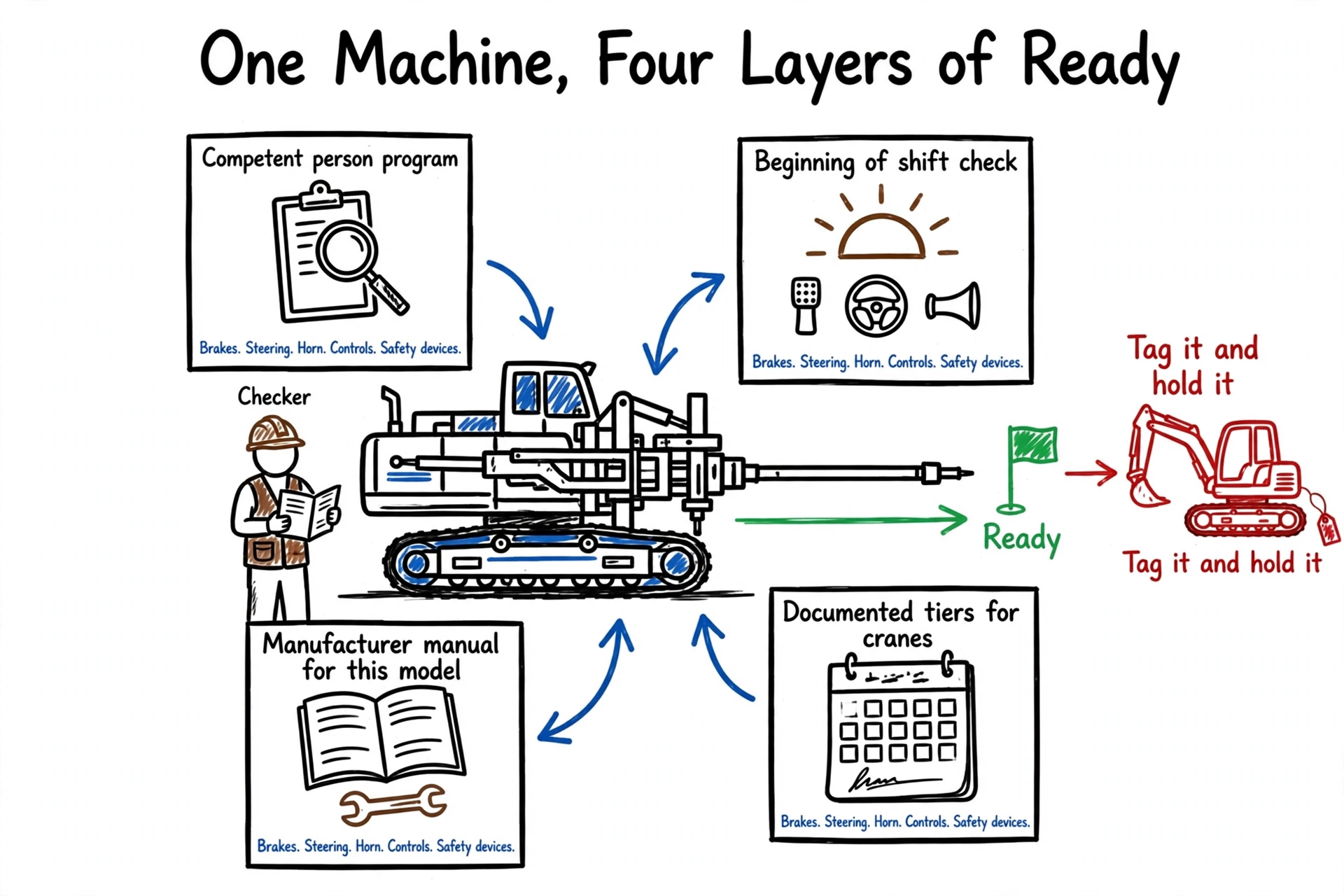
An equipment readiness check is an inspection with a verdict, performed before work and repeated at the interval the governing rule sets. The check rests on four layers, and a machine is ready only when every layer that applies to it has been satisfied.
Layer one: the general inspection program. Federal OSHA rule 29 CFR 1926.20(b)(2) requires the employer accident prevention program to provide for frequent and regular inspections of job sites, materials, and equipment, made by competent persons designated by the employer. A competent person is a person capable of identifying existing and predictable hazards in the surroundings or working conditions, and who has authorization to take prompt corrective measures to eliminate them. The same section, at 1926.20(b)(4), permits only employees qualified by training or experience to operate equipment and machinery. Section 1926.20(b)(3) sets the consequence for a failed check: the use of any machinery, tool, material, or equipment that does not comply with an applicable requirement is prohibited, and the item is identified as unsafe by tagging or locking the controls to render it inoperable, or it is physically removed from its place of operation. Crews call that state out of service: the machine stays parked and marked until the defect is corrected.
Layer two: the shift check for jobsite vehicles. Section 1926.601 covers motor vehicles that operate within an off-highway jobsite not open to public traffic, and it does not apply to equipment for which rules are prescribed in 1926.602. At 1926.601(b)(14), all vehicles in use are checked at the beginning of each shift to assure that listed parts, equipment, and accessories are in safe operating condition and free of apparent damage that could cause failure while in use. The federal list names service brakes including trailer brake connections, the parking system, the emergency stopping system, tires, horn, steering mechanism, coupling devices, seat belts, operating controls, and safety devices. The rule extends the same check to lights, reflectors, windshield wipers, defrosters, and fire extinguishers where that equipment is necessary. The verdict is written into the rule: all defects are corrected before the vehicle is placed in service.
Layer three: earthmoving equipment. Section 1926.602(a) covers earthmoving equipment such as scrapers, loaders, crawler or wheel tractors, bulldozers, off-highway trucks, and graders. Paragraph (a) sets the equipment requirements that a check verifies for the earthmoving equipment it lists, including seat belts under paragraph (a)(2), a service braking system capable of stopping and holding the equipment fully loaded under paragraph (a)(4), a horn on bidirectional machines under paragraph (a)(9)(i), and a reverse signal alarm or an employee signal for equipment with an obstructed view to the rear under paragraph (a)(9)(ii). Paragraph (b), Excavating and other equipment, carries its own narrower requirements, and excavators are covered under paragraph (b), not paragraph (a). Section 1926.602 contains no beginning of shift inspection clause of its own. Inspection for these machines rests on the frequent and regular competent person inspections under 1926.20(b)(2), together with the manufacturer manual and any employer or contract inspection program. A start of shift check using the 1926.601 list is a sound company practice for an excavator or loader. It should be recorded as company practice, and never described as a federal shift rule that 1926.602 does not contain.
Layer four: machines with their own inspection tiers. Two machine families carry detailed federal inspection schedules that sit on top of the general program:
- Cranes and derricks in construction, under 29 CFR 1926.1412. A competent person begins a visual shift inspection before each shift the equipment will be used, and the inspection is completed before or during that shift, observing for apparent deficiencies. Each month the equipment is in service, the shift inspection items are inspected again and documented, with the items checked, the results, the inspector name and signature, and the date retained for a minimum of three months. At least every 12 months, a qualified person performs the annual or comprehensive inspection, documented and retained for a minimum of 12 months. A qualified person is a person who, by recognized degree, certificate, professional standing, or extensive knowledge, training, and experience, has shown the ability to solve problems relating to the subject matter. For a deficiency in the shift inspection items other than safety devices and operational aids, the equipment is taken out of service until the deficiency is corrected when the competent person determines the deficiency is a safety hazard, under 1926.1412(d)(2). A deficiency in a safety device or an operational aid follows the actions in 1926.1415 and 1926.1416 before use, and those sections allow specified temporary alternative measures for some operational aids.
- Aerial lifts, under 29 CFR 1926.453. For extensible and articulating boom platforms, the rule at 1926.453(b)(2) requires that lift controls be tested each day before use to determine that the controls are in safe working condition, and that only authorized persons operate the lift. OSHA guidance presents a pre-start inspection generally for aerial lifts, directing that inspection before each work shift, following the manufacturer recommendations, covering vehicle components and lift components, and directs that a defective lift stay out of operation until repaired by a qualified person, with defective lifts removed from service and tagged out until repairs are made.
Manufacturer instructions run through every layer. Manufacturer instructions are the operation, inspection, and maintenance directions the maker publishes for a specific model, in the operator manual for that machine. For a horizontal directional drill, the drill rig used to bore a path underground for conduit, Vermeer operator manuals direct the operator to check the machine before operating, with the machine in good operating condition and all safety equipment installed and functioning properly, and Vermeer and Ditch Witch manuals and manufacturer service schedules provide daily walkaround and each use checks alongside hour based service intervals. The daily routine for a drill covers fluid levels, hydraulic leaks, hoses and belts, electrical items and the emergency stop, tracks, the mud system, and the drill rod and rod handling parts. The manual for the model on site governs the exact items and the exact order. A generic list from memory governs nothing.
General parking and shutdown rules in 1926.600 complete the picture of a machine left ready or left safe. Equipment parked has the parking brake set, and equipment parked on inclines has the wheels chocked with the parking brake set. Blades, buckets, dump bodies, and similar parts are fully lowered or blocked when the equipment is repaired or not in use, with controls in neutral, motors stopped, and brakes set unless the work requires otherwise. Equipment left unattended at night next to a highway in normal use, or next to construction areas where work is in progress, carries appropriate lights or reflectors, or sits behind barricades equipped with lights or reflectors.
What Does It Look Like?
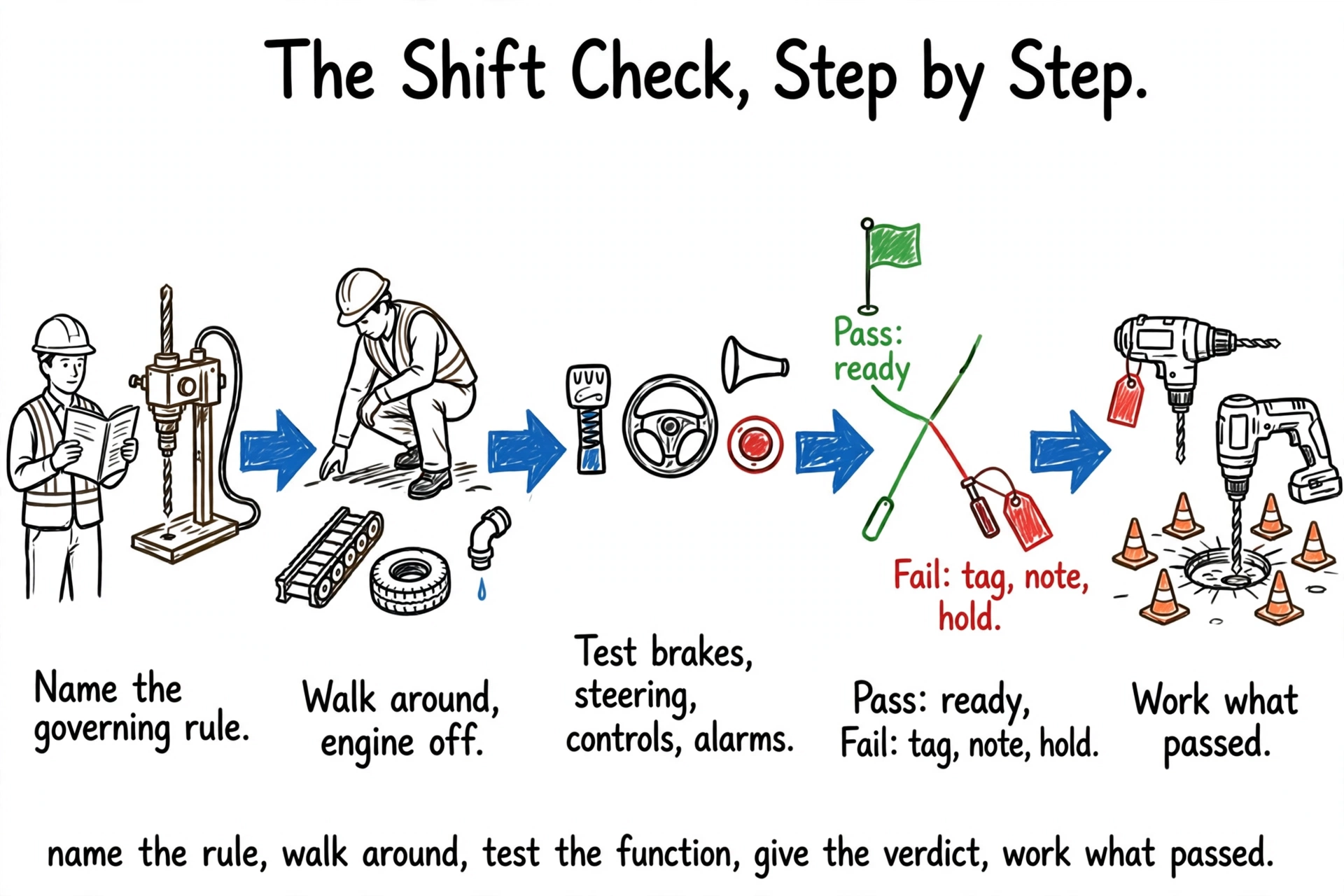
A readiness check has visible parts. A beginner can watch one happen and follow each step:
- The operator manual or the employer checklist for that machine sits open at the machine, and the checker works from the document rather than from memory.
- The checker walks around the machine with the engine off: tires or tracks, visible damage, leaks under the machine and at hose fittings, fluid levels where the manual directs a cold check, guards in place, and cab glass clean and undamaged.
- Safety markings and capacity information are present and readable. On an aerial lift, missing or unreadable placards, warnings, and control markings are themselves a defect under the OSHA pre-start list.
- The checker starts the machine and runs the function test: service brake, parking brake, and emergency stopping system where the machine has one, steering, operating controls through their range, horn, reverse alarm on machines with an obstructed rear view, lights, and safety devices.
- On a drill, the checker confirms the emergency stop works, looks over drill rod threads and the rod handling parts for visible damage, checks the mud pump and mixing system, and confirms drilling fluid supply before the first rod goes in the ground.
- On an aerial lift, the checker tests operating and emergency controls from the stations the manual names, checks outriggers and stabilizers, the guardrail system, and the hydraulic, air, pneumatic, fuel, and electrical systems for leaks and damage.
- On a crane, the competent person completes the shift visual inspection for apparent deficiencies before or during the shift, and the monthly and annual records exist, are signed and dated, and sit inside their retention windows.
- A failed item gets a tag at the controls or a lock that renders the machine inoperable, a written defect note, and a notification to the person who dispatches repairs. A defect that lives only in conversation tends to get operated by the next shift.
What Does It Do?
It moves discovery to the cheapest and safest moment. Every equipment defect has two discovery prices. Found at the check, a failed parking brake costs a repair and a replacement truck. Found on a grade with a loaded trailer behind it, the same failure can cost a runaway vehicle. The check buys the cheap discovery on purpose, while the machine sits still and nobody depends on it.
It tests function in addition to appearance. A brake pedal can look correct and still fail to hold. A reverse alarm can hang in place with a cut wire. A lift control can sit in a clean cab and still respond late. The function test exists because several items on the federal lists, including brakes, steering, operating controls, and safety devices, can only be verified by running the machine. Looking at a machine answers what it looks like. Testing it answers whether it works.
It creates the record that makes the next check honest. Crane monthly and annual inspections carry federal documentation and retention rules because a signed, dated record proves the inspection happened and shows what it found. For other machines, the employer program under 1926.20 and the contract set the record form. Either way, a written defect note with the machine, the item, the finding, and the date starts the repair process and protects the next operator, who can see that a defect was found and whether it was cleared.
It keeps a known defect from becoming the next crew problem. Tagging or locking the controls, or removing the machine from its place of operation, is the physical half of the verdict under 1926.20(b)(3). The tag converts a private finding into a public state that every person on site can read. Without that step, a machine that failed at dawn can be started at midday by a person who never heard the morning conversation.
It matches the machine to the segment before the segment depends on it. Readiness includes capacity and configuration in plain terms: the lift carries a legible load capacity and the planned load sits inside manufacturer limits, the drill has the rod, tooling, and fluid system the planned bore requires, and the support vehicle has the coupling devices and trailer brake connections the planned haul requires. A machine can pass every safety item and still be the wrong machine for the segment. The check catches that mismatch at the yard, where a swap is a phone call.
Where Does It Fit?
The readiness check sits between arrival and the start of work, and it repeats across the project:
- During project setup, the employer designates the competent persons for equipment inspections, builds the checklist for each machine type from the governing federal rule and the operator manual, and sets the tag and defect record process.
- At delivery or mobilization, each machine gets a first full check against its manual before it joins the fleet for the project, and hour based manufacturer services that fall due during the project get scheduled by engine hours.
- At the beginning of each shift, jobsite vehicles get the 1926.601(b)(14) check, controls on extensible and articulating boom platforms get tested before use that day under 1926.453(b)(2), and cranes get the shift visual inspection by a competent person. Earthmoving machines get the employer program check for that machine.
- Lesson 135 covered material readiness and Lesson 133 covered locates. This lesson covers the machine side of the same preparation. A segment is ready when its people, prints, permits, locates, materials, and equipment have each passed a check with a verdict.
- During the shift, a new noise, a new leak, a control that changes feel, or damage from a strike or a tip takes the machine out of the routine and back into inspection. Readiness is a state that can be lost mid shift, and the operator who notices the change is the check working as designed.
- At the end of the shift, machines get parked under the 1926.600 rules: brake set, wheels chocked on inclines, attachments lowered or blocked, and lights, reflectors, or barricades in place where the machine sits unattended near a highway or an active work area.
What Is at Stake
Safety. Equipment defects injure people in predictable ways: a brake system that cannot hold, a steering failure at travel speed, a hydraulic failure under load, a lift control that does not respond, a crane safety device that does not work. Federal inspection rules exist because these failures repeat across the industry. The beginning of shift check is the last controlled moment to find the defect before people stand in the path of the failure.
Schedule. A defect found at the check costs a repair window that the day can often absorb by resequencing. The same defect found after setup costs the setup, the open bore or excavation held in place, and the locate and permit windows that keep running while the machine sits. A machine with an overdue monthly or annual crane inspection, or an overdue manufacturer service, can stop a segment entirely when the gap surfaces at audit or after an incident.
Cost. A weeping hydraulic hose replaced in the yard costs a hose and an hour. The same hose failed under pressure can cost the pump it starved, the fluid it spilled, the cleanup the spill requires, and the bore it stopped mid path. Function tests and fluid checks are cheap because the failures they prevent compound.
Acceptance and compliance. Inspection records are project records. An OSHA inspection, an owner audit, or an incident investigation will ask who inspected the machine, against which list, with which result, and where the record sits. For cranes, missing monthly or annual documentation is itself a violation of 1926.1412, separate from the condition of the machine. For other machines, a missing record weakens the employer program that 1926.20(b)(2) requires.
The crew around the machine. Readiness protects people who never touch the controls: the locator walking ahead of the drill, the laborer guiding a backing truck, the inspector standing at the excavation edge. Those people rely on the horn, the reverse alarm, the brakes, and the safety devices working. The check is how that reliance gets earned each shift.
What Does Good Look Like?
- The checklist or operator manual for each machine is on site, and every check for the shift is complete before the machine is placed in service.
- Every item on the 1926.601(b)(14) list for jobsite vehicles shows a pass: brakes, parking system, emergency stopping system, tires, horn, steering, coupling devices, seat belts, operating controls, and safety devices, plus lights, reflectors, wipers, defrosters, and fire extinguishers where necessary.
- Fluid levels match the manual for the machine, and no fresh leak shows under the machine, at hose fittings, or on the ground where the machine sat overnight.
- The function test is complete: controls respond through their range, brakes hold, the horn and reverse alarm sound above surrounding noise, and safety devices and emergency stops work.
- Drill rod, rod handling parts, and the mud system show no visible damage, and drilling fluid supply covers the planned bore.
- Aerial lift placards, warnings, and control markings are present and readable, guardrails are complete, and outriggers and stabilizers operate as the manual directs.
- Crane shift, monthly, and annual inspections are current, with monthly records retained at least three months and annual records retained at least 12 months, each signed and dated by the inspector.
- A failed machine carries a tag at its controls or a lock that renders it inoperable, a written defect note exists, and the repair dispatcher has the note.
- Parked machines sit with the parking brake set, wheels chocked on inclines, attachments lowered or blocked, and lights or reflectors in place where 1926.600 requires them.
- Only employees qualified by training or experience, and authorized where the rule requires authorization, are assigned to operate each machine.
From the Field
Picture a bore crew arriving at dawn to drill a road crossing, with locates marked, the drill spotted at the entry pit, and a vacuum excavator on site to expose utilities along the path. The operator runs the drill pre-start routine from the operator manual before the first rod is loaded. Fluid levels check out. At the hydraulic hoses near the carriage, the operator finds a hose weeping fluid at a fitting, with a wet patch on the ground below and the hydraulic reservoir sitting below the level the manual calls for at a cold check.
A second finding follows during the function test. The emergency stop at the operator station fails to shut the machine down on the first press, then works on a harder second press. Either finding alone fails the check. Together they describe a machine that can lose hydraulic pressure during the bore and cannot be trusted to stop on command.
The schedule argues for starting anyway. The crossing sits inside a traffic control window booked for that morning, and topping off the reservoir would take minutes. Running the bore on a leaking hose risks a hose failure under pressure mid bore, a stalled drill string in the crossing, and fluid released into the entry pit and the soil around it. Running it with an unreliable emergency stop removes the control the crew counts on if a strike or a tangle happens during the bore.
The operator reports both findings, and the competent person for the site holds the drill out of service. The drill gets tagged at the controls, the defect note goes to the repair dispatcher with the machine, the two findings, and the time they were found, and a mechanic is called to replace the hose and repair the stop circuit before the drill returns to service. The crew resequences the morning: the vacuum excavator, which passed its own check in full, exposes the utilities along the path, and the crew completes the pothole records and the entry and exit preparation that the bore will need.
The drill returns after repair, passes a fresh pre-start check including a function test of the emergency stop, and the bore runs inside a rebooked traffic window with no open hole held overnight.
The decision rule is plain: a machine is ready when every item on the check that governs it passes, in appearance and in function. A failed safety item holds that machine, no matter what the schedule says. Tag it, write the defect down, work the tasks whose equipment passed in full, and return the machine to service only after correction and a fresh check.
What Can Go Wrong?
The check skipped under schedule pressure. The crew starts the machine on yesterday condition. A defect that developed overnight, during transport, or at the end of the prior shift enters service unseen, and discovery moves to the moment of failure.
The walkaround without the function test. The checker looks at brakes, steering, and controls and never runs them. A parking brake that will not hold, a steering fault, or a dead reverse alarm passes a visual check and fails in use. The federal lists name operating controls and safety devices because those items require a test in addition to a look.
A leak topped off and ignored. Low fluid gets refilled with no search for where the fluid went. The leak continues under pressure, the reservoir falls again mid task, and the machine loses the hydraulic function the fluid drives. A falling level is a finding. The level is the symptom, and the leak is the defect.
A defective machine left available. The operator tells the foreman about a failed item, no tag goes on the controls, and no note gets written. A second operator starts the machine after lunch with no knowledge of the finding. Section 1926.20(b)(3) requires the physical step: tag or lock the controls to render the machine inoperable, or remove it from its place of operation.
The wrong rule applied to the machine. A crew applies the vehicle shift list to a crane and calls the crane ready, while the monthly documented inspection under 1926.1412 sits overdue. Each machine family carries its own floor, and a pass under the wrong list is a failed check wearing a complete form.
An overdue tier discovered late. A crane annual inspection or a manufacturer hour based service falls due mid project and nobody tracked the date or the engine hours. The machine stops when the gap surfaces, and the segment stops with it, at the moment the schedule can least absorb the loss.
An unqualified operator assigned. A willing hand with no training or experience on that machine type gets the keys because the regular operator is absent. Section 1926.20(b)(4) permits only employees qualified by training or experience to operate equipment and machinery, and 1926.453(b)(2) permits only authorized persons to operate extensible and articulating boom platforms. Willingness is a good quality in a crew member. It is not a qualification.
What Should Someone Notice in the Field?
- Name the rule that governs the machine before checking it: 1926.601 for off-highway jobsite vehicles, 1926.602 equipment requirements plus the 1926.20 program for earthmoving machines, 1926.1412 tiers for cranes, and 1926.453 plus the manufacturer pre-start list for aerial lifts.
- Work from the operator manual or the employer checklist for that model, and complete the check before the machine is placed in service.
- Walk around with the engine off first: leaks, fluid levels, tires or tracks, hose condition, guards, cab glass, and readable placards and capacity markings.
- Run the function test every time: brakes including the parking and emergency systems, steering, controls through their range, horn, reverse alarm, lights, and safety devices including emergency stops.
- Treat a falling fluid level as a leak to find, and never as a refill task alone.
- Check the tier dates on cranes before the segment that needs the lift: shift inspection done, monthly documented inspection current, annual inspection inside 12 months.
- Tag or lock a failed machine at its controls, write the defect note with the machine, the item, the finding, and the time, and notify the repair dispatcher the same shift.
- Park under the 1926.600 rules at every stop: brake set, chocks on inclines, attachments lowered or blocked, and lights or reflectors where the machine sits near a highway or active work at night.
- Confirm the assigned operator is qualified by training or experience on that machine, and authorized where the governing rule requires authorization.
- Know the boundary: running a pre-start check, reading placards, and reporting a defect are recognition tasks a trained crew member can perform within the employer program. Repairing a brake system, a hydraulic circuit, a crane safety device, or a lift control system is repair work for qualified persons, and operating any machine in this lesson requires qualification by training or experience on that machine. Reading this lesson qualifies no one to operate or repair any equipment.
Key Terms
Equipment readiness check: A deliberate inspection and function test before work that confirms a machine is in safe operating condition, free of apparent damage that could cause failure in use, and cleared for service under the rule that governs that machine type.
Competent person: A person capable of identifying existing and predictable hazards in the surroundings or working conditions, and who has authorization to take prompt corrective measures to eliminate them.
Qualified person: A person who, by recognized degree, certificate, professional standing, or extensive knowledge, training, and experience, has shown the ability to solve problems relating to the subject matter, the work, or the project.
Frequent and regular inspections: The inspection pattern 29 CFR 1926.20(b)(2) requires in the employer accident prevention program, covering job sites, materials, and equipment, performed by competent persons the employer designates.
Shift inspection: A visual inspection for apparent deficiencies that a competent person begins before each shift a crane will be used, under 1926.1412(d), and the beginning of shift vehicle check required by 1926.601(b)(14) for jobsite vehicles.
Pre-start inspection: The before shift inspection OSHA guidance directs generally for aerial lifts, following manufacturer recommendations and covering vehicle components and lift components, with lift controls tested each day before use for extensible and articulating boom platforms under 1926.453(b)(2).
Out of service: The state of a machine held from use after a failed check, identified by tagging or locking the controls to render it inoperable, or by physical removal from its place of operation, until the defect is corrected.
Manufacturer instructions: The operation, inspection, and maintenance directions the maker publishes for a specific model in its operator manual, including daily checks and hour based service intervals.
Safety device: A device fitted to a machine to prevent or limit a hazardous event, such as an emergency stop, an alarm, or a protective control, verified by function test during the readiness check.
Horizontal directional drill: A machine that bores a guided path underground, steered from the surface, through which conduit is pulled back for fiber installation.
Check Your Understanding
- Section 1926.601(b)(14) requires a check at the beginning of each shift for jobsite vehicles. Name five items on the federal list, and state the rule for defects.
Answer: The list includes service brakes including trailer brake connections, the parking system, the emergency stopping system, tires, horn, steering mechanism, coupling devices, seat belts, operating controls, and safety devices, with lights, reflectors, windshield wipers, defrosters, and fire extinguishers checked where necessary. Any five named items earn the point. All defects are corrected before the vehicle is placed in service.
- An excavator has no beginning of shift clause in 1926.602. Which federal provision still requires its inspection, and by whom?
Answer: Section 1926.20(b)(2) requires the employer program to provide for frequent and regular inspections of job sites, materials, and equipment by competent persons designated by the employer. The manufacturer manual and the employer or contract program set the machine specific check. A start of shift check is sound company practice for the excavator, recorded as practice rather than as a 1926.602 federal shift rule.
- A crane passed its shift visual inspection this morning. Its last documented monthly inspection sits four months back, and its annual inspection is current. Is the crane ready?
Answer: No. Under 1926.1412, each month the equipment is in service the shift items are inspected and documented, with the record retained for a minimum of three months. A four month gap means the monthly tier is overdue, and the crane is held until the documented monthly inspection is completed by a competent person.
- In the From the Field scenario, which two findings failed the drill check, and what did the crew do with the morning?
Answer: A hydraulic hose was weeping at a fitting with the reservoir below the manual cold check level, and the emergency stop at the operator station failed to shut the machine down reliably on the function test. The competent person held the drill out of service with a tag at the controls and a written defect note to the repair dispatcher. The crew resequenced to utility exposure and site preparation using the vacuum excavator that had passed its check in full, and the bore ran after repair and a fresh passing check.
- An aerial lift shows a missing load capacity placard and a lower level control that does not respond during the pre-start check. The operator is experienced and knows the capacity from memory. Can the lift go up?
Answer: No. OSHA aerial lift guidance lists missing or unreadable placards and control markings as pre-start defects, and lift controls for extensible and articulating boom platforms are tested each day before use under 1926.453(b)(2) to determine that they are in safe working condition. A defective lift stays out of operation until repaired by a qualified person, and defective lifts are tagged out until repairs are made. Operator memory does not repair a control or replace a placard.
Lesson Takeaway
Ready is a verdict each machine earns each shift: a walkaround against its governing rule and its operator manual, a function test that proves brakes, steering, controls, alarms, and safety devices work, current tier inspections where the machine family requires them, and a qualified operator assigned. After this lesson, a yard full of machines reads as a set of unanswered questions until each machine passes, and a failed item reads as a tag, a written defect, and a resequenced day, never as a problem to operate around.
Sources and Technical References
U.S. Occupational Safety and Health Administration, 29 CFR 1926.20, General safety and health provisions. Covers the employer duty to initiate and maintain an accident prevention program, frequent and regular inspections of job sites, materials, and equipment by competent persons designated by the employer at paragraph (b)(2), the prohibition on using noncompliant machinery, tools, materials, or equipment with tagging or locking the controls to render them inoperable or physical removal at paragraph (b)(3), and the rule that only employees qualified by training or experience operate equipment and machinery at paragraph (b)(4): https://www.law.cornell.edu/cfr/text/29/1926.20
U.S. Occupational Safety and Health Administration, 29 CFR 1926.601, Motor vehicles. Covers vehicles operating within an off-highway jobsite not open to public traffic, exclusion of equipment covered by 1926.602, brake systems maintained in operable condition, and the beginning of each shift check at paragraph (b)(14) covering service brakes including trailer brake connections, the parking system, the emergency stopping system, tires, horn, steering mechanism, coupling devices, seat belts, operating controls, and safety devices, with lights, reflectors, windshield wipers, defrosters, and fire extinguishers where necessary, and correction of all defects before the vehicle is placed in service: https://www.osha.gov/laws-regs/regulations/standardnumber/1926/1926.601
U.S. Occupational Safety and Health Administration, 29 CFR 1926.600, Equipment. Covers general requirements for equipment in Subpart O, including heavy machinery held aloft being blocked or cribbed, blades, buckets, and dump bodies fully lowered or blocked when repaired or not in use with controls in neutral, motors stopped, and brakes set, the parking brake set whenever equipment is parked with wheels chocked on inclines, safety glass in cabs, and lights, reflectors, or barricades for equipment left unattended at night next to a highway or an active construction area: https://www.intrans.iastate.edu/wp-content/uploads/sites/10/2022/08/1926.600-Equipment.-_-Occupational-Safety-and-Health-Administration.pdf
U.S. Occupational Safety and Health Administration, Standard Interpretation, December 15, 2003, Requirement to use seat belts during the operation of earthmoving equipment. Quotes 29 CFR 1926.602(a) for earthmoving equipment including scrapers, loaders, crawler or wheel tractors, bulldozers, off-highway trucks, graders, and agricultural and industrial tractors, and the seat belt provisions for equipment covered by that section: https://www.osha.gov/laws-regs/standardinterpretations/2003-12-15-1
U.S. Occupational Safety and Health Administration, Fact Sheet, Subpart CC, Cranes and Derricks in Construction: Wire Rope Inspection, DOC FS-3635. Summarizes the 1926.1412 inspection tiers in table form: shift inspection by a competent person before each shift with documentation not required, monthly inspection by a competent person documented and signed and retained for a minimum of three months, and annual inspection by a qualified person documented and signed and retained for a minimum of 12 months: https://www.osha.gov/sites/default/files/publications/osha3635.pdf
U.S. Occupational Safety and Health Administration, eTool, Scaffolding, Aerial Lifts. Covers aerial lift types under 1926.453, training and authorization, the pre-start inspection before each work shift following manufacturer recommendations with vehicle components including fluid levels, leaks, wheels and tires, battery and charger, lower level controls, horn, gauges, lights and backup alarms, steering and brakes, and lift components including operating and emergency controls, hydraulic, air, pneumatic, fuel and electrical systems, insulating components, missing or unreadable placards and markings, fasteners and locking pins, cable and wiring harnesses, outriggers and stabilizers, loose or missing parts, and guardrail systems, and the direction to keep a defective lift out of operation until repaired by a qualified person and to remove defective lifts from service and tag them out until repairs are made: https://www.osha.gov/etools/scaffolding/aerial-lifts
Driveroo, OSHA Pre-Operation Inspection Requirements in 2026, reviewed November 4, 2026, with regulatory text checked against 29 CFR Parts 1910 and 1926. Summarizes which rule covers which machine, confirms that 1926.602 sets seat belt, brake, alarm, and other equipment rules for earthmoving equipment with no beginning of shift inspection clause, and that inspection for earthmoving equipment rests on 1926.20(b)(2) frequent and regular inspections by competent persons, with noncompliant equipment tagged, locked at the controls, or removed under 1926.20(b)(3): https://www.driveroo.com/osha-pre-operation-inspection-requirements/
HVI, Horizontal Directional Drill Maintenance and Inspection Guide. Summarizes Vermeer and Ditch Witch published schedules with daily walkarounds and services at hour based intervals, the four core drill systems covering the mud and drilling fluid system, rod handling and the drill string, hydraulics, and the powertrain, and the daily pre-shift priorities covering fluid levels, hydraulic leaks, hoses and belts, electrical items and the emergency stop, tracks, the mud system, and drill rod inspection and greasing: https://www.hvi.app/case-study/post/horizontal-directional-drill-maintenance-guide
Vermeer Navigator D7x11 Series II Horizontal Directional Drill, Operator Manual, hosted at ManualsLib. Contains the receiving and delivery checks and the safety direction to check the machine before operating, with the machine in good operating condition and all safety equipment installed and functioning properly, together with hydraulic fluid level, controls operation, and leak and damage checks for hydraulic components: https://www.manualslib.com/manual/2054308/Vermeer-Navigator-D7-11-Series.html
Previous lesson: Lesson 135: Are Materials Ready? |
Back to Level 7 hub |
Next lesson: Lesson 137: Where Will Equipment Be Set Up?