
Introduction
A materials readiness check is a deliberate review, done before a segment of work starts, that confirms the material on hand matches the project documents in type and quantity, arrived in usable condition, carries the approval the contract requires, and sits in storage that protects it until installation. The check compares physical material against paper: the print, the bill of materials, delivery records, and approved submittals where the contract requires them.
Level 7 prepares a jobsite before ground opens. Earlier lessons in this level covered the preconstruction meeting, crew knowledge, and the job briefing. This lesson covers the material side of the same preparation. A crew can be briefed, located, and permitted and still lose the day to a wrong reel, a short count, or a damaged handhole that nobody inspected on arrival.
What This Lesson Gives You
- Compare a delivery against the print and the bill of materials and confirm type, specification, and quantity before the segment starts.
- Inspect fiber cable reels, conduit, and handholes on receipt for visible damage and record a discrepancy while the supplier can still correct it.
- Confirm submittal and approval status for any material the contract holds to that step, and hold unapproved material out of the work.
- Judge whether storage and handling on site follow manufacturer instructions for reels, conduit, and enclosures, and flag storage that will damage material before installation.
- Name the long-lead items on a segment early enough that ordering, approval, and delivery finish before the crew needs the material.
Start With the Basics
Think about a cook who checks ingredients against a recipe before the pan gets hot. The cook reads the list, sets each item on the counter, counts what the recipe calls for, and looks at each item. An item that is missing, short, spoiled, or the wrong kind gets found while a trip to the store still costs minutes. The same cook who starts cooking and discovers the gap halfway through has heat on, timing running, and a dish that cannot wait.
A materials readiness check works through the same mechanism. The recipe is the set of project documents for the segment. The counter is the yard, the trailer, and the delivery ticket. The check happens while a correction still costs a phone call, a recount, or a replacement delivery. Once a bore is open, a trench is dug, or a crew is standing by, the same gap costs idle labor, an open excavation held overnight, and a schedule slip that moves every segment behind it.
One difference matters. A cook can often substitute an ingredient and still serve dinner. A fiber crew works to a contract specification. A different fiber count, a different conduit size, or a different enclosure rating is a different material, and the documents decide whether a substitute is allowed. The readiness check treats a near match as a mismatch until the governing document says otherwise.
What Is It?
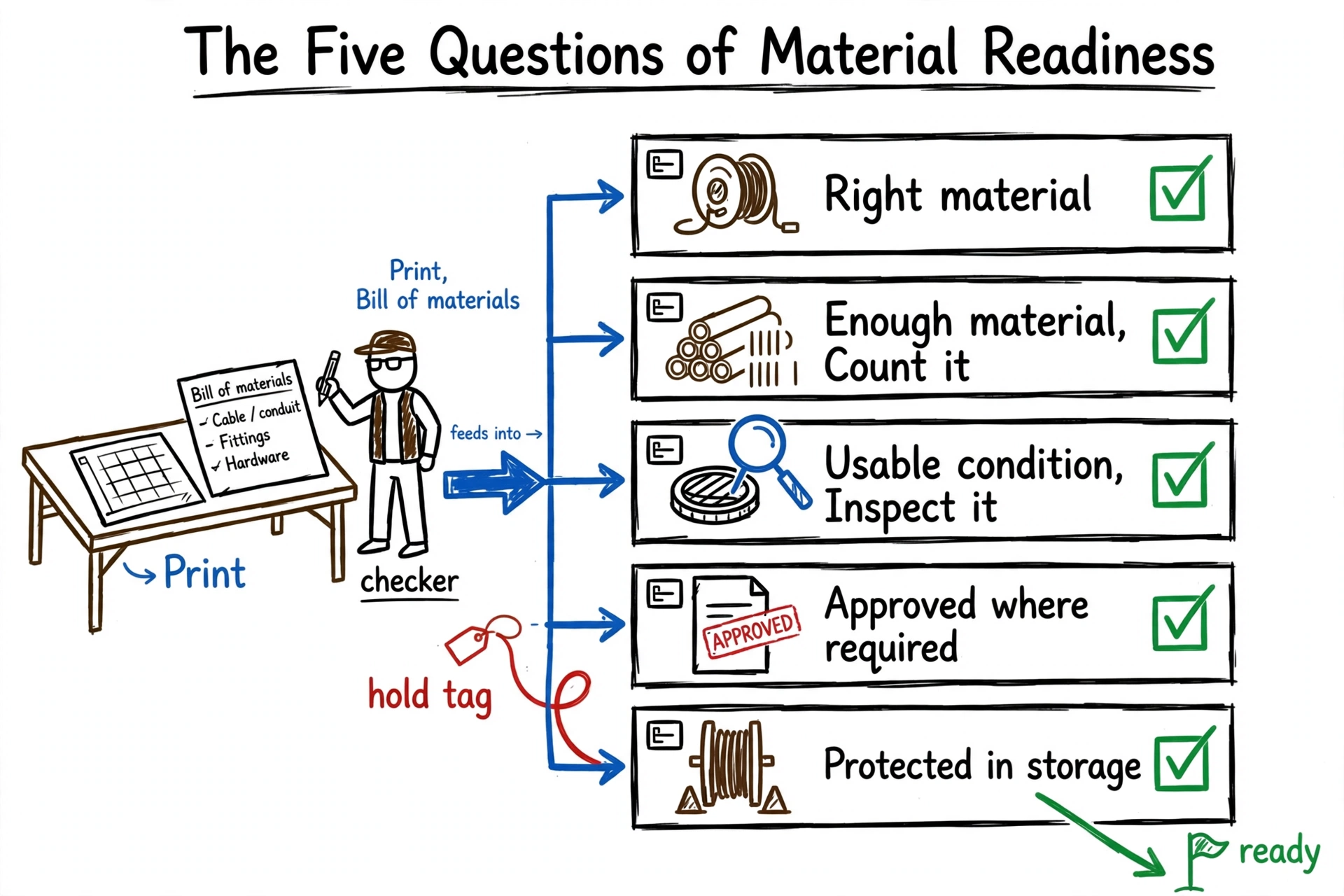
A materials readiness check is a comparison with a verdict. The comparison runs across five questions, and the segment is ready only when each question has a clear yes backed by something a second person could verify.
Question one: is it the right material? The print is the set of construction drawings for the project, showing what gets built, where it goes, and which materials the design calls for at each location. The bill of materials is the itemized list drawn from the print and the specifications, naming each material, its specification or product type, and the quantity the work requires. Right means the delivered item matches the bill of materials line for line: fiber count and cable type for cable, size and type for conduit, size and load rating for a handhole, and the same match for splice closures, markers, and every other line the segment needs.
Question two: is there enough of it? Quantity gets counted, in physical units, against the bill of materials quantity for the segment plus any allowance the project documents provide for waste, slack, and testing. Cable gets checked by reel identification and by the length marked for that reel against the length the segment requires. A delivery ticket states what the supplier says arrived. The count states what actually sits on site. Readiness rests on the count.
Question three: did it arrive in usable condition? Receiving inspection is the examination of material at delivery for damage, shortage, and mismatch, recorded at the time of receipt. The Fiber Optic Association guide for receiving cable on site directs that all fiber optic components be carefully inspected for damage when initially received, that quantities and types be confirmed against what was ordered, and that discrepancies or damaged goods be noted, with the supplier notified and replacement arranged as required. A state department of transportation construction manual states the same control in highway terms: the Caltrans Construction Manual, Section 3-6, Control of Materials, directs that no material be incorporated into the work until the required evidence or certificate of compliance has been received and the field inspection has been completed at the job site. Damage found at receipt is a supplier problem with a paper trail. Damage found at installation is a crew problem with a hole already open.
Question four: is it approved for this project? A submittal is a document, sample, or product record the contractor sends to the owner or engineer to show exactly which product will be installed, before the product is ordered or built into the work. An approved submittal is a submittal returned with an approval action under the contract review process. Contract submittal sections in common use state the gate plainly: no portion of work requiring a shop drawing, sample, or product data starts, and no material gets fabricated or installed, prior to approval of that item. The rule for the field is simple to state. Where the contract requires a submittal for a material, readiness includes a confirmed approved status. Material that arrived early and sits in the yard still waits for approval before it enters the work.
Question five: has storage protected it since arrival? Material can pass the first four questions on delivery day and fail the fifth question a week later. Storage and handling follow manufacturer instructions, meaning the handling, storage, and installation directions the maker publishes for that specific product, together with project document requirements where the project sets them. Readiness includes a look at where the material sits now: reels upright and protected, conduit supported and inspected, enclosures handled without impact damage, and small components secure in a clean and dry place.
A long-lead item cuts across all five questions. A long-lead item is a material whose time from order to delivery is long enough that ordering must happen well before the segment that needs it. Lead time is the interval between placing an order and receiving delivery on site. Long-lead items get identified early, during project setup, because the readiness check on the day of work can only report a late order. The check cannot shorten a factory or shipping timeline.
What Does It Look Like?
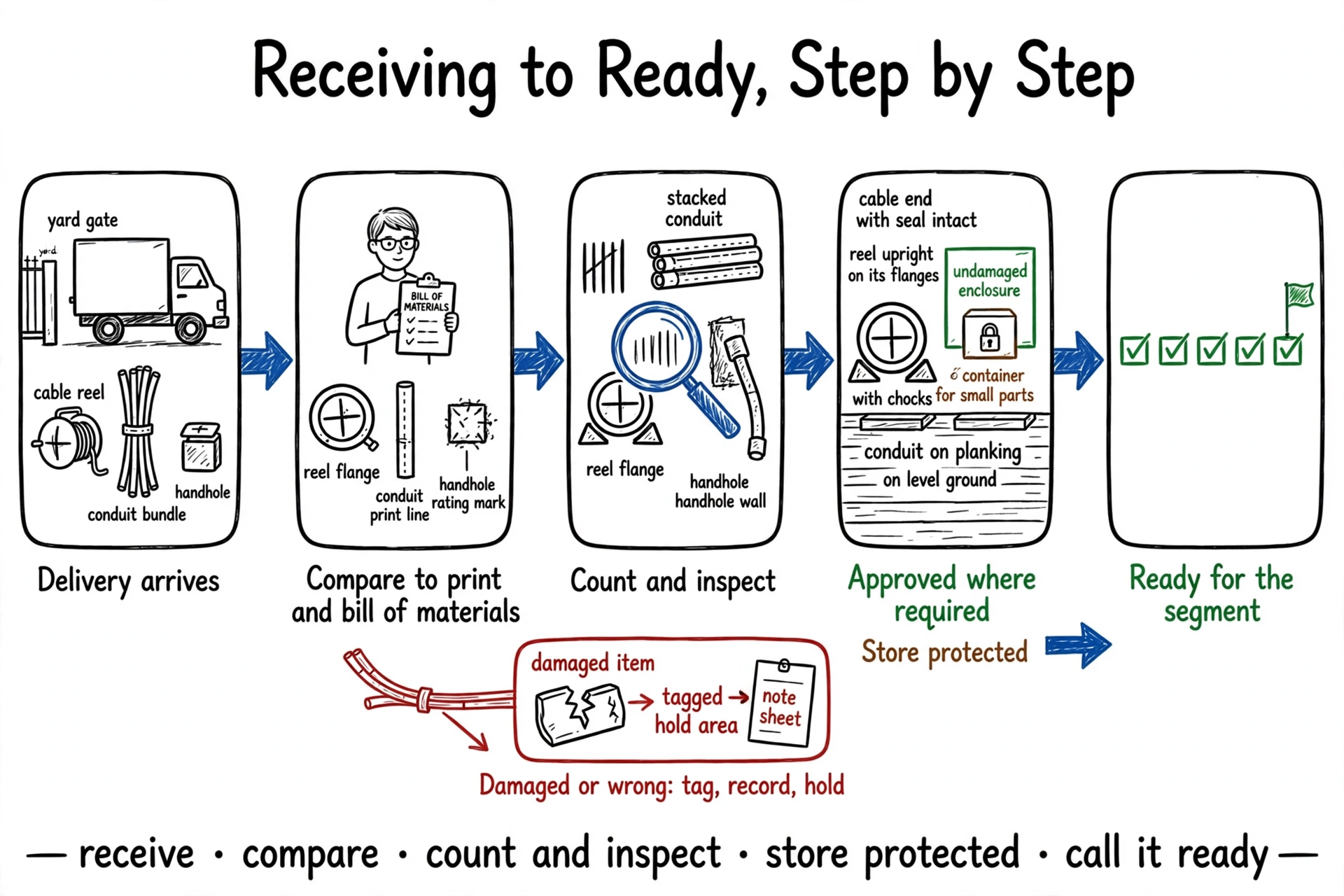
A readiness check has visible parts. A beginner can watch one happen and follow each step:
- The print and the bill of materials for the segment sit open, on a tailgate, a table, or a tablet, and the checker works from the documents rather than from memory.
- Each delivery gets matched line by line. The checker reads a bill of materials line aloud, finds the physical item, and confirms type and specification against markings on the item itself.
- Cable reels get checked by reel identification. Markings on the flange or reel tag name the cable description and length, and the checker confirms the reel on site is the reel the segment requires. The Fiber Optic Association receiving guide notes that both ends of the cable on a reel must remain available for testing, and that a continuity check with a fiber tracer or visual fault locator can confirm the cable survived shipment when damage is suspected.
- Quantities get counted out loud and marked off: reels, sticks or coils of conduit, handholes and covers, closures, and small parts in boxes with counts confirmed against the list.
- Condition gets inspected with eyes and hands where safe: reel flanges and protective covering for damage, conduit walls for cuts, gouges, and flattening, handhole walls and covers for chips and cracks, cable ends for intact seals and caps.
- The submittal log or approval record for the project sits with the documents, and the checker confirms approved status for each line the contract holds to a submittal.
- Storage gets walked as part of the check: reel position, conduit support, enclosure condition, and the security and dryness of the place small components are kept.
- Any shortage, mismatch, damage, or missing approval gets written down at the check, with the item, the document line, and the person notified. A discrepancy that lives only in conversation tends to stay unresolved.
What Does It Do?
It moves discovery to the cheapest moment. Every material problem has two discovery prices. Found at the check, a wrong reel costs a return and a redelivery. Found at the reel stand with the bore path ready, the same reel costs a crew standing idle, a setup torn down or held, and a day replanned around a delivery truck. The check buys the cheap discovery on purpose, while time remains to correct the problem.
It protects the specification. A fiber network gets built to a design that assumes specific cable, specific conduit, and specific enclosure ratings at specific places. The Caltrans manual frames the control at project scale: the resident engineer must verify that materials used in the work comply with contract specifications, and required evidence of compliance must be in hand before material enters the work. The readiness check is that verification at segment scale, performed by the people who will install the material.
It creates the record that makes correction possible. A noted discrepancy at receipt starts the supplier correction process with dates, counts, and photographs attached to a delivery. Hubbell guidance for underground enclosures makes the storage yard point directly: a successful install begins at the storage yard, and proper handling and transport to the job site keep the enclosure undamaged so the finished work performs as intended. A chip found at the yard leads back to handling and delivery. A chip found in the excavation, after the box was moved twice, has no clear owner and often becomes an argument instead of a replacement.
It keeps storage damage from becoming installed damage. The Plastics Pipe Institute storage guidance for polyethylene pipe starts with inspection: before pipe or fittings go into storage, they should be visually inspected for scratches, gouges, discoloration, and other defects, and damaged or questionable material should stay out of storage. Corning guidance for fiber cable gives reels the same treatment: cable reels should be stored vertically on their flanges, end-to-end in rows, and chocked to prevent rolling, with protective covering left intact until the reel arrives at the installation site, and the reel inspected for protrusions and broken flanges before installation begins. The readiness check confirms that protection actually happened, so a segment starts with material in the condition the factory shipped.
It exposes schedule risk while options remain. Naming long-lead items early converts a future surprise into a tracked order with a submittal date, an approval date, an order date, and a required on site date. When the check finds a long-lead item unordered weeks before its segment, the project still holds options: resequence segments, expedite, or reset the schedule honestly. A gap found on the morning of the segment holds none of those options.
Where Does It Fit?
The readiness check sits between delivery and installation, and it repeats at segment scale across the project:
- During project setup, the team builds the bill of materials from the print and the specifications, identifies long-lead items, and starts submittals for materials the contract requires.
- At each delivery, receiving inspection confirms type, quantity, and condition, notes discrepancies, and moves accepted material into protected storage.
- Before a segment starts, the readiness check runs across the five questions for the material that segment needs: right material, enough material, usable condition, approved status where required, and storage that kept it usable.
- Lesson 138 covers material staging, meaning where material gets placed for the work itself. This lesson ends at readiness. Staging a material that failed the readiness check only moves the problem closer to the hole.
- During the work, material drawn from storage gets a final look at issue: the reel identification matches the segment, the conduit count covers the run, and any damage picked up in storage gets caught before the material goes in the ground.
- At closeout, delivery records, inspection notes, and submittal approvals join the project record, showing which material entered the work and under which approval.
What Is at Stake
Schedule. Material gaps stop work in a way labor cannot fix. Extra hands cannot splice cable that never arrived, and a skilled crew cannot set a handhole that sits in a supplier yard two states away. Because segments run in sequence, one material gap can idle the crew, push locates and permits past their windows, and compress every later segment.
Cost. A discrepancy caught at receipt is documented while the delivery record is fresh, which is the position from which supplier correction under the delivery terms is normally pursued. The same discrepancy caught after installation can require removal and replacement of buried work, retesting, and restoration, with cost far higher and responsibility often in dispute. Storage damage carries the same split: a gouge found in the yard costs one stick of conduit, while a gouge found after burial can cost an excavation.
Quality and service life. Material that enters the ground damaged or off specification fails early in ways that surface months later: a crushed conduit that will not pass a mandrel or accept cable, a cable with shipment damage that shows excess loss, an enclosure with a cracked wall that takes on water. Buried plant hides its defects until repair costs peak.
Acceptance and payment. Owners accept work built from approved, compliant material, supported by records. Work built from unapproved or unverified material invites rejection, withheld payment, and removal orders under the contract. The Caltrans control of materials rule captures the consequence in one line: material stays out of the work until required evidence has been received and field inspection is complete.
Safety. Heavy reels, conduit coils under strap tension, and enclosure covers create handling hazards at delivery and in storage. The Plastics Pipe Institute technical note TN-58, the HDPE Conduit and Duct Handling Guide, addresses safe handling of reels and coils of HDPE conduit, including unloading, releasing wraps, and cutting strapping. Readiness includes noticing a damaged reel, a strained strap, or an unstable stack as a safety condition, and leaving the correction to people qualified and equipped for that handling work.
What Does Good Look Like?
- The print and bill of materials for the segment are on site, current, and marked up with the check results.
- Every line for the segment is confirmed: type and specification match the physical markings, and counted quantity covers the segment requirement.
- Cable reels are identified by reel tag or flange markings, both cable ends remain available for testing, and end seals or caps are intact.
- Receiving inspection notes exist for each delivery, and every discrepancy shows a notification and a resolution or a pending replacement date.
- Submittal status is confirmed for each material the contract requires, and no unapproved material is staged for installation.
- Reels stand upright on both flanges, chocked against rolling, with protective covering intact where the manufacturer shipped it that way.
- Conduit sits on a smooth, level surface free of stones and debris, supported on planking where ground conditions require it, separated by size and pressure rating so crews pull the right material.
- Handholes and covers show no chips, cracks, or impact damage, and small components sit in clean, dry, secure storage.
- Long-lead items for upcoming segments show order status and delivery dates that land before the segments that need them.
- A failed item is tagged or separated and recorded, so no crew member installs it by mistake.
From the Field
Picture an underground crew scheduled to place a duct run and two handholes, then pull fiber through the new path later in the week. The readiness check runs the afternoon before, with the print, the bill of materials, and the delivery tickets on the tailgate. Cable and closures check out. Conduit counts match. The handhole line stops the check.
The bill of materials calls for two enclosures of a size and tier rating suited to the locations on the print. The yard holds two enclosures of the right size. A closer look at the markings shows a lower tier rating than the print requires for one location, which sits where vehicles can cross. The second enclosure matches. One of two is right, and the pair fails the check as a set.
The foreman faces the decision. The excavation contractor is booked for the morning, the locate window is open, and setting the available enclosure would keep the day moving. The rating gap would then sit buried under backfill, invisible, carrying loads the enclosure was never rated to carry at that location. Correcting the rating after burial means digging the enclosure up and replacing it under traffic control, at far higher cost, after an inspector or a failure finds it.
The foreman holds the handhole portion of the segment. The crew resequences to the duct run, which passed its check in full, and completes that work. The supplier gets the discrepancy in writing that afternoon, with the print requirement, the delivered marking, and photographs. The correctly rated enclosure arrives on a replacement delivery, passes receiving inspection, and the handhole work runs later in the week inside the same locate window.
The decision rule is plain: material is ready when the physical item matches the document line in type, rating, quantity, and condition, with approval confirmed where the contract requires it. A near match is a failed check. Hold the affected work, work the segments that passed in full, and put the discrepancy in writing the same day.
What Can Go Wrong?
The wrong material delivered and accepted. A reel with the wrong fiber count, conduit in the wrong size, or an enclosure in the wrong rating enters the yard because nobody compared markings to the bill of materials. Installed, the error surfaces as a failed splice plan, a cable that will not fit the path, or an enclosure rejected at inspection.
The short count found at the run. Conduit or cable quantities were estimated from the delivery ticket rather than counted. The run stops short of the handhole, the trench stays open, and the crew waits on an emergency delivery that costs more and arrives on the supplier schedule.
Shipment damage carried into the ground. A broken reel flange, a crushed conduit end, or a chipped enclosure lip gets waved through at receipt. The Fiber Optic Association receiving guide exists for this moment: inspect on receipt, test continuity when damage is suspected, note the damage, and notify the supplier. Skipping the inspection transfers the cost of shipment damage to the project.
Storage damage after a good delivery. Reels laid on a side can let wraps shift and tangle. Conduit stored on rough ground picks up gouges. Enclosures dropped or struck in the yard chip at the lip. Material that passed receiving inspection fails at installation because storage undid the delivery condition.
Unapproved material installed. A product arrives before its submittal clears review, and schedule pressure puts it in the ground. Where the contract required approval before installation, the owner can reject the work, and an approval that arrives later does not by itself restore a record for material already buried; acceptance then depends on the owner and the contract.
The long-lead item ordered late. A specialty closure, a specific enclosure size, or a cable type with a long factory timeline gets ordered on a routine cycle. The segment date arrives with the material still in production or transit, and no field effort can recover factory time.
Paper readiness without physical readiness. The checklist shows every line complete because the checker worked from delivery tickets at a desk. The yard tells a different story: one reel short, one enclosure chipped, one approval still pending. Readiness is a physical condition confirmed at the material, with documents as the standard of comparison.
What Should Someone Notice in the Field?
- Work from the current print and bill of materials, and confirm each physical item against its document line before calling it ready.
- Read markings on the material itself: reel tags and flange markings, conduit print lines, enclosure size and rating marks, closure labels.
- Count quantities in physical units for the segment, and compare the count to the segment requirement rather than to the delivery ticket alone.
- Inspect condition at receipt and again at issue: reel flanges and covering, cable end seals, conduit walls and ends, enclosure walls, lips, and covers.
- Confirm submittal and approval status for every material the contract holds to that step, and keep unapproved material separated from approved stock.
- Check storage as part of readiness: reels upright on flanges and chocked, conduit on smooth level support separated by size and pressure rating, enclosures free of impact damage, small components clean, dry, and secure.
- Write every discrepancy down the day it is found, with the document line, the physical finding, and the person notified.
- Track long-lead items by required on site date, and escalate any order whose delivery date slips past the segment that needs it.
- Know the boundary: counting, comparing markings, and inspecting for visible damage are readiness tasks any trained crew member can perform. Moving reels with lifting equipment, releasing strapped coils, and lifting enclosure covers are handling tasks for qualified people using rated equipment and manufacturer instructions. Reading this lesson qualifies no one to perform that handling work.
Key Terms
Materials readiness check: A review before work starts that confirms material on hand matches the project documents in type and quantity, arrived in usable condition, carries required approval, and sits in protective storage.
Bill of materials: An itemized list drawn from the print and specifications, naming each material, its specification or product type, and the quantity the work requires.
Print: The construction drawings for a project, showing what gets built, where it goes, and which materials the design calls for.
Submittal: A document, sample, or product record the contractor sends to the owner or engineer to show which product will be installed, submitted before ordering or installation where the contract requires it.
Approved submittal: A submittal returned with an approval action under the contract review process, clearing that material for ordering and installation as the contract provides.
Receiving inspection: The examination of material at delivery for damage, shortage, and mismatch, recorded at the time of receipt so discrepancies can be corrected with the supplier.
Long-lead item: A material whose time from order to delivery is long enough that ordering must happen well before the segment that needs it.
Lead time: The interval between placing an order and receiving delivery on site.
Manufacturer instructions: The handling, storage, and installation directions the maker publishes for a specific product, which govern how that product is stored and handled together with project requirements.
Tier rating: A load rating class for underground enclosures under ANSI/SCTE 77, the specification for underground enclosure integrity, matching an enclosure to the loads its installed location will carry. Tier ratings cover locations with occasional non-deliberate vehicle traffic; deliberate roadway traffic is a separate rating case under the project documents.
Check Your Understanding
- Name the five questions a materials readiness check answers for a segment.
Answer: Is it the right material per the print and bill of materials; is there enough of it by physical count; did it arrive in usable condition under receiving inspection; is it approved where the contract requires a submittal; and has storage protected it since arrival per manufacturer instructions.
- A delivery ticket shows the correct quantity of conduit, and the checker marks the line ready from the ticket. What step is missing, and why does the step matter?
Answer: The physical count and condition inspection at the material are missing. The ticket states what the supplier says arrived. Readiness rests on what actually sits on site, counted and inspected, because a shortage or damaged piece discovered at the run costs far more than the same finding at receipt.
- The contract requires a submittal for a splice closure. The closure arrives on site before the submittal clears review, and the segment is scheduled this week. Can the closure be installed?
Answer: No. Where the contract requires approval before installation, material waits for approved status even when it is physically on site. Installing ahead of approval exposes the work to rejection and removal under the contract.
- In the From the Field scenario, why did one correct enclosure out of two still fail the check, and what did the foreman do?
Answer: The segment required two enclosures matched to the print, and one carried a lower tier rating than its location required, so the set failed as a set. The foreman held the handhole work, resequenced the crew to the duct run that passed in full, documented the discrepancy to the supplier the same day, and installed the correctly rated replacement after it passed receiving inspection.
- A cable reel passed receiving inspection in good condition. Two weeks later the reel lies on its side in the yard. Which readiness question is now at risk, and what guidance governs the correction?
Answer: The storage question is at risk. Corning guidance directs that cable reels be stored vertically on their flanges and chocked to prevent rolling, with protective covering intact. The correction follows manufacturer instructions for that cable, performed by qualified people with proper equipment.
Lesson Takeaway
Ready is a verdict a crew earns by comparison: physical material against the print and the bill of materials, condition against receiving inspection, status against the submittal record, and storage against manufacturer instructions. After this lesson, a yard full of material reads as a set of unanswered questions until each line is matched, counted, inspected, and cleared, and a near match reads as what it is: a segment that has not passed its check.
Sources and Technical References
Fiber Optic Association, The FOA Reference for Fiber Optics, Receiving Fiber Optic Cabling and Equipment on Site. Covers inspection of all components for damage on receipt, confirmation that quantities and types match what was ordered, noting discrepancies and notifying the supplier, continuity testing when damage is suspected, keeping both cable ends available for testing, reel handling with proper lifting equipment, and storage in a clean and dry location protected from harsh environments and secure against theft: https://www.thefoa.org/tech/ref/install/receipt.html
Corning Optical Communications, Standard Recommended Procedure 005-014, Issue 12, July 2018, Indoor Installation of Corning Optical Communications Fiber Optic Cable, Section 2, Cable and Connector Handling. Covers care against pulling, bending, and crushing damage, leaving protective covering on the reel intact until it arrives at the installation site, storing reels vertically on their flanges, end-to-end in rows, and chocked to prevent rolling, and inspecting the reel for protrusions and broken flanges before installation: https://www.corning.com/catalog/coc/documents/standard-recommended-procedures/005-014.pdf
Plastics Pipe Institute, Storing PE Pipe, Municipal and Industrial Division advisory guidance for HDPE handling and storage. Covers visual inspection for scratches, gouges, discoloration, and defects before pipe goes into storage, keeping damaged or questionable material out of storage, job site storage on a smooth level surface free of stones and debris with planking where ground conditions require it, and separation by size and pressure rating to prevent confusion: https://conduitcalc.plasticpipe.org/municipal_pipe/advisory/hdpe/handling-storing.html
Plastics Pipe Institute, TN-58, HDPE Conduit and Duct Handling Guide, as announced by Underground Infrastructure magazine, April 2019. The guide covers safe handling of reels and coils of HDPE conduit and duct, including unloading free standing reels, releasing the outside wrap and cutting strapping, avoiding entanglement, straightening coiled conduit, and cutting conduit to length: https://undergroundinfrastructure.com/magazine/2019/april-2019-vol-74-no-4/newsline/ppi-introduces-new-hdpe-conduit-duct-handling-guide
California Department of Transportation, Construction Manual, Chapter 3, Section 6, Control of Materials, July 2023. Covers the resident engineer duty to verify that materials comply with contract specifications, assignment of inspectors for materials requiring source inspection, and the direction that no material be incorporated into the work until required evidence or certificate of compliance has been received and field inspection at the job site is complete: https://dot.ca.gov/programs/construction/construction-manual/section-3-6-control-of-materials
Hubbell Power Systems, How to Install Large Enclosures, Hubbell blog, December 11, 2018. Covers underground enclosures commonly called handholes, selection by ANSI and SCTE tier rating, and the point that a successful install begins at the storage yard, with proper handling and transport keeping the enclosure undamaged; also covers lifting box and cover separately with proper straps and the damage rough handling causes to box lips and covers: https://blog.hubbell.com/en/hubbellpowersystems/how-to-install-large-enclosures?hs_amp=true
Hubbell Power Systems, How to Install Small Enclosures, Hubbell blog, November 28, 2018. Covers small underground enclosures, unloading carefully on site, selection by ANSI and SCTE tier rating, and careful cover installation without dropping, since rough handling can chip the lip of the box and damage the cover: https://blog.hubbell.com/en/hubbellpowersystems/how-to-install-small-enclosures?hs_amp=true
Section 01300, Submittals, Ute Water Conservancy District contract specification text. Covers submittals required by the contract documents, and the rule that material or equipment for which submittals are required shall not be incorporated into the work until after the submittals have been reviewed and approved: https://www.utewater.org/files/ec3d4f882/Section+01300.pdf
Previous lesson: Lesson 134: Have Existing Utilities Been Verified? |
Back to Level 7 hub |
Next lesson: Lesson 136: Is the Equipment Ready?