
Introduction
A utility easement is a limited legal right to use a defined part of land owned by someone else for a stated utility purpose, on the terms written in the document that created the right. The owner keeps the land. The holder gets only the use the document grants.
Level 2 introduced easements as a field recognition subject. This lesson goes deeper into permission itself: how to read scope from the document, how access and surface use share the same strip, and why work outside the written scope needs new permission before it starts. Level 6 is about permission to build, and the easement document is one of the core permission papers a project must hold and follow.
What This Lesson Gives You
- State who holds a utility easement, who owns the burdened land, and what each side keeps after the grant.
- Read an easement for its four scope questions: who holds it, for what purpose, where it runs, and what work it allows.
- Tell a utility easement apart from public right of way, a license, and a permit, and name which paper controls a given segment.
- Spot work that has moved outside the written scope and route it for new permission before the work proceeds.
- Explain why a blanket easement creates uncertainty for both sides, and why a specific written location protects the project.
Start With the Basics
Think about a key that opens one door. A building manager hands a contractor a key for the electrical room so the contractor can service one panel. The key works. The key also has clear limits. It opens the electrical room. It opens no office, no storage room, and no other floor. Carrying the key gives the contractor no right to rearrange the building, and lending the key to another crew gives that crew no rights at all. When the job needs a second room, the contractor asks for a second key. The key analogy covers scope, not who may turn the key: a contractor working for the holder under the holder paper is a different case from a crew borrowing permission it was never given, and the document and project papers control which case applies.
An easement works with the same logic, written down as a property right. Cornell Law School Legal Information Institute defines an easement as the grant of a nonpossessory property interest that gives the holder permission to use another person’s land. Nonpossessory means the holder does not possess or own the land. The holder gets a defined use. Everything outside that defined use stays with the owner.
A utility easement is an easement held for utility purposes. In fiber work, the purpose is usually to install, access, inspect, maintain, repair, and replace communications facilities inside a described area. The exact list comes from each document. One document may name several actions in detail. Another document may use short general language. Short language calls for careful reading by qualified people. Short language never calls for a field guess that fills in the gaps.
The habit this lesson builds is simple to state and strict in practice: read the paper first, then work inside the paper.
What Is It?
A utility easement has two sides, and naming them correctly prevents confusion in every later conversation:
- Easement holder: the person, company, or agency that holds the easement right and benefits from it. For a commercial fiber network, the holder is commonly the network owner or provider, even when a contractor performs the physical work.
- Servient owner: the owner of the land burdened by the easement. Legal writing also calls that land the servient tenement, meaning the parcel that carries the burden. The servient owner keeps ownership of the whole parcel, including the easement area.
The holder holds a right. The owner holds the land. Both statements stay true at the same time.
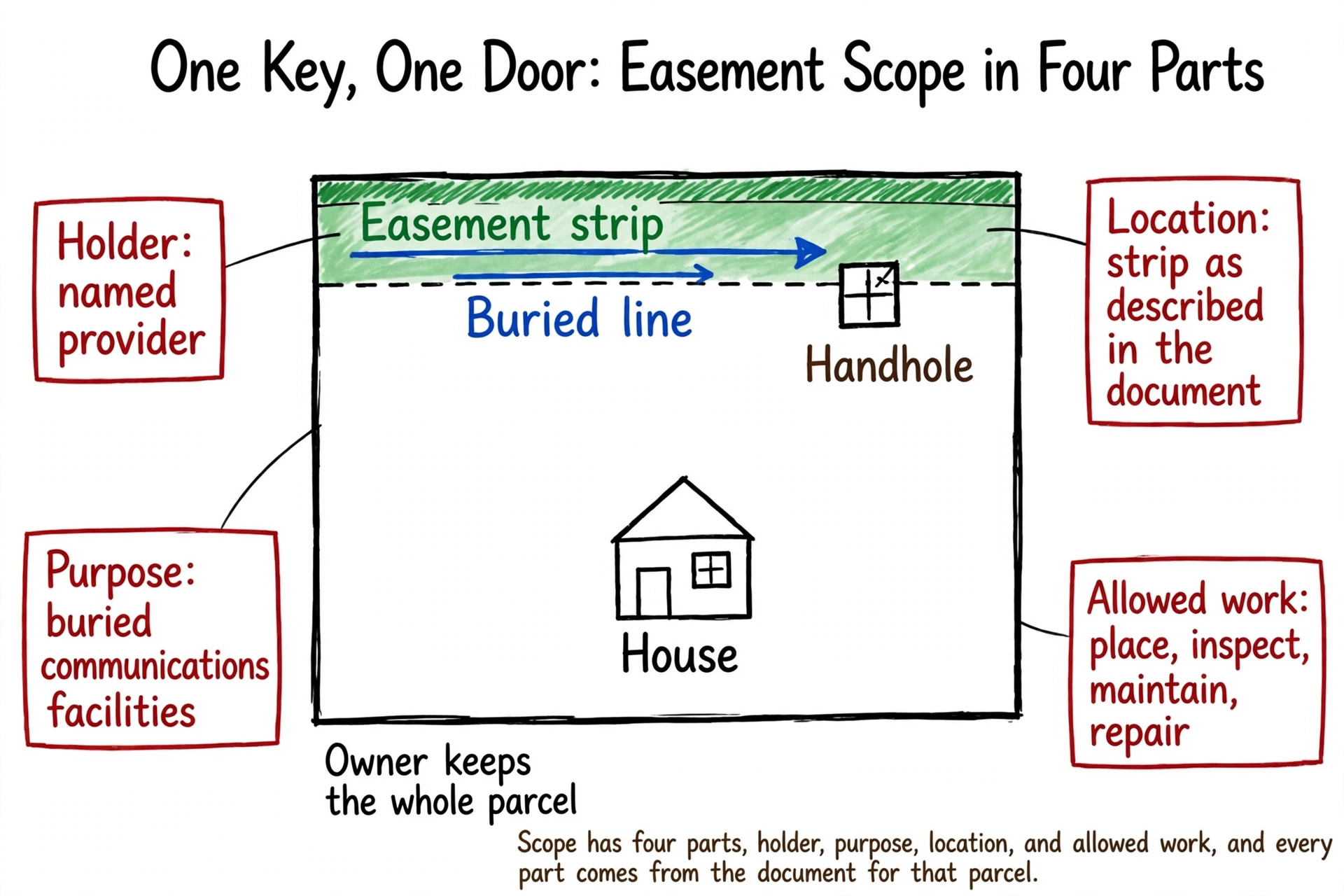
Scope is the full reach of the right the document grants. Scope has four parts, and a reader should be able to point to document language for each part:
- Holder: which named person or entity holds the right.
- Purpose: which utility purpose the right serves, such as communications facilities, electric facilities, or a broader utility purpose the document states.
- Location: where the right runs on the parcel, described by a written legal description, meaning a precise written description of land location used in deeds and surveys, by an exhibit drawing attached to the document, by a recorded plat, meaning a recorded map of a subdivision showing lots, boundaries, and often easement strips, or by a combination of those items.
- Allowed work: which actions the document allows inside that location, such as placing facilities, entering for inspection, maintaining, repairing, and replacing facilities.
If one part has no clear answer in the document, the scope question stays open. An open scope question goes to the project land staff and qualified advisers. An open scope question never gets answered by habit, by a neighboring parcel document, or by measuring cleared ground.
Express easement means an easement created by an express grant, in writing, where the owner grants the right in a document. Cornell lists creation by express grant alongside creation by implication, by necessity, and by adverse possession. Project work relies on express, written, and recorded easements whenever the project can obtain them. Recorded means filed in the county land records so later buyers, owners, and researchers can find the document. Recording rules and forms vary by state and county. Written and recorded papers are the papers a crew, an inspector, and a future repair team can all check years later. Claims based on implication, necessity, or long use are fact specific legal questions, and field staff never settle them.
Two patterns sort easements at recognition level:
- Easement appurtenant: an easement that benefits a particular parcel of land. Cornell explains that an appurtenant easement involves two pieces of land, a dominant tenement that benefits and a servient tenement that bears the burden. Because the benefit attaches to the benefited parcel, an appurtenant easement commonly passes to a new owner when that parcel is sold.
- Easement in gross: an easement that benefits a person or an entity, with no benefited neighboring parcel. Utility easements commonly follow this pattern. A provider holds rights across many parcels to build and maintain a network, and no single lot owned by the provider is the parcel being benefited. Transfer and assignment of an easement in gross depend on the document language and on state law, so no field rule covers every case.
A blanket easement is an easement whose document fails to fix a specific location on the parcel, describing the right in general terms across the property or across a large undefined area. Blanket language leaves both sides uncertain about where facilities may go and which surface uses remain clear. Some states restrict blanket easements in defined situations. Missouri law, as one state example, treats certain blanket easements acquired by condemnation after a stated date as void, using a definition centered on facilities placed at an undefined location. Other states handle blanket language differently. The field lesson travels everywhere: a document with no fixed location is a document that needs qualified review before anyone treats the whole parcel as available work area.
What Does It Look Like?
A utility easement is a legal right, so the clearest view of the easement is the document itself. In the project file, look for:
- A signed easement agreement or easement deed naming the holder, the servient owner, the purpose, and the allowed work.
- A legal description and an exhibit drawing showing the easement area against parcel boundaries.
- A recording reference showing the document was filed in the county land records, such as a book and page or instrument number, in the form that county uses.
- A plat reference where the easement was dedicated on a recorded subdivision plat.
- A project summary that translates the document into crew instructions: work limits, access route, notice duties, and restoration duties for that parcel.
On the ground, the easement area often shows only ordinary traces:
- A line of poles, pedestals, handholes, or marker posts following a rear or side lot line.
- A grass strip that lines up across several lots in a row.
- A gate or opening in a fence line aligned with the facility line.
- Fresh locate marks following the planned corridor during construction.
Each trace prompts a document check. No trace replaces the document check. A cleared strip can exist with no easement behind it. An easement can exist with no visible trace at all, before any facility is built.
A well prepared crew packet makes the easement visible on paper before anyone reaches the ground. The packet shows the parcel, the easement area as the document describes it, the access route the project will use, and the surface features the crew must protect or avoid. When the packet shows a shaded area with no document behind it, the shading is a drawing choice. The shading proves nothing until land staff tie it to a recorded paper.
What Does It Do?
A utility easement does four jobs for a fiber build, and each job stays inside the written scope.
The easement authorizes placement inside its area. When the document grants placement of stated facilities inside a described area, the holder has a legal basis to put those facilities there. Placement outside the described area has no basis in that document. Placement of a different kind of facility than the document describes also has no basis in that document. The document answers placement questions by purpose and by location together.
The easement carries access for the work it grants. Utility easement documents commonly grant access rights, meaning rights to enter the easement area to perform the allowed work, and the documents may also describe a route across other parts of the parcel to reach the easement area. Access follows the document. A grant that allows entry for inspection and repair supports entry for inspection and repair. Heavy equipment travel, material staging, and spoil placement are separate surface uses, and each one needs support in the document or in a separate project permission. A crew should never assume that a right to place a buried line also grants a right to stage reels anywhere on the parcel.
The easement limits conflicting surface use inside its area. Documents commonly restrict the servient owner from placing structures or other obstructions inside the easement area in ways that block access to the facilities or threaten the facilities. The exact restrictions come from the document and from applicable law. One document may list structures, walls, and deep rooted plantings. Another document may use general language about interference. Field staff report obstructions. Field staff never declare which surface items the document forbids, because that call requires reading the actual grant.
The easement preserves the servient owner retained rights. Retained rights means every ownership right the owner keeps after granting the easement. The owner keeps the right to use the easement area in ways that stay compatible with the granted utility use. Everyday examples commonly include walking across the area, mowing grass, and maintaining shallow plantings, where those uses leave access open and leave the facilities undamaged. The owner also keeps full use of the rest of the parcel outside the easement area, subject to other laws and restrictions that apply to the parcel. The holder has a duty in practice to exercise the granted rights in a reasonable way that respects the retained rights, and the document may spell out duties such as notice before entry and restoration after work. Reasonable exercise and restoration duties vary by document and by state law, so the project follows the papers for that parcel.
An easement does one more quiet job: the easement gives future readers a stable reference. A recorded document can be found after the owner sells, after the holder changes contractors, and after the original crew has moved on. That stability is why projects favor recorded express easements over informal arrangements for permanent plant.
Where Does It Fit?
Permission for one segment can involve several papers at once. Sorting the papers prevents the costliest mix ups.
- Utility easement: a property right in a defined part of private land, for a stated utility purpose, created by its own document and usually recorded. The easement controls private land questions on that parcel.
- Public right of way: land reserved or dedicated for public purposes, commonly the corridor along a road that holds pavement, shoulders, and space for utilities. Federal Highway Administration guidance treats right of way acquisition and utility accommodation as coordinated parts of project development, because facilities in a highway corridor follow the corridor rules and the agency authorization for that corridor. Work in public right of way follows the controlling agency permission for that corridor. A private easement across a yard grants no rights in the road corridor, and a road corridor authorization grants no rights across a yard.
- License: permission to enter or use land owned by another, in a manner that would otherwise count as trespass, as Cornell describes the real property sense of license. A license is generally personal permission, commonly revocable under its terms and applicable law, and a license generally creates no property interest in the land. A handshake permission to cross a yard for one afternoon is license territory. Permanent fiber plant needs a sturdier basis, and project land staff decide which basis a given use requires.
- Permit: an authorization from a government agency or a facility owner to perform stated work under stated conditions, such as a municipal permit, a highway permit, or a railroad crossing authorization. A permit governs the work the issuing authority controls. A permit creates no private easement, and a private easement satisfies no permit requirement.
In the project sequence, easement work happens before construction reaches the parcel:
- Design places the route and identifies each private parcel the route crosses.
- Land staff research title, plats, and existing easements, and obtain new express easements where the project needs them.
- A licensed surveyor locates parcel boundaries and easement areas where the project requires that precision.
- The construction packet carries the confirmed work limits and access instructions to the crew.
- Construction stays inside the confirmed limits, and any need beyond those limits returns to land staff before the added use begins.
- Operations rely on the recorded document for decades of locating, maintenance, and repair access.
Lesson 116 covers public right of way in full, and later Level 6 lessons cover municipal, highway, railroad, crossing, and environmental permits one at a time. This lesson supplies the easement layer of that permission stack.
What Is at Stake
Work without a right. Plant placed outside any confirmed right can draw a demand to remove and relocate the plant, a claim for damages, and a stop to the segment while land staff rebuild the permission. The build cost of the misplaced segment gets spent twice.
Work beyond scope. A holder can hold a valid easement and still exceed it. Adding a cabinet where the document allows only buried line, staging equipment outside the easement area, or cutting a new access path across a yard each presents the same problem: the use on the ground is larger than the use on paper. Exceeding scope exposes the holder to enforcement of the document limits and damages the holder standing with the owner.
The owner surface and plans. An easement area crosses land the owner still uses and may plan to improve. A vaguely located blanket easement can cloud the owner plans for a wide area, worry buyers and lenders, and start disputes about improvements that a specific easement area would have settled in advance. Specific locations protect the owner plans and the holder access at the same time.
Emergency and maintenance access. Years after construction, a repair crew needs to reach a failed line quickly and lawfully. A clear document, a findable recorded copy, and an easement area kept workable turn that night into a repair job. A missing document or a blocked area turns that night into a negotiation first and a repair second.
Trust with owners and agencies. A builder who reads the document before work, stays inside the scope, gives notice where the document requires notice, and restores surfaces as the document requires builds a record owners can check. That record carries into the next parcel and the next project. A builder who treats every yard as available work area spends that trust quickly.
Schedule. New permission takes time. Title review, owner contact, drafting, signing, and recording each add steps before work can proceed, and state and project requirements vary. A scope question raised during design costs a review. A scope question raised with a crew standing on the parcel costs idle time, rescheduling, and a rushed conversation with an owner who feels surprised.
What Does Good Look Like?
- The project file holds a recorded express easement, a recorded plat, or another confirmed written basis for each private parcel segment, and the file names the holder, the purpose, the location, and the allowed work.
- The crew packet shows the easement area and the access route for the parcel, tied to the document, with work limits a new crew member can follow without guessing.
- Facilities, handholes, and pedestals sit inside the easement area as the document describes that area.
- Staging, spoil, and equipment travel stay inside the easement area or inside another confirmed work area for that parcel.
- Entry follows the document terms for notice and access, and surfaces disturbed by the work are restored as the document, the permit, and the project specifications require.
- Any need beyond the written scope is identified before the added use starts, routed to land staff, and covered by new written permission before the use begins.
- Owner questions receive a prompt handoff to the designated land contact, with field notes that record the owner concern in plain observational words.
- As built records show where facilities were actually placed in relation to the easement area, so a future reader can match the ground to the document.
From the Field
Picture a two person crew assigned to place a buried fiber line and one handhole along the rear of a row of houses. The project packet includes a recorded utility easement for each lot on the row. Each document grants placement, inspection, maintenance, and repair of buried communications facilities inside a strip along the rear lot line, with entry on foot and with hand tools through a rear gate where a gate exists. The packet summary repeats those limits in plain words and shows the strip on an exhibit for each lot.
On the second lot, the crew lead sees a problem. A large reel will not pass through the rear gate, and the shortest path for the reel crosses the side yard of the same lot, outside the easement strip. The side yard is open grass. No fence blocks the path. The lead considers rolling the reel across the side yard, setting a material pile beside the strip for the afternoon, and returning the grass to shape before leaving.
The inspector on the segment asks one question: which paper covers the side yard use? The easement covers the rear strip. The packet names no staging area and no equipment route across the side yard. The open grass answers nothing, because open grass is a surface condition. Permission is a document condition.
The crew stops the added use before it starts. The lead calls the project land contact and describes the need in plain terms: reel delivery and a small staging pile outside the strip for one afternoon. The land contact checks the file, contacts the owner, and obtains written permission for the defined side yard route and staging spot for that day, with a restoration note for the grass. The crew waits on the confirmed rear strip work, completes the buried line placement there, and uses the side yard only after the written permission arrives.
The segment finishes with the line and the handhole inside the easement strip, the side yard restored, and a file that shows a paper for every surface the crew used. The owner later tells the land contact that the pause and the written request were the reason the owner agreed quickly when the project returned months later for a service drop on a neighboring lot.
The rule to carry is this: every surface a crew uses needs a paper that covers that use, and work outside the written scope waits for new permission before the use begins.
What Can Go Wrong?
Treating the whole parcel as the work area. The easement grants a defined area. Crews who treat fences, gates, and open grass as permission expand the work area beyond the document and create an owner dispute from a routine build day.
Staging and travel outside the strip. Reels, spoil piles, trucks, and bore equipment disturb more surface than a buried line does. Staging and travel outside the easement area, with no separate permission, is a separate unauthorized use even when the line itself sits correctly inside the strip.
Adding facilities beyond the granted purpose. A document that allows buried communications line and handholes may say nothing about an above ground cabinet, a generator pad, or facilities for a different utility. Added facilities need a scope check against the document, and any gap needs new permission.
Relying on a blanket document as a full parcel grant. A blanket easement with no fixed location invites argument about where facilities may go and which improvements interfere. Treating blanket language as permission to build anywhere on the parcel risks enforcement, relocation demands, and title problems for the owner that the holder gets blamed for creating.
Using one parcel paper for the next parcel. Easements are parcel specific. The document for one lot grants rights on that lot only. A row of similar houses can hide one lot with a different document, a narrower strip, or no recorded easement at all.
Skipping the document because the corridor looks established. Poles, pedestals, and an older line show that someone built there before. Prior building shows a history. Prior building proves nothing about which holder holds which right for new facilities today.
Promising the owner an outcome in the field. Field staff who promise a line move, a payment, extra restoration, or removal of an obstruction commit the holder beyond the field role. Owners remember promises. Holders then face a dispute about the promise layered on top of the original scope question.
What Should Someone Notice in the Field?
- Read the crew packet summary for the parcel before entering, and name the holder, the purpose, the easement area, and the access route from the paper.
- Compare the planned facility locations with the exhibit in the packet, and flag any facility that plots outside the easement area.
- Check where staging, spoil, and equipment travel will occur, and flag any of those uses planned outside the easement area or outside another confirmed work area.
- Watch the bore path, the trench line, and handhole placement during work, and raise drift outside the work limits with the crew lead the same hour you see the drift.
- Note structures, walls, plantings, stored material, or new construction inside the easement area, and report each item as a plain observation with location and time.
- Record owner statements about permission, boundaries, or access in the owner’s own key words, and pass the record to the designated land contact the same day.
- Confirm that any side yard route, driveway use, or staging spot outside the strip has its own written permission in the packet before the crew uses that surface.
- Know the boundary: reading an easement summary, observing work against work limits, and reporting scope questions are field support tasks. Interpreting a disputed document, locating a boundary, granting new permission, and advising an owner belong to land professionals, licensed surveyors, and qualified legal advisers. Reading this lesson qualifies no one to interpret easement law, to survey land, or to perform regulated or hazardous work.
Key Terms
Utility easement: An easement held for utility purposes, granting a defined use of part of land owned by someone else for stated facilities and stated work, on the terms in its document.
Easement holder: The person, company, or agency that holds the easement right and benefits from it.
Servient owner: The owner of the land burdened by the easement, who keeps ownership of the whole parcel including the easement area. The burdened parcel is the servient tenement in legal writing.
Scope: The full reach of the right a document grants, covering the holder, the purpose, the location, and the allowed work.
Express easement: An easement created by an express written grant in a document, as opposed to an easement claimed by implication, necessity, or long use.
Recorded: Filed in the county land records so the document can be found later by owners, buyers, holders, and researchers. Rules and forms vary by state and county.
Easement appurtenant: An easement that benefits a particular parcel of land, involving a benefited dominant tenement and a burdened servient tenement, and commonly passing when the benefited parcel is sold.
Easement in gross: An easement that benefits a person or an entity, with no benefited neighboring parcel. Utility easements commonly follow this pattern.
Blanket easement: An easement whose document fails to fix a specific location on the parcel, leaving the area where facilities may go undefined or broadly defined.
Access rights: Rights granted in a document to enter the easement area, and sometimes to cross other land by a stated route, to perform the allowed work.
Retained rights: Every ownership right the servient owner keeps after granting the easement, including use of the easement area in ways compatible with the granted utility use.
License: Permission to enter or use land owned by another in a manner that would otherwise count as trespass. A license is generally personal permission, commonly revocable under its terms and law, and generally creates no property interest.
Check Your Understanding
- An easement document names a communications provider as holder and grants placement and repair of buried communications facilities inside a strip along the rear lot line. The provider wants to add an above ground cabinet in the middle of the same strip. What scope question must be answered before the cabinet is placed, and where does the answer come from?
Answer: The question is whether the allowed work and purpose language in the document covers an above ground cabinet, since the grant names buried facilities. The answer comes from the document language, read by project land staff and qualified advisers. The strip location alone settles nothing, because scope covers purpose and allowed work alongside location.
- How does a utility easement in gross differ from an easement appurtenant at recognition level, and which pattern do utility easements commonly follow?
Answer: An easement appurtenant benefits a particular parcel, with a dominant tenement that benefits and a servient tenement that bears the burden, and the benefit commonly passes when the benefited parcel is sold. An easement in gross benefits a person or an entity, with no benefited neighboring parcel. Utility easements commonly follow the in gross pattern, because a provider holds network rights across many parcels.
- A servient owner mows the easement strip, walks across the strip daily, and keeps shallow flowers along one edge. The facilities stay reachable and undamaged. Which concept explains why those uses can continue?
Answer: Retained rights. The owner keeps ownership and keeps every use of the easement area that stays compatible with the granted utility use. The holder holds the defined utility use. Compatible surface use by the owner continues alongside the granted use.
- In the From the Field scenario, why did the crew stop before rolling the reel across the side yard, even though the yard was open grass with no fence in the way?
Answer: The easement and the packet covered the rear strip only, and no paper covered reel travel or staging across the side yard. Open grass is a surface condition, and permission is a document condition. The crew obtained written permission for the defined side yard route and staging spot before using that surface, and worked the confirmed strip while waiting.
- A project holds a municipal permit for work in the street and a recorded utility easement across a rear yard. A crew member says one of the two papers is enough paperwork for the whole segment. Why is that claim wrong?
Answer: The papers govern different layers. The municipal permit authorizes stated work under the conditions of the issuing authority for the area that authority controls. The easement grants the private property right across the yard. A permit creates no private easement, and a private easement satisfies no permit requirement. The segment needs each paper that its work touches.
Lesson Takeaway
A utility easement is a written, limited right: a named holder, a stated purpose, a described location, and allowed work, all sitting on land the servient owner still owns and still uses in compatible ways. After this lesson, the first move on any private parcel segment is to read the paper and name the scope, and the first response to any need beyond that scope is to stop the added use and obtain new permission before the use begins.
Sources and Technical References
Cornell Law School, Legal Information Institute, Wex, Easement: defines an easement as the grant of a nonpossessory property interest giving the holder permission to use another person’s land; explains appurtenant easements with a dominant tenement that benefits and a servient tenement that bears the burden; lists creation by express grant, implication, necessity, and adverse possession. https://www.law.cornell.edu/wex/easement
Cornell Law School, Legal Information Institute, Wex, License: explains that a license in real property is permission to enter or use land or property owned by another in a manner that would otherwise constitute a trespass, and that licenses may have territorial or time limits and can be revoked or forfeited. https://www.law.cornell.edu/wex/license
Cornell Law School, Legal Information Institute, Wex, Appurtenant: explains that appurtenant rights run with the land, are tied to a specified parcel, and are distinguished from rights in gross, which benefit a particular person. https://www.law.cornell.edu/wex/appurtenant
Utah Code Section 54-3-27, Public utility easement (one state example only): defines a public utility easement by reference to a recorded plat map or other recorded document dedicated to the use and installation of public utility facilities, and describes installation, maintenance, operation, repair, removal, replacement, and relocation rights plus entry and exit under Utah law. Other states use different wording. https://le.utah.gov/xcode/Title54/Chapter3/C54-3-S27_1800010118000101.pdf
Missouri Revised Statutes Section 523.282, Blanket easements void, when (one state example only): for that section, a blanket easement is an easement acquired by condemnation, or by negotiations in lieu of condemnation, whose instrument allows the holder to locate facilities at an undefined location on the burdened property; a blanket easement in that defined class created after December 31, 2006 is void, subject to an exception for instruments that fix the burden, scope, and footprint on completion of the initial structure. Other states handle blanket easements differently. https://law.justia.com/codes/missouri/2011/titlexxxvi/chapter523/section523282/
Federal Highway Administration, Project Development and Design Manual, Chapter 12, Right of Way and Utilities: covers right of way planning, acquisition, and utility coordination as parts of project development for federal lands highway projects. https://highways.fhwa.dot.gov/sites/fhwa.dot.gov/files/Chapter_12-20251029.pdf
Graphic Brief 1
Graphic title: One Key, One Door: Easement Scope in Four Parts
Main objects: A parcel outline drawn as a large rectangle in the center. A shaded easement strip along the rear edge inside the parcel outline, with a buried line and one handhole inside the strip. A house in the front half of the parcel, outside the strip. Four labeled callout boxes around the parcel, each connected to the strip by a thin leader line.
Placement: Title at the top. Parcel in the center with white space on all sides. Callout boxes placed two on the left and two on the right, evenly spaced. House near the bottom front of the parcel. Strip along the top rear edge. A small key teaching point area at the bottom.
Labels: Holder: named provider. Purpose: buried communications facilities. Location: strip as described in the document. Allowed work: place, inspect, maintain, repair. House. Easement strip. Buried line. Handhole. Owner keeps the whole parcel.
Arrows and relationships: Thin leader lines run from each callout box to the strip. One arrow along the buried line inside the strip shows the facility staying inside the granted area. No arrows cross into the yard outside the strip.
Important technical details: Lot boundary drawn as a solid black line. Inner edge of the strip drawn as a dashed line, so the parcel edge and the easement edge read as different lines. Strip shading in green, buried line in blue, house and boundary in black. No width number, depth number, or dimension anywhere, since location and width come from each parcel document.
What not to show: No staging area, truck, or reel outside the strip. No cabinet or second facility type. No fence presented as proof of the easement. No people, trees, vehicles, or decoration.
Key teaching point: Scope has four parts, holder, purpose, location, and allowed work, and every part comes from the document for that parcel.
Graphic Brief 2
Graphic title: Inside the Scope and Outside the Scope
Main objects: A plan view of one parcel split into two zones by a dashed line. The rear zone is a shaded easement strip holding a buried line, a handhole, and a footpath entry arrow at a rear gate. The front and side zones show the owner surface: a house, a lawn area with a mower symbol, shallow flowers along one edge, and a side yard area marked with a reel and a staging pile crossed by a red X and a stop hand.
Placement: Title at the top. Parcel fills the middle of the board. Strip across the top rear. House in the lower middle. Side yard on the right side of the parcel. Green check marks inside the strip and on the compatible owner uses. Red X over the reel and staging pile in the side yard. White space at the bottom for the key teaching point.
Labels: Inside scope: line and handhole in the strip. Access on foot through rear gate, as the document states. Owner retained use: mow, walk, shallow plantings, facilities reachable. Outside scope: reel route and staging in side yard, new permission required first.
Arrows and relationships: A green arrow enters through the rear gate and stays inside the strip. A red arrow starting toward the side yard staging spot stops at a stop hand on the strip edge, showing the added use waits for new permission. A thin arrow from the owner lawn area to the strip edge shows compatible surface use reaching the edge and stopping where access must stay open.
Important technical details: The dashed inner edge of the strip is the scope boundary for the build uses in this drawing. Owner compatible uses sit in both zones and carry green checks, teaching that retained rights continue inside the strip. Build uses outside the strip carry the red X. No dimensions, widths, depths, or invented document quotes anywhere on the board.
What not to show: No crew working in the side yard. No truck route across the parcel. No confrontation scene and no owner figure. No fence drawn as proof of the easement location. No decoration or extra facility types.
Key teaching point: The servient owner keeps compatible use of the whole parcel, the holder works inside the written scope, and any build use outside the scope waits for new permission.
Previous lesson: Lesson 117: What Is Private Property? |
Back to Level 6 hub |
Next lesson: Lesson 119: What Is a Municipal Permit?