
Introduction
A municipal permit is written permission from a local government to do described work in a local public right of way, on local streets, or in another place that local government controls, under the conditions written in that permit. For fiber construction, the local government is a city, a town, a village, or a county acting for roads and ground under its own control, and the issuing office is usually its public works or engineering department.
Level 6 studies permission to build one authority at a time. Lesson 86 defined a permit in general terms, and Lesson 112 taught how to read permit conditions as buildability limits. This lesson narrows the focus to the municipal level, where a large share of neighborhood fiber work happens, and teaches how to tell which local office controls a street, what a municipal application asks for, and how the conditions in a municipal permit govern daily work.
What This Lesson Gives You
- Name the local office that issues a municipal permit for a given street and explain why road jurisdiction and control decide that office.
- List what a municipal application package contains at a general level and match each item to the question it answers for the reviewer.
- Read a municipal permit for its location limits, work hours, notice steps, inspection steps, and restoration duty, and state each one in plain words.
- Tell a municipal permit apart from a state department of transportation permit and a railroad authorization by the ground each one controls.
- Spot work that has no municipal permit, work that runs past a municipal permit, and work that runs beyond the scope a municipal permit describes, and name the escalation step for each case.
Start With the Basics
Think about renting a community hall for an event. The hall manager gives written approval for one group, on one date, in one room. The approval lists the hours the group may enter, the cleanup the group owes afterward, and the staff check that happens before the group leaves. The approval covers that room on that date. The approval gives no right to use a different room, to stay past the listed hours, or to skip the cleanup.
A municipal permit works in a similar way. The local government manages streets and public ground the way the hall manager manages the hall. The permit names who may work, describes the work and the place, states a time limit, and attaches conditions for traffic, notice, inspection, and restoration. Permission and conditions travel together.
A few terms carry the whole lesson, so they are defined here and again in the section that follows.
- Municipality: a local government with authority over its own streets and public ground, such as a city, a town, or a village. Counties act in a similar local role for county roads and unincorporated areas under state law.
- Public works department: the local government department that builds and maintains local streets, drainage, and related public infrastructure, and that reviews and inspects work in the local right of way in many communities.
- Engineering division: the office inside or alongside public works that handles plan review, permits, and inspection for work in the right of way in many communities. Some communities place permitting in public works, some in engineering, and some in a combined department. The permit and the local government directory name the office for that place.
- Right of way use permit: a municipal permit that authorizes a party to occupy or work in the public right of way for described work. Communities use different names for this family of permits, covered in the next section.
Hold one distinction from the start. A municipal permit answers a local question: may this party do this work in this local corridor, under these local conditions. A state highway corridor, a railroad corridor, and a private parcel each raise a separate question for a separate authority or owner.
What Is It?
A municipal permit, for fiber construction, is a written authorization issued by a local government that allows a named permittee to perform described work at a described location in the local right of way or on other local public ground, during a stated period, subject to the conditions in the permit and in any general provisions the permit incorporates.
Each part of that definition does work:
- Written and issued by the local government. The issuer is the city, town, village, or county that controls the corridor. Review usually sits with the public works department or the engineering division, and approval may come from a city engineer, a town engineer, or a designated reviewer acting under the local municipal code. An application submitted to that office is a request. The issued permit is the permission.
- Named permittee. The permittee is the person, company, or agency named on the permit as the party who receives the permission and accepts its conditions. Example, City of Pacifica, California: its encroachment permit general conditions state that no party other than the named permittee or their agent is authorized to work under the permit. That sentence belongs to Pacifica and illustrates a pattern a reader will meet in other systems: the permit covers the named party and its agents, within the permit terms.
- Described work in a described place. Municipal permits for fiber work commonly cover occupying the right of way, excavating in the right of way, cutting a street surface, placing conduit or structures, and restoring the surface afterward. Local systems give this family of work different permit names. Names a reader may see include right of way permit, encroachment permit, excavation permit, street cut permit, and right of way use permit. An encroachment is work or a facility that occupies, crosses, or is placed in, on, over, or under a public right of way. The name on the form matters less than the match between the described work, the described location, and the work in front of the crew.
- Stated period. The permit states when permission begins, when it expires, or what event ends it, under its own terms and the local code it cites. One permit may tie expiration to a calendar date. Another may tie expiration to completion of the work. The date or event printed on the permit for that job controls that job.
- Conditions attached. Conditions are requirements that form part of the permission. Municipal condition topics include allowed work hours, advance notice before starting, traffic and pedestrian protection, inspection scheduling and access, restoration to the standard the permit names, cleanup, protection of drainage, and keeping a copy of the permit at the work site where the permit requires it. The specific conditions for a job are the ones written in that permit and its provisions.
A municipal permit differs from a franchise in scope. The Federal Highway Administration guide on pavement utility cuts defines a franchise agreement as an agreement executed to manage an occupant of public right of way, covering the rules, rights, and fees associated with using public property, for occupants that provide services to local, county, and state jurisdictions. A franchise, where a community uses one, is a broader occupancy agreement between the local government and a service provider. A municipal permit is a work level authorization for described work at a described place and time. A project may need to satisfy a franchise or access agreement at the company level and still need a municipal permit for a specific excavation or occupancy. The local code and the issuing office state which instruments a given job requires. A reader never assumes that holding one instrument satisfies the other.
A municipal permit also differs from permission for small wireless facilities, called small cells in industry speech. Some state laws and local codes handle those facilities under separate application tracks, separate agreements, or separate design standards. This lesson teaches the municipal right of way work permit for fiber construction. When a project includes pole mounted wireless equipment, the permitting lead checks with the issuing office whether a separate authorization track applies, and the crew works from the answer in writing.
What Does It Look Like?
A municipal permit has no single national form. Each local government uses its own application, its own permit face, and its own general conditions. The reading skill from Lesson 86 transfers directly: find the same core elements on any local form.
Elements to find on a municipal permit package:
- Permit name and type. The heading may say right of way permit, encroachment permit, excavation permit, or a local variant. The heading tells the reader which local program issued the document.
- Permit number and issue date. The number is how the local office, its inspector, and the job file refer to that exact permission.
- Issuing office and contact. The document names the public works department, engineering division, or reviewer who issued it, and the contact for notices and inspections.
- Permittee name. The party named as receiving the permission and accepting the conditions.
- Work description and location. Street names, address ranges, segment limits, side of street, and attached drawings or plans that show where the work may happen and what the work includes.
- Dates and hours. Effective date, expiration date or expiration event, any start deadline, and allowed work hours or days where the permit states them.
- Conditions and general provisions. A conditions sheet, standard provisions, or municipal code sections incorporated by reference. Example, Town of Timnath, Colorado: its right of way permit applicant instructions state that the permit is valid only for the locations and scope of work originally submitted and approved, and that added area or added street occupancy requires additional permits. That scope rule belongs to Timnath and shows why the conditions packet must be read with the permit face.
- Signatures and approval. A signature, stamp, or electronic approval from the issuing office that turns an application into an issued permit.
- Site copy requirement, where the permit states one. Example, City of Pacifica, California: its general conditions require the encroachment permit or a legible copy to be kept at the work site and shown on demand, and state that work will be suspended if the permit is unavailable at the site. Example, Town of Timnath, Colorado: its instructions require a copy of all approved permits to be available for inspection at the job site at all times. Each example belongs to its own city or town. The site copy rule for a given job comes from that job permit.
Signs in the field that a municipal permit is active and being followed:
- A permit copy in the foreman possession, with the conditions for that segment briefed at the start of the shift.
- Traffic signs, channelizing devices, and pedestrian passage set up before work occupies the street or sidewalk.
- Marked work limits that match the location description and the attached plan.
- A scheduled inspection point visible in the day plan, with the local inspector contact named.
- Restoration material and equipment on site that match the restoration standard the permit names.
A missing element is a finding on its own. A package with no conditions sheet, no expiration information, or no location plan leaves the reader unable to state what the permission covers, and that gap goes to the project lead before work starts.
What Does It Do?
A municipal permit does five jobs for work in a local corridor.
It authorizes local occupancy and local excavation. The Federal Highway Administration Construction Program Guide on utilities states the shared principle behind road corridor permits: joint use of the right of way of public roads and streets by utility facilities is generally in the public interest when the use does not adversely affect highway or traffic safety, does not impair the highway or its aesthetic quality, and does not conflict with federal, state, or local laws and regulations. The guide adds that the right of way of highways, particularly local roads and streets, is often used to provide public services to abutting residents. The municipal permit is the local instrument that applies that principle to one job. The local government reviews the proposed occupancy, sets conditions that protect the street and its users, and grants or denies the specific work.
It lets the local government coordinate its own streets. A local public works office tracks paving schedules, drainage work, water and sewer work, special events, and other permits on the same streets. Review of a municipal application lets that office check a fiber plan against a planned resurfacing, a planned utility project, or another active permit on the same block. Coordination at review costs a schedule adjustment. Conflict discovered after excavation costs a stop, a redesign, or a second restoration.
It converts local rules into job specific instructions. A municipal code states general rules for every party that works in the right of way. The permit translates a portion of those rules into instructions for one segment: the hours for that segment, the notice the office requires before that segment starts, the inspections that segment needs, and the restoration that segment owes. The crew follows the permit. The permit points back to the code and the local technical standards where questions remain.
It assigns responsibility for the local corridor. The permit names the party responsible for traffic protection, for pedestrian passage, for protecting drainage, for restoring disturbed surfaces, and for repairing damage the work causes. Example, City of Pacifica, California: its general conditions place restoration of any excavated or disturbed portion of the city right of way on the permittee, require the disturbed portion to be restored to its former condition as nearly as possible, and state that the permittee bears the cost when the city elects to make repairs after a failure to restore. That allocation belongs to Pacifica. The pattern to carry is broader: the permit for a job states who owes restoration and who bears its cost on that job.
It creates the local record and the closeout path. The permit number, the inspection record, and the final sign off connect the installed fiber plant to an authorized location on a local street. When restoration passes inspection and the office closes or signs off the permit under its process, the job has a complete local record. That record supports later maintenance planning, later permit applications on nearby streets, and any later question about what was authorized at that location.
A municipal permit leaves other permissions untouched. The permit grants no right to enter private property, no right to occupy a state highway, no right to enter railroad property, and no safety qualification for excavation, boring, or work near traffic. Each of those questions belongs to its own instrument and its own authority.
Where Does It Fit?
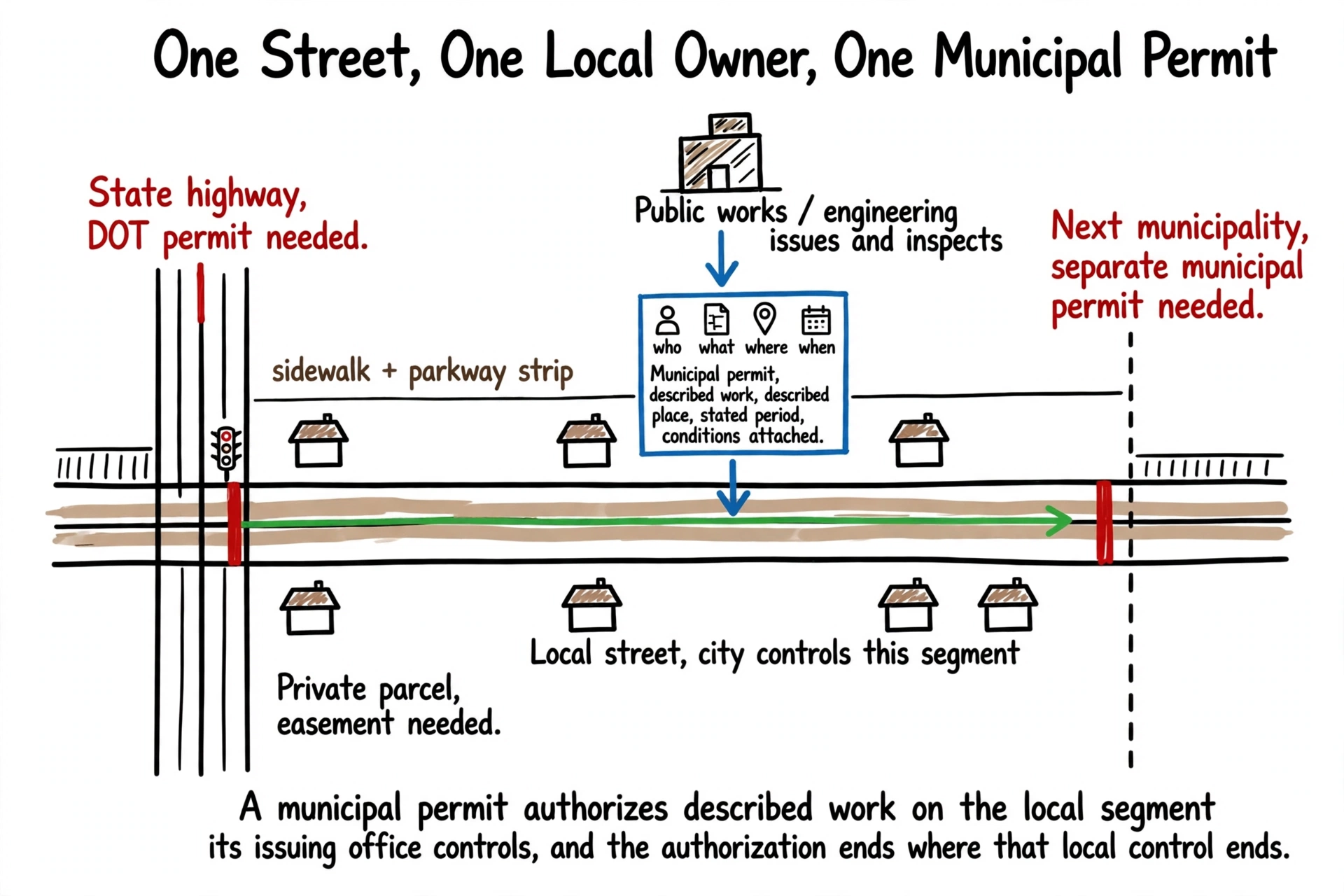
A municipal permit sits in the permission sequence for any segment that touches local ground. Road jurisdiction and control decide which authority controls each segment, and the route is checked segment by segment against that jurisdiction and control.
How jurisdiction sorts out in practice:
- Local streets and local right of way. The city, town, or village that owns or controls the street issues the municipal permit through its public works or engineering office. County government plays the local role for county roads and for areas where state law assigns the county that role.
- State highways. The state department of transportation, called the DOT, issues the permit for work in state highway right of way under the state accommodation policy. A municipal permit gives no authority on a state highway segment, even where the highway runs through the middle of a town and carries a local street name.
- Railroad corridors. The railroad controls its own property as a private owner. Work in a railroad corridor follows the railroad agreement and permit process, covered in Lesson 121. A municipal permit gives no authority inside a railroad corridor, even where a local street crosses the tracks.
- Private parcels. Entry and permanent facilities on private land rest on an easement or another agreement with the landowner, covered in earlier lessons. A municipal permit gives no right on a private parcel beside the street.
The sequence around a municipal permit runs in a steady order:
- Design identifies the segments that lie in local right of way and the local office for each segment.
- The applicant prepares the municipal application package for each segment or group of segments the local system allows on one application.
- The local office reviews the package, may request changes or added information, and issues, issues with conditions, or denies the permit.
- The project reads the issued permit, converts its conditions into the segment plan, and schedules notice and inspection steps.
- Construction proceeds inside the location, scope, hours, and dates the permit allows.
- Restoration follows the standard the permit names.
- Inspection and sign off close the permit under the local process, and the closed record joins the segment file.
One route often needs several municipal permits. Each city or town along the route issues its own permit for its own streets. A permit from one municipality authorizes no work in the next municipality, even on a street that keeps the same name across the boundary.
What Is at Stake
The right to be on that street. Work in a local right of way with no municipal permit, or work outside the location and scope a municipal permit describes, is unauthorized work in ground the local government controls. The local code and the permit terms set the consequences for that jurisdiction. Consequences named in municipal systems include stop work direction, fines or added fees under the local code, required removal or replacement of unauthorized work, and restoration at the permittee expense. Example, Town of Timnath, Colorado: its instructions state that failure to comply with a provision of its municipal code or manual, without prior written approval from the town, results in a Stop Work Notice, and that work without a permit incurs an additional fine under its schedule. That enforcement language belongs to Timnath. The general stake holds in every municipal system: the local office can halt and penalize work that proceeds without its permission, under its own rules.
Safety of street users. Municipal conditions on traffic control, pedestrian passage, open excavation protection, and work hours exist because local streets carry neighbors, school routes, mail delivery, emergency vehicles, and people walking dogs past the work area. The Manual on Uniform Traffic Control Devices, called the MUTCD, is the national standard for traffic control devices on streets open to public travel, and municipal permits commonly require traffic control that follows the MUTCD and any state supplement or local requirement. A crew that treats traffic conditions as paperwork leaves street users to manage hazards the permit was written to control.
The street as a public asset. A street cut, a bore pit in a parkway, or a torn sidewalk affects an asset the whole community paid for and uses daily. Restoration conditions protect pavement life, sidewalk usability, drainage function, and appearance. Restoration that fails early becomes a pothole, a settled trench line, or a tripping edge that the community lives with and the permittee may be called back to repair under the permit terms.
Schedule and cost. A municipal permit discovered missing after mobilization idles the crew assigned to that segment. A permit that expires before the segment finishes can pause the work until the issuing office grants an extension or a new permit under its process. A condition that requires a specific inspection before backfill can add a planned wait when the crew schedules it early and an unplanned delay when the crew discovers it with an open excavation.
Standing with the issuing office. Public works and engineering offices issue permits week after week to the same community of builders. A permittee that follows conditions, gives notice as required, and restores cleanly builds a record the office can see. A permittee that works without permits or leaves failed restoration behind builds the opposite record.
What Does Good Look Like?
- The issued municipal permit, its conditions, and its attached plans are in the job file and, where the permit requires it, at the work site, before mobilization for the segment.
- The permittee name, the work description, the location limits, and the dates on the permit match the segment about to be built, and the foreman can state each match out loud.
- Every condition that touches field work appears in the segment plan with an owner: allowed hours, notice before starting, traffic and pedestrian setup, inspection scheduling, restoration standard, and cleanup.
- The application record and the issued permit agree, so the work the crew builds is the work the local office reviewed.
- Expiration is tracked, and any extension request goes to the issuing office in writing before expiration, through the process the permit and the local code describe.
- At every boundary where the route leaves local ground, the file names the separate instrument that covers the next segment: a DOT permit for a state highway, a railroad agreement for a rail crossing, or an easement for a private parcel.
- Restoration is completed to the standard the permit names, the required final inspection is requested, and the permit closeout or sign off is filed with the segment records.
From the Field
Picture a fiber crew assigned to place conduit along a residential street and across one cross street to reach a cabinet. The job file holds a municipal permit for the residential street segment. The permit location description names the residential street between two cross streets, and its conditions require advance notice to the city before starting, traffic control following the approved plan, and restoration of every disturbed surface to the city standard named in the conditions.
On the second morning, the foreman studies the print and sees a shorter path. Crossing the cross street diagonally and placing the cabinet feed along the far side would save a bore setup. The far side of the cross street lies outside the location description in the permit. The cross street also carries a different traffic pattern, and the approved traffic plan in the permit package covers the residential street layout only.
The foreman faces a clear choice. One path treats the permit as general permission to work in the neighborhood and builds the shorter path the same day. The other path holds the added ground, keeps the crew on the permitted segment, and sends the proposed change to the project lead as a written question with the print sheet, the permit location description, and the traffic difference noted.
The foreman chooses the second path. The project lead contacts the city engineering office, describes the added crossing and the far side run, and asks whether the change needs an amended permit or a separate permit under the city process. The office replies in writing that the added ground needs coverage before work begins there, and the project schedules the crew on permitted segments while the added coverage is processed. The added ground is built later, under written coverage, with a traffic setup the city reviewed for that crossing.
No inspector had to discover unauthorized work. No restored crossing had to be reopened because the traffic plan never covered it. The delay cost part of one day of resequencing. Building first and asking later would have risked a stop work direction, removal or rework of the added segment, and a damaged record with the office that will review the next streets on the same project.
The rule to carry is this: a municipal permit covers the ground and the work it describes, and ground outside that description waits for written coverage from the issuing office before any crew occupies it.
What Can Go Wrong?
- Working with no municipal permit. The crew occupies or excavates in a local right of way on the strength of a design, a schedule, or a permit for a different segment. The local office can stop the work and apply the penalties its code provides, and the segment has no authorized record.
- Working beyond the described location. The crew builds a longer run, an added crossing, or a handhole outside the permitted limits. Sound construction outside the described location is still unauthorized construction at that location.
- Working beyond the described scope or method. The permit describes one method or one facility, and the crew builds a different method or an added facility. Scope and method changes go back through the issuing office process the permit describes.
- Working past expiration. The permit term ends while the segment is unfinished, and work continues on a copy of an expired document. An extension is a written grant from the issuing office, requested through its process. An expired permit authorizes no further work until the office acts.
- Missing a notice step. The permit requires advance notice before starting or before a phase, and the crew starts without giving it. The office loses its chance to schedule inspection, coordinate with other street work, or warn affected services, and the crew may be directed to pause until notice and coordination catch up.
- Missing an inspection step. A phase the permit requires the city to inspect gets covered before inspection. The office can require exposure, added documentation, or rework under its rules so the phase can be verified.
- Restoring below the named standard. The surface looks finished to the crew and fails the material, compaction, thickness, or finish standard the permit names. Failed restoration can draw a callback, a repair at permittee expense, or a hold on permit closeout.
- Assuming a municipal permit covers other ground. The crew carries city permission onto a state highway segment, into a railroad corridor, or onto a private parcel. Each of those places answers to a different authority or owner, and the city permit travels to none of them.
- Assuming a neighboring city permit transfers. The route crosses a municipal boundary and the crew keeps working under the first city permit. The second city never reviewed the work on its streets and never granted permission for it.
What Should Someone Notice in the Field?
- Confirm the segment in front of you lies inside the location description and limits on the municipal permit, and name the issuing office and the permit number out loud.
- Compare the permittee name on the permit with the party directing the work, and raise any mismatch to the project lead.
- Read the expiration date or expiration event and compare it with the planned finish for the segment, and flag any finish that lands past expiration.
- Check the allowed hours and days in the conditions against the planned shift, including any different hours the permit states for work inside traveled lanes.
- Confirm the advance notice the permit requires has been given, and note who gave it and when.
- Confirm the next inspection step in the conditions is scheduled, and check which phase must stay open or uncovered until that inspection happens.
- Check the traffic and pedestrian setup in the field against the traffic control approach the permit requires, and report any missing device or blocked passage.
- Check that restoration material and method on site match the restoration standard the permit names.
- At any point where the route leaves a local street for a state highway, a railroad corridor, or a private parcel, confirm a separate instrument covers that ground before work enters it.
- Keep the permit copy where the permit requires it, and know who on the crew produces it when an inspector asks.
- Safety and authority boundary: reading a municipal permit and reporting a mismatch are observation and support tasks. Issuing, amending, extending, or interpreting a municipal permit as a legal matter belongs to the issuing office and to the qualified people the project assigns to permitting. The work a municipal permit describes can involve excavation, boring, work near traffic, and work near other utilities, each governed by its own laws, qualifications, and safety process. This lesson qualifies no one to perform that work, to direct traffic, or to make permitting decisions for a project.
Key Terms
Municipal permit: Written permission from a local government to do described work in a local public right of way, on local streets, or on other local public ground, during a stated period and under stated conditions.
Municipality: A local government with authority over its own streets and public ground, such as a city, a town, or a village. A county fills a similar local role for county roads under state law.
Public works department: The local department that builds and maintains local streets, drainage, and related infrastructure, and that commonly reviews and inspects work in the local right of way.
Engineering division: The local office that commonly handles plan review, permitting, and inspection for right of way work, inside or alongside public works.
Permittee: The person, company, or agency named on a permit as the party who receives the permission and accepts its conditions.
Right of way (ROW): Land set aside for transportation or utility use, including the road surface, shoulders, sidewalks, and the space above and below, with boundaries shown on plats, plans, and records for that road.
Encroachment permit: A municipal permit name used in many communities for permission to occupy, cross, excavate, or place a facility in, on, over, or under a public right of way.
Excavation permit: A municipal permit name used in many communities for permission to dig, cut, or bore in the public right of way, usually paired with restoration and inspection conditions.
Franchise: A broader agreement between a local government and a service provider that manages occupancy of public right of way, covering the rules, rights, and fees for that occupancy. A franchise does not replace a work level municipal permit where the local system requires one.
DOT permit: A permit issued by a state department of transportation for work in state highway right of way, under the state accommodation policy. A municipal permit grants no authority on a state highway.
Check Your Understanding
- A route runs along a city street, crosses a state highway, and then runs along another city street. Which permits cover the three segments, and why does one permit fail to cover the whole route?
Answer: The city segments need municipal permits from the city for its own streets. The state highway crossing needs a DOT permit from the state department of transportation for state highway right of way. Jurisdiction follows road ownership and control. A municipal permit authorizes work only in ground the municipality controls, and a DOT permit authorizes work only in ground the state controls.
- List the general contents of a municipal permit application package and state what each item lets the local reviewer check.
Answer: The package commonly contains the applicant and permittee information, so the reviewer knows who accepts the conditions; a location description and plans or drawings showing the right of way, existing utilities, and the proposed work in detail, so the reviewer can check the work against the street and its existing facilities; a traffic control plan or traffic information where the work affects travel, so the reviewer can check protection for road users; a proposed schedule, so the reviewer can check timing against other street work and permit duration; and contractor license and insurance information, plus bonding documentation, where the municipality requires them, so the reviewer can confirm the party meets local requirements for working in the right of way. The exact list for a job comes from that municipality application instructions.
- In the From the Field scenario, the foreman found a shorter path across a cross street and along its far side. Why did the foreman hold that ground, and what happened next?
Answer: The far side of the cross street lay outside the location description in the municipal permit, and the approved traffic plan covered the residential street layout only. The foreman kept the crew on the permitted segment and sent the change to the project lead as a written question. The lead obtained written direction from the city engineering office that the added ground needed coverage before work began there, the crew resequenced to permitted segments, and the added ground was built later under written coverage with a traffic setup the city reviewed.
- A municipal permit expires on Friday and the segment will finish the following Tuesday. The design has stayed the same. What is the correct action?
Answer: The crew holds work past expiration and the project lead requests an extension or a new permit from the issuing office in writing, through the process the permit and the local code describe, before the expiration date where possible. An extension is a written grant from the issuing office. An unchanged design does not extend an expired permit, and work performed after expiration is unauthorized until the office acts.
- An inspector arrives and asks for the permit copy and the next inspection step. The foreman has the permit face and cannot find the conditions sheet. Why does that gap matter?
Answer: The conditions carry the job specific instructions the face alone may omit, including notice steps, inspection scheduling, allowed hours, traffic requirements, and the restoration standard. Several municipal systems also require a permit copy to be available at the site, and a missing conditions sheet means the crew cannot show how the work meets the full permission. The gap goes to the project lead, and the full package is assembled and briefed before further work depends on it.
Lesson Takeaway
A municipal permit is the local government written permission for described work on its own streets and public ground, issued by its public works or engineering office, bounded by the location, scope, dates, and conditions it states. After this lesson, a city street reads as ground with a named local owner, a named local office, and a written permission that must match the segment before a crew occupies it, and any ground outside that match reads as a written question for the issuing office.
Sources and Technical References
Federal Highway Administration, Construction Program Guide, Utilities, stating that joint use of the right of way of public roads and streets by utility facilities is generally in the public interest when the use does not adversely affect highway or traffic safety, does not impair the highway or its aesthetic quality, and does not conflict with federal, state, or local laws and regulations, and noting that the right of way of highways, particularly local roads and streets, is often used to provide public services to abutting residents: https://www.fhwa.dot.gov/construction/cqit/utilities.cfm
Federal Highway Administration, Pavement Utility Cuts, Controlling Pavement Cuts by Implementing Policy, defining public right of way and defining a franchise agreement as an agreement executed to manage an occupant of public right of way, including the rules, rights, and fees associated with using public property, for occupants that provide services to local, county, and state jurisdictions: https://www.fhwa.dot.gov/utilities/utilitycuts/man03.cfm
Town of Timnath, Colorado, Right of Way Permit Applicant Instructions, an EXAMPLE municipal instruction set. Examples drawn from this source in the lesson, the permit is valid only for the locations and scope originally submitted and approved, a copy of approved permits must be available at the job site, advance notice before construction and advance notice to schedule inspections are required, traffic control and public safety measures must be in place before construction or street occupancy begins, failure to comply without prior written approval results in a Stop Work Notice, and work without a permit incurs an additional fine under its schedule. Every value, hour, period, and fee in that document belongs to Timnath only and states no rule for any other municipality: https://timnath.org/wp-content/uploads/2026/08/ROW-Application-Instructions.pdf
City of Pacifica, California, Encroachment Permit General Conditions, Public Works, Engineering, an EXAMPLE municipal conditions set. Examples drawn from this source in the lesson, no party other than the named permittee or their agent is authorized to work under the permit, the permittee shall allow the city engineer or authorized representatives access to inspect all work, the permit or a legible copy shall be kept at the work site and shown on demand with work suspended if the permit is unavailable, pedestrian passage must be maintained, drainage must not be interfered with without approved provision, and the permittee is responsible for restoring disturbed right of way to its former condition as nearly as possible and bears the cost when the city elects to make repairs. Every hour and standard in that document belongs to Pacifica only and states no rule for any other municipality: https://www.cityofpacifica.org/departments/public-works/engineering/encroachment-permits/encroachment-permit-general-conditions
Federal Highway Administration, Manual on Uniform Traffic Control Devices, 11th Edition, Part 6, Temporary Traffic Control, the national standard municipal traffic control conditions commonly reference for work in streets open to public travel: https://mutcd.fhwa.dot.gov/pdfs/11th_edition/part6.pdf
Graphic Brief 1
Graphic title: One Street, One Local Owner, One Municipal Permit
Main objects: A whiteboard street map drawn in plan view. A residential street runs across the middle of the board with houses, sidewalks, and a parkway strip. A city limit style boundary line crosses the street near the right side, and a state highway crosses the street near the left side. A permit document panel sits above the local street segment, connected to a public works building symbol. A conduit path runs along the local segment only, inside a highlighted work limit band.
Placement: Title at the top. Street across the middle. State highway crossing at the far left. Municipal boundary line at the right. Permit document panel above the center segment. Public works building symbol at the top center. White space at the bottom for the key teaching point.
Labels: Local street, city controls this segment. Municipal permit, described work, described place, stated period, conditions attached. Public works / engineering issues and inspects. State highway, DOT permit needed. Next municipality, separate municipal permit needed. Private parcel, easement needed.
Arrows and relationships: Blue arrow from the public works building symbol down to the permit panel, showing the local office issues the permit. Green arrow along the conduit path inside the highlighted local segment only. Red stop bars where the conduit path reaches the state highway crossing and the municipal boundary, showing the municipal permit ends at each boundary.
Important technical details: The highlighted band shows location limits as a concept, with no dimensions, depths, clearances, or setback values anywhere on the board. The permit panel shows four match icons for who, what, where, and when, with no permit number, fee, or date value. Traffic devices are generic shapes with no device specifications.
What not to show: No conduit path continuing past a red stop bar. No crew excavating or boring. No agency logos, fee amounts, work hours, or expiration dates. No decoration or extra labels.
Key teaching point: A municipal permit authorizes described work on the local segment its issuing office controls, and the authorization ends where that local control ends.
Graphic Brief 2
Graphic title: Municipal Permit Flow, Application to Closeout
Main objects: A whiteboard sequence of six connected boxes running left to right in two rows of three, with a return arrow for a requested change. Box 1 shows an application packet with a plan sheet and a traffic sheet. Box 2 shows a reviewer desk with a check mark and a question mark branch. Box 3 shows an issued permit document with condition panels attached. Box 4 shows a work segment with traffic devices and a notice flag. Box 5 shows an inspector with a checklist beside an open phase and a restored surface. Box 6 shows a closed permit file folder placed into a segment record box.
Placement: Title at the top. Boxes 1 to 3 in the top row, left to right. Boxes 4 to 6 in the bottom row, left to right, with the flow arrow dropping from Box 3 down to Box 4. Return arrow along the bottom from Box 4 back to Box 2. White space at the bottom for the key teaching point.
Labels: 1. Apply: plans, traffic control, schedule, license and insurance as the municipality requires. 2. Review: local office checks the street, other work, and the code. 3. Issued permit: location, scope, dates, conditions. 4. Build inside the permit: hours, notice, traffic, limits. 5. Inspect and restore: phases witnessed, surface restored to the named standard. 6. Closeout: sign off filed with segment records. Change or added ground: back to the issuing office in writing.
Arrows and relationships: Green arrows flow from box to box in sequence, showing each stage depends on the stage before it. A red hold symbol sits on the arrow between Box 3 and Box 4, labeled No start before issuance. An amber return arrow runs from Box 4 back to Box 2, showing a scope or location change returns to the issuing office rather than to field improvisation.
Important technical details: The sequence matches the municipal permit life taught in the lesson: application, review, issuance with conditions, construction inside the permit, inspection and restoration, closeout. No fees, hours, notice periods, inspection lead times, depths, or dimensions appear anywhere on the board, since those values belong to the permit and the municipality for that job. Condition panels on Box 3 carry short labels only: hours, notice, inspection, restoration.
What not to show: No box suggesting work may start on an application receipt. No crew bypassing the hold symbol. No invented city names, form numbers, or fee figures. No decoration or extra branches.
Key teaching point: A municipal permit moves in order from application to review to issuance to work inside its conditions to inspection, restoration, and closeout, and any change in ground or scope returns to the issuing office in writing.
Previous lesson: Lesson 118: What Is a Utility Easement? |
Back to Level 6 hub |
Next lesson: Lesson 120: What Is a DOT Permit?