
Introduction
A railroad permit is the written permission a railroad grants, usually through a signed license agreement, that allows a named party to cross, occupy, or work on railroad property under the conditions written in that agreement. In this lesson the phrase railroad permit covers that family of railroad documents: a crossing agreement, a wireline or pipeline license, an encroachment agreement, and a right of entry for early work the railroad allows. The ground belongs to the railroad as a private owner, and the railroad grants the permission as the owner.
Level 6 studies permission one issuer at a time. Lesson 120 covers the state DOT approval for state highway right of way. This lesson covers the railroad corridor: why the railroad decides as a private property owner, what its engineering review checks, and which conditions on flagging, insurance, and access travel with the agreement into the field.
What This Lesson Gives You
- Read a railroad agreement and name the railroad, the licensee, the crossing or occupancy location, and the conditions that govern work there.
- Explain why a city permit, a county permit, and a state DOT permit each give a crew no right to enter railroad property.
- Describe the railroad engineering review: what drawings the applicant submits, what clearances and methods the railroad checks, and why an incomplete application stops the review.
- Check flagging, insurance, notice, and right of entry conditions against the planned day before a crew mobilizes.
- Stand at the edge of a railroad corridor, recognize the signs that the corridor begins there, and state the safety boundary that applies before anyone steps inside it.
Start With the Basics
Think about crossing a fenced farm field with a buried line. The farmer owns the field. Permission to cross comes from the farmer, in writing, and the writing states where the line may cross, how deep the farmer requires it to sit below the field work, when the crew may enter, and what the field must look like when the crew leaves. Permission from the county for the road beside the field gives no right to cross the field, because a different owner controls that ground.
A railroad corridor works in a similar way, with trains in place of farm work. Railroad right of way, shortened in this lesson to railroad ROW, is the land the railroad owns or controls for its track, its roadbed, its drainage, its signals, and the space above and below them. A railroad in this lesson means the company that owns or operates that corridor, including a large freight railroad, a short line railroad, or a passenger railroad. The railroad controls entry to its ROW the way any private owner controls entry to private land. The Federal Railroad Administration, shortened to FRA, states the public side of that control plainly: it is illegal to access private railroad property anywhere other than a designated pedestrian or roadway crossing.
Lesson 86 defined a permit in general terms, and Lessons 119 and 120 covered city and state highway approvals. This lesson stays with one issuer. Every idea here answers to the railroad that owns or operates the corridor, and the permission ends where railroad property ends.
What Is It?
A railroad permit is the railroad written permission for a specific use of railroad property. Railroads issue that permission in several document forms, and a reader should recognize each one:
- License agreement. A license is a written contract in which the owner grants a named party permission to use described property for a described purpose, under stated conditions, for a stated term. BNSF Railway states the rule in its Utility Accommodation Policy in direct terms: Utility License Agreements are required when utility facilities are installed, relocated, removed, or maintained along or across all BNSF property, and approved requests are authorized by a Utility License Agreement.
- Crossing agreement. A crossing in railroad work means a facility that passes from one side of the railroad ROW to the other side. Union Pacific defines a crossing as a pipeline or wireline that enters the railroad trackage from one side of the right of way to the other side in as near a straight line as possible. A crossing agreement licenses that single passage at a described location, often identified by railroad milepost and subdivision.
- Encroachment or longitudinal agreement. A longitudinal installation runs along the direction of the tracks inside the ROW for some distance. Union Pacific uses the word encroachment for a pipeline or wireline that enters the right of way and either stays inside it or follows along it for some distance. Longitudinal occupancy receives heavier review than a single crossing in railroad practice because the facility shares the corridor with the track over a long distance.
- Right of entry. A right of entry is a limited written permission to enter railroad property for a defined early purpose, such as survey work or a study the application needs, before any construction license exists. BNSF policy provides a Temporary Occupancy Permit for surveying or environmental and geotechnical study on BNSF right of way when an application needs that work. A right of entry for survey grants no right to build.
The licensee is the person, company, or agency named in the agreement as the party receiving the permission and accepting its conditions. The railroad grants the permission to that named party for that described work at that described location. A crew working for a different party, or building at a different milepost, cannot assume the agreement covers its work.
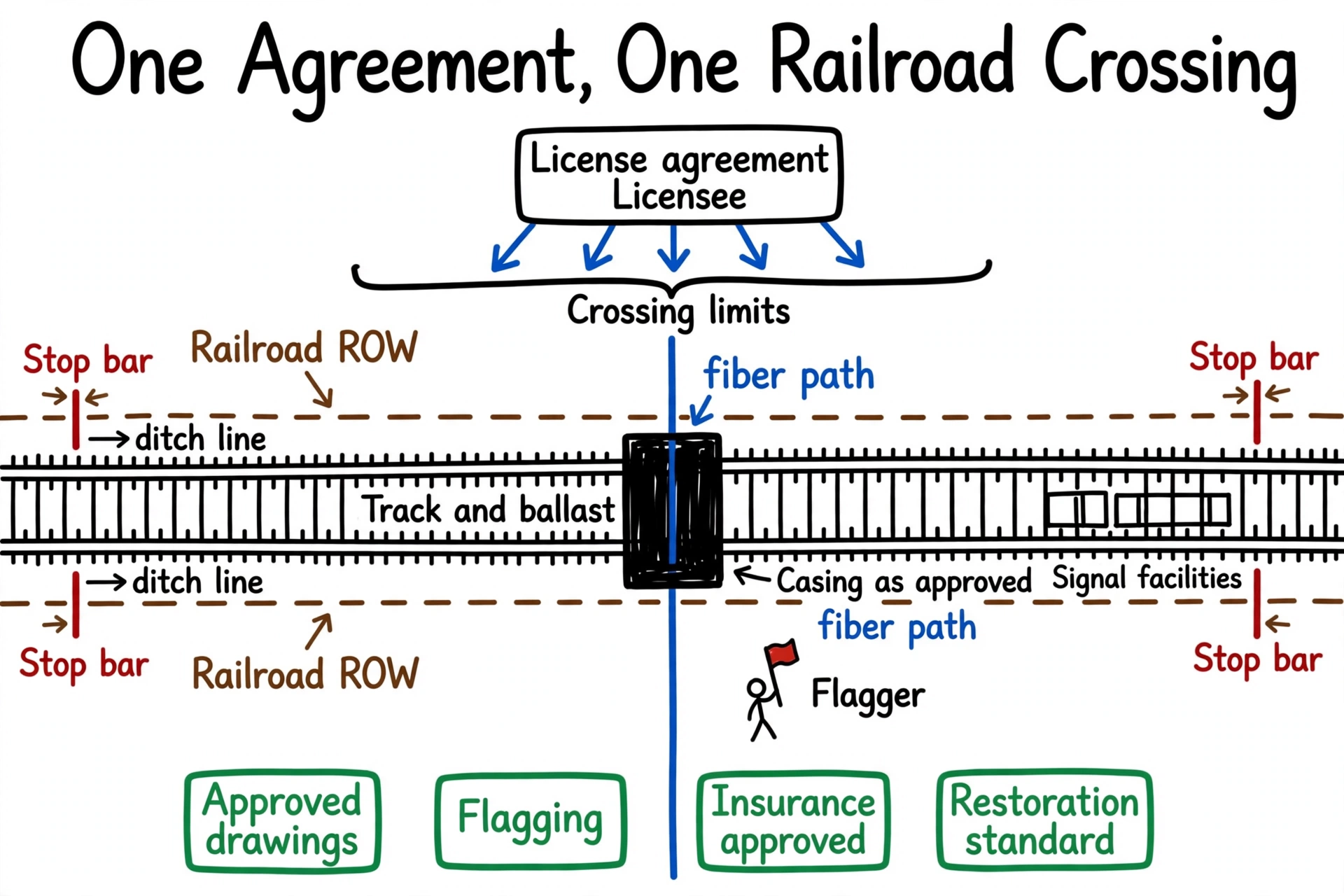
A railroad agreement has five working parts, and a reader should be able to point to each one:
- The executed agreement itself. The signed license or crossing agreement, with its agreement or folder number where the railroad assigns one, its effective date, and the exhibit drawings the agreement incorporates.
- The described work and location. The facility, the installation type, the milepost or stationing, the subdivision or line name where the railroad uses one, and the limits where work may occur.
- The engineering approval behind it. The railroad acceptance of the plan and profile drawings for the crossing or occupancy, recorded through the railroad review process described below.
- The term. The period the agreement stays in effect, including construction windows, notice duties before later entry for maintenance, and any expiration or renewal terms the agreement states.
- Agreement conditions. An agreement condition is an enforceable requirement attached to the permission, covering matters such as construction method, casing, depth, clearances, flagging, insurance, inspection, restoration, and future relocation duties. Conditions may sit in the agreement body, in the railroad utility accommodation policy or specifications the agreement references, in the approved drawings, or in a combination of all three.
One distinction controls the whole lesson. A government permit flows from a government power to regulate work in public ground. A railroad license flows from ownership. The railroad signs as a property owner protecting its track, its operations, and its people, and the railroad can condition, redesign, or refuse an occupancy under its standards and the agreement process, subject to any state law that applies to utility crossings in that state. Some states regulate parts of the crossing relationship by statute or by public service commission rule, and those state rules sit beside the agreement. State rules never turn a city or a DOT approval into railroad permission.
What Does It Look Like?
A railroad agreement lives in the job file before it lives in the field, and the corridor itself gives a second set of signs. Look for these elements when a railroad package lands in front of you:
- A title or heading that names the document type the railroad uses, such as utility license agreement, wireline crossing agreement, pipeline crossing agreement, or encroachment agreement.
- The railroad legal name and the office or agent handling the file, often the railroad real estate or engineering department, or an outside permitting agent the railroad names for applications.
- The licensee name and address, matching the party the contract says will perform or direct the work.
- A location description tied to the railroad, such as a milepost, a subdivision or branch name, a nearby road crossing name, and an attached plan and profile drawing marked as an exhibit.
- A description of the authorized work, such as an underground wireline crossing, an aerial crossing, a longitudinal run inside the ROW, or a facility attached to a structure the agreement names.
- Insurance exhibits or certificates the agreement requires, including railroad protective liability coverage where the railroad requires it, in the form and limits the agreement or the railroad insurance requirements state.
- Flagging and notice provisions, stating how flagging gets requested, how much advance notice the railroad requires, and which railroad representative coordinates the work window.
- Field signs at the corridor edge once the route reaches it, such as the track itself on its raised roadbed, ballast shoulders, milepost markers, signal cabinets and signal cable routes, drainage ditches, ROW fences or property markers, and posted signs at road crossings.
A package that references approved drawings, insurance exhibits, or a flagging arrangement nobody can produce is an incomplete package. An application receipt, an email saying a review has started, or a verbal assurance from a railroad contact deserves the same caution: the file needs the executed agreement before construction entry.
What Does It Do?
A railroad agreement does its work through the railroad standards and review behind it. Each function below protects the track, the trains, or the people near both.
It records owner consent for a private corridor. The agreement is the evidence that the owner of the ground said yes to this facility, at this location, under these conditions. Genesee and Wyoming states the underlying fact in its insurance requirements: under state law, the right of way of its railroads is private property. Entry without the owner consent recorded in an agreement is trespass, and FRA trespass prevention material treats entering or remaining on a railroad right of way without authorization as illegal entry onto private property.
It forces an engineering review before ground opens. Railroads route applications through their real estate and engineering process. CN requires an applicant to submit a completed application for utility crossing engineering review, warns that no application will be reviewed until the application is complete, and states that no construction related activities may be scheduled or conducted on railroad property until the railroad has issued its final approval, a written agreement has been signed, and flaggers have been secured. The review typically checks plan and profile drawings against railroad standards: the crossing angle, the position relative to tracks, bridges, culverts, and signals, the horizontal and vertical clearances, the construction method, drainage effects, and access points. Genesee and Wyoming general specifications require plan and cross section drawings showing the profile in relation to actual ground, track, and other facilities, submitted to the Engineering Department for approval before any agreement gets prepared, and require crossings to sit substantially perpendicular to the main line and clear of culverts and bridges.
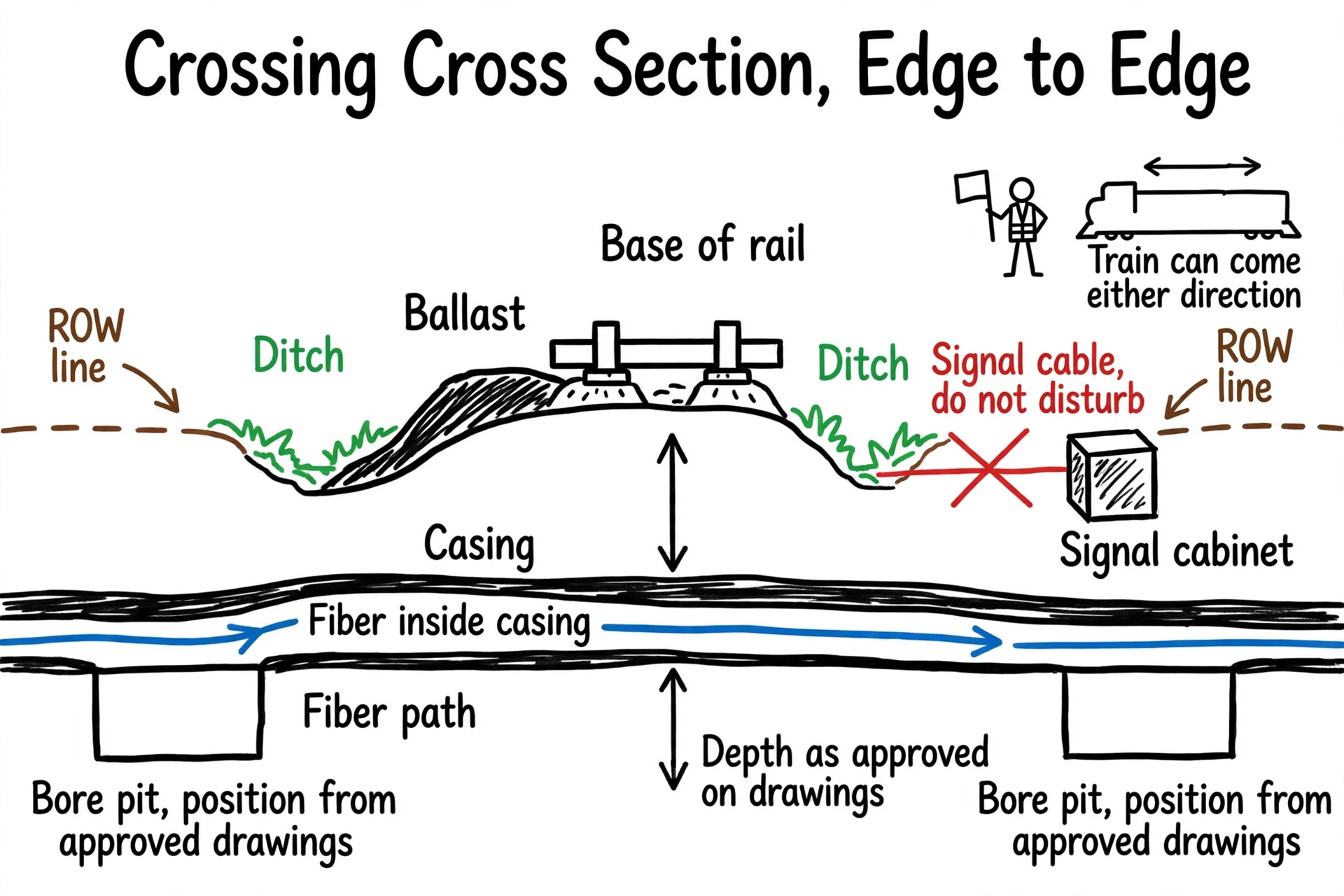
It applies the railroad design standards for the facility. The American Railway Engineering and Maintenance-of-Way Association, shortened to AREMA, publishes the Manual for Railway Engineering, the standard reference railroads cite for utility crossing design. Union Pacific states that it follows AREMA Manual for Railway Engineering Chapter 1, Part 5, Pipelines, and railroad specifications for wireline crossings draw on AREMA guidance and the National Electrical Safety Code, shortened to NESC, for power and communication lines. Design questions the standards answer include whether the carrier needs a casing, meaning a larger outer pipe or conduit that carries the load over the inner carrier pipe and protects the track structure if the carrier fails, what material the casing must be, how deep the installation must sit below the base of rail and below ditches, and how far the casing and the bore pits must extend from the track centerline. Every one of those values belongs to the controlling railroad standards and the approved drawings for the crossing. A value from another railroad, another state rule, or a prior job proves nothing about the crossing in front of the crew.
It controls how the work gets built under and near live track. Railroad specifications govern installation methods because a bore or a trench can move the ground that holds the track. Genesee and Wyoming specifications require an engineering inspector, provided by the applicant at the applicant cost, to monitor the ground and track for movement during drilling, reaming, and pullback, and require the installation process and all train movement to stop immediately if ground or track movement gets detected. The same family of specifications states that the railroad makes the sole determination when flagmen are required and when railroad construction inspection is required, at the expense of the party building the work. Approved drawings, approved methods, and railroad inspection together keep a utility installation from becoming a track defect.
It arranges flagging, the railroad protection for people near trains. A railroad flagger, also called a flagman or a watchman/lookout in railroad rules, is a qualified railroad representative who protects a work group near the track, watches for trains, and communicates with train crews and dispatchers under the railroad on-track safety program. Flagging exists because a train crew cannot stop a train the way a driver stops a truck. FRA states that a train traveling at 55 miles per hour can take more than a mile to stop, and that trains overhang the tracks by three feet or more on either side. Federal roadway worker protection rules at 49 CFR Part 214, Subpart C, require railroads to adopt and implement on-track safety programs that protect employees and contractors from trains and equipment while working on track, and FRA guidance explains that contractor employees who perform roadway worker duties on or near the track must receive on-track safety in the same manner as railroad employees. The railroad decides when flagging is required for a utility job, and the agreement or the railroad flagging process states how the applicant requests it and how far in advance. One labeled example shows how specific those rules get: an Iowa DOT developmental specification for work involving Union Pacific requires track protection for equipment operating within 25 feet of the nearest rail and bars any person or equipment within that distance until a railroad flagger is provided to watch for trains. The distance, the notice period, and the cost in that specification belong to that specification. The crossing in front of a crew answers to its own agreement and its own railroad.
It assigns the risk through insurance written for railroad work. Railroad protective liability insurance is a liability policy that names the railroad as the insured and covers liability arising from the contractor work on or near railroad property, bought by the contractor or the licensee for the railroad benefit. Railroads require it because a general liability certificate alone leaves the railroad exposed for claims that arise from operations on its own property. Genesee and Wyoming requires contractors completing new installations or working on or around its properties to obtain railroad protective liability insurance in the amounts its requirements state, with the specific railroad named as the insured, plus commercial general liability coverage naming the railroad as additional insured. The limits, the policy form, and the certificate language for a given job belong to that railroad insurance requirements and the agreement exhibits. Some railroad agreements make flagging wait on insurance: those agreements state that flagging services will not be provided until the contractor insurance has been reviewed and approved by the railroad. Read the agreement for the crossing to see whether that clause applies.
It preserves railroad operations and future use of the corridor. The corridor holds more than the track on the surface. Signal and communication cables run underground between the track and the signal facilities, drainage structures carry water away from the roadbed, and the railroad plans future track and siding work inside the same strip. Union Pacific encroachment guidance directs installations to the outer limits of the right of way and behind signal facilities because of the underground signal cable in the corridor. The agreement fixes the facility position, the access route, and the maintenance notice duties so the railroad can operate, inspect, and rebuild its own plant around the utility facility for the life of both.
Where Does It Fit?
A railroad agreement sits inside a chain of permissions, and its place in the chain is defined by ownership of the ground.
At route review, the planner divides the route by who controls each stretch of ground. One continuous fiber route can meet several issuers in a single mile:
- State highway ROW, controlled by the state DOT, covered by the DOT approval in Lesson 120.
- City streets, controlled by the city, covered by the municipal permit in Lesson 119.
- County roads, controlled by the county under its own system.
- A railroad corridor, controlled by the railroad as a private owner, covered by the railroad agreement in this lesson.
- Private parcels, covered by an easement or another land rights instrument, covered in Lessons 117 and 118.
- Regulated waters and similar features, which can require a separate environmental authorization, covered in Lesson 123.
A railroad agreement authorizes work only inside the railroad property it describes. A DOT permit for the highway crossing that runs over or under the same tracks gives no right to bore under the track. A city permit for the street that crosses the tracks at grade gives no right to place a handhole inside the railroad ROW beside that street. Permission follows ownership and control of the ground.
Inside the railroad segment itself, the sequence runs like this:
- The applicant identifies the railroad that owns or operates the corridor, using railroad maps, crossing signs, and the emergency notification sign at the nearest public road crossing, which names the railroad and the crossing number.
- The applicant submits the application package the railroad requires, with a cover description of the project, plan and profile drawings, the construction method, and the application fee where the railroad charges one, through the railroad online portal or the permitting agent the railroad names.
- The railroad reviews the package for completeness and then for engineering compliance with its standards and AREMA guidance. Incomplete packages pause at that gate, and CN states the rule plainly: an incomplete application gets no review.
- The railroad approves the drawings, requests changes, or denies the request, and the parties sign the license or crossing agreement that records the approval and its conditions.
- The licensee delivers the insurance certificates the agreement requires, secures approval of that insurance, and arranges flagging and inspection through the railroad process with the advance notice the agreement states.
- During construction, the licensee builds inside the described limits and approved method, works only inside the windows and protection the flagging arrangement provides, and hosts the railroad inspection the agreement calls for.
- After construction, the licensee restores the ROW to the agreement standard, completes any final inspection, and files the executed agreement with the segment records so future maintenance entry follows its notice terms.
A railroad agreement also sits beside federal safety law that governs the track itself. FRA track safety standards at 49 CFR Part 213 set requirements for the track structure the railroad maintains, and 49 CFR Part 214, Subpart C, governs on-track safety for roadway workers. The Association of American Railroads summarizes the interface this way: engineering review of a proposed installation checks compliance with FRA track safety standards, and federal rules require flagmen and watchmen or lookouts to protect workers near tracks. Those federal rules bind the railroad and its roadway workers. The utility crew protection on a given day still comes from the agreement, the railroad on-track safety program the railroad applies, and the flagging the railroad provides or requires.
Future work follows the agreement as well. BNSF policy requires a Utility License Agreement when facilities get installed, relocated, removed, or maintained along or across BNSF property, so a repair entry years later can need a new agreement, an amendment, or the notice process the existing agreement states. The original crossing agreement in the file proves the original installation was authorized. The file alone never proves a later entry is authorized.
What Is at Stake
Life safety at the track. FRA calls trespassing the leading cause of rail-related deaths in the United States, with more than 500 trespass fatalities each year. Trains run at any hour, in either direction, and FRA warns that trains are relatively quiet and do not always sound warning horns when approaching a crossing. A corridor that looks empty is an active transportation facility with no schedule a crew can rely on.
Track integrity and derailment risk. A bore that runs shallow, a casing that fails under load, or an excavation that lets the roadbed settle can damage the structure that carries trains. FRA material on trespass prevention explains that damage to ballast, the rock and soil material that supports the ties and rail, degrades the entire track structure and can lead to a derailment, which can cause a hazardous materials spill or damage to other people and property. Railroad engineering review, casing standards, and track monitoring during boring exist to keep utility work from creating that defect.
Stop work and removal. Work performed without an executed agreement, outside the described location, or by a method the railroad excluded is work the owner never authorized. The railroad can stop the work, bar further entry, and require correction or removal under the agreement terms and state law. Correct fiber in an unauthorized position is still unauthorized plant, and the removal cost lands on the party that built it.
Schedule. A railroad review runs on the railroad timetable. Applications returned as incomplete, drawings redrawn for clearances or casing, insurance certificates corrected and resubmitted, and flagging windows that must align with railroad availability all consume calendar time before ground opens. BNSF advises applicants that the average time for completion of its licensing process runs about eight weeks from the time the application is received, and that rush processing is not available for longitudinal requests. Reading railroad standards during design, while the alignment and method can still move on paper, keeps that time in planning.
Cost. Application and review fees, license fees, engineering inspection, flagging at the railroad rates, protective liability premiums, and restoration to the agreement standard all land on the job, and railroad specifications place flagging and inspection costs on the party building the work. A bid or a schedule that skipped the railroad package priced a different job from the job the railroad will allow.
The record for the life of the plant. Fiber under a track will need locating, repair, and eventual replacement. A clean agreement file, with approved drawings and the as-built position recorded, gives that future work a legal starting point and a known set of railroad contacts. A crossing built on a verbal assurance gives the next crew a trespass problem and the owner a facility with no documented right to exist there.
What Does Good Look Like?
- The executed railroad agreement for the crossing or occupancy sits in the job file with its approved exhibit drawings, insurance exhibits, and any amendments together in one place.
- The licensee, the described work, the milepost or location limits, and the agreement term each match the print segment the crew is about to build, and the foreman can state all four matches out loud.
- The insurance certificates in the file match the agreement exhibits, name the correct railroad as the agreement requires, and carry railroad approval before any flagging gets scheduled.
- The flagging arrangement for the work window is confirmed in writing with the railroad, with the required advance notice given and the railroad representative contact in the crew packet.
- Conditions that touch the field appear on the segment plan as assigned tasks, covering approved method, casing and depth from the approved drawings, access points, inspection points, and restoration.
- The crew enters railroad property only through the access points and during the windows the agreement and the flagging arrangement allow, and no one enters early to scout, stage, or mark inside the ROW without a right of entry that covers that entry.
- Expiration, notice, and maintenance entry dates sit on a tracked calendar, and any change in method, location, or facility goes back to the railroad for approval before the change gets built.
- At every point where the route leaves railroad property, the file holds the separate permission for the next stretch of ground, and nobody treats the railroad agreement as covering that stretch.
From the Field
Picture a fiber route that follows a county road, crosses under a single railroad track, and continues along the county road on the far side. The print shows one bore through the crossing. The job file holds a county approval for the road work on both sides of the corridor and a state approval for a short highway segment earlier in the route. The project coordinator starts the railroad application early, and the railroad returns the package as incomplete because the profile drawing lacks the ditch elevations and the casing detail the railroad standards require.
The coordinator corrects the drawing, resubmits it, and the railroad approves the crossing design. The agreement then takes time to execute. Insurance review follows, and the first certificate names the parent company in a place where the agreement requires the specific operating railroad as the insured under the protective liability policy. The certificate goes back for correction. Flagging cannot get scheduled until the railroad approves the corrected insurance.
Construction on the county road segments moves ahead while the railroad package finishes, and the crew reaches the edge of the corridor with the bore rig staged on county ground. The foreman studies the calendar. Shifting the rig across the corridor and finishing the bore that week would hold the published completion date, and the track carries only a few trains a day on that line. The agreement remains unsigned in the file, and no flagger has been assigned.
The foreman calls the project coordinator from the corridor edge and holds the segment. The coordinator confirms the file state: design approval in hand, executed agreement still pending, insurance approval still pending, flagging still unscheduled. The crew demobilizes the rig to the next county segment and builds there. The railroad package closes the following week, flagging gets confirmed in writing, and the crew returns to build the crossing inside the agreement limits, with the flagger on site and the engineering inspector watching the track during the bore.
The decision rule is direct: design approval is one step in a chain, and the chain closes only when the agreement is executed, the insurance is approved, and flagging is confirmed. Until all three sit in the file, the corridor edge is the work limit, no matter how quiet the track looks or how close the deadline sits.
What Can Go Wrong?
Entering on a government permit. A city, county, or DOT approval covers the ground that issuer controls. Railroad property answers to the railroad. A crew that carries a stack of government permits into the corridor without an executed railroad agreement is trespassing with paperwork.
Building on design approval alone. Engineering approval of a drawing settles the design question. The executed agreement settles the permission question, and insurance approval plus flagging settle the entry question. Treating any single step as the whole permission skips the steps that protect people and assign risk.
Submitting an incomplete application. Railroad review starts from a complete package. CN cancels an application that stays incomplete one year after the first notice of an incomplete submittal, and the applicant starts over with a new application and a new fee. Missing drawings, missing casing details, and missing insurance information spend schedule time at the cheapest stage to fix them.
Crossing at a shallow angle or in the wrong place. Railroad standards direct crossings to sit substantially perpendicular to the track and clear of culverts, bridges, buildings, and other important structures, because angled and crowded crossings complicate casing length, load design, drainage, and future track work. A line drawn for the shortest fiber path can fail review on geometry alone.
Skipping casing or guessing at depth. Depth below the base of rail, casing material and length, and separation from existing railroad cables belong to the controlling railroad standards and the approved profile. A depth remembered from a highway bore or a prior railroad job can leave the carrier in the zone where track loads, ditch work, or a future regrade reaches it.
Working without the required flagger. Flagging protects the crew from trains and protects trains from the work. A crew that enters the fouling zone the railroad defines, without the flagger the railroad requires, violates the agreement and the on-track safety structure behind it, and railroad specifications attach cost and stop work consequences to unprotected work.
Letting insurance lapse or naming the wrong railroad. Protective liability and general liability certificates must name the railroad entities the agreement requires and stay in force through the work. A certificate that names a parent company where the operating railroad belongs, or a policy that expires mid-job, can suspend flagging and entry until the file gets corrected.
Damaging signal cable or drainage. Signal and communication cables run underground inside the corridor, and ditches carry water away from the roadbed. A bore path or an access route chosen without the approved drawings can cut a signal cable or block drainage, and the repair plus the operational consequences land on the licensee under the agreement.
What Should Someone Notice in the Field?
- Identify the agreement in hand: the railroad legal name, the document type, the agreement or folder number where one is assigned, and the effective date.
- Confirm the document is an executed agreement with its approved drawings, insurance exhibits, and amendments present, rather than an application, a review letter, or a design approval alone.
- Compare the licensee name against the party performing or directing the work under the contract, and raise any mismatch before entry.
- Walk the location on the print: find the milepost or crossing limits the agreement describes, and mark every point where the route enters and leaves railroad property.
- Read the approved profile before any bore: casing material and limits, depth below the base of rail and below ditches, bore pit positions, and separation from signal facilities, all taken from the approved drawings for this crossing.
- Pull out the conditions that touch the day: required notice before entry, flagging confirmation for the window, inspection points, approved access points, and the restoration standard.
- Check the corridor from the edge before entry: track condition, milepost markers, signal cabinets, cable markers, ditches, fences, and any sign of recent railroad work inside the segment.
- Confirm nobody stages equipment, parks, or stores material inside the ROW outside the access and work limits the agreement allows.
- Report any field condition the agreement fails to cover, such as a second track, a new signal installation, or a washed ditch inside the limits, to the project lead and the railroad representative the same day.
- Know the boundary: reading a railroad agreement, marking corridor limits from public ground, and reporting mismatches are recognition and support tasks. Railroad corridors are extremely hazardous, trains can arrive at any time from either direction, and no one enters railroad ROW without the railroad authorization for that entry and the flagging the railroad requires for the work. Only qualified and authorized people may perform the boring, excavation, and on-track work the agreement describes, under the railroad on-track safety program. Reading this lesson qualifies no one to perform regulated or hazardous work.
Key Terms
Railroad permit: The written permission a railroad grants, usually through a signed license agreement, allowing a named party to cross, occupy, or work on railroad property under the conditions in that agreement.
License agreement: A written contract in which a property owner grants a named party permission to use described property for a described purpose, under stated conditions, for a stated term.
Licensee: The person, company, or agency named in a railroad agreement as the party receiving the permission and accepting its conditions.
Railroad right of way (ROW): The land the railroad owns or controls for its track, roadbed, drainage, signals, and the space above and below them.
Crossing: A facility that passes from one side of the railroad right of way to the other side, in as near a straight line as the site allows.
Longitudinal installation: A facility that runs along the direction of the tracks inside the right of way for some distance. Railroads also call this occupancy pattern an encroachment in some systems.
Casing: A larger outer pipe or conduit that encloses the carrier pipe or cable, carries loads over it, and protects the track structure if the carrier fails.
Railroad flagger: A qualified railroad representative who protects a work group near the track, watches for trains, and communicates with train crews and dispatchers under the railroad on-track safety program. Railroad rules also use the titles flagman and watchman/lookout.
Railroad protective liability insurance: A liability policy that names the railroad as the insured and covers liability arising from contractor work on or near railroad property, bought by the contractor or licensee for the railroad benefit.
AREMA: The American Railway Engineering and Maintenance-of-Way Association, publisher of the Manual for Railway Engineering, the standard reference railroads cite for utility crossing design.
Ballast: The rock and soil material that supports the ties and rail and forms part of the track structure.
Right of entry: A limited written permission to enter railroad property for a defined early purpose, such as survey or study work, before any construction license exists.
Check Your Understanding
- A route file holds a city permit, a county approval, and a state DOT permit, and the route crosses under a railroad track. Which document gives the crew the right to build the crossing, and why?
Answer: The executed agreement with the railroad that owns or operates the corridor gives that right. Railroad ROW is private property controlled by the railroad as owner, and each government approval covers only the ground its issuer controls.
- Name the three closing steps in the permission chain that must sit in the file before construction entry, beyond engineering approval of the design.
Answer: The agreement is executed by both parties, the insurance the agreement requires is submitted and approved by the railroad, and flagging for the work window is confirmed through the railroad process. CN states the same chain: final approval, a signed written agreement, and flaggers secured before construction activities get scheduled or conducted on railroad property.
- What does railroad protective liability insurance do, and whose name belongs on it as the insured?
Answer: The policy covers liability arising from the contractor work on or near railroad property, and the railroad is the named insured. The contractor or licensee buys the coverage for the railroad benefit, in the limits and form the railroad insurance requirements and the agreement exhibits state.
- In the From the Field scenario, the foreman held the segment at the corridor edge even though the design was approved and the line carried few trains. Name the three file items still missing, and state the decision rule.
Answer: The executed agreement was still pending, the corrected insurance approval was still pending, and flagging was still unscheduled. The decision rule: the chain closes only when the agreement is executed, the insurance is approved, and flagging is confirmed. Until all three sit in the file, the corridor edge is the work limit.
- A planner copies a casing depth and a bore pit distance from a prior job on a different railroad and puts both values on a new crossing print. Evaluate that practice.
Answer: The practice fails. Casing, depth below the base of rail, and pit distances belong to the controlling railroad standards, AREMA guidance as the railroad applies it, and the approved drawings for this crossing. Values from another railroad or another job prove nothing about this corridor, and the print goes through the engineering review of the railroad that owns the ground.
Lesson Takeaway
A railroad permit is the signature of a private owner on one defined piece of ground: railroad property, for a named licensee, for described work, at a described milepost, under an executed agreement backed by railroad engineering standards. After this lesson, a corridor crossing reads as a chain with links that each must close, covering design approval, an executed agreement, approved insurance, and confirmed flagging, and the crew work limit stays at the corridor edge until every link sits in the file.
Sources and Technical References
Federal Railroad Administration, Trespass Prevention, stating that trespassing is the leading cause of rail-related deaths in the United States with more than 500 trespass fatalities each year, that it is illegal to access private railroad property anywhere other than a designated pedestrian or roadway crossing, that a train traveling at 55 miles per hour can take more than a mile to stop, that trains overhang the tracks by three feet or more on either side, that trains do not follow a set schedule and do not always sound warning horns, and that damage to ballast degrades the track structure and can lead to derailment: https://railroads.dot.gov/highway-rail-crossing-and-trespasser-programs/trespassing-prevention/rail-suicide-prevention
Federal Railroad Administration, Roadway Worker Protection, explaining that 49 CFR Part 214, Subpart C, mandates railroad on-track safety programs protecting employees and contractors from trains and equipment while working on track, that FRA prescribes training and qualification requirements including flagman qualification at Section 214.351, and that contractor employees who perform roadway worker duties on or near the track must receive on-track safety in the same manner as railroad employees: https://railroads.dot.gov/railroad-safety/divisions/roadway-worker-protection
Association of American Railroads, Freight Rail Rights-of-Way Access, stating that freight rail property is private property open only to authorized personnel and individuals with permission, that engineering review of a proposed installation checks compliance with FRA track safety standards at 49 CFR Part 213, and that federal rules require flagmen and watchmen or lookouts to protect workers near tracks under 49 CFR Part 214: https://www.aar.org/issue/right-of-way-access/
BNSF Railway, Utility Accommodation Policy, January 2026, stating that Utility License Agreements are required when utility facilities are installed, relocated, removed, or maintained along or across all BNSF property, that approved requests are authorized by a Utility License Agreement, that applications with plans go through the BNSF permitting process, and that a Temporary Occupancy Permit covers surveying or environmental and geotechnical study on BNSF right of way when an application needs that work: http://midconcorridor.com/bnsf-resources/pdf/about-bnsf/utility.pdf
BNSF Railway, Pipeline and Wire Line Process Instructions, revised October 20, 2025, describing the online licensing application process through the BNSF rail permitting site, the application fee and drawing requirements, and advising that the average time for completion of the process is eight weeks from the time the application is received, with rush processing not available for longitudinal requests: http://dsetest.bnsf.com/bnsf-resources/pdf/about-bnsf/pipeline.pdf
Union Pacific, Utilities Installations, describing the online application process for wireline and pipeline crossings, encroachments, modifications, and maintenance requests, defining a crossing as a pipeline or wireline that enters the railroad trackage from one side of the right of way to the other side in as near a straight line as possible, defining an encroachment as an installation that enters the right of way and either stays inside it or follows along it for some distance, and stating that Union Pacific follows AREMA Manual for Railway Engineering Chapter 1, Part 5, Pipelines: https://www.up.com/real-estate/utilities
Union Pacific, Wireline and Pipeline Encroachment Guide, requiring longitudinal encroachments to sit at the outer limits of railroad right of way and behind signal facilities because of underground signal cable between the track and the signal facility, and listing the bridges, culverts, signals, signal houses, mileposts, right of way lines, and dimensions that construction drawings must show for railroad review: https://www.up.com/real-estate/utilities/encroach-procedure/encroach-guide
Canadian National Railway, Utility Crossing and Encroachment Application Packet, revised November 15, 2024, requiring a completed application for utility crossing engineering review with stamped engineering plans conforming to AREMA guidelines and railroad standards, stating that no application will be reviewed until the application is complete, that an application left incomplete one year after the first notice gets cancelled, and that no construction related activities may be scheduled or conducted on railroad property until the railroad has issued final approval, a written agreement has been signed, and flaggers have been secured: https://ecprod.cn.ca/corp/-/media/files/delivering-responsibly/safety/utility-installation/utility-crossing-encroachment-application-packet.pdf
Genesee and Wyoming, General Specifications for Utility Crossings, revised March 24, 2026, requiring plan and cross section drawings showing the profile in relation to actual ground, track, and other facilities, submitted to the Engineering Department for approval before preparation of any agreement, requiring crossings to sit substantially perpendicular to the main line and clear of culverts and bridges, stating that the railroad makes the sole determination when flagmen and railroad construction inspection are required at the expense of the party building the work, and requiring an engineering inspector provided by the applicant to monitor ground and track for movement during drilling, reaming, and pullback, with work and train movement stopped immediately if movement gets detected: https://www.gwrr.com/application/files/9917/7851/7806/Utility_Specifications_REVISED_03242026.pdf
Genesee and Wyoming, Insurance Requirements, stating that under state law the right of way of its railroads is private property, and requiring contractors completing new installations or working on or around its properties to obtain railroad protective liability insurance with the specific railroad named as the insured, plus commercial general liability insurance naming the specific railroad as additional insured: https://www.gwrr.com/services/real-estate/insurance-requirements
Iowa Department of Transportation, Developmental Specification DS-23081 for Construction or Maintenance Work on Railroad Right-of-Way involving Union Pacific Railroad, effective January 21, 2026, a labeled single specification example requiring track protection for equipment operating within 25 feet of the nearest rail and barring persons and equipment within that distance until a railroad flagger is provided to watch for trains, with advance notice duties stated in the specification: https://ia.iowadot.gov/specifications/ds/2023/DS-23081.pdf
American Railway Engineering and Maintenance-of-Way Association, Manual for Railway Engineering, Chapter 1, Part 5, Pipelines, the AREMA guidance for pipelines installed on or adjacent to railroad rights of way, covering casing pipe installation and depth of installation measured from the base of rail, as reproduced in railroad specification material: https://www.acwr.com/wp-content/uploads/2024/10/AREMA-Natural-Gas-Requirements-2.pdf
Previous lesson: Lesson 120: What Is a DOT Permit? |
Back to Level 6 hub |
Next lesson: Lesson 122: What Is a Crossing Permit?