
Introduction
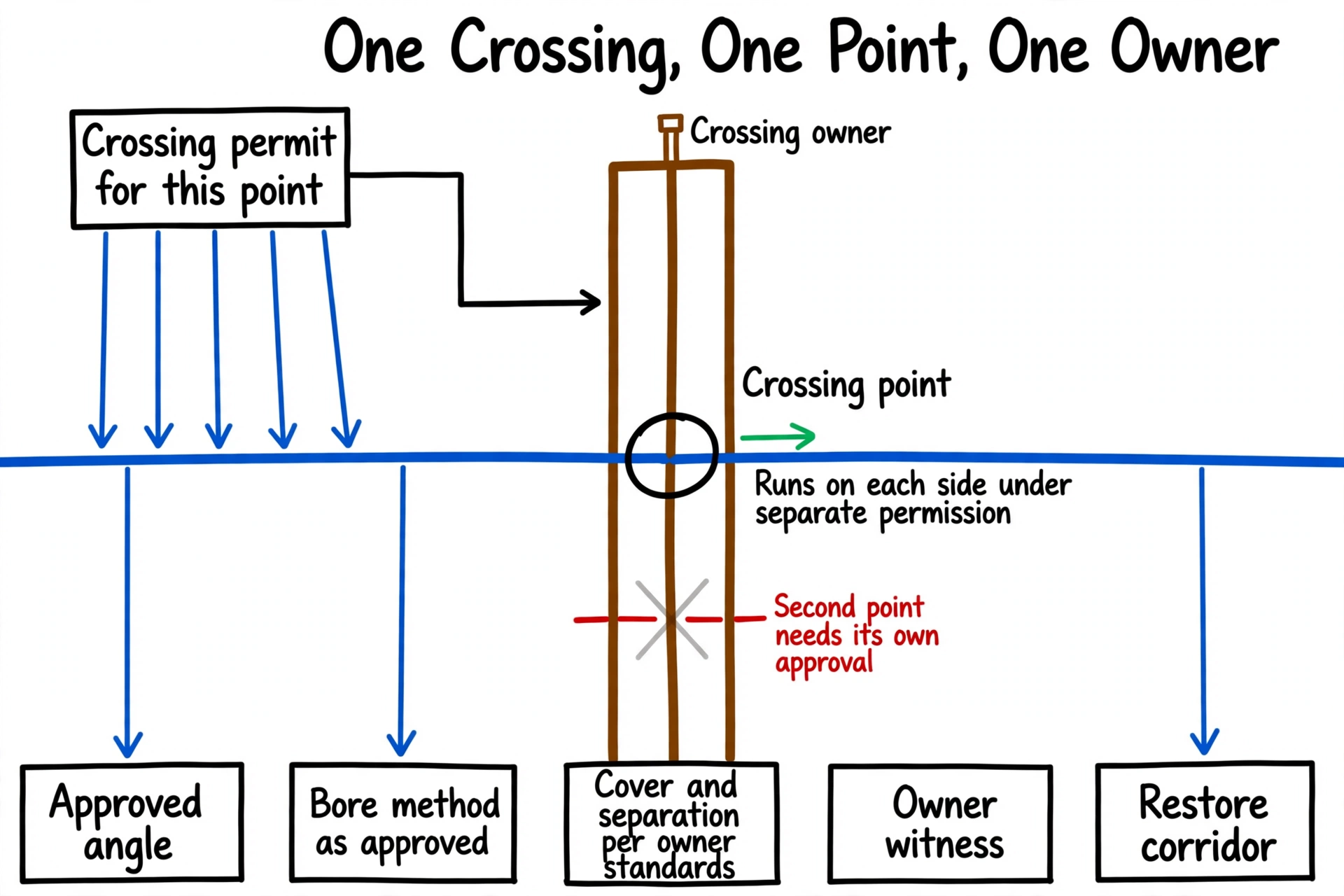
A crossing permit is a written authorization from the owner or controlling authority of a feature or corridor that allows a named party to cross that feature or corridor with a utility facility at one described point, under the conditions written in the authorization. The feature crossed can be a highway, a railroad, a waterway, a pipeline corridor, or another utility corridor. The authorization names the crossing point. It grants no running rights along the corridor it crosses.
Lessons 119, 120, and 121 covered issuers one at a time: a city, a state Department of Transportation, and a railroad. This lesson covers the crossing itself as its own kind of permission, shared across owners. A single fiber route can need several crossing authorizations in a single mile, and each one answers to a different owner with different standards.
What This Lesson Gives You
- Tell a crossing apart from a longitudinal run on a print, and name which kind of permission each one needs.
- Read a crossing authorization and find the crossing point, the crossing owner, the approved method, and the conditions that govern the work at that point.
- Explain why a crossing gets its own application, its own review, and its own conditions even when the route already holds permission for the ground on both sides.
- List the condition families that travel with a crossing approval, covering angle, casing where the owner requires it, depth and cover set by owner standards, separation, inspection and witnessing, and restoration.
- Stop a crossing that lacks its own authorization and route the question to the crossing owner before a crew opens ground there.
Start With the Basics
Picture a footpath that crosses a neighbor’s yard. Walking along the outside of the fence all season is one kind of use. Stepping through one gate, crossing the yard on a short marked line, and leaving through the far gate is a different kind of use. Permission for the second use names the gate, the line across the yard, and the condition the grass must be in afterward. It gives no right to walk along the inside of the fence, to move the gate, or to cross at a second place next week.
A utility crossing works in a similar way. The crossing owner is the party that owns or controls the feature or corridor being crossed and that holds the authority to approve or deny a crossing of it. Owners include a state Department of Transportation for a state highway, a railroad for its corridor, a pipeline operator for its pipeline corridor, and a federal agency for a navigable waterway authorization. Longitudinal occupancy means a facility running along the direction of a corridor, inside that corridor, for a distance. A crossing, also called a transverse crossing in many owner documents, means a facility passing across a corridor or feature, entering on one side and leaving on the other, with the contact between the two facilities concentrated at the crossing point.
Lesson 86 defined a permit in general terms, and Lessons 117 and 118 covered easements and private land rights. This lesson stays with the moment a route crosses ground or a facility that belongs to someone else. The crossing authorization is the document that governs that moment.
What Is It?
A crossing permit is the crossing owner written approval for one facility to cross one feature or corridor at one described point. Owners name the same kind of approval in different ways:
- Crossing permit or utility crossing permit in many highway and railroad systems.
- Use and occupancy agreement for highway right of way, the written arrangement described in 23 CFR 645.213 as setting out the terms under which a utility is to cross or otherwise occupy the highway right of way.
- Crossing agreement or encroachment agreement in pipeline practice, where the pipeline operator written consent covers work that crosses its facility or its right of way. Operator guidance from TC Energy and ONEOK each describes a crossing agreement as the permission step for work on or across a pipeline right of way, separate from a locate request.
- License agreement or encroachment agreement in railroad practice, where the executed agreement must be in place before work begins on railroad property. Lesson 121 covers railroad approvals in full, and this lesson refers to that system only in brief.
- A federal waterway authorization for a crossing of navigable waters, described in the waterway section below.
The name on the document varies by owner. The reading discipline stays the same under every name: find the owner, the party receiving permission, the single crossing point, the approved method, the term, and the conditions, and treat the full package as the approval.
A crossing approval has five working parts, and a reader should be able to point to each one:
- The approval itself. The issued permit, agreement, or authorization, with its number or agreement reference, its issue or execution date, and the approval record the owner system requires.
- The crossing point. The one location where the facility may cross, described by a plan and a profile or cross section drawing tied to the crossed feature. Federal highway regulation at 23 CFR 645.213 requires adequate drawings or sketches showing the proposed location of the facility with respect to the traveled way, the right of way lines, and, where applicable, the control of access lines and approved access points. Railroad practice makes the same point in its own form: Union Pacific requires a separate exhibit and application for each crossing of trackage.
- The crossed feature and the crossing facility. A description of what is being crossed, such as a highway, a track, a waterway, or a pipeline, plus a description of the size, type, nature, and extent of the facility doing the crossing, in the language 23 CFR 645.213 uses for highway agreements.
- The term. The period the authorization stays in effect, including any start deadline, completion deadline, or expiration date the document states.
- Crossing conditions. A crossing condition is an enforceable requirement attached to the authorization, covering matters such as crossing angle, installation method, casing where the owner requires it, depth and cover, separation from the crossed facility, notice, inspection and witnessing, protection of the crossed feature during work, restoration, and the record to be filed after work. Section 645.213 states that a highway use and occupancy agreement must, as a minimum, describe the requirements for location, construction, protection of traffic, maintenance, access restriction, and any special conditions applicable to each installation, and must state the action to be taken in case of noncompliance and the extent of liability and responsibilities associated with future adjustment of the utility to accommodate highway improvements.
Casing is a pipe placed around a carrier facility to carry external load and to protect the carrier and the crossed feature. A carrier is the conduit or cable that carries the fiber. Cover is the vertical distance from a defined surface or reference line down to the top of the buried facility or its casing. Separation is the horizontal or vertical distance the crossing facility must keep from the crossed facility or from another facility nearby. The crossing owner standards set the values for casing, cover, and separation for that crossing. No value travels from one owner system to another owner system, and no value in this lesson sets a field requirement.
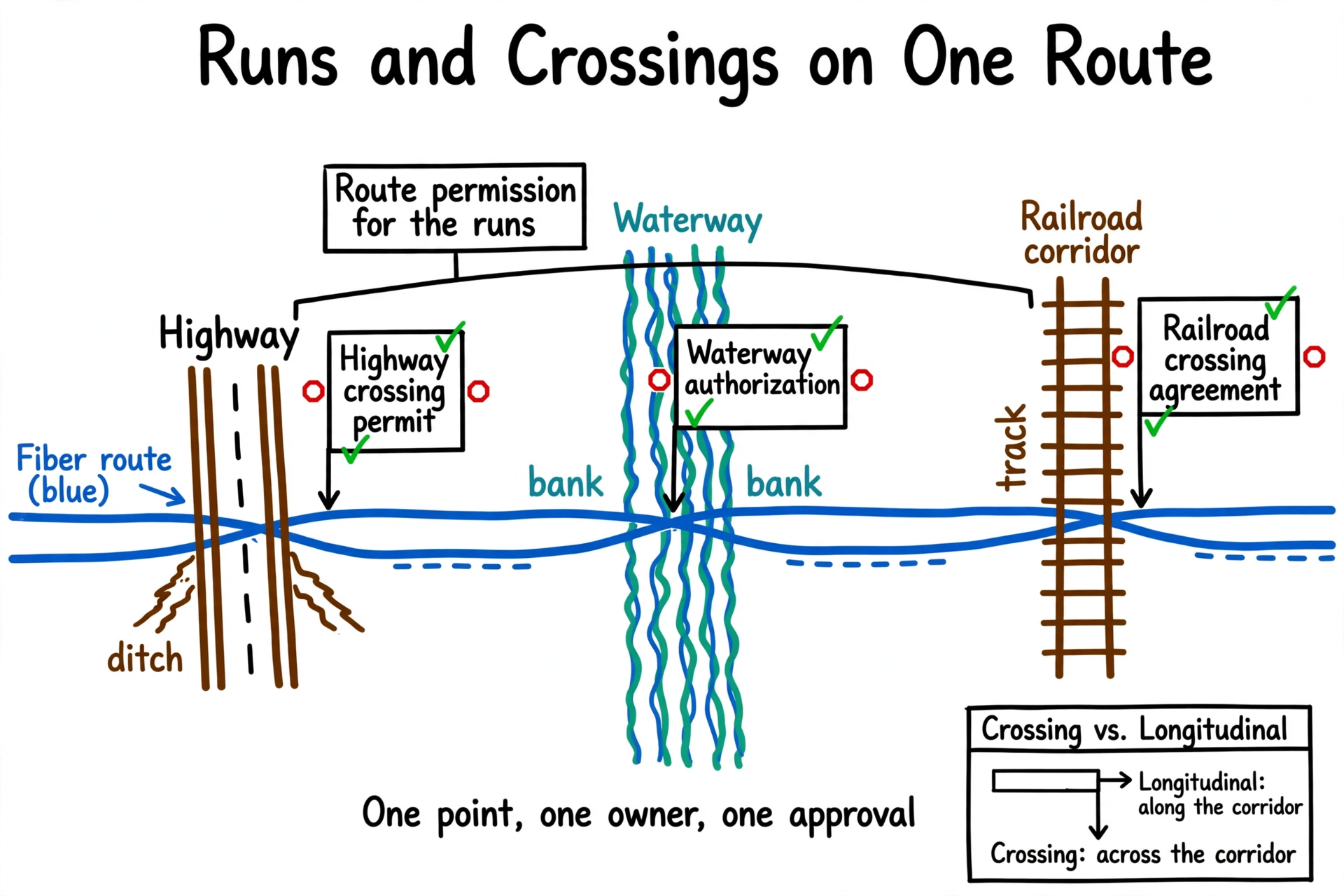
One contrast fixes the category. A longitudinal approval describes a run: a start, an end, and a length of corridor the facility occupies. A crossing approval describes a point: one place where two facilities cross, drawn in plan and profile, with the conditions concentrated at that point. A route drawing can hold both kinds of permission on the same sheet, and each segment of the drawing answers to the document that describes it.
What Does It Look Like?
A crossing authorization lives in the job file beside the route print, and the crossing point it describes can be found on the ground with the print in hand. Look for these elements when a crossing package lands in front of you:
- A title or heading that names the approval type the owner uses, such as crossing permit, crossing agreement, encroachment agreement, license agreement, or use and occupancy agreement.
- The crossing owner name and the office, department, or crossings team that issued the approval and takes notices and questions.
- The party receiving permission, matching the party the contract says will perform or direct the work.
- A crossing location description tied to the crossed feature, such as a highway route and crossing point, a railroad milepost, a waterway name, or a pipeline crossing location, with a plan drawing showing both corridors.
- A profile or cross section drawing showing the crossing facility passing under, over, or across the crossed feature, with the angle of crossing and the vertical relationship between the two facilities drawn as the owner requires.
- A description of the approved installation method for the crossing, such as a bore, a trench where the owner allows one, or an aerial span.
- Conditions covering casing where required, cover, separation, notice before work, inspection or witnessing during work, protection of the crossed feature, and restoration after work.
- Dates that bound the authorization, and any requirement for an as-built drawing or a completion notice after the crossing is built. Union Pacific drawing guidance, for example, requires an as-built drawing provided on railroad right of way maps to the standards the railroad specifies.
- Field signs at the crossing point once work begins, such as marked corridor edges, located and marked existing facilities, staged traffic control where a highway crossing needs it, and the owner inspector or representative the conditions call for.
A crossing package with a plan view and no profile deserves a question before it deserves a mobilization. The vertical relationship at the crossing point is half of what the owner reviewed, and a file that cannot show that relationship cannot prove the crew is building the crossing the owner approved.
What Does It Do?
A crossing approval does its work by concentrating the owner review, the owner standards, and the owner conditions at the single point where two facilities meet.
It fixes the crossing point and the crossing angle. Owner standards direct the geometry of a crossing. Wisconsin railroad property rules state that transverse crossings shall cross on a line as nearly perpendicular to the track alignment as is practicable. ONEOK encroachment guidance states that foreign crossings should sit at an angle as close to 90 degrees as possible to minimize the area of potential impact. Genesee and Wyoming general specifications for utility crossings state that crossings shall be substantially perpendicular to the railroad main line. The reason follows from the geometry: a crossing near a right angle spends the shortest distance inside the crossed corridor and gives both facilities the smallest shared footprint. A skewed crossing lengthens the exposure, complicates the profile, and can draw a separate review or a denial. The approved angle belongs to the crossing owner standards and the approved drawing for that point.
It applies the crossing owner standards for casing, cover, and separation. Federal highway policy at 23 CFR 645.211 requires state standards for regulating use and occupancy of highway right of way to state the horizontal and vertical location requirements and clearances for the various types of utilities clearly, and to prescribe specifications for and methods of installation. AASHTO guidance on accommodating utilities in highway right of way treats the transverse crossing as its own case, with depth of cover controlled by the low points in the highway cross section, usually the bottoms of the longitudinal ditches, and it illustrates encased and uncased crossing forms. Railroad specifications apply the same structure from the railroad side: casing rules, cover rules, and installation rules set by the railroad and by the industry codes the railroad references. Pipeline crossing agreements apply the operator standards for separation from the pipeline and for protection of the pipe during the crossing work, and industry practice for steel pipelines crossing railroads and highways is addressed in API Recommended Practice 1102, a document pipeline owners can reference in their own crossing requirements. In every system the pattern holds: the crossing owner sets the numbers, and the approved crossing drawing carries the numbers for that point.
It sets the installation method the owner reviewed. The owner approves a method together with a location. A bore approved under a highway, a track, or a pipeline reflects the owner judgment that the method protects the crossed feature at that point. A field decision to open cut, to move a bore pit, or to change the crossing path changes the work the owner reviewed, and it needs owner direction through the owner process. Railroad guidance shows how specific the method review can get: Union Pacific states that wet bores are not permitted on its property and sets bore pit placement rules in its encroachment guide. The fiber crew reads the method in the approval as a condition, and treats a method change as a paperwork event before it becomes a field event.
It creates the inspection and witnessing structure. Crossings concentrate risk at one point, and owners answer that concentration with presence. Highway agreements incorporate the state transportation department standards and state the action to be taken in case of noncompliance, under 23 CFR 645.213. Union Pacific requires a project inspector on its projects, with a flagman when required for protection of train operations, and other railroads set their own inspection and flagging requirements in their own specifications and agreements. Pipeline operators require a representative on site while work is conducted around their pipelines, in the ONEOK formulation, and TC Energy states that excavation on its right of way requires a company representative present even after a locate. A flagger on a railroad is a railroad employee assigned to protect train movements and the work party under railroad rules. A missed witnessing step at a crossing is hard to repair, because the moment the owner needed to see, such as the separation at the pipe or the cover under the track, gets buried by the work itself.
It separates the crossing permission from the locate. A locate request is a request through the one call system for facility owners to mark their underground facilities before excavation. Operator guidance treats the locate and the crossing agreement as two different steps: the locate marks what is in the ground, and the agreement grants permission to cross and sets the conditions for the work. A painted line on the ground proves a facility was marked. Paint grants no permission to cross anything.
It protects the crossed feature during and after the work. Section 645.211 requires state standards to cover preservation and restoration of highway facilities, appurtenances, and natural features and vegetation on the right of way, plus measures to protect traffic during and after installation. Railroad drawing guidance requires grading to prevent ponding and erosion protection on areas disturbed by construction. Pipeline agreements carry restoration and damage reporting duties for the corridor the crossing disturbed. The approval record after closeout, with inspections completed and the as-built filed where the owner requires one, becomes the starting record when either facility needs work at that point later.
Where Does It Fit?
A crossing approval sits at every point where a route crosses a feature or corridor that the route permission for the adjoining ground fails to cover. Route review finds those points one by one:
- A highway crossing, covered by the state Department of Transportation approval for that highway point, within the framework Lessons 119 and 120 built for municipal and state highway permission.
- A railroad crossing, covered by the railroad agreement for that crossing point, covered in Lesson 121.
- A waterway crossing, where work in, over, or under navigable waters of the United States requires approval from the U.S. Army Corps of Engineers under Section 10 of the Rivers and Harbors Act of 1899 before the work is accomplished. Corps guidance lists cable and pipeline crossings and installation of underground utility lines beneath navigable waters among the typical activities requiring Section 10 authorization. A discharge of dredged or fill material into waters of the United States, including wetlands, raises a separate authorization question under Section 404 of the Clean Water Act, and Corps guidance describes general permits, including nationwide permits, alongside individual permits as the forms an authorization can take.
- A pipeline corridor crossing, covered by the pipeline operator crossing agreement or encroachment agreement for that point, together with the locate and the operator witnessing the agreement requires.
- A crossing of another utility easement or corridor, covered by the consent or agreement of the party holding that corridor, in the form that party system uses.
Inside the project sequence, the crossing approval follows its own track:
- During design, the planner marks every crossing point on the route and names the crossing owner for each point.
- The applicant submits a crossing application for each point, with the plan and profile drawings, the proposed method, and the facility description the owner system requires. Union Pacific states the one point, one application rule plainly: each crossing of its trackage requires a separate Exhibit A and application, and other railroads require their own application and drawings for each crossing under their own forms.
- The crossing owner reviews the application against its own standards for angle, casing, cover, separation, and method, and issues the approval, issues it with conditions, requests changes, or denies it.
- Before mobilization, the permittee converts the crossing conditions into the crossing plan for that point, gives every notice the conditions require, and schedules every inspection or witnessing step.
- During construction, the crew builds the crossing at the approved point, by the approved method, and hosts the owner representative where the conditions call for one.
- After construction, the crew restores the crossed corridor to the standard the approval requires, completes the final inspection step, and files the closed approval and any as-built record with the crossing file.
A crossing approval also sits beside permissions that answer different questions. Permission to occupy the ground on both sides of a highway gives no right to cross the highway. A locate ticket gives no crossing right. An environmental authorization for a waterway crossing gives no right to cross the railroad on the far bank. Each document covers its own feature, its own point, and its own conditions.
What Is at Stake
Damage at the point of contact. A crossing places new work directly over, under, or through an operating facility: a traveled highway, a live track, a pressurized pipeline, or a navigable waterway. A strike, a settlement, or a cover failure at that point harms the crossed facility at the place where the two systems touch, and the consequences run to the public and to the owner of the crossed facility along with the fiber owner.
Safety of the traveling and working public. Highway crossings place crews in or under live traffic. Railroad crossings place crews inside a corridor where trains move under railroad control. Pipeline crossings place excavation beside a facility whose damage can release product. Crossing conditions on method, traffic protection, flagging, and witnessing exist because the crossed feature stays in service while the crossing is built.
Stop work and removal. A crossing built at a different point, at a different angle, by a different method, or with no authorization at all is a crossing the owner never approved. The owner can direct the work to stop and can require correction or removal under the agreement terms and the action for noncompliance the agreement states. Fiber installed neatly at an unapproved crossing point is still fiber installed without permission.
Restoration and the crossed asset. The crossing disturbs the crossed corridor at its most sensitive point: the pavement and ditch line at a highway, the roadbed at a track, the banks at a waterway, the cover over a pipeline. Restoration conditions protect that asset. A crossing that passes inspection on the day of the bore and settles a month later becomes a maintenance problem at a known location, and the crossing record names the party responsible for the repair.
Schedule. Crossing reviews run on owner timetables, one crossing at a time. A route with six crossings carries six review clocks, and the last approval to issue sets the date the route can be built through. Reading the crossing list during design, while crossing points and methods can still move on paper, keeps that time in planning. Discovering a missing crossing agreement with a bore rig staged spends the time with a crew standing by.
Future work at the point. Both facilities will need service at the crossing point someday. A clean crossing record, with the approved drawing, the completed inspections, and the as-built filed, tells the next crew where the crossing sits and under what conditions it was built. A crossing with no record forces the next project to locate, expose, and negotiate from the beginning.
What Does Good Look Like?
- Every crossing point on the route print carries a named crossing owner and a crossing authorization reference, and the foreman can match each point to its document.
- The issued crossing approval sits in the job file with its plan and profile drawings, its conditions, and its term, and the crossing point on the print matches the crossing point in the approval.
- Crossing conditions appear on the crossing plan as assigned tasks, covering angle, method, casing where required, cover, separation, notice steps, witnessing steps, and restoration.
- The locate for the crossing area is current, the crossed facility is marked, and the crew treats the locate and the crossing agreement as two separate documents with two separate jobs.
- The owner inspector, flagger, or representative the conditions require is scheduled before the crossing day, and the crew sequence gives that person the moments the conditions reserve for witnessing.
- Work at the crossing stays inside the approved point, angle, method, and limits, and any field condition that fails to match the approved drawing goes to the project lead the same day.
- Restoration at the crossing is checked against the standard named in the approval while correction is still simple, and the final inspection and as-built steps are scheduled before the crew leaves the point.
- At every other crossing point on the route, the file holds an authorization for that point, and nobody treats one crossing approval as covering a second crossing down the line.
From the Field
Picture a fiber route that runs along a county road, crosses under a state highway, and then crosses a pipeline corridor before reaching a handhole on the far side. The job file holds a state highway crossing approval for the highway point, with plan and profile drawings and a condition calling for notice to the district office before the bore. The pipeline corridor appears on the print as a wide easement band with a marker post at the road edge.
During the preconstruction read, the project coordinator checks each crossing point on the print against a document in the file. The highway crossing matches its approval. The pipeline crossing matches nothing. The file holds a locate ticket request for the corridor area, and the draft crew plan treats that ticket as the pipeline paperwork, with the bore entry pit drawn inside the pipeline right of way and the bore path passing under the pipeline.
The coordinator raises the gap in writing to the project lead before mobilization. The lead contacts the pipeline operator crossings process and learns what operator guidance states in general terms: work across a pipeline right of way needs a crossing agreement in place before work begins, the agreement sets the conditions for the crossing, and an operator representative is present while work is conducted around the pipeline. The locate still has its own job, marking the pipeline so the crossing can be built around a known line.
The project resequences the week. The crew builds the road segment and completes the highway crossing under its approval, with the district notice given as the condition requires. The pipeline crossing waits until the crossing agreement is executed, the entry pit is moved to the location the agreement allows, and the operator representative is scheduled for the crossing day.
On the crossing day, the bore passes under the pipeline at the approved point with the representative present, the separation the agreement requires is confirmed before the bore is covered by the completed work, and the corridor surface is restored under the agreement terms. The closed crossing agreement and the highway approval each sit in the file beside the crossing point each one governs.
The decision rule is direct: match every crossing point on the print to its own authorization before mobilization, treat a locate as a marking step that grants no crossing right, and hold any crossing whose agreement is missing until the crossing owner has issued it and its conditions are on the plan.
What Can Go Wrong?
Treating route permission as crossing permission. Permission to build along the ground on both sides of a highway, a track, a waterway, or a pipeline corridor covers the runs. The crossing between the runs needs its own authorization from the crossing owner for that point.
Treating a locate as an agreement. A one call locate marks underground facilities so excavation can avoid them. Operator guidance separates the locate from the crossing agreement, and the agreement is the document that grants permission and sets conditions. Paint on the ground has never signed anything.
Carrying one crossing approval to a second crossing. A crossing approval names one point. A second crossing of the same highway, the same railroad, or the same pipeline later on the route is a second crossing, with its own application, its own drawing, and its own conditions.
Building at a skewed angle to save a setup. A crossing drawn or built off the approved angle lengthens the shared footprint inside the crossed corridor and departs from the drawing the owner reviewed. Angle corrections belong in the application and the approved drawing, settled with the owner before the bore starts.
Skipping casing or cover the owner required. Casing, cover, and separation values in the approval come from the crossing owner standards for that point. A crew decision to save time by dropping a casing run or accepting shallow cover replaces the owner standard with crew opinion, and the owner can require the crossing to be redone under its terms.
Covering the crossing before the witnessing step. Separation at a pipeline, cover under a track, and the profile at a waterway bank can only be witnessed while the work is open. A crew that finishes and restores before the owner representative arrives can face exposure, added documentation, or rework under the agreement.
Moving a bore pit or entry point without direction. Entry and exit pits sit inside the crossed corridor or beside it, and owner rules can govern pit placement, as railroad guidance on bore pit location shows. A pit moved for convenience can land inside a protected area the approval kept clear.
Crossing a waterway on a land permission alone. A navigable waterway crossing answers to the federal authorization for work in, over, or under navigable waters, and a fill question can add a Section 404 authorization. An easement or a highway approval for the banks covers the banks. The water answers to its own authority.
What Should Someone Notice in the Field?
- Walk the print and list every crossing point on the route: every highway, railroad, waterway, pipeline corridor, and utility corridor the facility crosses.
- Name the crossing owner for each point, and confirm the file holds an issued crossing authorization for that point, with its drawings and conditions present.
- Compare the crossing point, the crossing angle, and the profile on the print against the approved crossing drawing, and raise any mismatch before work starts.
- Pull out the conditions that touch the crossing day: approved method, casing where required, cover, separation, notice steps, and the restoration standard.
- Confirm the locate for the crossing area is current and the crossed facility is marked, and confirm the crossing agreement sits in the file as a separate document from the locate ticket.
- Confirm the owner inspector, flagger, or representative the conditions require is scheduled, and check the crew sequence for the moments that person must witness.
- Check entry pits, exit pits, staging, and spoil placement against the limits the crossing approval allows at that point.
- Report any field condition the approval fails to cover, such as a crossed facility found at a different location than the drawing shows, to the project lead the same day and hold the crossing for owner direction.
- Know the boundary: reading a crossing approval, marking crossing points, and reporting gaps are recognition and support tasks. Only the crossing owner can issue, change, extend, or waive its own crossing authorization, and only qualified and authorized people may perform the excavation, boring, aerial work, traffic control, railroad corridor work, and pipeline corridor work a crossing involves. Reading this lesson qualifies no one to perform regulated or hazardous work.
Key Terms
Crossing permit: A written authorization from the owner or controlling authority of a feature or corridor allowing a named party to cross that feature or corridor with a utility facility at one described point, under the conditions in the authorization.
Crossing owner: The party that owns or controls the feature or corridor being crossed and holds the authority to approve or deny a crossing of it.
Crossing: A facility passing across a corridor or feature, entering on one side and leaving on the other. Many owner documents call this a transverse crossing.
Longitudinal occupancy: A facility running along the direction of a corridor, inside that corridor, for a distance.
Crossing condition: An enforceable requirement attached to a crossing authorization, covering matters such as angle, method, casing, cover, separation, notice, inspection and witnessing, and restoration.
Casing: A pipe placed around a carrier facility to carry external load and to protect the carrier and the crossed feature, installed where the crossing owner standards or the approval require it.
Carrier: The conduit or cable that carries the fiber through the crossing.
Cover: The vertical distance from a defined surface or reference line down to the top of a buried facility or its casing, set for a crossing by the crossing owner standards.
Separation: The horizontal or vertical distance a crossing facility must keep from the crossed facility or another nearby facility, set by the crossing owner standards or the agreement.
Crossing agreement: The written consent a pipeline operator or another corridor holder issues for work crossing its facility or right of way, setting the conditions for that crossing. Highway systems carry the same function in a use and occupancy agreement, and railroad systems carry it in a license or encroachment agreement.
Locate request: A request through the one call system for facility owners to mark their underground facilities before excavation. A locate marks facilities. It grants no permission to cross.
Check Your Understanding
- State the difference between a crossing and longitudinal occupancy, and name the kind of permission each one needs.
Answer: Longitudinal occupancy runs along a corridor inside it for a distance, and it answers to the permission for occupying that corridor. A crossing passes across a corridor or feature at one point, entering on one side and leaving on the other, and it answers to a crossing authorization from the crossing owner for that point.
- Name five condition families a crossing authorization can carry.
Answer: Any five of these fit: crossing point and angle; approved installation method; casing where the owner requires it; depth and cover set by the crossing owner standards; separation from the crossed facility; notice before work; inspection and witnessing during work; protection of the crossed feature; restoration after work; and the as-built or completion record to be filed.
- A crew holds a current locate ticket for a pipeline corridor and a route permit for the county road on both sides of the corridor. The foreman says the pipeline crossing paperwork is complete. Evaluate that claim.
Answer: The claim fails. The locate marks the pipeline and grants no crossing right, and the road permission covers the road segments. The crossing of the pipeline corridor needs the pipeline operator crossing agreement for that point, with its conditions and its witnessing step, before work begins.
- In the From the Field scenario, what did the preconstruction read find at the pipeline crossing, and what did the project do before building that crossing?
Answer: The read found no crossing authorization for the pipeline point. The file held only a locate ticket request, and the draft plan placed the bore entry pit inside the pipeline right of way. The project held the pipeline crossing, built the road segment and the highway crossing under the highway approval, obtained the executed crossing agreement, moved the entry pit to the allowed location, and scheduled the operator representative for the crossing day.
- A route crosses the same railroad at two points half a mile apart, and the file holds an executed railroad agreement for the first point. What does the second point need?
Answer: The second point needs its own crossing authorization. A crossing approval names one point, and Union Pacific, for example, requires a separate Exhibit A and application for each crossing of its trackage. The first agreement covers the first point only.
Lesson Takeaway
A crossing permit is the crossing owner signature on one point: one facility crossing one feature, at the angle, by the method, and under the conditions the owner approved for that point. After this lesson, a route reads as runs and crossings together, and every crossing point gets matched to its own authorization, its own drawing, and its own conditions before a crew treats the crossing as ready to build.
Sources and Technical References
Federal regulation, 23 CFR 645.211, State transportation department accommodation policies, requiring state standards for regulating use and occupancy of highway right of way to state horizontal and vertical location requirements and clearances clearly, to prescribe specifications and methods of installation and requirements for preservation and restoration, to provide traffic protection measures, and at subsection (d) requiring the department file to contain evidence of the written arrangements setting out the terms under which utility facilities are to cross or otherwise occupy highway right of way: https://www.law.cornell.edu/cfr/text/23/645.211
Federal regulation, 23 CFR 645.213, Use and occupancy agreements (permits), describing the written arrangements, generally in the form of use and occupancy agreements setting forth the terms under which the utility is to cross or otherwise occupy the highway right of way, and listing what each agreement must include or incorporate by reference: the transportation department standards, with requirements for location, construction, protection of traffic, maintenance, access restriction, and any special conditions; a general description of the size, type, nature, and extent of the facilities; adequate drawings or sketches showing the facility location with respect to the traveled way, the right of way lines, and control of access lines where applicable; the extent of liability and responsibilities for future adjustment; and the action to be taken in case of noncompliance: https://www.law.cornell.edu/cfr/text/23/645.213
Federal Highway Administration, Utilities Program, describing accommodation of utility facilities on highway right of way under state utility accommodation policies approved under the federal framework, and noting that a state may prohibit longitudinal utility installations: http://www.fhwa.dot.gov/utilities/
American Association of State Highway and Transportation Officials, A Guide for Accommodating Utilities Within Highway Right-of-Way, 2005 to 2006 edition excerpts, treating transverse crossing installations as their own case, with depth of cover at a crossing controlled by the low points in the highway cross section, usually the bottoms of the longitudinal ditches, with added mechanical protection or encasement where cover falls below the desired depth, and illustrating encased and uncased crossing forms: https://scltap.org/wp-content/uploads/2020/04/6.02.pdf
Union Pacific Railroad, Wireline and Pipeline Encroachment Guide, requiring a separate Exhibit A and application for each crossing of trackage, setting drawing content for crossings, requiring the agreement between the railroad and the applicant to be fully executed before work can begin on railroad right of way, requiring an as-built drawing on railroad right of way maps, and stating project inspector and flagging requirements for protection of train operations. Railroad specific values in the guide belong to Union Pacific only: https://www.up.com/real-estate/utilities/encroach-procedure/encroach-guide
Genesee and Wyoming, General Specifications for Utility Crossings, revised March 24, 2026, requiring plan and cross section drawings for a crossing to be submitted for approval before any agreement is prepared, and stating that crossings shall be substantially perpendicular to the railroad main line: https://www.gwrr.com/application/files/9917/7851/7806/Utility_Specifications_REVISED_03242026.pdf
Wisconsin Administrative Code, Trans 29.10(1)(c), utility facility specifications for department railroad property, providing that utility facilities shall cross the department railroad property on a line as nearly perpendicular to the railroad track alignment as is practicable. Wisconsin rules and fees belong to Wisconsin only: https://docs.legis.wisconsin.gov/code/admin_code/trans/29/10/2/b
TC Energy, Excavating Safely Near Pipelines, United States edition, explaining that a crossing or encroachment is a temporary or permanent structure across, on, along, or under a facility or pipeline right of way, that crossings and encroachments require approval and oversight from the pipeline operator through a crossing agreement, that a one call locate is required before excavation, and that excavation on a TC Energy right of way requires a company representative present even with a locate: https://www.TCEnergy.com/siteassets/pdfs/commitment/safety/click-before-you-dig/u.s/tc-oil-pipelines-exc-safety-us.pdf
ONEOK, Encroachment Guide, stating that an encroachment agreement must be executed before work begins on the pipeline right of way, that the operator requires a representative on site while work is conducted around its pipelines, that foreign crossings should sit at an angle as close to 90 degrees as possible to minimize the area of potential impact, and that no utilities or roads shall run parallel to the pipeline within the pipeline easement: https://edge.sitecorecloud.io/oneokinc1-oneok-prod-d654/media/ONEOK/Public-Awareness/Encroachment-guide-V2.pdf?sc_lang=en
American Petroleum Institute, Recommended Practice 1102, Steel Pipelines Crossing Railroads and Highways, the industry recommended practice for evaluating steel pipeline crossings of railroads and highways, referenced here as an example of an industry document a crossing owner can incorporate into its own crossing requirements: https://help.technicaltoolboxes.com/knowledge-base/api-1102-pipeline-crossing-railroad-liquid/
U.S. Army Corps of Engineers, Honolulu District, Frequently Asked Questions, stating that Section 10 of the Rivers and Harbors Act of 1899 requires approval before any work in, over, or under navigable waters of the United States, listing cable and pipeline crossings and installation of underground utility lines beneath navigable waters as typical activities requiring Section 10 permits, and stating that Section 404 of the Clean Water Act requires approval before discharging dredged or fill material into waters of the United States: https://www.poh.usace.army.mil/About/FAQ/
U.S. Army Corps of Engineers, Albuquerque District, Regulatory Program and Permits, Permitting Overview, describing Section 10 and Section 404 authorization, and describing general permits, including nationwide permits, regional general permits, and individual permits as the forms a Corps authorization can take: https://www.spa.usace.army.mil/Missions/Regulatory-Program-and-Permits/Permitting-Overview/
Previous lesson: Lesson 121: What Is a Railroad Permit? |
Back to Level 6 hub |
Next lesson: Lesson 123: What Is an Environmental Permit?