
Introduction
Pole attachment rights are the permission a communications company holds to place and keep its facilities on a utility pole owned or controlled by someone else, under a written agreement with the pole owner and under the government rules that govern that agreement. The permission attaches to named facilities on specific poles. It travels with paperwork: an agreement in the job file, an approved application for the poles on the print, and a record that the pole was prepared before the crew attached.
Level 6 studies permission one issuer at a time. Earlier lessons covered the city, the state highway agency, the railroad, and the private landowner. This lesson covers the pole owner: where the right to use another company’s pole comes from, which poles the federal framework reaches, which poles it leaves out, and what a field crew can check before anyone treats a pole as available.
What This Lesson Gives You
- Read a job file and name the agreement, the pole owner, the attacher, and the specific poles a pole attachment permission covers.
- Explain the federal framework in Section 224 of the Communications Act and name the pole owners that framework leaves out.
- Tell whether the FCC rules or a certified state regulator govern attachments in a given state, and say why the answer changes the rulebook in the file.
- Walk the sequence from application to attachment and point to the step where make-ready work and make-ready charges belong.
- Spot an unauthorized attachment risk on a print or in the field and state the hold decision before a crew attaches.
Start With the Basics
Think about renting one marked parking space inside a garage owned by someone else. The garage owner signs an agreement naming you, naming the space, and setting the rent and the house rules. Before you move in, the owner may need to move two cars and repaint a line so your space exists at all, and the agreement can charge you for that rearrangement because your arrival caused it. The agreement gives you the use of that one space for your vehicle. It gives you no share in the garage, no right to park in a different space when yours feels tight, and no right to hand your space to a friend under your signature alone.
A utility pole works in a similar way. The pole owner is the company or agency that owns or controls the pole itself. In many service areas the pole owner is an electric utility or a telephone company, because those companies built the pole lines for their own networks first. A pole attachment is any attachment by a cable television system or a provider of telecommunications service to a pole, duct, conduit, or right of way owned or controlled by a utility, as federal law defines the term in 47 U.S.C. 224(a)(4). The company placing the attachment rents defined space on a structure it does not own, and it holds that space under an agreement and under the rules described in this lesson.
The parking space analogy maps to the mechanism in three ways. The owner keeps the structure and sets the conditions for sharing it. The user pays rent for the space and pays the cost of preparing the space when its arrival causes the preparation. The permission names the user and the space, and work outside that naming sits outside the permission.
What Is It?
Pole attachment rights rest on three layers, and a reader should be able to point to each layer in a real job.
The federal statute. Section 224 of the Communications Act, codified at 47 U.S.C. 224, is the federal law that governs pole attachments. The law uses the word utility in a defined way. Under Section 224(a)(1), a utility is a person who is a local exchange carrier or an electric, gas, water, steam, or other public utility, and who owns or controls poles, ducts, conduits, or rights of way used in whole or in part for wire communications. Section 224(f)(1) then states the access duty: a utility shall provide a cable television system or any telecommunications carrier with nondiscriminatory access to any pole, duct, conduit, or right of way owned or controlled by it. Nondiscriminatory access means the owner opens its poles on terms that treat similarly situated attachers alike, rather than favoring one attacher over another.
The regulator and its rules. Section 224(b)(1) directs the Federal Communications Commission, shortened to the FCC, to regulate the rates, terms, and conditions for pole attachments so that those rates, terms, and conditions are just and reasonable, and to run complaint procedures for disputes. The FCC carries that duty out in its pole attachment rules at 47 CFR Part 1, Subpart J, sections 1.1401 and following. Section 224(c) creates the exception that field teams meet under the name reverse preemption. Where a state regulates pole attachment rates, terms, and conditions itself and has certified that regulation to the FCC, the statute gives the FCC no jurisdiction over those attachments, and the state regulator’s rules govern instead. Certification requires the state to certify that it regulates those matters, that it considers the interests of subscribers of the services offered through the attachments and the interests of utility consumers, and that it has issued and made effective its own implementing rules. The FCC reported in its 2025 pole attachment order that 23 states and the District of Columbia have certified and regulate pole attachments themselves. A project that crosses a state line can therefore change rulebooks at the border, even when the pole owner and the fiber look the same on both sides.
The agreement. The pole attachment agreement is the written contract between the pole owner and the attaching company that puts the framework into force for those two parties. The agreement names the owner and the attacher, sets the rent and other charges, states the application process for individual poles, carries the construction and safety standards the attacher must follow, and sets the inspection, correction, transfer, and removal terms. An attacher, called an attaching entity in the FCC rules at 47 CFR 1.1402(m), is an entity with a physical attachment to the pole, duct, conduit, or right of way. The term covers cable system operators, telecommunications carriers, local exchange carriers, utilities, governmental entities, and other entities with a physical attachment, and it does not include governmental entities whose attachments are only seasonal. A new attacher is a cable television system or telecommunications carrier requesting to attach new or upgraded facilities. An existing attacher is any entity that already has equipment on the pole. The statute and the rules set the outer frame. The agreement is the document the job file actually runs on, and the crew’s permission for a given pole traces back through an approved application under that agreement.
The federal framework has defined edges, and the edges matter as much as the duty:
- The statutory definition of utility excludes any railroad, any person who is cooperatively organized, and any person owned by the Federal Government or any State, per Section 224(a)(1). The statute defines State to include a political subdivision, agency, or instrumentality of a state, per Section 224(a)(3). Read together, poles owned by electric cooperatives, poles owned by municipalities and other government owners, and poles owned by railroads sit outside the Section 224 access duty and outside the FCC pole attachment rules. Access to those poles is negotiated with the owner under the owner’s own process and any state law that applies there. A separate agreement can still grant permission. The federal duty alone grants none on those poles.
- An electric utility may deny access on a nondiscriminatory basis where there is insufficient capacity and for reasons of safety, reliability, and generally applicable engineering purposes, per Section 224(f)(2). Denial is a regulated outcome inside the framework. Denial is never a blank refusal, and a schedule that assumes every application grants in the form first requested repeats the mistake Lesson 120 named for highway approvals.
- The right reaches poles, ducts, conduits, and rights of way owned or controlled by a utility. The right grants no ownership share in any pole, no easement on the land under the pole, and no permission on ground the pole happens to cross. Land rights and road permissions from earlier Level 6 lessons answer their own separate questions.
Two ownership arrangements appear often enough that the field should recognize the words. Joint use describes an arrangement where two pole owners use each other’s poles under a reciprocal agreement, so each company occupies space on poles the other owns and a single pole line serves both networks. Joint ownership describes a stronger arrangement where two parties co-own the same pole itself, holding undivided shares as tenants in common under a joint pole agreement, with each co-owner controlling defined space on the shared pole and licensing its own space to others under its own arrangements. In joint use, each pole still has one owner, and the other party attaches under the agreement. In joint ownership, the pole has two owners, and a third company seeking space deals with the co-owner who controls the space it wants. The agreement in the file states which arrangement covers the poles on the print, and the distinction decides whose signature the application needs.
What Does It Look Like?
Pole attachment permission lives in the job file first, and parts of it show up on the pole once work begins. Look for these elements when a pole package lands in front of you:
- A pole attachment agreement in the file naming the pole owner and the attacher, with the application process, charges, standards, and inspection terms the agreement carries.
- An approved application or permit record under the agreement listing the specific poles covered, usually by pole number, location, or an attached pole list and map, together with the facilities the attacher may place.
- A survey record for the listed poles showing existing attachments, available space, pole condition, and the preparation each pole needs before a new attachment fits.
- A make-ready estimate and, after the work, a final invoice record, described in the next sections of this lesson.
- Notices to existing attachers whose facilities the preparation will move, and a completion record showing the preparation finished before the attachment date.
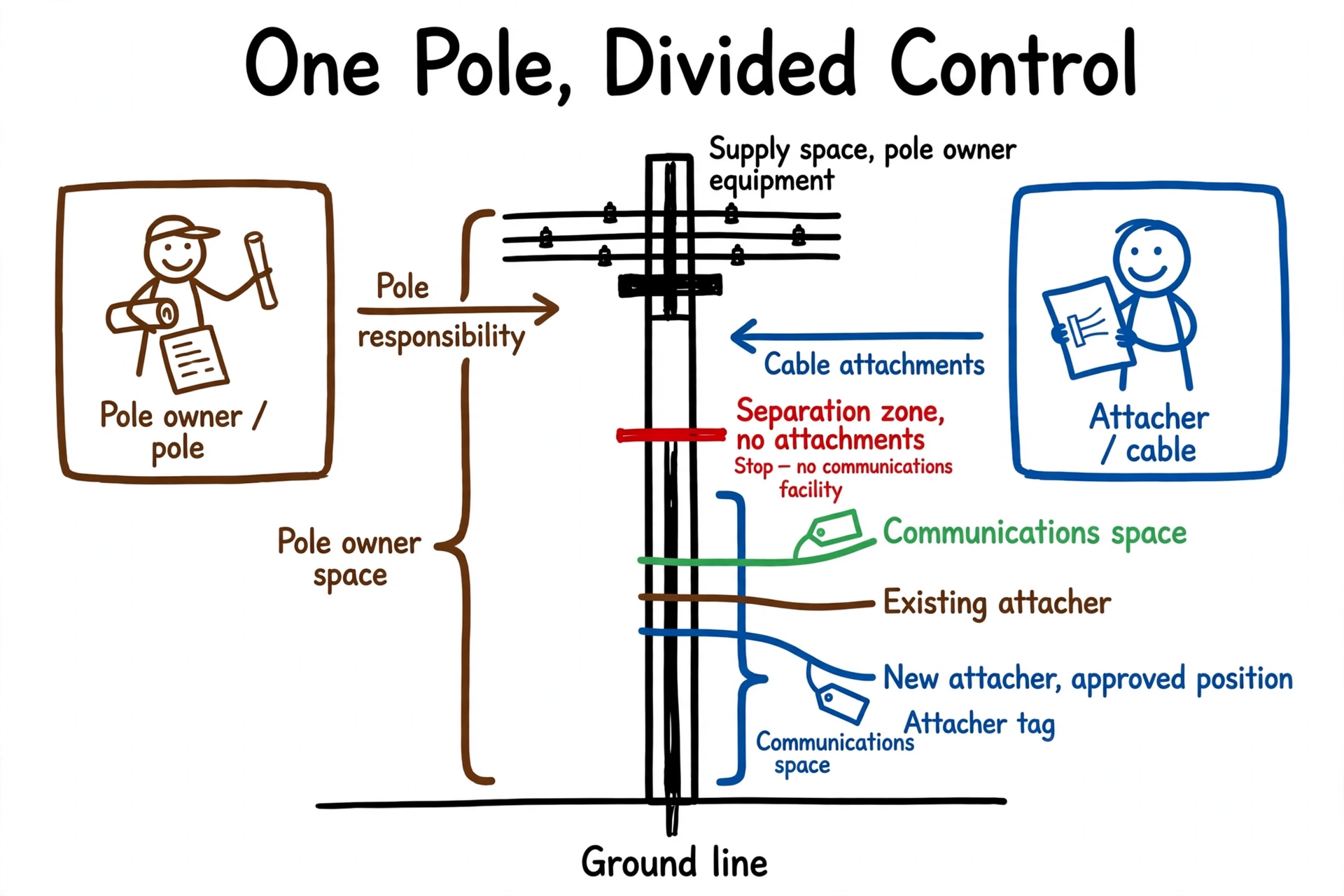
- Field signs on a completed attachment: the new facility sits in the communications space, the lower usable space on a pole that the FCC rules describe as typically reserved for low-voltage communications equipment, per 47 CFR 1.1402(r). Usable space is the space on a pole above minimum grade level that can be used for attaching wires, cables, and associated equipment, per 47 CFR 1.1402(c).
- An attacher tag or label on the facility where the pole owner’s standards require one, identifying whose cable hangs on the pole so repair crews and inspectors can match the facility to a record. Owner standards such as the Clark Public Utilities joint use standards treat attachment identification as a working requirement for repair and damage work.
- A pole record the owner and the attacher can both point to: pole number, attachment position, attachment date, and rent billing tied to that pole.
A job file that holds an agreement and no pole list describes a relationship. A job file that holds an approved pole list with completed make-ready describes permission a crew can build on. The difference between those two files is the subject of this lesson.
What Does It Do?
Pole attachment rights do their work by turning a general access duty into a controlled sequence on specific poles. Each part of the mechanism answers a question the field will ask.
It obligates the owner to share, inside the framework. Section 224(f)(1) gives a cable system or telecommunications carrier an enforceable claim to nondiscriminatory access on a covered utility’s poles, and Section 224(b)(1) backs the claim with FCC regulation of rates, terms, and conditions and a complaint process when the parties disagree. In a certified state, the state regulator holds the parallel role under its own rules. The duty explains why a pole owner runs an application process at all, rather than treating every request as a favor.
It divides the pole into controlled spaces. The electric owner’s supply conductors and equipment occupy the upper part of the pole, in the space owner standards call the supply space. Communications facilities occupy the communications space lower on the pole, below a separation zone that owner standards and the National Electrical Safety Code maintain between supply work and communications work. The attachment permission covers a position inside the communications space. The permission never extends upward into supply space, and the agreement’s standards govern exactly where inside the communications space a facility may sit.
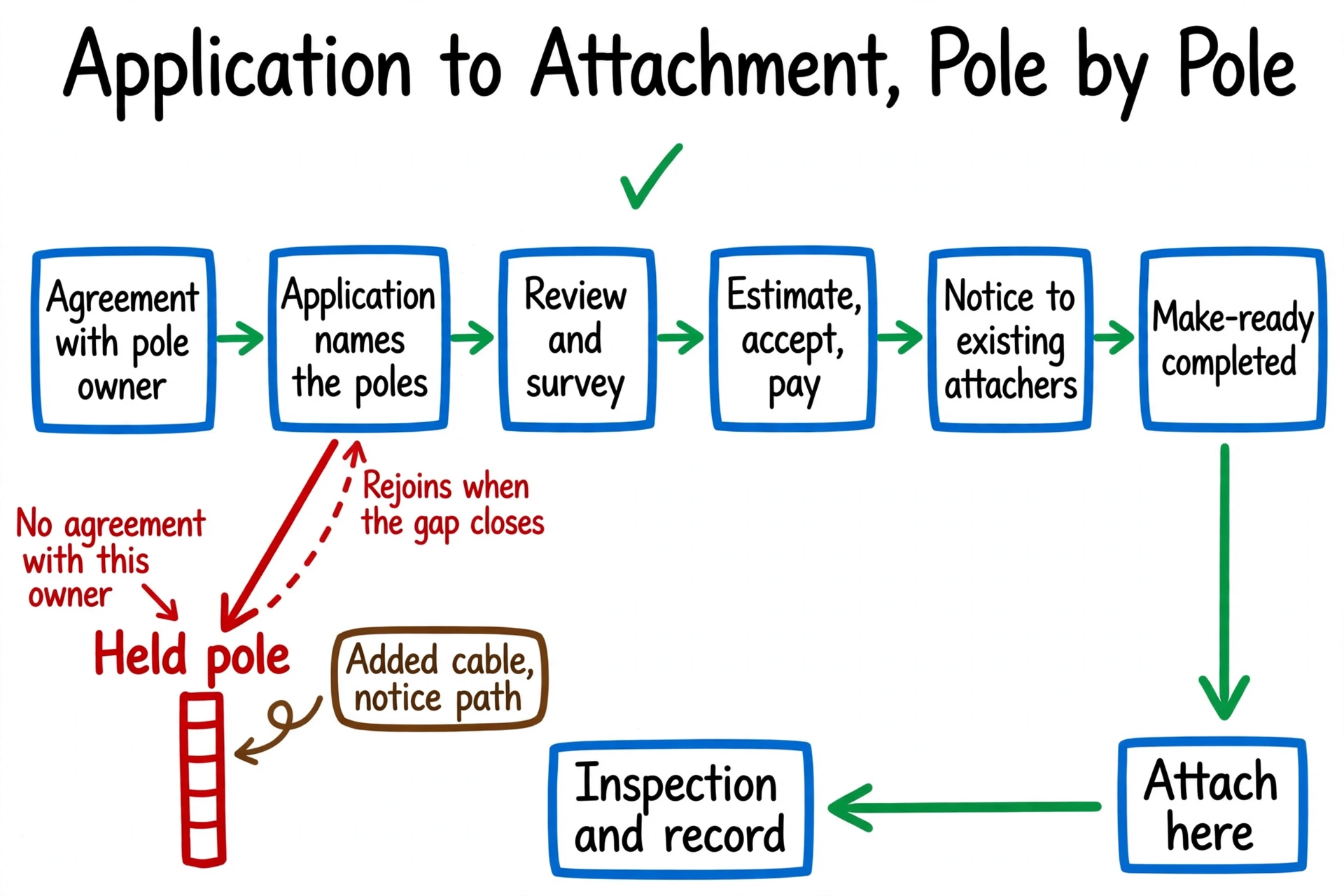
It sequences the work through an application. Under the FCC timeline rule at 47 CFR 1.1411, the process for FCC-jurisdiction poles runs in stages, and certified states run parallel stages under their own rules:
- The new attacher submits an attachment application for specific poles, under the agreement and the owner’s published procedures. The application is considered complete when it gives the utility the information its procedures require to begin surveying the poles.
- The utility reviews the application for completeness, then reviews it on the merits and surveys the poles inside one stage. The FCC rule sets the completeness decision at 10 business days after receipt. The utility must grant or deny access and complete the survey within 45 days after receipt of a complete application for a standard order, with longer periods the rule defines for larger orders. During the survey the utility checks existing attachments, space, and condition, and the new attacher and existing attachers may be present for field inspections that form part of the survey.
- Where access is granted, the utility presents a detailed, itemized estimate of charges for all necessary make-ready, pole by pole where the attacher requests it. The FCC rule sets that estimate at 14 days after the survey for a standard order, with a longer period for large orders. The attacher accepts the estimate and pays before make-ready begins.
It prepares the pole before the attachment. Make-ready means the modification or replacement of a utility pole, or of the lines or equipment on the pole, to accommodate additional facilities on the pole, per 47 CFR 1.1402(o). Make-ready work includes rearranging existing attachments to open space, adding support such as guying where engineering requires it, and replacing a pole with a taller or stronger pole where the existing pole cannot carry the added facility. Make-ready charges are the charges for that preparation, presented first as the itemized estimate. After the utility completes make-ready, if the final cost differs from the estimate, the utility provides a detailed, itemized final invoice of the actual charges incurred. The cost follows the arrival: the new attacher pays the cost its attachment causes. One limit protects the new attacher inside that rule. Under 47 CFR 1.1411, a utility may not charge a new attacher to bring poles, attachments, or third-party equipment into compliance with current standards where the noncompliance came from work another party performed before the new attachment. After the attacher pays, the utility notifies every known existing attacher whose facilities the make-ready may affect, states where and what make-ready will be performed, and sets the completion date. For attachments in the communications space, the FCC rule sets that completion date at no later than 30 days after the notice for a standard order, with longer periods for larger orders. Existing attachers move their own facilities inside that window, the utility completes its share, and only then does the new attachment go on the pole.
It sorts make-ready by risk. The FCC rules divide make-ready in the communications space into two kinds. Simple make-ready is make-ready where existing attachments could be transferred without any reasonable expectation of a service outage or facility damage, and which requires no splicing of an existing communication attachment and no relocation of an existing wireless attachment, per 47 CFR 1.1402(q). Complex make-ready covers transfers and work in the communications space reasonably likely to cause a service outage or facility damage, including splicing of a communication attachment or relocation of a wireless attachment, per 47 CFR 1.1402(p). The sorting matters because it decides who may perform the work and under which process, as the one-touch option below shows.
It offers a one-touch path for simple work. Under the FCC one-touch make-ready option at 47 CFR 1.1411(k), shortened to OTMR, a new attacher with only simple make-ready on a pole may elect in writing in its application to have a single qualified contractor perform all the simple make-ready in one trip, moving existing communications attachments itself rather than waiting for each existing attacher to move its own facilities in turn. The new attacher identifies the simple make-ready it will perform, and its contractor carries the responsibility for judging whether the work qualifies as simple. The utility reviews the application on the merits inside the shorter OTMR window the rule sets, and the utility may object to a simple classification with a specific, written, good-faith objection supported by evidence, in which case the work is treated as complex and returns to the standard process. Before OTMR work starts, the new attacher gives 15 days prior written notice to the utility and affected existing attachers, stating the date and time of the work, a description of the work involved, and the name of the contractor being used, and giving them a reasonable opportunity to be present. If anyone determines during the work that make-ready classified as simple is actually complex, that make-ready halts and the standard process governs it. OTMR reaches simple work in the communications space. Work above the communications space follows the standard process.
It backs missed deadlines with a limited self-help remedy. Under 47 CFR 1.1411(j), when a utility fails to complete a survey inside its deadline, or make-ready remains incomplete after its completion date, the new attacher may perform the survey or the make-ready itself using a contractor who meets the requirements at 47 CFR 1.1412, with notice rights for the utility and existing attachers to be present. The remedy has a hard edge the field should know: self-help is unavailable for pole replacements. A pole that needs replacement waits for the owner’s process, however the schedule feels about it.
It keeps the attachment under inspection after the work. When a new attacher performs make-ready itself under the self-help remedy or the one-touch process, the new attacher must notify the utility and existing attachers within 15 days after completing make-ready on a particular pole. That notice gives the utility and existing attachers at least 90 days to inspect the work, and they have 14 days after completing an inspection to report damage or code violations, with documentation. The new attacher then fixes damage it caused at its own expense within 14 days after notice, or pays the utility or existing attacher that fixes it. Owners also run their own inspection cycles, and the FCC rule requires a utility, on written request with an application, to share information from its most recent cyclical pole inspection reports for the poles in that application. The agreement adds the owner’s ongoing inspection and correction rights for the life of the attachment. An attachment stays accountable after the crew leaves, because the record of whose facility sits where is what the next storm crew, the next attacher, and the next inspector all rely on.
It handles added cable on an existing attachment through notice. Overlashing is the practice of lashing a new cable onto an existing attached cable, so the added cable rides on the existing attachment rather than taking a new position on the pole. Under 47 CFR 1.1416, a utility shall not require prior approval for an existing attacher overlashing its own wires, or for third-party overlashing carried out with the existing attacher’s permission. The utility may require advance notice of planned overlashing, capped at 15 days, and the notice requirement itself must reach attachers in advance in writing or sit inside the attachment agreement. Where the utility identifies a capacity, safety, reliability, or engineering issue from that notice, the utility must document the issue specifically inside the notice period, and the overlashing party addresses it by modifying its proposal or by explaining why a modification is unnecessary. The utility may charge no fee for reviewing a proposed overlash. After the overlash, the overlashing party notifies the utility inside 15 days of completion on that pole, the utility receives at least 90 days to inspect, and the utility has 14 days after its inspection to report damage or code violations the overlash caused, which the overlashing party then fixes at its own expense or pays the utility to fix. Overlashing eases one step, the prior approval step. Overlashing waives no notice, no responsibility for the added load, and no inspection that the rule and the agreement carry.
Where Does It Fit?
Pole attachment permission sits beside the other Level 6 permissions, and its place is defined by the structure rather than the ground.
A single pole can stand inside a public right of way from Lesson 116, cross a corner of private land under an easement from Lesson 118, and carry a highway crossing governed by the DOT approval from Lesson 120. The pole attachment agreement answers only the pole question: may this company place this facility on this pole, in this space, under this owner’s conditions. The right of way permission answers the ground question. The easement answers the land question. Each permission covers its own subject, and a file that holds one and lacks another holds a gap a crew can discover the expensive way.
Inside a fiber build, the sequence runs like this:
- During design, the route planner identifies the pole owner for every pole line on the route, pole line by pole line, because owner changes along a route are common and each owner runs its own agreement and application process.
- The attacher confirms an agreement exists with each owner on the route, or starts the agreement process where none exists, before applications go in.
- The attacher files applications for the specific poles, and the survey, estimate, acceptance, and make-ready stages run under the governing rules for that state and that owner.
- The construction schedule treats completed make-ready as the gate for aerial placement on each pole. A pole with pending transfers or a pending replacement is a pole the aerial crew passes and returns to.
- After placement, the attacher closes the record: attachment notifications, inspection corrections, tag installation where the owner requires it, and rent records tied to the pole list.
- Later work follows the same framework. Added cable on an existing attachment follows the overlashing notice path. A new facility, a relocation, or a transfer to a replacement pole follows the agreement’s application and notice terms for that change.
Ownership changes test the file over time. When a pole owner replaces a pole, Section 224(h) requires the owner to give written notice of a planned modification or alteration to entities holding attachments, so those entities get a reasonable opportunity to add to or modify their attachments, and Section 224(i) protects an attacher from bearing the cost of rearranging or replacing its attachment where the rearrangement is required because of an additional attachment or a modification sought by another entity. When an attacher sells its network or a different company takes over the facilities, the attachment permission does not move on the strength of the sale paperwork alone. The agreement controls assignment and transfer, and the new operator confirms its standing with the pole owner before it treats the poles as its own. Permission names a party. A new party steps into the permission through the owner’s process, never through assumption.
What Is at Stake
Safety around energized facilities. A pole carries electric supply conductors above the communications space, and every attachment decision changes the load on the pole and the working clearances around it. Make-ready engineering, the simple and complex sorting, and the bar on self-help pole replacements all exist because a pole loaded or rearranged past its capacity can fail, and because work sorted wrong can put a crew beside hazards the plan never priced. The agreement’s standards and the owner’s engineering review are safety controls wearing paperwork clothing.
Removal and back charges for unauthorized work. An attachment placed with no agreement, no approved application, or no completed make-ready stands on the pole without permission. Owner agreements and owner tariffs treat that condition as an unauthorized attachment, and the consequences run through the agreement and the governing rules for that jurisdiction: the owner can require the attachment to be removed or brought under a proper application, can bill rent and charges the agreement provides for the period the facility occupied the pole without permission, and can charge the correction and inspection costs the agreement assigns. No single national penalty figure exists, because the sanction lives in the contract and the jurisdiction. A crew that guesses the sanction will be small has priced a risk it never read.
Schedule. Pole work runs on the owner’s clock through the application stages. Surveys, estimates, transfers by several existing attachers, and pole replacements each consume calendar time before an aerial crew can attach. Reading the owner’s process during design, while the route can still shift to poles with room or to a different owner line, keeps that time in planning. Discovering a missing agreement or an unfinished transfer with a strand crew standing by spends the time at field rates.
Cost. Rent runs per attachment for the life of the facility, and make-ready charges land up front as a project cost. A design that assumes free space on every pole has priced a route that may not exist. Pole replacements inside make-ready, transfers of several existing facilities, and rework after a failed inspection all land on the job that caused them, under the cost rules the framework sets.
Existing attachers and the owner. Every company already on the pole holds its own permission and its own service obligations. Make-ready that moves a competitor’s cable carelessly, or an overlash that overloads a bundle another company owns, creates damage the rules assign to the party that caused it. The notice steps exist so the companies sharing one structure can protect their own plant while the structure changes around it.
Future access. Fiber on a pole will need repair, added capacity, and eventual transfer when the pole is replaced. A clean attachment record, with the agreement, the pole list, the make-ready file, and inspections closed, gives that future work a documented starting point. A route history of unauthorized attachments and missing records gives the next application a harder review and gives a storm restoration crew a pole nobody can fully account for.
What Does Good Look Like?
- The job file holds a signed pole attachment agreement with the pole owner for every pole line on the route, and the project lead can name the owner for each line without guessing.
- An approved application or permit record lists the specific poles to be attached, and the pole numbers on the record match the pole numbers on the print, pole for pole.
- The survey record for each listed pole shows existing attachments, space, and condition, and every pole needing preparation carries a make-ready entry.
- The itemized make-ready estimate sits in the file with the attacher’s acceptance and payment recorded, and no attachment date is scheduled before the make-ready completion record for that pole.
- Notices to existing attachers went out as the governing process requires, and transfers by existing attachers are verified complete on the poles the crew will touch.
- The crew attaches only on poles where the agreement, the approved application, and completed make-ready all three line up, and the foreman can state that match out loud for the day’s poles.
- Completed attachments sit in the communications space at the position the approval describes, carry the attacher tag where the owner’s standards require one, and appear in the attachment record the same week they were placed.
- Overlash work carries its advance notice where the owner requires one, its completion notice after the work, and a closed inspection step, all filed with the pole record.
- Where a pole line belongs to a cooperative, a municipality, or a railroad, the file holds that owner’s own agreement or written permission, and nobody cites the federal framework as covering those poles.
From the Field
Picture an aerial fiber build running down a long pole line toward a river crossing. The print shows one continuous line of poles. The job file holds a pole attachment agreement with the investor-owned electric utility that owns the first stretch of the line, an approved application listing those poles, and survey records the project coordinator is reviewing the day before the strand crew mobilizes.
The coordinator works the pole list against the survey records one pole at a time. On the first stretch, the records line up for nearly every pole. One pole in the middle of the stretch breaks the pattern. The survey flagged that pole for a transfer by an existing attacher as part of make-ready, the make-ready estimate covered the transfer, and the attacher paid it. The completion record for that transfer is missing from the file, and the existing attacher’s cable still sits at its old position in the field photos attached to the survey follow-up.
Past the river crossing, the pattern breaks a second time. The pole numbers continue in sequence and the poles look identical, and the ownership column on the route sheet changes at the crossing. The poles beyond the crossing belong to an electric cooperative that serves the far bank. The file holds no agreement with the cooperative and no application record for those poles. The agreement with the first utility covers its own poles only.
The crew lead proposes a practical split: attach everywhere the strand can reach, leave a coil at the one pole awaiting its transfer, and keep moving across the crossing while the office sorts out the cooperative paperwork, since the poles are standing there and the fiber is on the reel.
The coordinator holds two parts of that proposal and releases one part. The crew attaches on the poles where the agreement, the approved application, and completed make-ready all line up. The pole awaiting its transfer stays untouched until the existing attacher completes the move and the completion record lands in the file, because attaching into space the transfer was supposed to open would crowd the pole the engineering already judged. The cooperative stretch stays untouched entirely, because the cooperative sits outside the federal framework and no permission of any kind covers those poles yet. The coordinator escalates both holds to the project lead the same day, with the pole numbers written out.
The lead starts the cooperative’s own agreement and application process, chases the missing transfer to completion, and resequences the crew to underground work on the same project while the pole items close. When the transfer record and the cooperative permission arrive, the crew returns and finishes both stretches with a file that matches the plant.
The decision rule is direct: permission runs pole by pole and owner by owner, so a crew attaches only where the agreement names the owner, the application names the pole, and the make-ready record shows the pole ready, and every pole that fails any one of those three checks waits, however the poles around it look.
What Can Go Wrong?
Treating an agreement as covering every pole on the route. An agreement covers the owner’s poles through approved applications for specific poles. A route that crosses into a second owner’s pole line, including a cooperative, municipal, or railroad line outside the federal framework, needs that owner’s own permission. Pole lines change owners at rivers, highways, and service territory lines with no visible change in the poles.
Attaching before make-ready completes. The space the new facility needs often exists only after existing attachers transfer, after added support goes in, or after a replacement pole is set. Attaching into unprepared space overloads the pole or crowds facilities the engineering planned to move, and the correction happens with the new facility already in the way.
Skipping the application because space looks open. An empty position in the communications space is a physical observation. Permission is a paperwork condition. A facility placed on the strength of open space alone is an unauthorized attachment from the day it goes up, with the removal and billing exposure the agreement carries.
Overlashing with no notice where notice is required. The federal rule bars a utility from requiring prior approval for overlashing an existing attachment, and the same rule allows the utility to require advance notice, capped at 15 days, where the requirement has been given in writing or sits in the agreement. A crew that treats no prior approval as no steps at all can miss the notice, miss a documented engineering objection the owner was entitled to raise inside the notice period, and own the damage the post-overlash inspection finds.
Sorting simple work that is actually complex. OTMR and self-help run on the simple classification. Work that requires splicing an existing attachment, relocating a wireless attachment, or moving facilities in a way reasonably likely to cause an outage or damage is complex work under the FCC definitions. A crew that keeps working after the facts on the pole show complex conditions violates the process that authorized it to be there, and the rule requires that make-ready to halt.
Assuming permission transfers with a sale or a crew change. The agreement names the attacher. A buyer, a successor operator, or a different contractor directing the work steps into the permission through the agreement’s transfer terms and the owner’s process. Facilities that change hands on paper while the pole record still names the prior company create a billing and responsibility gap the next inspection will find.
Carrying one state’s rulebook into another state. In a certified state, the state regulator’s rules govern timelines, processes, and disputes. In an FCC state, Subpart J governs. A timeline, a notice period, or a cost rule remembered from a project across the state line proves nothing about the poles in front of the crew until the governing rulebook for the new state is confirmed.
Losing the pole record. Rent, inspections, transfers at pole replacement, and storm repair all run on the record of who is attached to which pole and where. A facility placed and never recorded, or recorded against the wrong pole number, taxes every later job that touches that pole and can surface as a billing dispute or an unauthorized attachment finding years later.
What Should Someone Notice in the Field?
- Identify the pole owner for the pole line in front of you, from the route sheet, the agreement in the job file, or the owner’s pole tag, and confirm the file holds an agreement with that owner.
- Confirm whether the state is a certified pole attachment state or an FCC-rules state, and name the rulebook the job is running under before citing any timeline or process from memory.
- Compare the approved pole list against the print and against the pole numbers on the ground, and flag any pole on the print that the approved application leaves out.
- Check the make-ready record for each pole on the day’s work: estimate accepted and paid, notices sent, transfers and replacements shown complete, and flag any pole where the completion record is missing.
- Look at the pole itself: existing attachments and their positions in the communications space, space for the planned facility at its approved position, signs of a recent transfer or a newly set replacement pole, and the condition of the pole as far as ground observation shows it.
- Check that the planned facility will sit in the communications space, and treat any plan that reaches toward supply space as a stop and escalate item for the project lead and the pole owner.
- Confirm any overlash on the day’s plan carries the advance notice the owner requires and the existing attacher’s permission where a third party’s cable is involved.
- Verify the completed work gets recorded the same week: pole number, attachment position, date, and tag where the owner’s standards require one.
- Report any pole where ownership, permission, or readiness fails to line up to the project lead the same day, with the pole number written down, rather than letting the crew’s sequence decide the question.
- Know the boundary: reading an agreement, checking a pole list, and reporting a mismatch are recognition and support tasks. Recognizing attachment paperwork never qualifies anyone to climb or work on a pole. Only qualified and authorized workers operating under the pole owner’s requirements and the employer’s safety process may climb, transfer facilities, or work in the communications space, and work anywhere near supply space belongs to the electric owner’s qualified crews.
Key Terms
Pole attachment rights: The permission a communications company holds to place and keep its facilities on poles owned or controlled by someone else, granted through a pole attachment agreement under the governing federal or state framework and tied to specific poles.
Pole attachment: Any attachment by a cable television system or provider of telecommunications service to a pole, duct, conduit, or right of way owned or controlled by a utility, as defined at 47 U.S.C. 224(a)(4).
Utility: In Section 224, a local exchange carrier or an electric, gas, water, steam, or other public utility that owns or controls poles, ducts, conduits, or rights of way used for wire communications. The definition excludes railroads, cooperatively organized persons, and persons owned by the Federal Government or any State.
Pole owner: The company or agency that owns or controls a pole and grants attachment permission on it under an agreement.
Pole attachment agreement: The written contract between a pole owner and an attacher setting rent, charges, application procedures, construction standards, and inspection, transfer, and removal terms for attachments on the owner’s poles.
Nondiscriminatory access: The Section 224(f)(1) duty of a covered utility to open its poles, ducts, conduits, and rights of way to cable systems and telecommunications carriers on terms that treat similarly situated attachers alike.
Reverse preemption: The Section 224(c) arrangement under which a state that regulates pole attachments itself and certifies that regulation to the FCC removes those attachments from FCC jurisdiction, so the state regulator’s rules govern.
Communications space: The lower usable space on a utility pole, typically reserved for low-voltage communications equipment, per 47 CFR 1.1402(r).
Make-ready: The modification or replacement of a utility pole, or of the lines or equipment on the pole, to accommodate additional facilities on the pole, per 47 CFR 1.1402(o).
Simple make-ready: Make-ready in the communications space where existing attachments could be transferred without any reasonable expectation of a service outage or facility damage, requiring no splicing of an existing communication attachment and no relocation of an existing wireless attachment.
Complex make-ready: Transfers and work in the communications space reasonably likely to cause a service outage or facility damage, including splicing of a communication attachment or relocation of an existing wireless attachment.
One-touch make-ready (OTMR): The FCC option under which a new attacher elects in its application to have one qualified contractor perform all simple make-ready on a pole in a single trip, under the notice and objection process at 47 CFR 1.1411(k).
Overlashing: Lashing a new cable onto an existing attached cable so the added cable rides on the existing attachment. Federal rules bar the owner from requiring prior approval and allow the owner to require advance notice capped at 15 days.
Joint use: An arrangement where two pole owners occupy space on each other’s poles under a reciprocal agreement, with each pole retaining a single owner.
Joint ownership: Co-ownership of a single pole by two parties holding undivided shares under a joint pole agreement, with each co-owner controlling defined space on the pole.
Unauthorized attachment: A facility placed on a pole without the agreement, approved application, or completed make-ready the governing framework requires, exposing the attacher to removal and the charges the agreement and governing rules provide.
Check Your Understanding
- Name the three layers pole attachment rights rest on, and state which document the job file actually runs on.
Answer: The layers are the federal statute at Section 224 of the Communications Act, the regulator and its rules (the FCC rules at 47 CFR Part 1, Subpart J, or a certified state’s own rules under reverse preemption), and the pole attachment agreement between the owner and the attacher. The job file runs on the agreement, applied through approved applications for specific poles.
- A route crosses poles owned by an investor-owned electric utility, then poles owned by an electric cooperative, then poles owned by a city. Which of those pole lines does the Section 224 access duty reach, and why?
Answer: The duty reaches the investor-owned electric utility’s poles. Section 224(a)(1) excludes from the definition of utility any person who is cooperatively organized and any person owned by the Federal Government or any State, and Section 224(a)(3) defines State to include political subdivisions such as a city. Cooperative and city poles sit outside the federal access duty, so permission there comes from each owner’s own agreement process and any applicable state law.
- Put these stages in order for an FCC-jurisdiction attachment and name the stage where the new attacher’s money moves: application, survey, make-ready, estimate, attachment.
Answer: The order is application, survey, estimate, then acceptance and payment, then make-ready, then attachment. The money moves at acceptance of the itemized make-ready estimate, before make-ready begins, and rent for the attachment runs under the agreement once the facility is placed.
- In the From the Field scenario, the coordinator released part of the crew’s proposal and held two parts. Name the two holds and the check each one failed.
Answer: The first hold was the pole awaiting an existing attacher’s make-ready transfer: the agreement and approved application covered the pole, and the make-ready completion record was missing, so the readiness check failed. The second hold was the cooperative stretch past the river crossing: no agreement and no application existed for those poles at all, and the cooperative sits outside the federal framework, so the owner and permission checks failed. The crew attached only where the agreement named the owner, the application named the pole, and the make-ready record showed the pole ready.
- A crew lead says a planned overlash needs no steps at all because the owner cannot require prior approval. Correct the claim using 47 CFR 1.1416.
Answer: The claim goes too far. Section 1.1416 bars the utility from requiring prior approval for overlashing an existing attachment, and the same section allows the utility to require advance notice capped at 15 days where that requirement was given in writing or sits in the agreement. The overlashing party must address any documented capacity, safety, reliability, or engineering issue the utility raises inside the notice period, must notify the utility inside 15 days after completing the overlash on a pole, and owns any damage or code violations the overlash causes, as the post-overlash inspection process confirms.
Lesson Takeaway
A pole attachment right is a named company’s permission to occupy defined space on specific poles owned by someone else, earned through an agreement, an approved application, and completed make-ready, under a federal or certified state rulebook that stops at cooperative, government, and railroad poles. After this lesson, a pole line reads as a list of owners and pole numbers with paperwork behind each one, and the check before attaching is always the same three questions: whose pole, which approval, and is the pole ready.
Sources and Technical References
Federal statute, 47 U.S.C. 224, Pole attachments, including the definitions of utility and State at subsections (a)(1) and (a)(3), the pole attachment definition at (a)(4), FCC authority over just and reasonable rates, terms, and conditions at (b)(1), state regulatory authority and certification at (c), the nondiscriminatory access duty and the denial grounds at (f), and owner notice of modifications and rearrangement cost protection at (h) and (i): https://www.law.cornell.edu/uscode/text/47/224
Federal regulation, 47 CFR 1.1402, Definitions, including pole attachment, usable space, make-ready, complex make-ready, simple make-ready, and communications space: https://www.law.cornell.edu/cfr/text/47/1.1402
Federal regulation, 47 CFR 1.1411, Timeline for access to utility poles, including application completeness and merits review, survey, the detailed itemized make-ready estimate and final invoice, the bar on charging a new attacher for preexisting violations caused by others, notice to existing attachers and make-ready completion periods, the self-help remedy and its exclusion of pole replacements, and the one-touch make-ready process at paragraph (k): https://www.law.cornell.edu/cfr/text/47/1.1411
Federal regulation, 47 CFR 1.1416, Overlashing, including the bar on prior approval, advance notice capped at 15 days, the overlashing party’s responsibility for its equipment and damage, and the post-overlash notice, inspection, and correction process: https://www.law.cornell.edu/cfr/text/47/1.1416
Federal Communications Commission, Accelerating Wireline Broadband Deployment by Removing Barriers to Infrastructure Investment, Fifth Report and Order, FCC 25-38, WC Docket No. 17-84 (released July 25, 2025), summarizing the Section 224 framework, the multi-stage pole attachment process, and reporting that 23 states and the District of Columbia have certified to regulate pole attachments themselves: https://docs.fcc.gov/public/attachments/FCC-25-38A1.txt
Federal Communications Commission, Accelerating Wireline Broadband Deployment by Removing Barriers to Infrastructure Investment, Third Report and Order and Declaratory Ruling, FCC 18-111, WC Docket No. 17-84 (released August 3, 2018), adopting the one-touch make-ready process, restating the definition of make-ready as the modification or replacement of a pole or of the lines or equipment on it to accommodate additional facilities, and confirming the rules govern attachments on poles covered by Section 224: https://docs.fcc.gov/public/attachments/FCC-18-111A1.txt
Federal Communications Commission, Public Notice DA 20-122, States That Have Certified That They Regulate Pole Attachments, WC Docket No. 10-101 (released February 3, 2020), explaining that state certification preempts the FCC from accepting pole attachment complaints under Subpart J and listing the certifying states: https://docs.fcc.gov/public/attachments/DA-20-122A1.txt
Clark Public Utilities, Joint Use construction standards, Section 1910, a pole owner standard defining supply space, communications space, and the communications worker safety zone, setting joint use attachment guidelines, and requiring identification of attachments to assist repair of third-party and storm damage: https://www.clarkpublicutilities.com/wp-content/uploads/2025/11/1910-Joint-Use.pdf
PPL Electric Utilities, Joint Use information for pole attachments, describing joint use as applying to customers that own their own poles under a negotiated agreement allowing two pole owners to mutually occupy an area without multiple separate pole lines, and distinguishing third-party attachments: https://www.pplelectric.com/site/More/For-Construction/Pole-Attachment-Services/Communications-Attachments/Joint-Use
Southern California Joint Pole Agreement (effective January 1, 1998), a joint pole agreement among pole-owning members, defining joint ownership as ownership of a utility pole by more than one member in any proportion on an undivided basis as tenants in common: https://aquarius.riversideca.gov/clerkdb/docview.aspx?id=3058&dbid=0
Pole Attachment and Joint Use Agreement filed as an exhibit with the U.S. Securities and Exchange Commission (Black Hills Power and Prairie Wave Black Hills, Contract 16194), an example executed agreement showing the structure field teams work under: a permit granted to a named licensee for attachments on the owner’s poles, an application process with pole strength information, make-ready changes described in the permit, overlashing terms, and an attachment inventory and unauthorized attachment process: https://www.sec.gov/Archives/edgar/data/1096788/000119312508057619/dex1029.htm
Previous lesson: Lesson 123: What Is an Environmental Permit? |
Back to Level 6 hub |
Next lesson: Lesson 125: What Are Permit Conditions?