
Introduction
Permit conditions are the enforceable requirements attached to an approval. The approval says yes to described work in a described place. The conditions say how that yes holds: where the work may go, which method may be used, when notice is due, which inspections must happen, how the ground gets restored, and when the permission ends.
Level 6 has met conditions one issuer at a time, inside the municipal approval in Lesson 119, the state DOT approval in Lesson 120, the railroad approval in Lesson 121, the crossing approval in Lesson 122, and the environmental approval in Lesson 123. This lesson pulls conditions out as a subject of their own, so a reader can find them, read them, and build to them under any issuer.
What This Lesson Gives You
- Open any approval package and locate every condition, including conditions that live in attachments and in documents the approval references.
- Sort the conditions in a package into general conditions that apply to every approval of that type and special conditions written for one segment or one crossing.
- Turn each condition that touches the field into a named task on the segment plan, with an owner and a due point in the sequence.
- Recognize a conflict between a condition, the print, and field reality, and route that conflict to the issuer for written direction before building through it.
- Explain who enforces conditions on a segment, which tools the issuer holds, and why a condition nobody on the crew read still binds the work.
Start With the Basics
Think about renting a hall for an event. The booking confirmation says the hall is yours for the evening. Attached pages carry the rules that make the booking workable: which doors may be used, how loud the music may be, when setup may start, what cleaning must happen before leaving, and what happens to the deposit if the room is left damaged. A renter who reads only the confirmation line knows the date. A renter who reads the attached pages knows how to keep the booking and the deposit.
An approval for fiber work works in a similar way. The issuer is the agency, owner, or authority that grants the approval and sets its terms. Issuers in Level 6 include a city, a state Department of Transportation, a railroad, and an environmental agency. The permittee is the person, company, or agency named on the approval as the party receiving the permission and accepting its conditions. The confirmation line in the hall example matches the approval face. The attached rule pages match the conditions. Both parts belong to one agreement, and the attached pages carry the same weight as the face.
One habit carries the whole lesson. Read the approval as a package. The package includes the face, every attachment, and every document the approval pulls in by reference. A condition found on page nine binds the work in the same way as a condition printed on page one.
What Is It?
A permit condition is a requirement the issuer attaches to an approval, stated in writing, that the permittee must meet for the permission to stay valid and for the finished work to be accepted. Conditions turn a general yes into a controlled yes. They describe the boundaries inside which the authorized work stays authorized.
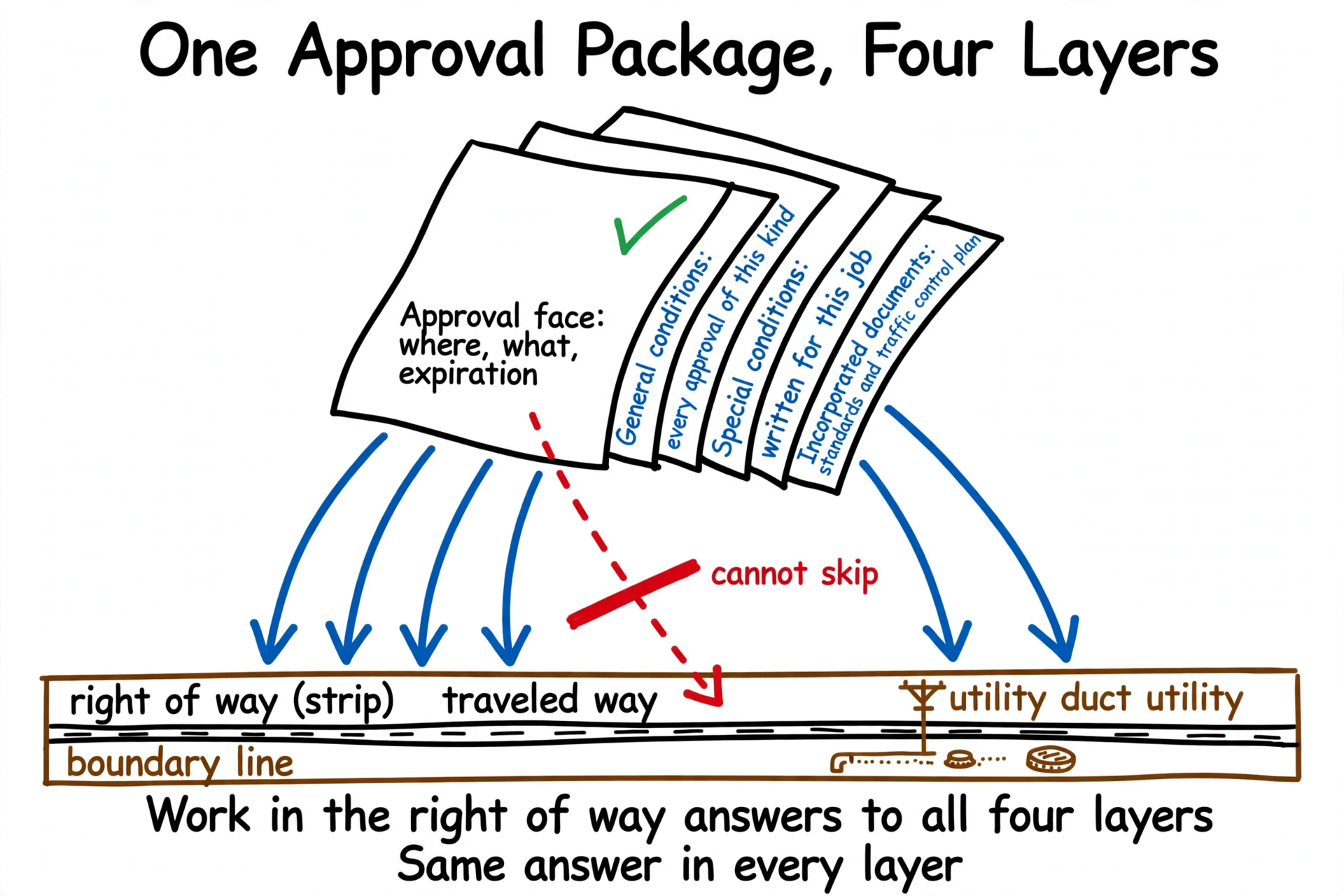
Conditions live in four places, and a complete read checks all four:
- On the approval face. The issued document itself carries conditions printed with the approval number, the permittee name, the location, and the term. Face conditions often cover the items the issuer wants visible at a glance, such as the segment limits, the expiration date, and a direction to keep a copy of the approval at the work site where the approval requires it.
- In general conditions or general provisions attached to the approval. General conditions are the standard requirements an issuer attaches to every approval of that type. A city may call this set general conditions. A state DOT may call the set general provisions or may carry the same content in its accommodation rules. The Illinois accommodation rules show the structure plainly: a subpart titled General Permit Condition covers obligation to comply, traffic control, cleanup and restoration, surety bond requirements, maintenance, as-built plans, and the obligation to remove, relocate, or modify a facility when the department requires it. Every permittee under that system receives the same baseline set.
- In special conditions written for one approval. Special conditions are requirements written for a single segment, crossing, or installation, added on top of the general set. Federal regulation uses the same idea. Section 645.213(a) requires a use and occupancy agreement to describe, at a minimum, requirements for location, construction, protection of traffic, maintenance, access restriction, and any special conditions applicable to each installation. A special condition answers a fact about this place: a school frontage, a structure attachment, a sensitive habitat edge, a railroad track nearby, or a highway project already scheduled inside the segment.
- In documents incorporated by reference. Incorporation by reference means an approval makes another document part of the approval by naming it, without reprinting its full text inside the approval. Section 645.213 opens with that mechanism: the written arrangements must include or incorporate by reference the transportation department standards for accommodating utilities, plus a description of the facility, drawings, liability for future adjustment, the action for noncompliance, and other provisions needed to comply with laws and regulations. A utility accommodation policy is the state written policy that controls how utilities may use highway right of way. An approved traffic control plan is a plan that shows how vehicles, bicycles, and pedestrians will be guided through or around a work zone. When an approval incorporates the accommodation policy or approves and attaches a traffic control plan, the requirements inside those documents become conditions of that approval.
Conditions also sort by subject. A crew meets the same families of conditions under every issuer, with the values inside each family set by the issued approval for the segment:
- Location and limits. Where the facility may sit, where work may occur, which access points may be used, and where staging, parking, and material storage may happen. Section 645.211(c)(1) requires state standards to state horizontal and vertical location requirements and clearances clearly. The approval for a segment applies those standards to a described alignment.
- Method. How the facility gets installed, including specifications and methods of installation the state standards prescribe under Section 645.211(c)(3), plus any method the approval excludes for that segment.
- Hours and notice. When work may happen and which notices must go out before work starts, before a phase closes, and before a closure or a crossing activity begins. The Santa Rosa encroachment program describes its city imposing noise and work hour conditions case by case. The actual hours and notice periods for a job live in the issued approval and its attachments.
- Traffic control. How traffic, bicycles, and pedestrians get protected during and after installation. Section 645.211(c)(4) requires measures covering control of access restrictions, rerouting or detouring, traffic control measures, procedures for utility traffic control plans, limits on vehicle parking and materials storage, and protection of open excavations. Traffic control on public roads follows Part 6 of the Manual on Uniform Traffic Control Devices, shortened to MUTCD, together with any state supplement the issuer references.
- Inspection and witnessing. Which steps the issuer will inspect, which phases must stay open until the issuer or its representative witnesses them, and how inspection requests get made. The Santa Rosa program states the pattern at city level: the applicant notifies the city at each point during construction so an inspection can happen before the next phase starts, and violations found at inspection must be corrected before work continues.
- Protection of existing facilities. How existing utilities, highway features, railroad property, drainage, monuments, and vegetation get located, marked, and protected during the work. Section 645.211(c)(3) pairs installation methods with preservation of highway facilities, appurtenances, and natural features and vegetation on the right of way.
- Restoration. The standard the disturbed ground, pavement, shoulder, ditch, sidewalk, and surface must meet when the crew leaves. Illinois Section 530.250 states the state version: the right of way returns to a condition at least as good as the condition before the permitted work, in a timely manner, using department approved materials and methods. The Santa Rosa conditions state the city version in similar terms: replace all components of the public street so the result is similar to or better than the condition before the encroachment.
- Documentation and as-built delivery. Which records the permittee must create and deliver, including drawings that show where the facility actually went. Section 645.213(c) requires adequate drawings or sketches showing the facility location against the traveled way, the right of way lines, and, where applicable, control of access lines and approved access points. Illinois carries an as-built plans condition at Section 530.300. An as-built record is a drawing or record that shows the facility as actually installed, with its real location, rather than the location the design proposed.
- Expiration and renewal. When the approval ends, which deadlines sit inside the term, and how an extension or renewal gets requested. The dates belong to the issued approval. A crew reads them from the package and tracks them on a calendar.
- Financial and responsibility terms. Insurance, indemnification, liability for future adjustment, and bond terms where the approval provides for them. Section 645.213(d) requires the agreement to state the extent of liability and responsibilities tied to future adjustment of the utility to accommodate highway improvements. A surety bond is a third party guarantee, issued by a bonding company, that the permittee will complete the permitted work and restoration as required, and that funds stand behind that promise if the permittee fails to perform. A performance bond serves the same guarantee purpose under the name many city programs use. Santa Rosa describes the city pattern: a performance bond guaranteeing faithful performance may be required, and when required repairs stay unfinished past a reasonable time, the city may perform the corrections and file a claim on the bond to recover its costs.
Two reading rules follow from the structure. The general set and the special set apply together. A special condition adds to the general set or narrows it for one place, and the reader follows both unless the issuer states a different order in writing. Statements and drawings submitted with the application can also become conditions. Illinois Section 530.210 states that statements and schematics in the application are material conditions of the permit, so a method promised in the application binds the field in the same way as a method printed in the general set.
What Does It Look Like?
Conditions rarely announce themselves with a single heading. A reader learns the shapes they take inside a real package:
- A numbered list on the approval face, often short, covering term, site copy, and segment specific directions.
- A separate general conditions or general provisions booklet, packet, or rule part attached to the approval or referenced on its face, with headed sections for traffic control, restoration, bonds, maintenance, and as-built delivery.
- A special conditions sheet, an exhibit, or a letter attached for one segment, naming the extra steps that segment requires.
- A reference line on the face that names another document, such as the state accommodation policy, a standard specifications book, an approved traffic control plan, approved drawings, or an environmental general conditions set.
- Approved drawings stamped or signed with the approval, showing the authorized alignment, the right of way lines, access points, and work limits.
- A term block with an effective date, a start or completion deadline, and an expiration date.
- Field traces once work begins: traffic devices set to the approved plan, a copy of the approval held where the conditions require it, inspection hold points marked on the schedule, marked existing facilities inside the work area, and restoration measured against a named standard rather than against crew opinion.
Environmental approvals show the same layered shape at federal level. A Nationwide Permit, shortened to NWP, is a general authorization from the U.S. Army Corps of Engineers for a category of work in waters of the United States, valid only when the work meets every applicable term and condition. Corps guidance for the NWP program states that a prospective permittee must comply with the NWP general conditions, plus any regional conditions and any case specific conditions imposed by the division engineer or district engineer. Three layers apply at once, and meeting two layers while missing the third leaves the work outside the authorization.
Railroad approvals show the layered shape in private form. A railroad license or crossing agreement carries general terms in the agreement body and segment terms in exhibits, and work near the track commonly carries conditions covering railroad flagging or watchman service, insurance including railroad protective liability coverage where the agreement requires it, clearance limits, and advance coordination with the railroad. The Iowa DOT special provision for work on railroad right of way shows the pattern in contract form: secure railroad permission before entering railroad property, arrange any temporary crossing through the railroad, reimburse flagging and watchman services the railroad provides, and carry the insurance kinds the provision lists. Values and thresholds belong to the railroad agreement for the crossing in hand.
What Does It Do?
It defines the authorized work. A condition draws the line between work the issuer approved and work the issuer never approved. A facility built to a sound technical standard in a place the conditions exclude sits outside the approval. A facility built by a method the conditions exclude sits outside the approval. Location, method, and limits conditions do the daily work of keeping construction inside the permission that was actually granted.
It converts policy into segment duties. A right of way, shortened to ROW, is land set aside for transportation or utility use. A state accommodation policy speaks to a whole highway system. A condition carries that policy down to one bore, one trench, one shoulder, and one restoration area. Section 645.211 lists what the policy must address. Section 645.213 requires the individual agreement to describe the requirements that apply to each installation. The condition is the joint where system policy becomes a crew task.
It sequences the job. Notice conditions place a communication before a construction step. Inspection and witnessing conditions place a hold point inside the sequence: a phase stays open, gets witnessed, and only then gets covered or followed by the next phase. Expiration conditions place the whole job inside a calendar window. Read early, conditions become the skeleton of the segment schedule. Read late, the same conditions become surprises with a crew standing by.
It allocates cost and risk before either appears. Restoration standards, bond terms, insurance terms, and liability for future adjustment assign the price of correction and the price of later highway work at the time of approval. Section 645.213(d) puts future adjustment liability inside the written arrangement for that reason. A bid and a schedule that skipped the conditions priced a different job from the job the issuer approved.
It creates the acceptance test. An inspector measures finished work against the conditions and the documents they incorporate. Restoration gets compared with the named standard. Facility location gets compared with the approved drawings and the as-built record. Traffic control gets compared with the approved plan. The condition supplies the yardstick before the argument about quality can start.
It gives the issuer a remedy with a paper trail. Section 645.213(e) requires the written arrangement to state the action to be taken in case of noncompliance with the transportation department requirements. Illinois carries the same idea through its sanctions sections: failure to comply fully with permit terms grounds revocation, a revoked permit can require facility removal at no expense to the department, and sanctions can include added bond or burial and encasement requirements. The remedy works because the condition was written down before the work began.
Where Does It Fit?
Conditions sit between the approval decision and the first hour of field work, and they stay active until the issuer closes the approval.
- At application, the applicant proposes location, method, drawings, and traffic control. Statements in that application can become material conditions, as Illinois Section 530.210 provides, so accuracy at application is a field concern rather than a paperwork detail.
- At review, the issuer tests the proposal against law, policy, and the conditions of the ground. The issuer may approve, approve with added special conditions, request changes, or deny.
- At issuance, the package assembles: face, general conditions, special conditions, approved drawings, approved plans, and every document incorporated by reference. The permittee read happens here, before mobilization, while the plan can still move on paper.
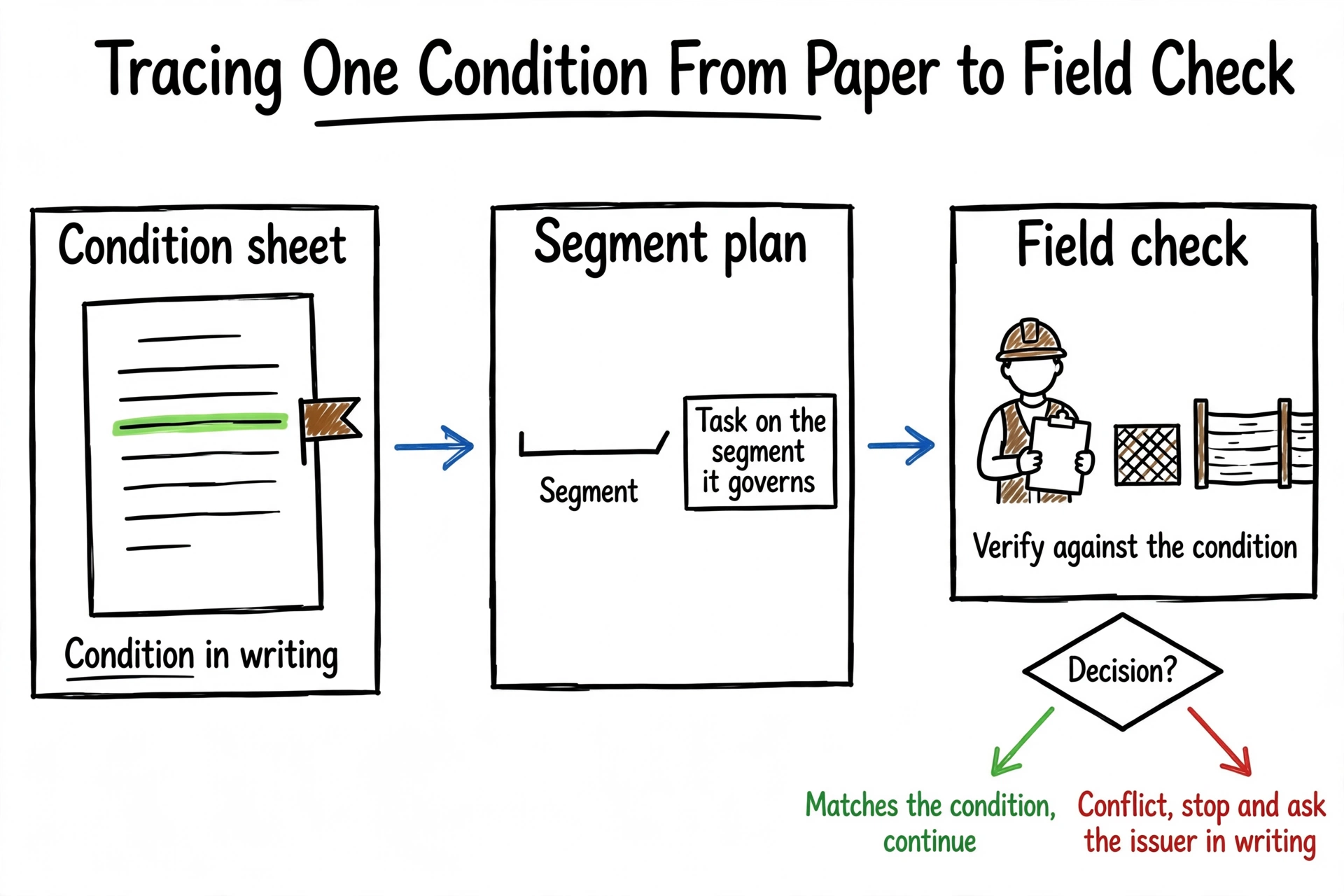
- Before construction, the permittee converts conditions into the segment plan: notices calendared, inspection hold points placed, traffic control staged to the approved plan, access and storage set inside the allowed limits, restoration standard named for the crew.
- During construction, conditions govern daily choices: hours, access, protection of existing facilities, open excavation protection, and the hold points where work pauses for inspection or witnessing.
- After construction, restoration, as-built delivery, final inspection, and any acceptance step close the conditions one by one. Bond release, where a bond exists, follows the issuer process after the obligations the bond secures are met. Illinois describes its surety bond as remaining in effect until released by the department.
- During the life of the facility, maintenance, adjustment, and removal obligations from the approval continue to answer questions about later entries and later highway work.
Conditions also sit beside the construction contract and the print, and the three documents answer different questions. The contract governs the commercial relationship between owner and builder. The print shows the design. The approval and its conditions govern whether the work may occupy the ground at all, and under which limits. A design can be buildable and still be unbuildable on that ground under the conditions that govern that segment.
Earlier Level 6 lessons each carried one issuer slice of this subject. Lesson 119 showed conditions inside a city approval. Lesson 120 showed conditions inside a state DOT approval backed by the state accommodation policy. Lesson 121 showed conditions inside a railroad agreement. Lesson 122 showed conditions tied to one crossing. Lesson 123 showed general, regional, and case specific conditions inside an environmental authorization. This lesson gives the reader one reading method that works across all five.
What Is at Stake
The permission itself. Work outside the conditions is work outside the approval. Illinois Section 530.200 states the baseline rule for its system: every permittee complies with the terms and conditions of the permit unless authorized, in writing, by the department, to do otherwise. An issuer that finds work outside its conditions holds remedies the approval and its rules describe, including correction, revocation, and removal in the systems that provide for them.
Traffic and public safety. Conditions on traffic control, parking and storage limits, and protection of open excavations exist because the public passes through or beside the work area. Section 645.211(c)(4) lists those measures as required content for state standards. A missed traffic condition exposes travelers and crew members at the same time.
Existing facilities and property. A strike on an existing utility, damage to a highway feature, or harm to railroad property during permitted work turns a construction problem into a liability problem, and the approval record identifies the responsible party. Protection conditions exist to prevent the strike and the damage rather than to assign blame afterward.
Schedule. A missed notice can delay a start. A missed hold point can require exposure of covered work or added documentation while the step gets reconstructed. An expired approval stops the segment until the issuer renews or reissues it through its process. Each delay costs crew time that a preconstruction read would have spent on paper.
Money. Correction, rework, removal, restoration to the named standard, standby during a stop, and a bond claim where the approval provides for one all carry real cost. Santa Rosa states the bond claim path plainly: the city may complete unfinished required repairs and claim its costs against the bond. The conditions priced those outcomes at issuance. Reading them early prices them into the plan.
Future work in the corridor. Issuers remember performance. Illinois lists a history of failing to comply with department directives or conditions of other utility permits among the poor performance grounds that can trigger a surety bond requirement on later work. A clean condition record helps the next application. A record of missed notices, failed restoration, and expired approvals makes the next review harder before it begins.
What Does Good Look Like?
- The complete package sits in the job file in one place: approval face, general conditions, special conditions, approved drawings, approved traffic control plan, and every document incorporated by reference, with nothing referenced and missing.
- The foreman can state, for the segment about to build, the location limits, the allowed method, the work hours, the notices already given, the inspection hold points ahead, the restoration standard, and the expiration date.
- Every condition that touches the field appears on the segment plan as an assigned task with a sequence position, covering notices, hold points, traffic control, access, storage, protection steps, restoration, and as-built delivery.
- Traffic control staged in the field matches the approved traffic control plan for that location, device by device and sign by sign.
- No phase that requires inspection or witnessing gets covered, backfilled, or built over before the witness step happens and gets recorded.
- Expiration and deadline dates sit on a tracked calendar, and any renewal or extension request goes to the issuer through its process before the term ends.
- A conflict between a condition, the print, and field conditions sits in writing with the issuer, and the affected work waits for written direction while unaffected work continues inside its own limits.
- Restoration gets checked against the standard named in the approval while correction is still simple, and the as-built record reflects the facility as installed.
From the Field
Picture a two person coordinator team preparing a short underground segment that crosses a state highway ROW and ends at a handhole just outside the ROW line. The job file holds the state approval. The approval face lists the segment, the method, and the expiration date. The coordinator reads the face, checks the date against the schedule, and starts building the segment plan.
A second read goes slower. The coordinator opens the attachments listed on the face. The general provisions carry the standard traffic control, restoration, and as-built duties. A special conditions sheet follows them. The special conditions require the issuing office to witness one phase of the installation before that phase gets covered, require notice to the issuing office before that witness step, and require the approved traffic control plan for the crossing day.
The draft field sequence tells a different story. The draft sequence covers the phase on the same day it gets built, with no witness step and no notice task, because the drafter worked from the approval face and the print. The print shows the facility path and the handhole. The print carries no witness requirement, since the print answers design questions and the approval answers permission questions.
The coordinator stops the paperwork rather than the crew. The segment plan gets rewritten on paper: a notice task placed before the witness day, a hold point placed at the phase the special conditions name, and a clear instruction that the phase stays open until the witness step happens. The coordinator sends the issuing office the notice the conditions require and confirms the witness arrangement before mobilization. The traffic control task gets tied to the approved plan named in the special conditions.
On the ground, the crew builds to the hold point and pauses. The witness step happens with the phase open and visible. The crew then covers the phase, completes the segment, restores the disturbed ROW surface to the standard the general provisions name, and delivers the as-built record the approval requires.
The decision rule is direct: read the whole package, face, general conditions, special conditions, and every referenced document, convert each condition into a sequenced task before mobilization, and hold any phase a condition reserves for notice, inspection, or witnessing until that step happens.
What Can Go Wrong?
Reading the face and filing the attachments unread. Conditions in general provisions, special conditions, and referenced documents bind with the same force as conditions on the face. A crew can satisfy every line on the face and still miss a notice, a hold point, a storage limit, or a restoration standard stated deeper in the package.
Treating a referenced document as background reading. Incorporation by reference makes the named document part of the approval. An accommodation policy, a standard specification, or an approved traffic control plan named in the approval carries enforceable requirements for that segment. A missing referenced document means an incomplete package and a question for the issuer before mobilization.
Assuming a condition nobody mentioned has expired or been waived. A condition stays in force until the issuer changes it through its own process. Illinois states the written form of that rule: departure from permit terms requires written authorization from the department. A verbal assurance at the tailgate, a habit from the last job, and silence from the inspector each leave the written condition exactly where it stood.
Building through a conflict. A condition can conflict with the print, with another condition, or with field reality, such as an existing facility sitting where the approved drawing shows clear ground. Building through the conflict picks a winner without authority. The issuer that wrote the condition holds the authority to resolve it, and the resolution belongs in writing in the job file.
Covering a hold point. A phase the conditions reserve for inspection or witnessing loses its evidence once covered. The issuer can require exposure, added documentation, or rework under its rules, and closeout stalls while the step gets reconstructed.
Working past expiration. An expired approval has ended under its own terms. The paper in the truck still looks official after the date passes. Renewal follows the issuer process. Work performed while the approval sat expired sits outside the approval, and the crew must not assume a later renewal covers it. The issuer states in writing what a renewal covers.
Carrying values from another approval. Hours, notice periods, depths, clearances, fees, bond amounts, and restoration details belong to the issuer, the system, and the individual approval for the segment. A value remembered from a city job proves nothing on a state segment. A value from one railroad agreement proves nothing under another railroad agreement.
Leaving restoration and records for the end. Restoration checked late becomes rework. An as-built record assembled from memory weeks later becomes guesswork. Conditions on restoration and documentation run during the work, and the closeout inherits whatever discipline the field applied while the ground stayed open.
What Should Someone Notice in the Field?
- Name the issuer, the permittee, the approval number, and the segment the approval describes, and confirm each one matches the work about to start.
- Inventory the package: face, general conditions, special conditions, approved drawings, approved traffic control plan, and every document incorporated by reference, and flag any referenced document nobody can produce.
- Pull the location and limits conditions: authorized alignment, work limits, access points, and parking and storage limits for the segment.
- Pull the method conditions: the installation method the approval allows and any method the approval excludes for this ground.
- Pull the calendar conditions: work hours, every required notice with its recipient, inspection and witnessing hold points, and the expiration date with any start or completion deadline.
- Compare traffic control in the field against the approved traffic control plan for the location, and compare rig setup, staging, and spoil placement against the allowed limits.
- Check protection steps for existing facilities and features inside the work area before ground opens, and confirm markings and locates match the approved drawings.
- Confirm the restoration standard named in the approval and the as-built delivery the approval requires, and assign both before the crew demobilizes.
- Raise any conflict among a condition, the print, and field conditions to the project lead and the issuer the same day, in writing, and hold the affected work for written direction.
- Know the boundary: reading conditions, marking hold points, and reporting conflicts are recognition and support tasks. Only the issuer can amend, waive, extend, or reinterpret its own conditions, and only qualified and authorized people may perform the excavation, boring, aerial work, traffic control, and other regulated or hazardous duties the conditions describe. Reading this lesson qualifies no one to perform regulated or hazardous work.
Key Terms
Permit condition: An enforceable requirement attached to an approval, stated in writing, that the permittee must meet for the permission to stay valid and for the work to be accepted.
General conditions: The standard requirements an issuer attaches to every approval of a given type, covering baseline duties such as traffic control, restoration, and compliance.
Special conditions: Requirements written for one segment, crossing, or installation, added on top of the general conditions to answer facts about that place.
Incorporation by reference: A method where an approval makes another named document part of the approval without reprinting its full text, so the requirements inside that document become conditions of the approval.
Issuer: The agency, owner, or authority that grants an approval and sets its conditions, such as a city, a state DOT, a railroad, or an environmental agency.
Permittee: The person, company, or agency named on an approval as the party receiving the permission and accepting its conditions.
As-built: A drawing or record that shows a facility as actually installed, with its real location, used to close the approval and to guide future work.
Surety bond: A third party guarantee from a bonding company that the permittee will complete the permitted work and restoration as required, with funds standing behind the promise if the permittee fails to perform.
Traffic control plan: A plan showing how vehicles, bicycles, and pedestrians will be guided through or around a work zone, approved by the issuer where the approval requires approval.
Utility accommodation policy: The state written policy, meeting the requirements of 23 CFR 645.211 on Federal-aid highways, that controls how utilities may use highway right of way in that state.
Check Your Understanding
- Name the four places conditions live inside an approval package.
Answer: Conditions live on the approval face, in general conditions or general provisions attached to the approval, in special conditions written for one segment or installation, and in documents incorporated by reference, such as an accommodation policy or an approved traffic control plan.
- What does 23 CFR 645.213 require a use and occupancy agreement to include or incorporate by reference?
Answer: The agreement must include or incorporate by reference the transportation department standards for accommodating utilities, with requirements at a minimum for location, construction, protection of traffic, maintenance, access restriction, and any special conditions for each installation, plus a general description of the size, type, nature, and extent of the facility, adequate drawings showing the existing or proposed location against the existing or planned highway improvements, the traveled way, the right of way lines, and, where applicable, the control of access lines and approved access points, the extent of liability for future adjustment, the action for noncompliance, and other provisions needed to comply with laws and regulations.
- A foreman says a special condition cannot apply to his segment because nobody from the issuing office mentioned it during the preconstruction meeting and the crew never read the attachment. Evaluate that claim.
Answer: The claim fails. A written condition binds the permittee whether or not anyone mentioned it aloud and whether or not the crew read the attachment. Illinois Section 530.200 states the pattern: the permittee complies with the permit terms unless the department authorizes otherwise in writing. Silence, habit, and an unread attachment change nothing. The crew reads the full package and builds to the condition, or seeks written direction from the issuer.
- In the From the Field scenario, where did the witness requirement live, why did the draft sequence miss it, and what did the coordinator change before mobilization?
Answer: The witness requirement lived in the special conditions sheet attached to the approval. The draft sequence missed it because the drafter worked from the approval face and the print, and the print answers design questions rather than permission questions. The coordinator added the required notice task, placed a hold point at the named phase with an instruction to keep the phase open, confirmed the witness arrangement with the issuing office, and tied traffic control to the approved plan before mobilization.
- During construction, the approved drawing shows clear ground at a bore pit location, and the crew finds an existing facility occupying that ground, so the pit must move. The move would place the pit outside the work limits the conditions allow. What should happen?
Answer: The affected work pauses and the conflict goes to the project lead and the issuer in writing the same day. Only the issuer can amend its conditions or authorize a different work limit in writing. The crew holds the affected pit work for that written direction, while any unaffected work that stays inside its own approval limits may continue. Nobody resolves a condition conflict by building through it.
Lesson Takeaway
An approval is a package, and the conditions are the working part of the package. After this lesson, an approval reads as layered duties: face, general conditions, special conditions, and referenced documents, each one converted into a sequenced field task, each conflict routed to the issuer in writing, and each segment built inside the permission that was actually granted.
Sources and Technical References
Federal regulation, 23 CFR 645.211, State transportation department accommodation policies, requiring state policies to address uniform procedures, horizontal and vertical location requirements and clearances, applicable codes, specifications and methods of installation, preservation and restoration of highway facilities and natural features, limitations on utility activity, traffic protection measures including traffic control plans, parking and storage limits, and protection of open excavations, compliance assurance and written approval for installations, and enforcement of control of access restrictions: https://www.law.cornell.edu/cfr/text/23/645.211
Federal regulation, 23 CFR 645.213, Use and occupancy agreements (permits), stating that the written arrangements must include or incorporate by reference the transportation department standards with requirements for location, construction, protection of traffic, maintenance, access restriction, and any special conditions for each installation, a general description of the size, type, nature, and extent of the facility, adequate drawings showing the existing or proposed location against the existing or planned highway improvements, the traveled way, the right of way lines, and, where applicable, the control of access lines and approved access points, the extent of liability for future adjustment, the action for noncompliance, and other provisions needed for legal compliance: https://www.law.cornell.edu/cfr/text/23/645.213
Federal Highway Administration, Information memorandum, Utility Accommodation and Other Uses of Highway Right-of-Way, June 28, 2017, summarizing the Part 645 framework, the public interest basis for accommodation, clear roadside location requirements, and the requirement that occupancy stay consistent with continued use, operation, maintenance, and safety of the facility: https://www.fhwa.dot.gov/utilities/170628.cfm
Illinois Administrative Code, Title 92, Part 530, Accommodation of Utilities on Right-of-Way, a state accommodation rule set showing the layered structure used in this lesson: Subpart A general provisions including incorporation by reference at Section 530.20, Subpart C general permit conditions including obligation to comply at Section 530.200, application statements as material conditions at Section 530.210, traffic control at Section 530.240, cleanup and restoration at Section 530.250, surety bond requirements at Sections 530.270 through 530.280, as-built plans at Section 530.300, and sanctions and revocation at Section 530.810. Section numbers and values belong to Illinois: https://ilga.gov/agencies/JCAR/EntirePart?titlepart=09200530
City of Santa Rosa, California, Encroachment Permits program page, Permit Conditions and Inspections sections, a city example describing standard condition families including hold harmless and indemnification, protection of street and restoration to a condition similar to or better than the prior condition, traffic, bicycle, and pedestrian controls, noise control and work hours imposed case by case, performance bonds with a city claim path when required repairs stay unfinished, notice to the city at each construction point so inspection happens before the next phase, and correction of violations before work continues. Program details belong to Santa Rosa: https://www.srcity.org/514/Encroachment-Permits
Iowa Department of Transportation, Special Provision SP-150605 for Work on Railroad Right-of-Way, an example railroad condition set in contract form covering permission before entering railroad property, temporary grade crossing arrangements through the railroad, railroad flagging and watchman services with reimbursement, clearance requirements, and insurance kinds. Requirements and values belong to that provision and the railroad agreement for the crossing: http://ia.iowadot.gov/specifications/provisions/2015/SP-150605.pdf
U.S. Army Corps of Engineers, Nationwide Permit program, General Conditions note, stating that a prospective permittee must comply with the NWP general conditions as applicable, in addition to any regional conditions or case specific conditions imposed by the division engineer or district engineer, the three layer structure used in this lesson for environmental approvals: https://www.swf.usace.army.mil/Portals/47/docs/regulatory/Permitting/Nationwide/2026/NWP24.pdf?ver=t6ME3mi_HOygGXwDNTgp8g%3d%3d
Federal Highway Administration, Manual on Uniform Traffic Control Devices, 11th Edition, Part 6, Temporary Traffic Control, the national standard that traffic control conditions reference for work in and near the traveled way: https://mutcd.fhwa.dot.gov/pdfs/11th_edition/part6.pdf
Previous lesson: Lesson 124: What Are Pole Attachment Rights? |
Back to Level 6 hub |
Next lesson: Lesson 126: What Are Work Limits?