
What You Are Learning
By the end of this lesson you will be able to answer one field question in plain words: when the work in the ground needs to be different from the work on the print, who is actually allowed to say yes to that difference?
You will learn what a field change is, what a change order is, and why those two phrases are not the same thing. You will learn where approval authority comes from, which is the contract documents and a written delegation from the owner, and why a job title by itself does not create that authority. You will be able to describe the usual roles on a fiber job: the owner, the engineer or designer, the contractor, the resident engineer or owner representative, the inspector, and the permit authority, and say what each one can and cannot approve. You will learn the difference between inspecting work and approving a change to the work, and why a person can rightly reject work that does not match the print and still have no authority to approve different work. You will also learn how to recognize an approval that will hold up, how to spot a verbal okay that will not, and what to do in the field when you are not sure the person saying yes has the authority to say it.
One boundary runs through this lesson. Recognizing who can approve a change is a reading and reporting skill. It does not qualify you to approve changes yourself, to direct construction, to work inside a permit area outside its conditions, or to perform any regulated or hazardous work. When this lesson tells you to pause and ask, that pause and that question are the correct field action.
Start With the Basics
Earlier lessons in this level taught you to read the construction information: the print, the notes, the specifications, the permit, and the other documents that describe the work before anyone builds it. Those documents are not just pictures. Together they form part of a legal and commercial agreement about what will be built, where it will be built, and what will be paid for it.
Start with the word contract. A contract is a binding agreement between parties that states what each party will do. On a construction job, the written agreement and the documents it incorporates are called the contract documents. That set usually includes the signed agreement, the general conditions, the drawings or prints, the specifications, any addenda issued before bidding or award, and any later modifications made in the manner the contract allows. The contract documents are the starting point for almost every authority question, because they name the parties, describe the work, and state how changes are to be made.
A field change is any departure in the field from what the contract documents require. Moving a handhole to a different location, changing a bore path, substituting a different material, changing a crossing method from bore to open cut, adding work that is not shown, or deleting work that is shown are all field changes if they differ from the documents. A field change can be small and sensible and still be a change. Size and good intention do not remove it from the change process.
A change order is a written modification to the contract, made in the form the contract requires, that records an agreed change to the work and, where they apply, the resulting adjustment to the contract price, called the contract sum, and to the allowed time, called the contract time. The AIA documents described later in this lesson define a change order this way in general terms: a written modification signed by the parties the contract names. A field conversation is not a change order. A note in a daily report is not a change order by itself. A change becomes part of the contract only when it is documented through the process the contract states.
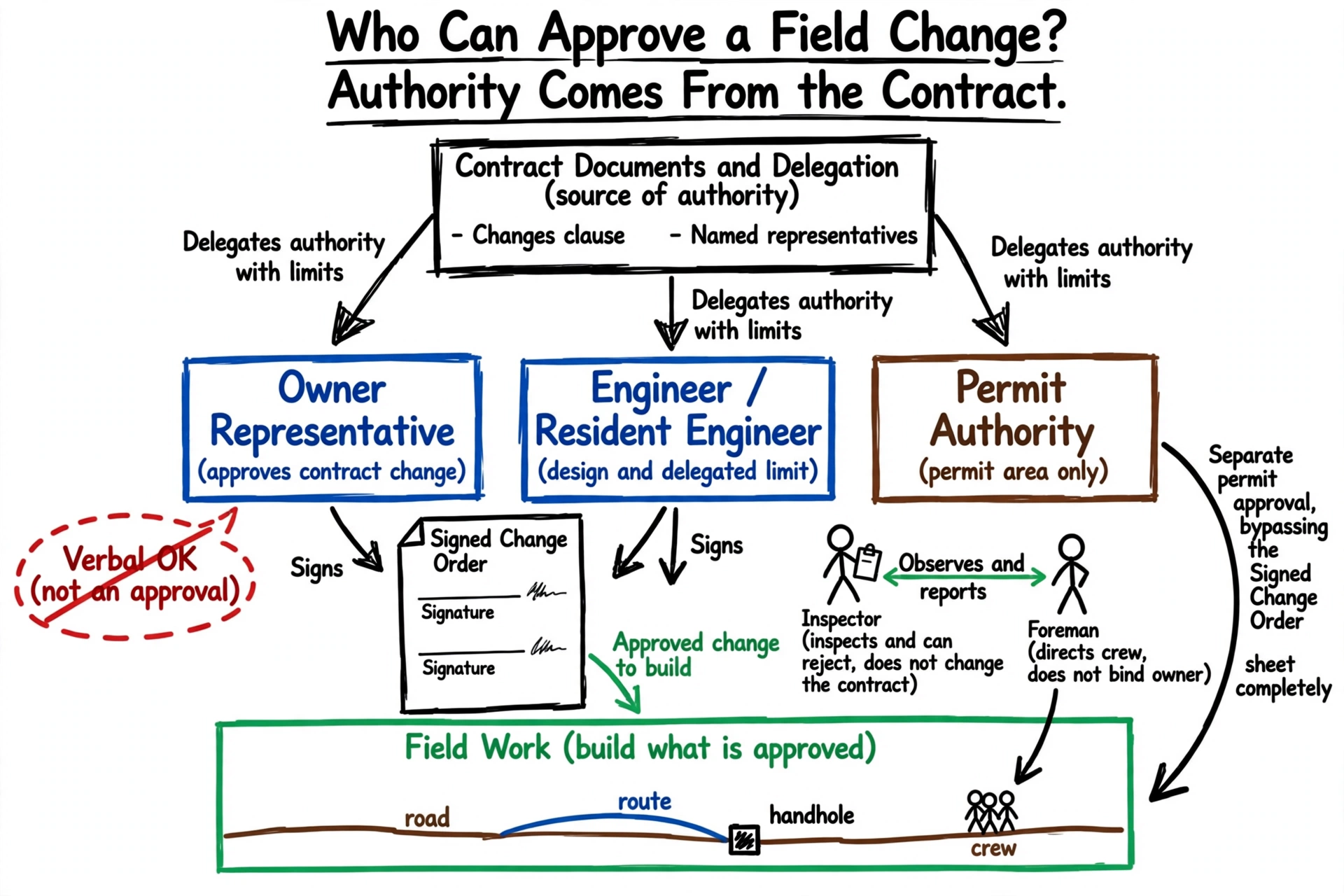
Delegation of authority means the owner, or another party with the right to do so under the contract, gives a named person or a named role a stated power to act on its behalf, within stated limits. Delegation is usually written. It may appear in the contract itself, in a letter, in a project procedures document, or in a formal warrant or appointment for public work. The key point is simple and it is the core of this lesson: authority to approve comes from the contract documents and from that delegation, not from a job title alone.
Hold that sentence. A person called engineer, inspector, project manager, or foreman may or may not hold approval authority on a given job. You find out by reading what the contract and the delegation say about that person or role on that job, not by reading the word on a vest, a truck door, or a business card.
What Is It?
Who can approve a field change is a question about authorized approval. Authorized approval means a yes given by a person who holds actual authority, under the contract documents and the owner delegation for that specific project, to bind the owner or the contracting party to that specific kind of change.
Actual authority is authority a principal actually gives to an agent. A principal is the party on whose behalf someone acts, on most jobs the owner for owner approvals. An agent is a person authorized to act for that principal within the authority given. Actual authority has two common forms discussed in construction references. Express authority is authority stated clearly, usually in writing, for example a contract clause naming who may sign change orders. Implied authority is authority that is reasonably necessary to carry out express authority, inferred from the role and the prior conduct the principal allowed. Both forms still trace back to what the principal actually granted.
Apparent authority is different, and the difference matters in the field. Apparent authority exists when a principal leads a third party to reasonably believe that an agent has authority, even if the agent was not actually granted that authority for that act. Construction payment guides explain that contractors sometimes argue apparent authority after doing extra work on an unauthorized direction, for example when an owner held out an architect as having power to approve changes. That argument is uncertain, often requires a lawyer, and is much weaker on public work. Industry guidance on public contracts is direct on this point: public bodies are generally not bound by the apparent authority of their agents. Change approval on a public contract must rest on actual authority, which in practice means the written authority in the contract and the delegation, such as a warranted contracting officer acting within the warrant. Do not rely on implied authority in the field, because it is narrow, fact specific, and often excluded by the contract itself. In plain field terms, “he seemed to be in charge” is not a safe basis for building changed work, and on a public job it is not a basis at all.
An unauthorized commitment is the public contracting term for an agreement made by a representative who lacked authority to make it. Federal Acquisition Regulation section 1.602-3, usually shortened to FAR 1.602-3, defines it as an agreement that is not binding solely because the government representative who made it lacked the authority to enter into it on behalf of the government. Ratification is the formal act of a properly authorized official later approving that unauthorized commitment. Ratification may or may not happen, it follows its own process, and a field crew should never build changed work counting on later ratification.
So, what is the approval you are looking for? It has four marks. First, it comes from a person named in the contract, or holding a written delegation from a party the contract empowers, for this project. Second, it covers this kind of change: a person authorized for a minor clarification with no cost or time effect may hold no authority over a change that adds cost, adds time, changes the design, or moves work inside a permit area. Third, it is given in the form the contract requires, which for most changes that affect price, time, or scope is writing, often a signed form. Fourth, it stays within any limit stated in the delegation, such as a contract specific dollar limit, a limit to certain work types, or a requirement to obtain a higher approval above a stated threshold. A yes that fails any one of those marks should be treated as unverified until the job process confirms it.
This lesson states no universal dollar limit and no universal threshold, because none exists as a general rule. Limits are set contract by contract and delegation by delegation. An example limit mentioned in any training example is contract specific only, and the limit that governs your job is the one written in your project documents.
What Does It Look Like?
An authorized approval leaves a paper trail you can point to. Learning to picture that trail is how you recognize a real approval in daily work.
In the project file, it looks like a contract provision you can open. The agreement or the general conditions name the owner representative, the engineer, and the contractor representative, and a changes clause states how changes are ordered and documented. On many building and civil jobs modeled on the American Institute of Architects documents, usually shortened to AIA, the general conditions are AIA A201. A201 Article 7 provides three change mechanisms: a change order, a construction change directive, and an order for a minor change in the work. You will meet those three forms again in the next section. Fiber and utility jobs may use owner standard terms, state department of transportation specifications, or a custom agreement instead of AIA forms, but they answer the same questions: who orders a change, who signs it, and what form it takes.
On the desk or in the project system, a delegation looks like a short written document. For a private owner it may be a letter or a contract exhibit naming a person and stating what that person may approve and up to what limit, if a limit applies. For a government owner it may be a formal warrant. Federal guidance explains that only a warranted contracting officer holds authority to award and modify a federal contract for money or schedule, and the warrant states that officer limit. State and local public owners use their own equivalent appointments and limits. The form differs. The idea does not: the authority is written down before it is used, and anyone on the job can ask to see it or to have it confirmed.
On the change itself, an authorized approval looks like a completed document, not a conversation. A change order is signed by the parties the contract requires. Under the AIA pattern, form G701 is the change order form, and the owner, the architect or engineer, and the contractor sign it once they have agreed on the change and on any adjustment to sum and time. A construction change directive, AIA form G714 in that pattern, is signed initially by the owner and the architect or engineer and directs the contractor to proceed before price and time are fully agreed. An order for a minor change, issued in the AIA pattern through an architect supplemental instruction on form G710, is a written order that by definition does not involve an adjustment to sum or time. Your job may use different form numbers or its own forms. What you should see in every case is writing, a description of the change, a reference to the contract, signatures or approvals from the roles the contract names, and a place in the project record where the document is filed.
In the field, an authorized approval often arrives as a copy of that document, a revised print with a stated revision, or a written direction that references the change document number. What it does not look like is just as telling. It does not look like a nod at a tailgate meeting, a thumbs up beside an open bore pit, a text that says “looks good, go ahead” from a person whose authority you have never seen stated, or an inspector initials on a daily inspection form that was designed to record conformance, not to modify the contract. Those field moments can be useful communication. They are not, without the contract basis behind them, an approval that changes the work.
What Does It Do?
Knowing who can approve a field change does four practical jobs on a fiber project.
First, it protects the work itself. Fiber outside plant work sits among other utilities, property lines, easements, roadways, and permit conditions. A change that looks minor at the pit, such as shifting a handhole, deepening a bore, or rerouting around an obstruction, can affect clearances from other facilities, access for future maintenance, splice design, footage and material counts, and compliance with the permit for that segment. Routing the decision to the person the owner authorized puts the change in front of someone charged with weighing those effects and with access to the design and permit record.
Second, it protects payment and time. A contractor who performs extra or changed work on direction from a person without authority runs a real risk of not being paid for that work. Construction contracting references give repeated examples of this outcome, including a federal case in which extra services directed by a person titled project coordinator were not paid because the contract required authorization by the contracting officer and that role and authority were not defined for the coordinator in the contract. Approval authority is therefore not paperwork for its own sake. It is the link between doing changed work and the contract obligation to pay for it and to allow time for it.
Third, it protects the design. The engineer of record is the licensed engineer who is responsible for the design, or the design firm acting in that role on the project. A field change that affects the design, such as a structural attachment, a crossing design, a material substitution with performance effects, or a change to a designed route, needs the review the contract assigns to that engineer. A field approval by someone without design responsibility does not transfer that responsibility and does not make the design sound.
Fourth, it keeps separate authorities separate. Some changes need more than one yes. A change inside a road right of way, which is the public land area reserved for the roadway and utilities, may need the owner contract approval and the approval of the permit authority that issued the right of way permit. A change directed under the contract does not amend a permit by itself, and a permit approval does not amend the contract price or time by itself. The approval question is therefore sometimes plural: who can approve this change under the contract, and who else must approve it under a permit, an easement condition, or another owner system affected by the change?
The function, stated in one line, is this: authorized approval turns a field idea into a contract change that the owner must recognize, the contractor can rely on for payment and time, and the record can prove later.
Where Does It Fit?
Approval authority fits inside a chain that runs from the contract, through delegated roles, to the field. Picture the chain in order.
At the top sits the owner. The owner is the party that owns the network being built, or the public or private entity that contracted for the work. The owner holds the original authority to change its own contract, to accept changes to price and time, and to delegate approval power to others. On a utility owner project the owner may be an internet service provider, a cooperative, a municipality, or a carrier. Individuals inside that owner organization hold only the authority the owner has given them through its own internal delegation, in addition to what the contract states.
Next sits the person or firm the contract names to administer the work or the design. Depending on the delivery method this may be an architect on a building job, an engineer on a civil or utility job, a construction manager, or an owner resident engineer. Resident engineer is a common public works title for the engineer in charge of the work at or near the site, acting for the owner or the agency within delegated limits. State department of transportation practice shows both the power and the limit of this role clearly: contract revisions are formally authorized through change orders, the contractor must not proceed with revised work until directed by the engineer, and certain major changes need documented prior approval from a higher level, including the Federal Highway Administration, usually shortened to FHWA, on federal aid projects where the stewardship plan requires it. Michigan DOT guidance, for example, states that its construction or project engineer, not consultant staff, must submit a request for FHWA review where required, and that major work performed before documented preapproval may be treated as nonparticipating for federal funding. The resident engineer is therefore often the right door to knock on, and at the same time a role with a ceiling that the field must respect.
Beside that role sits the contractor. The contractor is the company contracted to build the work. Its project manager and superintendent hold authority inside the contractor organization, and the contract usually names a contractor representative who can receive directions and sign change documents for the contractor. A contractor foreman, who leads a crew day to day, holds authority over crew means and methods within the contractor plan. That internal authority is real, but it runs downward into the contractor organization. It does not run upward into the owner contract. A foreman decision to build differently does not bind the owner to pay for different work.
In the field beside the work sits the inspector. An inspector is a person assigned to observe, measure, document, and check work against the contract documents, and to report or reject nonconforming work as the contract allows. Construction law references state the usual rule plainly: inspectors seldom have authority to change contract requirements, but they do have authority to reject work. Many standard contract clauses state the same limit in so many words, providing that an inspector is not authorized to change any term or condition of the specification without the written authorization of the owner authorized representative, and that the presence of an inspector does not relieve the contractor of any contract requirement. An inspector observation, even a favorable one, is therefore evidence about conformance. It is not, by itself, a modification of what conformance means.
Outside the contract chain sits the permit authority, also called the authority having jurisdiction for that permit. This may be a state department of transportation district, a county engineer, a city, a railroad, or another body that controls the right of way, the road, or the regulated area where work occurs. Utility permit systems illustrate the point: Minnesota DOT, for example, requires an approved permit before a utility owner places or changes a facility in trunk highway right of way, requires an authorized representative of the utility owner to sign the application, and requires the contractor to carry the approved permit while working there. If a field change moves work, changes its method, or extends it inside that right of way in a way the permit does not cover, the permit authority approval is required in addition to the contract approval, through the permit process that authority states.
Where does the reader of this lesson fit? At the reporting end of the chain. Your job, unless your own written delegation says otherwise, is to notice the need for a change, describe it accurately, ask who holds approval for it, confirm that approval in writing, and build only the work the documents and the authorized direction cover.
Why Does It Matter?
It matters first because unauthorized changed work creates a payment dispute that the field cannot fix later. The crew has already spent the labor, the material, and the day. If the direction came from a person without authority, the owner can refuse to recognize the change, the contractor can be treated in public contracting language as a volunteer for that extra work, and recovery arguments based on implied authority, apparent authority, or later ratification are uncertain and costly. The cheapest moment to test authority is before the changed work is built, when a phone call and a document cost almost nothing.
It matters because design and permit consequences outlive the workday. An unapproved reroute can place a facility outside the easement or permit area the owner actually holds, too close to another utility, or in a location the design did not intend for access and restoration. Correcting buried plant after restoration is far more expensive than pausing for approval, and in a regulated area an unapproved change can draw a permit violation for the owner as well as the contractor.
It matters because titles mislead in predictable ways. The person who knows the ground best is often the foreman. The person who sees the work closest is often the inspector. The person who answers the phone fastest is often a project coordinator or a field engineer. Knowledge, closeness, and availability are valuable, but none of them is the same thing as delegated approval authority. Jobs get into trouble precisely when a capable person acts outside the authority actually granted, sometimes honestly believing the authority exists. Construction case summaries include an example in which a government inspector believed he had authority to approve minor changes and relaxed a specification, the contracting officer learned of it only after the work was complete and refused to ratify it, and the board held that the inspector could not alter the contract. Good faith did not create authority.
It matters because a clear approval protects everyone who acted properly. The owner gets the change it actually authorized, at a price and time it accepted. The engineer keeps a design record that matches what was built. The contractor gets a document it can invoice against. The inspector gets a clean line between observing the old requirement and observing the new one. And the field crew gets a direction it can follow without quietly carrying commercial and legal risk that was never theirs to carry.
Finally, it matters for safety culture in a specific, limited way. A habit of stopping to confirm authority for contract changes builds the same pause and verify habit that good field work needs generally. This lesson does not make that pause a substitute for any safety process, and a contract approval never makes unsafe work safe or qualifies anyone to perform it. Approvals answer the question “is this change authorized?” Safety processes answer different questions, with different qualified people.
What Does Good Look Like?
Good approval practice on a fiber job looks like this.
The job starts with the authority map visible. At the preconstruction meeting and in the project file, the team identifies the owner representative, the engineer, the resident engineer if one is assigned, the inspector role and its limits, and the contractor representative. Any delegation limits the field needs to know are stated then, and the changes clause of the contract is reviewed in plain language: what forms are used, who signs each form, and what happens in an urgent situation. A newcomer arriving mid job can be shown that map in minutes.
A proposed change is described before it is decided. The description states what the documents currently require, what field condition was found, what change is proposed, and what effects are expected on cost, time, materials, design, permits, and other utilities. “Move the handhole” is not a description. A description names the segment, the current location by the reference the job uses, the proposed location, the reason, and the known effects. Good descriptions let an approver actually approve, because the approver can see what is being authorized.
The approval matches the change. A clarification that truly changes nothing in cost, time, or design intent follows the minor change or clarification path the contract provides. In the AIA pattern, the architect may order a minor change in writing only when it is consistent with the intent of the contract documents and involves no adjustment to sum or time, and if the contractor believes sum or time is affected the contractor must notify the architect before proceeding. A change that does affect scope, sum, or time follows the change order path, with agreement recorded before the work where the contract requires it, or the construction change directive path where the owner needs the work to proceed before agreement is complete. The form fits the facts. A minor change form is never used to carry a change everyone knows has a cost effect.
Writing comes before building, and urgent work still gets written. Where a genuine emergency or an unusual condition justifies speed, public agency practice offers the disciplined model: a verbal preapproval from the person who actually holds the authority, followed promptly by written documentation, with the discussion noted on the change record. Note who gave that verbal approval and confirm that person holds the authority. A verbal direction from a person without authority does not become safer because the situation is urgent. Urgency changes the speed of documentation. It does not change who holds authority.
The contractor protects itself politely and in writing. When direction arrives from a person whose authority is unclear, the good response is a short written notice to the authorized representative stating the direction received, asking for confirmation through the change process, and noting that the contractor is continuing all unaffected work. Contracting references recommend exactly this habit of prompt written notice to an authorized owner representative when an inspector direction appears to change the requirements, because it creates the record while relationships stay professional.
The record closes the loop. The signed change document is filed, the print or redline record is updated through the job revision process, the permit file is amended if the change touched a permit area, and the inspector is given the new requirement to inspect against. After a good approval, no one in the field has to guess which requirement is current, because the documents say so.
What Can Go Wrong?
The verbal okay failure is the most common. A field condition is found, a senior sounding person on site says to proceed differently, the crew does, and weeks later the change is disowned. The contractor performed changed work without a signed change and carries the cost risk. The defense is unglamorous and complete: get the direction from the authorized person, in the contract form, before building the change, or document an authorized verbal preapproval and its written follow up the same day.
The inspector approval failure happens when an inspector comment is treated as a design or contract decision. An inspector can accept that installed work matches the documents, reject work that does not, and report a field condition. When an inspector goes further and relaxes a requirement, approves a substitution, or redirects the route, that direction exceeds the usual inspector authority unless a written delegation for that job says otherwise. Crews that follow it can be ordered to remove and replace the work at contractor cost, because the requirement they were inspected against never actually changed.
The title assumption failure happens inside owner and agency organizations as well. A project coordinator, a field engineer, or a manager directs extra work in good faith, the work is performed, and the contracting officer or owner approver declines to sign because the direction was never theirs to give. Federal examples of this pattern are strict because public money is involved, and courts enforce the contract authorization requirement even when the contractor acted in good faith. Private owners apply the same contract logic, even if their internal process looks less formal.
The apparent authority trap is relying on how a person was presented instead of what the contract says. If an owner let an engineer approve small changes before, a contractor may assume the engineer can approve a large one. Past practice can support an implied or apparent authority argument in a dispute, but it does not give the field a reliable rule, and it gives no protection on public work, where approval must rest on actual authority and apparent authority generally does not bind a public body. Limits matter: authority for one kind or size of change is not authority for every kind or size.
The permit gap failure is obtaining the contract approval and forgetting the second authority. The owner approves a reroute by change order, the crew builds it inside a highway right of way on an alignment the permit does not cover, and the permit authority orders the work stopped or removed. The reverse also fails: a permit is amended, but no contract change is issued, and the contractor has permission to occupy the ground without any agreement to be paid for different work. Both approvals, each in its own system, are needed when both systems are touched.
The directive without agreement failure is mishandling a construction change directive. Under a directive the contractor is generally required to proceed with directed work while price and time are determined, and must protect its position by giving the notices and keeping the cost records the contract requires. A contractor that refuses to proceed at all, or that proceeds silently without notice and without records, harms its own claim. The directive path is a contract mechanism with its own duties, not an informal order and not an invitation to ignore paperwork.
The ratification gamble is building first and hoping an authorized official will ratify later. Ratification is discretionary, follows a formal process, and may be refused, especially where funding, design, or permit problems make the change unacceptable in hindsight. Work built on that hope is work built at risk, and buried fiber work is among the most expensive kinds of work to undo.
What Should Someone Notice in the Field?
You will rarely be the approver. You will often be the first person to see that a change is needed or that an approval is shaky. Work through these checks in order.
First, name the change honestly. Compare what the print and specifications require with what is being proposed or what is already being built. If they differ in location, method, material, quantity, or sequence in a way the documents do not already allow, you are looking at a change, even if everyone calls it a small adjustment or a field fix. Naming it correctly is what sends it to the right process.
Second, ask for the authority, not just the answer. Useful questions are short and neutral: “Who is the owner representative for changes on this contract?” “Is that approval authority in the contract or in a delegation I can note?” “Is there a limit on that authority that this change might exceed?” Record the name, the role, and the document you were pointed to. If the answer is a title with no document behind it, treat the authority as unverified.
Third, check whether the inspector line is being crossed. If the direction changing the requirement comes from an inspector, ask whether that inspector holds written change authority on this job. Expect the answer to be no, because the usual inspector authority is to inspect and reject against the existing requirement. Route the proposed change to the resident engineer, the engineer, or the owner representative the contract names, and let the inspector receive the approved change as the new basis for inspection.
Fourth, check the form. Ask what document will record this change: a change order, a construction change directive, a minor change order, a revised print, or a permit amendment. Note its number when it is issued. If the answer is that no document is needed for a change that plainly affects scope, cost, time, design, or permit area, that mismatch itself is the finding to raise.
Fifth, check the second authorities. Ask whether the change touches a permit area, an easement boundary, a railroad or highway crossing, another utility facility, or an environmental condition stated in the project documents. If it does, ask who approves in that system and whether that approval has been requested. Do not assume the contract approver cleared it.
Sixth, watch for the classic red flag phrases. “Just do it and we will paper it later.” “I am sure they will approve it.” “The inspector already said it is fine.” “We did it this way on the last job.” Each phrase replaces a document with a prediction. Predictions are not approvals. Note who said it, keep working on unaffected work as the contract requires, and escalate the change question through the contractor and owner representatives the same day.
Seventh, keep your own record. Write down the date, the location by the reference the job uses, the condition found, the change proposed, who directed what, and what you were shown as authority. A clear contemporaneous note protects the crew, helps the approver decide, and gives any later review the facts instead of recollections.
Eighth, hold the safety boundary. Stopping to confirm contract authority is a commercial and design pause. It is not a safety qualification, and an approved change is still built only by the people qualified and assigned for that work, under the job safety process. Never let an urgent approval conversation pull an unqualified person into regulated or hazardous work.
Practical Example
The following example is hypothetical. It is invented to teach the approval checking habit, and it does not describe a real project, a real company, or a real contract.
Hypothetical example: the handhole beside the driveway. A hypothetical buried fiber segment is being built for a cooperative owner under a written contract that names the owner operations manager as the owner representative for changes, names the design engineer, and assigns a third party inspector to observe and report. The contract changes clause follows the common pattern: changes affecting scope, sum, or time require a written change order signed by the owner representative and the contractor, and the inspector is stated to have no authority to change contract requirements.
On Tuesday the bore crew finds an unmarked obstruction where the print places a handhole, just inside a driveway apron. The contractor foreman proposes shifting the handhole along the route to clear ground beyond the driveway. The shift would change the structure location, change footage between splice points, and move the structure within the county right of way covered by the job permit. The inspector on site looks at the proposed spot and says it looks fine and will pass inspection there.
The foreman does the first thing right: the crew secures the work area, continues an unaffected section of the build, and treats the inspector comment for what it is, a field observation, not an approval. The foreman calls the contractor project manager and describes the change in writing: current location, proposed location, reason, and the three effects on structure position, footage, and permit area.
The project manager sends that description to the owner representative and to the design engineer. The engineer confirms the new location works for the splice plan with a small revision to the splice diagram. The owner representative then checks the permit question before signing: the county permit covers the road right of way segment but states locations by station range, and the proposed location falls inside that permitted range, so no permit amendment is needed, a fact the owner representative confirms with the county permit contact and notes in the file. That check mattered. Had the new location fallen outside the permitted range, a permit amendment would have been required in addition to the change order, and building first would have created a permit problem even with a signed change order.
The owner representative and the contractor then sign a short change order recording the moved handhole, the revised footage, the engineer revision reference, and a contract sum adjustment agreed from the unit prices already in the contract. The signed copy goes to the inspector, who now inspects the handhole at its new location against the changed requirement, and to the crew, who build it there.
Notice the order and the roles. The foreman identified and described the change but did not approve it for the owner. The inspector observed but did not approve it, and said nothing that changed the requirement. The engineer approved the design effect within the role the contract gave that firm. The owner representative approved the contract change within the delegation the owner had given, after clearing the permit question with the separate permit authority. One more teaching point hides in the delegation: in this hypothetical contract, the owner representative delegation carries a contract specific limit stated in that delegation letter, and the adjustment fell below it. Had the adjustment exceeded that limit, the same change would have needed a higher owner approval as well. That limit exists only because this hypothetical delegation states it, and it teaches the habit, not a number: read the limit in the documents for the job you are on.
Key Terms
Contract documents: the signed agreement and the documents it incorporates, usually including the general conditions, drawings or prints, specifications, addenda, and modifications made as the contract allows. They define the work and state how it may be changed.
Field change: any departure in the field from what the contract documents require, including a change in location, method, material, quantity, or scope, whether or not anyone has approved it yet.
Change order: a written modification to the contract, signed by the parties the contract requires, that records an agreed change to the work and any adjustment to the contract sum or contract time.
Construction change directive: a written order from the owner, prepared with the engineer in the AIA pattern, directing the contractor to proceed with changed work before the parties have agreed on the adjustment to sum or time. The adjustment is determined afterward by the method the contract states.
Minor change in the work: a written order for a change that is consistent with the intent of the contract documents and involves no adjustment to the contract sum and no extension of the contract time. In the AIA pattern the architect or engineer may order minor changes within that limit.
Delegation of authority: a grant, usually written, from a party with the right to grant it, giving a named person or role stated power to act on its behalf within stated limits.
Authorized representative: a person named in the contract or in a delegation as holding authority to act for a party for stated purposes, such as approving changes, within any stated limit.
Actual authority: authority a principal actually grants to an agent, either expressly in words or writing, or by implication as reasonably necessary to carry out the express grant.
Apparent authority: authority a third party reasonably believes an agent holds because of how the principal presented that agent, even if the agent was not actually granted that authority. It is an uncertain basis for payment and generally does not bind a public body.
Unauthorized commitment: in public contracting, an agreement made by a representative who lacked authority to bind the government or agency. Under FAR 1.602-3 it is not binding for that reason alone, unless it is later ratified.
Ratification: the formal approval of an unauthorized commitment by an official who holds authority to approve it. Ratification follows its own process and is never guaranteed.
Contracting officer: in government contracting, the warranted official authorized to award, direct changes to, and modify a contract for money or schedule, within the dollar limit stated in the warrant.
Resident engineer: the engineer in charge of the work at or near the site, acting for the owner or agency within delegated limits. The role often receives and processes proposed changes and may approve some changes, up to the ceiling the delegation states.
Engineer of record: the licensed engineer, or the design firm in that role, responsible for the design. Changes affecting the design require the review the contract assigns to this engineer.
Inspector: a person assigned to observe, document, and check work against the contract documents and to report or reject nonconforming work. Inspectors seldom hold authority to change contract requirements.
Right of way: the land area, often public, reserved for a roadway and for utilities and related uses. Work and changes inside a right of way are also governed by the permit issued for that area.
Permit authority: the body that issued a permit for work in a regulated area, such as a state or county road authority, and that must approve changes to the work as covered by that permit, through its own process.
Check Your Understanding
- A crew foreman with twenty years of experience says a handhole should move, and the site inspector agrees it will pass in the new spot. Why is that still not an approved field change on a typical contract?
- What is the difference between actual authority and apparent authority, and why is apparent authority an especially weak basis on a public job?
- Under the AIA A201 pattern, name the three mechanisms for changing the work and state the signing or agreement feature that sets each one apart.
- An owner representative signs a change order moving a bore route inside a highway right of way. The crew starts the next morning. What second approval question should have been asked before building?
- A person titled project coordinator directs a contractor to perform extra services that are not in the contract, and the contractor performs them in good faith. What risk has the contractor taken, and what should it have done instead?
Answer key:
- Because approval authority comes from the contract documents and the owner written delegation, not from experience or from agreement on site. A foreman holds authority inside the contractor organization over crew work, not authority to bind the owner to different work. An inspector usual authority is to inspect work against the existing requirement and to reject work that does not conform, not to change the requirement. Unless the project documents give either person written change authority for this kind of change, the change still needs approval from the representative the contract names.
- Actual authority is authority the principal actually granted, expressly in writing or by fair implication from that grant. Apparent authority is authority a third party reasonably believes exists because of how the principal presented the agent, even if it was never actually granted for that act. Apparent authority arguments are uncertain, fact specific, and often need a lawyer to pursue. On public contracts they generally fail altogether, because public bodies are not bound by the apparent authority of their agents. Change approval on a public contract must rest on actual authority, which in practice means the written authority in the contract and the delegation, such as a warranted contracting officer acting within the warrant. Do not rely on implied authority in the field, because it is narrow, fact specific, and often excluded by the contract itself.
- A change order is a written modification agreed and signed by the owner, the architect or engineer, and the contractor, adjusting sum or time as agreed, on AIA form G701 in that pattern. A construction change directive, form G714, is signed initially by the owner and the architect or engineer only, directs the contractor to proceed before sum and time are agreed, and leaves the adjustment to be determined by the contract method. An order for a minor change, issued through an architect supplemental instruction on form G710, is a written order by the architect or engineer for a change consistent with the contract intent that involves no adjustment to sum or time at all.
- Whether the permit authority for that right of way must also approve the changed work. A contract change order amends the contract between owner and contractor. It does not amend a highway or right of way permit. If the new alignment, method, or extent of work falls outside what the issued permit covers, the permit must be amended or a new approval obtained through the permit authority process before the changed work is built, or the work risks a stop or removal order in the permit area.
- The contractor has taken the risk of not being paid and not receiving time for the extra work, because a person without defined authority under the contract cannot bind the owner or agency to a change. Good faith performance does not cure missing authority, and federal contracting references give this exact pattern as a decided example. Instead, the contractor should have promptly notified the authorized representative or contracting officer in writing, asked for direction through the contract change process, and proceeded with the extra work only on an authorized written change, while continuing all unaffected contract work.
Lesson Takeaway
Authority to approve a field change does not live in a job title, a vest, or years of experience. It lives in the contract documents and in a written delegation from the owner, and it extends only as far as that grant extends: to the kinds of changes named, in the form required, within any limit stated. The owner holds the original authority and delegates it. The engineer protects the design and, in patterns such as AIA A201, joins in change orders and directives and may order truly minor changes with no cost or time effect. A resident engineer processes and may approve changes up to a delegated ceiling, with major public changes sometimes needing higher or FHWA prior approval. An inspector inspects and can reject work, and seldom can change what the work is required to be. A foreman directs a crew, not the owner contract. A permit authority separately governs changes inside its permit area. When you cannot point to the contract clause or the delegation behind a yes, treat that yes as unverified: describe the change in writing, ask the authorized representative, get the change document, check the second authorities, and build only what the approved documents cover. That habit protects the design, the permit, the payment, and the crew, and it is the whole lesson in one habit.
Sources and Technical References
- AIA Contract Documents, Construction Change Directive vs. Change Order: a construction change directive is a written order from the owner prepared by the architect directing changed work before cost or time are agreed, signed initially by owner and architect on form G714, while a change order is a written modification signed by owner, architect, and contractor adjusting sum or time, on form G701: https://learn.aiacontracts.com/articles/construction-change-directive-vs-change-order/
- AIA Contract Documents, What Is a Construction Change Order: under A201 a change order modifies the contract when owner, contractor, and architect agree; A201 states changes may be made through a change order, a construction change directive, or a written order for a minor change, with form G710 used for architect supplemental instructions for minor changes with no cost or time effect: https://learn.aiacontracts.com/articles/6378493-the-fundamentals-of-change-orders-in-construction/
- Faegre Drinker, Changes in Article 7 of AIA Document A201-2017: Article 7 covers the three change mechanisms, and section 7.4 allows the architect to order minor changes consistent with the contract intent involving no adjustment to sum or time, with a contractor duty to notify before proceeding if it believes sum or time is affected: https://www.faegredrinker.com/en/insights/publications/2019/5/changes-in-article-7-of-aia-document-a201-2017-what-contractors-need-to-know
- Construction Contracting textbook, Contract Changes (Virginia Tech Pressbooks): contractors who perform changes ordered by persons without authority under the contract run the risk of not being paid; a federal board enforced a requirement for contracting officer authorization even where extra work was directed in good faith by a person titled project coordinator whose authority was not defined in the contract; an inspector could not alter the contract by relaxing a specification: https://pressbooks.lib.vt.edu/constructioncontracting/chapter/contract-changes/
- Inspection, Acceptance, Warranties, and Commissioning (LawExplores): inspectors seldom have authority to change contract requirements, but they do have authority to reject work, and the recommended practice is written notice to an authorized owner representative when inspector actions appear to change the requirements: https://lawexplores.com/inspection-acceptance-warranties-and-commissioning/
- Surety Bond Quarterly, A Guide to Obtaining Payment for Changed Work Not Expressly Authorized: express authority is found in the contract naming of authorized representatives; unless the contract delegates authority to bind the owner, the contractor should obtain the owner written authorization; implied authority, apparent authority, ratification, and estoppel are fallback arguments, and public bodies are not bound by the apparent authority of their agents: https://www.suretybondquarterly.org/2018/09/17/a-guide-to-obtaining-payment-for-changed-work-not-expressly-authorized/
- MWMCA, Beware of the Authority Issue: only a warranted contracting officer can award, issue a notice to proceed, modify a contract for money or schedule, direct a change, suspend, terminate, or close out a government contract, while other personnel perform functions such as inspection and testing, which is why confusion arises; a verbal or written agreement with an inspector or field engineer for extra work may leave the contractor treated as a volunteer if the contracting officer does not sign: https://mwmca.org/index.php?section=news&action=showNews&var1=1242&var2=&var3=&var4=&var5=&var6=&var7=
- Excell Consulting, Ratification, Changes, and Unauthorized Commitments: an unauthorized commitment under FAR 1.602-3 is an agreement that is not binding solely because the representative lacked authority; work performed without a fully executed modification is at the contractor risk, and formal ratification by an official with authority is frequently the only remedy: https://www.excellconsulting.net/ratification-changes-unauthorized-commitments/
- Michigan DOT, Contract Revisions 103.02: contract change orders are the formal process by which revisions are authorized and incorporated; the contractor must not proceed with revised work until directed by the engineer; major changes as defined with FHWA under 23 CFR 635.102 and 23 CFR 635.120 may need FHWA involvement depending on the project Risk Based Project Involvement Stewardship and Oversight Plan. When that plan requires MDOT action, the MDOT construction or project engineer, not consultant staff, submits the request, and major work done before documented preapproval may be considered nonparticipating. Balancing change orders and fully state or locally funded extra work, other than a project limits extension, do not require FHWA approval under this guidance: https://mdotwiki2.state.mi.us/construction/index.php?title=103.02_Contract_Revisions&oldid=8823
- Missouri DOT Engineering Policy Guide 104.13, Construction Inspection Guidance: value engineering proposals route from the contractor through the resident engineer, with district and division recommendations and, for projects designated for federal involvement on value engineering change proposals, FHWA review, showing a tiered resident engineer authority structure for those proposals: http://epgtest3.modot.org/index.php?title=104.13_Construction_Inspection_Guidance_for_Sec_104&direction=next&oldid=35616
- Minnesota DOT, Permit Information and Forms, Utility Agreements and Permits: a utility owner must receive an approved permit before placing a new facility or making additions or changes to an existing facility in trunk highway right of way, the contractor must carry the approved permit while working there, and an authorized representative of the utility owner must sign the permit application: https://www.mndot.net/utility/forms.html
Flagged items: No universal dollar limit, percentage limit, or size threshold for who may approve a field change was found in the sources above, and none is stated as a rule in this lesson, because approval limits are set in each contract and each delegation. Any limit on your project must be verified in your own contract documents and delegation letter. No published fiber industry standard was found that sets a single approval chain for all fiber owners, so the owner, cooperative, and carrier chains described in this lesson are presented as the common contract pattern, not as a standard. Verify the named representatives, the changes clause, and any limits in the documents for the specific project before relying on them. Whether a specific resident engineer, engineer, or inspector on a given job holds written change authority beyond the usual limits described here is a project specific fact that can only be verified in that job delegation. AIA form numbers and the A201 Article 7 pattern apply to jobs using AIA documents; jobs under DOT specifications or owner standard terms use their own forms and clause numbers for the same functions, which must be read in those documents.
Previous lesson: Lesson 92: What Is a Field Change? |
Back to Level 4 hub |
Next lesson: Lesson 94: What Controls When Documents Disagree?