
What You Are Learning
By the end of this lesson you will be able to say, in plain words, what people usually mean when they say field change on a construction job, and why that phrase needs care. You will be able to tell a field change apart from four related ideas that are not the same thing: a formal change order, a request for information, a field order or minor change, and a Construction Change Directive. You will be able to explain why a change that looks small in the dirt can still matter for cost, time, safety, permits, and the final record of what was built. You will be able to describe how a field change should be documented, including the daily report, written direction, photographs, and the redline markup that later becomes part of the as-built record. You will also be able to spot the warning signs of a risky change, especially a verbal direction with no written follow-up, a change made outside the signed plans and easement, and a series of small changes that together stop looking small.
One boundary runs through the whole lesson. Reading about changes does not give anyone authority to make one. Only the people and the process named in the contract for that specific job can authorize a change that alters the work, the price, or the schedule. Recognizing a condition in the field is a different skill from being qualified or authorized to redesign the work, approve the change, or perform regulated or hazardous work. When this lesson says notice, record, and ask, it means exactly that.
Start With the Basics
Start with the documents you have already met in this level. The construction print is the drawing set that shows what is to be built, where it is to be built, and how the pieces relate. The specifications, often shortened to specs, are the written requirements that sit with the print and describe materials, methods, and quality. Together with the agreement and other listed documents, the print and the specs are part of the contract documents. Contract documents are the signed or issued papers that define the bargain: what work is owed, for what price, in what time, and under what rules.
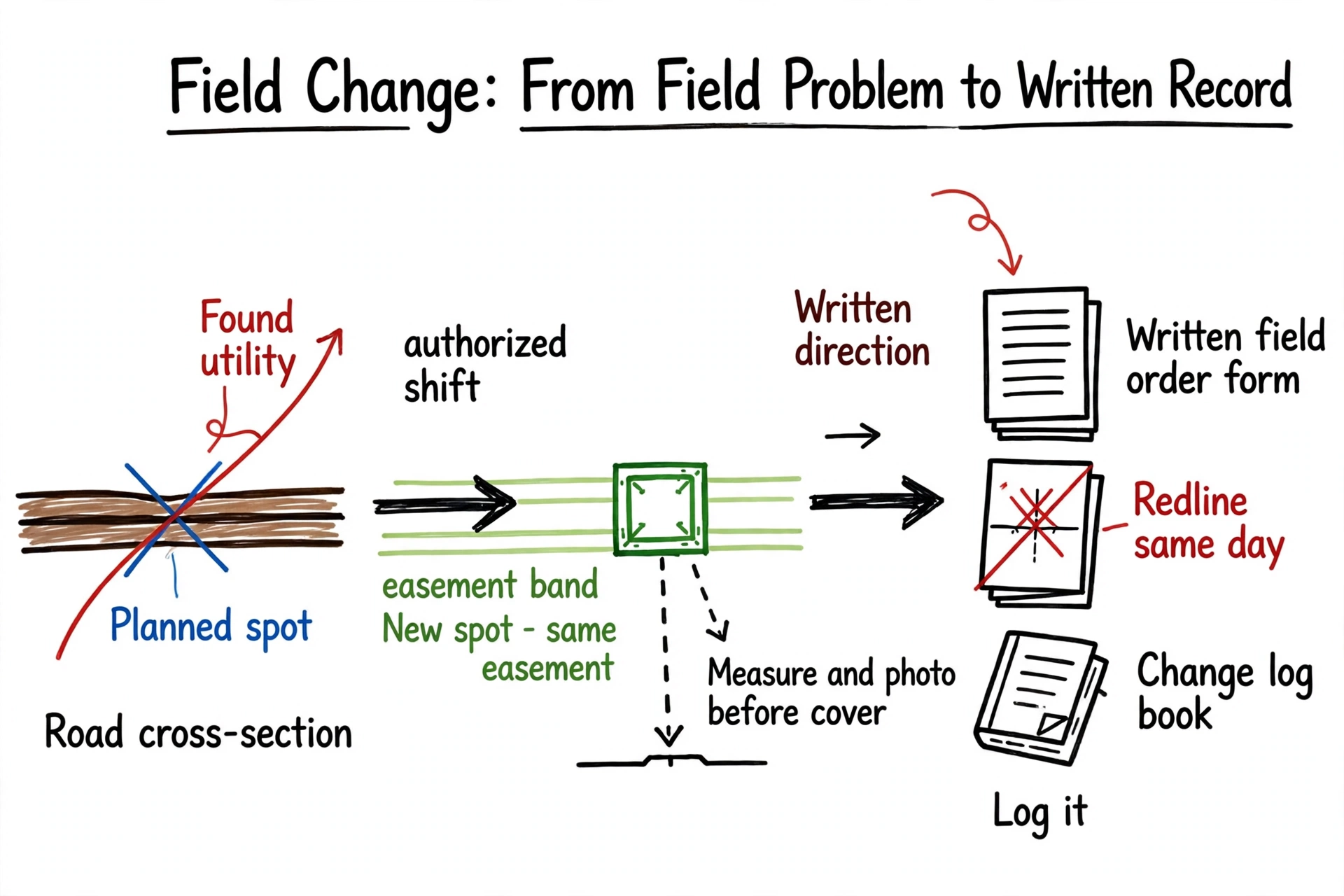
Now put a crew on a real street. The print shows a buried fiber route running along the east side of a road, with a handhole at a marked location. A handhole is a buried access box, usually set flush with the ground, where conduit ends meet and where cable and splice work can be reached later. The crew opens the ground and finds something the print did not show: an unmarked water line crossing exactly where the handhole was drawn, or solid rock where a bore was planned, or a driveway that was poured after the design was finished. The work as drawn cannot be built as drawn, or it cannot be built well as drawn, without adjusting something.
That adjustment, discussed and made where the work is happening, is what people on the job usually call a field change.
Three words need to be clear before anything else builds on them.
First, scope means the work the contract requires. Scope includes the route, the structures, the materials, and the method only where the contract controls the method. If new work is added, work is removed, or required work is done in a materially different way, the scope is being changed, even if the crew is standing in the same field.
Second, authorize means to give permission in the way the contract requires, by a person the contract gives that power to. A friendly nod, a helpful suggestion from someone passing by, and a direction from the person named in the contract are not the same thing. Who can authorize what is a contract question, not a personality question.
Third, record means the written job record: daily reports, emails and forms kept by the project, marked prints, photographs with locations, and logs. Memory is not a record. If a change matters later, and most changes do, someone will ask what the record shows.
Hold one sentence from this section. A field change starts as a field problem, but it only becomes a safe change when the right person authorizes it in the right way and the record shows what actually happened.
What Is It?
A field change is a common working phrase, not a single universal contract form. That is the most important definition in this lesson, and it is worth stating plainly.
On many jobs, field change means an adjustment to how, where, or in what detail planned work is carried out, made in response to conditions found in the field. Examples in outside plant fiber work include shifting a handhole a short distance to avoid a conflict, changing a bore entry pit location because the planned pit sits in a wet ditch, rerouting conduit around an obstruction that was not shown, or changing the side of a driveway where a crossing is made. The work still aims at the same finished network. The path to get there has moved.
On other jobs, the same two words are used more loosely for almost any departure from the print, including work that clearly adds scope, cost, or time. That loose use is where trouble begins, because the contract usually does not treat every departure the same way.
There is no universal rule that a field change is always minor, always free, always allowed on verbal direction, or always handled by one standard form. Each contract defines its own change process, its own forms, and its own limits. Some owners and engineers use a document actually called a field order for a narrow kind of minor change. Some use different names entirely, such as supplemental instruction, work directive, or contract modification. The Fiber Done Right point is simple: learn the phrase as field language, then ask what form and what authority this specific job requires for this specific change.
A field change is not the same as a change order. A change order is the formal, written amendment to the contract that records an agreed change in the work and, where they apply, the adjustment to the contract sum and the contract time. Under the widely used AIA A201 general conditions, a change order is prepared by the architect and signed by the owner, the contractor, and the architect, stating their agreement on the change and on any adjustment to sum and time. Other standard families, including EJCDC documents used on many civil and utility jobs, use the same basic idea with their own signers and forms. When a signed change order exists, the contract itself has been changed. A conversation in the field, by itself, has not done that.
A field change is not a request for information either. A request for information, usually shortened to RFI, is a written request from the contractor to the designer, engineer, or owner for clarification of the drawings or specifications. An RFI asks a question. It may or may not lead to a change. Industry and owner guidance is consistent on this point: an RFI response clarifies intent, and if the clarified work is beyond what the contract already required, the change process, not the RFI alone, is the path to amend the contract.
A field change is also not the same as discovering an error and quietly fixing it your own way. If the print is wrong, in conflict with itself, or in conflict with a found condition, that fact needs to go through the job process so the designer or engineer of record, meaning the licensed design professional responsible for the design, can address the design, and so cost and time effects are handled openly.
In short: a field change is the field adjustment. The contract papers that may be needed to authorize, price, schedule, and record that adjustment are separate steps, and skipping those steps does not make them unnecessary.
What Does It Look Like?
A field change rarely arrives as a single neat document with that title. In the field you are more likely to see its pieces.
You see a problem first. A locate mark, a pothole, or an open trench shows a utility where none was drawn. Potholing is carefully exposing an underground facility, often by hand digging or vacuum excavation, to confirm its exact location. You see a foreman, an inspector, and sometimes an engineer representative standing at the conflict, looking at the print, looking at the ground, and looking at the print again. You see measurements being taken to a curb, a pole, a property pin, or another fixed reference, and photographs being taken before anything is covered.
You may see a markup. A redline is a markup on the construction print, traditionally in red ink and now often in a digital markup tool, that shows what was changed or built differently from the issued drawing. On a field change, the redline might show the handhole crossed out at its drawn spot and redrawn at its new spot, with a note, a date, and initials. A sketch on a print, on a change form, or in a field notebook can serve the same early purpose if it is clear, dated, and kept.
You may see paper or a screen with one of several titles, depending on the job system. Titles you may meet include field order, field work order, minor change order, Architect’s Supplemental Instruction, Construction Change Directive, change order request, or a daily field report entry describing directed work. Do not judge what a document does by its title alone. Read who signed it, what it says about price and time, and whether it says proceed now or only asks for a price.
You may also see what a field change does not look like when it is being handled well. It does not look like a crew quietly burying a different route with no markup, no photo, and no note. It does not look like a text message that says move it over a bit, with no location, no reason, and no follow-up. And after the work is done, it does not look like a clean, untouched print set being turned in as if the job had been built exactly as drawn when everyone on the crew knows it was not.
In outside plant work the visible signs are often small: a handhole lid sitting a few feet from where a neighbor crew expected it, a bore pit scar on the other side of a driveway, a conduit stub facing a slightly different direction, or a splice case placed in a different structure than the print label suggests. Small on the ground does not mean small in the record. The next crew, the locator, and the repair technician will all trust the record to find that plant.
What Does It Do?
A properly handled field change does four jobs at once.
First, it keeps buildable work moving. Field conditions are real. Rock, water, unshown utilities, access limits, and changed surface features are normal reasons a plan meets the ground and needs adjustment. A clear field change process lets a minor, well understood adjustment be decided promptly instead of leaving a crew idle or tempting a crew to improvise without direction.
Second, it connects the field decision to the contract decision. The field question is: how do we build this correctly here? The contract questions are: is this within the original scope or beyond it, does it change the price, does it change the time, does it affect a permit or an easement, and who has approved it? A good process answers both sets of questions, in writing, close to the time the work is done. FHWA guidance for federal-aid highway work makes the same point at program scale: contract changes need documented reasons, a clear description of what work will be completed, any specification changes, and cost and time revisions, with approval at the level the funding process requires.
Third, it protects the design. Some adjustments are purely about placement within the intent of the design. Others touch the design itself, for example moving a splice point changes cable lengths and slack, or moving a crossing changes the method and the risk to another utility. Routing the change past the designer or engineer where the job requires it keeps the finished network coherent instead of becoming a chain of local fixes that no longer add up.
Fourth, it creates the truthful record. The redlines from field changes feed the as-built drawings. As-built drawings are the revised drawings that show what was actually constructed, including relocations, routing changes, and substitutions, as opposed to what was originally designed. In many systems, record drawings are the cleaned formal set made from the field redlines and kept as the owner record. Usage varies, and some contracts use as-built and record drawings for the same set, so check the definition in the job contract. If the field change is never marked, the as-built is wrong, and every future dig, locate, and repair starts from a wrong map.
A field change does not do one thing people sometimes wish it did. It does not settle payment by itself. Whether changed work is included in the original price, paid by a unit price already in the contract, paid as an adjustment, or not payable because it was never authorized depends on the contract language and the facts. That is exactly why the written trail matters while the work is still open and visible.
Where Does It Fit?
A field change sits in the middle of a sequence. Placing it in that sequence is the easiest way to avoid confusing it with its neighbors.
The sequence often starts with a question or a conflict. The crew or inspector compares the print to the ground and finds a gap. If the gap is only lack of clarity, the tool is an RFI: ask, in writing, what the documents require. The answer may be proceed as drawn, which means there is no change at all.
If the answer or the condition requires building differently, the next question is size and effect. Standard contract families sort changes into lanes. Under AIA A201 Article 7, changes in the work may be accomplished by change order, by Construction Change Directive, or by an order for a minor change in the work. A minor change is an adjustment consistent with the intent of the contract documents that does not change the sum or the time. In AIA practice the architect issues it, often on a supplemental instruction form, without needing all parties to sign a change order. In EJCDC practice the parallel tool is commonly called a Field Order, defined as a written order by the engineer requiring minor changes that do not involve a change in contract price or contract times. Names differ by family and by owner. The lane idea is the same: truly minor, no price or time effect, issued in writing by the design professional the contract names.
If the change affects price or time, or if the parties have not yet agreed on that effect, the lane changes. A Construction Change Directive is a written order, signed in AIA practice by the owner and the architect, directing the contractor to proceed with a change before final agreement on the adjustment to sum or time. It exists so urgent work does not wait for pricing, while still putting the direction in writing. A change order then follows when the parties agree, recording the final adjustment and amending the contract. On highway and public works jobs the same final step may be called a contract change order, supplemental agreement, or contract modification, and oversight approval may be required before or after execution depending on the program.
A field change, in everyday speech, can enter at several points in this sequence. A minor placement shift handled by a written field order started as a field change. A larger reroute handled by directive and then by change order also started as a field change. The phrase describes where the need was discovered. The forms describe how the contract handled it. Both descriptions can be true at once, and neither replaces the other.
At the far end of the sequence sits closeout. Every field change that altered what was built should appear on the redline set, flow into the as-builts, and be reflected in quantities, test records, and geographic records such as GIS where the owner maintains them. A change that was authorized and built but never closed into the record is only half finished.
There is also an outer boundary to the whole sequence. Courts and contract writers use the term cardinal change for a change, or a buildup of changes, so extensive that the work is no longer essentially the same work the parties bargained for. The doctrine comes from federal contracting law and is applied case by case, looking at the nature and size of the changed work and its effect on the whole job. A cardinal change is treated as outside the power of the ordinary changes clause, and directing one can be a breach of contract. Field crews do not decide cardinal change questions. The lesson for the field is narrower: if adjustments keep growing until the job no longer resembles the job that was bid, stop treating them as routine field changes and raise the question in writing through the chain at once.
Why Does It Matter?
It matters first for safety and for protection of other utilities. Many field changes in fiber work happen precisely because something underground was not where the papers said it was. Moving a bore, a trench, or a structure without checking locates, easement limits, and clearances can trade one conflict for a worse one. A change that looks convenient above ground can put a crew closer to a gas line, an electric duct, or a water main below ground. Recognizing a conflict and pausing for direction is field competence. Redesigning a crossing on the spot and proceeding as if qualified to do so is not. This lesson does not qualify anyone to locate facilities, direct a bore, or work around live utilities.
It matters for money, in both directions. A contractor who performs added work on a verbal assurance may later be told the contract required written authorization and the work was voluntary. Courts have sometimes allowed recovery for orally directed work, and have sometimes enforced the written requirement strictly, especially on public contracts, which is why relying on goodwill is a gamble rather than a process. An owner has the mirror risk: a pattern of verbal directions with no records becomes a pile of disputed extras at closeout, with no clean way to tell agreed work from assumed work.
It matters for time. A change that adds footage, structures, restoration, or a different construction method can affect the schedule even when no one mentions time while standing in the field. If the time effect is not raised when the change is directed, the argument later will be about memory. Written notice close to the event is how contracts expect that question to be preserved.
It matters for permits, easements, and property rights. A permit is the written permission from the authority that controls a road, railroad, or other regulated space, often with conditions on location and method. An easement is a legal right to use a defined part of someone’s land for a stated purpose. Moving plant outside the permitted or easement area is not a minor field adjustment, even if the move is physically short. That kind of change needs the owner and, where required, the permitting authority and the landowner process, not just a field decision.
It matters for the life of the network. Fiber plant stays in the ground for decades. Splice locations, handhole positions, and conduit routes recorded wrong will mislead locators, repair crews, and designers long after the original crew has forgotten the job. The cheapest time to tell the truth about a field change is the day it is made, while the trench is open and the measurements are easy.
Finally, it matters for trust. Owners rehire contractors whose changes are transparent: problem stated, option proposed, authorization clear, record clean. A job with no surprises in its change log reads as a well run job, even when the ground itself was full of surprises.
What Does Good Look Like?
Good starts before the change. The crew verifies the conflict instead of assuming it. The facility is exposed or located by the qualified process the job requires, measurements are taken, and the print, the permit, and the easement limits for that spot are checked. The question being raised is stated in one clear sentence: what is in the way, what cannot be built as drawn, and what adjustment is proposed.
Good authorization is written and matched to the size of the change. A truly minor adjustment with no price, time, permit, or design effect is handled on the written minor-change or field-order path the contract provides, by the person the contract names. Anything bigger, anything with a price or time effect, and anything the parties have not agreed on goes on the directive or change order path. If urgency forces work to start on verbal direction in a genuine emergency, the direction is confirmed in writing the same day, with the name of the person who directed it, the exact work directed, and a statement that price and time effects are reserved for the contract process. Confirm the direction in writing as soon as possible, the same day where practical. Prompt written confirmation is common practice guidance, because memory fades and leverage disappears once work is covered. Any deadline in the job contract controls.
Good documentation is specific. The record names the location by station, address, or structure, states the reason for the change, describes the work as changed, notes who authorized it and on what form, and attaches photographs taken before cover. Quantities affected are listed. The redline is marked that day, not reconstructed at closeout.
Good communication reaches everyone the change touches. The inspector knows. The locator knows the plant moved. The splice crew gets the new structure and footage. The office updates the change log, which is the running numbered list of changes and their status. No one downstream should learn about a field change by failing to find a handhole where the print said it would be.
Good also has a clear stop line. If the proposed adjustment would leave the easement, change the permitted method, alter the design in a way the field is not authorized to alter, or affect price or time without the required signatures, good looks like pausing that part of the work, protecting the site, and escalating in writing. Pausing one segment while other work continues is normal project management, not failure.
What Can Go Wrong?
The classic failure is the verbal change. A supervisor says to move the handhole and promises the paperwork will follow. The paperwork never follows, memories differ about how far it moved and why, and at payment time the written-change clause in the contract is quoted back to the crew that built it. Even when the law in a given place softens that result, proving a verbal direction costs time and money that a one-page confirmation would have saved.
The second failure is the silent change. The crew solves the problem neatly, buries the work, and marks nothing. The build is fine. The record is false. Months later a locate based on the as-built misses the actual route, a later excavation strikes or exposes plant no one expected there, or a splice crew opens the wrong structure. Silent changes convert a good field decision into a long-term hazard.
The third failure is lane confusion: treating a change that affects price, time, permits, or design as if it were a minor field adjustment. A reroute that adds footage and a second bore is not minor just because the crew can start it today. Each small change decided in the wrong lane makes the next one easier to decide the same way, until the job carries a large amount of undocumented, unpriced work. That buildup has a name in contract law when it goes far enough, discussed earlier as cardinal change risk, and it begins with ordinary small shortcuts.
The fourth failure is building outside the rights the project actually holds. A short move across a property line, into a different part of the right-of-way, or into a wetland or railroad area flagged on the permit can require removal and restoration at the builder’s cost, plus delay while new permission is obtained. Physical ease is not legal permission.
The fifth failure is fixing a design problem without the designer. A field fix that changes splice design, slack storage, cable count, or structure type can break the network logic the print was carrying. The conduit fits, the fiber does not. Design questions need the engineer of record in the loop, through the RFI and change process, even when the field answer seems obvious.
The sixth failure is waiting to document. Redlines reconstructed from memory at the end of a segment are consistently less accurate than redlines marked the day of the change. Photographs without a location reference, notes without dates, and forms without the authorizing name all lose value quickly. Documentation delayed is often documentation lost.
What Should Someone Notice in the Field?
Notice the mismatch itself. Any place where the ground, the marks, or the existing plant disagree with the print is a possible field change being born. Treat the mismatch as information to verify and report, not as permission to improvise.
Notice who is giving direction, and whether that person is the one the job has identified as able to direct a change. A suggestion from a property owner, a passerby utility worker, or a well-meaning inspector from another agency may be valuable information, but information and authorization are different things. If you cannot name the authority, ask before building.
Notice the words being used. Move it, add one, skip that one, and we will sort it out later are direction words. When you hear them about work that differs from the print, that is the moment to ask the documenting questions out loud: should this be on a form, who is signing, and where should it be recorded? Asking in the moment is professional, not difficult.
Notice the boundaries on the ground. Easement stakes, right-of-way markers, permit limits, locate marks for other utilities, and environmental flags all define the space the project is allowed to change. A proposed adjustment that crosses any of them is not a routine field change.
Notice cover-up approaching. Work about to be buried, bored past, or restored over is about to become invisible. If a change has been made there and it is not yet photographed, measured, and redlined, that gap is about to become permanent. Speak up before cover, not after.
Notice patterns. One crew repeatedly reporting conflicts in the same segment may mean the design information for that segment is poor, which is a fact the office and the designer need early, while they can still get ahead of the next segment. Field changes, counted and logged, are design feedback.
Notice, finally, your own limits. Notice a conflict, protect people and facilities, record what you saw, and route the decision to the people the contract charges with it. That is the field role this lesson teaches. It does not make the reader the designer, the authorizing official, or the person qualified to perform the underlying regulated work.
Practical Example
The following example is hypothetical. Any resemblance to a specific project is coincidental, and the handling described follows common contract practice. The contract for your specific job controls.
Hypothetical example: A crew is placing buried conduit and handholes along a county road. At the third handhole of the day, the vacuum excavation pothole finds an unmarked storm pipe crossing the exact spot the print shows for the handhole. The storm pipe was not on the utility map and carries no locate marks.
The foreman stops work at that structure, keeps the excavation safe, and calls the inspector. Together they measure the conflict and check the print and the easement. The easement strip is wide enough at this spot that the handhole can be shifted along the route, staying inside the easement, clear of the storm pipe, and still in line with the conduit runs on both sides. Cable design is checked with the project engineer by phone and then confirmed through the job RFI process: the shift shortens one conduit run slightly and lengthens the next, and the engineer confirms the splice and slack plan still works with the new footage.
Because the shift is consistent with the design intent and, on this hypothetical contract, involves no change to price or time, the engineer issues the written minor-change document the contract provides, referencing the location, the reason, and the new measured position. The crew builds to the new spot. Before backfill, the inspector photographs the open excavation showing the storm pipe, the new handhole position, and a tape measurement to the road centerline reference the job uses. The foreman redlines the print that evening: old location struck, new location drawn, note added with the date, the authorizing document number, and initials. The daily report repeats the same facts in words. The change log gains one numbered entry, status closed.
Now change one fact and watch the handling change with it. Suppose the only workable shift had required a second bore under a driveway and added footage the contract pays by unit price. The field problem is the same storm pipe. The contract handling is not the same, because price is now affected. On most contract systems that work would move to the change order path, or proceed on a written directive while the price adjustment is settled, with notice given in the way and within the time the contract states. The lesson of the pair is the core of this lesson: the ground decides that a change is needed, the contract decides how that change is authorized and paid, and the record proves both.
Key Terms
- Field change: Common field phrase for an adjustment to planned work made in response to field conditions. It is not a single universal contract form, so the job contract defines how it must be authorized and recorded.
- Change order: A formal written amendment to the contract, signed by the parties the contract requires, recording an agreed change in the work and any adjustment to contract sum and contract time.
- Contract documents: The agreement, drawings, specifications, and other listed documents, plus modifications issued under the contract, that together define the required work.
- Scope: The work the contract requires, including its locations, quantities, materials, and controlled methods.
- Request for information (RFI): A written request for clarification of the drawings or specifications. It asks a question and does not by itself amend the contract.
- Field order: In EJCDC and many owner systems, a written order by the engineer for minor changes that do not change contract price or contract times. Similar tools in other systems include a minor change order or supplemental instruction.
- Construction Change Directive: A written order, signed by the owner and the design professional in AIA practice, directing the contractor to proceed with a change before final agreement on price or time adjustment.
- Minor change: A change consistent with the intent of the contract documents that does not adjust the contract sum or the contract time.
- Redline: A markup on the construction print, traditionally in red, showing what was changed or built differently from the issued drawing.
- As-built drawings: Revised drawings showing what was actually constructed, built from field redlines and records. Record drawings are, in many systems, the cleaned formal set made from those field redlines and kept as the owner record, but usage varies and some contracts use as-built and record drawings for the same set, so check the definition in the job contract.
- Constructive change: An informal or indirect direction, act, or faulty specification that in effect changes the work without a formal change document, and that may support a claim for adjustment if notice and proof requirements are met. This is a contract and legal concept applied case by case.
- Cardinal change: A change, or buildup of changes, so extensive that the finished work is no longer essentially the same work the parties bargained for. It is treated as outside the ordinary changes clause.
- Easement: A legal right to use a defined part of land for a stated purpose, such as placing and maintaining fiber plant.
- Engineer of record: The licensed design professional responsible for the design on the project.
Check Your Understanding
- A crew member says, we made a field change today, so the contract has been updated. What is wrong with that sentence, and what would have to happen for the contract itself to change?
- A handhole must shift a short distance to avoid a found utility. The shift stays in the easement, matches the design intent, and has no price or time effect. Which contract lane does that usually belong in, and who normally issues the written document in EJCDC and in AIA practice?
- Why is an RFI response, by itself, not enough to rely on when the clarified work turns out to be beyond the original scope?
- Name three things that should be in the record of a field change before the work is covered up.
- A series of individually small verbal adjustments has, over two months, rerouted a large share of a segment and added substantial unpriced work. Name two risks this pattern creates and the action the field should take.
Answer key:
- A field adjustment and a contract amendment are different things. The contract itself changes only through the modification process the contract provides: a signed change order, a written directive, or a written minor change or field order, depending on the system, recording the change and any sum and time effect.
- It usually belongs in the minor change lane. In EJCDC practice the engineer issues a written Field Order. In AIA practice the architect issues an order for a minor change, often as Architect’s Supplemental Instructions. The exact signer and form always come from the job contract.
- An RFI asks for clarification and its response states what the documents require. It does not amend the contract. Work beyond the original scope needs the change process so authorization, price, and time are handled and signed in the required way.
- Any three of: the location identified by station, address, or structure; the reason for the change; a description of the work as changed; the name of the person who authorized it and the form used; photographs taken before cover; measurements to a fixed reference; the redline markup made the same day; a daily report entry and a change log entry.
- Risks include any two of: unpriced or unpaid work and a closeout dispute over verbal direction; an inaccurate as-built record because undocumented changes are easily lost; movement toward a buildup that is no longer the work that was bargained for, raising cardinal change concerns; permit or easement exposure if the reroute drifted outside approved limits. The field action is to stop treating the adjustments as routine, put the pattern in writing, and escalate through the chain for formal direction.
Lesson Takeaway
A field change is how real ground truth enters a planned job. The phrase itself is only field language. What makes a change safe, payable, and useful for the next thirty years is the discipline around it: verify the condition, get written authorization from the person and on the form the contract requires, match the handling to the size of the effect, photograph and measure before cover, redline the same day, and log it. Small change, full record. That habit protects the crew, the owner, the public underground, and the next person who has to find this plant in the dark.
Sources and Technical References
- AIA Contract Documents, Fundamentals of Change Orders in Construction, explaining A201 Article 7, the G701 Change Order, the G714 Construction Change Directive, and the G710 Architect’s Supplemental Instructions for minor changes: https://learn.aiacontracts.com/articles/6378493-the-fundamentals-of-change-orders-in-construction/
- Minnesota State, Construction Change Overview, summarizing AIA A201 Article 7 and defining RFI, Architect’s Supplemental Instruction, Proposal Request, and Construction Change Directive: http://minnstate.edu/system/finance/facilities/design-construction/pm_emanual/doc/co.40%20construction%20change%20overview%209-20-19.pdf
- Lexology, Modification of Contracts, comparing EJCDC C-700 and AIA A201 change order, work change directive, and Field Work Order or minor change provisions: https://www.lexology.com/library/detail.aspx?g=b6704085-c44c-41e7-83c1-6a7e6e1922f6
- Procore Construction Glossary, Field Order, describing a field order as an on-site instruction typically for a minor change not affecting contract price or timeline, to be documented and approved: https://www.procore.com/library/glossary/field-order
- Federal Highway Administration, Federal-Aid Essentials, Companion Resource for Change Orders (August 2012), on why changes occur, approval levels, documentation, and cost and time assessment: http://www.fhwa.dot.gov/federal-aidessentials/companionresources/04changeorders.pdf
- Virginia Tech Pressbooks, Construction Contracting, Chapter 14 Contract Changes, on the federal changes clause, constructive changes, notice, and cardinal changes: https://pressbooks.lib.vt.edu/constructioncontracting/chapter/contract-changes/
- LegalClarity, What Is a Cardinal Change? Doctrine and Contractor Rights, on FAR 52.243-4, the within-the-general-scope limit, and how courts assess cardinal changes: https://legalclarity.org/what-constitutes-a-cardinal-change-in-a-contract/
- Smith Currie, Can’t Get a Written Change Order? Document, Document, Document, on the risk of oral direction and same-day written confirmation practice: https://www.smithcurrie.com/publications/common-sense-contract-law/cant-get-written-change-order-document-document-document/pdf/
- ConWize Glossary, As-Built Drawings, on redline markups during construction capturing routing, dimensional changes, and concealed work, then formalized at closeout: https://conwize.io/glossary/as-built-drawings-updated-plans-showing-the-exact-final-state-of-a-completed-project/
- Rhumbix, What Is a Change Order in Construction, comparing change order, RFI, submittal, and Construction Change Directive and which documents modify the contract: https://www.rhumbix.com/blog/what-is-change-order-construction
Flagged as unverifiable or contract-specific, and therefore not stated as universal rules in this lesson: (1) There is no single universal definition of the phrase field change across all owners and contract families. What form is required, who may sign it, and what it may authorize must be verified in the contract documents for the specific job. (2) No universal dollar amount, percentage, footage, or day limit separates a minor change from a change order. Any such thresholds, where they exist, come from the specific contract, owner standard, or funding program, and were intentionally not invented here. (3) Notice deadlines for change claims vary by contract. Verify the required form and timing of notice in the job contract before relying on any deadline. (4) Whether orally directed work is recoverable varies by jurisdiction, contract language, and facts, including stricter enforcement on many public contracts. This lesson states the risk, not a legal outcome. Readers need project-specific contract review for legal questions.
Previous lesson: Lesson 91: What Is a Revision? |
Back to Level 4 hub |
Next lesson: Lesson 93: Who Can Approve a Field Change?