
Introduction
A permit is official written permission from an authority to do a specific activity, at a specific place, for a limited time, under stated conditions. On a fiber job, the authority is the body that controls the ground or the road corridor where the work will happen, and the permit is the document that says the named party may do the described work there.
This lesson sits in the level on reading construction information because a permit is a construction document, read alongside the print and the specification. The print shows where the fiber is designed to go. The permit answers a different question: whether this party is allowed to do this work, in this place, at this time, in this way. A reader who can find a permit, read its four matches, and spot a segment with no permission of its own can catch authorization problems while they are still paperwork problems.
What This Lesson Gives You
- Read any permit form and find the permittee, the described work, the location limits, and the dates without hunting for them
- Tell a permit, an easement, and a license apart on sight, and say which ground each one covers
- Check a route segment by segment and name the exact segment where permission runs out
- Spot the four states of paper, application, issued permit, acknowledgment, and closed permit, and refuse to treat the first as the second
- Separate a right of way permit from an OSHA safety permit when a conversation mixes the two
Start With the Basics
A fiber route almost never stays on land the fiber owner controls by itself. It crosses streets, runs along highways, passes under railroads, crosses private land, and shares space with water, sewer, gas, and electric lines. Someone controls each of those places. That someone has to agree, in writing, before a crew occupies the space or disturbs the ground.
A permit is one of the main written forms that agreement takes.
A permit works the way a hall pass worked in school. The office issued it, it named one student, it allowed that student to be in one place until a stated time, and it carried the office’s rules with it. The pass never made the hallway the student’s property, and it never excused the student from the school’s other rules. A construction permit behaves the same way: an issuing authority, a named holder, a described place and activity, a time limit, and conditions that travel with the permission.
Five words need plain definitions before the rest of the lesson builds on them.
- Permit: official written permission from an authority to do a specific activity, at a specific place, for a limited time, under stated conditions. If the activity, place, time, or conditions change, the permission may no longer cover the work.
- Authority: the government body, agency, or owner that has the legal power to allow or deny the activity in that place. The lesson also uses the terms issuing authority and permitting authority for the same party. Examples include a city public works department, a county engineer, a state department of transportation, and a federal agency for work on land or highways it controls.
- Permittee: the person, company, or agency named on the permit as the party who receives the permission and accepts its conditions. Work done under a permit is done in the permittee’s name. A crew that is not the permittee, or not working for the permittee under the contract, should not assume the permit covers them.
- Right of way (ROW): land set aside for transportation or utility use, such as the strip that includes a road, its shoulders, ditches, and the space above and below them. The exact width and boundaries of a right of way are shown on plats, plans, and records for that road. Do not guess them in the field.
- Condition: a requirement attached to the permission. Conditions are part of the permit. Permission without its conditions is not the permission that was granted.
Hold one idea before you read further. A construction print can show where fiber is designed to go, and a permit answers whether the work is allowed there. The design being correct does not by itself make the work authorized, and a permit being issued does not by itself prove the design is correct. A job needs both.
What Is It?
A permit, for construction and utility work, is a written authorization issued by an authority that allows the named permittee to perform described work in a described location, during a stated period, subject to the conditions written on or attached to the permit.
Unpack that definition piece by piece.
- It is written and issued. A permit is a document, paper or electronic, issued after an application and review. Verbal encouragement, a handshake, past practice on another job, or the fact that similar work was allowed last year is not a permit. Federal highway practice makes the written point explicit: under 23 CFR Part 645, Subpart B, on accommodation of utilities on Federal-aid highway projects, all utility installations on highway right of way are subject to written approval by the state transportation department, except where a use and occupancy agreement provides otherwise for matters such as maintenance, service connections on highways other than freeways, or emergency operations. The written record is the arrangement the parties can point to later.
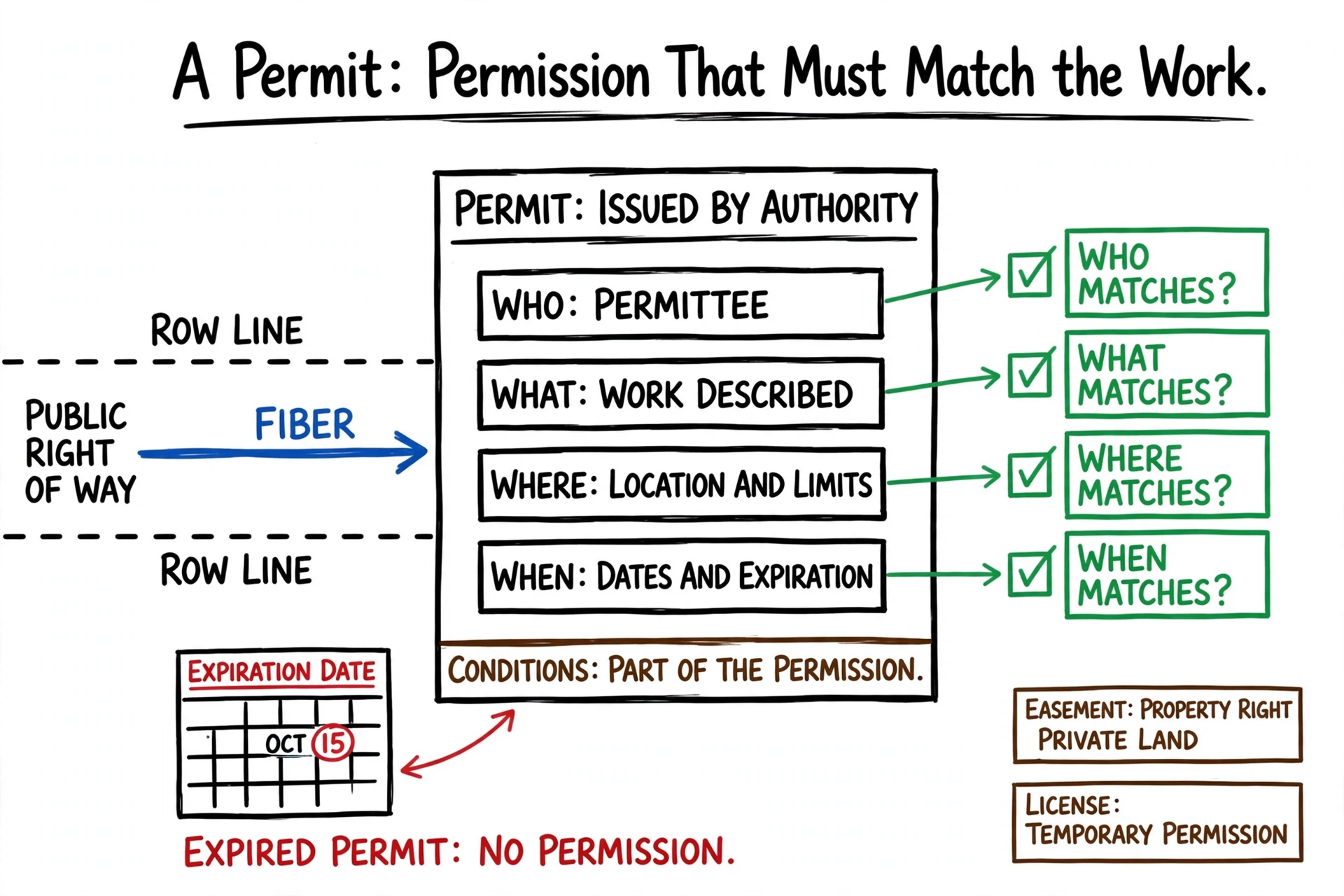
- It names who, what, where, and when. A useful permit identifies the permittee, describes the work and the facility to be installed or maintained, identifies the location, and states when the permission begins and ends or when it expires. If any of those four elements does not match the work in front of you, you have found a question to raise, and it deserves raising before work starts.
- It is limited. A permit is not a general right to occupy land forever. It covers the scope it describes. Work outside that scope, such as a different method, a different alignment, an added road crossing, or work after the expiration date, needs to be checked against the permit language and, where required, covered by an amendment, an extension, or a new permit through the issuing authority’s process.
- It carries conditions that bind the work. Typical condition topics include how the work must be performed, how traffic must be controlled, how the site must be restored, what notices must be given before starting, what inspections apply, and who is responsible for damage or liability. The specific conditions for a job are the ones written on that permit and in any general provisions it incorporates. No universal condition list replaces reading the actual document.
- It is not ownership and it is not an easement. Confusing a permit with a property right leads to serious errors, so the full comparison sits in Where Does It Fit below. In short: an easement is a property interest in land that generally continues until it expires or is legally terminated and, for many easements, runs with the land when ownership changes. A license is personal permission to use land that generally creates no property interest and is usually revocable. A permit is official permission from an authority under its rules. A permit does not transfer ownership of the land, and it does not by itself create a permanent property right to keep facilities in place. Long term rights to occupy private land are normally handled through easements or other recorded agreements, handled by qualified people, rather than through a construction permit alone. The exact legal effect of any of these instruments in a given state, including revocability, transferability, and recording requirements, is governed by that state’s law and the document’s own language.
- It is not the contract, the print, or the specification. Those documents were covered in earlier lessons in this level. The print shows the work. The specification states quality and method requirements in the contract. The permit states the authority’s permission and its conditions. A job normally needs all of them to agree. If they conflict, for example if the print shows a route outside the location the permit describes, the conflict is raised through the job process. A crew does not resolve it by choosing the document it prefers.
One more use of the same word needs separating now, because it appears on fiber jobs. A safety permit, such as an OSHA permit required confined space entry permit, is not a right of way permission at all. It is a workplace safety document that authorizes entry into a specific hazardous space under a safety program, for a stated task and period, with stated precautions. OSHA describes permit required confined spaces as spaces that may contain a hazardous atmosphere, a material that could engulf an entrant, converging walls or a sloping floor that could trap an entrant, or another serious hazard, and warns workers not to enter without training and without a permit to enter. The word permit is shared. The issuer, purpose, and authority are completely different. Examples in this lesson use permit in the construction and right of way sense unless they say safety permit explicitly.
What Does It Look Like?
Permits do not have one national form. A city encroachment permit, a state department of transportation utility permit, and a county highway permit will look different, because each authority uses its own form and its own general provisions. The reading skill is to find the same core elements on any form. Look for these elements.
- A title and permit type. The heading names the kind of permission, such as utility permit, encroachment permit, right of way permit, or construction permit. An encroachment is work or a facility that occupies, crosses, or is placed in, on, over, or under a public right of way. City guidance states this plainly: Houston describes encroachments as private uses into, upon, over, or under the city right of way, including utilities, cables, and conduits. Pittsburgh describes an encroachment permit as allowing a privately owned and maintained item or facility to occupy the public right of way. When you see encroachment permit on a fiber job, read it as permission to occupy or work in the right of way, under that city’s rules.
- A permit number and issue date. The number is how the authority, the inspector, and the job file refer to this exact permission. The issue date starts the clock for any validity period the permit states. Record both exactly. Similar numbers on different permits are different permits.
- The issuing authority and a contact or office. The document names who issued it, often a specific district, county, or city office. That office is the source for questions, notices, inspections, and extension requests under its process. A permit from one city does not authorize work in the next city, even on the same continuous route.
- The permittee name and address. Check that the name matches the owner or contractor who is supposed to do the work under the contract. Maryland State Highway Administration utility permit general provisions, for example, state that the administration issues utility permits only to companies, local governments, and municipalities it has approved as authorized public utilities, and that the permittee shall not perform work in its rights of way without a complete authorized utility permit for each location. That is one state system and its rule. The general lesson is broader: permits are issued to a named party for a location, and they are not issued to whoever arrives at the site.
- A description and location of the work. This may include a street or highway name, route limits, stationing or milepoints, a map or plan attachment, the type of installation, and whether the work is aerial, underground, a crossing, or a longitudinal run along the road. Longitudinal means running along the direction of the road within its right of way. A crossing means passing across the road or right of way. Federal and state accommodation policies treat crossings and longitudinal installations differently in some places, so the distinction on the permit matters.
- Dates: effective date, expiration date, and any start or completion deadlines. Many permits expire if work has not started by a stated date, or if work is not completed by a stated date. Two labeled examples show how local this is. One county code found in research provides that a utility permit is valid for a period not to exceed 90 days from issuance and expires if the work has not been initiated, with an extension possible on written request to the county engineer. A Los Angeles County express utility permit guideline provides that the permit expires if work has not commenced within 60 days of issuance, and that a 60 day extension may be granted if the permittee requests it in writing before the expiration date. Those numbers belong to those jurisdictions only. The only expiration date that governs your work is the one on your permit and in its governing provisions.
- Conditions, general provisions, and attachments. Many permits are issued in two parts: a short individual permit for the specific work, plus a longer set of general provisions that applies to all permits of that type from that authority. Maryland uses exactly that structure: Part 1 is the utility permit general provisions, and Part 2 is the individual work order permit, and together they form the complete authorized permit. Delaware regulations show a related pattern, requiring an executed master franchise agreement or an approved use and occupancy agreement in advance of utility permit applications in DelDOT maintained right of way. Read both parts. Reading only the one page approval and skipping the general provisions is a common and avoidable error.
- Signatures, acknowledgment, and approval stamps. The permit may require the permittee to sign and return an acknowledgment that it accepts the terms and conditions. Learn to distinguish four states of paper: an application submitted, a permit issued, a permit acknowledged or accepted where required, and a permit closed after inspection and acceptance of restoration. An unsigned draft, an application form, or an approval for a different phase is not the same as an issued permit. Only the issued permit, read with its provisions, authorizes the work it describes.
- Insurance, bond, and fee references, where the authority requires them. Some authorities require insurance certificates, bonds, or fees as part of issuance. The amounts and requirements are set by that authority and that permit. This lesson states no fee, bond, or insurance amount as a general rule, because no such universal amount exists. If a field copy references an attachment you do not have, note it as missing and obtain it through the job process.
Finally, note where the permit lives during work. Many permit provisions require a copy of the permit to be kept at the work site and made available to inspectors and contractors on request. Whether that requirement applies to your job is stated in your permit and its provisions. As a field habit, know where the current copy for your segment is kept, and check that it is the current version, including any extension or amendment.
What Does It Do?
A permit does five jobs on a fiber project.
- It authorizes. It is the authority’s written yes for described work in a described place. Without that yes, work in a public right of way or on controlled land may be unauthorized even if the design is sound, the crew is ready, and the customer wants the work done. Federal policy frames the reason: the Federal Highway Administration has determined that accommodating utilities in highway right of way is in the public interest, and at the same time the manner in which utilities cross or occupy the right of way can materially affect the highway, its safe operation, its appearance, and its maintenance. Authorization with conditions is how both interests are protected.
- It defines the allowed scope and method limits. State accommodation policies required under 23 CFR 645.211 must address, among other things, location requirements and clearances for utilities, installation specifications and methods, preservation and restoration of highway facilities and natural features, limits on activities in the right of way, and measures to protect traffic during and after installation, including traffic control plans and protection of open excavations. A permit issued under such a policy carries those controls down to the specific job. The permit tells the reader that work may proceed, and it also tells the reader within what boundaries.
- It coordinates competing uses of the same space. A road corridor carries traffic, drainage, and many buried and aerial utilities at once. The permit process lets the authority check a proposed fiber installation against the highway plans, other utilities, access control, and future road work before ground is disturbed. Delaware regulations, for example, require permit submissions to be coordinated with the state utility section when there are proposed or active highway construction projects in the vicinity, to ensure no conflicts. Coordination before construction is far cheaper than conflict during construction.
- It assigns responsibility. The permit names who is responsible for performing the work to the conditions, for traffic control, for restoration, for notices and inspections, and in many provisions for liability arising from the work. When something is damaged or a road surface fails after construction, the permit and its provisions are among the first documents the parties read to determine who accepted which obligation.
- It creates a record and a closeout path. The permit number, inspections, and final acceptance connect the installed facility to an authorized location. Many authorities close a permit only after a field review and acceptance of restoration. That record matters years later, when the fiber owner needs to maintain, relocate, or prove the basis on which its facility occupies the corridor.
A permit leaves three things undone, and stating them prevents common misunderstandings.
- It does not guarantee that no other utility is present, so it never replaces locating and exposing requirements under applicable law and job process.
- It does not approve the engineering design for the fiber network itself, except to the extent the authority review states.
- It does not waive any other law or permission. A right of way permit does not replace an easement needed on private land, an environmental authorization where one is required, a railroad agreement where one is required, or a safety program where one is required. Each permission covers its own ground. Whether a specific activity needs a permit, a franchise, a license, or a use and occupancy agreement in a given corridor is set by state law and the authority system for that corridor, and it is verified with that authority.
Where Does It Fit?
A permit sits between design and construction in the life of a job, and it stays active through construction and closeout.
Before the permit comes route design and rights research. Designers draw the proposed route on the construction prints. Researchers determine, segment by segment, whose land or right of way the route occupies, what existing rights the fiber owner already holds, and what new permissions are needed. On private land, the needed instrument is often an easement negotiated with the landowner and recorded. In a public road right of way, the needed instrument is often a permit, a franchise, a license, or a use and occupancy agreement, depending on state law and the authority’s system. The three instruments from the basics return here in practical form.
- An easement gives a limited property interest to use another person’s land for a stated purpose, such as installing and maintaining a utility line across a parcel. Easements are generally intended to be durable, often permanent unless the document states a term or a termination event, and appurtenant easements generally pass with the land they benefit. Obtaining, amending, or interpreting an easement is legal work for qualified people, and it is never a field decision.
- A license gives personal permission to use land for a limited purpose, generally without creating a property interest, and it is usually revocable under its terms. Temporary construction access is a common license situation. A license can be the right tool for short, temporary use. It is a weak foundation for a permanent facility that must remain and be maintained for decades, which is why permanent private land occupation is normally analyzed as an easement question.
- A permit gives official permission under an authority’s rules for work the authority controls, most often in a public right of way. It is the authority’s tool for managing public space. It is limited to its scope and term, and it can include conditions, inspections, and expiration.
Do not use the words interchangeably in job records. Writing license when the document is a permit, or easement when no easement exists, creates a false record of rights the project may not hold.
During application, the applicant submits the plans, locations, methods, traffic control information, and other material the authority requires. The authority reviews, may request changes, and then issues, issues with conditions, or denies. Under 23 CFR 645.211, a state transportation department may deny a utility request to occupy highway right of way based on state law, regulation, or ordinance, or on the department’s own accommodation policy. Denial and conditioning are built into the system. Construction scheduling that assumes every permit will issue on the first request, in the first form requested, is scheduling built on hope.
During construction, the permit is a daily control document alongside the print and the specification. The foreman checks that the segment being built is the segment the permit describes, that the date is within the permit term, that required notices have been given, that traffic control matches the approved approach, and that conditions affecting that day’s work are being followed. Inspectors for the authority may visit, compare work with the permit, and require correction of work that departs from it.
After construction comes restoration, inspection, and closeout. The permittee completes restoration required by the conditions, notifies the authority where required, and supports final inspection. The authority accepts and closes the permit, or lists items to correct. The closed permit, the as built records, and any easements form the rights record for the segment. Future maintenance work may need a new permit, a blanket permit, or only a notice, depending entirely on the authority’s system and the kind of work. Never assume that the construction permit automatically covers all future work forever. Check the provisions.
Across a long route, permits multiply. One route may need a state DOT permit for a state highway segment, city permits for city streets, a county permit for a county road, a railroad crossing agreement for a rail crossing, and easements for private parcels between roads. Each segment stands on its own permission. A crew can be fully authorized on one side of an intersection and unauthorized on the other side if the jurisdiction changes there. Reading the permit location description against the print, segment by segment, is how that trap is avoided.
What Is at Stake
- Legality and stop work risk. Work performed without a required permit, outside a permit scope, or after expiration can be stopped, can be required to be removed or redone, and can expose the owner and contractor to enforcement, fines, or liability under the governing law and provisions. The exact consequences are set by the jurisdiction and the permit terms, so this lesson lists no penalties as universal facts. The field lesson holds everywhere: unauthorized work puts the whole segment at risk, including work that was built correctly in every technical respect.
- Safety and the traveling public. Permit conditions on traffic control, open excavation protection, location, and restoration exist because work in a road corridor affects people who never agreed to be part of the project: drivers, cyclists, pedestrians, and neighboring utilities. Federal accommodation policy puts highway and traffic safety first among its considerations, while still recognizing that utilities provide an essential public service and traditionally use road right of way to deliver it. A permit is where that balance is written for a specific place. Treating conditions as paperwork separates the permission from the reasons it was granted.
- Cost and schedule. A missing permit discovered after mobilization idles crews and equipment. A permit that expires mid segment can halt work until an extension is issued, and extensions are requests rather than entitlements: they are granted, if at all, under the authority’s process and timing. A permit condition that requires a specific restoration or a specific work window changes the cost of the job. Reading permits during planning, while costs and dates can still be managed, is how those costs and dates become visible.
- The long term right to be there. A fiber facility is a long lived asset. The owner will need to enter, maintain, repair, and sometimes relocate it. The quality of the original rights record, permits for public right of way, easements for private land, and agreements for crossings, determines whether that future work starts from a clear documented basis or from an argument about what was allowed decades earlier. Careful permit reading today is asset protection for the life of the network.
- Professional trust. Authorities issue permits to parties they can rely on to follow conditions, restore the corridor, and communicate. Owners and contractors who repeatedly work outside permits damage their standing with the very offices they will need on the next route. A reader who can find, read, and respect a permit is protecting the project’s ability to get the next permit.
What Does Good Look Like?
- The permit is in hand before mobilization for the segment. The issued permit, its general provisions, and all attachments and amendments are in the job file and, where required, at the site. Nobody is working from an application receipt, a verbal assurance, or a permit for a neighboring segment.
- The four matches are checked and can be stated out loud. Who: the permittee matches the party performing or directing the work under the contract. What: the described work and method match the work planned. Where: the location description and attached plans match the print segment being built. When: the current date falls within the permit effective period, and any start, notice, and completion deadlines are known and scheduled.
- Conditions are converted into a checklist, with prose left behind. Each condition that affects field work, such as notice periods, inspection points, traffic control, work hours or windows where stated, restoration requirements, and site copy requirements, appears on the segment plan with an owner and a date. A condition nobody was assigned to meet is a condition likely to be missed.
- The permit is read together with the print, the specification, and the rights record. The route on the print falls inside the location the permit describes. Any private parcel segment is supported by its easement or other agreement, and nobody assumes the road permit covers it. Any conflict among documents is written down and raised before construction reaches it.
- Expiration is tracked on a calendar, with advance warning for each permit. Any extension request goes through the authority’s process before expiration, with the justification and lead time that authority requires. Work is never scheduled on the assumption that an extension will be granted.
- Changes trigger a permit question automatically. If the route moves, the method changes, a crossing is added, or the schedule slips past the term, the first question asked is whether the existing permit still covers the revised work. That question is answered from the permit language and, where needed, by the issuing authority.
- Closeout is completed and filed. Restoration is inspected, corrections are finished, the permit is closed where the authority’s process provides for closure, and the closed permit is filed with the segment’s as built records and easements, so a future reader can reconstruct exactly what was authorized.
From the Field
Picture a fiber project that runs buried conduit along a state highway, turns onto a county road, and crosses one private parcel to reach a cabinet site. The job file holds three permissions: a state DOT utility permit for the highway segment, a county permit for the county road segment, and a recorded easement for the private parcel. Each document covers only its own piece of the route.
Before mobilization, the project coordinator builds a one page permit map. For each segment the map lists the instrument type, the permit or document number, the permittee, the location limits, the expiration date, and the conditions that affect field work. Two problems appear while the map is still on paper.
The first problem is a date. The county permit states that it expires if work has not been initiated by a date that has become difficult to meet, because the highway segment is scheduled to take longer than planned. The coordinator does not assume an extension. The date goes to the permitting lead, who submits a written extension request to the county office through its process, before expiration, with the revised schedule. The county’s written response is filed with the permit, and the schedule is built on that written response.
The second problem is a boundary. Where the route leaves the county road and enters the private parcel, the print shows a handhole just inside the parcel line. The county permit’s location description ends at the right of way line, as expected. The easement covers the conduit run across the parcel and the cabinet site, and it describes access for installation and maintenance of the conduit line. Reading the easement closely, the coordinator notices it does not clearly mention a handhole at that location. The coordinator does not decide what the easement allows. A written question, citing the print sheet, the permit limit, and the easement language, goes to the project lead and to the qualified person who handles land rights for the project. The handhole location is resolved through that process before construction reaches the parcel.
When the crew mobilizes, the foreman carries the permit map with the prints. On the state highway segment, the crew works under the state permit’s conditions, including its notice and traffic control requirements. At the county line, the foreman can point to where one permit ends and the next begins. No segment is built on a neighboring segment’s permission, no work is scheduled past an expiration date, and no field decision is made about what an easement means.
Three different instruments, three different issuers or grantors, three different limits, read together before mobilization, turned two authorization failures into paperwork questions while paperwork could still fix them. The coordinator performed no legal interpretation and no construction work in this story, only reading, comparing, documenting, and raising questions, which is exactly the role this lesson teaches.
The rule to carry: map every segment to its own permission before mobilization, and treat any date or boundary that does not match as a written question for the people who own permitting, raised while the answer can still change the plan.
What Can Go Wrong?
- The no permit error. Work starts in a right of way or on controlled land with no issued permit at all, often because the segment looked like a continuation of a permitted segment. Jurisdictions change at city limits, at road ownership changes, and at rail and water crossings, sometimes in the middle of a route that looks continuous on the ground. Looks do not confer permission.
- The wrong permittee error. Work proceeds under a permit issued to a different company or owner. Permits name a permittee, and some authorities issue only to approved parties. A subcontractor who assumes the prime contractor’s permit automatically covers every party and every location, without checking the provisions and the contract, may be working outside the permission.
- The scope creep error. The crew builds more or differently than the permit describes: a longer run, an added handhole location, a changed crossing method, or an extra facility. Each addition may be sound engineering and still be unauthorized work if the permit does not describe it. Scope changes go through the permit process as well as the design process.
- The expired permit error. Work continues after the expiration date, or starts after a start by date has passed, because the crew had a copy of the permit and the copy still looked official. Paper does not expire visibly. Dates must be read and tracked. Extensions, where the system allows them, must be requested and issued, and work performed while expired is not cured retroactively by a later extension unless the authority states so in writing.
- The general provisions error. The crew reads only the approval page. In two part systems, the binding conditions live in the general provisions, the franchise or occupancy agreement, and the attachments. A crew can satisfy every line on the one page permit and violate the permit as a whole by missing a notice, inspection, or restoration requirement stated in provisions it never opened.
- The permit equals easement error. A road permit gets treated as if it granted rights across the private land the route also crosses, or a private easement gets treated as if it authorized work in the public road. Each instrument covers its own ground. A route is authorized only where each segment’s permission, of the correct type, is actually in place.
- The permit equals safety error. This one runs in both directions. A right of way permit gets treated as a safety authorization, which it never is: it qualifies nobody for excavation, boring, confined space entry, or any other hazardous activity. In the reverse direction, a safety entry permit, specific to a space, a task, and a shift or period under a safety program, gets treated as if it had something to do with land rights. Keep the two permit families separate in speech and in records.
- The restoration shortcut error. The corridor is left in worse condition than the conditions require, or final notice and inspection are skipped, so the permit cannot close. Unclosed permits and failed restoration follow the permittee into future applications and future disputes about damage the project did not cause and cannot prove it did not cause, because the closeout record was never completed.
- The assumed number error. A fee, an issuance timeline, a validity period, a depth, or a clearance gets imported from another jurisdiction or another job. How long issuance takes, what it costs, what location or clearance is required, and how long a permit lasts are all set locally by the authority, its published policy, and the permit itself. A reader who carries numbers between jobs without verification will eventually build a plan, a budget, or a bore path on a rule that does not exist where the work is happening.
What Should Someone Notice in the Field?
You may be handed a permit packet at a preconstruction meeting, find a copy in a job trailer, or be asked by an inspector to produce the permit for the segment you are standing on. Work through these checks in order. This is a recognition checklist. It helps you spot a problem early and raise it to the qualified people who own permitting for the job.
- Identify the document. State the permit type, the permit number, the issuing authority, and the issue date. Confirm you are holding an issued permit, and check that it is not an application, a draft, or a receipt. If general provisions or attachments are referenced, confirm they are present. A packet that references missing attachments is incomplete, and that gap is worth reporting before work starts.
- Check the permittee. Read the named permittee and compare it with the owner and contractor structure for the job as you understand it from the contract documents. If the name is unfamiliar, or belongs to a party no longer on the job, raise it. Do not decide on your own that the difference does not matter.
- Walk the location on paper. Compare the permit location description, limits, and attached plans with the construction print for the segment. Mark where the permit coverage appears to start and stop, and note any print segment that falls outside the described limits, especially at jurisdiction boundaries, road crossings, rail crossings, and private parcels. A segment with no matching permission is a stop and ask item.
- Read the dates early. Find the effective date, any start by requirement, the expiration date, and any completion deadline. Compare them with today’s date and with the planned schedule for the segment. If work is planned near or past expiration, flag it immediately, because extension lead time belongs to the authority.
- Extract the conditions that touch the field. Notice requirements before starting, inspection contacts, traffic control requirements, allowed work windows where stated, protection of the road and drainage, restoration standards, and whether a copy must be kept on site. Turn each one into a plain question: has this been done, is this scheduled, who owns it. If you cannot answer, the condition is not yet under control.
- Separate the permissions at boundaries. At each place the route leaves the public right of way, enters private land, crosses a railroad, or crosses water, ask which instrument covers that piece: permit, easement, license, crossing agreement, or another authorization required by law. If the answer is a shrug, that boundary needs work before the crew reaches it.
- Keep the safety boundary visible. A valid right of way permit in the truck does not make an excavation safe, does not authorize a bore under safety rules, and does not permit a vault entry in the OSHA sense. Safety permits, competent person duties, locating, and qualifications are separate systems with separate documents. Notice when a conversation mixes them, and separate the questions again: land and road permission in one column, worker safety authorization in the other.
- Know what to do when something does not match. Stop the affected work, keep people and the public safe under the job safety process, document what you found with the permit number and the exact language or date involved, and notify the project lead promptly. Do not contact an authority to renegotiate a permit, do not promise an inspector a fix outside your authority, and do not quietly adjust the route to fit the permit. Those decisions belong to the designated permitting and project leadership for the job.
- Safety boundary. Recognizing that a permit exists and appears to cover work is a reading skill. Determining that a project is legally permitted, in all respects and in all jurisdictions it crosses, is a responsibility assigned by the job to qualified people with the full record. The work a permit describes may involve excavation, boring, aerial work, work near traffic, work near other utilities, or entry into structures, each governed by its own laws, regulations, qualifications, and job safety process. This lesson qualifies you for none of that work. If you are not qualified and authorized for an activity, do not perform it, and raise the question through the job process.
Key Terms
- Permit: official written permission from an authority to do a specific activity, at a specific place, for a limited time, under stated conditions.
- Issuing authority: the government body, agency, or owner with legal power to allow or deny the activity in that place, such as a city, a county, a state department of transportation, or a federal agency for land it controls.
- Permittee: the person, company, or agency named on a permit as the party who receives the permission and accepts its conditions.
- Right of way (ROW): land set aside for transportation or utility use, including the road surface and the associated shoulders, ditches, and space above and below, with boundaries shown on plats, plans, and records for that road.
- Encroachment permit: a permit that allows a privately owned facility or work to occupy, cross, or be placed in, on, over, or under a public right of way, under the rules of the authority that controls that right of way. Many city and county systems use this name for utility work in their streets.
- Utility permit: a permit issued by a highway or public works authority for installation, relocation, maintenance, or removal of a utility facility in its right of way, often issued with a set of general provisions that forms part of the complete permit.
- General provisions: the standard conditions that apply to all permits of a given type from an authority, incorporated into each individual permit. Together with the individual permit, they state the full terms.
- Easement: a limited property interest to use another person’s land for a stated purpose, such as installing and maintaining a utility line. Easements generally continue until they expire or are legally terminated, and many run with the land when ownership changes.
- License: personal permission to use land for a limited purpose that generally creates no property interest and is usually revocable under its terms. Often suited to temporary uses such as short term construction access.
- Condition: a requirement attached to a permit, such as a notice, an inspection, a traffic control measure, or a restoration standard. Compliance with conditions is part of the permission.
- Expiration and extension: expiration is the end of a permit’s validity, by its stated date or by a stated event such as failure to start work in time. An extension is a written continuation granted by the issuing authority under its process, requested before expiration where its rules require it.
- Safety permit (permit required confined space): in OSHA usage, a workplace safety authorization for entry into a confined space that has or may have a hazardous atmosphere, an engulfment material, a trapping configuration, or another serious hazard. It is unrelated to land or right of way permission. The governing standards are 29 CFR 1910.146 for general industry and 29 CFR Part 1926 Subpart AA for construction, and the employer’s safety program for the job controls entry decisions.
Check Your Understanding
- Define a permit for construction work in a public right of way, and name the four elements that must match the work in front of you.
- What is the difference between a permit, an easement, and a license, and why does the difference matter for a permanent fiber facility on private land?
- A crew holds a one page issued permit. The permit references a set of general provisions that nobody on the job has opened. Why is the job file incomplete, and what kinds of requirements might the crew be missing?
- In From the Field, the coordinator finds two problems on paper: a county permit expiration date the schedule can no longer meet, and an easement that does not clearly mention the handhole the print shows on the parcel. What does the coordinator do about each one, and what does the coordinator refuse to do?
- An inspector asks whether the vault entry planned for tomorrow is permitted. The foreman holds up the right of way permit. Explain the confusion, and name the separate system that governs the entry question.
Answer key
- A permit is official written permission from an authority to do a specific activity, at a specific place, for a limited time, under stated conditions. The four elements are who, the named permittee; what, the described work and facility; where, the described location and limits; and when, the effective period and any start and completion deadlines. If any element does not match the planned work, the mismatch is raised through the job process before work proceeds.
- A permit is official permission from an authority under its rules, limited to its scope and term, and it does not transfer ownership or by itself create a permanent property right. An easement is a limited property interest in another person’s land for a stated purpose that generally continues until it expires or is legally terminated and often runs with the land. A license is personal permission that generally creates no property interest and is usually revocable. For a permanent facility on private land, the owner normally needs a durable property right that survives changes in land ownership and allows future maintenance, which is an easement question for qualified people. Building a permanent line on a revocable license, or on a road permit that does not cover the parcel, leaves the facility without a secure basis.
- In many systems the individual permit and the general provisions together form the complete permit. The provisions carry binding conditions on matters such as notices before starting, inspections, traffic control, installation and restoration standards, liability, and closeout. A crew that reads only the approval page can satisfy every line it has seen and still violate the permit as a whole. The file is complete only when the issued permit, its provisions, attachments, and any amendments or extensions are present and read together.
- For the date, the coordinator flags it to the permitting lead, who submits a written extension request to the county office through its process before expiration, with the revised schedule, and the schedule is then built on the county’s written response. For the handhole, the coordinator raises a written question, citing the print sheet, the county permit’s limit at the right of way line, and the easement language, to the project lead and the qualified land rights person, and the location is resolved before construction reaches the parcel. In both cases the coordinator refuses to decide alone: no assumed extension, and no personal interpretation of what the easement allows.
- The foreman is mixing two different permit families that share one word. The right of way permit authorizes described construction work in the corridor under the road authority’s rules. It says nothing about whether entry into a confined space is safe or authorized. Entry into a permit required confined space is governed by the applicable OSHA confined space standard and the employer’s safety program, with its own entry permit, training, attendant, testing, and rescue requirements, carried out by qualified and authorized people. Both questions must be answered by their own documents before the work proceeds.
Lesson Takeaway
A permit is official written permission to do specific work, in a specific place, for a limited time, under stated conditions, issued by the authority that controls that place to a named permittee. Read every permit for its four matches, who, what, where, and when, and then read its conditions and general provisions as part of the permission itself. Keep the neighboring instruments separate: an easement is a durable property interest for private land, a license is generally revocable personal permission suited to temporary use, and an OSHA safety permit is a workplace entry authorization that has nothing to do with land rights. Track expiration dates before they arrive, treat extensions as written grants and never as assumptions, and check every route segment and boundary for its own permission, because a permit for one segment covers no other segment. Reading a permit well qualifies you to recognize whether work appears to be covered and to raise exact, cited questions early. It does not qualify you to issue, interpret, or negotiate a permit as a legal matter, and it does not qualify you to perform the construction the permit describes.
Sources and Technical References
- Federal Highway Administration, Utility Accommodation and Other Uses of Highway Right of Way memorandum, June 28, 2017: 23 CFR Part 645 broadly addresses utility accommodation, accommodations must be consistent with federal, state, and local laws, the manner in which utilities occupy right of way can materially affect the highway and its safe operation, and non highway use of right of way requires agreement and public interest and safety determinations: https://www.fhwa.dot.gov/utilities/170628.cfm
- 23 CFR 645.211, State transportation department accommodation policies, via FindLaw: state policies must address location requirements and clearances, installation specifications and methods, preservation and restoration, limits on activities in the right of way, and traffic protection measures including traffic control plans and protection of open excavations, and files must contain evidence of written arrangements for utility occupation of highway right of way: https://codes.findlaw.com/cfr/title-23-highways/cfr-sect-23-645-211/
- Maryland Department of Transportation State Highway Administration, Utility Permit General Provisions: permits are issued only to approved authorized public utilities, a complete authorized utility permit consists of Part 1 general provisions plus Part 2 individual work order permits, and the permittee shall not perform work in SHA rights of way without a complete permit for each location: https://roads.maryland.gov/OOC/2025_MDOT_SHA_Utility_Permit_General_Provisions_(10-09-25).pdf
- Delaware Administrative Code, 2 Del. Admin. Code 2401-5.0, Administration of Utility Permits, via Cornell Law Institute: an executed master franchise agreement or DelDOT approved use and occupancy agreement is required in advance of utility permit applications in DelDOT maintained right of way, and permit submissions for work near DelDOT highway projects must be coordinated to avoid conflicts: https://www.law.cornell.edu/regulations/delaware/2-Del-Admin-Code-SS-2401-5.0
- City of Houston, Encroachment Permit, Houston Permitting Center: encroachments are defined as private uses into, upon, over, or under the city right of way, including utilities, cables, and conduits: https://www.houstonpermittingcenter.org/hpwoce1006
- City of Pittsburgh, Encroachment Permit: an encroachment permit allows a privately owned and maintained item or facility to occupy the public right of way: https://www.pittsburghpa.gov/Business-Development/Mobility-and-Infrastructure/Right-of-Way-Management/Encroachment-Permit
- Will County Code, Section 56.101, Utility or Facility Permit, via American Legal Publishing: used in this lesson as one jurisdiction example only, providing that a permit is required for utility work in a county highway right of way, that a permit there is valid for a period not to exceed 90 days and expires if work has not been initiated, and that the county engineer may extend it on written request. This is not a universal timeline: https://codelibrary.amlegal.com/codes/willcounty/latest/willcounty_il/0-0-0-47494
- Los Angeles County Department of Public Works, Land Development Division, Guidelines for Express Utility Permit, section E: an express utility permit there expires if work has not commenced within 60 days of issuance, and a 60 day extension may be granted on written request made before expiration. Used in this lesson as one jurisdiction example only; this is not a universal timeline: https://dpw.lacounty.gov/ldd/lib/forms/Guidelines/Road/Express Utility Permit Guidelines.pdf
- OSHA, Permit Required Confined Spaces fact sheet: a confined space has limited openings, is large enough for entry and work, and is not designed for continuous occupancy, and a permit required confined space may contain a hazardous atmosphere, an engulfment material, converging walls or a tapering floor, or another serious hazard, and workers must not enter without training and a permit to enter: https://www.osha.gov/sites/default/files/publications/confined_space_permit.pdf
- OSHA, 29 CFR 1910.146, Permit Required Confined Spaces (general industry), and 29 CFR Part 1926 Subpart AA, Confined Spaces in Construction: the governing standards behind the safety permit discussion in this lesson: https://www.osha.gov/laws-regs/regulations/standardnumber/1910/1910.146
- Stryker and Slev, Easement, License, Variance, Permit: What the Terms Mean: an easement is a right to use another person’s land for a specific purpose and is a nonpossessory interest that is generally permanent and goes with the land, a license allows use for a specific purpose without assigning the land or making the use permanent, and a permit is official permission from a municipality to use or develop land: https://strykerslev.com/easement-license-variance-permit-what-the-terms-mean/
- UpCounsel, License vs Easement: Key Property Rights Compared: an easement creates a nonpossessory property interest, a license generally gives personal permission without conveying an interest in the land, licenses are usually revocable while easements typically continue until they expire or are legally terminated, and long term utility routes often call for easement analysis while temporary construction access may suit a license: http://www.upcounsel.com/difference-between-license-and-easement
Graphic Briefs
Graphic Brief 1: Main Illustration
Whiteboard style: white background, hand-drawn marker lines, black, blue, green, red, and brown markers only, minimal labels, clear arrows, plenty of white space, accurate relationships, no decoration. This graphic teaches a permit as limited written permission that must match the work on four points: who, what, where, and when, plus its conditions.
Graphic title: “A Permit: Permission That Must Match the Work”
Main objects: in the center, one large permit document drawn in black marker, shown as a single page with a header band, four stacked field boxes in the middle, and a conditions band at the bottom. To the left of the document, draw one simple road corridor strip in brown and black marker, viewed from above, with a road band, a shoulder, and a right of way boundary line on each side drawn as dashed black lines. Inside the corridor, draw one blue fiber line running along the corridor. To the right of the document, draw four small checklist boxes in green marker, stacked vertically. Below the document, draw one simple calendar page in black marker with one date circled in red. In the lower right, draw two small separate document outlines, one labeled as an easement and one as a license, kept clearly separate from the main permit document, with white space between them.
Placement: the title sits at the top center. The permit document sits in the center and is the largest object. The road corridor strip sits to the left of the document at the same height. The four checklist boxes sit to the right of the document, aligned with the four field boxes. The calendar sits below the document. The easement and license outlines sit in the lower right, smaller than the permit, with a clear gap showing they are different documents. Labels sit next to the objects they name, with white space around every group.
Labels: label the document header “PERMIT: ISSUED BY AUTHORITY”. Label the four field boxes, top to bottom: “WHO: PERMITTEE”, “WHAT: WORK DESCRIBED”, “WHERE: LOCATION AND LIMITS”, “WHEN: DATES AND EXPIRATION”. Label the bottom band “CONDITIONS: PART OF THE PERMISSION”. Label the corridor “PUBLIC RIGHT OF WAY” and label its dashed lines “ROW LINE”. Label the blue line “FIBER”. Label the four checklist boxes, top to bottom: “WHO MATCHES?”, “WHAT MATCHES?”, “WHERE MATCHES?”, “WHEN MATCHES?”. Label the calendar “EXPIRATION DATE”. Label the two small documents “EASEMENT: PROPERTY RIGHT, PRIVATE LAND” and “LICENSE: TEMPORARY PERMISSION”. Add one small note under the calendar: “EXPIRED PERMIT: NO PERMISSION”.
Arrows and relationships: draw a thick blue arrow from the fiber line in the corridor to the WHERE field box, showing that the location of the work must match the location the permit describes. Draw four thin green arrows, one from each field box to its matching checklist box, showing that each field is checked against the real work. Draw a thin red arrow from the calendar up to the WHEN field box, showing that the date controls whether the permission is still alive. Draw a thin black double headed arrow between the permit document and the corridor, labeled “AUTHORIZES WORK HERE ONLY”, showing that the permit covers the described corridor segment and no other segment. Draw no arrow between the permit and the easement or license outlines, showing they are separate instruments for separate ground.
Important technical details: show all four match fields, who, what, where, and when, because a permit fails to cover work if any one of them does not match. Show conditions as a band inside the permit document itself, rather than as a separate optional note, because conditions are part of the permission. Show the right of way lines as boundaries and the fiber inside them, because the permit in this graphic is a right of way permission. Show the easement and license as separate, smaller documents with a gap, because they are not the same instrument as a permit. Show no fee, no validity period in days, no depth, and no clearance number anywhere, because those values are set by the issuing authority and the individual permit for each job.
What not to show: do not show any dollar fee, any number of days for validity, any depth, clearance, or dimension presented as a requirement. Do not show people digging, boring, climbing, or entering any structure. Do not show a checkmark or stamp implying a real job is approved. Do not show a courthouse, a gavel, a flag, or legal decoration. Do not draw the permit as covering the private land documents. Do not add vehicles, buildings, trees, or scenery beyond the simple corridor strip.
Key teaching point: a permit is limited written permission from an authority, and it covers work only when who, what, where, and when all match and its conditions are followed, while easements and licenses are different instruments that cover different ground in different ways.
Graphic Brief 2: Added Visual, One Route in Segments
Whiteboard style: white background, hand-drawn marker lines, black, blue, green, red, and brown markers only, minimal labels, clear arrows, plenty of white space, accurate relationships, no decoration. This graphic teaches that a single route crosses several permission boundaries, and each segment stands on its own document.
Graphic title: “One Route, Three Permissions”
Main objects: one horizontal route drawn across the frame in three segments, viewed from above. The left segment is a road corridor strip with a blue fiber line running along it, labeled as a state highway segment. The middle segment is a second road corridor strip in a slightly different road tone, with the same blue fiber line continuing, labeled as a county road segment. The right segment is a plain parcel outline with no road, the blue fiber line crossing it to one small cabinet square at its far edge. Above each segment, draw one document icon sized to match its segment: a permit document above the highway segment, a second permit document with a different number above the county segment, and a document labeled easement above the parcel. At each boundary between segments, draw one vertical red dashed line across the route. On the parcel segment, draw one small handhole square just inside the parcel boundary, with a red question mark beside it.
Placement: the title sits at the top center. The three segments sit in one row at the same height, joined so the fiber line reads as one continuous route. The document icons sit directly above the segments they belong to, aligned with them. The red dashed boundary lines sit exactly at the two joins between segments. Labels sit under each segment and under each document icon, with white space around every group.
Labels: label the left segment “STATE HIGHWAY” and its document “STATE DOT PERMIT”. Label the middle segment “COUNTY ROAD” and its document “COUNTY PERMIT”. Label the right segment “PRIVATE PARCEL” and its document “EASEMENT”. Label the two red dashed lines “PERMISSION CHANGES HERE”. Label the cabinet “CABINET SITE”. Label the handhole “HANDHOLE: NAMED IN THE EASEMENT?” Add one caption under the whole route: “EACH SEGMENT STANDS ON ITS OWN PERMISSION”.
Arrows and relationships: draw one thin blue arrow along the fiber line pointing in the direction of construction, crossing all three segments, showing one continuous route. Draw three thin black arrows, one from each document icon down to its own segment only, showing which document covers which ground. Draw no arrow crossing a red boundary line from any document, showing that no document covers a neighbor’s segment.
Important technical details: the fiber line is continuous while the permissions are not, because that contrast is the teaching point. Each document icon aligns with exactly one segment. The handhole sits inside the parcel, outside both road segments, because the story’s question is whether the easement names it. Show no dates, no fees, no depths, and no clearance numbers anywhere, because those values belong to the actual documents for a real job.
What not to show: do not show one document spanning two segments. Do not show people, vehicles, digging, or boring. Do not show a checkmark implying the handhole question is resolved. Do not add scenery, buildings, or trees beyond the simple corridor strips and the parcel outline.
Key teaching point: a route can look continuous on the ground while its permission is three separate documents with three separate limits, and the boundaries between them are exactly where unauthorized work happens.
Previous lesson: Lesson 85: What Is a Bill of Materials? |
Back to Level 4 hub |
Next lesson: Lesson 87: What Is a Traffic-Control Plan?