
What You Are Learning
By the end of this lesson you will be able to define a bill of materials in plain words. You will be able to describe what one looks like: a structured table of line items, where each line names one material, gives its description and identifying number, and states how much of it the job needs and in what unit it is counted. You will be able to explain where the quantities on a bill of materials come from, which is a count and measurement taken from the construction drawings and specifications for that job. You will be able to tell a bill of materials apart from three documents it is often confused with: a material takeoff, a cost estimate, and a bill of quantities. You will be able to explain what slack and waste allowances are, and why no allowance percentage in this lesson, or in any general guide, is a requirement for your job. You will also be able to explain how the materials planned on the bill of materials are compared at the end of the job with the materials actually installed, a step called as-built reconciliation.
This lesson teaches you to read and recognize a bill of materials in a job packet. It does not qualify you to prepare a bid, to order materials for a real job on your own authority, to approve a substitute material, or to install any material. Ordering, substitution, and installation follow the job process and are done or approved by the people the job assigns to them. When a bill of materials and the drawings disagree, the correct move is to raise the question through the job process, not to pick the answer you prefer.
Start With the Basics
The lessons before this one taught you to read the drawings. A construction print shows where the work goes. A plan sheet shows the route. Symbols, stationing, offsets, and footage tell you what is placed where and how far along the route it sits.
Drawings alone do not put materials on a truck. At some point someone has to turn the drawings into a shopping and staging list: how much cable, how much conduit, how many closures, how many handholes, and exactly which version of each one. That list is the bill of materials.
Think of it as a recipe written for a job instead of a kitchen. A recipe lists each ingredient, how much of it, and in what unit, so the cook does not have to guess from a picture of the finished dish. A bill of materials does the same work for a build. It lists each material the drawings call for, how much of it, and in what unit, so purchasing, the warehouse, and the field crew are all working from the same list instead of guessing from the drawings separately.
Five words need plain definitions before the rest of the lesson builds on them.
A line item is one row of the list. Each line item covers one distinct material. If two cables differ in fiber count, they are two line items, even though both are cable, because they are not interchangeable in the field.
A part number is the identifying number assigned to a specific material. It may be a manufacturer part number, meaning the number the maker uses for that exact product, or an owner or company stock code, meaning the number the owner or the company uses in its own inventory system. Either way, its job is to separate one exact item from similar items that share a general name.
A unit of measure is the unit a quantity is counted in. Common units on an outside plant bill of materials include each, written as EA, for items counted one by one such as a closure or a handhole; linear foot, written as LF, for materials measured by length such as cable, conduit, or strand; and package units such as reel, roll, box, or case, where the job buys the material that way. The unit is part of the quantity. A quantity with no unit, or with the wrong unit, is not a usable quantity.
A takeoff, also called a material takeoff or quantity takeoff, is the process of reading the drawings and specifications and counting and measuring what the job needs: counting discrete items, measuring lengths, and recording each amount. Industry estimating references describe the takeoff as answering what is needed and how much of it is needed, before any price is attached. The bill of materials is built from that takeoff work.
An estimate is a different document. An estimate takes quantities and applies prices, labor, equipment, overhead, and other costs to answer what the job will cost. A bill of materials answers what materials are needed and how much. An estimate answers what the work will cost. Confusing the two is a common beginner mistake, and this lesson returns to it.
Hold one idea before you read further. A bill of materials is only as good as the drawings, specifications, and revision it was built from. It is a derived list, not an original source. When the design changes and the list does not, the list becomes a confident way to order the wrong materials.
What Is It?
A bill of materials, usually shortened to BOM and pronounced as the single word bom, is a structured list of the materials, components, and parts required to build a defined scope of work, with the quantity and unit of measure for each item.
Unpack that definition piece by piece.
It is a list of materials, not a list of work steps. A bill of materials names things: cable, conduit, innerduct, splice closures, terminals, handholes, strand, lashing wire, clamps and hardware, warning tape, markers, and similar physical items, when the drawings for that job call for them. That example set is illustrative only. It is not a required list for every fiber job. An aerial job, an underground job, and a hybrid job that mixes both will carry different materials, and the drawings and specifications for the specific job decide what belongs on its bill of materials. A bill of materials normally does not price labor as a material line. Labor, equipment, and overhead belong to the estimate and the bid, even though a given company form may show material unit costs next to the quantities for pricing support. Read the form in hand to see what that company includes, rather than assuming every bill of materials handles cost the same way.
Each item is identified, not just named. A useful line gives more than a general noun. It gives a description detailed enough to separate the item from its near neighbors, such as fiber count and type for a cable, or size and type for a conduit or a closure, plus the part number or stock code where the job uses one. Two items can both be called splice closure in conversation and be completely different products with different capacities. The description and the number on the line are what prevent that mix up.
Each item carries a quantity and a unit. The quantity states how much of that item this scope needs. The unit states how that amount is counted. Together they tell purchasing what to buy, the warehouse what to stage, and the crew what to expect on the truck or the reel.
It covers a defined scope. A bill of materials may cover a whole project, one segment or release of a project, one work order, or one assembly, depending on how the owner and the company organize their work. The scope must be stated or clearly implied by the packet it travels with: which drawings, which segment, and which revision it belongs to. A list with no stated scope invites the classic error of ordering a whole project twice, once from each of two partial lists that nobody realized overlapped.
It is tied to a revision. Designs change. When drawings are revised, quantities and even whole line items can change with them. A controlled bill of materials carries a date, a revision mark, or both, so a reader can check that the list matches the current drawings. Using an old revision of the list with new drawings, or a new list with old drawings, is a mismatch even if every line on the list looks reasonable by itself.
A bill of materials is not the drawings. It does not show where anything goes, how it is installed, or in what order the work happens. Placement lives on the prints, in the details, and in the splice information covered elsewhere in this level. A bill of materials is not the specifications either. Specifications state the written requirements a material must meet. The bill of materials should agree with both. If it disagrees with either, that disagreement is a conflict to raise, not a tie for the reader to break alone.
A bill of materials is also not a delivery receipt and not a record of what was installed. It states what was planned and ordered for the scope. What actually arrived, what was actually installed, and what was returned are tracked in receiving records, field records, and the as-built reconciliation at closeout, covered later in this lesson. Treating the planned list as proof of what is in the ground is an error this lesson will name again.
What Does It Look Like?
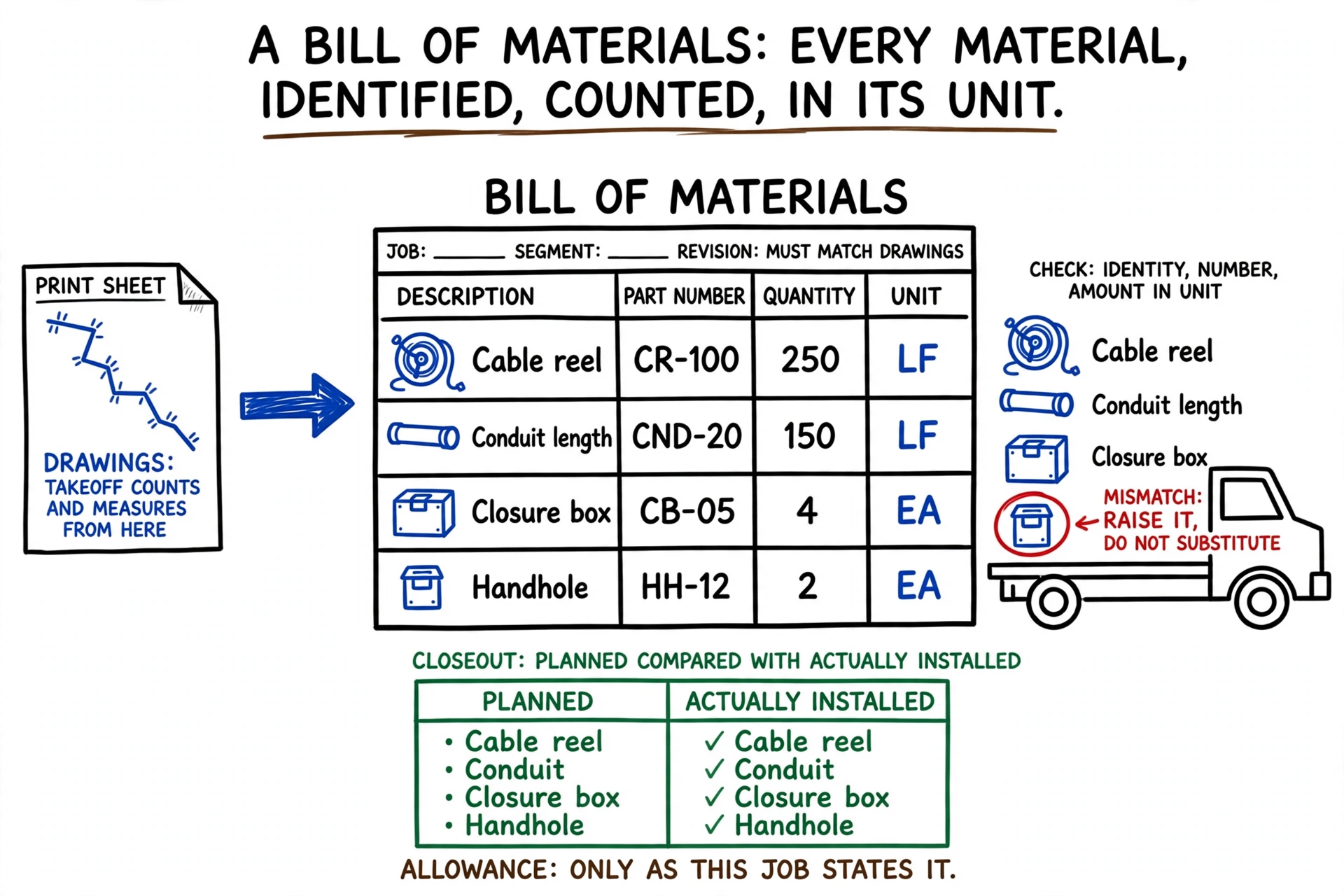
Picture a table, usually a spreadsheet or a printed form in the job packet, with a header block at the top and one row per material below it.
The header block identifies the list itself. Look for the project or job name and number, the segment or work order the list covers, the date, the revision, and who prepared it. Some headers also name the drawing set and revision the quantities were taken from. Read the header first, every time. It is how you know which job, which segment, and which version of the design this list belongs to.
The columns carry the working information. Names vary by company, but a typical bill of materials uses most of the following columns.
Line number. A simple sequence number for the row, so people can refer to line 12 in a phone call or an email without reading a long description out loud.
Item or description. A plain but specific description of the material, detailed enough to separate it from similar items. On a fiber bill of materials this is where fiber count and cable type, conduit size and type, closure type and capacity, or handhole type would be stated, as the job documents define them.
Part number or stock code. The manufacturer part number, the owner stock code, or both, exactly as the ordering system needs them. One wrong character in this column can order a different product that shares a similar name.
Quantity. The amount needed for the stated scope, as a number.
Unit of measure. The unit for that quantity, such as EA for each, LF for linear feet, or a package unit such as reel or box where the job uses one. Confirm the unit on every length line with special care. A quantity stated in feet and a quantity ordered by the reel describe the same cable in completely different counting systems, and converting between them requires the reel information for that product. Do not convert by guessing.
Unit cost and extended cost, on forms that carry them. Some bills of materials include a cost per unit and a line total, which is the quantity multiplied by the unit cost, to support estimating and purchasing. Others are quantity only and leave all pricing to the estimate or the purchase order. Either form is normal. What matters is knowing which form you are holding, so you do not treat a quantity only list as if it were a priced bid, or a priced list as if its prices were current without checking.
Notes or reference column, on many forms. This column may point a line back to the drawing sheet, detail, station range, or specification section it came from. When it is present, it is the fastest way to check a suspicious quantity, because it tells you exactly where to recount it.
Grouping follows the work. Many fiber bills of materials group lines into categories that mirror the construction package, for example aerial materials, underground materials, fiber cable and splicing materials, and hardware or miscellaneous materials. Grouping is an organizing choice by the preparer, not a rule. Its value is practical: a missing category stands out. If the drawings show underground work and the list has no underground group at all, something was likely missed, and that pattern check is one of the most useful quick reads a beginner can do.
At the bottom or in the header, look for allowance lines or notes. Some bills of materials show certain quantities already increased by an allowance for slack or waste, and some show the net quantity and the allowance as separate lines or a separate note. Both presentations exist. The presentation used on your job is set by that job and that company. What you must never do is assume an allowance is included when it is not shown, or assume it is missing and add your own on top of one that is already included. Either mistake changes the order. Read how the list in hand presents it, and ask through the job process when it is not stated.
You may meet the same list in more than one form on the same job: a design bill of materials issued with the drawings, a procurement version used to place orders, and field or warehouse pick lists drawn from it. The names and forms vary by owner and company. The reading habit does not vary: confirm scope, revision, description, quantity, and unit before you rely on any version.
What Does It Do?
A bill of materials does five jobs for a project.
First, it turns drawings into an order. Purchasing cannot buy a plan sheet. It buys line items. The bill of materials is the document a buyer or a supplier works from to quote, order, and deliver the specific products in the specific amounts the scope needs. Industry references on bills of materials and bills of quantities make the same point for construction generally: the materials list supports procurement and inventory control, and once it is finalized and approved it serves as the basis for purchase orders to suppliers and subcontractors. On a fiber job, that is the moment where a wrong part number or a wrong unit stops being a paperwork error and becomes the wrong material on a truck.
Second, it supports the estimate without being the estimate. An estimator starts from quantities. The takeoff produces the quantities, the bill of materials organizes them by material, and the estimate then applies material prices, labor, equipment, and other costs to those quantities. The Fiber Optic Association estimating guidance makes the underlying point that labor is directly tied to material quantities, so a mistake in a material quantity affects the outcome of the bid, not just the material order. A short quantity is therefore two problems at once: the job runs out of material, and the job was priced as if it needed less work than it does.
Third, it lets the warehouse and the field stage and check materials. A crew or a warehouse worker can check a delivery, a pallet, or a reel against the list: is this the item the line describes, is the part number the one on the line, and is the amount the amount the line states, in the unit the line states. That three part check, identity, number, and amount in unit, is the basic receiving habit this document makes possible.
Fourth, it creates a common reference for questions. When a designer, a buyer, an inspector, and a foreman all say line 12, they are talking about the same item, the same description, and the same quantity. Without that shared list, each party works from its own reading of the drawings, and disagreements are discovered at delivery or in the field instead of on paper where they are cheap to fix.
Fifth, it sets the baseline for closeout. At the end of the job, the planned list is compared with what was actually issued, installed, and returned. That comparison, the as-built reconciliation covered in the Where Does It Fit section below, shows what changed during construction: substitutions that were approved, quantities that grew or shrank with field conditions, and leftover material that goes back to stock. A job with no baseline list has nothing to reconcile against, and its records cannot show what was actually used.
A bill of materials does not do three things people sometimes expect of it. It does not show placement, so it cannot replace the prints. It does not approve itself, so a line on a list is not permission to substitute a different product that seems equivalent. And it does not update itself when the design changes, so its revision must be checked against the drawing revision every time it is used after a change.
Where Does It Fit?
A bill of materials sits between the design documents and the physical work, and it touches almost every stage of the job.
Before it come the drawings and the specifications. Designers draw the route and the structures and write the requirements the materials must meet. From those documents, an estimator, designer, or engineer performs the takeoff: counting structures and splice points, measuring route lengths and cable lengths from the plans, and pulling counts from supporting schedules such as a splice schedule where the set includes one. Each plan sheet and each segment generates its own line items, and the items are then organized into the bill of materials for the scope. The direction of travel matters for checking your work: every line on the list should trace back to something the drawings or specifications call for, and everything the drawings call for should appear somewhere on the list. A line that traces to nothing is a question. A drawing feature with no line is also a question.
Beside it sit the estimate and, on jobs that use one, the bill of quantities. The three documents are close relatives and are often confused, so the differences are worth stating plainly. The bill of materials lists materials and quantities for procurement and staging. The estimate applies prices, labor, equipment, and overhead to quantities to produce a cost. A bill of quantities, shortened to BOQ, quantifies work items for tendering and contract pricing, so that bidding contractors price the same scope in the same structure. Published construction references describe that split in the same way: the bill of quantities focuses on quantified work items used for cost estimation and tendering, while the bill of materials focuses on the materials and components themselves, used for procurement and inventory. Terminology is not perfectly uniform across owners and countries, and a given owner may use one of these terms more loosely than another. When a packet uses a term in a way that does not match this lesson, the packet documents and the owner standards for that job control what the term means on that job. Ask rather than assuming.
After it come purchasing and receiving. Purchase orders are written from its lines, suppliers quote against its descriptions and part numbers, and deliveries are checked against it on arrival. A change to the design after orders are placed flows back through this document: revised drawings produce a revised bill of materials, and the revision is how the team knows which orders to change, add, or cancel.
During construction, it travels with the packet. The field copy is how a foreman confirms the materials staged for a segment match the scope about to be built, and how an inspector can confirm that the product being installed is the product the design and the list call for, by comparing the label on the material with the description and part number on the line. Recognizing a mismatch at that moment, before the material is buried, lashed, or spliced, is the cheapest correction point on the whole job.
At closeout comes reconciliation. An as-built bill of materials, as the term is used in industry references, is the record of the actual materials, components, and assemblies used in the final construction, including any changes, substitutes, or alterations made during the work, as opposed to what was originally specified. Reconciling the planned bill of materials against that actual record is how the owner record ends up describing what was built rather than what was planned, how leftover material is identified for return or restock, and how billing that depends on installed quantities is checked. Substitutions recorded nowhere are the main way this record goes wrong: the ground holds one product and every document still names another. Approved substitutions belong in the job record through the job process at the time they happen, not reconstructed from memory at the end.
One boundary belongs in this section. A bill of materials is a commercial and logistics document. It carries no safety authority. It does not state how to install anything, it does not qualify anyone to handle or install a material, and a material being listed and delivered does not make any work method safe or permitted. Installation methods, qualifications, and safety requirements come from the specifications, the manufacturer instructions for the product, applicable regulation, and the job safety process.
Why Does It Matter?
It matters because materials are where design intent becomes money and schedule. A route drawn perfectly still stops if the closure on the truck is the wrong type, if the cable arrives short, or if the handholes were counted for a different segment. The bill of materials is the single document whose whole job is to prevent exactly those failures, so its errors carry an outsized cost compared with how plain the document looks.
It matters because quantity errors multiply. A takeoff error on a single structure repeats at every similar structure. A unit error is worse: a length needed in feet that is ordered as a count of reels, or a count needed as each that is ordered as a count of boxes, can be wrong by a large factor while looking tidy on paper. Because labor in an estimate is tied to material quantities, a quantity error also distorts the price and the planned crew time, not only the material order.
It matters because identification errors are quiet. A description that says only cable, or a part number with one wrong character, will often survive a casual read and produce a delivery of a real product that is simply the wrong product. The field discovers it at the worst moment, staged at a work site, with the planned work waiting. Specific descriptions and exact part numbers feel like paperwork detail. In practice they are the difference between building and waiting.
It matters because slack and waste are real but not standardized. Cable and other length materials are rarely installed at exactly the net measured length. Extra length is consumed by routing, by storage and splice slack that the design calls for at structures, by cuts and damaged ends, and by ordinary waste in handling. A well built bill of materials accounts for that reality through an allowance set for that job, that material, and that method. What no reader may do is import an allowance percentage from a guide, a video, a previous employer, or a previous job and treat it as a requirement. No federal rule, and no general industry standard verified for this lesson, sets one universal waste or slack percentage for fiber construction materials. Allowances are contract specific and company specific: they come from the owner standards, the contract documents, the design, and the company process for that job. Section What Does Good Look Like below shows how to handle an allowance when you meet one, including how to read a hypothetical example without mistaking it for a rule.
It matters because the bill of materials is an audit trail. Months or years later, when an owner asks what product was installed, what quantity was billed, or why a segment used more cable than its neighbor, the planned list, the purchase records, and the reconciled as-built record together are the answer. A list that was never revised when the design changed, or a substitution that was never recorded, breaks that trail at exactly the link a later reader needs.
Finally, it matters for honesty in both directions. Padding a list with unexplained extra quantities ties up money and stock and hides real usage. Trimming a list below what the drawings require to make a price look better guarantees a mid job shortage, a delay, and a change argument. The professional standard for this document is neither. It is a list that traces to the drawings, states its allowances openly where the job process calls for them, and is revised when the design is revised.
What Does Good Look Like?
A good bill of materials, and good use of one, look like this.
The header is complete and current. The job, the segment or scope, the date, the revision, and the drawing set and revision the quantities came from are all identified. A reader can tell in seconds whether this list belongs with the prints in the same packet.
Every line is specific. Each description separates its item from similar items, and each line carries the part number or stock code the ordering system uses, copied exactly. No line relies on a general noun alone for an item that comes in more than one type, count, size, or capacity.
Every quantity carries its unit, and the unit matches how the quantity was counted and how the item will be ordered and received. Lengths are in the length unit the list states. Counts are in each or in the package unit the list states. A reader never has to guess which counting system a number belongs to.
The list traces both ways. Every line can be pointed back to a drawing feature, a detail, a schedule, or a specification requirement. Every material the drawings call for appears on the list. Categories mirror the work in the drawings, so a whole missing type of work shows up as a missing group.
Allowances are stated, not smuggled. Where the job process calls for slack or waste allowance on a material, the list or its notes say so openly, stating whether quantities are net or whether they already include the allowance and how that allowance was set for this job. Consider this hypothetical illustration only: on a hypothetical job, a designer measures a net cable length from the plans for one segment, then applies the allowance that this hypothetical job contract specifies for cable on that segment, and shows the ordered quantity as the result, with the note stating both numbers. The teaching point is the transparency, not the numbers. The numbers in that illustration are invented for one hypothetical job and set no expectation for any real job. On a real job, the allowance, if any, comes from that job documents and that company process, and a reader who cannot find it stated asks through the job process instead of supplying one from memory.
Revisions are controlled. When the drawings change, the bill of materials is reissued or marked with the matching revision, changed lines are identifiable, and old copies are removed from field and warehouse use. Nobody stages material from a superseded list.
Substitutions follow the process. If a listed product is unavailable and a different product is proposed, the substitute is submitted and approved through the job approval process before it is ordered and installed, because specifications and owner standards, not field preference, decide what counts as an acceptable equal. The approved change is recorded so the reconciled record at closeout names the product actually installed.
Receiving and field checks actually happen. Deliveries are checked against identity, part number, and amount in unit. Installed products are compared with their lines before the work covers them. Discrepancies are raised the day they are found, while a return, a reorder, or a question to the designer can still fix them cheaply.
What Can Go Wrong?
The missing line error is the most common bill of materials failure. A material the drawings call for never makes it onto the list, often a small hardware or miscellaneous item rather than the main cable or conduit, because small items are easy to overlook in a takeoff focused on the big lengths and counts. The job discovers the gap when the work reaches the point that needs the item. Comparing categories on the list against types of work on the drawings, as described in What Does It Look Like above, is the routine defense.
The wrong version error is ordering or installing a similar but different product: a cable of the wrong fiber count or type, a closure with the wrong capacity, or a conduit of the wrong size or type. It comes from vague descriptions, miscopied part numbers, or an unapproved field substitution. Its cost is high because the wrong product can look plausible in a warehouse and even at a work site, and may only be caught at splicing, testing, or inspection, after it is installed.
The unit error is a quantity stated or read in the wrong unit of measure. Feet read as reels, each read as boxes, or a supplier package quantity read as an item count all produce orders that are wrong by a large factor while every number on the page looks neat. The defense is to read the unit column as part of the quantity on every line, and to question any quantity that seems far too large or far too small for the segment it covers.
The stale revision error is working from a list built on superseded drawings. The list was correct when it was made. The design then changed a count, a size, or a whole segment, and the list in the truck or the warehouse was never replaced. Revision checks against the current drawing set are the only defense, and they are skipped precisely because the old list looks familiar.
The double allowance error, and its mirror, the missing allowance error, both come from not knowing whether quantities already include slack or waste allowance. A reader who adds an allowance on top of quantities that already include one over orders. A reader who assumes an allowance is included when the quantities are net under orders, and the job runs short near the end of a segment. Both errors disappear when the list states its basis openly and the reader checks that statement before acting, as the good practice section describes. Neither error is fixed by memorizing a percentage, because the correct allowance is a property of the specific job documents, not of the material in general.
The takeoff transfer error is a correct count copied wrongly: a digit dropped, two segments combined into one line, or a quantity from the wrong segment pasted into this list. It is a clerical error with physical consequences, and the trace back habit is its defense. A quantity that cannot be recounted from the drawing reference in its notes is a quantity to question.
The planned equals installed error is treating the bill of materials as the record of the build. Materials are damaged and replaced, routes shift in the field through the approved change process, counts change, and approved substitutes go in. If none of that is recorded, the closeout record, the billing support, and the owner future maintenance information all describe a job that was never quite built. Reconciliation exists to close exactly this gap.
The scope overlap error is two lists that each cover part of the same work with an overlap neither preparer noticed, so the overlapped materials are ordered twice. Stated scope in the header, checked against the segment limits on the drawings, is the defense.
What Should Someone Notice in the Field?
You will meet the bill of materials in the job packet, on a delivery, and staged at a work site. Work through the checks in this order.
First, confirm the list belongs to this work. Read the header. Match the job, the segment or work order, and the revision against the prints in the same packet. If the segment limits or the revision do not match the drawings you are building from, stop and resolve the mismatch through the supervisor or the job process before staging or installing anything from the list. A mismatched packet is a finding, not an inconvenience.
Second, read for scope coverage. Scan the categories on the list and compare them with the types of work the drawings show for this segment. Aerial work with no strand or hardware lines, underground work with no conduit or structure lines, or splicing work with no closure lines are patterns that should prompt a question before the work starts, not a discovery during it.
Third, check identity before amount. For each material staged or delivered for the work in front of you, compare the label on the material itself with the line: does the description match, including the type, count, size, or capacity the line states, and does the part number or stock code match exactly, character for character? A correct quantity of the wrong product is still the wrong product. Report a mismatch before the material is installed, through the job process. Do not substitute a similar item on your own judgment, even when it looks equivalent. Equivalence is decided through the approval process against the specifications.
Fourth, check amount in unit. Count or measure what is staged against the quantity on the line, in the unit on the line. For length materials, note the footage marks or reel information the manufacturer provides on the product where present, rather than estimating length by eye. If the staged amount is plainly short for the segment, for example a cable quantity that cannot cover the route length plus the slack the design shows at structures, raise it early. Running out mid segment is a foreseeable event once the numbers are compared, not bad luck.
Fifth, watch the small lines. Closures get attention because they are large and countable. The failures that stop work mid task are often the small hardware, tape, marker, grounding, or consumable lines nobody recounted. When you check a segment, give the small lines the same identity and amount check as the large ones.
Sixth, record what actually happens. When an approved substitution is installed, when a quantity differs from the list because field conditions changed through the approved process, or when material is damaged and replaced, that fact belongs in the field record the job keeps, so reconciliation at closeout can be honest. Your field job with this document is to compare, recognize, record, and raise questions early. Ordering changes, approving substitutes, and revising the list belong to the roles the job assigns to them.
Seventh, hold the safety boundary. A material appearing on the list and sitting on the truck does not qualify you to install it and does not make a work method safe. Handling, splicing, aerial work, underground work, and every other installation task follow their own qualifications, manufacturer instructions, and the job safety process covered elsewhere in this curriculum. This lesson teaches you to read the list. Nothing more.
Practical Example
The following example is hypothetical. It is invented to teach the reading habit, not to describe a real job, a real company, or a real allowance for any material.
Hypothetical example: the segment that almost ran short and the closure that was almost wrong. A hypothetical crew is about to build one underground segment. The foreman, Sam, spreads the prints and the bill of materials for the segment side by side before any material is loaded.
Sam starts with the header. The segment name and limits on the list match the plan sheets, and the list revision matches the drawing revision in the packet. That check passes.
Sam then scans categories against the drawings. The drawings show conduit, two structures, a cable run with a splice point, and warning and marking materials. The list has lines in each of those groups. That check passes too.
On identity, one line fails. The splice closure line gives a specific closure type and part number. The closure staged in the warehouse carries a similar name but a different part number, and its stated capacity on its label does not match the capacity in the line description. Sam does not accept it as close enough and does not swap in a different closure on personal judgment. Sam raises the mismatch to the project lead before loading. The lead confirms through the job process that the warehouse picked a similar product in error. The correct closure is pulled, and its label is checked against the line again before it goes on the truck.
On amount, a second problem appears. The cable line states a quantity in linear feet. Sam compares it with the route footage from the plan sheets plus the slack the design drawings show stored at the structures on this segment, and the listed quantity appears to cover the route with nothing left for the structure slack the drawings call for. Sam cannot tell from the list whether its quantities are net or already include the allowance this hypothetical job uses, because the list carries no note saying so. Sam raises that as a question instead of adding a personal percentage on top, which could have double counted an allowance that was already there. The designer replies through the job process that the quantities on that revision were stated net and reissues the list with the job specified allowance applied and a note stating that basis openly. The corrected quantity is loaded.
No material in this hypothetical was ordered, substituted, or installed on the strength of one person judgment at the truck. The list did its job because someone read it against the drawings, checked identity before amount, and treated an unstated allowance as a question rather than an invitation to invent a number.
Key Terms
Bill of materials (BOM): a structured list of the materials, components, and parts required to build a defined scope of work, with the quantity and unit of measure for each item. It supports ordering, staging, checking, and closeout reconciliation.
Line item: one row of a bill of materials, covering one distinct material. Items that differ in type, count, size, or capacity are separate line items even when they share a general name.
Description: the written identification of a line item, detailed enough to separate it from similar items, such as fiber count and type for a cable or size and type for a conduit or closure.
Part number: the identifying number for a specific product, assigned by its manufacturer, or the stock code assigned by the owner or company inventory system. It is copied exactly, character for character.
Quantity: the amount of a line item required for the stated scope, always read together with its unit of measure.
Unit of measure: the unit a quantity is counted in, such as each (EA) for counted items, linear foot (LF) for length materials, or a package unit such as reel, roll, box, or case where the job uses one.
Takeoff: the process of reading the drawings and specifications to count discrete items and measure lengths and other quantities the job needs. A takeoff answers what is needed and how much, before prices are applied.
Estimate: a cost document that takes quantities and applies material prices, labor, equipment, overhead, and other costs to answer what the work will cost. An estimate is not a bill of materials.
Bill of quantities (BOQ): a document that quantifies work items in a standard structure for tendering and contract pricing, so bidders price the same scope the same way. It focuses on work items and cost, where a bill of materials focuses on the materials themselves for procurement and inventory.
Slack: extra length of cable or similar material intentionally provided at a point, such as at a structure for splicing, testing, or future work, as the design for that job calls for. Required slack for a job comes from its design and standards, not from this lesson.
Waste allowance: an amount added to a net quantity, where the job process calls for one, to account for material consumed by cuts, damage, and handling. Its size is set by the contract documents, owner standards, and company process for the specific job. No universal percentage is stated in this lesson, because none was verified as a general requirement.
As-built bill of materials: a record of the actual materials, components, and assemblies used in the final construction, including approved changes and substitutes, as opposed to what was originally planned.
Reconciliation: the closeout comparison of the planned bill of materials with the materials actually issued, installed, and returned, so the final record describes what was built and leftover material is accounted for.
Revision: a controlled version mark, with a date, that ties a bill of materials to the version of the drawings it was built from. A list and a drawing set with different revisions are a mismatch to resolve.
Approved substitute: a different product accepted in place of a listed product through the job approval process, after being checked against the specifications and owner standards for the job. A similar looking product is not an approved substitute until that process accepts it.
Check Your Understanding
- What is a bill of materials, and what four pieces of information does a useful line item carry?
- What is the difference between a takeoff, a bill of materials, and an estimate?
- A crew member says the job must add a standard waste percentage from a guide the crew member used at a previous company, on top of every quantity on the list. What are the two errors in that plan?
- A delivery matches the quantity on a line exactly, but the part number on the product label differs from the part number on the line by one character. Is the delivery correct? What should happen next?
- At closeout, why is the planned bill of materials by itself not an acceptable record of what was built, and what step closes that gap?
Answer key:
- A bill of materials is a structured list of the materials, components, and parts required to build a defined scope of work. A useful line item carries a specific description that separates the item from similar items, the part number or stock code exactly as the ordering system uses it, the quantity required for the scope, and the unit of measure that quantity is counted in. The list also needs a header identifying its job, scope, date, and revision.
- A takeoff is the process of counting and measuring from the drawings and specifications, answering what is needed and how much, before prices. A bill of materials is the organized list of materials and quantities built from that work, used for ordering, staging, and checking. An estimate takes quantities and applies material prices, labor, equipment, overhead, and other costs to answer what the work will cost. The takeoff feeds the list, and the list quantities feed the estimate. Only the estimate states a cost of the work.
- First, there is no universal standard waste percentage for fiber construction materials that this lesson, or the sources it verified, could establish. Allowances are set by the contract documents, owner standards, design, and company process for the specific job, so a percentage from a previous company has no authority on this job. Second, the crew member has not checked whether the quantities on this list are already stated with the job allowance included. Adding any percentage on top of quantities that already include one double counts it and over orders. The correct move is to find how this list states its basis, or raise the question through the job process if it does not state it.
- No. Quantity is only one of the checks. Identity comes first: the description and the part number identify the exact product, and a part number that differs, even by one character, can identify a different product with a different type, size, or capacity. The delivery is treated as a mismatch, reported through the job process before the material is installed, and resolved by the roles assigned to ordering and approvals. It is not accepted as close enough and no substitute is made on personal judgment.
- Because construction changes the plan. Approved substitutes are installed, quantities shift with field conditions through the approved change process, and material is damaged and replaced. The planned list records none of that by itself. Reconciliation closes the gap: the planned bill of materials is compared at closeout with what was actually issued, installed, and returned, producing an as-built record that names the materials actually used, including approved changes, and accounts for leftover material.
Lesson Takeaway
A bill of materials is the structured list that turns drawings into materials: one line per distinct material, each line carrying a specific description, an exact part number or stock code, a quantity, and the unit that quantity is counted in, all under a header that states the job, the scope, and the revision the list was built from. Quantities come from a takeoff of the drawings and specifications. The list supports the estimate but is not the estimate, and it supports tender quantities documents without being one. Read it by checking the header and revision first, identity before amount, and amount always together with its unit. Treat slack and waste allowances as job specific facts that the list must state openly, never as universal percentages to import or invent. Compare what is staged and installed against it while correction is still cheap, record approved changes as they happen, and reconcile it at closeout so the final record describes what was built. Reading a bill of materials qualifies you to recognize materials, spot mismatches, and raise good questions early. It does not qualify you to order on your own authority, approve a substitute, or install anything.
Sources and Technical References
- Cin7, Bill of Materials (BOM): What It Is and How It Works: a bill of materials is a list of all the materials and components required to build a finished product, and a complete BOM record includes the part number, part name, description, quantity, and unit of measurement for each item, with procurement and inventory uses: https://www.cin7.com/blog/what-is-bill-of-materials/
- United BIM, BOQ and BOM: Definition, Difference and Importance in Construction: a bill of materials focuses on materials and components required for a scope and supports material planning, procurement, and inventory control, while a bill of quantities quantifies work items and is used for tendering and cost estimation, prepared from the project drawings and specifications: https://www.united-bim.com/what-is-boq-bom-and-how-bim-is-improving-boq-bom-development-process/
- Procore, Understanding the Bill of Quantities in Construction: a bill of quantities outlines required labour, materials, and quantities so contractors tender for the same scope, and it differs from a bill of materials in scope, because a bill of quantities covers project costs and labour while a bill of materials focuses only on materials, listing quantities and cost of each, is used with suppliers, and once finalised and approved serves as the basis for issuing purchase orders: https://www.procore.com/en-au/library/construction-bill-of-quantities
- ConstructConnect, Material Takeoff: What Is It and Why It Is Essential in Construction: a material takeoff is a detailed list of all materials and their quantities needed to build a project, created from the construction drawings and plans, focusing on materials and quantities while the estimate that follows calculates material costs, labor, equipment, and overhead; quantity types include count for discrete items and length for linear items such as pipes, conduits, and cables: https://www.constructconnect.com/blog/material-takeoff
- The Fiber Optic Association, Cable U Training, Communications Estimating: estimating teaching material stating that materials and apparatus are listed in detail on the takeoff and pricing work, that conformity with the technical specifications and the manufacturers specified in the bid package must be observed, and that labour units are directly proportional to material quantities, so a mistake in a material quantity affects the outcome of the bid: https://www.thefoa.org/tech/estimate.htm
- Arena Solutions, As-built Bill of Materials glossary: an as-built bill of materials is a detailed account of the actual materials, components, and assemblies utilized in a product final construction or manufacture, as opposed to the specifications originally intended, representing any changes, substitutes, or alterations made during production, and supporting maintenance, compliance verification, and traceability: https://www.arenasolutions.com/resources/glossary/as-built-bill-of-materials/
- Draftech, Fiber Construction BOM Guide: a fiber construction bill of materials is a structured document that mirrors the construction package, each category of the list mapping to a section of the drawings, with aerial, underground, fiber plant, and miscellaneous categories; quantities are described as coming from the construction drawings by measuring linear footage from route plans, counting structures from placement maps, and pulling splice point counts from the splice schedule. Cited here only for category structure and quantity sources, which match the takeoff references above: https://draftech.com/blog/fiber-construction-bom-template-guide
Flagged and hedged items: The Draftech guide cited above also publishes specific waste and scrap percentages by material type. Those percentages come from that single commercial source, were not corroborated as a federal requirement, an owner standard, or a general industry standard by any other source checked for this lesson, and are therefore NOT stated in this lesson as typical, standard, or required values. No universal waste, scrap, or slack percentage for fiber construction materials was verified for this lesson. Any allowance on a real job must be verified in that job contract documents, owner standards, design, and company process. Whether a given bill of materials includes unit and extended costs, how it groups categories, which part number system it uses, and whether it is issued per project, per segment, or per work order are all set by the owner and company for that job and must be verified on the form in hand. Terminology for bill of materials, bill of quantities, and takeoff varies between owners and countries; the distinctions in this lesson follow the cited construction references, and the documents for a specific job control where they differ.
Previous lesson: Lesson 84: Print vs. Specification |
Back to Level 4 hub |
Next lesson: Lesson 86: What Is a Permit?