
Introduction
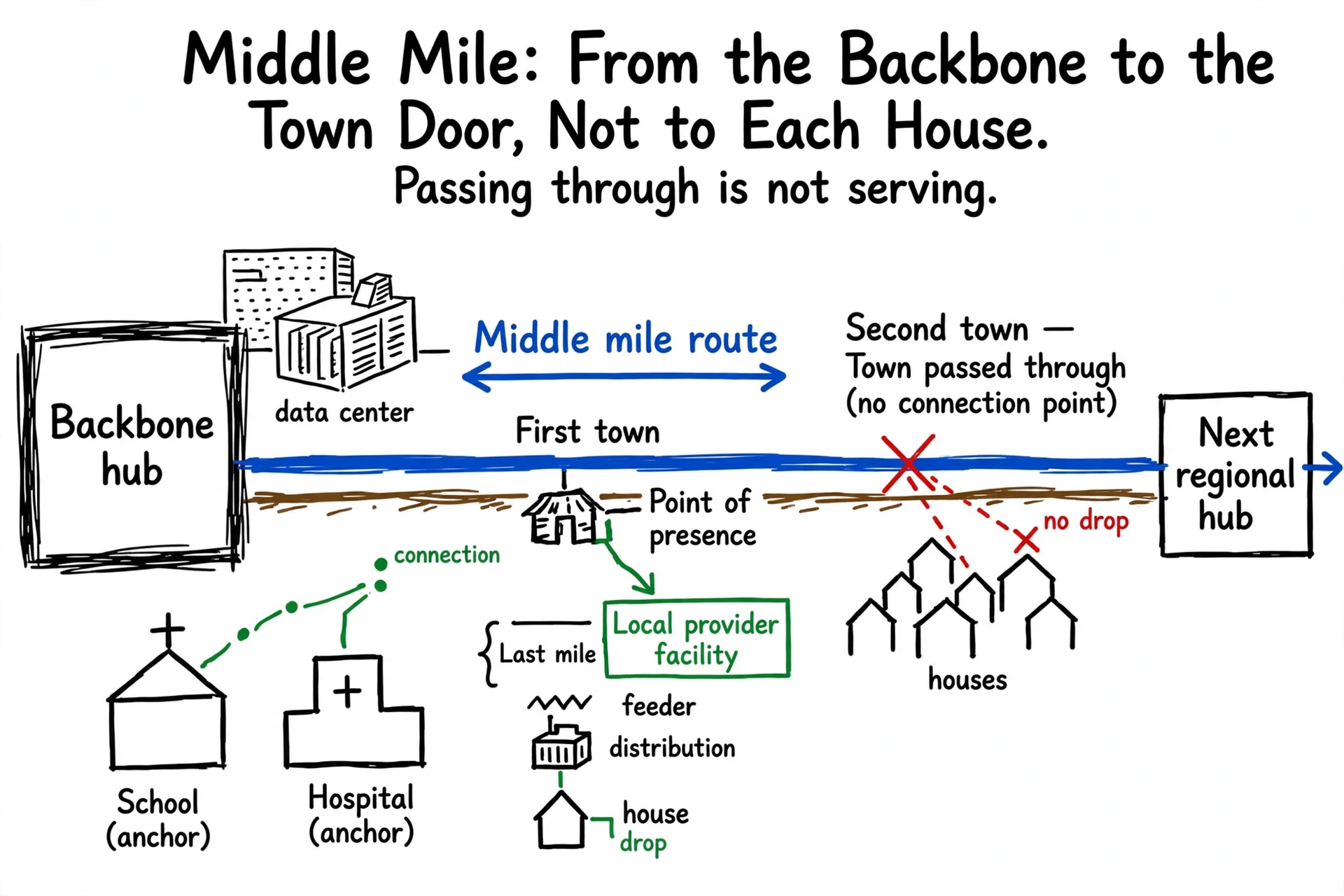
Middle mile is the shared segment of a broadband network that connects the backbone, the high capacity core of the network, to local networks that serve towns and communities. It carries combined traffic over longer distances and hands that traffic to local providers at defined connection points.
This lesson sits between Lesson 16, which covers the backbone, and the earlier lessons on feeder, distribution, and the last mile. Middle mile is taught here because a field reader who cannot place this segment will misread whole routes: a cable can cross a town, pass a school, and run in front of houses while connecting none of them.
What This Lesson Gives You
- Place middle mile correctly between the backbone and the last mile on any route you are reading.
- Tell middle mile plant apart from feeder, distribution, and drop plant by the job it is doing.
- Spot an interconnection point and a point of presence and explain what each one makes possible.
- Read a route map and separate three different facts: miles built, connections completed, and premises actually served.
- Explain why a route passing through a town can leave every home in that town without service.
Start With the Basics
Think about how water reaches a house. A treatment plant serves a whole region. Large mains carry water over long distances toward towns. Inside a town, smaller pipes branch through streets. A service line then connects one house to the pipe in its street.
Broadband follows the same shape. At the far end sits the backbone, the core of the internet, connecting major cities, data centers, and exchange points. Lesson 16 covers it. At the near end sits the last mile, covered in Lesson 15: the final segment reaching end users at their premises. In broad usage the last mile includes distribution plus drops. In narrow usage it names the drop alone.
Between those two ends sits the middle mile. It connects the backbone to local last mile networks, carries traffic for whole communities or groups of towns, and delivers that traffic to points where local networks can pick it up. It brings capacity close enough that a local provider can then build the last mile and offer service at addresses.
One plain sentence carries the idea. The backbone moves data between regions. The middle mile moves data between the backbone and a local network. The last mile moves data to a person at an address.
Two cautions belong at the start. First, middle mile usually stops short of the direct retail connection to a home or small business. That connection is the job of the last mile, and federal program language makes this point the center of its definition. Second, middle mile names a segment and a role. It does not name a single cable, box, or building. You see its parts: routes between towns, splice points, small facilities, and interconnection locations.
What Is It?
Middle mile is the middle segment of a broadband network. It links the backbone, or core network, to local networks that serve end users. It carries large amounts of data over longer distances than a neighborhood network covers, and it hands that data to local providers and facilities at defined connection points.
The working parts of the definition:
- Backbone. A major high capacity route forming the core of a network, connecting large regions and major hubs. Lesson 16 introduces it.
- Local network. The network serving a defined local area, such as a town system or a provider network reaching homes and businesses there. A local network still needs a path to the wider internet, and middle mile provides a large part of that path.
- End user. The person or organization using a connection at the end of the network, such as a household buying retail service.
- End user location. The address or building where that user is located. Earlier lessons call the same thing premises.
- Interconnection. The physical linking of two networks so they can exchange traffic. An interconnection point is the location where that linking happens.
- Point of presence (PoP). A location where a network is present and others can connect to it, such as a provider facility, a hut, or a data center.
NTIA, the National Telecommunications and Information Administration, administers the federal Enabling Middle Mile Broadband Infrastructure Program. NTIA describes middle mile infrastructure, in summary, as any broadband infrastructure that does not connect directly to an end user location. The law behind the program lists examples that show how wide the term runs in federal use:
- Leased dark fiber, meaning fiber installed but not yet carrying a lit signal in that arrangement. To lease dark fiber means one organization pays to use strands built by another and provides its own equipment to light them.
- Interoffice transport, the connection between provider facilities in different places.
- Backhaul, the link carrying combined traffic from a local site back toward the core network. A cell tower is a common example: the tower serves phones nearby, and backhaul carries that gathered traffic toward the provider core. This lesson uses middle mile for the segment and backhaul for one job it performs.
- Carrier neutral internet exchange facilities, places where providers and content networks exchange traffic. Carrier neutral means the facility is not tied to only one carrier.
- Carrier neutral submarine cable landing stations, where an undersea cable comes ashore and connects to land based networks, and undersea cables themselves.
- Transport connectivity to data centers.
- Special access transport.
- Wired or private wireless infrastructure, including microwave capacity and tower access.
The private wireless entry carries a lesson of its own. Middle mile is defined by role. A microwave link can perform a middle mile job. This academy focuses on outside plant fiber, so this lesson centers on fiber routes, and the definition still covers the wireless cases.
The Pennsylvania Broadband Development Authority glossary describes middle mile, in summary, as the robust high speed network that brings broadband close enough to a residence or business for a provider to offer access, and notes that it connects to the global internet backbone. NTIA teaching material describes it as the midsection that carries large amounts of data at high speeds over long distances and connects the backbone to the last mile. All three wordings agree on the shape: middle mile brings high capacity close to where people live and work, connects toward the backbone, and stops short of the direct retail connection.
A community anchor institution, often shortened to anchor institution, is an organization serving a community centrally that needs substantial connectivity itself. Federal law for this program defines it to include:
- A school.
- A library.
- A medical or healthcare provider.
- A community college or other institution of higher education.
- Another community support organization or entity.
In general industry talk, people often say middle mile connects anchor institutions, and that talk has a true core. Routes are often planned to reach or pass near anchors, and anchor connectivity is often a reason to build through an area that would otherwise be hard to justify. In the federal program definition, however, middle mile infrastructure does not connect directly to an end user location, and that statement expressly includes an anchor institution. That is a program rule about what counts for that funding. An anchor can still be served by a network that uses middle mile. The direct connection into the anchor building is treated as an end user connection for that program, separate from the middle mile segment itself.
Definitions vary by program and document. When a document uses the term middle mile, check how it treats anchors and direct premises connections before comparing its numbers with anyone else’s.
Middle mile has no fixed length, fiber count, or capacity that applies everywhere. One route crosses a county. Another crosses a state. Another reaches an island by undersea cable. Distance helps recognition in rural cases. Role defines the segment.
Middle mile is also shared in a way drops are not. One drop serves one premises. One middle mile route can carry at once the combined traffic of a local provider, a school district, a hospital system, and a cell site. That sharing is the economic heart of the segment.
What Does It Look Like?
Because middle mile is a segment and a role, you recognize it by the pattern of its parts and by what those parts leave undone. Middle mile plant often looks quieter than last mile plant even though it carries far more combined traffic. Last mile plant branches constantly because it must reach addresses. Middle mile plant travels.
Look for these signs:
- A fiber route running a long distance along a highway, county road, or corridor, passing through a town without branching down side streets.
- A cable continuing straight through an area on poles, or a buried route marked by posts, handholes, or vaults, with no drops leaving toward houses.
- Splice enclosures where sections join or a branch leaves toward a community facility, instead of the frequent small terminals seen where drops are made.
- A small facility, hut, or secured building near a town or anchor, where the long route meets local equipment. This is often a point of presence or interconnection point.
- A branch, sometimes called a lateral, leaving the main route toward a town facility, school, hospital, tower site, or hub, while the main route continues past it.
Contrast that with Lesson 15. In a neighborhood you see distribution branching down streets, terminals near homes, and one drop per premises. On a middle mile route you can travel a long way and see none of that. That absence, on a route carrying a major cable between places, is itself a recognition clue.
Construction methods look familiar, because middle mile uses the same building blocks as earlier lessons. Aerial cable is attached on poles along main corridor lines. Buried cable runs in conduit, often with larger handholes or vaults than a single drop would need. Methods do not define the segment. A buried route can be middle mile, feeder, distribution, or a drop, depending on its job.
Anchors give another clue, with a caution attached. A route may carry a branch toward a school, hospital, or library campus. Seeing that branch does not tell you how a funding document classified it. Observation tells you where fiber goes. Documents tell you which segment it was counted under.
Interconnection sites have their own look, although much of it sits inside a secured site. From outside you may see:
- A modest building or hut.
- Power and cooling equipment.
- Backup power.
- Fencing.
- Provider signage.
Inside, which is restricted access and restricted work, the defining feature is meeting equipment where two networks connect. If you are not authorized, you do not enter. Recognition from the road is enough here.
One more caution closes this section. A long route through open country is not automatically middle mile. It could be a backbone route between major cities, and from the road the two can look almost identical. Maps, records, and role tell them apart. A backbone route primarily connects major core hubs. A middle mile route primarily connects backbone points to local networks and communities. When you cannot tell, say so and check records instead of guessing from cable size.
What Does It Do?
Middle mile does four jobs.
First, it aggregates traffic. Aggregation means gathering many separate streams into one combined flow. Every video call, school session, hospital transfer, and business upload in a local area becomes part of a combined total when it leaves that area. The local network gathers its users’ traffic. Middle mile carries that total onward. Without aggregation onto a shared route, each local network would need its own long distance path, and many could not afford one.
Second, it transports traffic over distance. Backbone hubs tend to sit in larger metro areas, where many large networks meet. Communities spread across counties and states, often far from those hubs. Middle mile bridges that geography.
Third, it provides interconnection. A route alone is only a path. It becomes useful when local networks can connect at known points, on known terms. At those points a local provider hands off traffic and receives traffic back, an anchor network can connect, and a wireless carrier can obtain backhaul for tower sites. The value of a route depends on more than miles placed. It depends on where the connection points are, who may use them, and what using them costs.
Fourth, it lowers the barrier for last mile builders, when it is designed and priced to do so. A provider building in an unserved town faces two problems: building the neighborhood network, and obtaining an affordable path out of town to the backbone. When the second problem has no practical answer, the first often goes unsolved. NTIA describes the purpose of its middle mile funding, in summary, as reducing the cost of connecting unserved and underserved areas to the backbone. Middle mile does not replace the last mile. It makes the last mile more possible by solving the shared long distance part once for many users.
A related concept is open access. An open access network allows multiple providers to use the same infrastructure under stated terms, instead of reserving the route for one owner’s retail network only. Each provider still operates its own local and retail parts, while the shared route is built once. Some public and cooperative networks adopt this model. Read the project documents to learn which model a given network uses. The label alone does not settle the terms.
The limits matter as much as the jobs. Middle mile by itself connects no household. A household is connected when a last mile network reaches its premises and a drop and activation complete service, as Lesson 15 teaches. Middle mile by itself creates no retail competition. It creates the possibility that providers can reach a community affordably. It guarantees no quality of service on its own. The segments depend on each other.
Where Does It Fit?
Place the segments in order, from the widest part of the internet inward to one address:
- Content and data centers sit at the far side, holding the services and applications users reach.
- The backbone comes next, connecting major regions and exchange points between large hubs. Lesson 16 covers it. In road terms, it is the interstate network.
- Middle mile comes after the backbone, moving outward toward communities. It connects backbone points and regional hubs to local networks and towns. Its destinations are communities and connection points. In road terms, it is the state highway bringing you to the towns. The highway reaches the town. It does not pull into every driveway.
- Feeder comes next inside a local provider network, and this is where students confuse the segments. Feeder fiber, Lesson 13, carries signal from a central office, headend, or hub, Lesson 12, toward a service area.
- Distribution fiber, Lesson 14, then spreads the signal through a neighborhood to terminals.
- The drop, Lesson 10, leaves a terminal, Lesson 9, and reaches one premises. Distribution plus the drop form the working end of the last mile, Lesson 15.
The practical difference between middle mile and feeder is network boundary and destination. Middle mile typically moves traffic between networks, or between a core hub and a local network, and it may be owned by a different organization than the retail provider serving homes. Its destination is a community, a facility, or a local point of presence. Feeder typically moves signal within one provider’s access network, from that provider’s facility toward its neighborhoods. The two can meet at the local facility. Middle mile delivers traffic to the facility door. Feeder carries it onward.
One journey ties the chain together. A student in a small town starts a video lesson hosted in a distant data center. Data leaves the data center, crosses backbone routes to a regional hub, travels over middle mile to the town point of presence, enters the local facility, moves over feeder to the service area, spreads over distribution through the neighborhood, passes through a terminal, crosses the drop to the house, and reaches the student’s equipment. Return traffic follows the same chain in reverse.
Funding programs follow this same map. Programs often fund segments separately because economics and eligible applicants differ by segment. A middle mile program funds infrastructure that stops short of the direct end user connection. A last mile focused program funds deployment to premises. A community may need both. When you hear that a county received a middle mile award, ask three questions: where are the interconnection points, which local networks and anchors will connect, and what last mile builds will use this route?
What Is at Stake
Middle mile is often the missing link that decides whether local service is possible at all. The stakes run in six directions.
- Whether a local network can exist. A town can have poles, conduit, and a willing provider and still have no viable case when the only long distance transport out of town is too expensive, too limited, or offered on terms the provider cannot accept. The barrier is not in the neighborhood. It is the segment between town and backbone. Adequate and affordable middle mile access is a necessary step before a last mile provider can offer service households can pay for.
- Cost downstream. Transport is a cost a local provider must recover from customers, anchor clients, or funding. When a shared route brings that cost down, the provider can direct more money toward distribution, drops, and operations. When transport is scarce, retail prices rise, the local network is built thinner, or the project does not happen. Prices vary by route, market, and contract, so this lesson states no universal price or saving.
- Resilience. Resilience means how well a network keeps working or recovers when something fails. A community on a single middle mile route has a single point of failure. One cut or facility failure can affect every customer and institution on that path at once. A second diverse route, a physically separate path that does not share the same trench, bridge, or corridor for the critical stretch, can keep service running or restore it faster. Not every community has two routes. When reading a plan, ask whether the map shows one line into town or more than one, and what happens if that line is cut.
- Who can compete and grow. An open access or wholesale route lets a small provider, a cooperative, a city network, or a new entrant reach a community without first building a long route to a distant city.
- Work that depends on it. Crews and inspectors feel middle mile even when they never work on a middle mile job. A feeder build ending at a facility with no middle mile capacity ready will sit idle. A distribution build sold as coming soon depends on a transport path that may still be in permitting miles away. A cut on a rural highway route may be the only middle mile link for a county, with a hospital among its downstream users.
- Truth in reporting. Awards are announced with maps and mile counts that sound like household connections. They are not household connections. A truthful account separates three numbers: miles of route built, interconnection points and institutions reached, and premises actually connected by last mile service using the route. The first number can be large while the third is still zero.
What Does Good Look Like?
A good middle mile network is reachable, documented, shared where it promises to be shared, and sized for its communities with room to grow. Standing on the ground and reading the records, you can verify:
- The route connects backbone or regional hub points to clearly identified local connection points, so a map reader can point to each interconnection and to the path onward.
- Interconnection is real in practice. Points of presence have the space, power, and equipment needed for another network to connect, and connecting terms are stated in project or commercial documents. Specific prices and capacities come from those documents.
- Records match the field. Maps, splice records, fiber assignments, and facility records show which fibers are lit, which are dark and available under the network model, which local networks use which services, and where each interconnection sits. A later operator can trace a path from a town facility toward the backbone without guessing.
- Capacity planning is honest. The network carries current traffic with headroom for growth, and the operator can explain how capacity would increase: lighting more fibers, upgrading end equipment, or adding a route.
- Resilience is considered and its limits are stated. Where a diverse second path exists, records show it is truly diverse. Where only one path exists, the operator and the community know it, instead of implying a backup that is not there.
- Anchors and local providers were part of route planning. The route passes within practical reach of the facilities it claims to serve, and the laterals needed to reach them are identified.
- Construction is finished cleanly. Attachments are orderly, enclosures are secured and documented, markers are in place as required, and restored surfaces look finished. Specific depths, clearances, and tensions come from codes, permits, owner requirements, and project specifications.
Good here means a local provider can connect at a known point, on known terms, and carry community traffic to the backbone on a documented path, today and as demand grows.
From the Field
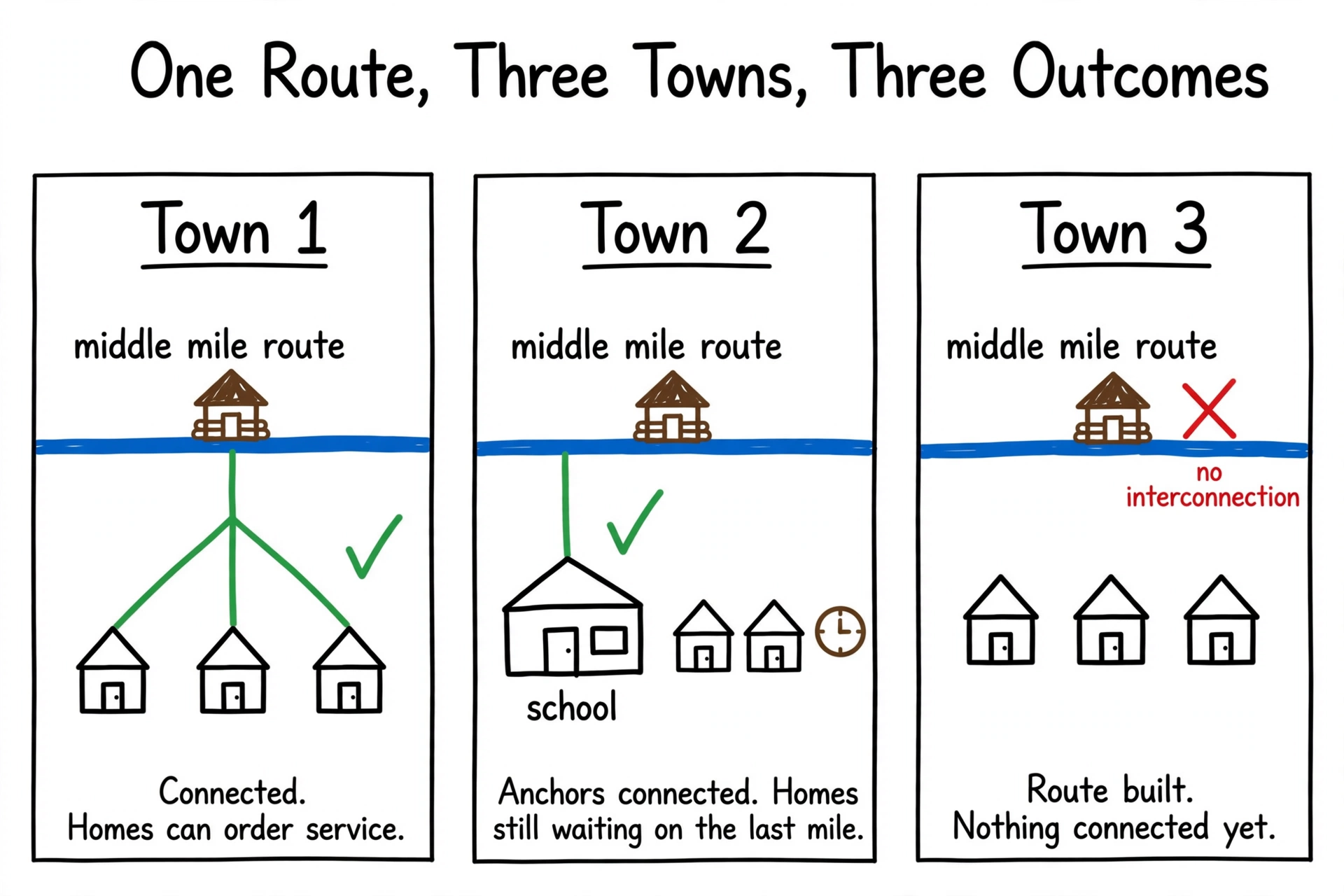
Picture a county with one larger town holding a regional backbone point of presence, and three smaller towns along a state highway. Each smaller town has a school, a clinic, and a small provider or cooperative that wants to offer home fiber service. None of the three can afford a separate long route back to the regional hub. In this scenario, the one transport quote each received was high enough to make home service prices unworkable.
A regional middle mile project is built. One shared route runs along the highway from the regional hub through all three towns and onward to the next county hub. In each town, the project builds a point of presence at a small secured hut near the town provider facility, plus a lateral toward the school district facility area. The project documents, following the federal program style definition, state that middle mile scope ends at those points of presence and lateral endpoints. Direct connections into individual buildings, including the final school connection and any home connections, are separate work.
In the first town, the provider interconnects at the hut in the same season the route is finished. It builds feeder and distribution through two neighborhoods and begins connecting homes with drops. The full chain now exists: backbone, middle mile, feeder, distribution, terminal, drop. Residents can order service.
In the second town, the provider interconnects, and its last mile build is funded for the following year. The school district and clinic complete their separate building connections. Homes still cannot order service. A truthful report for this town reads: middle mile in use by anchors, last mile in progress, zero homes connected.
In the third town, the route and hut stand in place, and the provider and the operator have not completed their interconnection agreement. Hut finishing work is still pending. No local traffic uses the route yet.
On the project map, all three towns show the same line. In the field, the three towns sit in three different states: one serving homes, one serving anchors with homes pending, and one serving no local user yet. A new crew member driving the highway sees one continuous cable and asks why the report treats the towns differently. The answer is the Level 1 system view. The crew member is looking at one segment, and service to a person requires every segment.
Carry this rule: judge a middle mile build by completed interconnections and by the premises actually using the route. The line on the map is the smallest part of the claim.
What Can Go Wrong?
Middle mile problems affect many people at once, because the segment is shared. A drop failure affects one premises. A middle mile failure can affect a whole network at once.
- A single route cut with no diverse backup. A dig-in, a storm, or a vehicle strike interrupts the only path to the backbone, and every downstream network on that path loses its upstream connection at the same time.
- Capacity that falls behind demand. A school expands online testing, a hospital adds imaging transfers, or hundreds of new households connect through a new last mile build the operator did not plan for. Lit equipment and sold services at the ends set the practical limit until they are upgraded. Users feel slowdowns at busy times.
- A route that passes through without connecting. Fiber runs through a town between two cities, with no interconnection point, no lateral to the local facility, and no terms offered to a local provider. Residents assume service is coming. The town gained a view of a cable and gained no connection.
- Interconnection on paper only. A point of presence is announced, and the site lacks finished power, space, or equipment, or the process to use it stays unclear, so no provider completes a connection. Mileage is reported as built while useful connections remain at zero.
- Anchor expectations that were never scoped. A school or hospital was named in a funding narrative, and its lateral, inside connection, or service agreement was never in any funded scope. The institution is still unconnected when the route is finished, even when the route crew built exactly what its drawings showed.
- Records that do not support repair. Assignments are incomplete, splice records are missing, or the as-built route differs from the map after an unrecorded change. When the route is cut at night, the repair crew loses hours while a whole community waits.
- Confusion about the term in reporting. One report counts anchor direct connections as middle mile, another excludes them, a third counts a long feeder route as middle mile. Comparisons mislead until the definitions are placed side by side.
What Should Someone Notice in the Field?
You are likely looking at middle mile when the network is moving between places and gathering whole communities of traffic, instead of serving addresses one by one. Observe from a safe and authorized position:
- A substantial route between towns, with long stretches that have no branches, no drop terminals, and no building connections.
- Houses and businesses along the route with no drop from this cable and no wall enclosure fed by it, even though the cable passes in front of them. That absence is a positive clue. This route is not their service connection.
- Handholes, vaults, and splice points spaced for the route and its branches, at route spacing instead of neighborhood terminal spacing.
- A lateral leaving the main route toward a provider facility, school site, hospital area, tower site, or town hub, while the main route continues onward.
- A modest secured facility, a hut, cabinet site, or provider building near a town edge or anchor campus, with power and cooling, where the long route terminates or passes through connection equipment. Treat it as a point of presence or interconnection location until records confirm its role.
- Markers naming a regional, wholesale, state, cooperative, or transport network, instead of the retail brand a household would buy from. Some middle mile operators sell no home service at all.
- Crews staging and working mile after mile along a corridor, instead of working house by house.
Hold three conclusions back until records confirm them. A town is not served just because a route crosses it. A large cable is not backbone or middle mile based on size alone. An anchor is not connected just because a route passes its campus. Those conclusions need records: interconnection points, service agreements, fiber assignments, and activation status. Observation tells you where plant is. Records tell you what it is doing and for whom.
Safety boundary, stated plainly. Recognizing middle mile does not qualify you to climb poles, open enclosures or vaults, enter a hut or facility, splice fiber, or dig to expose a buried route. Aerial plant shares poles with electric facilities that can kill. Buried routes share corridors with other utilities that are dangerous to strike, and a cut can affect emergency and healthcare traffic for a whole area. Observe from the ground, from a public or authorized position. Report through your project process when that is your assignment. Leave hands-on work to qualified and authorized crews. Any digging follows the 811 locate process and state law.
Key Terms
- Middle mile. The segment connecting the backbone or core network to local last mile networks. It carries large amounts of combined data over longer distances, provides interconnection points, and usually stops short of a direct end user premises connection.
- Backbone. The core high capacity routes connecting major regions, cities, and data centers. Lesson 16 covers it.
- Last mile. The final segment delivering service to end users at their premises. In broad usage it includes neighborhood distribution plus drops. Lesson 15 covers it.
- End user location. The address or building where the person or organization using a retail connection is located. Also called premises in earlier lessons.
- Community anchor institution. An organization serving a community centrally that needs substantial connectivity, such as a school, library, healthcare provider, community college, or another community support organization.
- Interconnection. The physical linking of two networks so they can exchange traffic. An interconnection point is the location where that linking happens.
- Point of presence (PoP). A location where a network is present and where other networks can connect to it, such as a provider facility, hut, or data center site.
- Backhaul. A link carrying combined traffic from a local site, such as a tower site or local network point, back toward the core network. Backhaul is one job middle mile performs.
- Dark fiber. Installed strands not yet lit in a given arrangement. Leased dark fiber is the use of another organization’s strands under a lease, with the user lighting them.
- Aggregation. Gathering many separate traffic streams into one combined flow.
- Open access. A shared model in which multiple providers may use the same infrastructure under stated terms, instead of the route being reserved for one owner only.
- Feeder. Cable carrying signal from a central office, headend, or hub toward a service area inside one provider access network, before distribution spreads it through neighborhoods. Lesson 13 covers feeder.
- Lateral. In general field use here, a shorter branch from a main middle mile line to a specific nearby connection point, such as a town facility or anchor area.
- Internet exchange facility. A location where providers and content networks exchange traffic. A carrier neutral facility is not tied to one carrier only.
Check Your Understanding
- In your own words, what is middle mile, and what are the two segments it sits between?
- A fiber route is built along a highway through a town. No interconnection point is built in the town and no local provider connects to the route. Has that town gained broadband service from this build? Explain using segment names.
- On the project map in the field story, three towns show the same completed route line, and only the first town’s residents can order service. What separates the first town from the other two, and what rule should you use when reporting on a middle mile build?
- Two documents describe the same school connection differently. One counts it as part of a middle mile project. The other, following the federal middle mile program definition, treats the direct connection into the school as an end user connection outside the middle mile segment. Can both be following their own definitions, and what should a reader do?
- What is open access in a middle mile network, and what does open access leave undone for a household?
Answer key
- Middle mile is the shared high capacity segment connecting the backbone to local last mile networks, carrying combined community traffic to interconnection points. It sits between the backbone and the last mile.
- No. The town gained a route passing through, and it gained no connection. Without an interconnection point and a local network using it, and without last mile distribution and drops to premises, no end user is served. Passing through is not serving.
- The first town completed the whole chain: the provider interconnected at the point of presence and built feeder, distribution, and drops, so homes can order service. The second town interconnected and connected its anchors, with the last mile build still pending. The third town has the route and hut in place, with no completed interconnection and no local traffic. Judge and report a middle mile build by completed interconnections and premises actually using the route, never by the line on the map alone.
- Yes. Definitions vary. General usage often describes middle mile as connecting anchors, while the federal program definition treats a direct anchor connection as an end user connection outside middle mile. Use the document’s own definition, and do not compare numbers across different definitions.
- Open access means multiple providers may use the same shared infrastructure under stated terms. It can lower the regional barrier for providers when the stated terms are workable. It connects no household by itself. A provider still must interconnect, build or lease last mile access, and activate service.
Lesson Takeaway
Middle mile is the segment between the backbone and the last mile. It carries combined traffic over longer distances, connects core hubs to communities at interconnection points, and usually stops short of the direct end user connection. Program definitions differ on direct anchor connections, so the document definition controls. You now read a route differently: the cable is the easy part to see, and the connections decide what the route is worth. Homes are served when a local network interconnects and a last mile build completes distribution and drops to their addresses.
Sources and Technical References
- NTIA, Enabling Middle Mile Broadband Infrastructure Program. Program page stating the definition used in this lesson and the purpose of reducing the cost of connecting unserved and underserved areas to the backbone. https://Broadbandusa.ntia.gov/funding-programs/enabling-middle-mile-broadband-infrastructure-program
- NTIA, Enabling Middle Mile Broadband Infrastructure Program webinar presentation. Teaching material describing middle mile as the midsection carrying large amounts of data over long distances and connecting the backbone to the last mile. https://broadbandusa.ntia.gov/sites/default/files/2022-06/May-26-Webinar-Presentation.pdf
- Pennsylvania Broadband Development Authority, Broadband Glossary. State glossary defining middle mile as the network bringing broadband close enough for a provider to offer access and connecting to the backbone, and last mile as the final leg to retail end users. https://broadband.pa.gov/resources/broadband-glossary/
- United States Code, Title 47, Chapter 16, Subchapter III, Enabling Middle Mile Broadband Infrastructure, as published on the House website. Statutory definitions for anchor institution, interconnect, internet exchange facility, and middle mile infrastructure, including its list of included services. https://uscode.house.gov/view.xhtml?path=/prelim@title47/chapter16/subchapter3&edition=prelim
- Zhone, What is Middle Mile broadband infrastructure? Vendor glossary restating the federal definition and explaining aggregation between networks. Used as a secondary check, not as an authority over NTIA or the statute. https://zhone.com/company/resources/glossary/middle-mile/
- Ziply Fiber, Last mile vs middle mile vs backbone internet explained. Provider explainer with the plain language three part comparison of last mile, middle mile, and backbone. Checked against NTIA and Pennsylvania definitions. https://ziplyfiber.com/blogs/article/internet-infrastructure
- Arista Networks, Enabling Open Access Middle Mile. White paper on open access middle mile as shared infrastructure and a shared business model linking local providers and anchors to the backbone. Used for the open access concept only. http://sit.www.arista.com/assets/data/pdf/Whitepapers/Middle-Mile-Networks-WP.pdf
- Lightwave, Plotting the middle mile fiber opportunity. Industry article describing middle mile fiber as bridging the core backbone and local last mile networks. Used for industry context, not for program rules. https://www.lightwaveonline.com/MiddleMile
Previous lesson: Lesson 16: What Is a Backbone? |
Back to Level 1 hub |
Next lesson: Lesson 18: What Is Point-to-Point Fiber?