
Introduction
A backbone is the highest capacity core of a fiber network: the major high speed routes that connect cities, regions, major facilities, and whole networks to each other and carry their combined traffic over long distances. It sits at the top of the layered network, above every segment that serves a neighborhood or a single address.
The word is used loosely in press releases, funding programs, and everyday field talk, and loose use leads to projects described, funded, and reported under the wrong segment name. This lesson sits after feeder, distribution, and the last mile (Lessons 13, 14, and 15) and before middle mile (Lesson 17), because the backbone is the far end of the chain those lessons build toward, and a reader who knows the chain can place the term correctly every time.
What This Lesson Gives You
- Explain what a backbone is in plain words, and name the kinds of places it connects.
- Tell backbone, middle mile, feeder, distribution, and the last mile apart by what each segment connects.
- List the field clues that suggest a route is playing a core role, and state plainly what appearance alone cannot prove.
- Say what a point of presence, an internet exchange point, a diverse path, and a ring are, in plain language.
- Test a claim that fiber has arrived somewhere by naming the segments still missing between the backbone and an address.
Start With the Basics
Imagine the road system in a state. Interstate highways carry the heaviest traffic over the longest distances, connecting cities and regions. Smaller highways carry traffic from an interstate exit toward a town. Local streets carry traffic through a neighborhood. A driveway carries one car to one house.
A fiber network is layered in a similar way. No single segment does every job. Some routes carry the combined traffic of many communities over long distances. Some carry that traffic closer to a community. Some spread it through a neighborhood. One final route reaches one home or business.
The backbone is at the top of that layered picture. It is the highest capacity core part of the network, built to carry the most combined traffic over the longest distances, connecting the largest places and facilities to each other.
Three ideas matter right away:
- A backbone names a role played by a set of core routes. No special cable color and no special box marks one out for you to spot.
- Its traffic is combined traffic: the traffic of many customers, neighborhoods, and often many communities, gathered together and carried as one large flow.
- A backbone does not deliver service to a house by itself. A backbone passing through a town has connected nobody in that town until the smaller segments downstream of it are built.
Hold those three ideas and the rest of the lesson will make sense. Confusion about this term usually comes from forgetting one of them.
What Is It?
A backbone is a major high speed transmission route, or a set of connected routes, that links smaller networks to each other and carries their combined traffic over long distances.
That definition needs a few terms explained plainly before we build on it.
Capacity is how much traffic a route can carry. Highest capacity here means the backbone is designed to carry more combined traffic than the smaller segments that feed into it. It does not mean a specific number. This lesson states no required speed, capacity figure, or fiber count, because no single figure from the sources checked applies everywhere. Capacity depends on the design, the equipment at the ends, and the fibers in use, and only partly on the cable in the ground.
A carrier is a company that owns or operates a network that carries traffic for others or for its own customers over a wide area. A central office is a provider facility in a community where network equipment sits and local connections are gathered. A headend is the cable system facility where signals are received and processed for distribution. A hub is a smaller facility that serves part of a larger service area and connects back to a larger facility. Lesson 12 covers all three facility types in detail, so this lesson uses those words only as place names for facilities a backbone connects.
A route is the path a cable follows through the field, along poles, through conduit underground, or both. A segment is one part of a whole network that does a distinct job.
So, restated simply: the backbone is the core set of routes that connects major facilities and smaller networks to each other and moves their combined traffic between cities, regions, and major connection points.
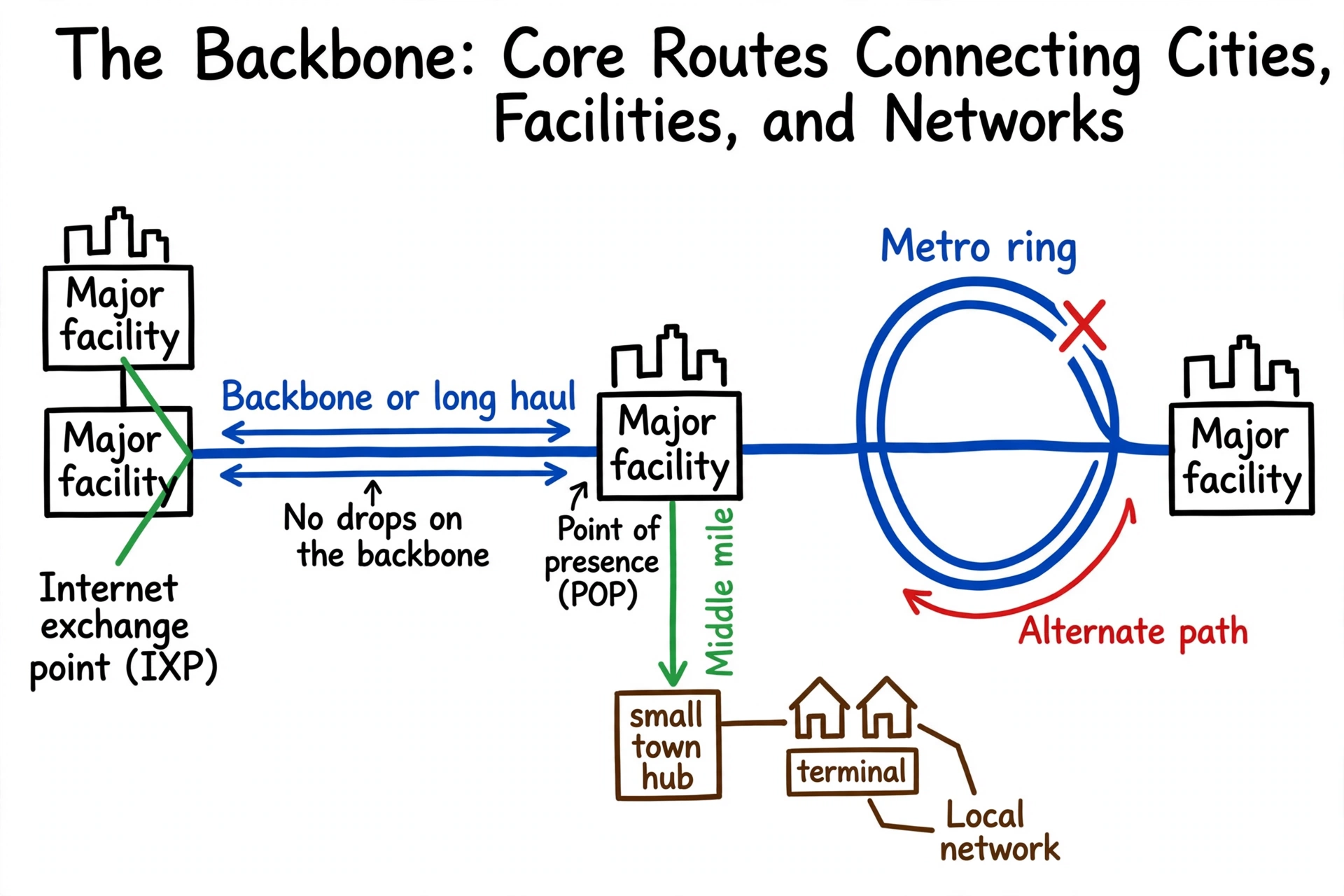
In outside plant fiber construction, OSP for short, the word is used for that wide area core. A long haul route is a backbone route that runs over a long distance between distant places, such as between cities or across a region. Long haul describes distance and role, and the term carries no measured number of miles. This lesson states no distance that turns a route into long haul, because sources use the term for very long networks with national and major regional reach and set no universal cutoff. A metro backbone route is a core route inside or around one metropolitan area, connecting major facilities there to each other and to long haul routes leaving the area. Metro is short for metropolitan. Its geography is one city area rather than the country or a large region.
Note a second usage you may meet outside OSP work. Inside a building or on a campus, people also use backbone for the cabling that connects equipment rooms to each other. That is a building cabling usage, separate from what this lesson teaches. In OSP, carrier, and broadband funding usage, backbone refers to the wide area core described above. When a document matters, look for how that document uses the term.
The backbone also has no single owner. Sources describing the internet backbone explain that it is made up of individual high speed fiber optic networks owned by different large providers, joined together so traffic can pass from one network to another. That joining is called interconnection, meaning networks connecting at agreed points so traffic can move between them. The backbone on one project is usually one owner’s portion of a much larger joined up whole.
Finally, a backbone is a concept for a core role, in the same way the last mile is a concept for a final role. No single piece of hardware is stamped backbone. The term names the job that core routes, facilities, and connection points do together.
What Does It Look Like?
This section has to be honest, because a backbone does not look the way beginners expect.
You mostly do not see a distinct backbone object. There is no backbone terminal on a pole, no backbone pedestal in a yard, and no standard backbone enclosure on a wall that tells you what you are looking at. A backbone route uses the same basic kinds of plant you have already learned about: fiber cable, poles, conduit, handholes, splice enclosures, and facilities. Its role, its position in the network, and the places it connects make it a backbone. The hardware carries no different look.
You can still learn to recognize signs that a route may be playing a backbone or long haul role. Treat these as clues to check against project documents and records, never as proof by appearance alone:
- A route that passes through an area instead of serving it. A backbone route may cross a town or a stretch of countryside without drops, without terminals serving nearby homes, and without branches into neighborhoods. Its job on that stretch is to get from one major place to another.
- A route in a major corridor. Long haul routes often follow corridors that already cross long distances in a fairly direct line, such as highway and railroad corridors and established utility corridors. The corridor is a clue about purpose. On its own, it proves nothing about role.
- Larger cable in the corridor. A project may describe its backbone cable as high count, meaning the cable contains many individual fibers. Do not turn that into a rule or a number. This lesson states no fiber count that makes a cable a backbone cable, because counts are chosen by design and vary by owner and project. A cable that looks thick also tells you little, because jacket and strength elements affect outside size. Role comes from design and records, and never from a guess by diameter.
- Facilities rather than premises at the ends. Where a local route ends at houses, a backbone route ends and connects at facilities: central offices, headends, hubs, data centers, and the connection points described below. A data center is a building built to house large numbers of computers and network equipment, with the power and cooling to support them.
- Few access points along the way, compared with distribution. Distribution plant is built so drops can connect at many points. Backbone plant is built to move traffic past an area, with access points placed for the core route design rather than for serving each property it passes.
Two connection points deserve a plain explanation, because you will hear their names in backbone conversations even if you cannot recognize them from a truck.
A point of presence, shortened to POP, is a physical location where a provider network is present and where connections to that network can be made. A POP sits inside a facility. From outside the building you may see nothing that names it.
An internet exchange point, shortened to IXP, is a physical location where many different networks connect to each other to exchange traffic. Think of it as a meeting place for networks. Sources on broadband structure describe backbone and long haul networks as running to buildings that act as internet exchange points, typically in larger metropolitan areas. Peering is the word for networks exchanging traffic with each other at such points under their own agreements. You only need the picture: backbones connect places, and exchange points are important places they connect.
What you will not see is a sign that says backbone starts here. The boundary between a backbone route and a middle mile route, or between one owner network and another, is a design, ownership, and records boundary. You infer a backbone from the pattern: a through route, in a major corridor, connecting facilities and cities, carrying combined traffic, with local serving plant branching off it somewhere downstream rather than at every pole.
What Does It Do?
The backbone does the core carrying job for the network. It does four main things.
First, it carries combined traffic over long distances. Distribution gathers a neighborhood. Feeder gathers a service area. Middle mile gathers a community or a group of communities. The backbone gathers all of that upward flow and carries it between regions, and carries the returning flow back down the same layered path. If you picture water, smaller streams join into rivers. The backbone is the river part of the system.
Second, it connects networks to networks. At POPs and internet exchange points, it connects one provider network to others, so traffic from a small local network can reach a destination on a different network in a different state or country. Without that connection, each local network would be an island that could only talk to itself.
Third, it connects major facilities to each other. Central offices, headends, hubs, and data centers are where traffic is gathered, processed, and handed on. Backbone routes are the core links between those facilities. Transport is the plain industry word for carrying traffic from one point to another over a network, as opposed to delivering it to an end user.
Fourth, it gives smaller networks somewhere to go. A middle mile route, covered next in Lesson 17, has value because it reaches a backbone. Federal middle mile material describes middle mile as the midsection that connects the backbone to the last mile, which connects to end users. The backbone is where middle mile is trying to get to.
The backbone does not do the local jobs. Fanning out through a neighborhood is distribution work. Connecting one house is a drop. A backbone usually does not connect directly to individual end users at all. End user connections happen several layers downstream.
Where Does It Fit?
Place the lessons you have learned in order, from the customer outward to the core, because the backbone makes most sense as the far end of a chain you already know.
Start at the premises, the property or building where an end user is located. The drop, from Lesson 10, connects one premises to a terminal, from Lesson 9. Distribution cable, from Lesson 14, spreads the signal through a neighborhood to terminals near groups of premises. Feeder cable, from Lesson 13, carries the signal from a central facility out toward a service area. Together, in the broad usage taught in Lesson 15, distribution plus drops make up the last mile.
Beyond the local facility, the chain continues outward. Middle mile, which you will study in Lesson 17, connects local networks to the backbone. It brings capacity into or near a community, and it usually does not connect directly to individual homes. Think of middle mile as the link between a community and the core.
The backbone sits beyond middle mile, at the core. It connects cities, regions, major facilities, and other networks to each other, including at internet exchange points in larger metropolitan areas.
A simple way to keep the five terms straight is this. The last mile connects people at addresses. Feeder and distribution move signals within and around a local service area. Middle mile connects a community outward. The backbone connects regions, major facilities, and whole networks to each other.
Now place two backbone words inside that picture. A long haul route is backbone at its longest scale, running between distant cities or across regions and, for the largest providers, across the country. A metro backbone route is backbone at city scale, connecting major facilities within one metropolitan area and linking them to long haul routes leaving the area. Both are backbone work. The difference is geography and scale, while the job stays the same. A local provider may also call the links between its own central offices and hubs its backbone in its own documents. That usage is honest as long as the document makes its scope clear. Always ask: backbone of what, and between which places?
Funding language uses the same chain. In the NTIA material used as a source for this lesson, middle mile is the midsection between the backbone and the last mile, and a separate federal middle mile program funds that midsection. A project described as middle mile is therefore a different project from a backbone project and from a last mile project. When a press release or a sales claim calls a route a backbone, check what it actually connects. A route that connects a town to the core is usually middle mile in program usage, however much it matters to that town.
One honest complication remains. In real networks, the lines between these roles are drawn by owners and documents, and not by nature. One long haul route may also carry a middle mile function for a community it passes, and one facility may be both a local hub and a carrier POP. The layered picture above is the standard teaching picture. When a real map shows one route doing duty in more than one role, ask which role the document is talking about and judge the claim by the connections it describes.
What Is at Stake
- Everything downstream depends on it. A neighborhood can have perfect distribution and perfect drops and still have no useful service if there is no working path outward through feeder, middle mile, and backbone to the wider network. The backbone is easy to overlook in local construction because it may have been built years earlier by a different owner in a different corridor. Every local build still has to answer one question: where does this traffic go when it leaves here? If the answer has a gap at the backbone level, local work cannot fix it by itself.
- A problem at the backbone level affects many people at once. A cut drop usually affects one customer. A damaged distribution section may affect a street or a neighborhood. A failure on a core route can affect the combined traffic of many communities or a whole region, because that traffic was gathered onto a small number of core routes. Few cables, high consequence is a fair summary. That concentration is no flaw. Gathering traffic is what makes long distance carriage efficient. The concentration is why backbone routes are engineered, documented, and protected with more care than a beginner might expect for what can look, from the road, like just another cable in a corridor.
- The backbone is where networks meet, so it shapes cost, choice, and reach for smaller providers. A small local provider that can connect at a nearby POP or exchange point can offer the wider internet without building its own route across the country. A community with no nearby connection point faces a longer middle mile problem before its last mile can mean anything. Where the backbone is reachable, local networks are cheaper to complete and operate. Where it is out of reach, local ambition runs into a transport problem first.
- Backbone claims are easy to exaggerate, so clear language protects everyone. Saying fiber has arrived in a region can mean a backbone route crossed the county line, which is real progress for transport and no direct service for any address. Saying a community is connected to the backbone can mean a middle mile route reached a facility in town, which still leaves distribution and drops unbuilt. Lesson 15 made this point for the last mile. This lesson makes the same point at the opposite end of the network.
What Does Good Look Like?
A good backbone, in general terms, looks connected, documented, and protected against a single failure taking down the whole flow. Judge it by function and records, and never by appearance from the road.
- Core routes connect the intended major places. The facilities, cities, regions, and connection points in the design are actually linked, with no gap where a map shows a line but no completed and tested connection exists.
- Capacity fits the combined job. The design carries the gathered traffic it serves, with room for the growth the design promises. Specific figures come from the owner design and equipment, and not from this concept lesson.
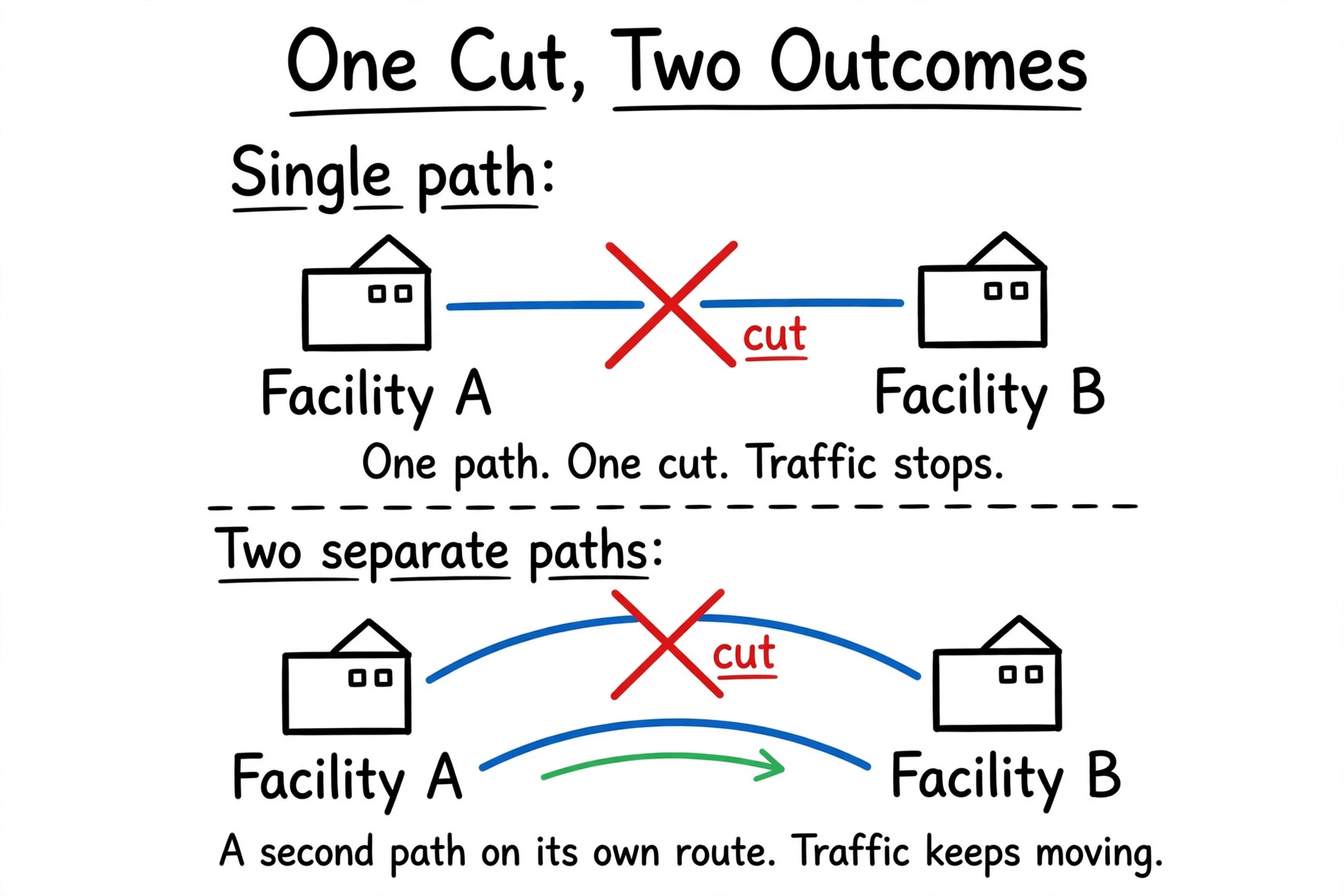
- Where protection was promised, there is more than one way through. Redundancy means having an alternate path ready when the first path fails. A diverse path is an alternate route that avoids the first route’s physical corridor and risks, so one event is less likely to cut both. A ring is a closed loop of facilities, so traffic can travel either way around it. Good backbone design commonly uses diverse paths and, in many metro and regional designs, rings. One carrier announcement describes a physically diverse long haul route connecting a metro ring in New York City to Ashburn, Virginia, built specifically to add that kind of redundancy on a corridor. An operator in Washington State reported completing a fiber ring to serve data centers, described as providing geographically diverse, redundant paths and a connection to its broader long haul network. Be precise, though: some backbone routes are single paths, often called spurs when they branch off a core to reach one place, and a single path has no alternate way around a cut. Good means the protection in the field matches what the owner promised and the design documents say.
- Interconnection points work as designed. At POPs and exchange points, connections to other networks are complete, tested, and recorded, so traffic can pass from one network to another.
- Records match the field. Core routes, splice points, facility connections, and path diversity are documented well enough that an operator can tell, during a failure, which traffic is affected and which alternate path it should take. On core plant, a wrong record costs outage time. Crews lose hours working from a map the field does not match.
Good, at the backbone level, means combined traffic can move between major places, keep moving when one path fails where protection was promised, and be traced using records that match reality.
From the Field
Picture a carrier finishing a long haul backbone across a state with three cities in a line: a large metropolitan area in the east, a mid sized city in the middle, and a smaller city in the west. The route runs from an internet exchange point in the eastern metropolitan area, through a central office in the middle city, and on to a carrier facility in the western city. Inside the eastern metropolitan area, a metro backbone ring connects the exchange point to two data centers and the carrier’s main facility, so traffic can reach the exchange point by either side of the ring.
A separate project builds a middle mile route from the middle city’s central office down to a hub in a small town to the south. A local provider follows with feeder and distribution through the town and runs drops as residents sign up. The new route is the biggest construction the town has ever seen, and the town’s traffic now has a path to the core.
Before the project closes, the coordinator drafts the completion announcement. His draft reads: backbone construction complete, and town residents can now order high speed service. The field lead reviewing the draft has to decide whether it goes out as written. She checks the draft against what each segment actually connects. The town route connects one community to the core, which makes it middle mile in program usage, whatever it means to the town. The backbone in the announcement belongs to the carrier route between the cities. And service at an address exists only where distribution has passed and a drop has been connected, which is still happening street by street.
She sends the announcement back with two corrections. The completed project is a middle mile route that reaches the backbone at the middle city’s central office. Service becomes available address by address as the local provider finishes distribution and connects drops. The corrected version is less exciting, and it is also the version nobody has to walk back later.
Months later, a cut damages the single middle mile path into town, and the town loses service even though every drop in town is undamaged and the backbone between the cities is working normally. Because the records name each segment by its real role, the outage report points crews at the middle mile spur first, instead of sending them to check town plant or the carrier core. Each segment can only deliver what the segment next to it hands over, and a healthy backbone cannot rescue a cut middle mile spur.
The rule to carry: name a segment by the places it connects, and claim service only at addresses a completed drop reaches. A route’s importance to a town never changes its role in the network.
What Can Go Wrong?
Backbone problems are fewer in number than last mile problems, but each one tends to reach further.
- A single path failure with no way around it. A core route built as one path, or a pair of paths that share the same corridor, bridge, or structure, can fail from one cut or one event. Traffic gathered from many communities then has nowhere to go. Operators build physically diverse long haul routes specifically to add redundancy on a corridor. Diversity that exists only on a drawing, while both paths share the same physical risk, fails the first time the shared risk is hit.
- A ring that is not really closed. A design described as a ring only protects traffic if the loop is complete and the equipment is set up to send traffic the other way when one side fails. A missing segment, or protection that was planned and never finished, leaves a break point that behaves like a single path while everyone assumes it is protected. Assuming a ring where none exists is worse than knowing a route is a single path.
- Congestion at the core. Growth downstream can outgrow a core route or a connection point that once seemed large enough. Local plant may be in good condition while service slows, because the gathered flow has outgrown the core path. The fix belongs to owner design and equipment decisions rather than local construction, and local teams serve everyone better by recognizing the pattern than by rebuilding good local plant while hunting for a core problem.
- A failure at a major facility or connection point. Core routes meet at facilities and exchange points, so a serious problem at one of those places can affect many routes at once even when every cable between facilities is intact. The work inside those facilities belongs to qualified facility and equipment teams.
- Confusion about the term itself. One person calls a community middle mile route a backbone because it is the biggest route that town has. Another reserves backbone for national core routes. A third is talking about building cabling inside a facility. The conversations sound alike and mean different things, and projects get misdescribed and misreported because of it. The fix is the same as in Lesson 15: ask which scope and which document definition the speaker is using, and name the places the route actually connects.
- Upstream completion mistaken for local service. A completed backbone project is sometimes announced in language that sounds like homes can now order service. On the strength of a backbone alone, they cannot. Middle mile, feeder, distribution, terminals, and drops still have to reach addresses.
Backbone trouble is usually ordinary trouble at a larger scale: one cut where there was no alternate path, one facility problem where many routes meet, or one record or claim that did not match the network as built.
What Should Someone Notice in the Field?
You are probably looking at a backbone or long haul role when you see a route behaving like a through route between major places, rather than a serving route for nearby addresses. Use these observations, from a safe, public, or authorized position, and always check them against project documents before you state a conclusion:
- Through movement. A route that runs past neighborhoods, farms, and small streets without branching to serve them, headed in a fairly direct line toward a distant place or a major facility.
- Major corridors. Cable placed along corridors built for long distance travel or transport, rather than cable that turns into street after street. Corridor alone is only a clue, so pair it with the through movement above.
- Facility endpoints. Routes that begin, end, or connect at central offices, headends, hubs, data centers, or carrier facilities, rather than at houses or small businesses.
- Absence of customer serving hardware along the stretch. Long stretches with no terminals serving nearby premises and no drops leaving the route are consistent with a core role. Distribution looks the opposite: frequent access points and individual connections.
- Markers and records that name distant places. Where project documents, route markers you are authorized to read, or facility records describe a route by the cities, facilities, or connection points it links, that naming itself reflects a core role. Read records, and never guess from cable size.
- Construction staged by distance. Crews working corridor by corridor over long stretches, with splice and facility work concentrated at endpoints and selected points along the way, rather than crews working address by address as in the last mile.
- The safety boundary. Recognizing that a route may be a backbone does not qualify you to open splice enclosures or facilities, enter a central office, headend, data center, POP, or exchange point, splice or test fiber, climb poles, or work in any corridor, including highway and railroad corridors, where access is controlled and hazards are serious. A mistake on a core route can cut service for a region and put the worker at risk at the same time. Observe from the ground from a public or authorized position, report through your project process if that is your assignment, and leave hands on work to qualified and authorized crews. Any digging follows the 811 locate process and state law. Reading this lesson teaches recognition only.
Key Terms
- Backbone. The highest capacity core routes of a network that connect cities, regions, major facilities, and other networks to each other and carry their combined traffic over long distances. In OSP and broadband program usage, this is the wide area core, not local serving plant.
- Long haul. A backbone role played over long distances between distant places, such as between cities or across a region. The term describes distance and role and has no single universal mileage cutoff in the sources checked.
- Metro backbone. Core routes inside or around one metropolitan area that connect major facilities in that area to each other and to long haul routes leaving the area.
- Carrier. A company that owns or operates a network that carries traffic for others or for its own customers over a wide area.
- Point of presence (POP). A physical location where a provider network is present and connections to that network can be made. A POP sits inside a facility.
- Internet exchange point (IXP). A physical location where many different networks connect to each other to exchange traffic. Exchange points are often located in larger metropolitan areas.
- Interconnection. Networks connecting to each other at agreed points so traffic can pass from one network to another. Peering is the exchange of traffic between networks under their own agreements at such points.
- Redundancy. Having an alternate path ready when the first path fails, so traffic can keep moving.
- Diverse path. An alternate route that does not share the same physical corridor and the same risks as the first route, so one event is less likely to cut both.
- Ring. A route layout in which facilities are connected in a closed loop, so traffic can travel either way around the loop. If one side is cut, traffic can go the other way. Not every backbone is a ring.
- Middle mile. The segment that connects backbone routes to local networks, bringing capacity into or near a community without usually connecting directly to individual end users. Lesson 17 covers it in detail.
- Feeder. Cable that carries the signal from a central facility toward a service area, before distribution spreads it through a neighborhood. Lesson 13 covers it in detail.
- Distribution. The part of the local network that carries the signal through a neighborhood to terminals near groups of premises. Lesson 14 covers it in detail.
- Last mile. The final segment that delivers service to end users at their premises, in broad usage neighborhood distribution plus individual drops. Lesson 15 covers it in detail.
Check Your Understanding
- In your own words, what is a backbone, and what are the two kinds of places it mainly connects?
- In the From the Field story, the draft announcement called the town project completed backbone construction and said residents could now order service. What two corrections did the field lead make, and what rule was she applying?
- Explain redundancy, diverse path, and ring in plain language, and state one thing about rings that this lesson warns you not to assume.
- You drive along a corridor and see a fiber route pass straight through a small town with no drops and no terminals serving its homes, continuing toward a distant city facility. What can you reasonably infer, what can you not prove from appearance alone, and what should you check?
- A backbone route is completed across a county. A headline says residents can now get high speed service at home. What is wrong with that claim on backbone facts alone, and which segments still have to reach an address before the claim is true?
Answer key
- A backbone is the highest capacity core set of routes carrying combined traffic over long distances. It mainly connects major facilities and places, such as cities, regions, central offices, headends, hubs, and data centers, and it connects whole networks to each other at points of presence and internet exchange points.
- She corrected the segment name and the service claim. The completed project was a middle mile route that reaches the backbone at the middle city’s central office, and service becomes available address by address as distribution is finished and drops are connected. The rule: name a segment by the places it connects, and claim service only at addresses a completed drop reaches.
- Redundancy is having an alternate path ready when the first fails. A diverse path is an alternate route that does not share the same physical corridor and risks. A ring is a closed loop of facilities where traffic can go either way around. Do not assume every backbone is a ring, or that a route called a ring is complete and protected until documents confirm it.
- You can infer the route may be playing a through, core role such as backbone or long haul, because it passes through without serving addresses and heads toward a major facility. You cannot prove its role, owner, capacity, or fiber count from appearance alone. Check project documents and records.
- A backbone alone connects no individual address. Middle mile must reach the local network, feeder must carry the signal toward the service area, distribution must pass near the premises with a terminal connection point, and a drop must complete the path to the building.
Lesson Takeaway
The backbone is the highest capacity core of the network: the routes that connect cities, regions, major facilities, and whole networks to each other and carry their combined traffic over long distances, including at points of presence and internet exchange points. Middle mile connects a community to that core, and feeder, distribution, and the last mile move signals inside a local area to addresses. In the field you usually see no distinct backbone object at all. You infer a core role from a through route in a major corridor connecting facilities, and you confirm it in records. Where backbone design is good, it is connected, documented, and protected by redundancy where protection was promised, with no pretending that every route is a ring.
Sources and Technical References
- Network World, What is the internet backbone and how it works. Describes the internet backbone as individual high speed fiber optic networks owned by large providers and joined together. Used for ownership and interconnection. https://www.networkworld.com/article/968484/what-is-the-internet-backbone-and-how-it-works.html
- NTIA, Enabling Middle Mile Broadband Infrastructure Program webinar presentation. Describes middle mile as the midsection connecting the backbone of internet infrastructure to the last mile, which connects to end users. Used for program placement of backbone in the chain. https://broadbandusa.ntia.gov/sites/default/files/2022-06/May-26-Webinar-Presentation.pdf
- Broadband Glossary (Missouri broadband glossary PDF). Defines backbone as a major high speed transmission line linking smaller high speed internet networks. Used as a short glossary definition, checked against the longer sources above. https://dev.mobroadband.datahubs.org/wp-content/uploads/sites/58/2020/05/Broadband-Glossary.pdf
- CCF Digital Equity, Broadband 101 Fact Sheet. Describes backbone or long haul as very long networks with national and major regional reach running to buildings that act as internet exchange points, typically in larger metropolitan areas, and middle mile as high capacity fiber connecting communities to the backbone. https://static1.squarespace.com/static/6165cb6ecbf6d70401a212f6/t/61a95f02c7d4ff72d13b7dfe/1638489858660/CCF+Digital+Equity+-+Broadband+101+Fact+Sheet.pdf
- TechTarget, What is a point of presence (PoP)? Defines a point of presence as a physical location where networks connect, acting as an access point to the wider internet. https://www.techtarget.com/it-infrastructure/definition/What-is-a-point-of-presence-PoP
- Fierce Network, NTIA agrees to set measurable goals for $1B Middle Mile program. Summarizes middle mile as the portion connecting the last mile with the network backbone. Used to confirm program usage. https://www.fierce-network.com/broadband/ntia-agrees-set-measurable-goals-1b-middle-mile-program
- United Fiber and Data announcement via Telecom Ramblings, United Fiber and Data Completes Diverse Fiber Optic Network from NYC to Ashburn, VA. A company announcement describing its own physically diverse long haul route connecting a metro ring in New York City to Ashburn, Virginia. Used only as an attributed example of diverse long haul construction in practice, not as a standard. https://newswire.telecomramblings.com/2019/05/united-fiber-data-completes-diverse-fiber-optic-network-nyc-ashburn-va/
- Broadband Communities, Ziply Fiber completes fiber ring for Quincy, Washington data centers. Reports a completed ring described by the operator as providing geographically diverse, redundant paths and a connection to its broader long haul network. Used only as an attributed example, not as a standard. https://bbcmag.com/ziply-fiber-completes-fiber-ring-to-accommodate-data-centers-in-rural-washington/
- Teridion, Understanding the Backbone Network. Describes backbone networks as aggregating traffic, connecting geographically dispersed areas, and using redundant paths for reliability. Used as a general industry explainer, checked against the sources above. https://www.teridion.com/blog/networking-technology/backbone-network-the-backbone-of-your-internet-infrastructure/
Previous lesson: Lesson 15: What Is the Last Mile? | Back to Level 1 hub | Next lesson: Lesson 17: What Is Middle Mile?