
Introduction
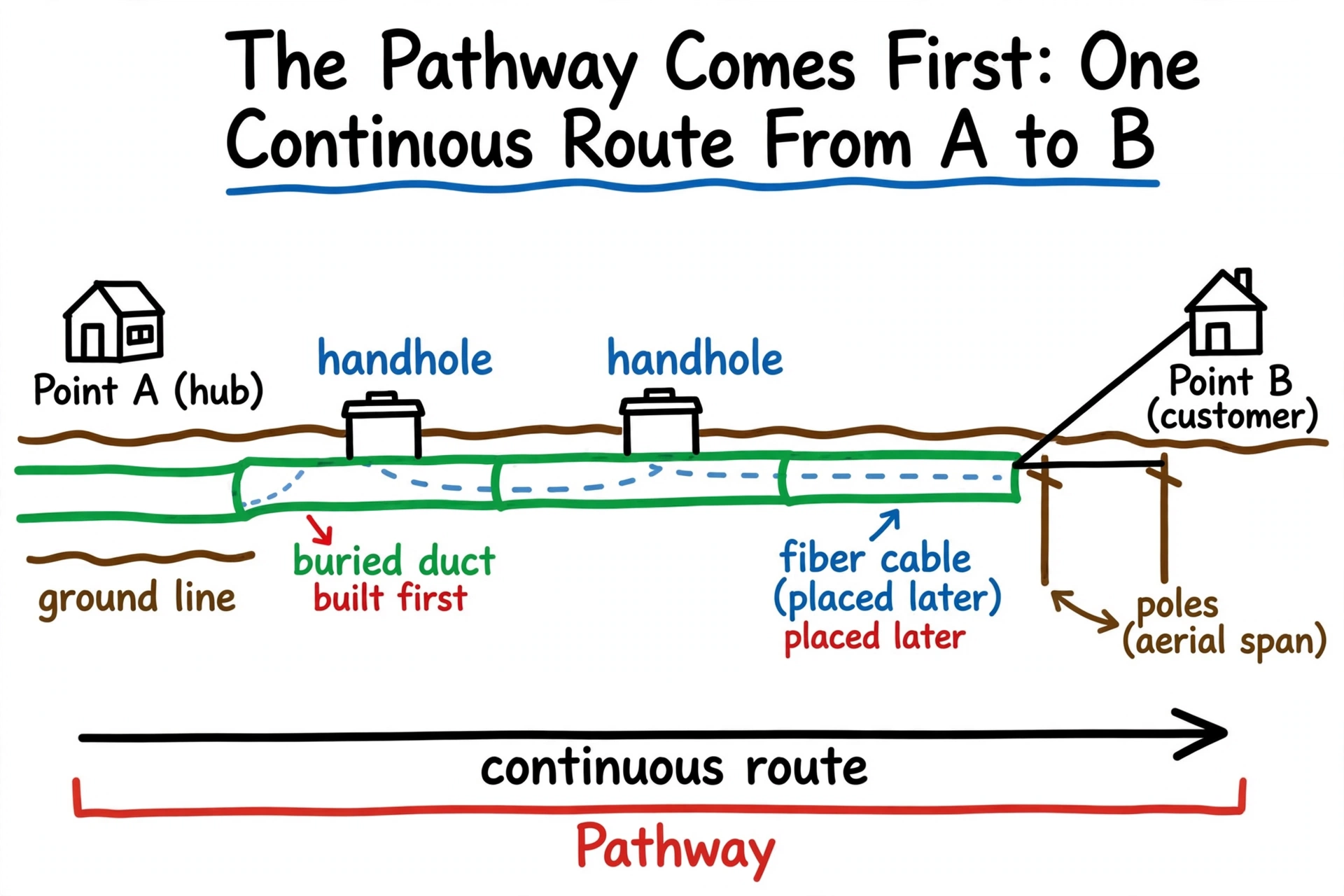
A pathway is a continuous, protected route built for fiber optic cable to travel through, from one point to another. The pathway is the route plus the protection around it. It is a complete thing on its own, and it exists before any cable goes inside it.
This lesson sits early in the course because the rest of outside plant construction is organized around the pathway. Design chooses it, permitting follows it, crews build it, inspectors verify it, and cable placement depends on it being ready. Lessons 4, 5, and 6 then define the parts that make pathways up.
What This Lesson Gives You
- Tell a pathway apart from the cable that travels inside it, in plain words, when someone mixes the two up.
- Read the surface signs of a pathway, including lids in a line, orange paint and flags, route marker posts, and a pole line, and say where the route likely runs.
- Judge whether a pathway is ready for cable by checking four qualities: continuous, protected, clear, and documented.
- Explain why a finished pathway can sit empty for months or years and still be doing its job.
- Spot the common pathway failures, including blockages, crushed sections, missing sections, and a wrong route, and name what each one stops.
Start With the Basics
Think about a city subway system. Before any train ever runs, somebody has to dig the tunnels, build the stations, and lay the tracks. The tunnel is separate from the train. The tunnel is the route the train will use someday. Fiber construction works the same way. Long before a fiber optic cable carries a single pulse of light, somebody builds a route for it to travel through. That route is the pathway.
The analogy maps to the real work in three ways:
- Built first. Tunnels and tracks exist before the first train, the same way a pathway is built before the first cable.
- Useless with a gap. A tunnel that stops ten feet short of the station carries no train anywhere. A pathway with one missing segment carries no cable.
- Separate decisions. The people who build tunnels make different decisions, on a different schedule, from the people who run trains on them. Pathway crews and cable crews split the same way.
A hallway in a new building makes the same point at a smaller scale. Carpenters frame the hallway before anyone moves through the building, and the hallway itself carries nobody. It makes movement possible later, and a hallway walled off halfway down helps no one reach the far rooms. The pathway is the hallway of the fiber network: a built route whose whole value is what it lets travel through it later.
Here is the basic idea in one sentence. A pathway is the combination of the route and the protection around it. The route says where the cable goes. The protection keeps the cable safe once it is there. When you understand the pathway, the rest of outside plant construction starts to make sense, because nearly everything else in the trade is organized around it.
What Is It?
A pathway is a continuous, protected route built for fiber optic cable to travel through, from one point to another.
Take that definition apart piece by piece.
- Route. The line the pathway follows across the land. Every pathway has a starting point, such as a network hub, and an ending point, such as a neighborhood or a customer building, and a planned line between them.
- Continuous. Unbroken from end to end. A pathway cannot have a gap in it. If you want to pull a cable through a tube that runs for a mile, that tube has to connect, segment to segment, for the whole mile. One missing link and the cable cannot get through.
- Protected. The cable inside is shielded from harm. How the protection works depends on how the pathway is built, covered below.
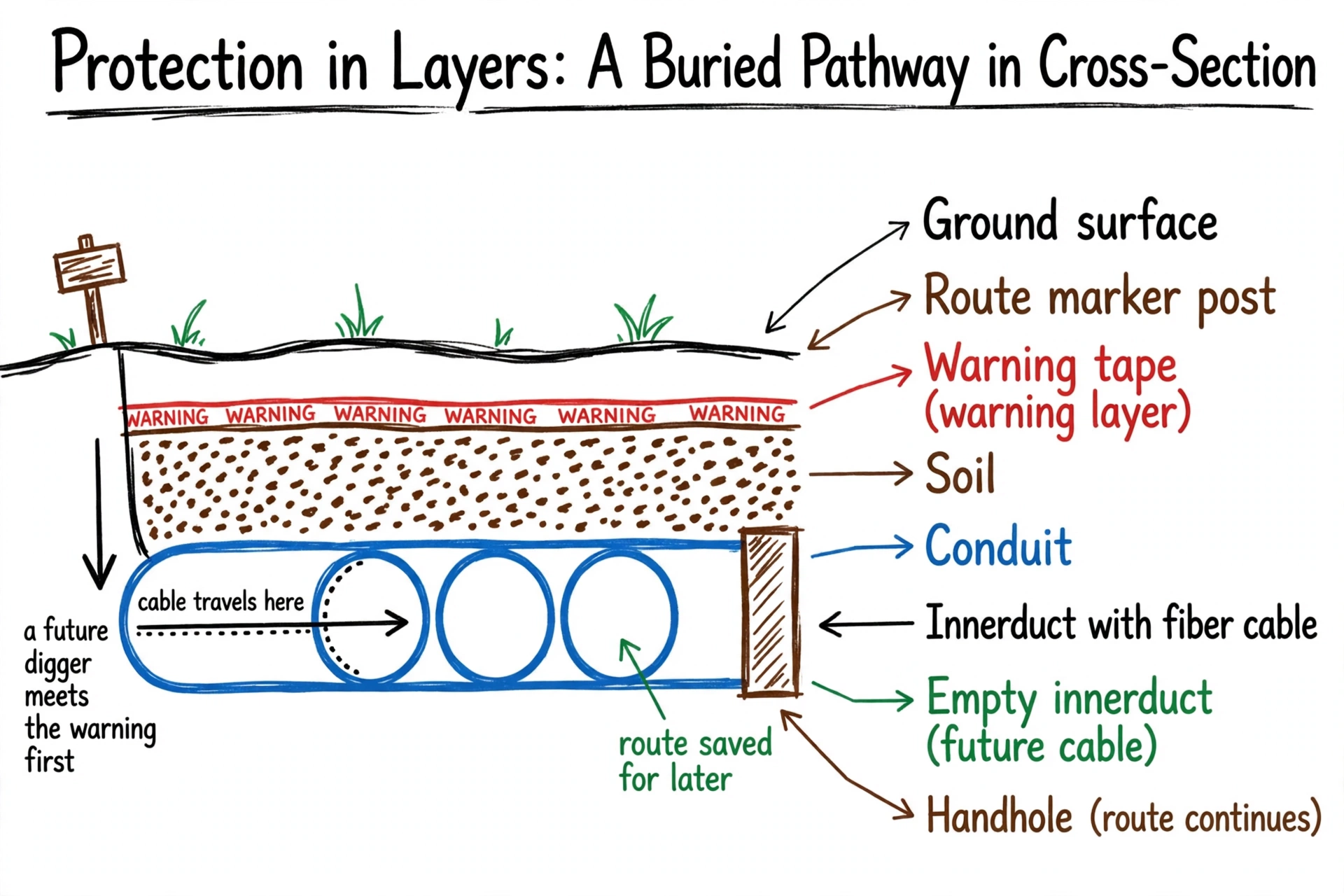
For buried pathways, protection usually comes from the tube the cable sits inside and from the soil around it. The physical parts have their own names, and they are the vocabulary of underground construction:
- Conduit. A tube, usually buried, that forms an underground pathway and protects the cable inside it. Lesson 4 defines conduit in full.
- Duct. In outside plant work, a large tube or pipe, often buried, that carries cable or smaller tubes. Conduit and duct are closely related terms, and the industry uses both.
- Innerduct. Smaller tubes placed inside a larger conduit or duct. One large tube can hold several innerducts, and each innerduct can carry its own cable. One pathway can therefore serve multiple future cables.
- Microduct. A very small tube, often installed in bundles, designed for small fiber cables. Crews use microduct where many small cables will be placed over time.
- Handhole. A small underground box with a lid, set at intervals along a buried pathway, giving workers access to the pathway for placing or servicing cable. Lesson 5 defines handholes in full.
For aerial pathways, the protection comes from the cable design itself and from keeping the cable up in the air, clear of excavation equipment and ground level hazards. The route is a pole line, a row of utility poles with cable or support strand strung between them. The cable is lashed, attached along the strand, so the span between poles holds it in place. Height does real protective work on an aerial route. Height has limits, covered in What Does It Look Like? and What Can Go Wrong?
A pathway is separate from the cable. Hold onto that distinction, because it is the central one in this lesson. The pathway is the route. The cable is the thing that travels the route and carries the data. They are separate decisions, often made by separate crews, sometimes years apart. A finished pathway with no cable in it is a normal sight in this industry. A cable with no pathway has nowhere protected to go.
There is no universal size, depth, or length that defines a pathway. Those numbers come from the design documents and the contract for each specific project.
What Does It Look Like?
A pathway looks different depending on how it is built. It always runs from point to point in connected pieces, and each construction type leaves its own signs.
Underground pathways are common, and you mostly cannot see them. What you see are the signs that a buried pathway is there:
- Lids and boxes in a line. A line of small lids or access boxes set in the ground at intervals tells you a pathway runs beneath that line. If the line of boxes turns, the pathway probably turns with it.
- Locate paint and flags. Orange flags and orange spray paint on the ground mark the approximate location of buried communications lines. Orange is the color code for communications, telephone, and cable lines, used by utility locators across the United States.
- Route markers. Small posts or signs that say “buried cable” or “fiber optic cable” mark where a route runs, turns, or crosses.
- Warning tape. A strip of plastic tape, printed with words such as “CAUTION: FIBER OPTIC CABLE,” is often buried in the soil above a conduit. If you see a trench open during construction and catch a glimpse of that colored tape before any pipe shows up, the tape is a warning layer sitting above the pathway.
Aerial pathways are visible. Look up:
- A pole line runs in a series, one pole after another, with cable strung between them.
- The pathway is the route the poles follow plus the space between them where cable can be lashed along a support strand.
- Where the poles stop and the ground starts showing access boxes, the pathway likely transitions from aerial to underground.
A real pathway often mixes the two types. A common layout is an underground run of duct between access boxes for most of a route, followed by a short aerial span on poles to cross a river or reach a building. The pathway is still one continuous route even though the construction type changes along the way.
One honest limit belongs in this section. Aerial height protects cable from excavation equipment and ground level hazards, and storms, ice, falling trees, and vehicle strikes still damage aerial cable regularly. Buried plant actually sees fewer physical faults. Neither construction type is safe from everything. Each one trades one set of hazards for another, and Lesson 2 compared the two methods directly.
You do not need to memorize dimensions for this lesson. Size, depth, and length live in the design documents and the contract for the project in front of you.
What Does It Do?
A pathway does three jobs. Each job explains a decision the industry makes every day.
First, it protects the fiber. Fiber optic cable carries data as pulses of light through strands of glass, and glass does poorly when it is crushed, kinked, or dug into. The pathway keeps the cable away from those hazards. Buried pathways put earth and tubing between the cable and the surface world, so a shovel, a tire, or a mower meets soil and tube before it can reach glass. Aerial pathways put height between the cable and everything on the ground, so ground level work happens below the cable instead of through it. Protection is the pathway acting as a buffer between fragile glass and a rough environment.
Second, it provides a route for future cable. This is the subtle job, and it explains the timing of the whole industry. The pathway separates two decisions: where the cable will go, and when cable goes in. A company can build the pathway now and place the cable later, when funding arrives or when customers sign up. The route decision is settled up front. The cable decision can wait. Every empty tube in the ground is that separation made physical: the expensive, disruptive route work is done, and the cable expense is deferred until the cable is actually needed.
Third, it makes cable installation possible. Pulling, pushing, or blowing fiber cable through an existing continuous tube is far easier and faster than digging a new trench every time a project needs to add cable. A well built pathway turns a future construction project into a simple cable placement job. Those placement methods get their own lesson later in the course. For now, hold onto the dependency: every one of them assumes the pathway is already there, continuous, and clear.
Notice what the pathway never does. It carries no signal, processes nothing, and connects no customer by itself. Its work is physical and preparatory. That is exactly why it is easy to undervalue, and exactly why the next sections treat its condition as seriously as they do.
Where Does It Fit?
The pathway comes first in the build sequence, and almost everything else depends on it.
- Design decides where the pathway goes. Designers choose the route, avoid obstacles, and decide which parts are buried and which parts are aerial.
- Permitting usually follows the pathway. Permits are tied to where you dig or set poles, which is the pathway route, rather than the cable inside it.
- Inspection checks the pathway at multiple stages: while it is being built, covering questions such as whether the trench is right and the tube is connected, and again before cable goes in, covering whether the pathway is continuous, clear, and usable. An inspector’s main job on a pathway is to confirm it is ready to receive cable.
- Cable placement comes last, sometimes much later. A pathway commonly sits in the ground for months or even years before the fiber cable is installed. When the cable crew finally arrives, their first assumption is that the pathway is continuous, protected, and clear of blockages. When that assumption fails, the cable crew cannot do its job, and the failure belongs to a phase of work that may have closed long before.
This lesson connects to the lessons around it. Lesson 2 compared underground and aerial construction, and pathways are what those two methods build. Lesson 4 defines conduit in detail. Lesson 5 defines handholes. Lesson 6 covers poles and aerial construction.
What Is at Stake
The pathway is built first, so every mistake in it multiplies. A pathway that is wrong, damaged, or blocked keeps the cable out, or lets the cable in and fails later. Fixing a pathway problem is always harder than building it right the first time, for a simple physical reason: the fix usually has to go through finished ground to reach a problem the original crew could touch with their hands.
Consider what a blocked tube means in practice. The pathway was built. The trench is closed and paved over. Landscaping is done. Then the cable crew arrives, feeds a line into the tube, and hits a blockage halfway through. Now someone has to figure out where the blockage is, dig up finished ground, cut out the bad section, repair it, and restore the surface. That rework costs money and time nobody budgeted, and the project schedule slips while the repair is designed, permitted, and dug. A pathway problem discovered late is an expensive and disruptive problem in fiber construction.
The stakes reach past the repair bill:
- Schedule. Projects are sequenced around the assumption that the pathway will be ready. Downstream crews handling cable placement, splicing, and testing stand idle or get rescheduled when it is not ready, and the delay cascades from crew to crew.
- Property and permission. A pathway built somewhere other than the designed and permitted location can cross property the project has no right to occupy. The fix then involves legal correction or rebuilding the route, and both are slower than construction.
- Future safety of the route. Records, route markers, and warning tape are how future diggers learn a pathway is below them. A pathway that is poorly documented or built off its recorded line leaves the next excavation crew working from a wrong picture of the ground.
- The cable itself. A pathway that has lost its protection can still accept a cable, and that cable then lives exposed to the crush, water, and dirt the pathway was built to keep out. The failure arrives later, after everyone has stopped watching that section.
What Does Good Look Like?
A usable pathway has four basic qualities: continuous, protected, clear, and documented. These are general good practice. Every project has its own contract documents and specifications, and those documents are what a pathway is actually judged against. Standing on a route, a person can verify each quality:
- Continuous. The pathway connects unbroken from one end to the other. Every segment joins the next. In an underground run, the tube sections are connected at every joint, and the route can be traced from access box to access box without a gap.
- Protected. The cable inside is shielded from the environment it will live in. For buried pathways, the tubing is intact and buried, with warning tape or other marking layers above it where the design calls for them. For aerial pathways, the route keeps the cable clear of hazards at the height and clearance the design specifies.
- Clear and usable. Nothing inside the pathway blocks a cable from passing through. This quality needs active checking because pathways often sit empty for a long time. Dirt, water, collapsed sections, or construction debris can get in between the pathway build and the cable installation. Common industry practice is to proof a conduit before cable goes in: pushing a rigid gauge, called a mandrel, through the tube to confirm the tube is clear and undamaged. Manufacturer guidance, such as CommScope’s conduit construction manual, recommends proofing existing conduit to confirm that obstructions are cleared and that continuity and alignment are good. Whether proofing is required on a given project depends on the contract. Clear is a condition a crew verifies with a proofing pass. Assuming a tube is clear is how blockages survive to meet the cable crew.
- Documented. The pathway is recorded: where it runs, what it is made of, and where its access points are. Documentation lets a future crew find the pathway, verify the route, and place cable in it years later. A pathway nobody can find or verify is barely better than no pathway at all.
From the Field
Picture a contractor building the fiber pathway for a new subdivision while the subdivision’s own roads are still under construction. The design is simple: a run of buried tube from the road entrance to a series of access boxes, one near each street. No fiber cable will be placed yet. The plan is for the pathway to wait until homeowners arrive and order service.
The road work is running behind, and the paving crew is pressing every other trade to clear out of its way. The pathway foreman gets the suggestion he expected: skip the proofing pass, close everything up, and let the cable crew deal with the tube when cable day comes. The tube went in clean, the argument goes. Everyone saw it.
The inspector on the route makes the other call. Each run gets proofed, and each joint gets checked, while the trench work and the access boxes are still easy to reach and the roads are still dirt and gravel. The mandrel run takes little time on the finished streets. On one run it stops partway.
The crew opens that section the same day and finds the cause: a joint had separated during backfill, and dirt had poured into the open tube. The repair is ordinary work at this stage. They dig a short stretch of unfinished road, reseat the joint, clean the tube, proof the run again, and watch the mandrel come through. The roads then get paved, the landscaping goes in, and the pathway sits empty for two years, exactly as planned.
When the first homeowners order service, a cable crew opens the access boxes and places fiber through the existing pathway in a matter of days. No new trenching. No torn up streets. The route decision was made and built during road construction, and the cable decision waited until there were customers, which is the separation this lesson teaches.
Run the skipped proofing version in your head. The same separated joint waits underground while the street is finished over it. Two years later the cable crew’s line stops dead halfway through the run, and the finished street has to be cut open, the bad joint found and repaired, and the pavement restored. Same pathway, same cable, same defect. The only difference is when somebody chose to look.
The decision rule to carry: proof the pathway and confirm its joints before the surface closes over it. Buried and out of sight proves nothing about a tube. A mandrel that travels the full run is evidence the route will work when the cable crew arrives, and evidence is cheapest while the ground is still open.
What Can Go Wrong?
Four common pathway problems, with what each one causes.
- Blockages. Dirt, rocks, or construction debris get inside the tube, or a section collapses. Cable cannot be placed through that section. The blockage must be located and cleared, or the section repaired, which usually means digging. Water gets into buried tube too, and water alone does not stop a cable. The stoppers are solids and collapsed walls.
- Crushed or damaged sections. Heavy equipment drives over an unprotected tube, or a joint was poorly connected and separates under load. The pathway loses its protection, and possibly its continuity. Water and dirt enter, and future cable is at risk even when it can still be placed.
- Missing sections. A segment of tube was never installed, or an access box was never set where the design required one. The pathway fails the continuous test. Cable cannot pass, and the missing work has to be built, often after the surface above it was already finished.
- Wrong route. The pathway was built somewhere other than the designed and permitted location. The cable ends up in the wrong place, the pathway may cross property it has no right to be on, and the fix involves either legal correction or rebuilding the route.
Every one of these problems is preventable with careful construction and inspection, which is exactly why inspectors check pathways before cable goes in.
What Should Someone Notice in the Field?
You do not need to be qualified to build or inspect a pathway to start recognizing one. Beginner level observations anyone can make from the surface:
- Lids and boxes in a line. A row of small access lids or boxes set in the ground at intervals usually means a buried pathway runs beneath that line. If the line of boxes turns, the pathway probably turns with it.
- Route markers. Posts or signs that say “buried cable” or “fiber optic” mark a pathway’s location. They exist so the route can be found years later and so future diggers know something is below.
- Paint and flags. Colored paint lines and small flags on the ground mark buried utilities. Orange marks communications lines. Orange paint or flags are a sign that a fiber or telecom pathway is near the surface there. These marks come from utility locating, the process where buried lines are marked before digging. In the United States, the free 811 “call before you dig” service coordinates that marking.
- Warning tape in an open trench. Excavation work that exposes a strip of colored plastic tape printed with a warning message is showing you a warning layer. That tape sits above a buried pathway.
- A pole line. Poles in a row with cable or support strand between them are an aerial pathway. Where the poles stop and the ground shows access boxes, the pathway likely transitions from aerial to underground.
- Open trench with tube being placed. A trench with long sections of tube being joined and laid in it is a pathway under construction. The cable is absent, and it may stay absent for a long time. That is normal.
- A condition worth reporting. A lid line that disappears where drawings say the route continues, fresh paving over a spot where an access box should sit, or a route marker knocked flat are observations worth passing to the project team, with a photo and a location.
The safety boundary, stated plainly:
- Recognizing a pathway is observation work. Building, opening, excavating, or repairing one is crew work for trained and authorized people.
- Never dig to check whether a pathway is really there, and never treat paint, flags, or markers as exact locations. Locate marks show approximate locations, and the digging itself belongs to qualified crews working under the project’s procedures.
- Reading this lesson teaches recognition. It qualifies nobody for excavation, conduit work, pole work, or any other regulated or hazardous task.
Key Terms
- Pathway. A continuous, protected route built for fiber optic cable to travel through, from one point to another. The route plus the protection around it. The pathway is separate from the cable.
- Conduit. A tube, usually buried, that forms an underground pathway and protects the cable inside it. Defined in full in Lesson 4.
- Duct. In outside plant work, a large tube or pipe, often buried, that carries cable or smaller tubes. Conduit and duct are closely related terms, and the industry uses both.
- Innerduct. Smaller tubes placed inside a larger conduit or duct. One large tube can hold several innerducts, and each innerduct can carry its own cable, so one pathway can serve multiple future cables.
- Microduct. A very small tube, often installed in bundles, designed for small fiber cables. Used where many small cables will be placed over time.
- Handhole. A small underground box with a lid, set at intervals along a buried pathway, giving workers access to the pathway for placing or servicing cable. Defined in full in Lesson 5.
- Pole line. A row of utility poles with cable or support strand strung between them, forming an aerial pathway.
- Continuity. The quality of being unbroken from end to end. A pathway has continuity when every segment connects to the next with no gaps.
- Blockage. Anything inside a pathway that stops cable from passing through: dirt, debris, or a collapsed or crushed section.
- Proofing. Checking that a conduit is clear and undamaged before cable is placed, commonly by pushing a rigid gauge, a mandrel, through the tube.
- Mandrel. The rigid gauge pushed through a conduit during proofing. A mandrel that travels the full run confirms the tube is clear, continuous, and aligned well enough for cable.
- Warning tape. A strip of printed plastic tape buried in the soil above a conduit, warning future diggers that a cable or pathway is below.
- Route marker. A post or sign at the surface marking where a buried pathway runs, so the route can be found and avoided by future excavation.
Check Your Understanding
- A contractor finishes building a pathway along a new road. No fiber cable is installed yet. Is the project incomplete? Explain why or why not.
- You are walking a site and see a row of small lids set in the ground, turning a corner at the end of a block. What does that most likely tell you about what is underground?
- In From the Field, the inspector chose to proof each run before the subdivision roads were paved, and the mandrel stopped on one run. What did that timing buy the project, and what would the same separated joint have cost if the cable crew had found it two years later?
- Why is it useful to separate the route decision, where the pathway goes, from the cable decision, when cable gets installed? Give one practical reason.
- True or false: a pathway and a fiber optic cable are the same thing. Explain your answer.
Answer Key
- Not necessarily. A pathway is the route, and the cable is a separate decision that often comes later. The pathway phase is complete when the route is continuous, protected, clear, and documented. Cable placement is a later phase that depends on the pathway being ready.
- It most likely means a buried pathway runs beneath that line of lids, and the pathway turns the corner where the lids turn. The lids are access points along the route.
- The timing bought a cheap repair. The separated joint was found while the roads were still unfinished, so the crew dug a short stretch, reseated the joint, cleaned the tube, and proofed the run again the same day. Found two years later, the same defect would have stopped the cable crew’s line halfway through a finished street. The fix would then have required cutting open the pavement, locating and repairing the joint, and restoring the surface, turning a days long cable job into a weeks long excavation project. The rule: proof before the surface closes, because buried and out of sight proves nothing.
- It lets the expensive, disruptive work, such as trenching, boring, and setting poles, happen once, at the best time, such as during road construction, while the cable, which is also expensive, is purchased and installed only when it is actually needed, such as when customers sign up. Any practical reason along these lines is correct.
- False. The pathway is the continuous, protected route. The cable is the thing that travels the route and carries the data signal. They are separate parts of the network, often built and installed at different times.
Lesson Takeaway
A pathway is the route plus the protection: a continuous, protected path built for fiber cable to travel through, from point A to point B, existing as a complete thing before any cable goes inside it. After this lesson, the signs read differently. A line of access lids, a row of poles, orange paint on the ground, and a route marker post are the visible surface of one connected route, and the questions that matter about that route are always the same four: Is it continuous? Is it protected? Is it clear? Is it documented? The next three lessons define the parts that make pathways up: conduit in Lesson 4, handholes in Lesson 5, and poles in Lesson 6.
Sources and Technical References
- The Fiber Optic Association (FOA) Reference Guide, Outside Plant: https://foa.org/tech/ref/OSP/jargon.html. FOA’s illustrated jargon reference; defines cable as providing protection to the fiber for its environment, and distinguishes cable types for OSP applications.
- FOA Lesson Plan: Fiber Optic Cable (Fiber U): http://fiberu.org/OSP/LP6.html. Covers OSP cable types (underground, direct burial, aerial) and how cable choice relates to the installation environment.
- CommScope, ConQuest Conduit Construction Manual: https://ja.commscope.com/globalassets/digizuite/2325-conduit-const-manual-co-107146.pdf. Manufacturer guidance recommending “proofing” existing conduit (rigid mandrel, roughly 90 percent of inner diameter) to confirm obstructions are cleared and continuity and alignment are good before cable work. (Referenced via a search snippet; the specific 90-percent figure is CommScope’s recommendation, not a universal rule.)
- POTS and PANs blog, “Installing Fiber in Conduit”: http://potsandpansbyccg.com/2015/09/18/installing-fiber-in-conduit/comment-page-1/. Describes the build sequence (conduit buried first, fiber placed later by pulling, pushing, or blowing), innerduct as smaller tubes inside a larger conduit, and factory-installed pull cords.
- NYSDOT specification excerpt, “Rod and Clean Conduit”: https://www.dot.ny.gov/portal/page/portal/spec-repository-local/680.995600MO.pdf. Example of a contract specification requiring a mandrel passed through the full conduit run before cable installation. Contract-specific, not universal.
- 811 utility locate marking practices (orange = communications): https://www.dekalbcountyonline.com/811-the-number-to-call-before-digging/, https://www.centerpointenergy.com/en-us/safety/call-before-you-dig. US practice; paint color codes and 811 procedures vary by state.
← Previous: Lesson 2: Underground vs. Aerial | Level 1 Hub | Next: Lesson 4: What Is a Conduit? →