
Introduction
Fiber cable has to travel from one place to another, and the cable travels in one of two places: below the ground or above it on poles. Underground construction puts the cable in the earth. Aerial construction hangs the cable in the air, supported by poles. This lesson defines each method, shows what each one looks like, and explains how the cable gets installed each way.
The choice between the two methods shapes cost, schedule, reliability, and repair work for the life of the network, so it is taught early. Lesson 1 defined the outside plant, the physical network hardware outside buildings. This lesson covers the two routes that hardware can take between buildings, and later lessons take up the parts of each route in detail: conduit in Lesson 4 and handholes in Lesson 5.
What This Lesson Gives You
- Name the two places fiber cable can travel and define each method in plain words
- Recognize underground and aerial plant in the field from surface signs alone
- Walk through the basic installation sequence for each method, step by step
- Explain why a project chooses underground, aerial, or a mix of both on one route
- Spot the common failure signs for each method and know what to report
Start With the Basics
Think of the cable run as a trip between two buildings. One route for the trip runs through a tunnel. The tunnel shields the traveler from weather and traffic, and a breakdown inside the tunnel is hard to reach and slow to fix. The other route runs across an open bridge. The bridge is quicker and cheaper to build, the traveler is in plain sight the whole way, and a breakdown is easy to reach. The bridge leaves the traveler exposed to storms the whole time. Fiber placement works the same way. Underground is the tunnel: protected, hidden, and harder to reach for repairs. Aerial is the bridge: visible, faster to build, and exposed to weather.
Every other point in this lesson hangs on that one picture. The cable does the same job either way. The path decides what can hurt it, what it costs to build, and how a crew gets to it when something fails.
What Is It?
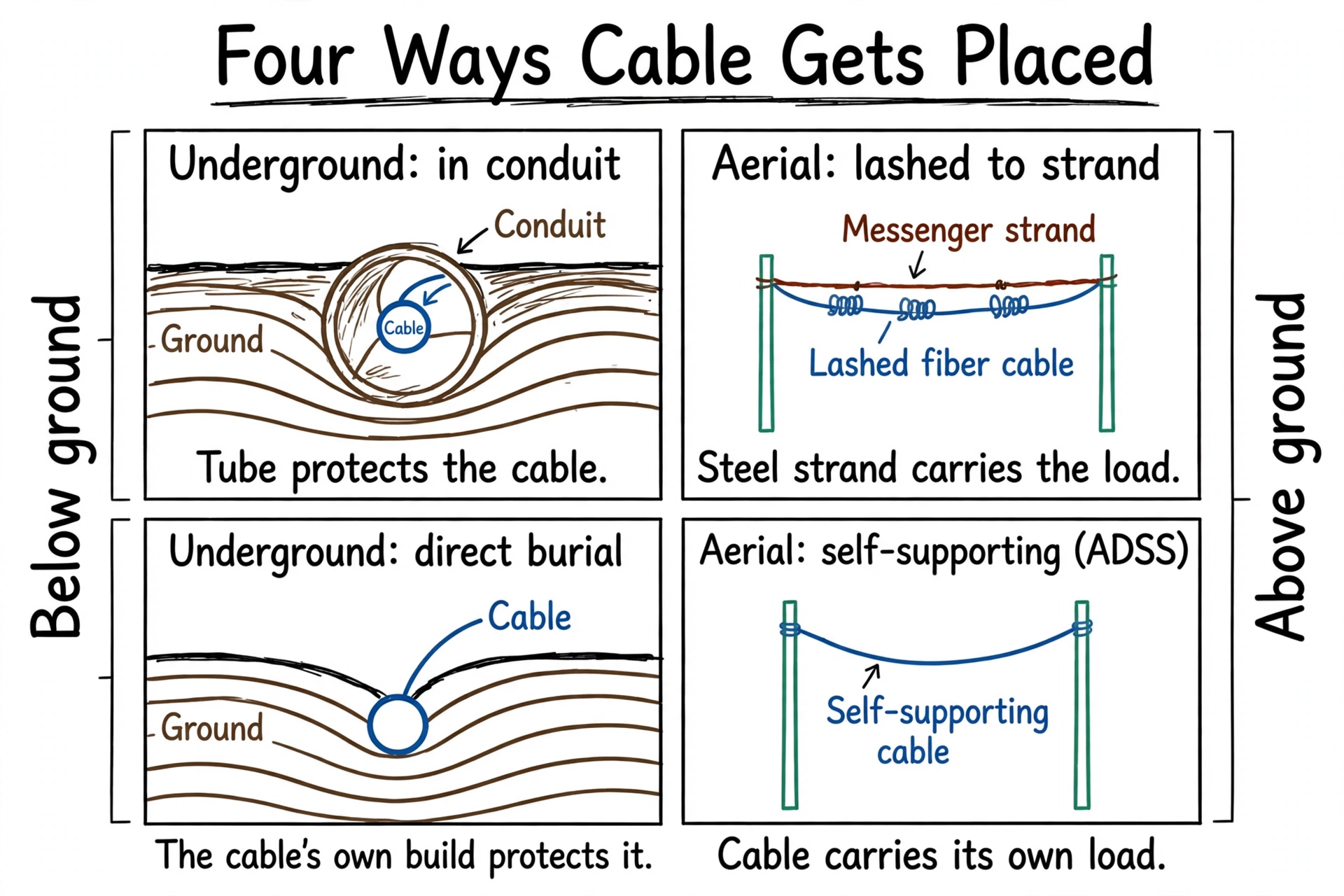
Underground construction is fiber cable installed below the surface of the ground. It takes two main forms:
- Conduit installation: the cable is pulled or blown through a conduit, a tube placed underground that protects the cable and leaves a path for future cable. Conduit gets full treatment in Lesson 4.
- Direct burial: the cable is placed directly in the earth with no conduit around it, using cable built for that duty.
Underground construction is the umbrella term for every method that puts the cable in the dirt.
Aerial construction is fiber cable installed above the ground, supported by utility poles. A utility pole is a tall post, usually wood, set into the ground to carry wires overhead. Poles carry electric wires and communication wires, and fiber is one more kind of wire hanging on them.
Fiber cable alone cannot carry its own weight across a long span of open air, so aerial cable is supported in one of two ways:
- Lashed cable: the fiber cable is tied to a separate steel support cable called a messenger strand, often shortened to strand. The tying is done with a thin wire wrapped in a spiral around both cables, and that wrapping is called lashing.
- Self-supporting cable: the cable is built with a support element inside its own body, so it can span between poles with no separate strand. One common type is ADSS, short for all-dielectric self-supporting cable. All-dielectric means the cable contains no metal at all, a property that matters near power lines. Another self-supporting style is figure-eight cable, shaped like the number 8 in cross-section, with the strength element in the upper loop.
One ownership fact shapes all aerial work. The company installing fiber almost never owns the poles. Poles are typically owned by an electric utility, a telephone company, or a municipality. The fiber company gets written permission to attach to them. The work of preparing a pole to accept a new attachment is called make-ready. Permission and make-ready are business and permitting topics covered in later lessons. Here, the point to carry is simple: aerial fiber is usually a guest on someone else’s structure.
What Does It Look Like?
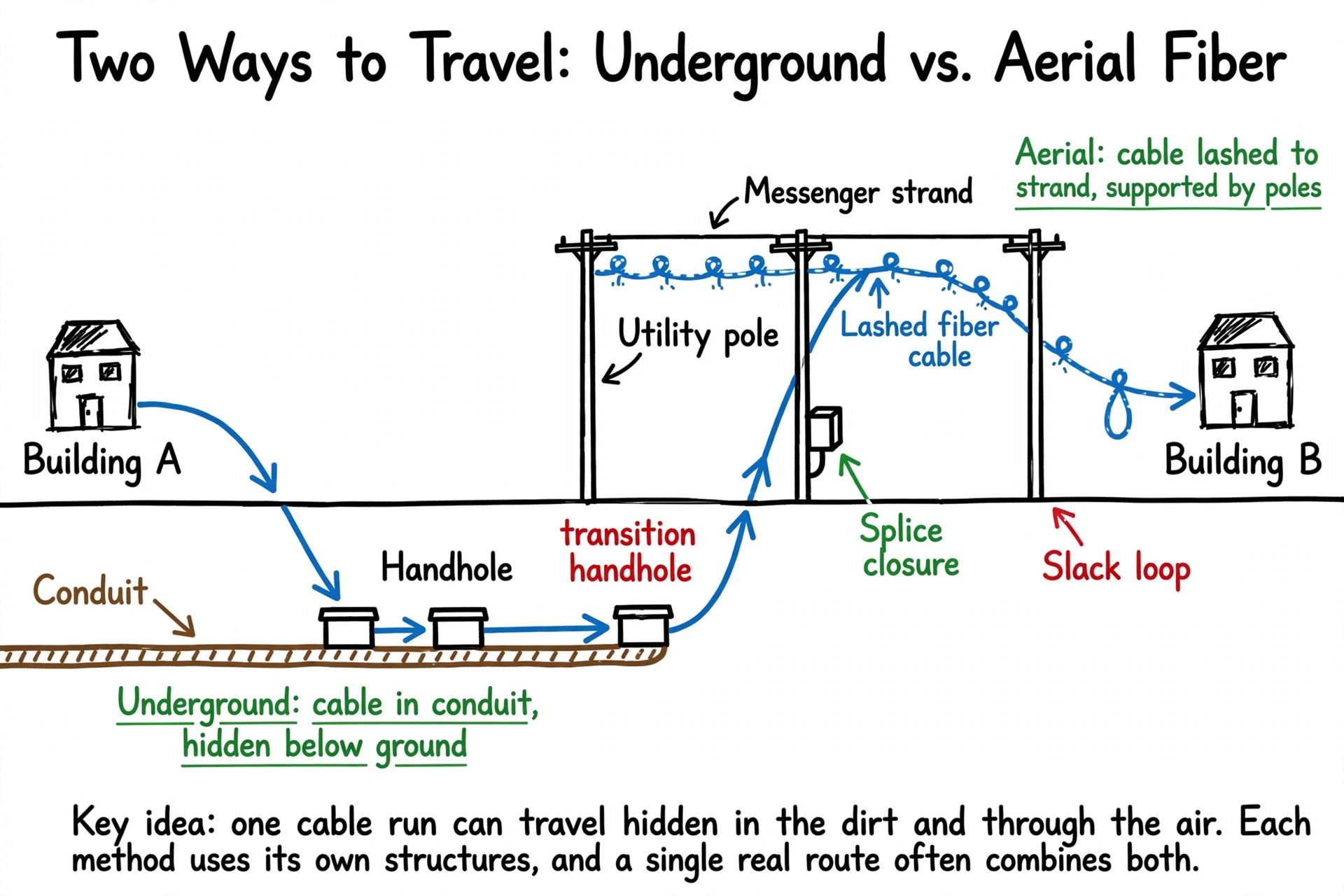
Underground, finished work. A finished underground route is designed to disappear. Look for these signs:
- A row of small green or gray lids flush with the grass or pavement along a street. Those lids belong to handholes, shallow buried boxes with removable lids where workers reach the cable for connections. Lesson 5 covers handholes in detail.
- Narrow disturbed strips of soil or pavement where a trench was dug and refilled
- Small warning markers or signs stating that fiber is buried nearby
Underground, during construction. The work is visible while it happens:
- Open trenches or bored holes
- Reels of conduit staged along the route
- Excavation and boring equipment at work
Aerial. Aerial fiber stays in the open and is easy to see:
- Poles standing in a line along streets or alleys
- Cables running through the air between poles in long, shallow curves
- The fiber cable hanging just below a slightly thicker steel strand, held to it by the spiral wrap of lashing wire
- Small loops of extra cable at poles, called slack loops or drip loops. A slack loop stores spare cable for future work, and its downward loop lets water drip off the cable instead of running into the connection point.
- Enclosed boxes mounted on poles at intervals. Those are splice closures, weatherproof cases where individual fiber strands are joined together.
Compared with underground, aerial looks busier, because every part of it sits in plain view.
What Does It Do?
Both methods do the same job in the network: carry the fiber cable from point A to point B and keep it safe along the way. The difference is the path the cable takes and the work that path requires.
How underground installation works, at a beginner level:
- The route is prepared first, by digging a trench or by boring, which drills a hole underground without opening the surface. Boring is how a route passes under a road without tearing the road up.
- If conduit is used, the tube is placed in the trench or pulled through the bore, and handholes are set at intervals along the route.
- The cable is then pulled or blown through the conduit from one handhole to the next. Pulling means a rope is threaded through the conduit first, the cable is attached to the rope, and workers or a winch draw the cable through. Blowing uses compressed air to push the cable through, a method that is gentler on the cable over long runs.
- Connections between cable sections are made at the handholes, and the joined fibers are sealed inside closures.
Each step exists for a reason. The conduit gives the cable a protected, repeatable path. The handholes break the route into reachable sections, so a crew can install, join, and later service the cable without digging up the whole run.
How aerial installation works, at a beginner level:
- The poles are prepared, and the messenger strand is strung from pole to pole and tensioned, pulled to the tightness the design calls for. The strand is the load-bearing member of the span.
- The fiber cable is raised into position beside the strand.
- A tool called a lasher travels along the strand and spirals lashing wire around the strand and the cable together, binding them as it goes.
- Self-supporting cable skips the lashing step. It is pulled across the spans and attached at each pole with hardware made for that cable.
- Connections between cable sections are made at the poles. Closures are mounted on the pole or on the strand, and slack loops are stored at the pole for future access.
The mechanism to remember is load path. In lashed construction, the strand carries the weight and the wind load, and the fiber cable rides along underneath. In self-supporting construction, the cable carries its own load through its built-in strength element.
Where Does It Fit?
Underground and aerial are choices made during route design, the step where engineers decide exactly where the cable will go. Many real networks are hybrid routes: aerial along one stretch, underground along another. A single route might run aerial through a rural area where poles already exist, drop underground where it crosses a city that requires buried utilities, and go aerial again on the other side.
Underground work interacts with:
- Trenches, bores, conduit systems, and handholes
- Roadways and sidewalks
- Existing buried utilities: water, gas, electric, and sewer lines
- Tree roots and property boundaries
Aerial work interacts with:
- Poles, messenger strand, lashing wire, and pole-mounted closures
- Electric power lines, telephone wires, and cable television lines sharing the same poles
- The pole owner, whose permission and preparation work set part of the schedule
What Is at Stake
The choice between underground and aerial is one of the biggest decisions in any fiber project, and it reaches into cost, schedule, reliability, and records.
- Cost. Aerial construction generally costs less per foot of route than underground, because there is no digging. The poles often already exist, so the fiber company pays for attachment and labor rather than excavation. Underground construction costs more because digging, boring, restoring pavement, and placing handholes all cost money. Treat this as a general industry pattern with real exceptions. Crowded poles that need replacement work can erase the aerial savings, and easy rural trenching can be cheap.
- Schedule. Aerial work is usually faster to build. No excavation means fewer crews and faster daily production. Underground work is slower, because digging and surface restoration take time, and underground permits can involve more authorities.
- Reliability. Underground cable is protected from weather. Storms, falling trees, and vehicles cannot easily damage cable they cannot reach. Aerial cable is exposed to all three. Underground cable carries a different threat: dig-ups, damage caused when someone excavates later and strikes the buried cable. Each method has its own main threat, and neither method is safe from everything.
- Maintenance access and repair time. Aerial faults are easy to find, because a broken pole or a cable hanging on the ground announces itself. Repair crews can usually reach the problem quickly. Underground faults are harder to locate and require excavation to fix, which makes repairs slower and more expensive. Underground plant tends to fail less often from weather and takes longer to repair when it does fail.
- Permitting. Both methods require permits, from different authorities and with different complications. Underground permits deal with digging in public rights of way and working around other buried utilities. Aerial permits deal with attaching to poles the fiber company does not own, and the pole owner’s make-ready work can take significant time.
What Does Good Look Like?
Good underground work:
- Cable installed with no damage during the pull or the blow
- Handholes placed at intervals that keep the cable reachable
- Conduit paths continuous and sealed
- Surface restored so the finished route does not look disturbed
- Accurate records of exactly where the cable lies, because the cable itself cannot be seen once the route is closed
Good aerial work:
- Cable lashed neatly and snugly to the strand, with no loose hanging sections
- Consistent spacing of the cable above the ground along the route
- Clean transfers where the cable passes each pole
- Closures mounted securely, with slack stored properly
- Plant clear of trees, buildings, and other cables
- Strand properly tensioned and terminated, because the strand carries the load
Acceptance specifics such as burial depth, clearances, and restoration standards come from contract documents and manufacturer specifications, which differ by project. Standard practice and contract requirements are separate things. Work can follow accepted industry practice and still fail a stricter contract specification, so the contract governs acceptance on any given job.
From the Field
Picture a route designer and a field inspector walking a proposed route between a downtown district and a rural road, about three miles end to end. The first cost sketch assumed aerial construction the whole way. Poles line the rural road, and aerial work is the faster, cheaper build, so the early plan simply extended the same method into town.
The walk changed the plan. Downtown, the city requires utilities to be buried, so an all-aerial design would stall at permitting no matter how much it saved on paper. The poles downtown were also crowded with existing attachments. The rural stretch told the opposite story: poles already standing, clear airspace, and two miles of trenching that would cost more and take longer than the aerial build it replaced.
The decision was to split the route. The first mile runs underground in conduit, with handholes, through the downtown district. At the edge of downtown, the conduit ends at a handhole and the cable rises up a pole to become aerial. The remaining two miles run lashed to strand on the existing poles.
The hybrid design cost more than the all-aerial sketch and less than burying the full three miles. It also cleared permitting, because each stretch now matched the rules and conditions of the ground it crossed. The transition point at the handhole was recorded on the route documents, so a future crew can find the exact spot where the plant changes from buried to aerial.
The decision rule: choose the method stretch by stretch, from the rules and conditions on that stretch, and record every place the route changes methods.
What Can Go Wrong?
Underground failure modes:
- Fiber cut during later excavation. Another party digs in the area and strikes the buried cable. Service stops instantly, and the repair is expensive. This is the most common serious failure of buried plant.
- Installation damage. Cable pulled too hard or bent too sharply during the pull can be damaged before it ever carries service.
- Water intrusion. Water entering poorly sealed closures or handholes damages connections over time.
- Rodent damage. Rodents can chew exposed cable in buried structures and conduit ends.
- Settling handholes. A handhole set out of level can sink or fill with debris, which makes later access harder.
Aerial failure modes:
- Storm damage. Trees falling on spans, plus wind and ice loading, can break strands and poles. This is the most common serious failure of aerial plant.
- Vehicle strikes. A vehicle hitting a pole can bring down every cable on it.
- Failed lashing. Lashing wire applied poorly can unravel, leaving the cable unsupported.
- Excess sag. Cable hanging too low can be snagged by traffic or equipment.
- Electrical proximity. Aerial plant shares poles with power lines, so work near power is restricted to qualified workers. The hazard is present even when the fiber itself carries no electricity.
These are the routine failure modes the industry designs around. Every network is built expecting some of them to happen over its lifetime.
What Should Someone Notice in the Field?
Underground signs to look for:
- Handhole lids at regular intervals along a route. They are the fingerprints of buried cable.
- Narrow restored strips in grass or pavement
- Warning markers or signs stating that fiber is buried nearby
- Excavation happening near handholes or along a buried route. Digging near buried cable is worth noting, because accidental damage during digging is the main threat to buried plant.
Aerial signs to look for:
- The messenger strand and the lashed fiber cable below it, span by span
- Slack loops stored at the poles
- Cable hanging much lower than its neighbors
- Cable visibly dragging or separated from the strand
- Poles that lean heavily
- Splice closures open or hanging loose
Safety boundary:
- A cable down on the ground near a pole, or anything touching power lines, is a stay-clear situation. Downed lines can be energized.
- Notice the condition, stay clear of it, and report it to someone qualified. Recognizing a hazard never qualifies a beginner to approach it or work on it.
Key Terms
- Underground construction: fiber cable installed below the surface of the ground, either in conduit or buried directly.
- Aerial construction: fiber cable installed above the ground, supported by poles.
- Conduit: a tube, usually plastic, placed underground to protect cable and allow future cable to be pulled through. Full detail in Lesson 4.
- Direct burial: an underground method in which cable is placed directly in the earth without conduit, using cable built for that duty.
- Handhole: a small buried box with a removable lid that gives workers access to underground cable for connections and maintenance. Full detail in Lesson 5.
- Utility pole: a tall post, usually wood, set in the ground to carry wires overhead. Poles are usually owned by a utility or municipality, and fiber companies attach to them with permission.
- Messenger strand: a steel support cable strung between poles. The fiber cable is lashed to it. Often shortened to strand.
- Lashing: the thin wire spiraled around the messenger strand and the fiber cable together to bind them, and the act of applying it.
- Self-supporting cable: fiber cable built with its own internal support element, so it can span between poles without a separate messenger strand. ADSS is one common type.
- ADSS: all-dielectric self-supporting cable. All-dielectric means the cable contains no metal.
- Splice closure: a weatherproof case where fiber strands are joined together, placed underground in handholes or mounted on poles in aerial plant.
- Slack loop (drip loop): a loop of extra cable stored at a pole or handhole, used for future repairs and to let water drip off the cable.
- Make-ready: the work of preparing a utility pole to accept a new attachment.
- Hybrid route: a route that uses underground construction on some stretches and aerial construction on others.
- Dig-up: damage to buried cable caused by later excavation striking it.
Check Your Understanding
- In one or two sentences, explain the difference between underground and aerial fiber construction.
- A new office park requires that no overhead wires be visible anywhere on the property. Which construction method must be used, and what underground access points would you expect to see along the route?
- Why can aerial construction often be built faster and for less money than underground, and what is one situation where that advantage might disappear?
- In the From the Field story, the first plan was aerial construction for the full three miles. What did the route walk reveal, and what decision rule came out of it?
- You are driving a route and you see a cable hanging much lower between two poles than its neighbors, with no tension on it. What does that observation likely mean, and what should you do?
Answer key
- Underground construction places fiber cable below the surface of the ground, in conduit or buried directly. Aerial construction hangs fiber cable above the ground, supported by utility poles, either lashed to a steel messenger strand or as self-supporting cable.
- Underground construction. Expect handholes, the small lidded boxes flush with the ground that give workers access to the buried cable.
- Aerial work is generally faster and cheaper because there is no digging, and the poles often already exist, so the main work is attachment and labor rather than excavation. The advantage can disappear when the poles need extensive preparation or replacement work, or when trenching is easy and the poles are crowded, damaged, or slow to get permission for.
- The walk revealed that the city requires buried utilities downtown, so an all-aerial design would stall at permitting, and that the downtown poles were crowded. It also showed the rural stretch favored aerial: poles already standing and clear airspace. The decision rule: choose the method stretch by stretch, from the rules and conditions on that stretch, and record every place the route changes methods.
- The cable has likely separated from its support or the span has been damaged, and it could fail completely or be snagged by traffic. As a beginner, stay clear of it, touch nothing, and report it to whoever is responsible for the route.
Lesson Takeaway
You now read a route differently. A row of lids in the grass and a line of poles are two answers to the same question, and each answer carries its own costs, threats, and repair work. When you see a route change from buried to aerial, look for the handhole and the pole where it happens, and ask what rule or condition on that stretch forced the change. That question, asked stretch by stretch, is how fiber routes get designed.
Sources and Technical References
- FOA (Fiber Optic Association) Online Reference Guide, OSP sections on outside plant installation methods (underground in conduit, direct burial, aerial suspension): https://www.thefoa.org/tech/ref/ (general reference index; the FOA guide is the standard industry training reference)
- Fiber Optic Association guidance, as cited in industry training: outside plant installations generally use single mode fiber, and cable is installed underground in conduit, by direct burial, or by aerial suspension
- ecmag.com, “Looking Good! Guidelines for aerial fiber optic cable installation”: https://www.ecmag.com/magazine/articles/article-detail/looking-good!-guidelines-for-aerial-fiber-optic-cable-installation
- outsideplantcabling.com, “Different Types of Cables For Aerial Fiber Cable Installation” (lashed cable, figure-eight, ADSS descriptions): https://outsideplantcabling.com/different-types-of-cables-for-aerial-fiber-cable-installation/
- fs.com, “Underground Fiber Optic Cable Installation: A Complete Best Practices Guide” (conduit pulling vs. direct burial methods): https://www.fs.com/blog/underground-fiber-optic-cable-installation-9372.html
← Previous: Lesson 1: What Is OSP? | Level 1 Hub | Next: Lesson 3: What Is a Pathway? →