
Lesson Number and Title
Lesson 162, Level 9: Build With Open Trench
Title: What Is Excavation?
Introduction
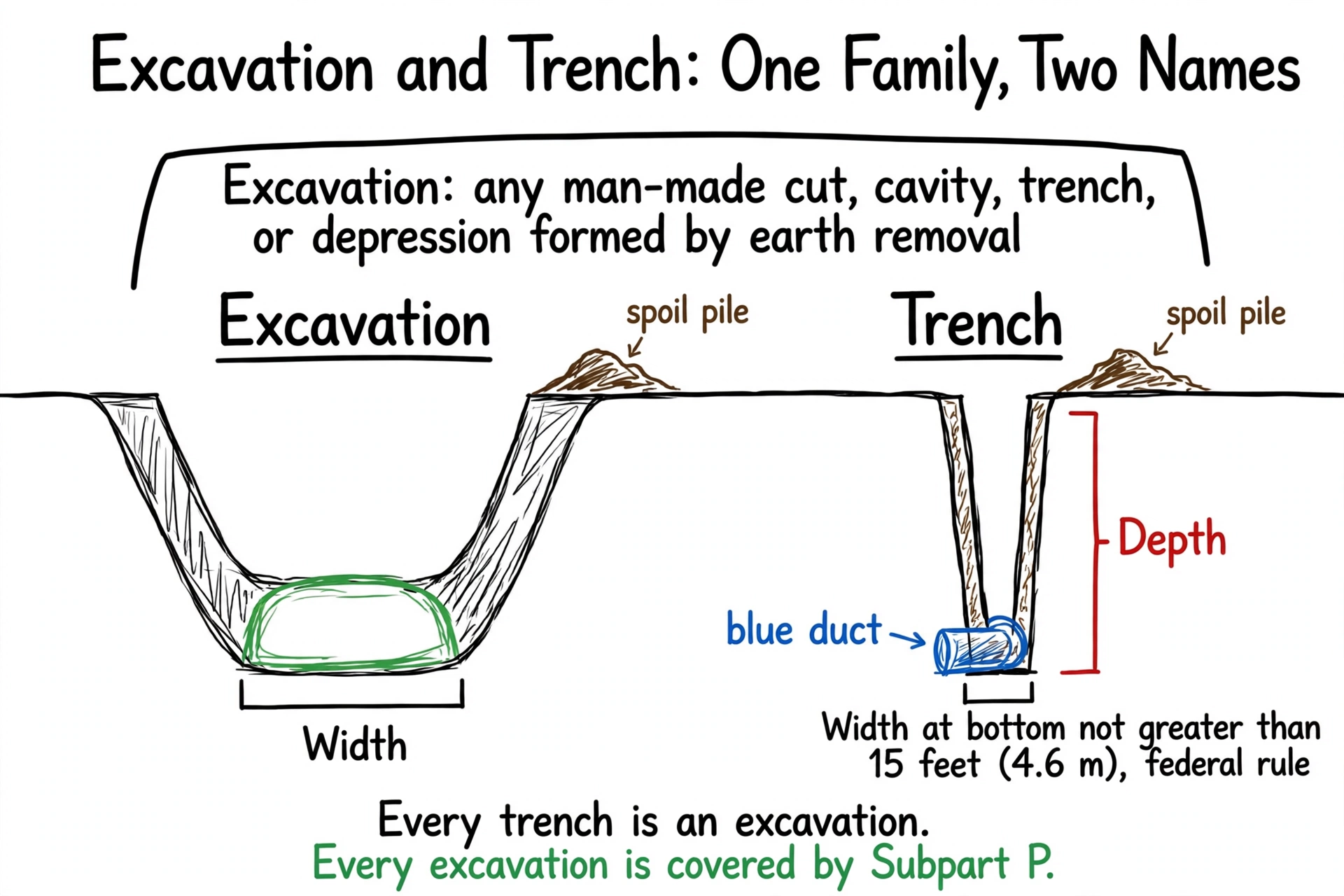
An excavation is any man-made cut, cavity, trench, or depression in an earth surface, formed by earth removal, in the wording of the federal rule at 29 CFR 1926.650. Open trench work for fiber duct begins with excavation, and the word carries a legal meaning alongside its plain meaning. A hole dug for a handhole, a narrow cut for duct, and a wide pit for a vault can each be an excavation under that definition.
Level 9 teaches building with open trench. This opening lesson sets the vocabulary and the safety frame for the whole level: what counts as an excavation, how a trench differs from the wider family, why the work is regulated, and what a beginner is qualified to recognize from the surface before any entry or digging decision is made.
What This Lesson Gives You
- State the federal definition of excavation and tell whether a given cut, pit, or depression in the ground meets it.
- Tell a trench apart from other excavations using the federal tests of narrowness, depth compared with width, and width at the bottom.
- Name the role of the competent person on an excavation site and explain why that role carries authority to stop work.
- Recognize spoil, access points, protective systems, and warning signs of wall distress from the surface without entering the excavation.
- Apply the boundary between recognizing a condition and being qualified to work in or direct excavation work.
Start With the Basics
Excavation starts with a simple action: earth is removed and a space opens where solid ground stood before. The removed earth has to go somewhere. The walls of the new space have to stand, slump, or be supported. People, duct, and tools have to get in and out of the space if the work requires entry. Every later lesson in this level builds on those three facts.
Picture digging a deep hole in damp sand at the beach. The sides hold for a moment while the sand is wet and packed. As the hole gets deeper and the sand dries or is disturbed, grains slide from the walls and collect at the bottom, and the walls lean inward toward the space a person cleared. Ground on a construction site behaves through the same mechanism at a larger scale. Soil that has been cut loses the support of the soil beside and below it, and gravity pulls loose or weakened material toward the open space. The weight involved is far greater in a construction excavation, and the consequence of a wall moving is far more serious. The beach hole teaches the mechanism in miniature: an open cut creates unsupported faces, and unsupported faces tend to move.
A second picture helps with the word itself. Think of a filled storage bin. Lifting material out creates a cavity shaped by the sides of what remains. Excavation works the same way in the ground. The cavity is defined by the earth left in place around and below it, and the shape, width, and depth of that cavity decide which rules and which protections apply to the work inside it.
What Is It?
Excavation, defined by the federal rule. The Occupational Safety and Health Administration, called OSHA in this lesson, defines an excavation in 29 CFR 1926.650 as any man-made cut, cavity, trench, or depression in an earth surface, formed by earth removal. Each part of the definition does work:
- Man-made means the opening results from people removing earth. A natural sinkhole or an animal burrow falls outside the definition.
- Cut, cavity, trench, or depression covers the full range of shapes, from a shallow scrape that forms a depression to a deep narrow trench.
- Formed by earth removal means the opening exists because soil or rock was taken away. Filling, grading that only adds material, or driving over ground does not create an excavation by itself.
Scope of the federal rule. OSHA states in 1926.650(a) that Subpart P, the part of the federal construction rules covering excavations at 29 CFR 1926.650 through 1926.652, applies to all open excavations made in the earth surface, and that excavations are defined to include trenches. Subpart P is a federal requirement. A state operating under an OSHA approved state plan can impose additional or stricter requirements, and project contracts can add requirements of their own. The federal text is the floor described in this lesson. The governing documents for a real site are the federal rule, any applicable state plan rule, and the contract documents together.
Trench, defined as a subset. A trench is a narrow excavation, in relation to its length, made below the surface of the ground. OSHA adds two tests in the same definition:
- In general, the depth is greater than the width.
- The width of a trench, measured at the bottom, is not greater than 15 feet (4.6 m).
OSHA adds a further case: if forms or other structures are installed or constructed in an excavation so the dimension from the form or structure to the side of the excavation is 15 feet (4.6 m) or less, measured at the bottom, the excavation is also considered a trench. Width in the trench test is measured at the bottom, and that measurement point matters because sloped or benched walls can make the top opening far wider than the bottom.
Cave-in, defined. A cave-in is the separation of a mass of soil or rock material from the side of an excavation, or the loss of soil from under a trench shield or support system, and its sudden movement into the excavation, by falling or sliding, in sufficient quantity that it could entrap, bury, or otherwise injure and immobilize a person. OSHA describes cave-ins as the greatest risk to workers in trenching and excavation work.
Competent person, defined. A competent person under 1926.650 is a person who is capable of identifying existing and predictable hazards in the surroundings or working conditions, and who has authorization to take prompt corrective measures to eliminate them. Both halves matter. Knowledge without authority fails the definition, and authority without the ability to identify hazards fails it as well.
Protective system, introduced. A protective system is a method of protecting employees from cave-ins, from material that could fall or roll from an excavation face or into an excavation, or from the collapse of adjacent structures. OSHA summarizes the families of protection as sloping or benching the walls, shoring the walls with supports, or shielding workers with a structure such as a trench box. Later lessons in this level teach each family in detail. This lesson introduces the term at recognition level only.
Spoil, defined. Spoil is the earth removed from an excavation and set aside at the surface. Spoil is part of the excavation system even though it sits outside the cut, because its weight and position act on the walls and the edge.
Methods at recognition level. Earth is removed by hand tools on small or precise work and by machines such as excavators and trenchers on larger work. The method changes the speed and the shape of the cut. The method does not change the definition. A hand dug hole that meets the definition is an excavation, and a machine dug cut that meets the trench tests is a trench.
What Does It Look Like?
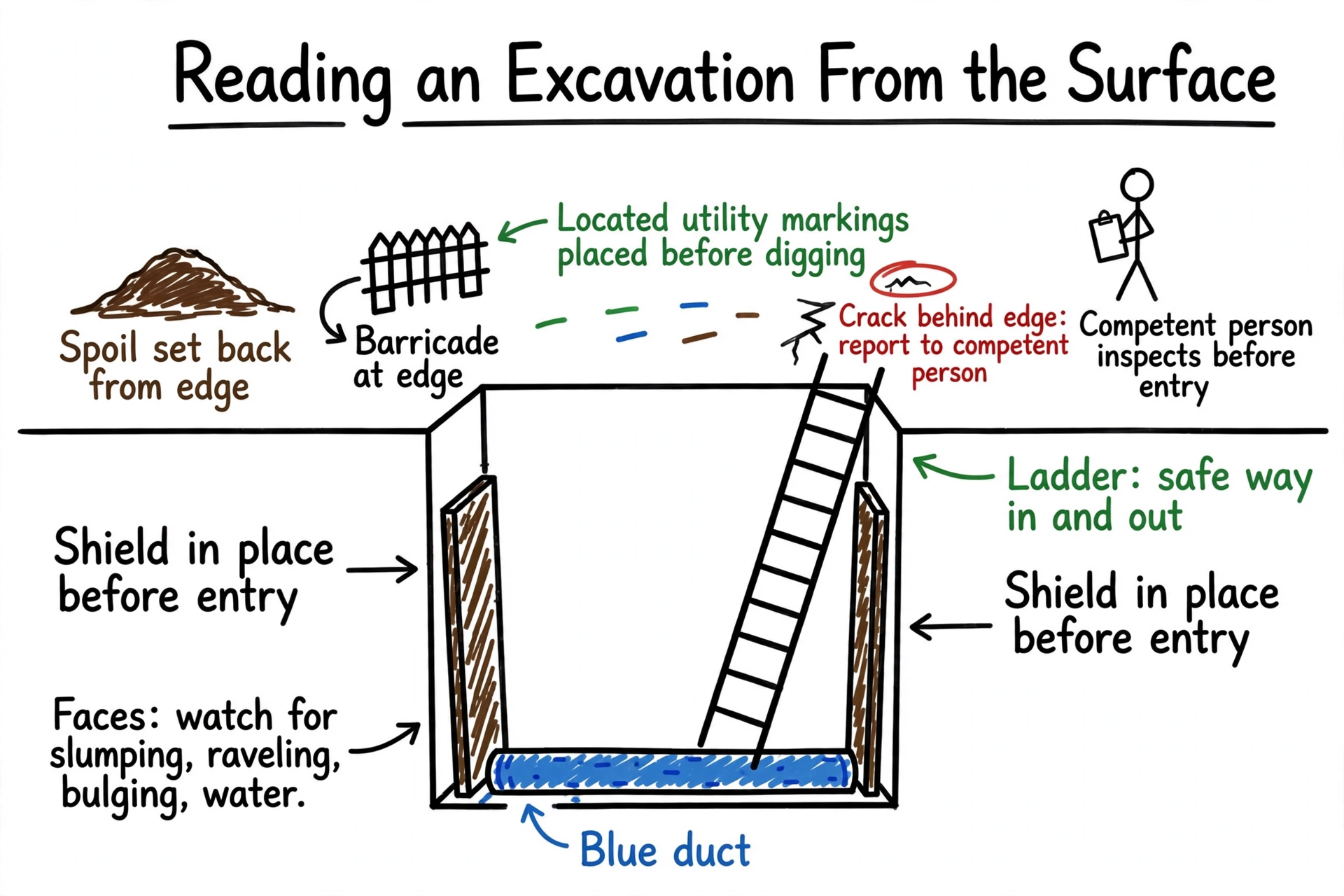
An excavation announces itself by the opening in the ground and by the activity arranged around the opening.
The opening itself:
- A cut or depression with visible earth faces, called faces or sides in the federal definitions, where soil or rock has been removed.
- A bottom surface below the surrounding grade, reached by stepping down, climbing down, or looking down into the opening.
- A shape that reads as a wide pit, a narrow linear cut, or a shallow depression, each of which can meet the excavation definition.
- Exposed layers in the faces where soil types, fill, or rock change with depth, visible as changes in color, texture, or looseness.
Around the opening:
- A spoil pile or a spoil row beside the cut, made of the earth that came out of it, often looser and differently colored than the undisturbed surface.
- A machine positioned to dig, lift, or set material, or hand tools staged near the edge on hand work.
- Barricades, fencing, covers, or warning devices at the edge where the site plan or the rule requires protection against falls or entry by the public.
- A ladder, stairway, or ramp providing entry and exit where workers enter the excavation.
- A protective system in place in deeper work: sloped or benched walls, shoring members against the faces, or a shield structure standing in the cut.
- Markings at the surface showing the estimated location of underground installations, placed before digging began.
Signs that change the reading at a glance:
- Cracks in the ground running parallel to the edge, behind the face.
- Material slumping, spalling, or raveling from a face, or soil bulging at the bottom of a face.
- Water standing in the bottom, seeping from a face, or running into the cut.
- Spoil, pipe, or equipment sitting at the very edge of the opening.
- An excavation with workers inside and no protective system, no visible means of exit, or no sign that an inspection has taken place.
What Does It Do?
Excavation creates the working space that open trench construction needs. The Fiber Optic Association describes underground construction as beginning with digging a trench to bury conduit, generally plastic pipe, with directional boring used as an alternative where digging up the surface is to be avoided. The excavation is the access step that makes every following step possible.
The opening gives access to the depth where the work sits. Duct, handholes, and vaults sit below the surface. Earth removal is what brings workers, material, and inspection to that level. Without the opening, the buried plant cannot be placed, joined, or checked.
The shape controls the work that can happen inside. A wide excavation gives room for structures, forms, and multiple workers with material staged beside them. A narrow trench gives a line for duct to follow, with room for placement and bedding along its length. Width at the bottom, depth, and wall shape together decide what fits, how workers move, and how material is lowered and set.
The walls become a structure that must be managed. Intact ground supports itself through the mass around it. Cutting removes part of that mass, and the remaining faces carry new loads from the ground behind them, from spoil and equipment at the edge, and from water in the soil. Sloping cuts the faces back to an angle the soil can hold. Benching cuts the faces into steps. Shoring braces the faces with supports. Shielding places a strong structure between the worker and a face that may move. Each approach answers the same mechanism: an unsupported vertical face in soil tends to move toward the opening.
The removed earth becomes a second job. Spoil must be placed, kept back from the edge, and later returned as backfill or removed from the site. Its placement affects the walls while the excavation is open and affects the finished surface after backfill and compaction in later lessons.
Where Does It Fit?
Excavation is the opening act of open trench construction, and it recurs at every structure and every repair along a route.
- Before excavation. The route is planned, the estimated location of underground installations is determined, and the competent person is designated for the work. OSHA at 1926.651(b) requires that the estimated location of utility installations that may reasonably be expected to be encountered be determined before opening an excavation.
- Excavation itself. Earth is removed by hand or machine to the line, width, and depth the project documents state. The competent person inspects the excavation, the adjacent areas, and the protective systems as the rule requires.
- Work inside the excavation. Crews place bedding, duct, and structures, make joints and connections, and set warning and locating features covered in Level 8 and in later Level 9 lessons.
- Backfill and restoration. The excavation is filled in controlled material and compacted, and the surface is restored. Later lessons in this level teach backfill and restoration as their own subjects.
- Later work on the same ground. Repairs, additions, and relocations open new excavations through plant that is already buried, which is why locating and records from the first build matter when the ground is opened again.
What Is at Stake
Cave-ins can bury a worker with little warning. OSHA states that trench collapses, or cave-ins, pose the greatest risk to workers lives in this work, and that cave-ins are more likely than other excavation related incidents to result in worker fatalities. A face can fail as a single mass. A worker in the path of that mass can be entrapped or buried, and self rescue is unreliable once soil covers the body.
Other hazards gather around the same opening. OSHA lists additional hazards for trenching and excavation work: falls into the opening, falling loads, hazardous atmospheres, water accumulation, incidents involving mobile equipment, and contact with buried utilities whose location was missed or misjudged. Each hazard has its own controls in Subpart P and in the project safety program.
A wrong classification leads to wrong protection. Calling a trench a simple hole, or measuring its width at the top instead of the bottom, can place the work under the wrong set of expectations. The protective system decision, the access decision, and the inspection decision all follow from what the opening actually is under the definitions.
Edge loads add risk that is easy to create and easy to miss. Spoil, material, and equipment at the edge add weight behind the face and can fall or roll into the opening. Federal rule 1926.651(j)(2) requires employees to be protected from excavated or other materials or equipment that could fall or roll into an excavation, by keeping such materials or equipment at least 2 feet from the edge, by using retaining devices sufficient to prevent falling or rolling in, or by both methods.
Delays follow a stop that could have been a plan. An excavation closed by a competent person after work has started, because protection, access, or utility clearance was skipped, costs the day and can cost the schedule for duct placement and cable work behind it. Planning the protection and the inspection before the first bucket of earth moves is the cheaper path.
The public shares the risk at open ground. An open excavation near a sidewalk, a road, or a yard exposes people who have no training and no protective equipment. Barricades, covers, and prompt backfill protect people who never agreed to be part of the job.
What Does Good Look Like?
- The opening is classified before entry using the federal definitions, with trench width judged at the bottom and depth compared with width.
- A competent person is named for the excavation, is capable of identifying its hazards, and holds clear authority to take prompt corrective action, including removing workers.
- The estimated location of underground installations was determined before digging opened the ground, and exposed installations are protected or supported while the excavation is open.
- A protective system matched to the conditions is in place before workers enter where the rule requires one, using sloping or benching, shoring, or shielding as the chosen method.
- Spoil, material, and equipment are kept back from the edge or restrained by retaining devices, so nothing can fall or roll into the opening.
- A safe means of entry and exit is in place and reachable, and the excavation shows evidence of inspection before the shift and after any event that could increase hazards.
- Faces show no unaddressed cracking, slumping, bulging, or water condition, and any such sign has been reported to the competent person and acted on.
- The edge is barricaded, covered, or otherwise protected where people outside the crew could approach the opening.
From the Field
Picture a two person crew opening a narrow cut for duct along the edge of a commercial lot, with a machine operator supporting them from the surface. The cut is deeper than it is wide, and its width at the bottom is well within the trench range taught in this lesson. The plan for the morning is to reach grade, set the duct, and have the cut ready for inspection before midday.
Early in the dig, the operator sets spoil in a growing row close to the edge because the lot is tight and the far side holds parked material. One of the crew members walking the line notices a crack opening in the surface behind the spoil row, running parallel to the cut, and loose material beginning to ravel from the upper part of the face below it.
No worker has entered the cut yet. The crew member calls the condition out to the competent person instead of stepping down to look more closely. The competent person walks the edge, confirms the crack and the raveling, and holds entry. The spoil row is pulled back from the edge by machine, the face is re-examined, and the protective approach for the cut is reviewed before any entry is allowed.
Work resumes later than planned, with the duct set after the edge condition is corrected and the inspection is recorded. The delay is real, and the crew feels it. The alternative path is easy to trace: a worker inside the cut, a face loaded by spoil at its edge, and a crack that was announcing movement while entry was still a choice.
The rule to carry is plain: a crack behind the edge, material moving from a face, or spoil crowding the edge is a stop and report condition. Entry waits until the competent person has examined the excavation and cleared it, and no schedule pressure converts a warning sign into background noise.
What Can Go Wrong?
A face collapses into occupied space. Soil separates from the side of the excavation and moves suddenly into the opening. A worker in the path can be entrapped, buried, or immobilized, and rescue itself exposes additional workers to the same unprotected face.
The opening is misjudged as too shallow or too wide for the rules to matter. A cut measured at the top instead of the bottom, or judged by eye instead of by the definitions, can be treated as casual digging while it meets the trench tests in full. Protection, access, and inspection decisions then lag behind the actual hazard.
Spoil and loads crowd the edge. Material placed at the edge adds load behind the face and can slide or roll into the opening. The federal setback and retaining device rule exists because this failure is common, quick to create, and slow to be noticed as the pile grows bucket by bucket.
A buried utility is struck. Digging that begins before the estimated location of underground installations is determined, or that proceeds carelessly near a known location, can cut electric, gas, water, communication, or sewer lines. Consequences range from outage and flooding to fire, explosion, and serious injury, depending on the utility struck.
Water weakens the walls and hides the bottom. Rain, a broken water line, or groundwater can accumulate in an excavation, soften faces, undermine supports, and conceal hazards below the surface. OSHA requires inspections after rainstorms and other hazard increasing events where worker exposure can reasonably be anticipated.
Workers cannot get out quickly. An excavation entered without a ladder, ramp, stairway, or other safe means of egress leaves workers to climb walls or shoring when seconds matter. Federal rule 1926.651(c)(2) requires a safe means of egress in trench excavations 4 feet or more in depth, located so a worker needs no more than 25 feet of lateral travel to reach it.
The atmosphere inside the opening harms workers. Excavations near landfills, stored hazardous substances, or certain utility work can collect or encounter hazardous atmospheres. Testing and controls for atmospheric hazards are governed by Subpart P and the project safety program, and they belong to qualified people with the right instruments.
What Should Someone Notice in the Field?
- Name what the opening is before anything else: excavation in every case where earth was removed by people, and trench where the cut is narrow for its length, deeper than its width in general, and no wider than 15 feet (4.6 m) at the bottom under the federal rule.
- Look for the competent person: ask who holds that role for this excavation, and confirm that person has inspected the excavation, the adjacent areas, and the protective systems before work and as conditions change.
- Check the edge: spoil, material, and equipment kept back or restrained, no cracks running parallel to the edge behind the face, and barricades or covers where the public can approach.
- Read the faces from the surface: no slumping, spalling, raveling, or bulging left unreported, and no water standing, seeping, or running in without the condition being addressed.
- Confirm a protective system is in place before entry where one is required, and recognize its family: sloped or benched walls, shoring against the faces, or a shield standing in the cut.
- Confirm a safe way in and out: a ladder, stairway, ramp, or other safe means of egress positioned within reach of where workers are, and kept clear.
- Confirm utility locations were established before digging, and treat exposed installations in the walls or bottom as protected objects, never as handholds, steps, or supports.
- Know the boundary: observing an excavation from the surface, naming its type, reading its edge and faces, and reporting a warning sign to the competent person are tasks covered by this lesson. Entering an excavation, classifying soil, selecting or installing a protective system, operating excavation machines, and directing digging near utilities belong to trained and qualified people working under a competent person and the project safety program. Reading this lesson qualifies no one to enter or work in an excavation, and recognizing a hazard is a different thing from being qualified to correct it.
Key Terms
Excavation: Any man-made cut, cavity, trench, or depression in an earth surface, formed by earth removal, per OSHA 29 CFR 1926.650.
Trench: A narrow excavation in relation to its length, made below the surface of the ground, in general deeper than its width, with a width at the bottom not greater than 15 feet (4.6 m) per OSHA 1926.650.
Competent person: A person capable of identifying existing and predictable hazards in the surroundings or working conditions, and authorized to take prompt corrective measures to eliminate them, per OSHA 1926.650.
Cave-in: The separation of a mass of soil or rock from the side of an excavation, or loss of soil from under a shield or support system, with sudden movement into the excavation in a quantity that could entrap, bury, injure, or immobilize a person.
Protective system: A method of protecting workers from cave-ins, from material that could fall or roll into an excavation, or from collapse of adjacent structures, including sloping, benching, shoring, and shielding methods.
Spoil: Earth removed from an excavation and set aside at the surface, to be returned as backfill or removed from the site.
Faces or sides: The vertical or inclined earth surfaces formed as a result of excavation work.
Subpart P: The OSHA federal construction rules for excavations at 29 CFR 1926.650 through 1926.652, applying to all open excavations made in the earth surface.
Check Your Understanding
- A crew digs a pit for a vault. The pit is wider than it is deep. A worker says the pit cannot be an excavation because it fails the trench tests. Is the worker right?
Answer: No. Excavation is the wider term. Any man-made cut, cavity, trench, or depression formed by earth removal is an excavation under 1926.650, and Subpart P applies to all open excavations. The trench tests decide whether the opening is also a trench. They do not decide whether it is an excavation.
- A narrow cut is deeper than its width, and its width at the bottom measures within the federal trench limit, while its top opening is far wider because the walls are sloped. Is the cut a trench, and which width controls?
Answer: Yes, the cut is a trench. Width in the federal trench definition is measured at the bottom. A wide top opening created by sloping does not remove the cut from the trench definition when the bottom width is not greater than 15 feet (4.6 m) and the other tests are met.
- A supervisor can identify trench hazards from long experience, and a second supervisor holds authority to stop work and order corrections, while the first supervisor holds no such authority. Which supervisor meets the federal definition of competent person on that fact alone?
Answer: Neither half alone meets the definition. A competent person must be capable of identifying existing and predictable hazards and must hold authorization to take prompt corrective measures to eliminate them. The role requires both abilities in the same person.
- In the From the Field scenario, what did the crew member notice, what decision followed, and why was staying out of the cut the right first move?
Answer: The crew member noticed a crack opening behind a spoil row set close to the edge, with material raveling from the face below it. The condition was reported to the competent person, entry was held, spoil was pulled back, and the face and protective approach were re-examined before entry. Staying out kept every worker clear of a face showing signs of movement, and it placed the decision with the person holding the authority and the duty to make it.
- A trench requires a protective system at a given depth under the federal rule, and a shallower trench shows signs of a potential cave-in on inspection. Does the shallower depth settle the protection question?
Answer: No. Under 1926.652(a), protection is generally required in excavations 5 feet or more in depth unless the excavation is made entirely in stable rock, and protection is also required in an excavation less than 5 feet deep where examination by a competent person indicates a potential cave-in. Depth alone never overrides a competent person finding of hazard.
Lesson Takeaway
An excavation is defined by earth removed, and a trench is the narrow, deeper than wide member of that family, judged by its width at the bottom. The reader who can classify an opening on sight, name the competent person, and read the edge, the faces, the spoil, and the protection from the surface holds the frame that every open trench lesson after this one builds inside.
Sources and Technical References
Occupational Safety and Health Administration, 29 CFR 1926.650, Scope, application, and definitions applicable to this subpart. Covers the scope of Subpart P for all open excavations, the definition of excavation as any man-made cut, cavity, trench, or depression in an earth surface formed by earth removal, the definition of trench as a narrow excavation with depth greater than width in general and width at the bottom not greater than 15 feet (4.6 m), and the definitions of cave-in, competent person, protective system, and faces or sides: http://www.osha.gov/laws-regs/regulations/standardnumber/1926/1926.650
Occupational Safety and Health Administration, Trenching and Excavation, Overview. Covers cave-ins as the greatest risk to workers lives, the protective approaches of sloping or benching, shoring, and shielding, safe entry and exit, keeping materials away from the edge, standing water and atmospheric hazards, and inspection before entry, with the applicable standards at 29 CFR 1926.650, 1926.651, and 1926.652: https://www.osha.gov/trenching-excavation
Occupational Safety and Health Administration, Trenching and Excavation Safety, OSHA 2226. Covers the excavation and trenching standards at 29 CFR Part 1926, Subpart P, the danger of cave-ins, the weight of soil, and methods for preventing cave-ins including sloping or benching, supporting the sides, and placing a shield between the side of the excavation and the work area: https://www.osha.gov/sites/default/files/publications/osha2226.pdf
Occupational Safety and Health Administration, OSHA Technical Manual, Section V, Chapter 2, Excavations: Hazard Recognition in Trenching and Shoring. Covers excavation and trenching as among the most hazardous construction operations, the Subpart P framework at 1926.650, 1926.651, and 1926.652, and hazard recognition for cave-ins and related excavation hazards: https://www.osha.gov/otm/section-5-construction-operations/chapter-2
Cornell Law Institute, Legal Information Institute, 29 CFR 1926.650. Covers the regulatory text of the scope and definitions section of Subpart P, including excavation, trench, and related definitions, as an independent republication of the federal rule: http://www.law.cornell.edu/cfr/text/29/1926.650
Fiber Optic Association, Outside Plant Construction, Underground Construction. Covers underground cable plant construction beginning with digging a trench to bury conduit, generally plastic pipe, with directional boring as an alternative to avoid digging up the surface, and the construction context for open trench fiber work: https://www.thefoa.org/tech/ref/OSP_Construction/Underground_Construction.html
Previous lesson: Lesson 161: What Is Open-Trench Construction? |
Back to Level 9 hub |
Next lesson: Lesson 163: What Determines Trench Depth?