
Lesson Number and Title
Lesson 163, Level 9: Build With Open Trench
Title: What Determines Trench Depth?
Introduction
Trench depth is the distance from the finished ground surface down to the bottom of an open trench, and the number a crew digs to is set by several stacked requirements rather than by habit or by a single rule. The governing requirement is usually stated as cover, the distance from the top of the buried conduit or cable up to finished grade. Cover and trench depth are two different measurements, and confusing them is the classic way a run ends up buried too shallow.
Level 9 teaches open trench construction step by step. Lesson 161 introduced the method and Lesson 162 covered excavation itself. This lesson explains where the depth number on a trench comes from: the cover the project documents require, the conduit and bedding that sit below that cover, and the local conditions, crossings, and surface loads that can push the required depth deeper along the same run.
What This Lesson Gives You
- Tell cover apart from trench depth on sight, and state which point each measurement starts and ends at.
- Build a trench depth from its parts: required cover, plus the outside diameter of the conduit, plus the bedding thickness under it.
- Name the sources that can set a cover requirement on a fiber job, and rank project documents, permits, and owner standards above any general code table.
- Spot the places along a run where depth must change: road crossings, ditch lines, other utilities, rock, and areas with deep frost penetration.
- Check a dug trench against the requirement before conduit goes in, using a tape or grade rod measured from finished grade.
Start With the Basics
Picture planting a young tree from a nursery pot. The planting instruction cares about one measurement: the top of the root ball sits level with the surrounding soil. The hole the gardener digs is deeper than that measurement suggests, because the hole has to hold the whole root ball below the surface line, plus any loose soil placed under it. Digging the hole only as deep as the surface measurement would leave the top of the root ball sticking out of the ground.
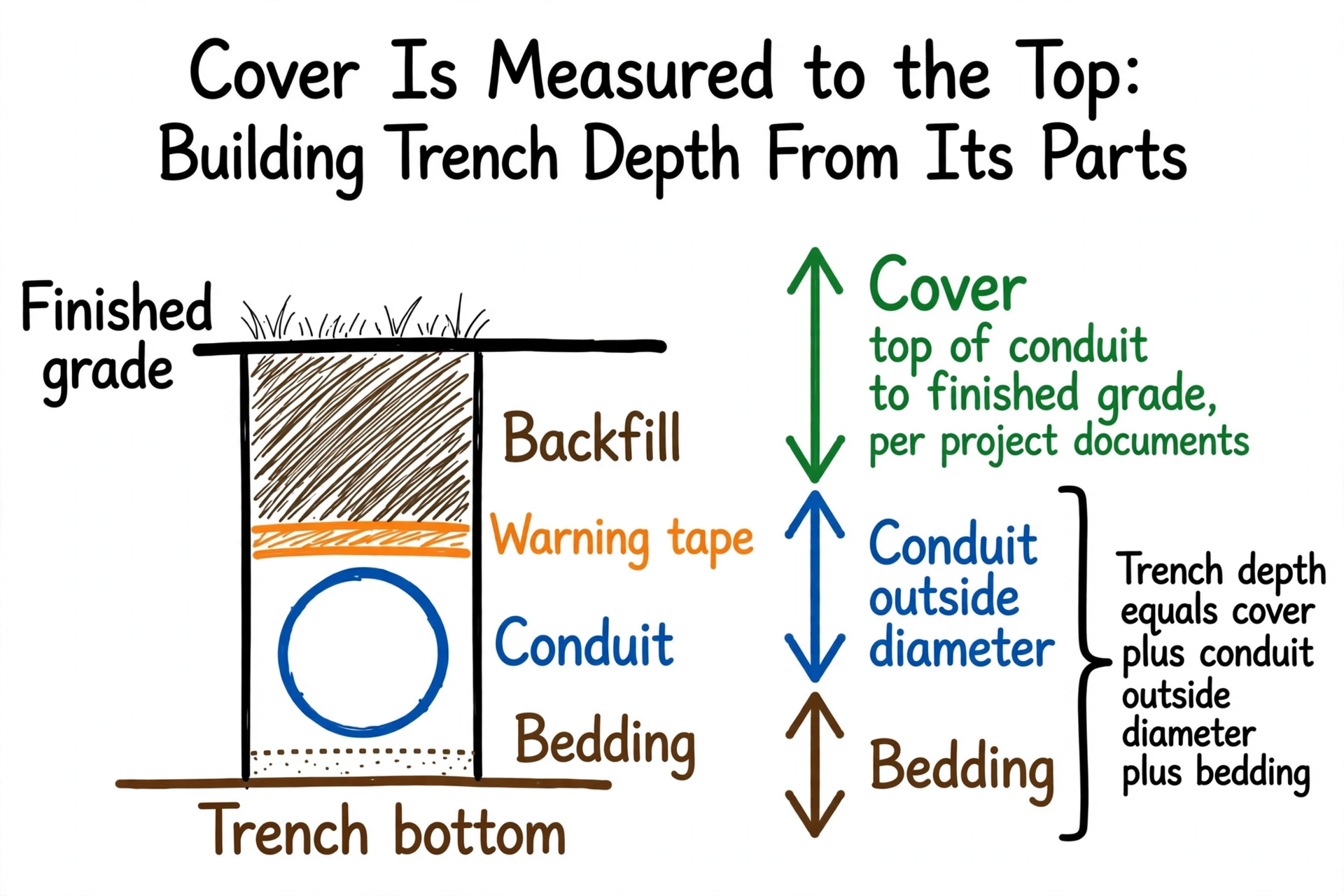
A conduit trench works the same way. The requirement that matters, cover, is measured to the top of the conduit. The hole has to be deeper than the cover number, because the hole also holds the full height of the conduit and the bedding, the layer of sand or fine material placed under the conduit to support it. A crew that digs the trench exactly as deep as the cover number has built in a shortage equal to the conduit height plus the bedding, before any other factor is considered.
What Is It?
Trench depth is a result. Several inputs produce it, and each input has an owner. The definitions below build the calculation in order.
Cover. Cover is the shortest distance from the top surface of a buried cable, conduit, or raceway up to the top surface of finished grade. That wording follows the note to Table 300.5 in the National Electrical Code, called the NEC in this lesson. The NEC is the electrical installation code published by the National Fire Protection Association and adopted, often with local amendments, by states and cities. Two words in the definition carry the lesson. Top: the measurement starts at the top of the conduit, never at its bottom and never at the trench floor. Finished grade: the measurement ends at the surface the ground will have when the job is complete, which can sit higher or lower than the ground a crew is standing on during construction.
Trench depth. Trench depth is the distance from finished grade down to the trench bottom, the excavated floor the bedding rests on. The relationship between the two measurements is arithmetic:
- Trench depth equals required cover, plus the conduit outside diameter, plus the bedding thickness under the conduit.
- A duct bank adds the full height of the bank in place of a single conduit diameter, plus any encasement the design calls for.
Outside diameter. The outside diameter is the full width across the outside of the conduit. A conduit rests on its bedding and its top sits one outside diameter above the bedding surface, so the full diameter counts in the trench depth even though only the top point matters for cover.
Bedding, introduced. Bedding is the prepared layer of sand or fine granular material placed on the trench bottom under the conduit. It gives the conduit level, continuous support and keeps the conduit off sharp or uneven ground. Lesson 166 teaches bedding in full. For depth, bedding matters for one reason: every inch of bedding under the conduit is an inch added to the trench depth, and bedding placed after the trench was measured changes the cover the conduit ends up with.
Finished grade. Finished grade is the final ground surface elevation after all grading, paving, and restoration on the project are complete. Cover judged against a temporary construction surface can pass during the dig and fail after final grading removes soil, or after a ditch is re-cut to its design depth.
Where the cover requirement comes from. On a fiber job, the cover number that governs comes from the project documents, and several authorities can feed into those documents:
- Project documents and owner standards. The drawings, specifications, and the network owner’s construction standards state the cover for the run. These govern the job.
- Permits and right of way conditions. A road authority, railroad, or landowner permit can impose its own cover under its pavement or across its land, and that condition binds the work in that segment.
- Codes adopted for the work. The NEC and the National Electrical Safety Code, called the NESC in this lesson, each carry burial rules for the installations within their scope. The NESC covers utility supply and communication lines in outside plant settings. The NEC covers electrical installations, and its cover table is a useful example of how cover is defined and structured, while a fiber run follows the documents and standards written for that run.
- Program standards. Work funded under a program such as the United States Department of Agriculture Rural Utilities Service, called RUS in this lesson, follows the RUS construction standards for that program’s plant.
- Manufacturer instructions. Conduit and cable makers publish installation guidance for their products, including handling and burial practice for the product in hand.
An example of a cover table, read with its scope attached. NEC Table 300.5 lists minimum cover for electrical wiring methods at 1,000 volts and below. In its general location row, the table calls for 24 inches of cover over direct buried cable, 18 inches over a nonmetallic raceway listed for direct burial, and 6 inches over rigid or intermediate metal conduit. Under streets, highways, roads, alleys, driveways, and parking lots, the table calls for 24 inches across those methods. Those numbers govern the electrical installations the NEC covers. A fiber conduit is a communication installation, and the table reaches a fiber trench only when project documents adopt or reference it. The table still teaches two transferable points: cover is measured to the top of the raceway, and the required cover changes with the surface above the run.
A program standard example. Federal regulation at 7 CFR 1755.505, part of the RUS standard for service installations at customer access locations, states that buried service wire or cable is plowed or trenched to a depth of 12 inches or greater where practicable in soil, 36 inches in ditches, and 3 inches in rock, with depth measured from the top of the wire or cable to the surface. That rule belongs to RUS buried service drops at customer locations. Its transferable points are the same two: depth there is also measured from the top of the cable, and the required depth changes sharply with the ground the run crosses, with ditches demanding far more than ordinary soil.
General industry practice, labeled as practice. The Fiber Optic Association, called the FOA in this lesson, describes underground fiber conduit as usually buried about 1 to 1.2 meters (3 to 4 feet) deep to reduce the likelihood of being dug up accidentally, and notes that colder climates can call for greater depth where frost penetrates deeper. That is the FOA’s description of common practice, offered as background. Practice explains what crews often see. Practice never sets the requirement on a specific job.
What Does It Look Like?
Depth determination happens on paper first and is then visible in the trench as a set of checkable features.
On the documents:
- A cover requirement stated in the drawings or specifications for the run, sometimes varying by segment, with deeper cover called out at road crossings, ditches, and other utilities.
- A trench detail or cross section showing finished grade, the conduit, bedding under it, and warning tape above it, each in its layer.
- Permit conditions in the job file that state cover under a road, across a ditch, or on a landowner’s property.
- Notes tying depth to a named standard or owner requirement, rather than a bare number with no source.
In the trench:
- A trench bottom that sits visibly deeper than the cover number alone, by roughly the height of the conduit plus the bedding layer.
- A tape, grade rod, or depth gauge in use at the trench, read from a string line or surface point that represents finished grade.
- Bedding spread on the trench bottom before conduit is laid, at a thickness the crew can state.
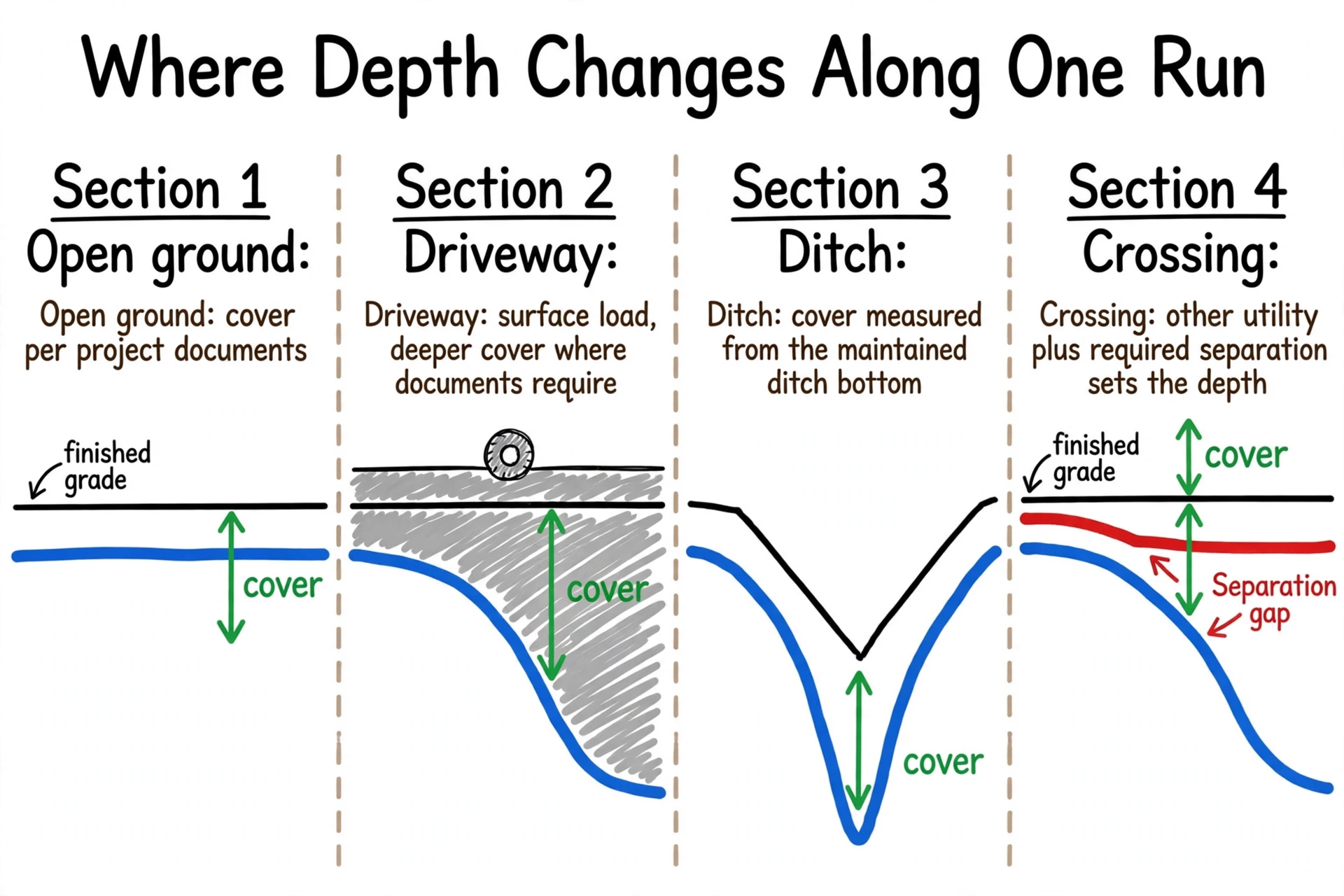
- Depth changing deliberately along the run: the trench floor stepping down ahead of a road crossing or a ditch, and rising back after it.
- At a crossing with another utility, the conduit passing over or under the other line with a visible gap between the two, rather than resting against it.
Signs the depth was never determined, only assumed:
- A trench dug to one uniform depth along a run that crosses a ditch, a driveway, and another utility at the same level throughout.
- A crew measuring depth from the bottom of the trench and comparing that number directly to a cover requirement.
- Bedding added under conduit in a trench that was already at its final depth, raising the conduit with no adjustment to the dig.
- No stated source for the depth in use: nobody on site can say which document set the number.
What Does It Do?
Determining trench depth correctly puts the conduit at the elevation where every later protection the design counted on actually exists. Each input to the depth does its own work.
Cover is the protection layer. The soil between the conduit top and the surface is what stands between the conduit and the world above it: digging tools, fence posts, plows, vehicle loads, erosion, and frost action in the soil. Cover works by distance. A spade, a post hole digger, or a shallow cultivation tool reaches only so far down, and cover places the conduit below that working zone. Cover also spreads surface load. Weight applied at the surface, such as a vehicle tire, presses down and outward through the soil, so the deeper the conduit sits, the more the load has spread before it reaches the conduit. That is why cover requirements rise under roads and driveways in table after table: the load above the run is part of what sets the depth.
The conduit diameter and bedding are geometry, and geometry is unforgiving. The depth calculation has no judgment in it. Once the required cover is fixed, the trench must contain the bedding and the full conduit height below the cover line. An error here is a pure measurement error, repeated along every foot of a trench dug to the wrong floor elevation.
Separation at crossings sets local depth. A crossing is the point where the new run passes over or under an existing utility or structure. Depth at a crossing is set by the other line’s elevation plus the separation, the required clear distance between the two facilities. The NESC gives the pattern for conduit systems in its Section 320 separation rules, quoted in industry references: a communication conduit system is separated from a supply conduit system by 3 inches of concrete, 4 inches of masonry, or 12 inches of well tamped earth. Separations from gas and other lines that transport flammable material carry their own NESC rule for conduit systems, Rule 320 B, which states a separation of not less than 12 inches from such lines. The governing separation on a job comes from the applicable code, the other utility’s owner, and the project documents. Where the crossing line sits deep, the new conduit may have to dive under it, and the trench depth for that segment is set by the crossing rather than by the cover table.
Frost depth is a local input. Frost depth, also called the frost line, is the deepest level frost is expected to penetrate the ground in a given place. It is a published local figure, set by climate, and it varies from a few inches in warm regions to several feet in cold ones. Frost matters to a buried run through ground movement: soil that freezes and thaws can heave, shift, and settle, and water bearing facilities have the added risk of the water itself freezing, which is why plumbing and building codes tie burial to the local frost depth. For a fiber run, the project documents and owner standards state whether the run must sit below the local frost depth. The transferable point is that frost depth is read from local data for the job’s location. A depth that works in one state can be wrong in another for this reason alone.
Rock and ditches rewrite the local number. Shallow rock can make the specified depth unreachable with ordinary excavation, and standards handle that case explicitly rather than leaving it to the field. The RUS service rule above allows 3 inches in rock where 12 inches is the soil figure, and industry guidance published in EC&M describes shallower burial in hard rock paired with added protection such as a concrete slab over the duct. Ditches pull the other way: a ditch is re-cut and cleaned over its life, so the effective surface at a ditch line is the ditch bottom at its deepest maintained condition, and the RUS service rule’s 36 inch ditch figure shows how much deeper a ditch crossing can demand. Both cases are decided by the documents and the authority for that segment, with any change from the specified depth approved and recorded rather than improvised.
Where Does It Fit?
Depth determination sits between design and digging, and it is revisited at every change of segment along the run.
- Design and permitting. The designer sets cover by segment from owner standards, applicable codes, and permit conditions, and the drawings carry the result. Road, railroad, and ditch crossings get their own callouts because their requirements differ from open ground.
- Pre-construction review. Before excavation, the crew confirms the cover for each segment, the conduit size and bedding thickness that convert cover into a trench floor elevation, and the crossings that force local depth changes. Lesson 162’s excavation work starts from these numbers.
- During excavation. The operator digs to the trench floor elevation, and depth is checked against finished grade as the dig proceeds, segment by segment, so a shallow section is found while the machine is still over it.
- Conduit placement. Lesson 167 covers placing conduit in the trench. Placement confirms the as-built cover: bedding thickness plus conduit position determine the real cover, and the check happens before backfill hides the evidence.
- Before backfill. Lesson 174 covers what needs documented before the trench closes, and the measured cover at crossings and low points belongs in that record, because after backfill the cover can only be estimated from the surface.
What Is at Stake
A shallow run is an exposed run. Cover is the conduit’s defense against the next excavation. Every future dig above the line, a fence line, a sign post, a landscaping project, a repair to another utility, meets a shallow conduit sooner and with less warning soil to spare. The FOA’s stated reason for burying conduit in the range it describes is exactly this: reducing the likelihood of the plant being dug up.
The cover-versus-depth error repeats at full trench scale. A crew that digs to the cover number as a trench depth produces a run that is short by the conduit diameter plus the bedding along its whole length. Found before backfill, the fix is deeper digging. Found after backfill and restoration, the fix is re-excavation of a finished run, or an owner decision to accept plant that fails its own standard.
Road crossings concentrate load and consequence. A run under a road carries traffic load for its whole life and sits in ground that road crews will cut, mill, and rebuild. Tables and permits raise cover at crossings because a shallow crossing risks both the conduit under load and the road surface above it, since a poorly supported trench under pavement settles and shows at the surface.
Crossings done shallow create conflicts underground. A conduit laid at standard depth through a crossing, without regard to the other utility’s elevation and the required separation, can end up resting on the other line, blocking its future maintenance, or sitting inside the separation the other owner requires. Correcting a crossing after both lines are buried means exposing two owners’ plant.
Depth errors become record errors. The record states the cover the owner believes the plant has. Locates, future designs, and dig clearances are planned from that record. A run recorded at specified cover and built shallow hands every later crew a false map of where the risk sits.
Safety sets the boundary on checking. Verifying depth means working at the edge of, and sometimes in, an excavation. Excavations carry cave in and struck by hazards that grow with depth, and federal excavation rules under OSHA 29 CFR Part 1926 Subpart P govern protective systems and competent person duties for that work. Reading a tape from the surface and reporting a shallow trench are recognition tasks. Entering or working in a trench that requires protective systems belongs to qualified crews under that standard and the project safety program.
What Does Good Look Like?
- The cover requirement for each segment of the run can be named with its source: the drawing, the specification, the permit, or the owner standard that set it.
- The trench floor elevation for each segment is the cover requirement plus the conduit outside diameter plus the bedding thickness, and the crew digging can state all three numbers.
- Depth checks are read from finished grade, or from a grade reference the crew can tie to finished grade, at the start of each segment and at every low point and crossing.
- The trench deepens ahead of road crossings, ditch lines, and utility crossings where the documents call for it, and the deepening is dug as part of the run rather than patched in afterward.
- At every crossing, the conduit clears the other facility by the separation the documents require, with the gap visible and measurable before backfill.
- Bedding sits at its specified thickness under the conduit, and any bedding added beyond the plan is matched by a deeper trench floor, so the cover at the conduit top is unchanged.
- Any place where specified depth could not be reached, such as shallow rock, is raised to the inspector or owner, handled under the documents, and written into the record with the protection added.
From the Field
Picture a two person crew trenching a conduit run across open ground toward a ditch crossing, on a job where the specification states the required cover for the run and a deeper cover at the ditch. The plan detail shows the conduit resting on a bedding layer. The operator digs the open ground section with the trench depth set equal to the cover figure from the specification, a number the crew lead read off the detail that morning.
The inspector checks the first section before conduit is placed. The tape reads from the surface down to the top of a test length of conduit laid on its bedding, and the cover comes up short by about the height of the conduit and the bedding together. The trench floor matches the number on the detail. The conduit top does not, because the detail’s number was a cover requirement and the crew had dug it as a trench depth.
The decision point is whether to place conduit and let backfill make up the difference. The inspector holds placement on the section. Backfill above the conduit counts toward cover only when the finished grade stays where the plan puts it, and this section sits beside a ditch that the county re-cuts, so surface soil there is the least reliable cover on the run. The crew deepens the trench floor by the conduit diameter plus the bedding thickness, re-lays the bedding, and the recheck reads the specified cover at the conduit top, with the ditch section dug to its deeper figure from the start.
The rule to carry is plain: dig the trench to the cover requirement plus everything that sits below the top of the conduit, and check cover at the top of the conduit against finished grade before anything is placed or buried.
What Can Go Wrong?
Cover dug as trench depth. The trench floor is set to the cover number, and the conduit top ends up short by its own diameter plus the bedding. The error is uniform, quiet, and only visible to someone who measures at the conduit top.
Measuring from the wrong surface. Depth read from a construction surface, a spoil ridge, or a high shoulder passes a run that finished grading will leave shallow. The measurement is only as good as the grade it is read from.
Bedding creep. Bedding placed thicker than planned, or added to level a rough trench bottom, raises the conduit inside a trench dug to the correct floor depth. Each unplanned inch of bedding is an inch of cover lost.
One depth for the whole run. A uniform trench crosses a ditch, a driveway, and another utility at open ground depth. The ditch gets re-cut into the conduit’s cover, the driveway load sits closer than the documents allow, and the crossing separation is whatever chance provided.
Rock handled by opinion. The trench stops at rock and the conduit goes in shallow with no approval, no added protection, and no record entry. The next crew reads a record that states full depth over a section that has very little.
Crossing separation spent as depth. To hold a grade or avoid deepening, a conduit is laid tight against the line it crosses. The separation the other owner requires is gone, and future work on either line starts with an exposure neither record admits.
Final grading after the check. Cover verified during construction is re-measured by nobody after the grader passes. Soil removed in final grading comes directly out of the cover the run was accepted with.
What Should Someone Notice in the Field?
- Ask what the required cover is for the segment in front of you, and which document set it. A number with no source is a number to verify before digging continues.
- Do the addition out loud: required cover, plus conduit outside diameter, plus bedding thickness, equals the trench depth to dig. Compare it with the depth actually being dug.
- Watch where depth is measured from. The reading should tie to finished grade, and the cover check itself is read at the top of the conduit.
- Note bedding thickness as placed, and check whether the trench floor was deepened to allow for it.
- Look ahead along the run for the depth changers: road and driveway crossings, ditch lines, other utilities to cross, shallow rock, and low ground that final grading may cut down.
- At a crossing, look for a visible, measurable gap between the new conduit and the existing facility, in the direction the documents require.
- Check whether depth is being re-verified at segment changes and low points, or only once at the start of the run.
- Read the record entry for depth: it should state measured cover where it was checked, including crossings, rather than repeating the specified number.
- Know the boundary: reading a tape or rod from the surface, doing the cover arithmetic, and reporting a shallow or tight condition are tasks covered by this lesson. Excavation work, entering a trench, and working around crossings with live utilities belong to qualified people under OSHA excavation rules and the project safety program. Reading this lesson qualifies no one to excavate, and recognizing a depth problem is a different thing from being qualified to dig the correction.
Key Terms
Cover: The shortest distance from the top of a buried cable, conduit, or raceway to the surface of finished grade, as the NEC defines the term in the note to its Table 300.5.
Trench depth: The distance from finished grade down to the bottom of the excavated trench.
Trench bottom: The excavated floor of the trench, on which the bedding rests.
Bedding: The prepared layer of sand or fine material placed under the conduit to give it level, continuous support; taught in full in Lesson 166.
Finished grade: The final ground surface elevation after grading, paving, and restoration are complete.
Crossing: The point where a new run passes over or under an existing utility or structure.
Separation: The required clear distance between two underground facilities at a crossing or along a parallel run.
Frost depth: The deepest level frost is expected to penetrate the ground at a given location, a published local figure that varies with climate.
Check Your Understanding
- A specification requires a stated cover for a conduit run. The crew digs the trench exactly that deep, then adds bedding and lays the conduit. What is the cover when the trench is backfilled, and why?
Answer: The cover is short by the conduit outside diameter plus the bedding thickness. Cover is measured from the top of the conduit to finished grade, and the trench had to hold the bedding and the full conduit height below that top point. Digging the trench to the cover number spends the whole allowance on the hole and leaves nothing for what sits in it.
- A trainee says the NEC Table 300.5 figure for nonmetallic raceway settles the depth for a fiber conduit job. What is right and what is wrong in that claim?
Answer: The table is a real cover table and its definition of cover, measured to the top of the raceway from finished grade, applies as a measurement method anywhere. The figures themselves govern the electrical installations within the NEC’s scope. A fiber job’s cover comes from its project documents, permits, and owner standards, which may adopt the table or may set different values.
- Why does the RUS service standard state one depth for soil and a much deeper one for ditches?
Answer: A ditch is re-cut and maintained over its life, so the ground surface at a ditch line drops to the maintained ditch bottom and material above the line is removed again. The 7 CFR 1755.505 service rule, 12 inches or greater in soil and 36 inches in ditches for buried service wire and cable, prices that future removal into the depth at the crossing.
- In the From the Field scenario, why did the inspector refuse to let backfill make up the missing cover beside the ditch?
Answer: Cover counts only against finished grade that will remain. Beside a ditch that gets re-cut, surface soil is removed as routine maintenance, so cover built out of that soil would be spent by the ditch work itself. The inspector held placement, the crew deepened the trench floor by the conduit diameter plus the bedding, and the recheck confirmed the specified cover at the conduit top.
- A run crosses under an existing supply conduit. The crew holds the run at its standard depth and the two conduits end up touching. Which requirement failed, and what sets the correct depth at that point?
Answer: The separation requirement failed. At a crossing, depth is set by the existing line’s elevation plus the required separation between the two facilities, taken from the applicable code, the other utility’s owner, and the project documents. The NESC pattern for conduit systems separates communication conduit from supply conduit by 3 inches of concrete, 4 inches of masonry, or 12 inches of well tamped earth.
Lesson Takeaway
Trench depth stops being a guess the moment it is treated as a sum with named parts: a cover requirement with a source, a conduit diameter, and a bedding thickness, adjusted where crossings, ditches, rock, frost, and surface load change the requirement. The reader who does that addition, and who measures cover at the top of the conduit against finished grade, catches the shallow run while it is still an open trench and cheap to fix.
Sources and Technical References
National Fire Protection Association, National Electrical Code, Table 300.5 and its notes. Covers minimum cover for electrical wiring methods at 1,000 volts and below, including 24 inches for direct buried cable, 18 inches for nonmetallic raceway, and 6 inches for rigid metal conduit in general locations, and 24 inches under streets, roads, alleys, driveways, and parking lots, with cover defined in Note 1 as the shortest distance from the top of the buried cable, conduit, or raceway to the top surface of finished grade. The table governs electrical installations within the NEC’s scope and is used in this lesson as the definition source and a scoped example: https://muscoengineering.com/downloads/table3005.pdf
Mike Holt Enterprises, NEC Questions and Answers, based on the 2017 NEC. Covers Section 300.5(A) minimum burial depths per Table 300.5, restates the Note 1 definition of cover, and notes that the 300.5 cover requirements do not apply to signaling, communications, and other power limited wiring systems: https://www.mikeholt.com/newsletters.php?action=reply&inResponseTo=22477&letterID=1756
United States Department of Agriculture, Rural Utilities Service, 7 CFR 1755.505, Buried services. Covers the RUS standard for buried service wire and cable at customer access locations, including installation plowed or trenched to a depth of 12 inches or greater where practicable in soil, 36 inches in ditches, or 3 inches in rock, with depths measured from the top of the wire or cable to the surface of the ground or rock: https://www.ecfr.gov/api/renderer/v1/content/enhanced/2024-08-01/title-7?subtitle=B&chapter=XVII&part=1755§ion=1755.505
Fiber Optic Association, Outside Plant Construction, Underground Construction. Covers underground fiber conduit construction, including the description of conduit usually buried about 1 to 1.2 meters (3 to 4 feet) deep to reduce the likelihood of accidental dig up, greater depth in extreme cold climates where frost penetrates deeper, trenching, duct placement, and marker tape above the conduit: https://www.thefoa.org/tech/ref/OSP_Construction/Underground_Construction.html
EC&M, Know What’s Below: Buried Fiber Optic Cable Safety. Covers burial depth as damage prevention for underground fiber plant, marker tape buried about halfway down in the trench, shallower burial in hard rock paired with a concrete slab or poured concrete protection, and above ground signs marking the route: https://www.ecmag.com/magazine/articles/article-detail/integrated-systems-know-whats-below-buried-fiber-optic-cable-safety
Cabling Installation and Maintenance, Separating Power and Communications Conduits. Quotes NESC Section 320 B 2 on separation between supply and communication conduit systems: 75 mm (3 inches) of concrete, 100 mm (4 inches) of masonry, or 300 mm (12 inches) of well tamped earth, and explains the NESC as the code for outside plant supply and communication lines: https://www.cablinginstall.com/home/article/16467438/separating-power-and-communications-conduits
IEEE Standards Association, NESC Section 32 presentation. Covers Rule 320 B on separation from other underground installations, including gas and other lines that transport flammable material, stating a separation of not less than 12 inches between supply or communication conduit systems and such lines: https://studyres.com/doc/14737002/presentation—the-ieee-standards-association
Polieco Group, Installation Instructions for Cable Ducts. Covers manufacturer installation guidance for cable ducts, including cover height measured from the top of the duct, a trench bottom of sand or similar material giving continuous and level support, and layered backfill practice around the duct: https://polieco.com/en/how-to-lay-a-cable-duct/
Occupational Safety and Health Administration, 29 CFR Part 1926 Subpart P, Excavations, full text as reproduced at EHSO. The federal excavation safety standard governing protective systems, competent person duties, and safe entry for trench work, referenced in this lesson for the boundary between checking depth and performing excavation work: https://www.ehso.com/oshaConstruction_P.htm
Previous lesson: Lesson 162: What Is Excavation? |
Back to Level 9 hub |
Next lesson: Lesson 164: What Determines Trench Width?