
Introduction
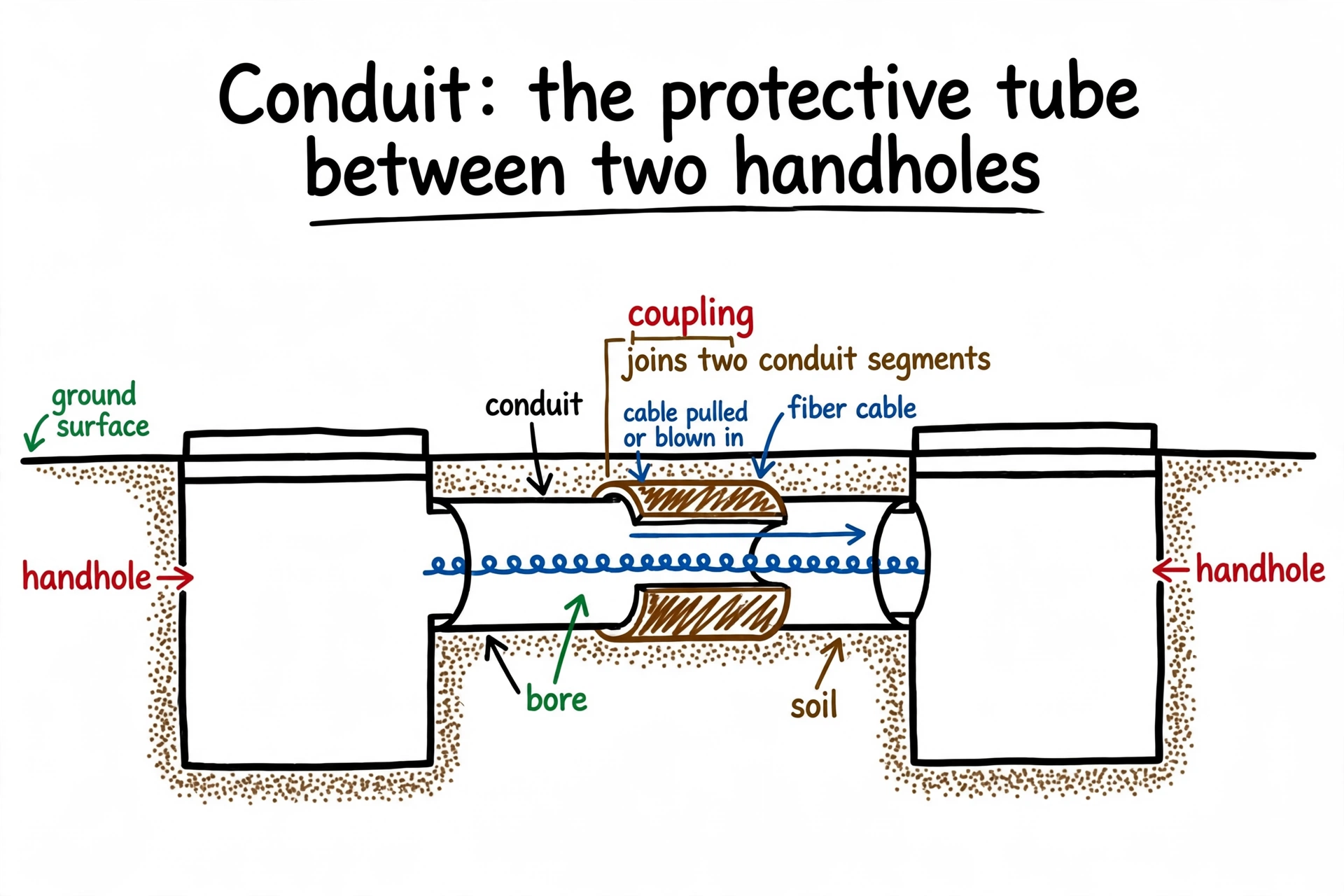
A conduit is a protective tube, usually made of plastic, that is installed underground to hold fiber cable and shield it from the soil, rocks, water, and digging around it. The cable travels inside the empty space of the tube, so the tube takes the abuse of the ground and the cable stays intact inside it.
This lesson is taught early because almost everything built after it depends on it. Lesson 3 defined a pathway as the continuous protected route fiber travels. Conduit is the physical pipe that makes the underground version of that pathway real, and Lesson 5 covers the handhole, the underground box this pipe usually connects to.
What This Lesson Gives You
- Recognize conduit on a reel, in an open trench, and entering a structure, and read its color and printed markings.
- Explain the three jobs conduit does: it protects the cable, it creates a smooth path for placing the cable, and it preserves the ability to replace the cable later.
- Tell a continuous, protected run from a run that will block cable placement.
- Spot the field conditions that matter before cover: proper joints, protected ends, clean entries into structures, and visible damage.
- Know what to report when you see a problem, and what to leave to trained crews.
Start With the Basics
Think of the fiber cable as the valuable thing that carries the internet signal. It is thin, fragile, and expensive to replace. You would not bury it bare in rocky dirt where shovels, rocks, and settling soil can reach it. Conduit is the pipe you put the cable inside. It is the protective tunnel that lives underground so the fiber does not have to face the dirt on its own.
A shipping tube works on the same principle. A poster slides into a stiff cardboard tube for mailing. The tube takes the dents and bends of transit, its smooth inside lets the poster slide in and back out without tearing, and the same tube can carry a replacement poster later. Conduit does all three of those things for fiber cable, at construction scale and buried for decades: it absorbs the punishment, it provides the smooth slide, and it stays in the ground ready for the next cable.
In Lesson 3, you learned that a pathway is the continuous protected route fiber travels. Conduit is the physical pipe that makes the underground version of that pathway real. Hold on to the word continuous. A conduit run that is open, joined, and clear from one end to the other is a pathway. A run with one crushed section or one blocked stretch has a gap in that protection, and the cable cannot use it until the gap is fixed.
What Is It?
A conduit is a tube, usually made of plastic, that is installed underground, and sometimes inside a building or on an aerial structure, to hold and protect cables. Common conduit materials on fiber projects include HDPE (high-density polyethylene, a tough plastic widely used for underground duct) and PVC (polyvinyl chloride, a rigid plastic pipe material). The word duct is often used to mean the same thing, and in the fiber world you will hear both terms used almost interchangeably.
Inside a conduit, there is an empty space called the bore. The fiber cable goes into that bore during a later step called cable placement. Placement simply means the process of getting the cable into the conduit and into its final position along the route.
A few related terms you need now, because everyone on a job site will use them:
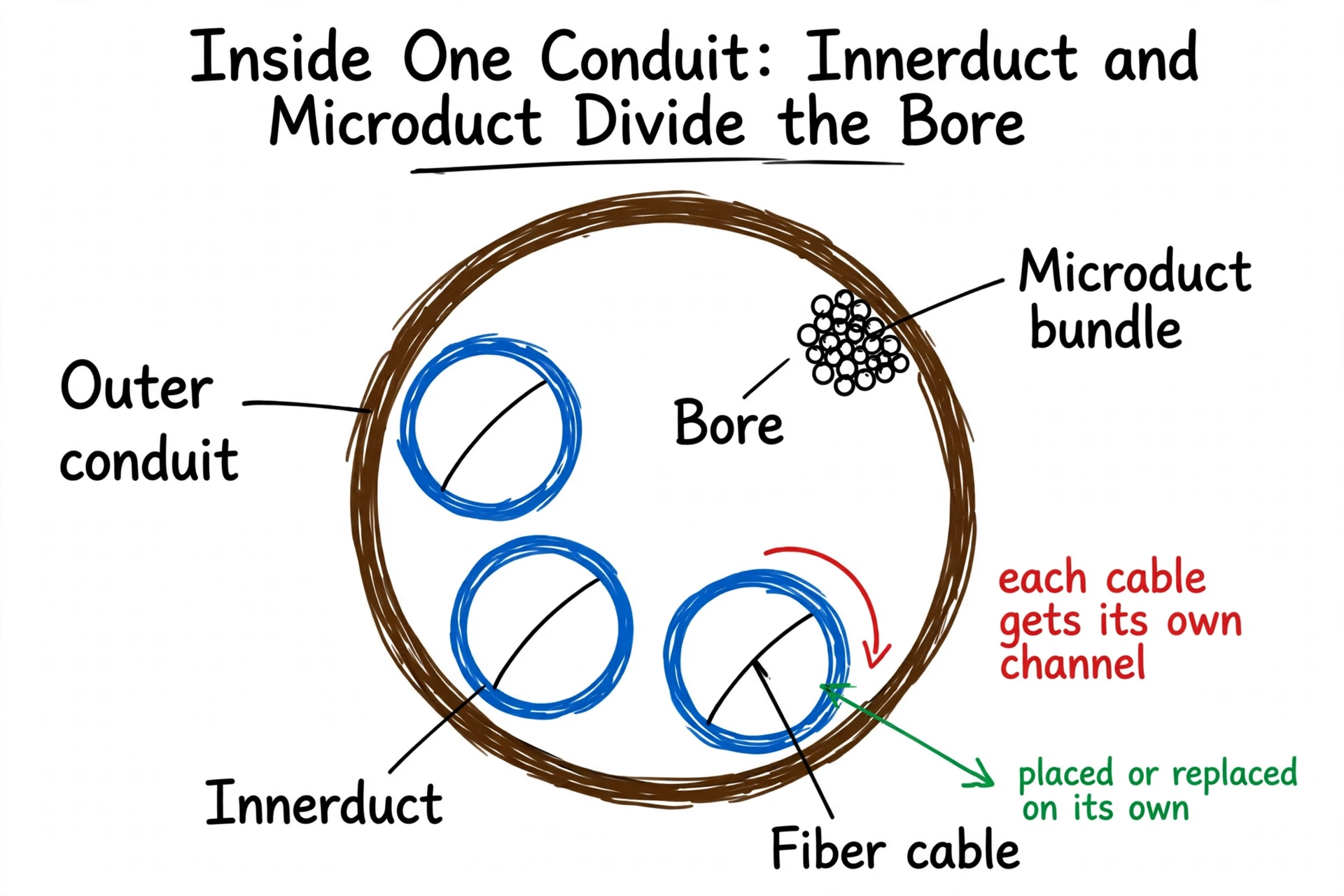
- Innerduct: a smaller tube placed inside a larger conduit. The big outer pipe gives overall protection, and the innerducts divide its bore into separate smaller tunnels. That way, several cables can share one big conduit without tangling, and each one can be installed or replaced on its own.
- Microduct: a very small tube, used with small-diameter fiber cables. Several microducts are often bundled together inside one conduit, which lets a network pack many cables into the space of one pipe. Manufacturer product data for microduct systems describes sizes, bundled configurations, and pre-installed fiber options for these small tubes.
- Coupling (or coupler): a short, slightly wider sleeve that joins two conduit segments end to end. It slides over the ends of both pieces and holds them together, forming one continuous tube. Rigid PVC pipe is the exception: it usually glues into socket fittings instead. Your project specifications decide which kind you use.
- Cable placement: the step where fiber cable is put into the conduit, usually by pulling it through with a rope or by blowing it through with compressed air.
- Proofing: a check performed before cable goes in, to confirm the conduit is open, clear, and undamaged. This lesson only mentions proofing so you know the step exists; a later lesson covers it in detail.
Why the nesting of tubes inside tubes? Because the bore is shared space, and shared space creates problems when cables are placed at different times. A cable pulled through a large open bore can wrap around a cable already in place, and pulling an old cable out can drag against the ones staying behind. Innerduct and microduct solve that by giving each cable its own channel inside the shared protection of the outer conduit. The outer pipe handles the ground. The inner tubes handle the organization.
Note that in this lesson, conduit always means the protective tube in an outside plant pathway. The electrical conduit an electrician runs inside a house follows the same basic idea, and it belongs to a different trade, with different materials, rules, and work. Same word, different world, and the color and context clues in the next section help you tell them apart in the field.
What Does It Look Like?
Forms you will see on site:
- A large coil or reel of colored plastic pipe is the sight you will run into again and again. Flexible conduit arrives wound on wooden or steel reels, like a giant spool of hose.
- Rigid conduit sometimes arrives in straight sticks, usually about ten or twenty feet long.
- In an open trench, conduit is the pipe laid in the bottom of the trench, waiting to be covered with soil.
- Where the trench ends at a structure, the conduit sticks up out of the ground and enters the structure through an opening. Lesson 5 defines the handhole, the small underground box this pipe usually connects to.
Color and markings:
- The color you will see most often on a fiber job is orange. Orange is a common industry choice for telecom conduit because it stands out in a trench and signals a communications line, so anyone digging later has a visual warning to dig carefully.
- Other colors are used too. Some conduit is black with colored stripes.
- Gray conduit is common on electrical work, and that color is a clue you are looking at a different trade’s pipe.
- Along the outside of the conduit, manufacturers print markings: the material, the size, and a running footage count that tells you how many feet of pipe are behind that point. Product data from conduit manufacturers confirms sequential footage markings as a standard feature. Those printed numbers are how crews know how much conduit they have used, and they are worth reading when you are trying to identify a pipe.
Joints you will see:
- A coupling looks like a short, slightly wider section of pipe at a joint. Where two segments meet, the coupling wraps both ends so the bore stays smooth and continuous.
- Coupling styles vary: push-on and heat-fused sleeves for HDPE duct, and glued socket fittings for rigid PVC.
- Conduit segments are joined this way roughly every stick length on rigid pipe, and less often on long coiled runs. That difference is why coiled HDPE is popular: fewer joints mean fewer places for things to go wrong. Every joint is a place where alignment can slip, where a sleeve can sit short of fully seated, and where dirt can enter if the connection fails. A run with fewer joints starts with fewer of those risks, and every joint on any run deserves a look before it is buried.
What Does It Do?
Conduit does three jobs. Each job answers a specific physical problem, and losing any one of them shows up later as cost.
First, it protects the cable. Soil presses in, rocks shift, water flows, and someday another crew will dig in the same area. The conduit takes that abuse so the fiber does not have to. A crushed conduit usually means the cable inside it took a beating too. Every cable is rated for how much crush it can take, and a crushed pipe has almost certainly blown past that rating, so treat the cable as damaged until someone qualified checks it. The mechanism is simple: force applied to the ground reaches the pipe first, and the pipe either holds its round shape and spreads that force around the bore, or it deforms and passes the force straight to the cable inside.
Second, it creates a smooth path for getting the cable in. The inside of the conduit is slick, sometimes with a special low-friction lining, so the fiber cable can be pulled or blown through hundreds or thousands of feet from one access point to the next. Manufacturer data describes low-friction coextruded linings built into microduct for exactly this purpose. Friction is the enemy of every placement: the longer the run and the rougher the interior, the more force the cable has to endure to get through. A smooth bore keeps that force down. Without that smooth tube, installing cable along an underground route would be nearly impossible.
Third, it preserves the future. Because the cable sits inside a tube rather than buried directly in the dirt, it can be pulled out and replaced with a bigger or newer cable later, using the same conduit. That ability to remove and replace cable without digging the route up again is a major reason fiber networks are built with conduit instead of burying the cable directly. The conduit is a one-time excavation that keeps paying off: the ground is opened once, and every cable generation after the first rides through the tube the first crew left behind.
How does the fiber actually get in? At a concept level, there are two main methods:
- Pulling means attaching the cable to a rope, often with a swivel so the cable does not twist, and drawing it through the conduit from one end.
- Blowing (also called jetting) means using compressed air to push the cable through, with the air carrying it along inside the tube. It is gentler on the cable and can cover longer distances.
Both methods depend entirely on the conduit being a smooth, continuous, unobstructed tube. If the conduit is crushed, kinked, or full of dirt, neither method works. The pull rope hangs up on the obstruction, or the air escapes through a separated joint, and the placement stops at the same place every time: the defect.
Where Does It Fit?
Conduit goes in during pathway construction, which happens before the fiber cable arrives. The sequence runs in this order:
- Dig the trench, or bore the hole underground without trenching.
- Lay the conduit in the trench or pull it into the bored hole.
- Join the segments with couplings.
- Run the conduit into structures like handholes.
- Cover it back up.
- Verify it is usable, through proofing.
- Place the fiber cable.
In other words, conduit is the shell that gets built first so the valuable part can be installed second.
It typically runs from handhole to handhole, handhole after handhole, forming the underground chain of the network pathway. See Lessons 2 and 3 on underground pathways and the pathway concept. Where trenches are dug, conduit is laid in the open trench. Where the ground cannot be dug up, under a road or driveway for example, conduit is installed by boring, a method that pushes or drills a hole horizontally underground without opening a trench, and the conduit is then pulled into that hole.
Conduit also interacts with inspection. Inspectors look at conduit before it is buried: they check that it is continuous, that joints are properly coupled, that ends are protected, and that it enters structures correctly. That timing has a reason. Some of that inspection happens while the trench is still open, because once the trench is backfilled (filled back in with soil), problems are hidden and much more expensive to fix. The open trench is the last cheap look anyone gets at the run. Every check in this lesson is aimed at that window.
What Is at Stake
Everything that happens later depends on the conduit. If the conduit is damaged or poorly installed, the fiber cable cannot be placed, or it gets damaged during placement, or it fails years later and cannot be replaced. A crushed section of pipe becomes a problem for the entire network segment, because cable must pass through every inch of the run. One bad section breaks the whole pathway, the same way one blocked tunnel closes an otherwise clear road.
The cost impact is real. Fixing conduit after the trench is buried means re-digging, which costs labor, equipment time, and schedule days. A blocked run discovered during cable placement can stop an entire crew and delay the rest of the project, since fiber work behind that run cannot proceed until the pathway is fixed.
The future cost is quieter and larger. A network built in good conduit can be upgraded by replacing cable inside pipe that is already in the ground. A network with ruined conduit faces a second construction project for the same upgrade. Building the conduit right the first time is one of the cheapest ways to protect a project budget, its schedule, and the value of everything that will ever travel through that route.
What Does Good Look Like?
Good conduit work has a few recognizable characteristics:
- Continuous runs. The conduit forms an unbroken tube from one access point to the next. No gaps, no missing sections.
- Proper joints. Where segments meet, they are joined with the right couplings, fully seated, so the bore is smooth and the joint does not separate when the soil moves or cable is pulled through.
- Protected ends. Conduit ends that are not yet connected to a structure are capped, plugged, or taped shut so dirt, water, and debris cannot get inside.
- Correct routing into structures. The conduit enters handholes and other structures cleanly, in the right position, without sharp bends at the entry point.
- No damage. The pipe is not crushed, kinked, gouged, or flattened anywhere along the run.
One distinction matters here. Everything above is general good practice. A real project also has contract specifications, the written technical requirements the customer and contractor agreed to. Specifications may require specific materials, sizes, colors, installation methods, and test results. An example specification for fiber optic innerduct from a state transportation department shows how concrete those requirements get, down to the duct material, the color called for in the plans, and a required drag line inside the duct. Good practice gets you in the right neighborhood; the contract specifications define exactly what counts as acceptable on that particular job.
From the Field
Picture a two-person crew finishing a conduit run along a 500-foot trench late in the afternoon. The pipe is laid, the segments are joined, and the run reaches the structures at both ends. The work the lesson describes is done, with one small exception: the open conduit ends at both ends of the trench are still uncovered.
Here is the decision point. Capping the ends takes a couple of minutes. The day is ending, the caps are a walk away, and the plan sounds reasonable when someone says it out loud: leave the ends open tonight, cap them first thing in the morning, and get back to it.
The crew leaves the ends uncapped overnight. Overnight it rains.
By morning, both ends have several feet of muddy water and silt inside the pipe. Rain fell on open ground, water followed the slope and the open mouths of the pipe, and fine soil washed in with it and settled inside the bore. Nothing about the run looks wrong from the surface. The pipe is in the ground, the trench work is finished, and the defect is invisible inside the tube.
The problem surfaces the next week, when the cable crew arrives to pull fiber. The rope snags in the silt. The conduit is blocked, and the placement crew has to spend a full day flushing and clearing the run before any cable can go in. A crew that was scheduled to place cable spends its day cleaning a tube that was clean when the installing crew left it.
Run the two numbers side by side. Capping the ends: a two-minute job at the end of a shift. Skipping it: a full day of delay for a second crew, a week later, with the schedule rearranged around a blocked run.
The decision rule to carry: an open end gets capped, plugged, or taped before the crew leaves it, every time, in every weather. Ends are protected in the same shift they are opened, because a bore left open overnight belongs to the rain.
What Can Go Wrong?
- Crushed or flattened conduit. Heavy equipment driving over a shallow or unprotected run, or rocks pressing against the pipe, can crush it. The bore narrows or closes, and cable cannot pass.
- Kinked conduit. If flexible conduit is bent too sharply during installation, it can kink like a garden hose. A garden hose kinks at the bend and the water stops; conduit does the same thing to a cable trying to pass. The kink pinches the bore shut at the bend.
- Separated joints. Couplings that were not properly joined can pull apart when soil settles or when cable is pulled through. The gap lets dirt and water in and can catch or damage the cable as it passes.
- Blocked runs. Dirt, gravel, or water that gets in through open ends can fill or clog the bore. A conduit full of debris is a conduit that cannot accept cable.
- Open ends left unprotected. Conduit ends left uncapped in a trench or sticking out of the ground will collect soil and water. This is one of the most common and most avoidable problems on the list, and it is the failure in From the Field.
The consequence is the same in every case: the pathway cannot do its job, so fiber cannot be installed or replaced, and someone has to dig it up and fix it. Stated plainly, without exaggeration: bad conduit work converts a cheap step done right into an expensive step done twice.
What Should Someone Notice in the Field?
You do not need to be an installer to notice conduit and spot the obvious problems. Here is what a beginner should look for:
- Color and markings. Orange pipe with printed markings along its length is very likely telecom conduit. Read the printed text; it tells you the material and size.
- Open ends that should be capped. If you see a conduit end sticking up out of the ground or out of a trench with nothing covering it, that is worth noting. It should be capped or plugged.
- Visible damage. Crushed, flattened, kinked, or gouged pipe is visible to the naked eye. A coupling that has slid off or a joint with a visible gap is also visible.
- Conduit entering structures. Where pipe meets a handhole or building, look for whether it enters cleanly and whether the opening around it looks sealed or finished.
The safety boundary, stated plainly:
- Noticing and reporting is one job. Installing, repairing, and formally inspecting conduit is another job, and it belongs to trained people following the project specifications and safety rules.
- Observation happens from a safe position at the surface. Open trenches and buried work carry hazards that this lesson does not train you to work around.
- Reading this lesson teaches recognition. It does not qualify you to install, repair, or inspect conduit to a professional standard.
Key Terms
- Conduit (duct): a protective tube installed underground (or elsewhere) that holds and protects cables. Duct is used to mean the same thing in fiber work.
- Bore: the hollow inside of a conduit; the space the cable travels through.
- Innerduct: a smaller tube placed inside a larger conduit, creating separate channels so multiple cables can share one conduit without tangling.
- Microduct: a very small tube used with small-diameter fiber cables; often bundled with other microducts inside a larger conduit.
- Coupling (coupler): a short sleeve that joins two conduit segments end to end, keeping the bore continuous.
- Cable placement: the process of installing fiber cable into conduit, by pulling or by blowing.
- Pulling: installing cable by drawing it through the conduit with a rope.
- Blowing (jetting): installing cable by pushing it through the conduit with compressed air.
- Proofing: a check, done before cable placement, that confirms the conduit is open, clear, and undamaged. Covered in detail in a later lesson.
- Backfill: soil placed back into a trench over the conduit after it is installed.
- Boring: an underground installation method that creates a horizontal hole without digging an open trench, used where the surface cannot be disturbed.
Check Your Understanding
- In your own words, why is fiber cable placed inside conduit instead of being buried directly in the dirt? What problems does the conduit solve?
- A friend sees orange pipe coiled on a reel at a job site and asks what it is for. Explain what it is and what will eventually go inside it.
- In From the Field, the crew left both conduit ends uncapped overnight, planning to cap them in the morning. What did that one decision cost the project, and what does the decision rule say to do instead?
- Why does a crushed section of conduit matter even if the rest of the 1,000-foot run is in perfect shape?
- Two neighboring projects both need fiber along the same street. One buries the cable directly; the other installs conduit and places the cable inside. Ten years later, both need bigger cables. Which project has the easier job, and why?
Answer key:
- Conduit protects the cable from soil pressure, rocks, water, and future digging; it provides a smooth tube so cable can be pulled or blown in; and it allows the cable to be removed and replaced later without re-digging. Direct burial leaves the cable exposed to all of those hazards and makes replacement require new digging.
- It is conduit (also called duct), the plastic pipe that forms the underground pathway for fiber. The empty bore inside it will hold fiber optic cable, which gets pulled or blown in later, after the conduit is installed and verified usable.
- Overnight rain carried muddy water and silt several feet into the pipe through the open ends. The run was blocked when the cable crew arrived the next week, and that crew spent a full day flushing and clearing it before any cable could go in. A two-minute capping job skipped at the end of a shift became a full day of delay. The rule: ends are capped, plugged, or taped before the crew leaves them, in the same shift they are opened.
- The cable must travel through the entire run. A crushed section narrows or closes the bore at that point, so cable cannot pass it. One bad section breaks the whole pathway, like one blocked tunnel on an otherwise clear road.
- The conduit project has the easier job. The old cable can be pulled out of the conduit and the new cable pulled or blown in through the same tube, with no digging. The direct-burial project has to dig the street up again to install the new cable.
Lesson Takeaway
Conduit is the protective plastic tube that forms the underground pathway for fiber cable, and it earns its place three ways: it shields the cable from the ground, it gives the cable a smooth tube to travel through, and it lets a future crew replace the cable without opening the ground again. After this lesson, a reel of orange pipe reads differently. You can name its parts (bore, innerduct, microduct, coupling), read its markings, and judge a run by what your eyes can verify: continuous, joined, capped, clean at the entries, and undamaged.
Sources and Technical References
- Fiber Optic Association (FOA), “Fiber Optic Ducts and Microducts” by Vladimir Grozdanovic: duct and microduct types, materials (HDPE, PVC), sizes, and installation by pulling or blowing/jetting. https://foa.org/tech/ref/install/Ducts.pdf
- Dura-Line (HDPE conduit manufacturer), MicroDucts HDPE product data: microduct sizes, low-friction coextruded lining (SILICORE), sequential footage markings, pull string and pre-installed fiber options. https://duraline.com/-/ods/Resource/462/3068/Original/DL_MD_HDPE.4.23.pdf?version=1680554175
- Dura-Line, FuturePath hybrid conduit product data: multiple conduit/microduct sizes in one installation, installation methods (plow, directional bore, trench, microtrench), applicable standards (ASTM F-2160, ASTM D-3350, NEMA TC-7, UL 651A, UL 1990). https://www.duraline.com/-/ods/Resource/163/3057/Original/DL_FP%20Hybrid_3way_5.23.pdf?version=1683032943
- NYSDOT specification item for fiber optic innerduct (example of contract-level specification): HDPE innerduct, color per plans, drag line (muletape) requirement. https://ht.dot.ny.gov/spec-repository/680.9912–11.pdf (cited only as an example of how contract specs define innerduct, not as a universal requirement)
- Millennium (fiber contractor), “Pulling vs. Blowing Fiber: A Beginner’s Guide”: blowing method concept, proofing before placement, cable preparation. https://www.mymillennium.us/blog/pulling-vs-blowing-fiber/
- Cabling Installation & Maintenance, “A comparison of conventional fiber and blown cable”: pulling vs blowing distances and speeds as reported by the author (figures are that article’s reported values, not universal rules). https://www.cablinginstall.com/design-install/cabling-installation/article/16466307/a-comparison-of-conventional-fiber-and-blown-cable
← Previous: Lesson 3: What Is a Pathway? | Level 1 Hub | Next: Lesson 5: What Is a Handhole? →