
Introduction
A DOT permit is a written approval from a state Department of Transportation that allows a named party to install, cross, or work with a utility facility inside state highway right of way, under the conditions written in the approval. It covers only the state highway ground the approval describes. It covers no city street, no county road, no railroad corridor, and no private parcel.
Level 6 studies permission one issuer at a time. Lesson 119 covers the municipal permit a city issues for its own streets. This lesson covers the state level: who issues the approval, what federal framework sits behind it on Federal-aid highways, what an application and review look like, and which conditions travel with the approval into the field.
What This Lesson Gives You
- Read a state DOT approval and name the issuer, the permittee, the highway segment, and the conditions that govern the work there.
- Explain the federal test in 23 CFR 645.205 and name what a state accommodation policy must address under 23 CFR 645.211.
- Tell whether a document in hand is called a utility permit, an encroachment permit, or a use and occupancy agreement in that state, and read it the same careful way under any of those names.
- Walk a route to the exact point where state highway jurisdiction ends and say which other issuer controls the next segment.
- Check expiration, notice, inspection, traffic control, and restoration conditions against the planned day before a crew mobilizes.
Start With the Basics
Think about setting up a work table inside a state office building hallway. The building manager controls the hallway. Permission to place the table comes from that manager, in writing, and the writing states where the table may sit, how much of the hallway must stay clear for people passing, when the work may happen, and what condition the hallway must be in when the work leaves. Permission for the hallway gives no right to set up in the shop next door, because a different manager controls that room.
A state highway corridor works in a similar way. The state Department of Transportation, shortened in this lesson to the state DOT, is the state agency that builds, operates, and controls the state highway system in that state. Right of way, shortened to ROW, is land set aside for transportation or utility use, such as the strip that holds a highway, its shoulders, its ditches, and the space above and below them. The state DOT controls the state highway ROW. A crew that wants to place fiber in that strip, cross under the highway, or occupy the shoulder to do the work needs the state DOT written approval for that ground.
Lesson 86 defined a permit in general terms. This lesson stays with one issuer. Every idea here answers to the state DOT and its highway ROW, and the approval ends where that jurisdiction ends.
What Is It?
A DOT permit is the state DOT written approval for a specific utility use of state highway ROW. Under 23 CFR 645.213, the written arrangements are generally in the form of use and occupancy agreements, and the section heading itself adds the word in parentheses: Use and occupancy agreements (permits). States name the same kind of approval in different ways:
- Utility permit in many state DOT systems, for installing, adjusting, maintaining, or removing a utility facility in state highway ROW.
- Encroachment permit in systems that use encroachment language for a facility or activity that occupies the ROW.
- Utility installation request or a similar application name in systems where the approved request form itself becomes the approval record, such as the Texas example described below.
The name on the form varies by state. The reading discipline stays the same under every name: find the issuer, the permittee, the location, the term, and the conditions, and treat the full package as the approval.
Three federal ideas frame the state approval on highways that carry federal aid:
- A Federal-aid highway is a highway built or improved with federal highway funds and administered through the state transportation department. Subpart B applies to the categories listed in 23 CFR 645.203, including new utility installations within the ROW of Federal-aid or direct Federal highway projects.
- Utility accommodation is the practice of allowing utility facilities to share highway ROW under controlled conditions. Section 645.205 states the federal policy test. Accommodation serves the public interest when such use and occupancy do not adversely affect highway or traffic safety, or otherwise impair the highway or its aesthetic quality, and do not conflict with the provisions of Federal, State, or local laws or regulations.
- A utility accommodation policy is the state written policy that controls how utilities may use highway ROW in that state. Section 645.211 requires each state transportation department policy to make adequate provision for a defined list of subjects, described in the next sections of this lesson. The Federal Highway Administration, shortened to FHWA, evaluates the adequacy of state policies using current AASHTO guidance on accommodating utilities within highway ROW and on roadside design.
The permittee is the person, company, or agency named on the approval as the party receiving the permission and accepting its conditions. The state DOT issues the approval to that named party for that described work. A crew working for a different party, or on a different segment, cannot assume the approval covers its work.
A DOT permit has four working parts, and a reader should be able to point to each one:
- The approval itself. The issued document, with a permit or agreement number, an issue date, and the signature or approval record the state system requires.
- The described work and location. The facility, the installation type, the highway name or route, and the limits where the work may occur, often with drawings attached.
- The term. The period the approval stays in effect, including any start deadline, completion deadline, or expiration date the approval states.
- Permit conditions. A permit condition is an enforceable requirement attached to the approval, covering matters such as location, installation method, traffic protection, notice, inspection, and restoration. Conditions may sit on the approval face, in general provisions attached to every approval of that type, in the state accommodation policy the approval references, or in a combination of all three.
One state example shows how the pieces fit together in a real system. In Texas, labeled here as an example only, a utility planning a new installation in Texas Department of Transportation ROW outside a highway project submits a Utility Installation Request on Form 1082. District approval covers new installations, except installations on utility bridges, attachments to highway structures, and exceptions to the Utility Accommodation Rules; approval of exceptions to the UAR is the responsibility of the Maintenance Division. Approval of attachments to highway structures is the responsibility of the Bridge Division. The Texas review checks that the form is complete, checks the utility statutory right to occupy the ROW in the manner proposed, checks compliance with the UAR in the type, manner, and location of the proposed installation, includes an on-site visit to determine the location can be accommodated without harm to maintenance or operation, and checks for no conflict with any proposed or active highway project. Form numbers, review offices, and rule citations belong to Texas. Another state runs the same function through different forms, different offices, and its own state rules.
What Does It Look Like?
A DOT permit lives in the job file before it lives in the field, and parts of it show up at the work location once work begins. Look for these elements when a state DOT package lands in front of you:
- A title or form heading that names the approval type used in that state, such as utility permit, encroachment permit, or use and occupancy agreement.
- A permit or agreement number and an issue date, used by the district office, the inspector, and the job file to refer to this exact approval.
- The issuing office, often a named district or area office of the state DOT, with a contact for notices, inspections, and questions.
- The permittee name and address, matching the party the contract says will perform or direct the work.
- A location description tied to the highway, such as a route name, segment limits, a crossing point, or an attached plan showing where the facility may go.
- A description of the authorized work, such as a longitudinal run along the ROW, a crossing under or over the highway, a handhole or cabinet placement, or shoulder work to reach an existing facility.
- Dates that bound the approval, including any effective date, start deadline, and expiration date stated in the package.
- Conditions and referenced documents, such as general provisions, the state accommodation policy, an approved traffic control plan, drawings, and any special conditions written for this segment.
- Field signs once work starts, such as traffic control devices set to the approved plan at the highway segment, marked work limits at the ROW edge, and a copy of the approval held where the permit requires it to be held.
A package that references attachments nobody can produce is an incomplete package. A permit face with no conditions sheet, no drawings, and no general provisions in the file deserves a question before it deserves a mobilization.
What Does It Do?
A DOT permit does its work through the state accommodation policy behind it. Section 645.211 lists what that policy must address, and each item on the list becomes a control the individual approval can apply to a specific segment.
It fixes location and clearance expectations. State standards for regulating utility use and occupancy must state the horizontal and vertical location requirements and clearances for the various types of utilities. Longitudinal placement means a facility running along the direction of the highway inside the ROW. A crossing means a facility passing across the highway or its ROW. The policy treats placement questions in writing, so the approval for a segment can point the facility to an allowed position inside the strip and keep it clear of the traveled way, drainage features, and planned highway work as the state standards require.
It sets installation method and restoration expectations. Section 645.211 requires the state standards to cover specifications for and methods of installation, plus requirements for preservation and restoration of highway facilities, appurtenances, and natural features and vegetation on the ROW, plus limitations on utility activity inside the ROW where limits protect highway interests. The approval for a segment carries those expectations down to the bore, the trench, the shoulder repair, and the grass strip the crew disturbed.
It protects traffic during and after the work. The same section requires measures to protect traffic and its safe operation during and after installation. The listed measures include control of access restrictions, provisions for rerouting or detouring traffic, traffic control measures to be employed, procedures for utility traffic control plans, limitations on vehicle parking and materials storage, and protection of open excavations. A traffic control plan is a plan that shows how vehicles, bicycles, and pedestrians will be guided through or around a work zone. Traffic control on public roads follows Part 6 of the Manual on Uniform Traffic Control Devices, shortened to MUTCD, published by FHWA, together with any state supplement the state DOT has adopted. The permit condition is what makes the plan enforceable for this job at this highway location.
It creates the written record the system runs on. Section 645.211(d) requires compliance with applicable state laws and the approved state accommodation policy to be assured, requires the responsible state transportation department file to contain evidence of the written arrangements setting out the terms for crossing or occupying the ROW, and states that every utility installation on highway ROW is subject to written approval by the state transportation department. However, such approval will not be required where so provided in the use and occupancy agreement for such matters as utility facility maintenance, installation of service connections on highways other than freeways, or emergency operations. The approval in the job file is that written arrangement for the segment.
It preserves the state power to say no. Section 645.211(c)(5) states that a state transportation department may deny a utility request to occupy highway ROW based on state law, regulation, or ordinance, or on the department policy itself. Denial, conditioning, and redesign requests belong to the system. A schedule built on the assumption that every DOT application issues in the form first requested is a schedule built on hope.
It tightens control on freeways. A freeway is a divided arterial highway with full control of access (23 CFR 645.207); in practice, entry and exit occur only at designated interchanges. Control of access is the state control over where vehicles and people may enter or leave the highway ROW. Under 23 CFR 645.209(c), each state transportation department submits an accommodation plan that addresses how it will consider applications for longitudinal utility installations inside the access control lines of a freeway, including installations in interchange areas that must be constructed or serviced by direct access from the main lanes or ramps. If a State transportation department elects to permit such use, the plan must address how the State transportation department will oversee such use consistent with this subpart, Title 23 U.S.C., and the safe and efficient use of the highways. The plan must assure that safety effects are ascertained and that no use is permitted that would adversely affect safety, and a utility strip along the outer edge of the ROW, separated from the through roadway by a utility access control line, is part of the arrangement the regulation describes. A state may also adopt a policy more restrictive than the federal text for longitudinal installations along freeway ROW and for access to build or service them. The field meaning is plain: a state DOT approval for work inside freeway access control lines carries a heavier review and tighter conditions than an approval on an ordinary highway shoulder, and access for construction and later service follows the approved plan only.
Where Does It Fit?
A DOT permit sits inside a chain of permissions, and its place in the chain is defined by jurisdiction.
At route review, the planner divides the route by who controls each stretch of ground. One continuous fiber route can cross ground controlled by several issuers in a single day of driving:
- State highway ROW, controlled by the state DOT, covered by the DOT approval in this lesson.
- City streets, controlled by the city, covered by the municipal permit in Lesson 119.
- County roads, controlled by the county under its own system.
- Railroad corridors, controlled by the railroad as a private owner, covered in Lesson 121.
- Private parcels, covered by an easement or another land rights instrument, covered in Lessons 117 and 118.
- Regulated waters and similar features, which can require a separate environmental authorization, covered in Lesson 123.
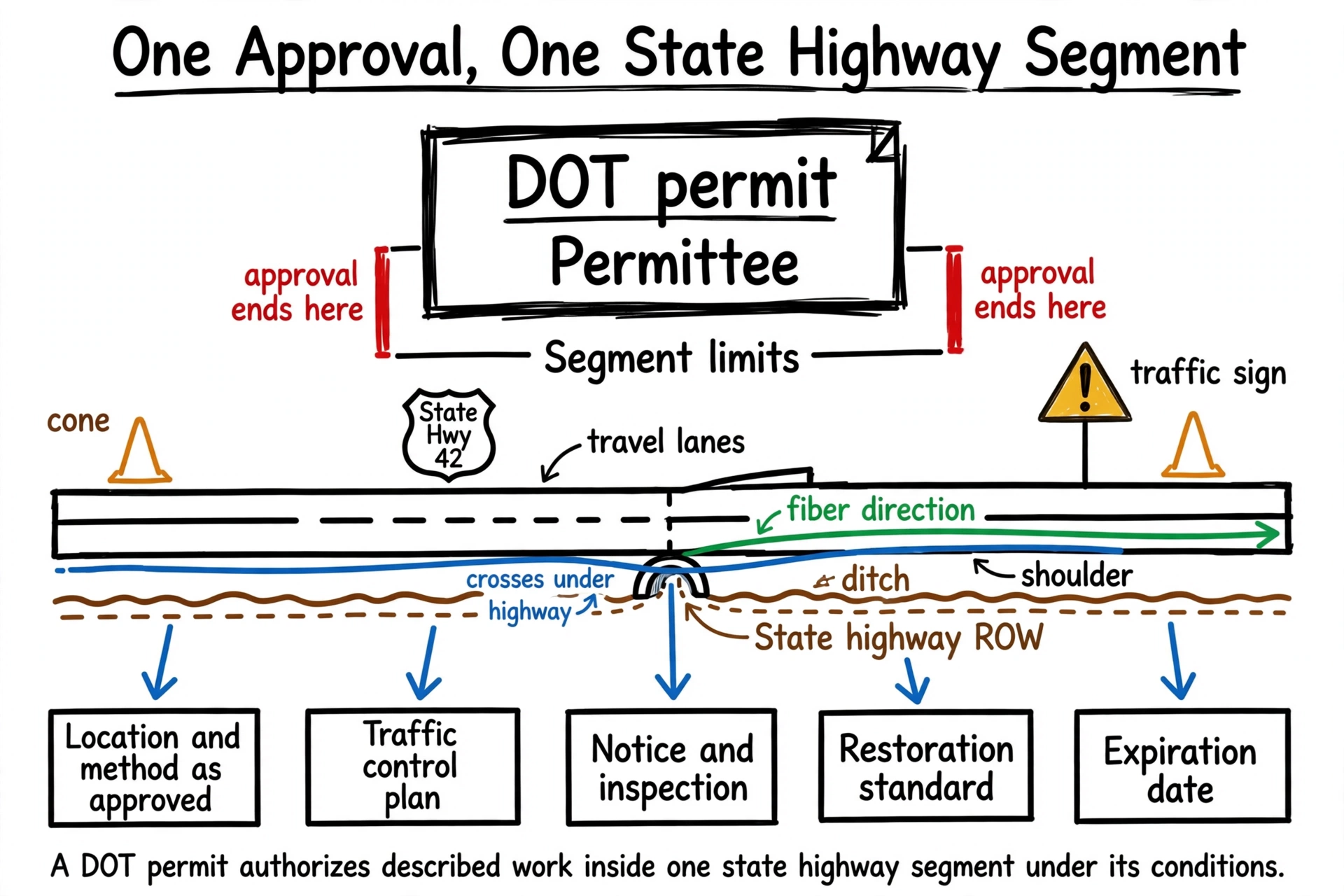
A DOT permit authorizes work only inside the state highway segment it describes. Where the route leaves state highway ROW and enters a city street, the city approval governs that stretch, even when the pavement looks continuous and the road keeps the same local name. Where the route returns to a state highway, the DOT approval governs again. Jurisdiction follows control of the ground. Jurisdiction never follows the color of the pavement or the habit of the crew.
Inside the DOT segment itself, the sequence runs like this:
- The applicant prepares an application package with the drawings, locations, methods, and traffic control information the state system requires for that kind of installation.
- The state DOT reviews the package against state law and the state accommodation policy, checking the proposed type, manner, and location of the installation, as the Texas example review describes in its own system.
- The state DOT issues the approval, issues it with conditions, requests changes, or denies the request under the grounds Section 645.211 preserves.
- The permittee reads the full issued package, converts its conditions into the segment plan, and gives every notice the conditions require before work starts.
- During construction, the permittee builds inside the described limits and method, follows the approved traffic control, and hosts every inspection the conditions call for.
- After construction, the permittee restores the ROW to the standard the approval requires, completes any final inspection or acceptance step the state system provides, and files the closed approval with the segment records.
A DOT permit also sits beside permissions that answer different questions. It grants no rights on private land. It replaces no environmental authorization where one is required. It qualifies no one to perform excavation, boring, aerial work, or traffic control duties, because those activities answer to safety law, training, and the job safety process. Each permission covers its own ground and its own question.
Future work follows the state system as well. Maintenance, adjustment, or a new installation inside the same ROW can each require a new approval, an added approval, or a notice process, depending on the state system and the kind of work. A construction approval held in the file proves the original installation was authorized. The file alone never proves a later entry is authorized.
What Is at Stake
Highway and traffic safety. Section 645.205 makes safety the first test of accommodation, and Section 645.209(a) states that highway safety and traffic safety hold paramount importance when utilities are accommodated inside highway ROW. Work on a shoulder or across lanes places crews beside live traffic moving at highway speed. Conditions on traffic control, parking, material storage, and protection of open excavations exist because the traveling public passes through the work area with no briefing and no choice.
Stop work, correction, and removal. Work performed outside the described location, by a method the approval excludes, or after the approval term has ended is work the state DOT never authorized. The issuing office can direct the affected work to stop and can require correction or removal under the permit terms and state rules for that segment. Plant built correctly in a technical sense can still be plant built in the wrong legal position.
Restoration and the highway asset. The ROW holds pavement, shoulders, drainage, signs, guardrail, and vegetation the state maintains for the public. Restoration conditions protect that asset after the crew leaves. A shoulder that settles, a ditch that drains poorly after disturbance, or a pavement cut repaired below the named standard becomes a state maintenance problem created by utility work, and the approval record points to the party responsible for fixing it.
Schedule. A DOT review runs on the state timetable. Applications returned for changes, conditions that require a different method or a different access point, and freeway reviews that run through the accommodation plan all consume calendar time before ground opens. Reading the policy expectations during design, while the alignment and method can still move on paper, keeps that time in planning. Discovering the same expectations from an inspector in the field spends the time with a crew standing by.
Cost. Traffic control built to the approved plan, restoration built to the named standard, rework ordered after an inspection, and standby time during a stop all land on the job. The approval and its referenced standards state the expectations that drive those costs. A bid or a schedule that skipped the conditions priced a different job from the job the state approved.
Future access to the corridor. Fiber placed under a DOT approval will need service, repair, and eventual adjustment when the highway changes. A clean approval record, with inspections completed and restoration accepted, gives that future work a documented starting point. A corridor history of expired approvals, missed notices, and failed restoration gives the next application a harder review before it starts.
What Does Good Look Like?
- The issued DOT approval for the segment sits in the job file with its number, issue date, conditions, general provisions, drawings, and any amendments together in one place.
- The permittee, the described work, the highway segment limits, and the approval term each match the print segment the crew is about to build, and the foreman can state all four matches out loud.
- Conditions that touch the field appear on the segment plan as assigned tasks, covering notice steps, inspection points, traffic control, access points, work limits, and restoration.
- Traffic control staged at the highway matches the approved traffic control plan for that location, and devices follow the MUTCD and any state supplement the permit references.
- The crew enters and leaves the ROW only at access points the approval allows, and material and equipment stay inside the storage and parking limits the conditions set.
- Expiration and deadline dates sit on a tracked calendar, and any extension request goes to the issuing office through its process before the term ends.
- Restoration in progress is checked against the standard named in the approval while correction is still simple, and the final inspection step is scheduled before the crew demobilizes.
- At every point where the route leaves state highway ROW, the file holds the separate permission for the next stretch of ground, and nobody treats the DOT approval as covering that stretch.
From the Field
Picture a fiber route that runs along a state highway shoulder, then turns and follows a road into a town, then leaves the town on the same numbered route and continues along the highway again. The print shows one continuous line. The job file holds a state DOT approval for the highway work and a city approval for the town streets. Each approval lists its own limits, its own conditions, and its own expiration date.
During the preconstruction read, the project coordinator lays the print beside both approvals and marks the two jurisdiction changes on the print in pencil. The first change sits where the state highway enters the town limit and the road becomes a city street. The second change sits where the route leaves the town and the highway ROW resumes. The coordinator checks each approval against its own stretch. The DOT approval describes the shoulder work on both highway stretches, requires the approved traffic control plan for shoulder operations, and calls for notice to the district office before starting and an inspection step tied to restoration. The city approval covers the town stretch under city conditions.
One mismatch surfaces while the paper is still on the table. The crew sequence in the draft schedule runs the town stretch first and reaches the second highway stretch last, close to the DOT approval expiration date. A second mismatch sits at the town exit. The draft plan stages the bore rig on the highway shoulder just past the town limit to save a move, and that staging point falls inside the DOT segment, where the approval traffic and storage conditions govern the shoulder. The staging idea was drawn while the crew was thinking about the town stretch, where different conditions apply.
The coordinator raises both items in writing to the project lead before mobilization. The lead resequences the work so the highway stretches build well inside the DOT term, requests direction from the district office on the staging point under the DOT conditions, and briefs the foreman on the two pencil marks where one approval ends and the other begins. The foreman carries the marked print with both approvals in the truck.
On the ground, the crew builds the first highway stretch under the DOT conditions, changes its setup at the town limit to match the city approval, and changes back at the second pencil mark. The district inspection tied to restoration finds highway work matching the DOT approval, inside its limits and inside its term.
The decision rule is direct: find the jurisdiction line on paper before the crew finds it on the ground, match each stretch of work to the approval that controls that stretch, and hold any staging, access, or method that belongs to the wrong approval until the controlling issuer gives direction.
What Can Go Wrong?
Treating one approval as covering the whole route. A DOT permit covers state highway ROW only. A route that enters a city street, a county road, a railroad corridor, or a private parcel needs the separate permission for that ground. Pavement continuity hides jurisdiction changes, and a crew can cross from authorized ground into unauthorized ground without any visible change in the road.
Reading the approval face and skipping the conditions. Conditions can live in general provisions, in the state accommodation policy the approval references, and in attached plans. A crew can satisfy every line on the face and still miss a notice step, an inspection step, a storage limit, or a restoration standard stated in the referenced documents.
Working after expiration. An expired approval has ended under its own terms. Paper in the truck still looks official after the date passes. Dates must be read, tracked, and renewed through the issuing office process before the term ends, and an extension is a written grant rather than an assumption.
Entering a freeway segment on an ordinary approval. Longitudinal work inside freeway access control lines runs through the state accommodation plan process under Section 645.209(c), with tighter access and service rules. An approval written for a conventional highway shoulder describes different ground and different access, and it cannot be stretched to cover a freeway segment.
Staging or parking outside the allowed limits. Section 645.211 requires state standards to address limitations on vehicle parking and materials storage as part of traffic protection. A rig, a reel trailer, or a spoil pile placed outside the approved area can violate the approval even when the installed facility itself sits in the correct position.
Missing a notice or inspection step. A phase the conditions require the district to witness can be covered or restored before the witness step happens. The issuing office can require exposure, added documentation, or rework under its rules, and the segment closeout stalls while the step is reconstructed.
Restoring below the named standard. A shoulder, ditch, or pavement repair that looks finished can still fail the preservation and restoration requirements the state standards carry into the approval. The standard in the package controls acceptance. Crew opinion never replaces it.
Carrying numbers from another state. Fees, review times, validity periods, depths, and clearances belong to the state system, the state policy, and the individual approval for that job. A value remembered from a Texas form, a neighboring state manual, or a prior project proves nothing about the segment in front of the crew.
What Should Someone Notice in the Field?
- Identify the approval in hand: the state DOT office that issued it, the approval type name used in that state, the permit or agreement number, and the issue date.
- Confirm the document is an issued approval with its conditions, general provisions, drawings, and amendments present, rather than an application, a receipt, or a draft.
- Compare the permittee name against the party performing or directing the work under the contract, and raise any mismatch before work starts.
- Walk the location limits on the print: find where the described state highway segment begins and ends, and mark every point where the route leaves state highway ROW for a city street, a county road, a railroad corridor, or private land.
- Read the term dates: the effective date, any start or completion deadline, and the expiration date, and compare all three against the planned schedule for the segment.
- Pull out the conditions that touch the day: required notice before starting, inspection steps, approved access points, parking and storage limits, and the restoration standard.
- Compare traffic control staged in the field against the approved traffic control plan for that location, device by device and sign by sign.
- Check that rig setup, entry and exit points, staging, and spoil placement all sit inside the work limits and access lines the approval allows, with added care inside any freeway access control area.
- Report any field condition the approval fails to cover, such as a highway project under construction inside the segment or a work area that cannot hold the approved setup, to the project lead the same day.
- Know the boundary: reading a DOT approval, marking jurisdiction lines, and reporting mismatches are recognition and support tasks. Only the issuing state DOT office can change, extend, waive, or reinterpret its own approval, and only qualified and authorized people may perform the excavation, boring, aerial work, and traffic control duties the approval describes. Reading this lesson qualifies no one to perform regulated or hazardous work.
Key Terms
DOT permit: A written approval from a state Department of Transportation allowing a named party to install, cross, or work with a utility facility inside state highway right of way, under the conditions in the approval.
State DOT: The state Department of Transportation, the state agency that builds, operates, and controls the state highway system in that state.
Right of way (ROW): Land set aside for transportation or utility use, such as the strip holding a highway, its shoulders, ditches, and the space above and below them.
Federal-aid highway: A highway built or improved with federal highway funds and administered through the state transportation department, covered by the federal utility accommodation framework in 23 CFR Part 645, Subpart B.
Utility accommodation policy: The state written policy, meeting the requirements of 23 CFR 645.211 on Federal-aid highways, that controls how utilities may use highway right of way in that state.
Use and occupancy agreement: The written arrangement described in 23 CFR 645.213 as generally in the form of a use and occupancy agreement, setting out the terms under which a utility facility may cross or otherwise occupy highway right of way. Many states issue this arrangement as a utility permit or an encroachment permit.
Permittee: The person, company, or agency named on an approval as the party receiving the permission and accepting its conditions.
Control of access: State control over where vehicles and people may enter or leave highway right of way, applied in full on freeways, where entry and exit happen only at designated interchanges.
Longitudinal: Running along the direction of the highway inside the right of way, as opposed to crossing it.
Traffic control plan: A plan showing how vehicles, bicycles, and pedestrians will be guided through or around a work zone, following the MUTCD, any state supplement, and the procedures in the state accommodation policy.
Check Your Understanding
- State the federal policy test for accommodating a utility on a Federal-aid highway under 23 CFR 645.205.
Answer: Accommodation serves the public interest when such use and occupancy do not adversely affect highway or traffic safety, or otherwise impair the highway or its aesthetic quality, and do not conflict with the provisions of Federal, State, or local laws or regulations.
- Name four subjects a state accommodation policy must address under 23 CFR 645.211.
Answer: Any four of these fit: uniform procedures controlling the manner, nature, and extent of utility use; horizontal and vertical location requirements and clearances stated clearly; applicable government or industry codes; specifications and methods of installation; preservation and restoration of highway facilities and natural features; limitations on utility activity inside the ROW; and traffic protection measures during and after installation, including traffic control plans, parking and storage limits, and protection of open excavations.
- A job file holds an approval titled encroachment permit from the state DOT and a second file holds a use and occupancy agreement from a different state DOT. A trainee says only one of them can be a real DOT permit. Evaluate that claim.
Answer: The claim fails. States name the same kind of state highway ROW approval in different ways. Federal regulation at 23 CFR 645.213 describes the written arrangements as generally in the form of a use and occupancy agreement, with (permits) in the section heading, and many states issue the approval as a utility permit or an encroachment permit. The reader checks the issuer, permittee, location, term, and conditions under any of these names.
- In the From the Field scenario, what did the coordinator mark on the print, and what two mismatches did the preconstruction read find?
Answer: The coordinator marked the two jurisdiction changes where the route left state highway ROW for the town streets and where it returned to the highway. The read found a sequence that pushed the second highway stretch close to the DOT approval expiration date, and a staging plan that placed the bore rig on the highway shoulder inside the DOT segment while the idea had been drawn under town thinking, where different conditions apply. The lead resequenced the highway work inside the DOT term and requested district direction on the staging point.
- A crew finishes a city street segment in the morning and reaches a freeway shoulder segment in the afternoon, holding an approval written for a conventional state highway. What should happen before work starts on the freeway segment?
Answer: Work on the freeway segment waits. Longitudinal installations inside freeway access control lines run through the state accommodation plan process under 23 CFR 645.209(c), with tighter access, safety review, and service rules, and a state may apply a more restrictive policy there. The crew escalates to the project lead so the correct approval for that segment can be confirmed with the state DOT before anyone builds.
Lesson Takeaway
A DOT permit is the state signature on one defined piece of ground: state highway ROW, for a named party, for described work, inside a stated term, under written conditions backed by the state accommodation policy. After this lesson, a route reads as a chain of jurisdictions rather than a single line, and the state link in that chain gets checked for its issuer, its limits, its dates, and its conditions before a crew treats the shoulder as a workplace.
Sources and Technical References
Federal regulation, 23 CFR 645.203, Applicability, listing the categories Subpart B applies to, including new utility installations within the ROW of Federal-aid or direct Federal highway projects: https://www.law.cornell.edu/cfr/text/23/645.203
Federal regulation, 23 CFR 645.205, Policy, stating that accommodation of utility facilities on the right of way of a Federal-aid or direct Federal highway project serves the public interest when such use and occupancy do not adversely affect highway or traffic safety, or otherwise impair the highway or its aesthetic quality, and do not conflict with the provisions of Federal, State, or local laws or regulations: https://www.law.cornell.edu/cfr/text/23/645.205
Federal regulation, 23 CFR 645.211, State transportation department accommodation policies, requiring state policies to address uniform procedures, location requirements and clearances, applicable codes, installation specifications and methods, preservation and restoration, activity limitations, traffic protection measures including traffic control plans and protection of open excavations, the state power to deny a request under state law or policy, written approval for installations, with the 645.211(d) exception where the use and occupancy agreement so provides for utility facility maintenance, installation of service connections on highways other than freeways, or emergency operations, and detailed procedures for evaluating freeway applications: https://www.law.cornell.edu/cfr/text/23/645.211
Federal regulation, 23 CFR 645.213, Use and occupancy agreements (permits), describing the written arrangements as generally in the form of use and occupancy agreements and listing what they must include or incorporate by reference: https://www.law.cornell.edu/cfr/text/23/645.213
Federal regulation, 23 CFR 645.209, General requirements, stating that highway and traffic safety hold paramount importance in utility accommodation, and at subsection (c) requiring a state accommodation plan for longitudinal utility installations inside the access control lines of a freeway, with safety criteria, a utility strip at the outer edge of the right of way, and room for a state to adopt a more restrictive freeway policy: https://www.law.cornell.edu/cfr/text/23/645.209
Federal Highway Administration, Guidance on the Use of Highway Right-of-Way, addressing accommodation of broadband and other utility projects as utilities under 23 CFR Part 645, Subpart B, coordination with state DOTs on utility accommodation policies, and the Section 645.205 public interest test: https://www.fhwa.dot.gov/real_estate/right-of-way/corridor_management/guidance-use-highway-right-of-way.pdf
Texas Department of Transportation, Right of Way Division, ROW Utilities Manual, Section 11, New Utility Installations in Existing Right of Way, an example state system in which new installations outside a highway project are requested through the district on a Utility Installation Request form, district approval covers new installations except installations on utility bridges, attachments to highway structures, and exceptions to the Utility Accommodation Rules, approval of exceptions to the UAR is the responsibility of the Maintenance Division, and review checks the form is complete, the statutory right to occupy, compliance in type, manner, and location, an on-site visit, and no conflict with a proposed or active highway project. Form numbers and offices belong to Texas only: https://www.txdot.gov/manuals/row/utl/chapter-12–unique-conditions-and-special-cases/section-11–new-utility-installations-in-existing-.html
Federal Highway Administration, Manual on Uniform Traffic Control Devices, 11th Edition, Part 6, Temporary Traffic Control, the national standard the state traffic control conditions reference for work in and near the traveled way: https://mutcd.fhwa.dot.gov/pdfs/11th_edition/part6.pdf
Graphic Brief 1
Graphic title: One Approval, One State Highway Segment
Main objects: A whiteboard drawing of a numbered state highway running left to right across the middle of the board, with travel lanes, a shoulder, a ditch, and a ROW line drawn as a dashed brown line along the outer edge. A fiber path drawn in blue runs along the shoulder inside the ROW and crosses under the highway at one point. A large approval document panel stands at the top center, tied to the highway segment with a bracket showing the segment limits. Condition panels hang below the document: location, method, traffic control, notice and inspection, restoration, and term dates.
Placement: Title at the top. Highway across the middle. ROW dashed line along the bottom edge of the highway strip. Approval document panel at the top center with a bracket spanning only the state highway segment. Condition panels in a row beneath the highway. White space at the bottom for the key teaching point.
Labels: State highway ROW. DOT permit. Permittee. Segment limits. Location and method as approved. Traffic control plan. Notice and inspection. Restoration standard. Expiration date.
Arrows and relationships: Blue arrows run from the approval panel down to each condition panel, showing the conditions travel with the approval. A green arrow follows the fiber path inside the segment limits. A red stop bar sits at each end of the bracket, showing the approval ends at its segment limits.
Important technical details: The fiber path stays inside the ROW line and follows the shoulder, with the crossing drawn passing under the highway. No depths, clearances, distances, fees, review times, or validity periods appear anywhere on the board, since those values belong to the state policy and the individual approval. Traffic devices are generic sign and cone shapes with no invented specifications.
What not to show: No fiber path continuing past the segment limits under the same approval. No crew working outside the bracket. No agency seal, permit number, or dollar figure. No decoration or extra labels.
Key teaching point: A DOT permit authorizes described work inside one state highway segment, under its conditions and inside its term, and the authorization ends at the segment limits.
Graphic Brief 2
Graphic title: Same Road, Two Issuers
Main objects: A comparative whiteboard drawing of one continuous road running left to right across the whole board, split into two halves by a vertical jurisdiction line in the middle. The left half is labeled as a state highway segment, with a state DOT office symbol, a shoulder, a ditch, and a ROW line. The right half continues as a city street segment, with a city office symbol, curb, sidewalk, and houses. The fiber path in blue runs continuously across both halves. Two approval document panels sit above the road, one over each half, each tied to its own half with its own bracket and its own condition tags. A small inset at the bottom shows the road returning to a state highway segment with a third bracket tied to the DOT approval.
Placement: Title at the top. Road across the middle, jurisdiction line at the center. State highway half on the left, city street half on the right. DOT approval panel above the left half, city approval panel above the right half. Return inset along the bottom. White space at the bottom for the key teaching point.
Labels: State highway segment. State DOT permit. City street segment. Municipal permit. Jurisdiction line. Same road, different issuer. Check the approval at every line.
Arrows and relationships: A blue arrow follows the fiber path across the full road, showing the route stays continuous while permission changes. A green check sits on each approval panel over its own half only. A red stop symbol sits on the jurisdiction line under each approval bracket, showing neither approval crosses the line. An arrow from the bottom inset points back to the DOT panel, showing the DOT approval governs again where state highway ROW resumes.
Important technical details: The road surface stays visually continuous across the jurisdiction line, teaching that pavement continuity hides the change in control. The state half shows shoulder and ditch cross section elements. The city half shows curb and sidewalk elements. No depths, clearances, fees, dates, or distances appear, since those belong to each approval for that segment.
What not to show: No single approval panel spanning both halves. No crew carrying one setup across the line unchanged. No invented city or state names, seals, or form numbers. No decoration or extra labels.
Key teaching point: One road can cross two jurisdictions, and each stretch answers to the issuer that controls that ground, so the approval check repeats at every jurisdiction line.
Previous lesson: Lesson 119: What Is a Municipal Permit? |
Back to Level 6 hub