
Introduction
Private property, in the land sense used in this lesson, is land owned by a private party, such as a person, a family, a company, or another non-government owner, where the owner holds the right to control who may enter and what may be done there. Lesson 23 taught the property line, the legal dividing line between parcels. This lesson teaches the ownership interest on one side of that line, and why that interest controls whether a fiber crew may step onto the ground at all.
This lesson opens Level 6, Understand Permission to Build. Public right of way came first, in Lesson 116, because a public corridor carries a public right to be there for stated purposes. Private land works under a different rule. A crew has no general right to enter private land for convenience, for a shortcut, or because the work nearby is authorized. Entry needs a permission that covers that parcel, that purpose, and that area, and this lesson teaches how to recognize whether that permission exists.
What This Lesson Gives You
- Explain private property as an ownership interest, and name the rights bundled into full ownership at a recognition level.
- Tell an owner, an occupant, and a tenant apart, and state why the person standing at the door may hold no authority to grant construction entry.
- Name the three routes by which permission to enter private land normally reaches a fiber project: a recorded easement, a license or written owner authorization, and a customer service agreement for work at that customer address.
- Read posted signs, closed gates, locks, and fences as signals to stop and check, and state why an open gate creates no permission on its own.
- Apply the stop rule when permission for a parcel is unclear: stay out, document what the record shows, and escalate to the project role that handles land rights.
Start With the Basics
Think about a house and its keys. The owner holds every key and decides who gets one, which door each key opens, and how long each person may keep it. A guest handed a key to feed a cat for a weekend holds a narrow permission for one purpose, for a short time, under conditions the owner set. The guest holds no right to invite a work crew in, to store equipment in the garage, or to let a neighbor cross the yard.
Land works in a similar way, and the key picture maps to the real mechanism. Ownership is the full set of rights in a parcel, the way holding every key is the full set of access to a house. A permission to enter is one key handed out for one purpose. It opens only what the grantor had the right to open, it covers only the purpose named, and it can end. A fiber crew that treats a weekend key as ownership will enter rooms it was never given. A fiber crew that treats one narrow permission as a general right will cross parcels it was never given.
Hold onto one sentence for the whole lesson. Being allowed somewhere for one purpose, by one person, on one parcel, says nothing about any other purpose, person, or parcel.
What Is It?
Private property refers to ownership of property by private parties, meaning parties other than the government. That is the definition used by the Cornell Legal Information Institute. For fiber work, the property that matters is real property, which means land and the things permanently attached to it, such as buildings and other immovable structures. A house lot, a farm field, a church yard, a store parking lot, and a vacant parcel held by a company are all private property when a non-government party owns them.
Fee simple is the greatest possible property interest in land, granting its owner all traditional property rights. Cornell describes a fee simple interest as stretching out in time, in its absolute form without a set end, with only one fee simple existing at a time for a given piece of land. When people speak in plain words about someone owning land outright, fee simple is usually the interest they mean. The owner of a fee simple can also split off smaller pieces of the interest and grant them to others, such as a lease for a term, a life estate for a person lifetime, or an easement for a stated use. The smaller grants are covered later in this section and in Lesson 118.
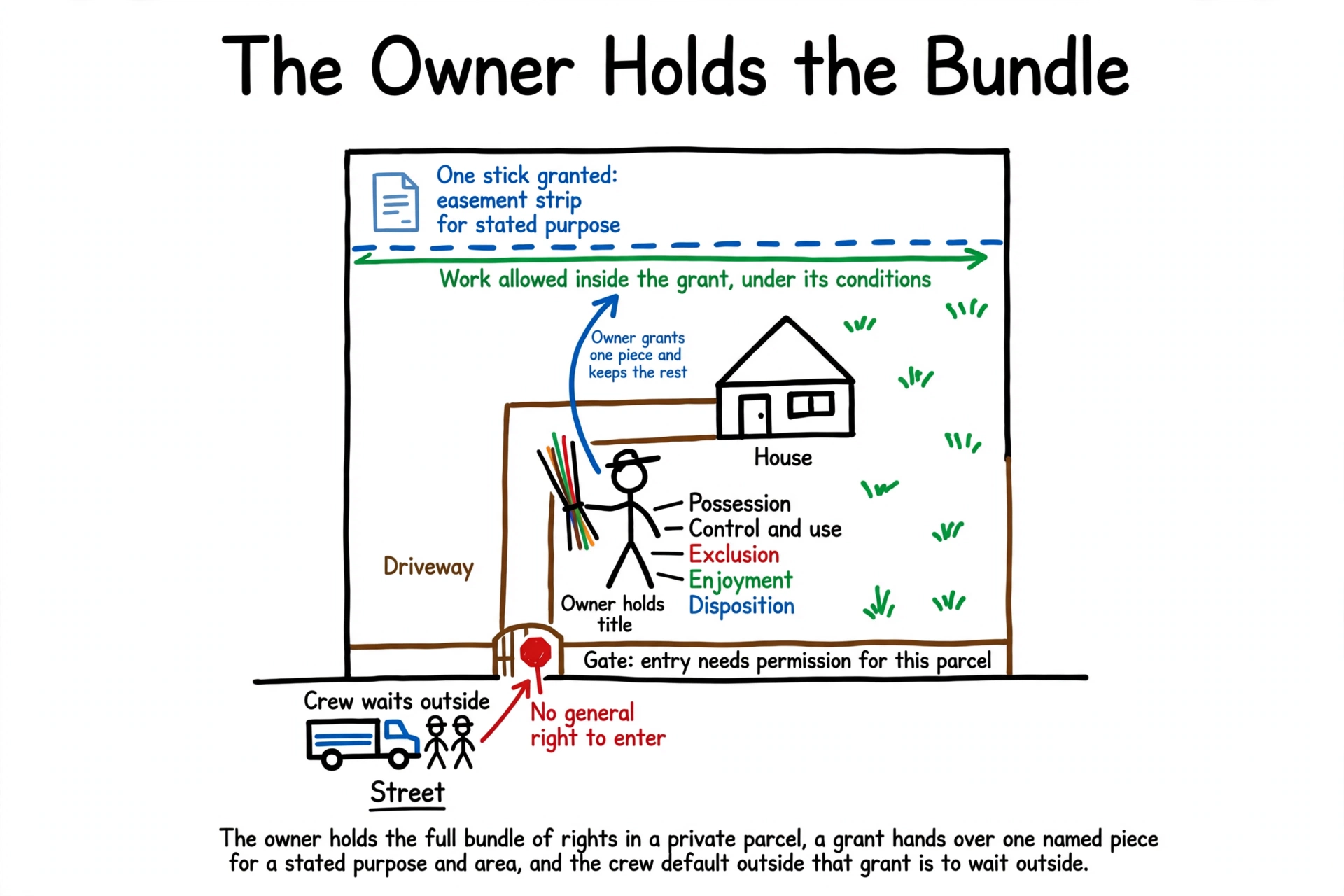
Teachers often describe full ownership as a bundle of rights. Picture the rights as separate sticks held in one hand. At a recognition level, the bundle includes these sticks:
- Possession: the right to occupy and hold the land.
- Control and use: the right to decide how the land is used, within the law and within any recorded limits on that parcel.
- Exclusion: the right to keep others off the land, and to allow entry only on the owner terms.
- Enjoyment: the right to use and enjoy the land without interference from others.
- Disposition: the right to sell, give away, lease, or pass the land to heirs.
This lesson uses the bundle as a recognition tool only. It teaches a field reader to see why an owner can exclude a crew, why an owner can grant a limited right and keep the rest, and why a limited grant gives the crew only the stick that was granted. It gives no legal advice, and it qualifies no reader to interpret a deed, decide who holds title, or judge whether a claimed right is valid. Those questions belong to the project land rights process and to qualified legal advisors.
Two more distinctions carry the rest of the lesson.
An owner is the party who holds title to the parcel, the party named as grantee in the recorded deed or holding the ownership interest under the land records. An occupant is a person who lives on or uses the parcel day to day. An occupant may be the owner. An occupant may also be a tenant, meaning a person who holds possession of the land or a building for a term under a lease, which is an agreement granting possession to the tenant while title stays with the owner. A tenant holds real rights in the space the lease covers, including day to day control of entry to that space in ordinary life. A tenant still holds only the interest the lease granted. A tenant grant of permission for a construction crossing, a staging area, or a buried facility is a different and larger question than letting a visitor in for the afternoon, and a field crew cannot sort out at the door whether a given tenant, occupant, family member, employee, or neighbor holds authority for the entry the project needs.
That limit leads to the working rule for this academy. Permission for construction entry comes to the crew through the project record, in documents the project obtained from the party with authority to grant them. A friendly conversation at the fence can support courtesy and scheduling. A conversation is a weak substitute for the document, and where the conversation and the document disagree, the crew follows the document and escalates the disagreement.
Private property also needs one contrast. Public property is property held by a government body. Lesson 116 covered public right of way, a public corridor where entry for stated public purposes follows from the corridor status and its permits. Private parcels carry no equivalent general entry right for utility work. The difference between the two kinds of ground is the difference between Lesson 116 and this lesson, and a crew that carries right of way habits onto private land will cause harm quickly.
What Does It Look Like?
Private property has no single look, because ownership is a legal fact rather than a paint color. A beginner sees parcels, buildings, and signals. The field skill is reading those signals as a prompt to check the record.
Parcels a fiber route commonly touches include:
- A house lot with a yard, a driveway, and a service drop running to the house.
- A rental house or apartment parcel, where the people present are occupants or tenants and the owner may live elsewhere.
- A farm or ranch parcel, where open ground can look empty while every acre is owned, used, and watched.
- A business parcel, such as a store lot, a warehouse yard, or an office site, where an employee on site may hold no authority over land decisions.
- A vacant parcel with no building at all, held by a person, a company, a church, a homeowners association, or another private party.
- A private road or shared drive serving several parcels, where the driving surface looks public and the underlying land is private.
Signals that an owner is exercising the right to exclude include:
- Posted signs reading Private Property, No Trespassing, Posted, or Keep Out at gates, corners, and entry points.
- A closed or locked gate across a drive or field entrance.
- A fence built to enclose the parcel, with entry only through a gate.
- A lock on a gate, a shed, a private road barrier, or an equipment yard.
- Purple paint marks on trees or posts in states that recognize paint as a posting method, under rules that state sets.
- A person on the parcel telling the crew to leave or to stay out.
Each signal means the same thing for field purposes: stop outside, check the project record for permission covering that parcel, and enter only when the record supports entry. State law varies on the legal effect of posting, on paint marks, on fencing, and on what notice the law requires before entry becomes a criminal offense in that state. This lesson states no state rule as general. The field response does not depend on the state rule. A posted, gated, or fenced parcel is ground where the owner has signaled exclusion, and a crew needs documented permission before crossing that signal for construction work.
Signals that can mislead a beginner include:
- An open gate. A gate left open for the owner delivery, for livestock work, or by mistake signals nothing about permission for a fiber crew.
- An unfenced field with no sign. Absence of a fence is absence of a fence. Ownership does not depend on a barrier.
- A worn path or tire tracks across a parcel. Past passage by someone proves past passage. It grants the project no right to repeat it.
- A utility pole, a pedestal, or an existing line already on the parcel. Existing facilities may sit inside a recorded easement, under an older agreement, or in a disputed position. Their presence raises a records question. Presence alone grants no new entry right for new work.
- A customer work order for one address. That order supports work for that customer at that address. It says nothing about the neighbor parcel the crew would like to cross to reach the address faster.
What Does It Do?
The ownership interest does practical work on every fiber job, because it decides where crews may lawfully place their bodies, their machines, and their plant.
Exclusion sets the default. The starting position on private land is stay out. Entry becomes lawful for the project when a right covering the entry exists. The crew does not need an owner to prove the land is private before the crew respects it. The project needs a document showing the right before the crew enters.
Limited grants define the allowed work. Owners routinely grant pieces of the bundle and keep the rest. Three grant forms matter for fiber work:
- An easement is the grant of a nonpossessory property interest that gives the easement holder permission to use another person land for a stated purpose. Cornell uses that definition, and Lesson 118 covers easements in full. A utility easement typically covers a defined strip, named facilities, and access for installation and maintenance within that strip. Work outside the strip, or work beyond the stated purpose, stands outside the grant.
- A license is permission to use the owner land for a stated purpose, where the permission is personal to the person or party it was given to and can be revoked by the owner. Teaching references distinguish a license from an easement on exactly that ground: an easement is an interest in land, a license is permission only. A license can be written or, for small everyday matters, spoken. For construction entry, the project needs the permission in a form it can document, with the parcel, purpose, area, and conditions named.
- Owner authorization in project practice means a written permission, an access agreement, or a signed form the project obtained from the owner or the owner authorized representative, covering the entry the project plans. The name of the form varies by project and company. The content is what matters: who granted it, which parcel, what work, where on the parcel, which conditions, and what time window.
A customer service agreement is the contract under which a customer orders service at an address. The order carries the customer’s consent for the provider to enter that customer parcel to install and maintain that service, within the scope of the order and the provider terms the project record names. The scope is the limit. Where the customer is a tenant, the possession rule in this section also applies, and owner documents and occupant agreement remain two separate tasks. The agreement covers the serving parcel and the work of serving it. It does not cover staging on a neighbor lot, crossing a rear parcel to save a bore, or placing facilities that serve other addresses across land the customer does not own.
Possession explains the door problem. Trespass law protects the possessory interest in land. A tenant in possession, rather than an absent owner, is often the person whose day to day possession an entry would disturb, while title and the power to grant lasting rights in the land remain with the owner. Land rights for construction are obtained through the project record, normally from the owner side. Possession sits with the occupant: a tenant in possession holds the day to day right to control entry to the leased space, so owner documents and occupant agreement are two separate tasks, and neither one replaces the other. A crew that asks only the occupant has skipped the project record task. A crew that holds owner documents and ignores the occupant has skipped the possession task, and may meet a locked gate and an angry resident on arrival.
The interest survives a change of faces. Land can be sold, leased, and inherited while facilities and easements tied to it remain in the records. A new owner takes the parcel with its recorded burdens. A familiar face leaving a house does not erase the record, and a new face arriving does not erase it either. Crews work from the current project record for the parcel, refreshed when the project directs, rather than from memory of who lived there last season.
Where Does It Fit?
Level 6 builds the permission picture piece by piece:
- Lesson 116 covered public right of way, where entry follows the public corridor and its permits.
- This lesson covers private property, the ownership interest that makes entry a permission question in the first place.
- Lesson 118 covers the utility easement, the recorded limited right that carries a large share of fiber construction across private land.
- Lesson 119 covers the municipal permit, the city or county authorization for work the permit describes.
Earlier lessons supply the supporting skills. Lesson 21 introduced right of way, Lesson 22 introduced easements, and Lesson 23 taught the property line that divides one ownership from the next. This lesson adds the missing piece those lessons assumed: the owner on each side of the line holds rights, and the project enters only under a grant drawn from those rights.
In the build sequence, permission work sits before mobilization. Designers route plant through public corridors and recorded easements where they can, and land rights staff obtain easements, licenses, or access agreements for the private parcels the route must cross. Permits are pulled for the work the permits describe. The site readiness judgment in Lesson 115 tests permission as its first gate. Construction then works parcel by parcel, and each parcel on the daily plan carries its own permission basis. A route is a chain of parcels, and the chain holds only where every link has its own basis. Permission for parcel one lends nothing to parcel two.
Drops fit at the end of the same chain. A through route may cross ten private parcels under easements to reach a street, and each home on that street then receives a drop under its own customer agreement. The two permission types sit side by side on one job and never blend. The easement for the through route does not authorize a drop across a non-customer yard, and a customer agreement for a drop does not authorize the through route to cross that yard to serve the next street.
What Is at Stake
Trespass exposure. Trespass to land, in the general sense Cornell describes, is knowingly entering another owner property without permission, including causing an object or another person to enter it. Placing a bore, a trench, a spoil pile, a parked rig, or a staged reel on private land without a right to be there falls inside the conduct this concept covers. Criminal trespass is defined by state statute, and states differ on notice, posting, intent, and penalties. This lesson states no penalty and no state threshold, because none applies nationally. The project exposure also runs in civil terms: removal of placed facilities, restoration of the ground, compensation questions, and legal cost, handled by the project and its advisors rather than by the crew.
A good intention is weak protection. A crew that crosses a parcel to save an hour, certain the owner would not mind, has still entered without permission. Work for a public serving network, a friendly purpose, and a plan to restore the grass do not create the missing right. Cornell framing turns on entry without permission, and permission is the element the crew must be able to show.
Damage to the owner use. A rut across a pasture, a crushed sprinkler line in a yard, a gate left open to livestock, and a bore pit in a garden each take something the owner was using. Restoration can repair ground. Restoration cannot return the week the owner lost, and the owner memory of the project lasts longer than the scar.
Schedule and rework. Work stopped by an owner complaint stops on the owner terms, in the middle of a sequence, with ground open. Facilities placed without a right may need removal and relocation into the corridor the project actually holds. A half day spent confirming permission during planning costs less than a week spent relocating plant under dispute.
Trust across the whole route. Owners talk to neighbors. One crew that cuts across a yard without asking teaches the next ten owners to refuse cooperation, lock gates, and call the county about every later crew, including crews holding perfect documents. Careful permission work on one parcel buys cooperation on the next.
Safety. An owner who finds strangers and machines on posted land may confront the crew. Dogs, livestock, farm equipment, and firearms are ordinary features of rural private land in many areas. Entering only where the record supports entry, with the occupant notified through the project process, keeps a paperwork failure from becoming a physical confrontation.
What Does Good Look Like?
- Every private parcel on the daily plan carries a named permission basis in the project record before the crew mobilizes: a recorded easement, a license or written owner authorization, or a customer agreement for that address.
- The record for each parcel names the grantor, the parcel or address, the allowed area, the allowed work, the conditions, and any time window, in terms a crew lead can check in the field.
- The crew works inside the allowed area for that parcel and treats ground outside the area as ground with no permission, even when the outside ground is closer or easier.
- Occupants receive courtesy notice through the project process before work at their address, and the notice is recorded, while land rights rest on documents obtained through the project record, and entry at an occupied parcel also respects the occupant’s possession under the lease.
- Posted signs, closed gates, and locks are honored on sight. A crew that meets one checks the record from outside the parcel and enters only when the record clearly covers that parcel and that entry.
- Temporary uses such as staging, parking, spoil placement, and turnaround space appear in the permission record for the parcel used, or the crew uses ground the project already holds for those purposes.
- Any doubt about a parcel produces a written note the same day, naming the parcel, what the record shows, what is missing, and who the question went to.
- Finished work sits only on parcels where the project held a right to place it, with as built records that match the permission record parcel by parcel.
From the Field
Picture a two person bore crew assigned to place conduit along the rear of several house lots, inside a recorded utility easement that runs along the rear lot lines. The plan, the easement documents, and the locate tickets are in the truck. The rear easement strip is reached from the street by a side yard on the end lot, and the plan shows the crew entering the easement strip from the street end, where the easement itself meets the public corridor.
The crew arrives and finds the street end access blocked by a delivery truck parked for the morning. A crew member points to the side yard next door, on a parcel that sits outside the easement route. The gate on that side yard stands open. The yard offers a short, flat walk to the rear strip, saving a long carry around the block. A person in that yard waves at the crew and calls out that crossing is fine.
The crew lead checks the job record before anyone steps through the gate. The record lists easement rights for the rear strip on each lot the conduit will cross. The record lists no easement, no license, and no owner authorization for the side yard parcel. The person waving is a renter the lead has seen at the house, and the record names a different party as the owner of that parcel. The wave is a friendly courtesy from the occupant. The wave is not a document, the renter authority to grant a construction crossing is not established in the record, and the open gate adds nothing.
The lead thanks the renter, explains that the crew has to work from its access documents, and keeps the crew out of the side yard. The lead calls the project contact, reports the blocked access and the missing permission for the shortcut parcel, and asks for direction. The project contact offers two paths: wait for the delivery truck to clear, or have land rights staff seek written authorization from the side yard owner for a one day crossing. The lead chooses the wait, stages from the street side inside the public corridor, and starts the rear strip work from the end the easement reaches once the truck moves.
The bore finishes that day inside the easement strip, with no entry onto the side yard parcel. The delay costs under an hour. The project record gains a note about the blocked access and the shortcut that was declined, so the next crew on that street inherits the answer instead of facing the same open gate as a fresh temptation.
The rule to carry is this: a crew enters a private parcel only when the project record names a permission for that parcel, and an open gate, a worn path, and a friendly wave from an occupant each fall short of that standard.
What Can Go Wrong?
Treating the shortcut as harmless. A crew crosses an unlisted parcel to carry tools, reaches the authorized strip faster, and leaves only footprints. The entry still happened without permission, the owner camera may hold the footage, and the project now answers for a trespass complaint on a job that was otherwise fully documented.
Accepting permission from the wrong party. A tenant, a house sitter, an adult child, a neighbor, or an employee grants a crossing in good faith, and the crew builds on that grant. The owner later states that no one with authority approved the entry. The crew holds a conversation rather than a document, and the project must repair the relationship and possibly the ground.
Reading an easement as general access to the whole parcel. An easement covers its strip and its stated purpose. A crew that stages reels on the lawn outside the strip, parks across the driveway, or places spoil on the garden has left the grant while standing on the same parcel.
Extending a customer agreement to the neighbors. A customer orders service and welcomes the drop crew. The crew crosses the neighbor yard to shorten the bore, treating the customer welcome as route permission. The neighbor never ordered anything, never signed anything, and finds a bore pit in the yard. The customer agreement never covered that ground.
Ignoring a posted signal because the record looks close. A sign reads Posted at the gate, and the crew easement sketch is too rough to confirm whether the gate parcel is the easement parcel. Entering to check from inside reverses the correct order. The record gets confirmed first, from outside, through the project process.
Leaving temporary use undocumented. The bore is fully authorized, and the crew parks a rig and a trailer on a side parcel for the day because the shoulder is narrow. The parking, rather than the bore, draws the complaint. Temporary occupation is still entry and use, and it needs its own basis in the record.
Arguing the law at the fence. An owner tells the crew to leave, and a crew member answers with claims about utility rights and easement law. The argument hardens the owner, creates a confrontation risk, and puts legal conclusions in the mouth of a person with no authority to make them. The correct move is to withdraw to ground the project clearly holds, stay courteous, and pass the dispute to the project contact the same day.
What Should Someone Notice in the Field?
- Check the daily plan parcel by parcel and name the permission basis for each private parcel before leaving the yard: easement, license or written owner authorization, or customer agreement for that address.
- Compare the parcel in front of you with the record. Confirm the address, the parcel, and the allowed area match the ground you are about to enter.
- Read posted signs, gates, locks, and fences as stop and check signals, and wait outside while the record is confirmed.
- Note who is present on the parcel and describe that person role carefully in your notes: owner, tenant, occupant, employee, or unknown. Record what was said without treating the statement as a grant of construction rights.
- Watch for the gap between the work area and the support area. Staging, parking, spoil, and turnaround ground each need a permission basis too.
- Check that occupant courtesy notice was given for work at an occupied address, and report a missed notice before starting rather than after a complaint.
- Write down any parcel where permission is missing, unclear, expired on its face, or in conflict with what the ground shows, and send the note to the project contact the same day.
- Know the boundary: recognizing private property, reading its signals, and checking the project record are field skills. Deciding who holds title, whether a claimed easement is valid, whether an entry was lawful, or what a person legal rights are is legal work for qualified advisors and the project land rights process. Reading this lesson gives no legal authority to enter any parcel, and it qualifies no one to give legal advice to an owner, a tenant, or a coworker.
Key Terms
Private property: Land or other property owned by a private party rather than by the government, where the owner holds the right to control entry and use.
Real property: Land and the things permanently attached to it, such as buildings and other immovable structures.
Fee simple: The greatest possible property interest in land, granting the owner all traditional property rights. In its absolute form it has no set end in time. Some fee simple grants carry conditions that can end them, which is one more reason title questions belong to the land rights process.
Bundle of rights: A teaching picture of full ownership as separate rights held together, including possession, control and use, exclusion, enjoyment, and disposition. An owner can grant one right and keep the rest.
Owner: The party who holds title to a parcel under the land records, named as grantee in the recorded deed or holding the ownership interest by other recorded means.
Occupant: A person who lives on or uses a parcel day to day. An occupant may be the owner, a tenant, a family member, or another person the owner allows to be there.
Tenant: A person who holds possession of land or a building for a term under a lease, while title stays with the owner.
Lease: An agreement granting a tenant possession of land or a building for a term, under stated conditions and rent or other terms.
Easement: The grant of a nonpossessory property interest that gives the holder permission to use another person land for a stated purpose, such as a defined strip for utility facilities and access to them.
License: Permission to use an owner land for a stated purpose, personal to the party it was given to, that creates no interest in the land and can be revoked by the owner.
Trespass: In general terms, knowingly entering another owner property without permission, or causing an object or another person to enter it, where state law defines the offense and its elements in that state.
Posted land: Land an owner has marked with signs, and in some states with paint marks under that state rules, giving notice that entry requires permission.
Customer service agreement: The contract under which a customer orders service at an address. The order carries the customer’s consent for entry onto that customer parcel for the work of installing and maintaining that service, within the scope of the order and the provider terms the project record names.
Check Your Understanding
- Name the five rights in the bundle of rights as this lesson teaches them, and state which right makes stay out the default on private land.
Answer: The rights are possession, control and use, exclusion, enjoyment, and disposition. Exclusion makes stay out the default, because the owner holds the right to keep others off the land and to allow entry only on the owner terms.
- A house is occupied by a tenant under a lease, and the owner lives in another state. A fiber crossing needs to pass through the yard. Why does the project need more than the tenant cheerful approval at the door, and what separate courtesy task still involves the tenant?
Answer: The tenant holds possession for the lease term and holds only the interest the lease granted. A tenant can allow ordinary entry to the space the lease covers. A construction crossing, staging area, or buried facility is a larger grant than ordinary entry, it is not established by a doorstep offer, and the project takes it only through the project record. Land rights for construction are obtained through the project record, normally from the owner side, and occupant agreement on an occupied parcel is a separate task that owner documents do not replace. The tenant still receives courtesy notice through the project process, because the work will interrupt the tenant day to day possession.
- A recorded utility easement crosses the rear of a lot. Name two crew actions on that same lot that the easement, standing alone, does not authorize.
Answer: Answers will vary in wording. Correct examples include staging reels or a trailer on the lawn outside the easement strip, parking across the driveway outside the strip, placing spoil outside the strip, and crossing a side yard outside the strip for access. The easement covers its defined strip and its stated purpose, and ground outside the strip needs its own permission basis.
- In the From the Field scenario, the side yard gate stood open and the renter waved the crew through. Why did the lead keep the crew out, and what two paths did the project contact offer?
Answer: The project record listed no easement, no license, and no owner authorization for the side yard parcel, and the person waving was a renter whose authority to grant a construction crossing was not established in the record. An open gate creates no permission. The project contact offered a wait for the delivery truck blocking the authorized street end access to clear, or a land rights request to the side yard owner for written authorization for a one day crossing. The lead chose the wait.
- A customer orders a fiber drop and tells the crew to cross the neighbor back yard to shorten the run, adding that the neighbor will not mind. What does the customer agreement cover, what does it leave uncovered, and what should the crew do?
Answer: The customer agreement carries the customer’s consent for entry onto that customer parcel for the work of installing and maintaining that customer service, within the scope of the order and the provider terms the project record names. It leaves the neighbor parcel uncovered, because the neighbor is a separate owner who granted the project nothing. The crew builds the drop using ground the project holds rights on, documents the customer request and the reason the shortcut was declined, and passes any request for neighbor parcel access to the project contact for the land rights process.
Lesson Takeaway
Private property is an ownership interest before it is a piece of ground. The owner holds the bundle of rights, including exclusion, and can grant one narrow piece of that bundle while keeping the rest. A fiber crew enters only under a grant the project record can name for that parcel: an easement, a license or written owner authorization, or a customer agreement for that address. After this lesson, an open gate reads as a gate, a friendly wave reads as courtesy, and a parcel with no named permission in the record reads as ground the crew stays off until the record changes.
Sources and Technical References
Cornell Law Institute, Legal Information Institute, Wex, Private Property. Defines private property as ownership of property by private parties, meaning parties other than the government, and lists real estate among its forms. Used for the private property definition and the private and public contrast: https://www.law.cornell.edu/wex/private_property
Cornell Law Institute, Legal Information Institute, Wex, Property. Explains that the owner of property can possess, use, transfer, or dispose of it, and distinguishes real property, consisting of land and immovable items such as structures, from personal property. Used for real property and disposition concepts: https://www.law.cornell.edu/wex/property
Cornell Law Institute, Legal Information Institute, Wex, Fee Simple. Describes fee simple as the greatest possible property interest in land, granting its owner all traditional property rights, stretching out in time, with only one fee simple at a time for a given piece of land, and notes that a fee simple owner can split the interest into smaller grants. Used for fee simple and the splitting off of lesser interests: https://www.law.cornell.edu/wex/fee_simple
Cornell Law Institute, Legal Information Institute, Wex, Easement. Defines an easement as the grant of a nonpossessory property interest that provides the easement holder permission to use another person land, and describes affirmative easements as giving the holder the right to do something on the grantor land. Used for the easement definition: https://www.law.cornell.edu/wex/easement
Cornell Law Institute, Legal Information Institute, Wex, Trespass. Describes trespass as knowingly entering another owner property or land without permission, and describes trespass to land as physically invading an owner real property or causing an object or a third party to invade it. Used for the general trespass concept, stated at a general level only, with criminal definitions and penalties left to state law: https://www.law.cornell.edu/wex/trespass
Introduction to the Law of Property, Estate Planning and Insurance, Business LibreTexts, Section 11.3, Easements: Rights in the Lands of Others. Defines an easement as an interest in land created by agreement that permits one person to make use of another person estate, and distinguishes a license as permission, revocable at the will of the owner, to make use of the owner land, personal to the grantee. Used for the easement and license distinction, and for the license basis of the customer consent described for a customer service agreement: https://biz.libretexts.org/Bookshelves/Civil_Law/Introduction_to_the_Law_of_Property_Estate_Planning_and_Insurance/11%3A_The_Nature_and_Regulation_of_Real_Estate_and_the_Environment/11.03%3A_Easements-_Rights_in_the_Lands_of_Others
West Virginia Code, Section 61-3B-1, Definitions. Defines posted land, fenced land, and trespass for that state article, including sign and purple paint posting methods with that state specifications, and excludes entry under rights of way and easements from its trespass definition. Used only as one state example showing that posting methods, notice rules, and trespass definitions are set by state law and vary by state. No West Virginia specification is taught in this lesson as a general rule: https://code.wvlegislature.gov/pdf/61-3B-1/
Graphic Brief 1
Graphic title: The Owner Holds the Bundle
Main objects: A plan view of one house lot in the center, drawn as a rectangle with a simple house outline, a driveway, and a yard. A standing owner figure beside the house holding a bundle of five sticks in one hand, each stick a separate colored line. A crew truck and a two person crew standing outside the lot edge on the street side, stopped at a gate in a fence line around the lot. A dashed strip along the rear of the lot showing the one granted piece, with a small document icon pinned to it.
Placement: Title at the top. Lot in the center, taking up the middle of the board. Owner figure inside the lot near the house, large enough to read clearly. Crew and truck at the bottom left, outside the fence, on a band labeled Street. Dashed granted strip along the top edge of the lot, labeled as the rear of the lot. White space at the bottom for the key teaching point.
Labels: Private parcel. Owner holds title. Possession. Control and use. Exclusion. Enjoyment. Disposition. One stick granted: easement strip for stated purpose. Gate: entry needs permission for this parcel. Crew waits outside.
Arrows and relationships: One blue arrow from the owner hand to the dashed rear strip, labeled Owner grants one piece and keeps the rest. One red stop arrow from the crew toward the gate, ending at the gate, labeled No general right to enter. One green arrow inside the dashed strip only, running along the strip, labeled Work allowed inside the grant, under its conditions.
Important technical details: Each of the five sticks carries one rights label, so the bundle reads as separate rights held together. The dashed strip sits fully inside the lot and covers only the rear band, leaving the rest of the yard plainly outside the grant. The gate is closed. No dimensions, strip widths, depths, or distances anywhere on the board, since those come from the recorded document for a parcel.
What not to show: No crew member inside the lot outside the dashed strip. No open gate. No person handing over a deed or giving legal advice. No fence drawn as a property line determination. No decoration or extra labels.
Key teaching point: The owner holds the full bundle of rights in a private parcel, a grant hands over one named piece for a stated purpose and area, and the crew default outside that grant is to wait outside.
Graphic Brief 2
Graphic title: One Route, Three Kinds of Ground
Main objects: A plan view map running left to right across the board, showing a fiber route as a blue line crossing three zones in sequence. Zone one on the left is a gray band labeled Public right of way along a street, with houses facing it. Zone two in the middle is a private parcel with a house, crossed by a dashed green strip labeled Recorded easement strip, with the blue route line running inside the dashed strip, and the rest of that parcel shaded lightly and labeled Private parcel, work inside the strip only. Zone three on the right is a second private parcel with a house and a yard, crossed by a dotted blue line showing a tempting shortcut route drawn with a red X over it, labeled No permission in the record: do not enter. A small customer house at the far right end of the authorized route, with a short drop line from the easement strip to that house, labeled Customer drop under customer agreement for that address.
Placement: Title at the top. Route running horizontally across the middle, entering from the left edge and ending at the customer house on the right. Three zones divided by clear vertical breaks, each zone labeled at the top. Shortcut parcel on the right, drawn slightly below the main route line so the shortcut reads as a detour. White space at the bottom for the key teaching point.
Labels: Public right of way: corridor and permits govern entry. Recorded easement strip: enter the strip for the stated purpose. Private parcel outside the strip: no entry. No permission in the record: do not enter. Customer drop: that address, that customer agreement only. Every parcel needs its own permission basis.
Arrows and relationships: Blue arrows along the authorized route through the right of way and inside the easement strip to the customer house, showing one continuous lawful path. A red arrow starting toward the shortcut parcel and ending in a stop hand at its edge. A short green arrow from the easement strip to the customer house along the drop line. No arrow crosses the no permission parcel.
Important technical details: The easement strip is dashed and narrow relative to its parcel, and the route line stays inside it for the full crossing. The shortcut line is dotted and crossed out, so no viewer can read it as an approved alternate. The customer drop connects only to the customer house and touches no other yard. No widths, depths, distances, or scale anywhere on the board.
What not to show: No crew, truck, or equipment inside the no permission parcel. No gate drawn open as an invitation. No route line outside the easement strip on the middle parcel. No legal advice text, no penalty figures, and no decoration.
Key teaching point: A route crosses three kinds of ground in a row, each kind carries a different permission basis, and the parcel with no permission in the record stays empty even when crossing it would be shorter.
Previous lesson: Lesson 116: What Is Public ROW? |
Back to Level 6 hub |
Next lesson: Lesson 118: What Is a Utility Easement?