
Introduction
Site readiness is a planning stage judgment that a defined segment of fiber work can be built as drawn, under the permits and conditions that apply to that segment, with a documented plan for every known conflict. The judgment pulls together the route, the ground, the crossings, the access, the traffic, and the restrictions studied across Level 5, and it ends in one of three calls: ready, ready after named conditions are resolved, or not ready.
This lesson sits at the end of Level 5 as its capstone. Earlier lessons tested one question at a time. This lesson teaches how those answers combine into a single buildability decision, who has the authority to make that decision, and why starting work to create momentum can turn a small unresolved condition into a much larger problem.
What This Lesson Gives You
- Sort a segment into ready, ready after conditions are resolved, or not ready, using evidence from the plan, the permits, and the field walk.
- Name the five readiness gates and state what evidence closes each gate.
- Spot the difference between a condition that can be resolved before mobilization and a conflict that stops the segment.
- Explain why starting early work can create pressure to waive a gate, and why that pressure is a failure mode on its own.
- Write a short readiness note that names the segment, the open conditions, the owner of each condition, and the decision.
Start With the Basics
Think about a pilot before takeoff. The aircraft, the crew, the weather, the fuel, and the clearance each get checked on their own. The flight is ready only when every check passes together. A single failed check holds the flight, even when the other checks are green, because the checks protect one shared outcome.
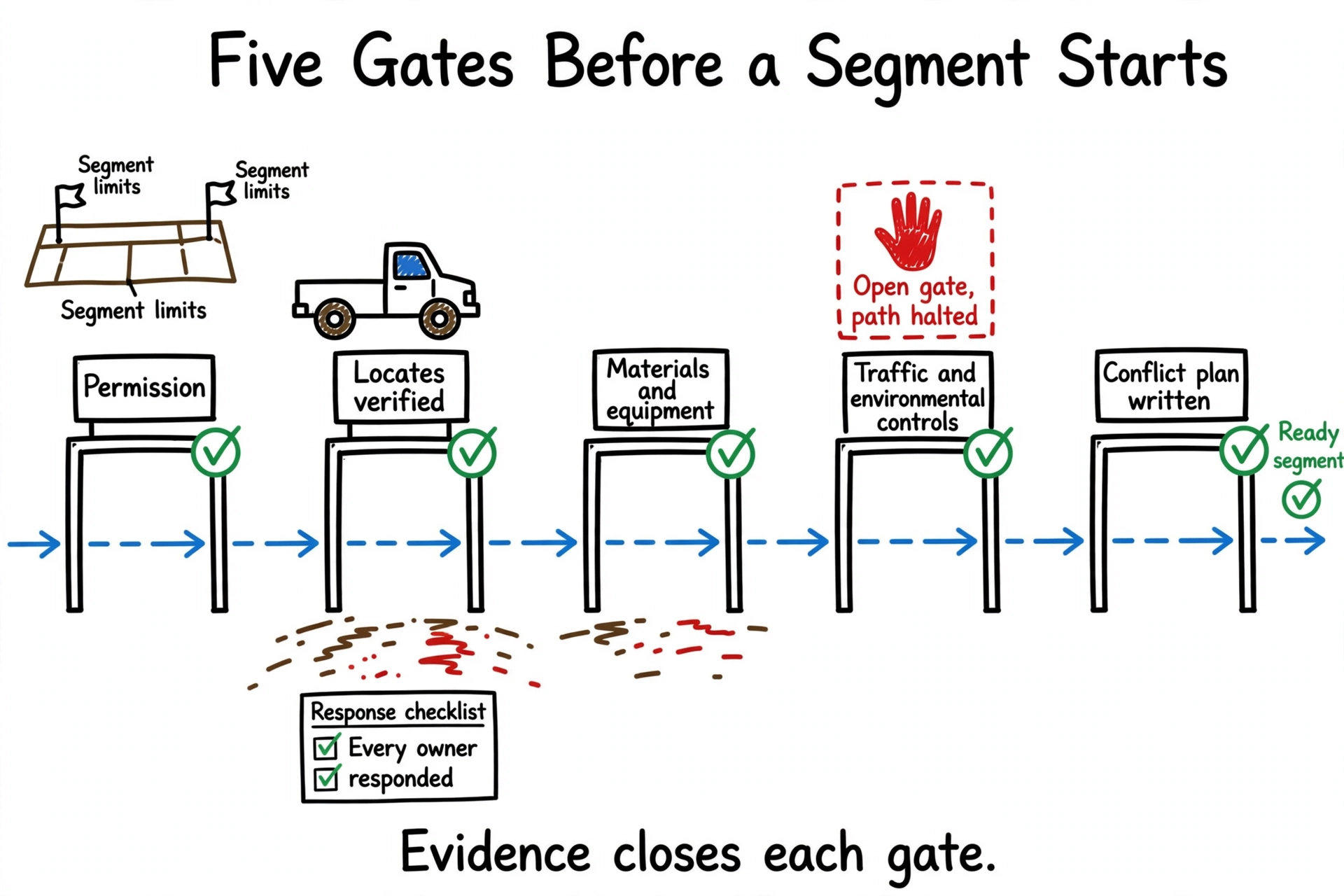
A fiber segment works in a similar way. A readiness gate is a single condition that must be satisfied and evidenced before work starts on a segment. The gates in this lesson are a teaching framework drawn from project documents, permits, and safety rules. They are:
- Permission gate: the right to enter and build on that ground, under the easement, right of way permit, or other authorization for that segment.
- Locates gate: underground facilities in the work area have been requested, marked or cleared, and verified through the response process the state system requires.
- Materials and equipment gate: the duct, cable, structures, equipment, and crew the plan calls for are available and can reach the work.
- Controls gate: traffic control and environmental controls required for that segment are planned, approved where approval is required, and ready to install.
- Conflict plan gate: every known conflict found in design review and in the field walk has a written plan, a named owner, and a place in the sequence.
Constructability is the optimum use of construction knowledge and experience in planning, design, procurement, and field operations to achieve overall project objectives, in the definition used by the Construction Industry Institute and repeated in transportation agency guidance. Readiness is the moment constructability becomes a decision. The question stops being whether the design looks sound on paper and becomes whether this segment, on this ground, under these documents, can proceed.
A gate is closed by evidence. A permit in hand closes part of the permission gate. A verbal assurance closes nothing.
What Is It?
Site readiness is a documented judgment, made at the planning stage by an authorized role, that a defined segment can be built as planned. Three parts of that definition matter:
- Defined segment. Readiness applies to a specific stretch of work with clear limits. A whole route is rarely all ready or all blocked at once. One segment can be ready while the next segment waits on a crossing permit.
- Documented. The call and its evidence are written down, so a later reader can see which gates were checked, what evidence was used, and which conditions remained open.
- Authorized. The call belongs to the roles the project assigns, such as the project manager, the construction manager, the engineer of record, or the owner representative named in the contract. A field observer can gather evidence and recommend. The observer does not make the final call unless the project has assigned that authority.
The judgment produces three outcomes:
- Ready. Every gate is closed by evidence. Work can mobilize for that segment as planned.
- Ready after conditions are resolved. One or more gates have open items that are understood, owned, and scheduled to close before the affected work starts. The segment is not ready today. It becomes ready when the named conditions close and the closure is recorded.
- Not ready. A gate has a conflict with no workable plan yet, a missing permission, an unresolved safety or environmental restriction, or missing evidence the project requires. Work on that segment stops at planning and the issue escalates to the role that can resolve it.
Readiness in this lesson is a planning stage buildability judgment. A later lesson in Level 7 covers day of construction readiness for a crew on a specific morning. The two judgments use similar words and answer different questions. Lesson 115 asks whether the segment should be released for construction at all. The later lesson asks whether a released segment is set up for that day of work.
What Does It Look Like?
A ready segment leaves a paper trail a stranger could follow. Look for these signs:
- A readiness note or checklist for the segment, signed or recorded by the authorized role, with each gate marked closed or open.
- Permits, easements, and right of way authorizations for the segment filed together, with conditions and expiration details visible.
- A locate ticket for the work area with responses from facility owners recorded, and field marks that match the response record.
- A delivery and staging record showing the duct, cable, handholes, and other planned material on hand or scheduled before the work that needs them.
- A traffic control plan for work in or near the road, prepared before the site is occupied, as the Manual on Uniform Traffic Control Devices states as guidance.
- Environmental controls named in the permit conditions, with the materials and the installation sequence ready before ground is disturbed.
- A conflict list from the design review and the site walk, with each item assigned, planned, and either closed or carried as a named condition.
Signs that readiness is being claimed without evidence:
- A start date on the schedule with no readiness record behind it.
- A permit described as expected, pending, or routine, with no document in the file.
- Locate marks on the ground with no check that every facility owner has responded.
- Material listed as ordered, with no delivery date tied to the sequence.
- A known conflict described in conversation and absent from every written list.
- A segment described as ready in general terms, with no limits showing where the ready stretch ends.
What Does It Do?
The readiness judgment protects the work by forcing five separate questions to be answered together before ground is disturbed.
Permission controls legality. Easements, franchise terms, and right of way permits define where crews may enter, what they may build, and which conditions apply. The Federal Highway Administration constructability checklist treats permitting, environmental review, and right of way as review items alongside plans and schedules, because a design that cannot be legally occupied cannot be built on schedule either. Work started without the controlling permission risks removal, restoration disputes, and stop orders from the agency or the landowner.
Locates control underground risk. In the United States, excavators contact 811, the national call before you dig number, and facility owners mark their underground lines or report that an area is clear. Positive response is a confirmation process, used in many state 811 systems and described in Common Ground Alliance best practice, that tells the excavator each facility owner has marked, cleared, or otherwise responded for that ticket. Where the state system provides positive response, guidance directs the excavator to check it to verify that all operators have responded before excavating, and to compare the marks in the field with the response record. Where the state uses a different response process, the excavator follows the process that state law requires. Paint on the ground alone does not prove the ticket is complete.
Materials and equipment control sequence. A segment that starts without its duct, structures, or the right machine stops midstream, and an open trench or a half finished crossing sits exposed while everyone waits. Readiness ties each material and machine to the step that needs it.
Controls protect people and the site. The Manual on Uniform Traffic Control Devices, called the MUTCD, states that a temporary traffic control plan, in detail appropriate to the complexity of the project, should be prepared and understood by all responsible parties before the site is occupied. Environmental permit conditions work in a similar way. Erosion and sediment controls required by a permit must be planned and installed as the permit directs, and the Federal Highway Administration policy on erosion and sediment control for highways funded under Title 23 aims to minimize erosion and sediment damage to the highway and adjacent properties and to abate pollution of surface and ground water resources. Permit conditions for a given fiber segment set the controls that apply on that segment.
The conflict plan controls surprises that are already known. Level 5 field walks surface conflicts with driveways, drainage, other utilities, trees, structures, and tight working room. A conflict with a written plan and a named owner is a managed condition. A conflict held only in memory becomes a field improvisation later.
Together, the gates convert hope into evidence. The segment starts because the record shows it can proceed, and any later question about why it started has a written answer.
Where Does It Fit?
Readiness sits between planning and mobilization. The sequence in Level 5 runs like this:
- Route and alignment studies set where the plant will go.
- Access studies confirm equipment and crews can reach the work and that future maintenance access survives the build.
- Crossing reviews cover roads, rail, water, and other utilities the route must pass.
- Congestion, soil, rock, and groundwater studies describe what the ground and the corridor will allow.
- Restoration and traffic studies describe how the site will be returned and how road users will be protected during the work.
- Environmental and permitting reviews, covered in Lessons 111 and 112, set the restrictions and authorizations for the segment.
- Site walks, covered in Lessons 113 and 114, verify the paper against the ground and record conflicts while change is still cheap.
- The readiness judgment in this lesson combines those products into a release decision.
- Mobilization and construction follow only for segments released as ready, or for segments whose named conditions have closed and been recorded.
Readiness also repeats. A segment released in one month can lose readiness when a permit condition changes, a locate ticket expires under state rules, or a new conflict appears during adjacent work. The judgment is revisited when the evidence changes.
What Is at Stake
Safety. Federal safety guidance for site preparation work calls for hazards to be identified before work begins. One example cited in this lesson, the OSHA site preparation guidance for drilling and servicing work, calls for a job safety analysis before beginning work and whenever work activities change. The specific assessment and plan a fiber project requires come from the applicable OSHA standards, state rules, and project documents for that work. A segment released with an unplanned traffic exposure, an unverified locate, or an uncontrolled environmental hazard sends a crew to solve safety problems in the field that planning was meant to solve on paper.
Legality and permission. Work outside an easement, beyond a permit limit, or against a permit condition can draw stop work direction, fines under the controlling law, removal of plant, and restoration at the builder expense. The documents for the segment set the exact exposure.
Damage to other utilities. Excavating before every facility owner has responded risks striking a line that was never marked. Damage brings repair cost, service outages for strangers, incident reporting, and possible enforcement under state dig law.
Schedule. Starting a blocked segment rarely saves time. Crews mobilize, open ground, hit the unresolved conflict, and demobilize or idle while the condition is resolved under pressure. The same condition resolved during planning costs a meeting and a document.
Cost. Rework, idle equipment, emergency traffic control, unplanned restoration, and damage repairs all cost more than the gate check that would have caught the condition. Constructability practice exists to move construction knowledge into planning precisely to reduce errors, delays, and cost overruns.
Trust and relationships. Landowners, road agencies, and owners judge a builder by whether its promises match its paperwork. A crew that starts before permission is documented teaches every other party to verify the builder claims from scratch on the next segment.
Decision pressure. Starting work creates its own momentum. Open ground, a waiting crew, and a public schedule make the unresolved gate feel smaller than it is, and each day of progress raises the cost of stopping. That pressure is a predictable failure mode of releasing work early, and the readiness process exists to make the decision before the pressure exists.
What Does Good Look Like?
- The segment has clear limits, and the readiness record names those limits.
- Every gate is marked closed, open with a named condition, or blocking, with the evidence for each mark written next to it.
- Permits and easements for the segment are in the file, read, and summarized into the conditions the crew must follow.
- Locates gate closes when a locate ticket covers the work area, the response process required in that state confirms every facility owner has responded, and the field marks match the response record.
- Material, equipment, and crew assignments are tied to the sequence, with delivery dates that land before the steps that need them.
- The traffic control plan and the environmental controls for the segment are prepared, approved where the permit requires approval, and ready to install before occupation or disturbance.
- Every known conflict from design review and the site walk appears on a written list with a plan, an owner, and a due point in the sequence.
- The final call uses one of the three outcomes, is recorded by the authorized role, and names the conditions that must close before any conditional segment starts.
- Anyone on the project can open the record and see why the segment was released, without asking for a verbal history.
From the Field
Picture a project team reviewing a short underground segment that crosses a side street and continues along a grass shoulder. The design is complete. The crew is available the following week, and the schedule shows the segment as the next release. The readiness review works through the gates one at a time.
The permission gate closes first. The right of way permit for the shoulder work and the street crossing is in the file, and its conditions are listed in the review notes, including the traffic control requirement for the crossing. The materials gate closes next. Duct, handholes, and tracer wire are staged, and the bore machine assigned to the crossing is confirmed for the planned dates.
The locates gate stays open. The locate ticket for the segment shows responses from the electric, water, and fiber owners. The gas owner has not responded in the response system the state requires, and no gas marks appear along a stretch where the record drawing shows a gas service crossing the planned path. The field marks match the responses that exist. The missing response is the problem, and paint from the other owners does not cure it.
One voice in the review suggests starting the shoulder work and leaving the crossing for later, so the crew stays productive. The reviewer looks at the sequence. The shoulder work opens the segment, commits the crew, and puts the unresolved crossing at the center of an active job, where schedule pressure will argue for proceeding before the gas response arrives. The open gate is recorded as a condition instead, with the segment marked ready after conditions are resolved, and the locate follow up assigned to a named person with a date.
The gas owner responds two days later and marks the service. The marks confirm the service crosses the planned path, and the crossing plan is adjusted on paper to account for the marked facility using the methods the project documents require. The condition is recorded as closed, the readiness call is updated to ready, and the crew mobilizes with the full segment planned.
The crew completes the segment in one mobilization. No open ground waited on a locate, no field decision had to be made beside an unmarked service, and the record shows exactly why the start moved by two days.
The rule to carry is this: a gate stays open until its evidence arrives, and work released around an open gate imports the gate problem into the field, where the pressure to waive it only grows.
What Can Go Wrong?
Treating the schedule as the readiness test. A date on a calendar proves a plan exists. The date says nothing about permits, locates, materials, or conflicts, and crews released by date alone meet the missing gate in the field.
Accepting paint as proof of a complete locate. Marks show that some owners responded. Checking the response process required in that state confirms that every owner on the ticket responded, and a missing response can mean a facility in the path was never marked.
Starting partial work around an open gate. Early work commits the crew, opens ground, and creates pressure to proceed past the unresolved condition. The partial start converts a planning delay into a field standoff.
Carrying conflicts in conversation. A conflict everyone discussed and nobody wrote down has no owner and no plan. The conflict resurfaces during construction, assigned to whoever is standing closest.
Reading a permit after mobilization. Permit conditions can govern traffic control, work hours, environmental controls, and restoration. A crew that learns the conditions after arrival may have the wrong devices, the wrong sequence, or work underway that the permit does not allow.
Assuming material is ready because it was ordered. An order is a promise, not a delivery. A segment released on ordered material can stall with ground open while a shipment moves.
Waiving a gate to protect the start date. Each waiver teaches the team that gates are negotiable under pressure. The next gate gets waived earlier, with less discussion, until a waived gate produces damage, a stop order, or an injury.
Releasing the whole route on one segment of evidence. Evidence gathered on an easy stretch proves nothing about the crossing, the congested corridor, or the restricted parcel two segments later. Readiness follows segment limits.
What Should Someone Notice in the Field?
- Read the readiness record for the segment and confirm your work falls inside the segment limits it covers.
- Check that the permit conditions for the segment are posted or briefed, and compare the site setup against them.
- Confirm the locate ticket is current for the work area and that the response process required in that state shows every facility owner has responded.
- Compare the field marks with the response record and the plan, and report any mark that is missing where the plan shows a facility crossing.
- Look for the planned material staged or confirmed, and report substitutions or shortages before ground opens.
- Check that traffic control devices on site match the traffic control plan for that location.
- Check that environmental controls named in the permit are installed or ready to install before disturbance in that area.
- Compare the site against the written conflict list, and report any condition in the field that appears on no list.
- Report any pressure to proceed past an open gate through the project channel, in writing, the same day.
- Know the boundary: gathering evidence, walking the site, and reporting gaps are observer and support tasks. The readiness call itself, and any decision to waive or close a gate, belongs to the authorized roles the project assigns. Reading this lesson does not qualify anyone to make that call, to direct excavation, or to perform regulated or hazardous work.
Key Terms
Site readiness: A documented planning stage judgment that a defined segment can be built as planned, under its permits and conditions, with a plan for every known conflict.
Readiness gate: A single condition that must be satisfied and evidenced before work starts on a segment, such as permission, locates, materials, controls, or the conflict plan.
Constructability: The optimum use of construction knowledge and experience in planning, design, procurement, and field operations to achieve overall project objectives.
Positive response: A confirmation process, used in many state 811 systems and described in Common Ground Alliance best practice, that shows each facility owner has marked, cleared, or otherwise responded to a locate ticket. Where a state uses a different response process, state law controls that process.
Traffic control plan: A plan, prepared before a site is occupied, that shows how road users and workers will be protected and guided through or around work in or near a road, following the MUTCD.
Conditional readiness: A judgment that a segment becomes ready only when named open conditions close and the closure is recorded. The segment is not ready until then.
Escalation: Passing an unresolved condition to the role with the authority and resources to resolve it, with the condition recorded in writing.
Segment: A defined stretch of work with clear limits, judged for readiness on its own evidence.
Check Your Understanding
- Name the five readiness gates in this lesson and the evidence that closes the locates gate.
Answer: The gates are permission, locates, materials and equipment, controls, and the conflict plan. Locates gate closes when a locate ticket covers the work area, the response process required in that state confirms every facility owner has responded, and the field marks match the response record.
- A segment has every permit in hand and all material staged. A drainage conflict found on the site walk has no written plan and no owner. Which outcome fits, and why?
Answer: The segment cannot be called ready. With a known conflict unplanned, the outcome is ready after conditions are resolved if a plan and owner are assigned and the condition closes before the affected work, or not ready if no workable plan exists yet. The conflict plan gate stays open until the plan exists in writing.
- In the From the Field scenario, why did the reviewer refuse the suggestion to start the shoulder work while the gas response was missing?
Answer: Starting the shoulder work would have opened the segment and committed the crew around an unresolved crossing, creating schedule pressure to proceed before the gas owner responded. The reviewer recorded the missing response as a named condition instead. The gas service was marked two days later, the crossing plan was adjusted on paper, and the crew finished in one mobilization.
- How is the readiness judgment in this lesson different from crew day readiness covered later in Level 7?
Answer: This lesson judges buildability at the planning stage: whether a segment should be released for construction at all, based on permissions, locates, materials, controls, and known conflicts. Crew day readiness judges whether a released segment is set up for one specific day of work.
- A project lead proposes waiving the controls gate because the traffic control devices arrive tomorrow and the crew is already on site. What does this lesson say about that proposal?
Answer: A gate closes on evidence, and starting work creates pressure to waive gates, which this lesson names as a failure mode. The traffic control plan must be prepared before the site is occupied, as the Manual on Uniform Traffic Control Devices states as guidance. The proposal goes to the authorized role, the condition is recorded, and work in the affected area waits for the controls the plan requires.
Lesson Takeaway
A segment is ready when the evidence says so, gate by gate, inside clear limits, recorded by a role with the authority to decide. After this lesson, a start date reads as a claim that needs a record behind it, and an open gate reads as planning work still to finish, never as a small detail the field will sort out.
Sources and Technical References
Federal Highway Administration, Constructability Review Checklist, covering review of plans, schedules, permitting, environmental items, and right of way alongside design details at design milestones: https://highways.fhwa.dot.gov/media/49146
New Jersey Department of Transportation, Constructibility Manual, stating the Construction Industry Institute definition of constructability as the optimum use of construction knowledge and experience in planning, design, procurement, and field operations to achieve overall project objectives: https://www.nj.gov/transportation/eng/documents/constructibility/constructibility.shtm
Federal Highway Administration, Manual on Uniform Traffic Control Devices, 11th Edition, Section 6A.02, Fundamental Principles of Temporary Traffic Control, stating that a temporary traffic control plan, in detail appropriate to the complexity of the project, should be prepared and understood by all responsible parties before the site is occupied: https://mutcd.fhwa.dot.gov/pdfs/11th_edition/part6.pdf
South Carolina 811, Excavator Quick Reference material hosted by Greenwood Commissioners of Public Works, directing excavators to check positive response to verify all operators have responded before excavating and to compare field marks with the response: https://greenwoodcpw.com/wp-content/uploads/2021/08/811-Excavator-Quick-Reference-1.pdf
Common Ground Alliance Best Practices, Practice 4-9, Positive Response to Locate Request, describing how the facility owner or operator provides a positive response to a locate request through the one call center within the timeframe specified by state or provincial law, so the excavator can know whether all facility owners or operators have responded before excavation begins.
Occupational Safety and Health Administration, Oil and Gas Well Drilling and Servicing eTool, Site Preparation, calling for a job safety analysis before beginning work and whenever work activities change, and for contacting One Call before excavation: https://www.osha.gov/etools/oil-and-gas/site-preparation/
Federal Highway Administration, Erosion and Sediment Control, Construction Program Guide, stating FHWA policy that federally funded highways be located, designed, constructed, and operated to minimize erosion and sediment damage and abate pollution of surface and ground water: https://www.fhwa.dot.gov/construction/cqit/erosion.cfm
Graphic Brief 1
Graphic title: Five Gates Before a Segment Starts
Main objects: A horizontal path for a fiber segment running left to right across the board, interrupted by five gate frames in a row. A small segment map at the left end showing a route segment with clear start and end flags. A crew truck waiting at the left, outside the first gate. A finished segment symbol at the right end.
Placement: Title at the top. Path across the middle. Five gates evenly spaced along the path, each gate drawn as an open frame with a sign panel above it. Truck at the far left. White space at the bottom for the key teaching point.
Labels: Permission. Locates verified. Materials and equipment. Traffic and environmental controls. Conflict plan written. Segment limits. Ready segment.
Arrows and relationships: Blue arrows run along the path and stop at each gate frame. A green check mark sits on each gate sign, showing evidence closes the gate. A red stop hand at one gate in a small inset shows an open gate halting the path.
Important technical details: Each gate sign carries a small document icon, showing evidence rather than opinion closes the gate. The locates gate shows paint marks and a response checklist together, since marks alone do not prove every owner responded. No permit numbers, dimensions, depths, or clearance values anywhere on the board, since those come from project documents.
What not to show: No crew working beyond an open gate. No excavation, trench, or bore machine in operation. No traffic devices drawn in detail that could be mistaken for an approved layout. No decoration or extra labels.
Key teaching point: A segment starts when all five gates close on evidence, in order, inside the segment limits.
Graphic Brief 2
Graphic title: Three Readiness Calls
Main objects: A decision flow drawn top to bottom in three stages. A diamond at the top asking whether every gate is closed by evidence. Three outcome boxes below: a green box, an amber box, and a red box. Small side notes attached to the amber and red boxes showing a condition list with an owner and a date, and an escalation arrow going up to a manager figure.
Placement: Title at the top. Diamond in the upper middle. Green outcome box directly below the diamond. Amber and red boxes branching left and right below. Condition list attached to the amber box. Escalation arrow from the red box rising to the top right corner. White space at the bottom for the key teaching point.
Labels: All gates closed on evidence? Ready: mobilize as planned. Ready after conditions resolve: named condition, owner, date, record the closure. Not ready: stop and escalate. No work starts around an open gate.
Arrows and relationships: Green arrow from the diamond down to the Ready box. Amber arrow from the diamond to the conditional box, with a return arrow showing the segment moving to Ready only when the condition closure is recorded. Red arrow from the diamond to the Not ready box, with an upward arrow labeled Escalate to the authorized role.
Important technical details: The conditional box shows a short written condition list, making clear the segment is not ready today. The return arrow passes through a small record symbol, showing closure must be documented. No schedule dates, permit numbers, or invented thresholds anywhere on the board.
What not to show: No box suggesting work may start while a gate is waived. No crew, equipment, or excavation scenes. No decoration, shading, or extra branches.
Key teaching point: Readiness has three honest outcomes, and the conditional outcome becomes ready only when the named conditions close and the closure is recorded.
Previous lesson: Lesson 114: What Is a Site Walk Looking For? |
Back to Level 5 hub |
Next lesson: Lesson 116: What Is Public ROW?