
What You Are Learning
By the end of this lesson you will be able to explain, in plain words, what happens when two project documents say different things about the same piece of work. You will be able to define an order of precedence clause, which is the contract language that ranks documents so a conflict has a stated answer, and you will be able to explain why that ranking is never universal. The ranking in one contract does not carry over to the next job.
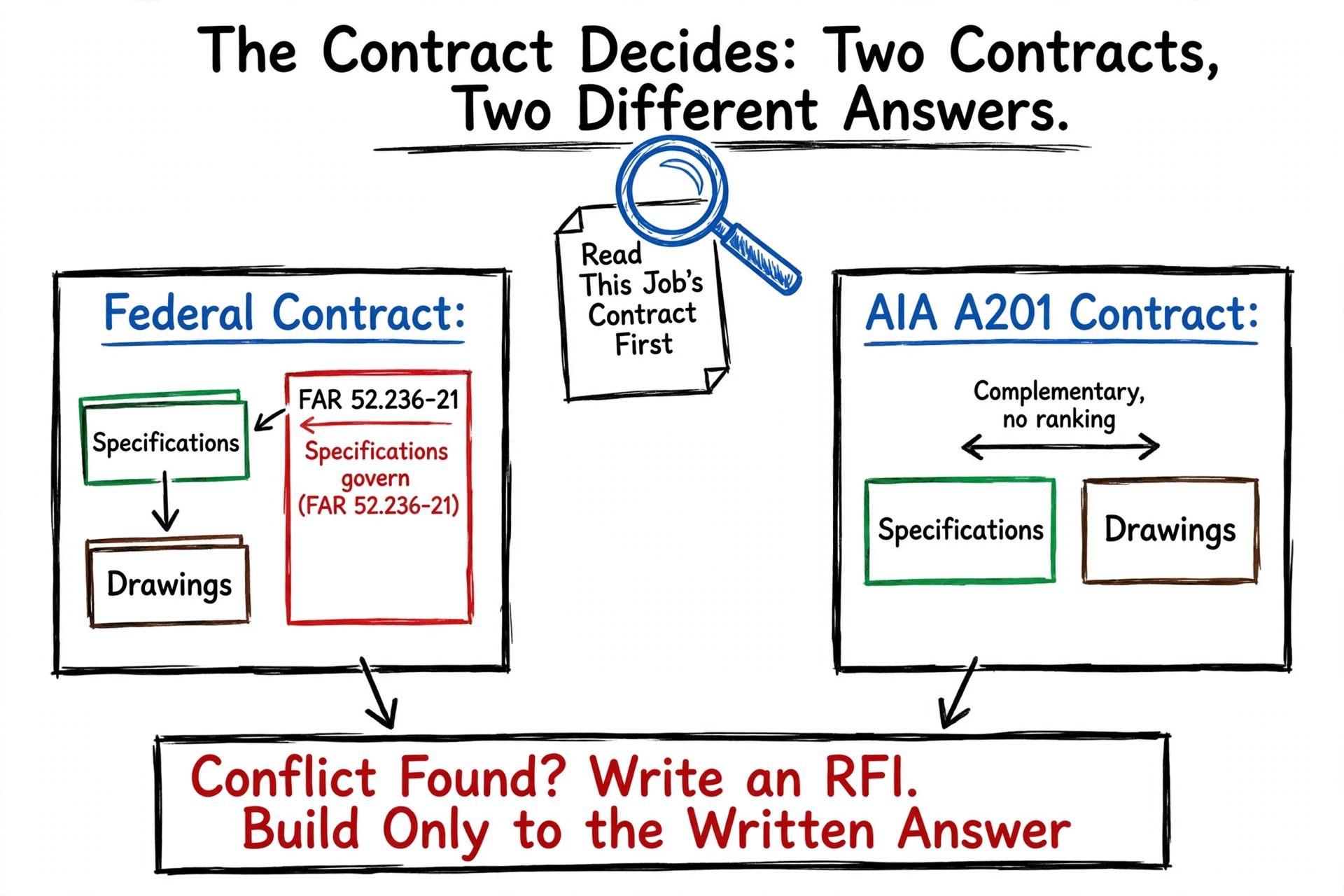
You will be able to describe three real approaches used in practice. First, the complementary documents approach in the standard AIA A201 general conditions, where drawings and specifications are treated as complementary with no hierarchy between them. Second, the federal approach in FAR 52.236-21, which does state rules for federal construction contracts, including that specifications govern over drawings in case of difference. Third, the state highway approach summarized by the Federal Highway Administration, where project specific documents typically rank above standard documents.
You will also be able to describe the working tool that resolves most conflicts in real life: the Request for Information, usually shortened to RFI, a formal written question that asks the design team or the owner representative to state in writing which requirement governs. And you will be able to state the field rule that protects everyone: when documents disagree, do not guess, do not pick the easier one, and do not build on an assumption. Stop, document the conflict, and get the answer in writing.
One boundary runs through this lesson. This lesson teaches you to recognize a document conflict and to route it correctly. It does not make you the person who decides which document governs. That decision belongs to the roles named in the contract, usually the architect or engineer of record, the owner representative, or, on federal work, the Contracting Officer. Reading this lesson does not qualify anyone to interpret a contract as a lawyer, to direct changed work, or to perform regulated or hazardous work.
Start With the Basics
Earlier lessons in this level taught you the pieces of construction information one at a time: the construction print, the plan sheet, the legend, symbols, stationing, offsets, footage, specifications, detail drawings, schedules, and revision clouds. Each piece was written or drawn by someone, usually at a different time and often by a different person or firm.
Here is the problem this lesson is about. Real document sets are large. A fiber project can carry dozens of plan sheets, a specification book, standard details, addenda issued during bidding, and later revisions. With that much paper, two documents will sometimes point in different directions. The plan sheet shows a handhole in one location. A detail drawing shows a different size. A specification section names one material. A note on the drawing names another. A written dimension on the sheet does not match what the drawing measures when you scale it.
That mismatch has a name. A discrepancy is a difference between two documents, or within one document, where both cannot be followed at the same time, or where it is not clear which one states the real requirement. A conflict is a stronger form of discrepancy, where following one document means violating the other.
Before anything else, three definitions need to be clear.
First, the contract documents are the full set of documents that together form the construction contract for a job. Depending on the contract, that set typically includes the agreement between owner and contractor, the general conditions, any supplementary conditions, the drawings, the specifications, addenda issued before the contract was signed, and modifications issued after signing, such as change orders. The exact list is stated in the agreement for each job, and the list matters, because only documents inside the contract carry contract force. A helpful email, a salesman brochure, or an old KMZ file from an earlier lesson is not a contract document unless the contract says it is.
Second, an order of precedence clause, sometimes called a contract precedence clause or a coordination clause, is a paragraph in the contract that states, in advance, which document governs when documents conflict. Govern is the key verb in this whole lesson. When document A governs over document B, it means A states the requirement you follow for that point, and B gives way on that point.
Third, precedence means ranking. To say one document takes precedence over another is to say it ranks higher for the purpose of resolving a conflict.
Hold one sentence from this section, because the rest of the lesson returns to it. There is no universal ranking that applies to every construction job. The answer to “which document wins” always starts with the same move: read this job’s contract and find out what it says.
What Is It?
“What controls when documents disagree” is a question about a system, and the system has three parts.
The first part is the contract’s own stated rule, if it has one. Many contracts include an order of precedence clause. The clause lists document types in a ranked order. When two listed documents conflict, the one ranked higher governs. Some clauses also carry smaller rules inside them. Some contract families add smaller rules of their own. The GSA supplement GSAR 552.236-21 states that large scale drawings govern over small scale drawings. The Defense supplement DFARS 252.236-7001 states that figures marked on drawings are followed in preference to scale measurements. Separately, a document that modifies the contract, such as an addendum or a change order, changes the earlier document it modifies. None of these rules applies on a job unless that job’s contract or a supplement that applies to it states the rule.
The second part is the complementary principle, used where the contract deliberately does not rank drawings against specifications. The standard AIA Document A201, General Conditions of the Contract for Construction, states this principle in Section 1.2.1. Paraphrased closely from that section, the intent of the contract documents is to include everything necessary for proper execution and completion of the work, the contract documents are complementary, and what is required by one document is as binding as if required by all. The AIA’s own published guidance confirms the consequence: under A201 and its construction manager counterpart, the form documents provide that drawings and specifications are complementary and do not create a hierarchy. So under an unmodified A201 contract, “the specifications always beat the drawings” is simply false. Something shown only on the drawings is still required. Something stated only in the specifications is still required. Neither document outranks the other.
The third part is the human decision process, because no ranking answers every conflict. Rankings handle conflicts between document types. They do not handle a conflict inside one drawing, a conflict between two notes on the same sheet, a missing dimension, or a field condition that matches neither document. For those, the contract provides a person and a process. The person is the one the contract names as interpreter, commonly the architect or engineer of record on private work, and the Contracting Officer on federal work. The process is the RFI, covered in detail later in this lesson. FAR 52.236-21 states this same duty for federal contracts in direct words: in case of discrepancy in the figures, in the drawings, or in the specifications, the matter shall be promptly submitted to the Contracting Officer, who shall promptly make a determination in writing.
So “what controls” is never a single document. What controls is, in order: the contract’s own precedence language where it applies, the complementary reading of the documents where no ranking exists, and a written determination from the named decision maker where the documents still do not resolve the point.
It is worth naming what does not control, because these are the answers people reach for in the field. Habit does not control: the way the last job worked proves nothing about this job’s contract. Seniority does not control: the loudest or most experienced voice on the crew does not outrank the contract. Convenience does not control: the cheaper or faster reading has no standing. And a single document pulled out of the set does not control by itself, because the contract reads the documents together, as one agreement.
What Does It Look Like?
You will usually meet this subject in one of four physical forms.
The first form is a paragraph in the front end of the contract documents. Front end means the opening sections of the project manual, before the technical specifications, where the agreement, the general conditions, and any supplementary conditions live. An order of precedence clause looks like ordinary contract text, often a numbered list of document types, highest first. It may sit in the agreement itself, in a section often titled “Contract Documents” or “Order of Precedence,” or in the supplementary conditions that modify the general conditions. On public highway work it often sits in the Division 100 general provisions, in the sections on control of work or scope of work, or in the special provisions for the project.
The second form is the conflict itself, spotted on the paper. It looks like this: you read a plan sheet note that names one conduit size, you turn to the specification section for underground conduit and read a different size, and both statements are about the same run. Or a detail drawing shows one handhole type while the plan sheet symbol and legend call out another. Or the written station limits in a note do not match where the drawing places the work. A conflict rarely announces itself. It looks like two normal looking statements that happen to disagree, which is why careful readers find them and hurried readers build them.
The third form is an RFI. On paper or in a project app, an RFI is a short formal form with a number, a date, the name of the person asking, exact references to the drawing sheet and specification section in conflict, a plain statement of the question, and space for the written response. It looks administrative, and it is, on purpose. That form is the record that a conflict was found and answered.
The fourth form is the written answer. It may come back as the RFI response itself, as a clarification sketch attached to the response, as a bulletin or supplemental instruction, or, where the answer changes the work or the price, as a change order. A change order is a formal modification to the contract, signed as the contract requires, that changes the work, the price, or the time. The answer you can rely on is the one that arrives through one of these written channels, filed with the project record, not a verbal answer at the tailgate.
What Does It Do?
The precedence system does four practical jobs on a project.
First, it keeps small conflicts from becoming arguments. When two documents disagree on a minor point and the contract already ranks them, the crew does not have to debate. The ranked answer is applied, the discrepancy is noted, and work continues within the contract’s own rule.
Second, it protects the intent of the design. Drawings and specifications divide the work of describing a job. Drawings show shape, location, arrangement, and quantity relationships in picture form. Specifications state quality, materials, workmanship, and performance in words. Reading them as complementary, each supplying what the other lacks, is what produces the complete requirement. A ranking that let one document erase the other would break that design on purpose. This is exactly why the AIA form documents refuse to rank drawings against specifications.
Third, it creates a record. The duty to report a discrepancy promptly, and to get the determination in writing, means conflicts and their answers become part of the project file. Months later, at inspection, at payment, or in a dispute, the file shows who decided what, and when. Memory does not have to carry that weight.
Fourth, it assigns risk honestly. Whoever builds on an unreported guess carries the risk of that guess. FAR 52.236-21 states this rule directly for federal work: ‘Any adjustment by the Contractor without such a determination shall be at its own risk and expense.’ The precedence system, used properly, moves the decision to the party the contract holds responsible for it, before the money is spent, not after.
Where Does It Fit?
This subject sits at the reading desk, not at the trench, and it sits early. The best time to find a document conflict is during bid review or during the preconstruction read through, when the design team can answer without a crew standing idle. The second best time is during submittal review and layout, before material is ordered and before anything is in the ground. The worst time is after installation, when the answer may require removal and replacement.
It also sits between earlier lessons and later ones in this level. Earlier lessons taught you what each document is: the print, the specifications, the details, the schedules, and the revisions. This lesson teaches you how those documents relate when they collide. Later work in this program, on change orders, as built documentation, and project records, builds on the written determinations this process produces.
One more fit is worth naming. This subject also lives inside the bid. A bidder who finds a conflict should ask about it before prices are due. Under the federal case law, the duty is sharpest for an obvious discrepancy inside one document category, such as inside the drawings or inside the specifications, which the bidder had a duty to raise. A conflict between the specifications and the drawings on a federal job is different: under Hensel Phelps the precedence clause itself resolves it, and the contractor may rely on the clause as written. Either way, asking early is cleaner and cheaper than arguing later.
On the organizational side, it fits inside contract administration, which is the office and field work of running the contract as written: RFIs, submittals, change orders, meeting minutes, and the project file. The field role in that system is narrow and important. Field personnel find conflicts, because they read the documents closest to the work. Field personnel report conflicts, with exact references. Field personnel do not resolve conflicts by personal choice, because the contract gives that authority to named roles, and a field decision made without that authority can be reversed at the builder’s cost.
Why Does It Matter?
It matters first in money. Buried fiber work is expensive to redo. A conduit run placed to the wrong size, a handhole set to the wrong type, or a bore path built to a superseded revision can mean excavation, replacement material, reinspection, and delay, and the party who guessed usually pays. The precedence clause and the RFI process exist so that the expensive decision is made once, in writing, by the right person, before the work is buried and hidden.
It matters second in schedule. A conflict found early costs an email. The same conflict found with a crew and a bore rig standing by costs a day. The same conflict found after backfill costs a week. Prompt reporting is not paperwork for its own sake. It is the cheapest schedule protection on the job.
It matters third in quality and acceptance. The inspector tests the finished work against the contract requirement. If the crew built to the document that did not govern, the work can be correct in craftsmanship and still be rejected, because it does not match what the contract, properly read, required.
It matters fourth in fairness. Construction contracts are written agreements about who carries which risk. The owner and designer carry the risk of their documents being complete and consistent. The contractor carries the risk of building what the documents, properly read, require, and of asking promptly when the documents do not agree. Using the stated process keeps each risk with the party who agreed to carry it. Guessing quietly moves the designer’s risk onto the crew without anyone agreeing to that move.
What Does Good Look Like?
Good practice starts before any conflict exists. At the start of a job, someone in authority reads the agreement and the general conditions and finds the precedence language, or confirms that the contract uses the complementary approach with no ranking. The crew leadership knows which system this job uses, because they looked, not because they assumed. The current document set is controlled: one known location holds the latest drawings, specifications, addenda, and revisions, and superseded sheets are marked or removed so nobody builds from an old print.
When a conflict surfaces, good practice looks like this. The person who spots it stops on that item only, and keeps other unaffected work moving if the contract and the supervisor allow it. The conflict is written down the same day, with the exact sheet number, detail number, and specification section for both sides of the disagreement. An RFI goes in promptly, in the project’s stated format, stating one clear question. The RFI suggests a resolution if the asker has one, which helps the designer answer faster, but it does not present the suggestion as already approved.
While the answer is pending, nobody orders the disputed material and nobody buries the disputed work. When the written answer arrives, it is distributed to everyone affected, the field set is marked or reissued as the project requires, and the answer is filed where the next reader will find it. If the answer changes the work, the price, or the time, it is carried into a change order through the contract’s own process rather than treated as a casual instruction.
Good practice also has a tone. Conflicts are reported as neutral facts: these two documents say different things, which one governs. Nobody hides a conflict to avoid looking slow, and nobody treats an RFI as an accusation against the designer. Document sets are human products. Conflicts are expected, and the system for handling them is part of the job.
What Can Go Wrong?
The most common failure is the universal rule myth: someone states, with confidence, that specifications always govern over drawings, or that drawings always govern over specifications, as if one sentence settled every job. As the sources for this lesson show, that rule exists in the federal FAR clause and in many public works contracts, and it does not exist in the standard AIA A201, which treats the documents as complementary. Carrying one job’s rule onto another job is how compliant work gets built wrong.
The second failure is silent guessing. A reader spots the conflict, decides which document is probably right, and builds without asking. If the guess is wrong, the builder owns the correction. If the guess is right, the project file still has no record, and the same conflict waits to confuse the inspector, the next crew, and the as built drawings.
The third failure is scaling a drawing to settle a dimension. Precedence clauses that address dimensions commonly give the written, figured dimension priority over a scaled measurement. That rule is not in the basic FAR 52.236-21 clause. It appears in federal supplements such as DFARS 252.236-7001 and in the FHWA typical highway clause in calculated dimension form, and it applies only where the contract for the job states it. Drawings can be printed off scale, reduced, or distorted in copying. Measuring a print with a ruler to override a written dimension reverses the stated order and produces locations that are wrong by small amounts everywhere.
The fourth failure is building from a superseded document. An addendum or revision changed the requirement, but the old sheet is still in the truck. Version conflicts are document conflicts too, and the later issued document normally governs over the one it replaced, under the modification language of the contract.
The fifth failure is the verbal answer. A designer, inspector, or owner representative answers a conflict question in conversation, the crew builds to it, and nothing is written down. Weeks later the recollection differs, the work is questioned, and there is no determination in the file to settle it. Verbal direction feels fast and performs badly.
The sixth failure is late reporting. The FAR clause requires discrepancies to be submitted promptly, and AIA A201 Section 3.2.2 likewise requires the contractor to promptly report errors, inconsistencies or omissions discovered, as a request for information. A conflict reported after the affected work is built has lost most of its value, because the cheap options are gone.
What Should Someone Notice in the Field?
Notice the front end first. On a new job, notice whether anyone can tell you, from the actual contract, whether this project has an order of precedence clause and where it sits. If the answer is a shrug or a universal rule quoted from memory, that is a finding worth raising with supervision before work starts.
Notice pairs of documents as you read. When a plan note names a material, check the specification section for the same item. When a detail shows a size, check the plan callout. When a schedule lists equipment, check it against the plan symbols. Conflicts live in the seams between documents, and the seams are exactly where a careful reader slows down.
Notice written dimensions that do not match the drawing geometry. Notice notes that reference a detail or a specification section that does not exist in your set, or that exists in a different revision. Notice revision clouds and addenda you have not seen. Each of these is a discrepancy asking to be reported, not a puzzle asking to be solved alone.
Notice version control in the truck and at the gang box. If two copies of the same sheet carry different revision dates, one of them is a conflict waiting to be built. Notice whether RFI answers are reaching the field set, marked on the drawings the crew actually uses, or whether answers live only in an office inbox.
Finally, notice pressure. The moment someone says “just pick one, we need to keep moving” about a genuine conflict, you have noticed the exact situation this lesson exists for. The correct field move is to pause that item, write down both references, and send the question up the stated channel the same day.
Practical Example
The following example is hypothetical. Any resemblance to a real project is coincidental, and the numbers in it are illustrative only, not requirements for any job.
Hypothetical: a crew is building a buried fiber route along a county road. The plan sheet for the segment shows a symbol at a road crossing and the legend identifies that symbol as a specific handhole type, call it Type A. The crew foreman, checking material before delivery, opens the detail sheet referenced by the plan note. The detail drawing shows the crossing structure drawn and labeled as a larger structure, call it Type B, with different dimensions. The specification section for structures lists Type B for crossings under paved roads. So the plan symbol points one way, and the detail and the specification point another way.
Here is how the system handles it, step by step. The foreman does not order either structure and does not let the crossing excavation proceed on a guess. The foreman writes down the conflict with exact references: plan sheet number and symbol, detail sheet number, specification section number. The contractor’s project manager checks this job’s contract before assuming any ranking. On this hypothetical job, suppose the contract is a public works contract whose general provisions contain an order of precedence clause stating that specifications govern over drawings and that detailed drawings govern over general drawings. Both sides of that clause point the same way here, toward Type B. Even so, because the plan sheet affirmatively shows a different structure at a specific station, the project manager submits a short RFI asking the engineer of record to confirm that Type B governs at that crossing, and attaches the two references. The engineer answers in writing, confirming Type B and issuing a corrected plan note by clarification sketch. The answer is filed, the field set is marked, the correct structure is ordered, and the crossing is built once.
Now change one fact and watch the answer change. Suppose instead that this hypothetical job runs under an unmodified AIA A201 contract. There is no clause ranking the specification above the drawing, so nobody on the project can settle the conflict by quoting a hierarchy. The complementary principle says both documents bind, and since both cannot be satisfied with one structure, the conflict goes to the architect for interpretation by RFI, exactly as the AIA guidance contemplates. The process is the same. The stated reason is different. That difference is the whole lesson: the process is stable, but the governing rule comes from the contract in front of you.
Key Terms
- Contract documents: The set of documents that together form the construction contract, typically the agreement, conditions, drawings, specifications, addenda, and signed modifications. The exact set is listed in each job’s agreement.
- Order of precedence clause: Contract language that ranks document types in advance, so that when two documents conflict, the higher ranked document governs.
- Govern: To state the controlling requirement. When one document governs over another, the governing document is the one followed on that point.
- Complementary documents: The principle, stated in AIA A201 Section 1.2.1, that the contract documents complete each other, and what any one of them requires is binding as if all of them required it.
- Discrepancy: A difference between documents, or within one document, where the requirement is unclear or the statements cannot both be followed.
- Specifications: The written technical requirements for materials, workmanship, and performance, usually organized in a project manual.
- Drawings: The graphic documents showing design, location, dimensions, and arrangement of the work, including plans, details, and schedules drawn on sheets.
- Figured dimension: A dimension written in numbers on a drawing, as opposed to a dimension obtained by measuring the drawing.
- Addendum: A written change to the bidding documents issued before the contract is signed. Plural: addenda.
- Change order: A signed formal modification to the contract after signing, changing the work, the price, or the time.
- Request for Information (RFI): A formal written question from the contractor to the design team or owner representative asking for clarification of the contract documents. The AIA publishes a standard form for it, AIA G716.
- Contracting Officer: The government official authorized to act for the owner on a federal contract, including making written determinations on discrepancies under FAR 52.236-21.
Check Your Understanding
- A coworker says, “Everyone knows the specifications always beat the drawings.” What is wrong with that statement as a general rule?
- Under the standard AIA A201, what does it mean that the contract documents are complementary?
- On a federal construction contract under FAR 52.236-21, in case of difference between drawings and specifications, which governs, and what must the contractor do when there is a discrepancy in the figures, the drawings, or the specifications?
- A written dimension on a drawing disagrees with the length you get by scaling the drawing with a ruler. Under the dimension rule commonly stated in precedence clauses, which one do you trust, and why?
- You find a genuine conflict between a plan sheet and a detail drawing on your job. List the field steps you take, in order, before any of the disputed work is built.
Answer Key
- It takes a rule that exists in some contracts, such as the federal FAR clause and many public works contracts, and treats it as universal. The standard AIA A201 has no such hierarchy. It treats drawings and specifications as complementary. The only reliable rule is to read the contract for the job in front of you.
- It means the documents complete each other. What is required by any one contract document is as binding as if required by all of them. Something shown only on the drawings, or stated only in the specifications, is still required, and neither document outranks the other.
- The specifications govern. The contractor must promptly submit the discrepancy to the Contracting Officer, who makes a determination in writing. Building on the contractor’s own adjustment without that determination is at the contractor’s own risk and expense.
- Trust the figured, written dimension. Precedence clauses that address the point give written dimensions priority over scaled measurements, and prints can be reduced, stretched, or copied off scale, so a scaled measurement is the less reliable statement of the two.
- Stop on the disputed item. Write down the exact references for both sides, sheet, detail, and specification section. Report the conflict promptly through the project’s stated channel, normally an RFI to the design team or owner representative. Do not order the disputed material or build the disputed work on a guess. Wait for the written answer, then mark the field set, file the answer, and build to the written determination.
Lesson Takeaway
When documents disagree, the contract decides, not habit, not seniority, and not whoever is in a hurry. Some contracts rank their documents in an order of precedence clause. The standard AIA A201 deliberately does not rank drawings against specifications and instead reads them as complementary. Federal contracts under FAR 52.236-21 state their own rules and require discrepancies to go promptly to the Contracting Officer for a written determination. Because the rules differ by contract family, the professional habit is always the same: find the conflict, write down both references, ask in writing through the RFI process, and build only to the written answer.
Sources and Technical References
- FAR 52.236-21, Specifications and Drawings for Construction. The federal clause states that anything mentioned in the specifications and not shown on the drawings, or shown on the drawings and not mentioned in the specifications, is of like effect as if shown or mentioned in both; that in case of difference between drawings and specifications, the specifications shall govern; and that discrepancies in the figures, drawings, or specifications shall be promptly submitted to the Contracting Officer for a written determination. Full text via FAR Clause reference: https://farclause.com/FARregulation/Clause/FAR52.236-21_Alt_II-specifications-and-drawings-for-construction and prescription at 48 CFR 36.521: http://www.law.cornell.edu/cfr/text/48/36.521
- GSAR 552.236-21 supplement to the FAR clause, which adds that large scale drawings govern over small scale drawings and that schedules take precedence over conflicting information on drawings, as that supplement provides for GSA contracts: https://www.acquisition.gov/node/58462/printable/print and https://www.law.cornell.edu/cfr/text/48/552.236-21
- AIA Contract Documents help center, FAQs on understanding documents. AIA states that under A201 and A232 the form documents provide that drawings and specifications are complementary and do not create a hierarchy, and points to guides A503 and A533 for adapting the general conditions to establish an order of priority: https://help.aiacontracts.com/hc/en-us/articles/1500009284162-FAQs-Understanding-documents
- AIA A201 Section 1.2.1 complementary language, quoted and discussed in the Construction Specifications Institute chapter article on the complementary clause: https://www.csinext.org/technical/key-clauses-of-the-general-conditions-complementarity/
- Federal Highway Administration, Technical Advisory on Development and Review of Specifications. FHWA summarizes the typical highway order of precedence found in state DOT general conditions: project special provisions, project plans, supplemental specifications, standard specifications, standard plans, and notes that calculated dimensions take precedence over scaled dimensions under a typical clause: https://www.fhwa.dot.gov/construction/specreview.cfm and attachment at https://www.fhwa.dot.gov/construction/specrevattach2.cfm
- Cohen Seglias, Order of Precedence, government contracting database. Summarizes the federal clause, the contractor duty of inquiry for discrepancies within a document category, and case law including Hensel Phelps Construction Co. v. United States, 886 F.2d 1296 (Fed. Cir. 1989), holding that a contractor may rely on the precedence clause as written: https://www.cohenseglias.com/contracting-database/order-precedence/
- Procore Library, Contract Precedence. General explainer on precedence clauses with worked examples from federal and institutional contracts, including ConsensusDocs based language ranking change orders and amendments first: https://www.procore.com/library/contract-precedence
- Young Architect Academy, Drawings vs. Specifications: Which Takes Precedence. Explains the origin of the “specifications always win” myth in the FAR clause and its absence from standard AIA documents: https://academy2.youngarchitect.com/drawings-vs-specifications/
- New York State DOT Standard Specifications, Section 101, listing contract document components in that department’s own declining order of precedence, used in this lesson only as an example that DOT orders differ from the FHWA typical list: https://www.dot.ny.gov/main/business-center/engineering/specifications/english-spec-repository/2023_1_specs_usc_tc_vol1.pdf
Previous lesson: Lesson 93: Who Can Approve a Field Change? |
Back to Level 4 hub |
Next lesson: Lesson 95: What Happens When the Print Doesn’t Match the Field?