
What You Are Learning
By the end of this lesson you will be able to define a construction specification in plain words. You will be able to explain how a specification differs from a drawing: the drawing shows where work goes and what it looks like, and the specification states in words what materials are required, what quality is required, and how the work is to be built and checked. You will be able to describe what a specification looks like, including a bound or electronic specification book, a table of contents organized by divisions and sections, and the common three part structure inside a technical section. You will be able to name the main kinds of specification: prescriptive, performance, proprietary, and reference standard. You will be able to explain the difference between a standard specification that an owner reuses on many jobs, a supplemental specification that revises it, and a special provision written for one project. You will be able to explain how specifications are organized by systems such as CSI MasterFormat, and why outside plant fiber work often appears under site and utilities divisions rather than under a fiber title. You will also be able to state the safety and authority boundary clearly: reading a specification helps you recognize what the contract requires. It does not qualify you to perform regulated or hazardous work, and it does not replace the contract documents for the specific job in your hand.
This lesson teaches you to read and recognize a specification. It does not qualify you to write specifications, to approve a material substitution, to decide that work meets a specification, or to perform the construction the specification describes. When a drawing and a specification disagree, or when a specification is missing or unclear for work you are looking at, the correct move is to stop and raise the question through the job process.
Start With the Basics
Earlier lessons in this level covered the drawing side of the construction information. A plan sheet shows the route from above. A profile shows it from the side. A detail shows a small part enlarged. All of those are pictures, drawn to scale, with labels, notes, and symbols.
A specification is the written side of the same job.
Think of it this way. A drawing can show a handhole in the right place, at the right station, with the right outline. The drawing alone cannot fully say what that handhole must be made of, how strong it must be, how it must be set and bedded, what cover it must carry, what tests or inspections apply, or what happens if the delivered product is different from the one named. Those answers are written, not drawn. They live in the specification.
Five words need plain definitions before the rest of the lesson builds on them.
A specification, often shortened to spec, is a written requirement in the contract documents that states what materials, products, quality, workmanship, installation method, or result is required for a part of the work.
A contract document is any document that is made part of the construction contract for a job. Drawings and specifications are both contract documents when the contract says so. A helpful article or a manufacturer catalog is not a contract document unless the contract incorporates it.
A standard is a published rule or test method issued by a recognized organization, such as a standard for a material or a method for testing it. A specification may require compliance with a standard instead of writing every requirement out in full. That is called incorporating the standard by reference.
A submittal is a document the contractor sends to the owner or designer for review before or during construction, such as product data for a material the contractor proposes to use. Many specifications require submittals so a proposed product can be checked against the specification before it is installed.
Shall is a word you will meet constantly in specifications. In specification writing, shall is normally used to state a requirement, while will is often used to state something the owner or another party will do. The exact meaning for a job is defined in that job’s general requirements and contract language, so read the definitions section for the set in hand instead of assuming.
Hold one idea before you read further. Drawings and specifications are partners, not rivals. Neither one alone tells the whole story of a job, and a reader who uses only one of them is working with half the contract.
What Is It?
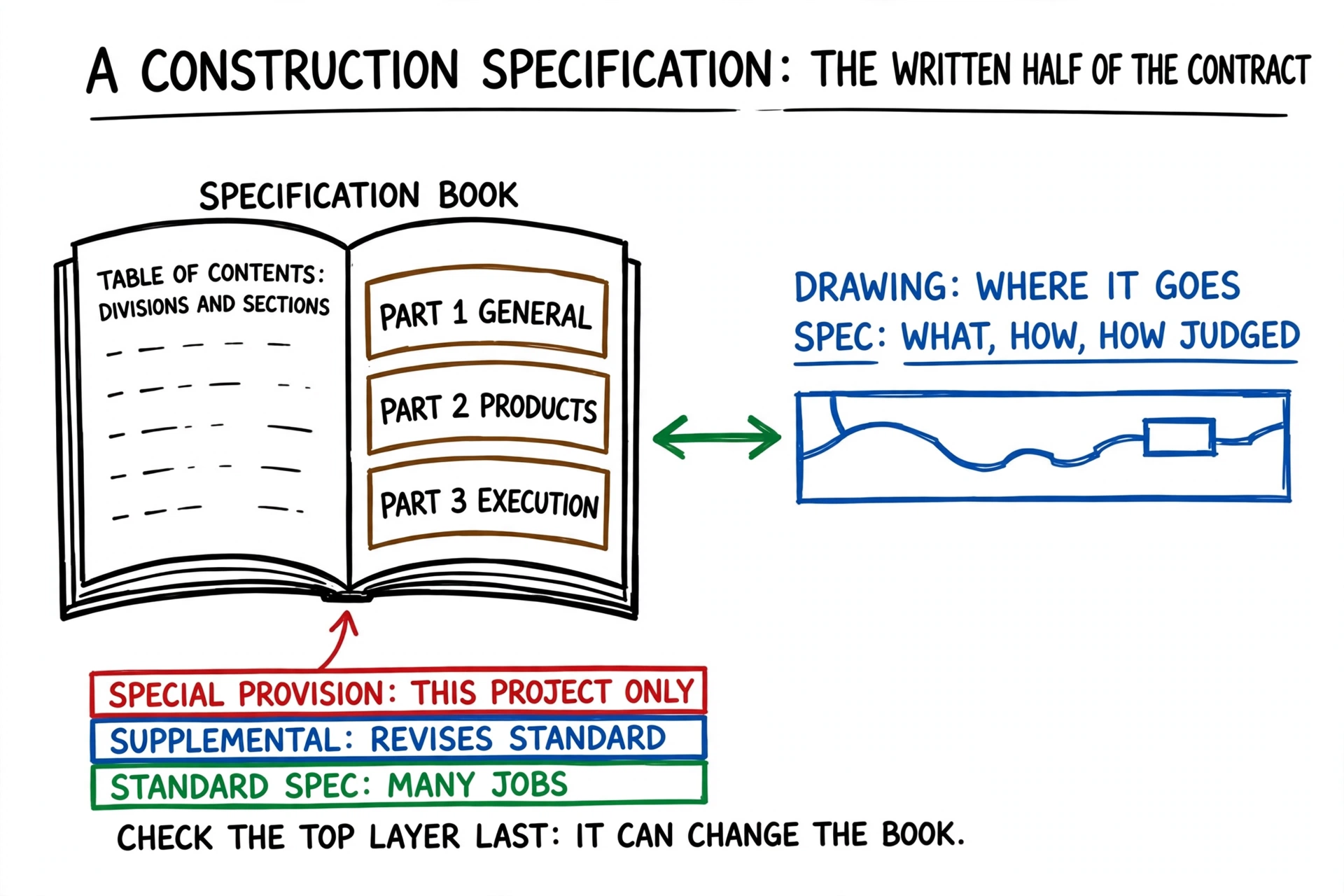
A construction specification is the written part of the contract documents that describes, in words, the materials, products, quality, workmanship, methods, and performance required to build the work shown on the drawings.
Unpack that definition piece by piece.
It is written. A specification is text organized into divisions, sections, and numbered articles and paragraphs. It may run to hundreds or thousands of pages on a large job, or it may be a short set of written requirements on a small job. Its size does not change its role.
It is part of the contract. When a specification is included in or referenced by the contract, following it is not optional guidance. It is a contract obligation. That is why the exact edition, the exact section, and any project specific changes matter so much. A specification for a different job, or an old edition of a standard specification, does not govern your job unless your contract says it does.
It states requirements the drawings do not carry well. Industry references describe construction specifications as the detailed written instructions that complement the drawings and describe the materials and methods required to construct each component of the project. Drawings are strong on location, alignment, dimensions, and relationships. Specifications are strong on quality, composition, installation, testing, and acceptance.
It applies in layers. A single piece of fiber work may be governed at the same time by a general requirements section that applies to the whole job, a technical section that covers that kind of work, a standard referenced inside that section, a manufacturer instruction referenced for a named product, and a special provision that changes one requirement for this project only. Learning to read a specification means learning to find all of those layers, not just the first paragraph you find.
A specification is not the same as a general note on a drawing. A note is a short written instruction placed on a sheet, and it is also binding when it is part of the contract documents. A note usually covers one situation on that sheet. A specification section covers a whole kind of work, wherever it appears on the job. The two often point to each other: a drawing note may send you to a specification section, and a specification may send you to a drawing or detail.
A specification is also not a manufacturer catalog, a sales sheet, or an installation guide on its own. Those documents become requirements for a job only to the extent the specification or contract actually references them, and only in the edition or version the documents state.
What Does It Look Like?
Picture a thick book, a binder, or a long electronic document with a cover page that names the project, the owner, and the edition or date. In highway and public works work this is often called the spec book. In building work it is often called the project manual. The name varies by owner and by sector. The function is the same.
Open it and look for these elements.
A table of contents organized by divisions and sections. The table of contents lists each section by number and title, so a reader can find the section that covers a kind of work without reading the whole book. On a state department of transportation job, for example, the Alabama Department of Transportation publishes its Standard Specifications for Highway Construction as a book organized into divisions, starting with Division 100, General Provisions, and publishes general application and project specific special provisions alongside the standard book for each edition year. Federal highway work has a parallel example: the Federal Highway Administration publishes the FP-14, the Standard Specifications for Construction of Roads and Bridges on Federal Highway Projects, issued in 2014, with its own divisions and sections and libraries of supplemental specifications.
General provisions or general requirements near the front. These sections set the rules for the whole job rather than for one material. In the Alabama and New Hampshire standard books, Division 100 sections include definitions and terms, bidding requirements, award and execution of contract, scope of work, control of work, control of material, legal relations, prosecution and progress, and measurement and payment. Names and numbering differ by owner. The pattern is consistent: the front of the book explains how the job is administered, how words are defined, how work is controlled and accepted, and how it is measured and paid.
Technical sections for kinds of work. After the general sections come sections that each cover one kind of construction: earthwork, aggregates, conduit, structures, restoration, and so on, depending on the owner system in use. Each technical section is identified by its number and title in the table of contents.
A three part structure inside many technical sections. A widely used structure, described in industry guides to prescriptive specifications, divides a technical section into three parts. Part 1, General, covers the scope of the section, the standards it references, the submittals required, and quality control. Part 2, Products, states the required materials and products and their properties. Part 3, Execution, states how the work is prepared, installed, and tested or checked after installation. Not every owner uses this exact structure. State highway books often use their own article structure, with headings such as description, materials, construction methods, measurement, and payment. The reading habit is the same either way: find the part that states the material, the part that states the method, and the part that states how the result is measured, accepted, and paid.
Project specific material bound in or issued with the book. Many jobs add special provisions, supplemental specifications, and special contract requirements that modify the standard book for this project. In the New Hampshire standard book, those terms are defined in plain order: supplemental specifications are revisions to the standard specifications, and special provisions are additions and revisions to the standard and supplementary specifications applicable to an individual project. Alabama states the order of control even more directly: project specific special provisions prevail over general application special provisions, standard specifications, and plans. That order is an owner rule for those books, not a universal rule for every job. Your job’s own order of precedence, stated in its contract, controls when documents conflict.
References to outside standards. Inside a section you will see citations to standards published by other organizations. Instead of writing a full test method, the specification names the standard and requires the work or material to comply with it. When you meet such a citation, the cited standard is part of the requirement, and the edition named or adopted for the job matters.
Formal language throughout. Specifications use shall statements, defined terms that may be capitalized, cross references to other sections, and numbered paragraphs so a requirement can be cited exactly, for example by division, section, and paragraph. That formality is deliberate. In a dispute or an inspection, the team needs to point to the exact sentence that states the requirement.
What Does It Do?
A specification does five jobs that drawings cannot do as well.
First, it defines quality. Two conduits can look identical in plan view and be very different products, with different materials, wall strength, and intended use. The specification states which product, which material properties, and which referenced standards are required, so quality is a written requirement instead of an assumption.
Second, it states how work is to be executed where the method matters. Some sections prescribe the method step by step. Others state the result required and leave the method to the contractor. Either way, the specification is where that choice is recorded, along with preparation, installation, and field quality control steps the job requires.
Third, it states how work is tested, accepted, and corrected. A specification may require sampling, testing, inspection, documentation, or a demonstration that a result was achieved, and it states what happens when work does not conform. The FHWA FP-14 structure shows this pattern at the general level, with sections on control of work, control of material, contractor quality control, contractor sampling and testing, and acceptance of work.
Fourth, it states how work is measured and paid. In highway style books, technical sections commonly end with measurement and payment articles that define the unit, what is included in that unit, and what is not paid separately. That language decides whether a task a crew performed counts inside a pay item or outside it. A drawing cannot settle that question. The specification does.
Fifth, it creates a common requirement that every bidder and every crew works to. Because the specification is issued with the contract, all parties price, plan, build, and inspect against the same written requirements. When work is questioned later, the specification is the first place the team looks for the agreed answer.
A specification does not draw the route. If you need to know where work goes, how far it runs, or what it crosses, you go to the drawings, the plan, the profile, and the details. If you need to know what the work must be made of, how it must be installed, and how it will be judged, you go to the specification. A complete reading uses both.
Where Does It Fit?
A specification sits beside the drawings in the contract documents, and the two are read together for every part of the work.
In the document set, the order is typically this. The agreement and general contract conditions set the legal framework. Division 00 or its equivalent, in systems that use it, holds procurement and contracting requirements. Division 01 or the general provisions hold requirements that apply to the whole job. The technical divisions hold the sections for each kind of work. The drawings sit alongside the book as a separate part of the same contract. A sheet index and a specification table of contents are the two finding tools: one finds the drawing, the other finds the written requirement.
In organizing systems, the best known example is MasterFormat, published by the Construction Specifications Institute, known as CSI, together with Construction Specifications Canada. MasterFormat is a master list of divisions, section numbers, and titles used to organize information about a facility’s construction requirements. It was a 16 division system in its 1995 edition. In 2004 it was expanded to 50 divisions, and it has been revised in later editions since then, including the 2018 edition referenced in published division lists. Its current groupings include Division 00 for procurement and contracting requirements, Division 01 for general requirements, a facility construction subgroup, a facility services subgroup, a site and infrastructure subgroup that includes Division 31 Earthwork, Division 32 Exterior Improvements, and Division 33 Utilities, and a process equipment subgroup. Division 27 Communications is in the facility services subgroup. For outside plant fiber work, that placement is the practical lesson: there is no single fiber division to look under. Depending on the owner and the designer, conduit and duct work may be filed with utilities, trenching and backfill with earthwork, restoration with exterior improvements, and communications cabling and equipment under communications. Public works and highway owners often do not use MasterFormat at all for their road and utility books. They use their own division systems, such as the state DOT division structure described earlier. The system in use is stated by the book in front of you. Never assume a section number from one system exists in another.
Before the specification in the life of a job come design and procurement. Designers select the standard specification that will govern, write the project specific sections and special provisions, and reference the standards and products the design depends on. The owner issues the book with the drawings for bidding or negotiation.
During construction, the specification is a daily working document. Contractors plan methods and order materials against it. Submittals are checked against it. Inspectors compare installed work with it, using the inspection and testing methods the job documents state. Questions about what a requirement means are raised and answered through the job process, and any formal change is issued as a written contract change, not as a verbal understanding.
After construction, the specification remains part of the record of what was required. Together with record drawings and test and inspection records, it helps a future reader understand what standard the work was built to, even when the specification itself does not prove what was actually installed.
Why Does It Matter?
It matters because a frequent and costly reading failure in construction is using the drawing alone. A crew builds the right shape in the right place from the wrong material, by the wrong method, or without a required test, and the work fails acceptance even though it looks correct. The specification is the document that would have stated the material, the method, and the test before the work was done.
It matters because specifications settle questions that opinion cannot. When a contractor, an inspector, and an owner disagree about whether a product is acceptable or whether a task is included in a pay item, the answer the contract points to is the written requirement, read with its referenced standards and its project specific changes. Knowing how to find and read that requirement is a basic professional skill on any crew, even for a reader who will never write one.
It matters because of the layers. A reader who finds the standard section and stops may miss a special provision that changed that section for this project. Alabama’s published rule for its own book, that a project specific special provision prevails over the standard specification and over plans, shows why the last layer matters. That exact order belongs to that owner. The general lesson belongs everywhere: always check whether your job has supplemental specifications or special provisions that modify the standard text you are reading, and always read the order of precedence stated in your own contract.
It matters because specification type changes who carries the risk. Industry references make this distinction consistently. A prescriptive specification tells the contractor exactly what materials and methods to use, and the design team keeps responsibility for the design choices it prescribed. A performance specification states the measurable result the finished work must achieve and leaves the means and methods to the contractor, so the contractor carries more responsibility for choosing a method that achieves the result. Misreading one kind as the other can lead a reader to assume a freedom the contract does not give, or to wait for an instruction the contract will never provide.
Finally, it matters for safety, stated plainly. Some specifications reference safety related standards, traffic control requirements, or protective methods. Reading those sections helps you recognize that a requirement exists. It does not qualify you to perform excavation, trenching, confined space entry, electrical work, traffic control, or any other regulated or hazardous activity. That work is governed by applicable law and regulation, by the job safety process, and by the qualifications and authorizations the job requires, and it is performed by the people qualified for it. If a specification appears to conflict with a safety requirement, stop and raise it through the job process. Never resolve that kind of conflict on your own in the field.
What Does Good Look Like?
A good specification, and good use of one, look like this.
The book is identified. The reader can state the project, the owner, the edition or date of the standard specification in use, and whether supplemental specifications or special provisions have been issued for this job. No requirement is quoted from an unidentified or superseded edition.
The right section is found and cited exactly. A requirement can be pointed to by division, section, and paragraph, and any cross referenced section or standard has actually been opened and read, not assumed.
The three questions are answered for each kind of work. What material or product is required, how must it be installed or what result must it achieve, and how will it be tested, accepted, measured, and paid. If the specification in hand does not answer one of those questions, that gap is noted as a question, not filled by habit.
Drawings and specifications agree, or the disagreement is raised. Where a drawing note, a detail, and a specification section speak to the same work, they are read together. A conflict between them is recorded and raised through the job process under the contract’s order of precedence, not settled by choosing the document you prefer.
Submittals and substitutions follow the stated process. A product is checked against the products part of its section before it is ordered or installed, and any proposed change from a named product follows the substitution procedure the general requirements state. A product is never accepted on the word similar alone.
Changes are written. When a requirement is changed for the job, the change appears as an issued special provision, a supplemental specification, or a formal contract change that the reader can file with the book. Verbal changes are not treated as specification changes.
What Can Go Wrong?
The drawing only error is a common and costly specification mistake. A team builds from the sheets, never opens the book, and discovers at inspection that the material, the method, or a required test was stated in a section nobody read. The work may have to be removed, retested, or redone at someone’s cost. Its mirror image is the spec only error: reading the written requirement without the drawing, and losing the location, alignment, and relationships that only the drawing shows.
The wrong edition error is quiet and costly. Standard specifications are reissued and revised. A reader who pulls an old edition from a truck, a website, or a previous job may be reading requirements the owner has already changed. Confirm the edition your contract adopts, every time.
The missing special provision error is missing the layer that controls this project. A standard section says one thing. A project specific special provision issued for this job says another. The reader who never checked for special provisions follows the standard text and builds work the project does not want.
The type confusion error is treating a performance requirement as if it were a recipe, or a prescriptive requirement as if it were a suggestion. If the section prescribes a named material and a stated method, substituting a different material or method without the stated approval process is nonconforming work, even if the result looks the same. If the section states a result and a test, the contractor must choose and prove a method that passes. The words in the section tell you which situation you are in.
The reference standard trap is citing a standard without reading it. A specification that requires compliance with a named standard makes that standard’s requirements part of the job for the scope cited. A reader who has not obtained and read the cited edition cannot state what the job actually requires.
The proprietary surprise is failing to notice that a section names a specific manufacturer or product. Industry references call this a proprietary specification. It may allow substitutes through a stated procedure, it may list acceptable equivalents, or it may allow no substitute, and the exact language controls. On public work, naming and substitution rules may also be shaped by procurement law and owner policy for that job. Do not assume a substitute is allowed or forbidden. Read the section and the general requirements.
The conflict resolution error is settling a disagreement between documents by preference, seniority, or whoever is standing closest. Contracts state an order of precedence for their documents, and owners publish rules for their books. Follow the order stated for your job, and raise the conflict in writing through the job process when the order does not clearly resolve it.
What Should Someone Notice in the Field?
Carry the relevant specification sections together with the drawings for the segment you are looking at. A specification left in the office cannot help a reader standing at a handhole. Work through the checks in this order.
First, identify the book. State the project name, the owner, the standard specification edition, and whether special provisions apply to this segment. If you cannot name the edition, stop and find it before you judge any work against the book.
Second, find the section for the work in front of you. Use the table of contents, not memory. In a MasterFormat organized book, check the site and infrastructure divisions as well as communications, because fiber work is often split across earthwork, utilities, exterior improvements, and communications sections. In a state DOT book, use that book’s own division list. Open every cross reference the section makes.
Third, answer the three questions out loud for the item you are inspecting or planning. What does the products part require. What does the execution part require, or what result and test does a performance section require. How is the work measured, accepted, and paid. If any answer is missing from the documents in hand, write it down as an open question.
Fourth, compare the delivered and installed material with the products requirement. Read the labels, markings, and product data for what is actually on site and compare them, word by word, with the named product, the required properties, and any referenced standard in the section. A material that looks right and is labeled differently is a question to raise, not a judgment to make alone. This comparison is a recognition skill. Acceptance decisions belong to the people the job assigns to make them.
Fifth, check for the project layer. Ask whether a special provision, a supplemental specification, or an issued change touches this section or this item. If one does, read it alongside the standard text and note where it changes the requirement for this job.
Sixth, notice tests and documentation as work, not paperwork afterthoughts. If the section requires a test, a sample, a record, or a submittal, note whether it is scheduled and who performs it under the job process. Work built without a required test may be impossible to accept later without additional steps the contract states.
Seventh, hold the boundary. You can recognize whether work appears to match a written requirement and raise a question when it does not. Reading a specification does not authorize you to direct a change, approve a substitution, accept nonconforming work, or perform regulated or hazardous construction. Those decisions and activities belong to the qualified and authorized people the job names.
Practical Example
The following example is hypothetical. It is invented to teach the reading habit, not to describe a real job or a real company.
Hypothetical example: the handhole that matched the drawing and failed the book. A hypothetical fiber crew is setting handholes along a buried conduit segment. The plan sheet and a detail show the handhole location, size outline, and how the conduit enters it. The crew has a product on the truck that matches the outline on the detail, and the foreman, Casey, is about to set it.
Before the hole is dug, Casey opens the specification section the detail references. The products part of that section names a required load rating class for handholes in this owner system and references a standard the product must comply with. It does not state a numeric load value in the paragraph Casey reads, so Casey does not invent one. Instead Casey reads the rating marking molded into the product on the truck and reads its product data sheet. The marking names a different, lower class than the section requires.
Casey stops the set, photographs the marking, and raises the mismatch to the project lead with the exact citation: division, section, and paragraph for the required class, and the marking on the delivered product. No argument happens at the hole, because the written requirement and the delivered label can both be pointed to. The project lead directs the crew to set no handholes from that delivery and to work a different segment while the correct product is obtained through the job process.
Casey also checks the back of the book and finds a project special provision for this job. For this project only, it adds a documentation requirement to the same section: a delivery record for each structure, filed with the inspection records. Casey adds that step to the segment checklist, so the correct handholes, when they arrive, will also carry the paperwork this project requires.
The lesson in the example is not the rating class. It is the sequence. The drawing showed size and place. The specification stated quality and a referenced standard. The special provision added a project only requirement. Reading all three, before excavation, turned a failed inspection and a removal into a short delay on a different segment. The crew did no work based on the specification alone beyond recognizing the mismatch and raising it. Product acceptance and the decision on the delivery belonged to the project lead under the job process.
Key Terms
Specification: a written requirement in the contract documents that states the materials, products, quality, workmanship, method, or result required for a part of the work. Often shortened to spec.
Spec book or project manual: the bound or electronic collection of specification sections for a job, including its general requirements and technical sections.
Standard specification: an owner specification written for general application and repetitive use across many projects, such as a state DOT standard specifications book or the FHWA FP-14 for federal highway projects.
Supplemental specification: a revision to a standard specification, issued to update the standard text between editions or for a program of work.
Special provision: an addition or revision to the standard and supplemental specifications that applies to an individual project. Project specific special provisions state the requirements that are unique to that job.
Prescriptive specification: a specification that states the specific materials and the method or procedure to be used. The contractor follows the stated materials and method, and the design team retains responsibility for those prescribed choices.
Performance specification: a specification that states the measurable result or performance the finished work must achieve, without prescribing the exact means, and leaves the choice of materials and methods to the contractor within the stated criteria and tests.
Proprietary specification: a specification that names a specific manufacturer, brand, or product. Whether a substitute is allowed, and by what procedure, is stated in the section and the general requirements for the job.
Reference standard specification: a specification that requires compliance with a published standard issued by a recognized organization, incorporated by reference instead of being rewritten in full.
MasterFormat: the CSI and Construction Specifications Canada system of divisions, section numbers, and titles for organizing construction information. Expanded from 16 divisions in 1995 to 50 divisions in 2004, with later revisions.
General requirements: the sections near the front of a book that apply to the whole job, covering matters such as definitions, submittals, quality control, control of work and material, and measurement and payment.
Submittal: a document, such as product data, that the contractor sends for review to show that a proposed material or method complies with the specification.
Order of precedence: the contract rule that states which document controls when two contract documents conflict. The rule for a job is stated in that job’s contract and owner system.
Check Your Understanding
- What is a construction specification, and what does it state that a drawing does not state as well?
- What is the difference between a standard specification, a supplemental specification, and a special provision?
- A section names one specific material and gives a step by step installation method. A second section states a measurable result and a test, and says the contractor shall choose the method. Which section is prescriptive and which is performance, and why does the difference matter?
- A reader finds a clear requirement in a standard specification book. Name two checks that reader must still make before treating that requirement as the final word for this project.
- In a MasterFormat organized book, a new reader looks only for a division titled fiber and finds nothing. Explain why, and name the divisions that reader should check instead for outside plant work.
Answer key:
- A construction specification is the written part of the contract documents that states, in words, the materials, products, quality, workmanship, methods, and performance required for the work shown on the drawings. Drawings are strong on location, alignment, dimensions, and relationships. A specification states quality, composition, installation requirements, referenced standards, testing and acceptance, and how work is measured and paid, none of which a drawing carries as completely.
- A standard specification is written by an owner for general application and repetitive use on many projects, such as a state DOT book or the FHWA FP-14. A supplemental specification is a revision to that standard text. A special provision is an addition or revision that applies to an individual project only. On jobs that use all three, the project specific layer is the one most likely to change the requirement you are reading, which is why it must always be checked.
- The first section is prescriptive: it prescribes the material and the method, and the contractor is to follow them, with the design team retaining responsibility for the prescribed choices. The second section is performance: it defines the outcome and how it will be verified, and leaves means and methods to the contractor, who carries more responsibility for achieving the result. The difference matters because it decides what freedom the contractor actually has, what must go through a substitution or approval process, and who carries the risk if the result fails.
- First, confirm the edition: that the book in hand is the edition the contract for this job actually adopts, not an older or newer edition from another job. Second, check the project layer and the contract order: whether a supplemental specification or a project specific special provision modifies that section for this job, and what the order of precedence in this contract says if documents conflict. A requirement read without those two checks may already have been changed for this project.
- MasterFormat has no division titled fiber, and outside plant work is split by kind of work rather than gathered under the technology name. In the current MasterFormat groupings, check the site and infrastructure subgroup, Division 31 Earthwork for trenching and backfill, Division 33 Utilities for conduit and duct systems, and Division 32 Exterior Improvements for surface restoration, and also check Division 27 Communications in the facility services subgroup for communications cabling and related work. The exact filing for a job is set by its designer and owner, and many public works owners use their own division system instead of MasterFormat, so the table of contents of the book in hand is always the authority.
Lesson Takeaway
A construction specification is the written half of the contract: the drawings show where the work goes, and the specification states what it must be made of, how it must be built or what result it must achieve, and how it will be tested, accepted, measured, and paid. Read it in layers: the general requirements for the whole job, the technical section for the kind of work, every standard it references, and the supplemental specifications and special provisions that change the standard text for this project. Know which kind of specification you are reading, because a prescriptive section, a performance section, and a proprietary section give the contractor different freedom and different responsibility. Use the table of contents and the organization system of the book in hand, whether that is CSI MasterFormat or an owner system such as a state DOT book, and never assume a section number travels between systems. Reading a specification qualifies you to recognize what the contract requires and to raise exact, cited questions early. It does not qualify you to perform the construction, approve a substitution, or accept work.
Sources and Technical References
- CSI MasterFormat, divisions and history, Architect Wisdom guide to MasterFormat: MasterFormat is a standard developed by the Construction Specifications Institute for organizing specifications, it standardizes the numbering and written format of project specifications, it was originally 16 divisions, it was expanded in 2004 to 50 divisions with six digit section numbers, and Division 00 is Procurement and Contracting Requirements, Division 01 is General Requirements, Division 31, 32, and 33 sit in the site work area in current lists, and Division 33 is Utilities: https://architectwisdom.com/masterformat/
- 50 Divisions, Wikipedia, summarizing CSI MasterFormat: MasterFormat beginning in 2004 defines 50 divisions of construction information, before 2004 it consisted of 16 divisions, it has been updated in later years including a 2018 edition, and its groupings include Division 00 Procurement and Contracting Requirements, Division 01 General Requirements, Division 27 Communications, Division 31 Earthwork, Division 32 Exterior Improvements, and Division 33 Utilities: https://en.wikipedia.org/wiki/50_Divisions
- Types of Construction Specifications, Procore: construction specifications describe the materials and methods required, the three main types are prescriptive, performance, and proprietary, prescriptive specs identify specific materials and installation methods, performance specs outline the desired performance outcomes without prescribing the exact means, and proprietary specs mandate a specific product usually by name and model: https://www.procore.com/library/types-of-construction-specifications
- Construction Project Specifications, Egnyte guide: the three core types are prescriptive, where the design side dictates how, performance, where the contractor decides how and must hit defined outcomes, and proprietary, where a specific product is named, and prescriptive specs typically contain general provisions, required products, and execution procedures: https://www.egnyte.com/guides/aec/project-specifications-meaning
- Types of Specifications in Construction, Young Architect Academy: there are four main types including reference standard specifications, which require compliance with an established industry standard rather than writing all requirements from scratch, and MasterFormat organizes construction information into 50 numbered divisions: https://academy2.youngarchitect.com/construction-specification-types/
- Alabama Department of Transportation, Specifications page: ALDOT publishes its Standard Specifications by edition year, including the 2026 and 2022 editions, with tables of general application special provisions that add to and revise specific sections of the standard book: https://www.dot.state.al.us/publications/Construction/Specifications.html
- Alabama Department of Transportation, 2022 Standard Specifications for Highway Construction, complete book: the book is a compilation of standard specifications for insertion by reference into ALDOT construction contracts, its requirements may be revised or amended by special provisions applicable to a specific contract, and it defines special provisions as additions and revisions to the standard specifications applicable to an individual project, general application special provisions as additions and revisions applicable to multiple projects, and project specific special provisions as prevailing over general application special provisions, standard specifications, and plans for that owner system: https://www.dot.state.al.us/publications/construction/pdf/Specifications/2022/SpecBookComplete.pdf
- New Hampshire Department of Transportation, Standard Specifications for Road and Bridge Construction, 2016 edition: the contract may include standard specifications, supplemental specifications, and special provisions, supplemental specifications are revisions to the standard specifications, special provisions are additions and revisions to the standard and supplementary specifications applicable to an individual project, and standard specifications are the current edition of that book approved for general application and repetitive use: https://www.dot.nh.gov/sites/g/files/ehbemt811/files/inline-documents/2016-nhdot-spec-book.pdf
- FHWA, FP-14 Library of Supplemental Specifications, Eastern Federal Lands: the FP-14 is the Standard Specifications for Construction of Roads and Bridges on Federal Highway Projects issued in 2014, supplemental specifications are approved for use in developing special contract requirements for projects using the FP-14, and its divisions include Division 100 General Requirements with sections on terms and definitions, control of work, control of material, acceptance of work, and measurement and payment, and project requirement sections on contractor quality control and contractor sampling and testing: https://highways.dot.gov/federal-lands/specs/efl-los/fp-14-library
Flagged and hedged items: No depth, clearance, load value, dimension, test threshold, or other numeric requirement for fiber work is stated in this lesson as a requirement, because those values are set by the contract documents, owner standards, permits, and applicable codes for each specific job and must be verified there. The MasterFormat division placements cited are from the published 50 division lists found in the sources above. The full current MasterFormat is a licensed CSI publication, so a reader who needs the authoritative section number and title for a specific kind of work must verify it in the licensed edition or in the table of contents of the book for the job, not from this lesson. The Alabama and New Hampshire definitions and precedence rules are those owners’ rules for their own books, used here as documented examples of how standard, supplemental, and special provision layers work. They are not presented as universal rules for every owner or every contract. Whether a given fiber requirement is filed under utilities, earthwork, communications, or an owner specific section is set by the designer and owner for that set and must be verified in that set’s table of contents.
Previous lesson: Lesson 82: What Is a Construction Note? |
Back to Level 4 hub |
Next lesson: Lesson 84: Print vs. Specification