
What You Are Learning
By the end of this lesson you will be able to define a construction note in plain words. You will be able to tell the difference between a general note that applies to a whole project, a sheet note that applies only to the sheet where it appears, and a key note that is tied to a numbered marker in the drawing. You will be able to describe what notes look like on a sheet, where they usually sit, and how a leader line or a flag connects a note to the exact feature it describes. You will be able to explain what notes do that lines and symbols cannot do on their own. You will also be able to state what to do when a note conflicts with another note, with the drawing, or with the specifications: stop, check the order of precedence in the contract for that job, and raise the conflict through the job process instead of choosing on your own.
This lesson teaches you to read and recognize construction notes. It does not qualify you to build from a note alone, to resolve a contract conflict by yourself, to change a design, or to perform regulated or hazardous work. When a note is unclear, missing, or in conflict, the correct move is to raise the question through the job process before work proceeds.
Start With the Basics
Earlier lessons in this level introduced the construction print, the plan sheet, the legend, and symbols. A drawing can show a great deal with lines alone. It can show where a conduit runs, where a handhole sits, and where a route turns. What lines alone cannot show well is the instruction behind the line. Lines do not explain themselves. They cannot tell you that an existing facility must be protected in place, that a crossing must follow a particular detail, that work in one area is governed by a permit condition, or that a feature drawn on the sheet is not part of this contract.
Notes carry that missing instruction in words.
A few terms need plain definitions before the rest of the lesson builds on them.
A specification, often shortened to spec, is the written technical requirement document for a job. Specifications describe materials, methods, quality, and testing in words, in a separate document or book that sits alongside the drawings. Drawings show where and what. Specifications describe how and to what standard, in far more detail than a sheet can hold.
A contract document is any document that the signed contract for a job lists as part of that contract. On many jobs the drawings, the specifications, the general conditions, and any addenda are all contract documents. A note on a drawing is therefore not a casual comment. If the drawing is a contract document, its notes carry contract weight.
An addendum is a formal written change or addition issued before bids are due or before award, depending on the process for that job. A revision is a formal change to a sheet after it was first issued, usually marked on the sheet and recorded in the title block. Notes can be added, deleted, or rewritten by an addendum or a revision, which is why checking that you hold the current sheet matters.
A leader line, often shortened to leader, is a thin line with an arrowhead at one end that points to an exact feature in the drawing. The other end connects to a short line of text or to a note number. The leader removes doubt about which feature a note describes.
A flag note is a note identified in some sets by a small shaped symbol with a number inside, placed near the feature it affects, with its full text listed elsewhere on the sheet or in the set, and because owners use the terms flag note and key note differently, the legend and the note list on the sheet in hand control the meaning for that set.
Hold one idea before you read further. Skipping the notes is the most common beginner mistake in plan reading, and it is also one of the most expensive. The drawing tells you what is drawn. The notes often tell you what is actually required.
What Is It?
A construction note is a written instruction, condition, or explanation placed on a construction drawing, or in a note block that is part of the drawing set, that tells the reader something the lines, symbols, and dimensions on that drawing do not fully show by themselves.
Unpack that definition piece by piece.
It is written, not drawn. A note is sentences or short numbered statements in text. That is what separates a note from a symbol, which is a picture mark, and from a dimension, which is a stated measurement between two points.
It is part of the drawing. A note printed on a sheet, or in a general notes sheet that is part of the issued set, belongs to that set. A sticky note added by hand in the field, a mark on a personal copy, or a comment in an email is not a construction note in this sense unless it is later issued formally through the job process. Only the issued set, at its current revision, carries the designer’s instruction.
It adds what the picture cannot carry. Common subjects for notes in outside plant fiber work include which standards or specifications apply, what must be verified in the field before work starts, how an existing facility is to be treated, which detail or other sheet to follow at a crossing or structure, what is excluded from the work, and what condition applies only at one location. The exact subjects vary by owner and by job. No single list covers every set.
Notes come in scope levels, and naming the level is the first reading skill.
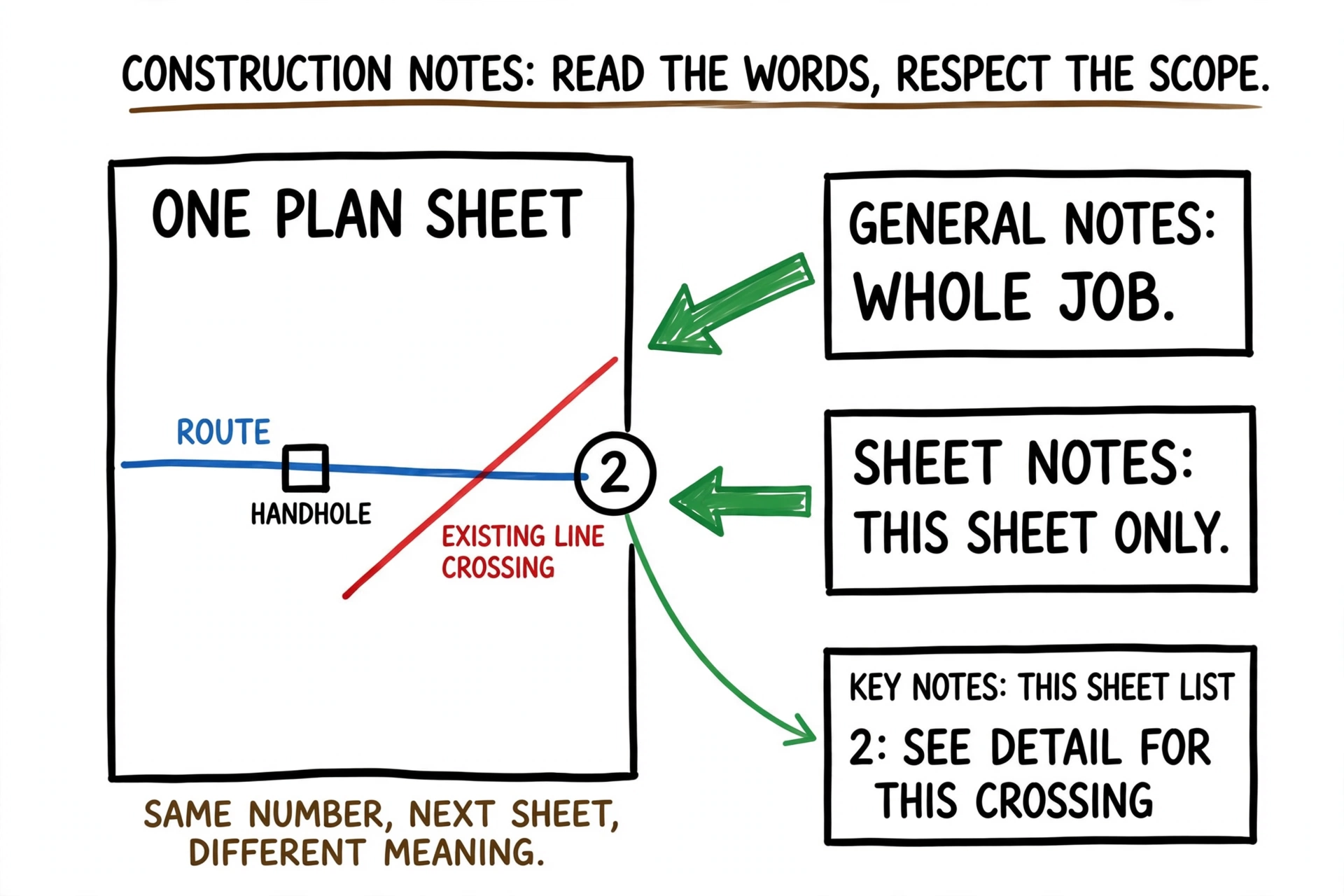
A general note applies broadly. General notes usually appear early in the set, often on a cover sheet or a dedicated general notes sheet, or in a note block on the first sheets. Plan reading guidance commonly describes general notes as applying to the entire project, across sheets and disciplines. A set may also carry general notes for one discipline or one part of the work, which apply broadly within that part. Read the heading above the note block. The heading tells you the reach of the notes under it.
A sheet note, also called a general sheet note or a sheet specific note, applies only to the sheet where it appears. Plan reading guidance describes these notes as relevant only for that sheet in the set. A condition that is true on one plan sheet may not be stated, or may be stated differently, on the next sheet. That is why each sheet’s own note block must be read, even on a long run of similar sheets.
A key note, also written as keynote, is a numbered note tied to a marker in the drawing. Instead of writing a full sentence in the middle of a crowded drawing, the designer places a small numbered marker next to the feature and lists the full text in a key note list on the same sheet. Plan reading guidance notes two cautions that matter in the field. First, key note numbers commonly start over on each sheet, so the same number on two different sheets can mean two different things. Second, a marker may appear with or without a leader arrow, depending on space. Always read the key note list that belongs to the sheet you are on, not the list from another sheet.
A local note or specific note is a short written instruction placed right next to the one feature it describes, often with a leader pointing to that feature. It applies only there. It does not travel to similar looking features elsewhere on the sheet unless the note itself says so.
These categories are common practice in plan reading teaching, not a single federal rule. Owners, designers, and state departments of transportation use their own sheet standards, headings, and numbering habits. The categories help you ask the right question, which is always the same: how far does this note reach, this sheet only, this feature only, or the whole job?
What Does It Look Like?
Picture a plan sheet for a fiber route. The drawing fills most of the sheet. Along one side, often the right side or across the top or bottom depending on the owner’s sheet layout, sits a block of numbered text under a bold heading such as GENERAL NOTES or SHEET NOTES. The text is small, dense, and easy to skip. That block is the first place to look.
General notes often look different again. In many sets they occupy their own sheet near the front, sometimes more than one sheet, with numbered notes grouped under subheadings. A Federal Highway Administration Federal Lands bridge plan checklist, for example, treats general notes and estimate as an early part of the plan set and lists specification and material topics as typical general note subjects for that kind of work. That example is a highway bridge standard, not a fiber rule. It shows the pattern: broad requirements that apply across the work are collected up front, in writing, rather than repeated on every sheet.
Sheet notes look like a shorter numbered list in a box on the sheet itself. A typical entry is one or two sentences. It may name a condition on that segment, point to a detail, or state that a drawn feature is shown for reference only. Each sheet carries its own sheet note list, so Note 3 on one sheet should not be assumed to have any connection to Note 3 on the next sheet unless the text itself creates one.
Key notes look like two linked parts. In the drawing you see small markers, often a number inside a circle or another shape, placed beside features, sometimes with a leader arrow and sometimes without one where space is tight. At the edge of the sheet you see the matching numbered list that spells out each marker in full sentences. The reader’s job is to work back and forth: find the marker, find its number in that sheet’s list, read the full text, then return to the feature.
Local notes look like a sentence or two written in open space near a feature, with a leader line running from the text to an arrowhead touching the exact line, structure, or crossing the note describes. If the leader touches a different feature than you first assumed, the leader wins. It is the designer’s pointer.
Notes also change in appearance when a sheet is revised. A changed note may be marked with a revision cloud, which is a wavy loop drawn around the changed area, and a small numbered triangle called a delta that ties the change to a revision entry in the title block. A note with a cloud around it deserves a second, slower read, because something about the requirement changed after the sheet was first issued.
What notes do not look like is also worth stating. A note is not the title block, although the title block can contain short status wording such as a preliminary or not for construction stamp. A note is not the legend, although a legend entry can include a short explanation next to a symbol. A note is not a dimension, although a note can state a requirement that no dimension on the sheet repeats. If the words impose a condition, an action, a prohibition, or a reference to follow, you are reading a note in effect, whatever the block is titled.
What Does It Do?
A construction note does five jobs that the drawn lines cannot do alone.
First, it states requirements that have no picture. A requirement to follow a named standard, to notify an owner before starting in an area, to protect a feature in place, or to restore a surface to a stated condition cannot be drawn. It can only be written. Notes are where those requirements live on the drawings.
Second, it limits or expands what a drawn feature means. A line on a plan might look like work to be built. A note may state that the line is an existing facility shown for information, or that it is future work by others, or that it is part of this contract only between two stations. Without the note, the line is easy to misread in exactly the wrong direction.
Third, it connects the sheet to the rest of the contract. Notes routinely point outward: to a specification section, to a detail on another sheet, to a standard drawing, or to a permit or owner requirement named in the set. Plan reading teaching stresses this tying function. Studying the notes is how a reader finds the right specification and the right detail instead of guessing from the picture.
Fourth, it records conditions and responsibilities. A note can state who provides a material, who verifies a location, what must happen before a step can start, or what happens if field conditions differ from what is shown. Those sentences allocate work. Missing one can mean doing work that was not yours, or skipping work that was.
Fifth, it carries the exceptions. Drawings are built from standard patterns, standard symbols, and standard details. Real routes are not standard. The creek crossing that is different, the segment where the usual method does not apply, and the structure with a special condition are almost always handled in notes. A reader who learns the standard pattern and stops there has missed the part of the set that was written specifically for this job.
A note does none of this by floating free. Its force comes from the drawing being a contract document for that job. That is also why informal words do not carry the same weight. A verbal assurance in the field does not rewrite a printed note. Only a formal change issued through the job process does that.
Where Does It Fit?
Notes fit inside a larger family of contract documents, and a good reader keeps the family straight.
At the top sits the contract itself, with its general conditions and any special conditions or special provisions written for this job. Federal Highway Administration specification review guidance describes a typical highway order in which project specific provisions sit above project plans, which sit above supplemental and standard specifications and standard plans. That is one documented highway pattern, presented here as an example only. It is not the order for every fiber job, and it must never be assumed for a job whose contract says something different.
Next come the drawings as a set. The general notes sheet or sheets sit near the front of that set. Each plan sheet, profile sheet, and detail sheet then carries its own sheet notes, key notes, and local notes. Lesson 81 covered details, the enlarged close ups of one small part of the work. Notes and details work as a pair: a note often sends you to a detail, and a detail often carries its own notes that govern only that detail.
Alongside the drawings sit the specifications. Specifications are longer, more detailed written requirements, usually organized in sections. A short note on a sheet and a long specification section can cover the same subject. They are meant to be read together as complementary parts of one contract, not as rivals to pick between without a rule.
That rule, where a contract provides one, is called the order of precedence. It is a clause in the contract that ranks the documents so a conflict can be resolved by rank instead of by opinion. A widely cited federal contracting pattern provides that, in case of a difference between drawings and specifications, the specifications govern, and that a discrepancy within the drawings or within the specifications must be submitted promptly for a written determination. Other contracts rank documents differently, and some require clarification before work on the affected part proceeds. There is no universal ranking a reader can memorize and apply to every job. The only safe general rule is this: find the order of precedence clause in the contract for the job in front of you, and if there is no clear clause or the conflict is within one document, raise it as a question through the job process, commonly by a request for information, often shortened to RFI, rather than deciding it in the field.
Notes also fit into the life of the job over time. Notes are written at design, tested at bid, when readers price what the notes require, and used again at construction, when crews and inspectors check work against them. When a question exposes a gap or an error in a note, the answer, if it changes the requirement, comes back formally as a clarification, revision, or change under that contract, and the note, not memory, is what future readers will see.
Why Does It Matter?
Notes matter because they are where cost, scope, and risk hide in plain sight.
A note can add work that no line shows. Protecting an existing facility, hand work near a crossing where a note requires it, extra restoration, and traffic control conditions are examples of the kind of requirement that commonly lives in words rather than in extra drawn lines. A bid or a work plan built from the pictures alone will miss that work, and the miss is discovered later, at the most expensive time.
A note can also remove work that a line seems to show. Work by others, future work, and reference only features are commonly identified in notes. Building something that a note assigned to someone else, or that a note excluded, wastes effort and can create damage or liability that did not need to exist.
Notes matter for inspection and acceptance as well. An inspector checks finished work against the requirements for the job. Many of those requirements are written, in the specifications and in the notes. A segment can look correct in shape and position and still fail because a written condition, such as following a referenced detail at a structure, was never read.
Most of all, notes matter because conflicts are resolved on paper, not by confidence. When a note and a drawing disagree, the person who noticed the conflict early and raised it in writing protected the job. The person who picked the version they liked and built it took a serious risk, because the federal clause at FAR 52.236-21 states that an adjustment made without a written determination from the Contracting Officer is at the contractor’s own risk and expense, and the contract for the job in front of you must be checked to see what it says about proceeding without a determination.
For a beginner, the practical translation is simple. Reading the notes is not extra credit after reading the drawing. Reading the notes is reading the drawing.
What Does Good Look Like?
A well written and well read set of notes has recognizable signs.
The note block is easy to find and clearly headed. The reader can tell at a glance whether the block in front of them is the project general notes, a discipline block, the sheet notes for this sheet, or a key note list.
Each note says one thing clearly. A good note names the feature, area, or stations it applies to, states the requirement in direct words, and points to the specification section, detail, or standard that carries the full requirement where one exists. A reader does not have to guess which structure, which crossing, or which end of the segment the note means.
Numbering is consistent inside its own scope. Key note markers in the drawing all appear in that sheet’s key note list, and every entry in the list is either used in the drawing or clearly marked as not used, according to the practice for that set. Sheet note numbers are not reused for a different meaning on the same sheet.
Notes agree with the rest of the set. The note, the drawn feature, the detail it references, and the specification section it names all tell the same story. Where a general note states the usual rule, a sheet or local note that creates an exception says so in a way the reader can connect to that rule.
Revisions are visible. Changed notes are clouded or otherwise marked under the owner’s practice, the delta ties to a revision entry, and no loose, unissued pages with handwritten replacement notes are circulating as if they were the set.
And on the reader’s side, good looks like a habit. The notes for the sheet are read before the work on that sheet is planned, key note markers are resolved to their full text every time, and conflicts are written down as questions with the sheet and note numbers attached, so the answer can be traced later.
What Can Go Wrong?
The most common failure is the simplest one. The notes are never read. A reader studies the lines, feels confident, and plans the work, while a sheet note on that very sheet changes the method, the scope, or the condition for the segment. No drawing skill protects against a requirement that was never opened.
A second failure is reading the wrong scope. A reader applies a sheet note from a previous sheet to the current sheet, where it was not repeated because it does not apply, or applies a local note written for one structure to every similar structure on the route. Scope errors run in both directions. A general note missed at the front of the set can be just as damaging, because the reader treats each sheet as if it were complete on its own.
A third failure is the key note shortcut. A reader sees marker 4 beside three features, reads the key note text once, and assumes the other sheets use marker 4 the same way. Because key note numbering commonly restarts on each sheet, that assumption silently imports the wrong requirement onto the next sheet.
A fourth failure is acting on a conflict without a determination. A note says one thing, the detail shows another, and the specification section says a third. A reader picks the one that is easiest to build. Under the federal clause at FAR 52.236-21, an adjustment made without a written determination is at the contractor’s own risk and expense, and each job contract must be checked for its own rule on proceeding in the face of a known conflict. The correct handling costs a question. The incorrect handling can cost the whole segment.
A fifth failure is trusting an outdated or unofficial copy. A note that was revised, deleted by addendum, or replaced on a reissued sheet still looks authoritative on an old print in a truck. Work built from a superseded note is work built from a document that no longer governs.
A sixth failure is treating a note as a substitute for field verification or for qualifications. A note may state that an existing facility is shown at a recorded location, or that locations must be verified before work. Reading that note does not verify anything, and it does not locate anything. Verification, locating, excavation, and other regulated or hazardous work belong to the qualified people and processes the job requires, under the applicable federal, state, and local rules and the contract. A note never expands what a reader is qualified to do.
What Should Someone Notice in the Field?
Field in this lesson means at the work site with the current set in hand, comparing paper to ground before and during planned work, within your own role. Notice these things.
First, notice whether you actually have the note pages. On site, readers often carry only the plan sheets for the day’s segment. If the general notes sheet and the sheet notes for those segments are not with you, you are carrying half the instruction. Stop and get the complete current sheets.
Second, notice scope words. Words such as all, entire, and throughout point toward a broad requirement. Words such as at this location, this structure only, or a stated station range point toward a narrow one. A single word in a note can change how much of the route the note covers.
Third, notice pointer words. Phrases such as see detail, per specification section, as shown on, and in accordance with are not filler. Each one is a direction to another document that carries part of the requirement. If you have not opened the pointed to document, you have not finished reading the note.
Fourth, notice existing facility language. Notes about existing utilities, structures, pavement, fences, trees, and surface features often carry protection, avoidance, or restoration conditions. Compare those notes with what is actually visible on the ground in front of you, and raise any mismatch, such as a visible facility that no note and no line accounts for, through the job process.
Fifth, notice revision marks around notes. A clouded note on your sheet means the requirement changed. Check the revision entry, confirm your copy matches the current issue for the job, and make sure anyone working from an older copy knows it is superseded.
Sixth, notice what the notes do not say. If a crossing, a structure, or a condition in front of you has no note, no key note marker, and no detail reference anywhere in the set, that silence is information. It means the set, as far as you can find, does not answer that point. Record it as an open question rather than filling the silence with an assumption.
Recognizing a note condition in the field is observation and communication. It is not authorization to dig, bore, cut, enter a confined space, work near energized facilities, or perform any other regulated or hazardous task. Those tasks require their own qualifications, permits, locates, and job processes, handled by the people assigned to them.
Practical Example
The following example is hypothetical. It is invented to teach the reading habit, not to describe a real job or a real company.
Hypothetical example: the note that changed one crossing. A hypothetical fiber crew is preparing a buried conduit segment along a county road. The lead, Sam, reads the plan sheet the night before and sees the route crossing an existing water line at one station, drawn the same way as two other crossings on the sheet. The picture alone suggests all three crossings are alike.
Sam then reads the sheet notes. Note 1 is a general statement for the sheet pointing to the crossing detail on another sheet. Note 2, however, names the water line crossing by station and states that this crossing follows a different detail, names that detail, and states that the existing line at this crossing is to be protected in place under a condition stated in the note. In the drawing, a small key note marker sits beside that crossing. Sam finds that number in this sheet’s key note list and confirms the full text matches Note 2’s direction. On the previous sheet, the same key note number meant something unrelated, which Sam notices only because the lists were read separately, sheet by sheet.
The reading changes the plan in three concrete ways. The crew’s preparation now includes the correct detail for this crossing instead of the usual one. The protection condition in the note is added to the work plan and briefed, instead of being discovered at the crossing. And because the note and the usual detail differ, Sam writes the difference down as a question for the project lead before the segment is scheduled, attaching the sheet number, the note number, and the two detail references, so the lead can confirm which documents govern under the contract for that job.
No ground is disturbed on the strength of this reading. Locates, verification, and the crossing work itself proceed through the normal job process, by the qualified people assigned to them. The notes did their job earlier and cheaper: they separated the one different crossing from the two routine ones, pointed to the governing detail, and surfaced a document conflict while it was still only a question on paper.
Key Terms
Construction note: a written instruction, condition, or explanation on a construction drawing, or in a note block that is part of the drawing set, that states what the lines, symbols, and dimensions do not fully show by themselves.
General note: a note that applies broadly, to the whole project or to a defined large part of it, usually collected early in the set or on a general notes sheet under a clear heading.
Sheet note: a note that applies only to the sheet where it appears. Each sheet’s note block must be read on its own, even when sheets look similar.
Key note: a numbered note tied to a small numbered marker placed in the drawing beside a feature. The full text is listed on the same sheet. Numbering commonly starts over on each sheet.
Local note: a short written instruction placed next to the one feature it describes, often connected to that feature by a leader line. It applies only there unless its text says otherwise.
Flag note: a note identified by a small shaped symbol with a number inside, placed near the feature it affects, with its full text listed elsewhere on the sheet or in the set. Usage varies by owner.
Leader line: a thin line with an arrowhead that points to an exact feature in the drawing and connects it to its note text or note number.
Specification: the written technical requirement document for a job, describing materials, methods, quality, and testing in far more detail than the drawings carry.
Order of precedence: a contract clause that ranks the contract documents so that a conflict between them can be resolved by rank. The ranking is set by each contract and is not the same on every job.
Request for information: a formal written question, often shortened to RFI, used through the job process to ask for clarification when documents are unclear, missing, or in conflict.
Revision cloud and delta: a wavy loop drawn around a changed area of a sheet, paired with a small numbered triangle that ties the change to a revision entry in the title block.
Addendum: a formal written change or addition to the contract documents, issued through the process stated for that job, that can add, delete, or rewrite notes.
Check Your Understanding
- What is a construction note, and what does it carry that lines and symbols cannot carry on their own?
- A key note marker numbered 4 appears on two different sheets. A reader reads the text for 4 on the first sheet and applies it on the second sheet without opening the second sheet’s list. What is wrong with that?
- A sheet note names one crossing by station and sends it to a different detail than the other crossings on the same sheet. How far does that note reach, and what should the reader do with the difference?
- A note and a specification section appear to conflict. What determines which one governs, and what should a field reader do instead of choosing?
- A crew member says the notes were read last week on a similar segment, so this sheet’s notes can be skipped. Name two distinct reasons that is unsafe reading.
Answer key:
- A construction note is a written instruction, condition, or explanation that is part of the drawing set. It carries requirements that have no picture: standards to follow, conditions to meet, scope limits such as work by others or reference only features, responsibilities, and pointers to details and specification sections. Lines show where and what. Notes state much of what is required about that work.
- Key note numbering commonly starts over on each sheet, so the same number can carry a completely different text on the next sheet. The reader must resolve every marker against the key note list on the sheet where the marker appears. Applying the first sheet’s text to the second sheet silently imports the wrong requirement.
- The note reaches only the crossing it names, because it identifies that crossing by station and gives it its own direction. The other crossings stay under the general direction for the sheet. The reader should follow the pointer to both details, record the difference with the sheet and note numbers, and raise it through the job process for confirmation of which documents govern before work at that crossing is planned as final.
- The contract for that job determines it, through its order of precedence clause where one exists. Rankings differ between contracts, and a widely cited federal pattern ranks specifications above drawings for a difference between them, while other contracts rank documents differently. The field reader does not choose. The reader records the conflict, checks the clause, and raises the question formally, commonly by RFI, for a written determination before proceeding on the affected work.
- First, each sheet carries its own sheet notes, and a note that applied on the earlier sheet may not apply here, while a new exception note on this sheet would be missed entirely. Second, the set may have changed: an addendum or revision can add, delete, or rewrite a note between the two readings, and only the current sheet shows it. Similar ground does not mean identical instructions.
Lesson Takeaway
A construction note is the written part of the drawing: the instructions, conditions, limits, and pointers that lines and symbols cannot show. Read the general notes for the job, then read the sheet notes, key notes, and local notes on every sheet you use, resolving each marker against the list on that same sheet and following each pointer to its detail or specification section. Respect scope. A note reaches only as far as its heading and its words say it reaches. When notes conflict with each other, with the drawing, or with the specifications, do not choose in the field. Find the order of precedence in the contract for that job and raise the conflict in writing through the job process. Reading notes well qualifies you to recognize requirements and to ask traceable questions early. It does not qualify you to resolve contract conflicts alone, to change a design, or to perform regulated or hazardous work.
Sources and Technical References
- How To Read Construction Plans Like a Pro, GoCodes: general notes apply to the entire construction project across sheets and disciplines, general sheet notes are relevant only for that sheet, and keynotes are numbered markers, usually in circles and sometimes with arrows, whose numbers start over on each sheet: https://gocodes.com/construction/how-to-read-construction-plans/
- How to Read Construction Drawings: A Practical, Field-Tested Guide, Illustrarch: general notes apply to the whole sheet or discipline, keynotes are numbered tags tied to a list on the sheet, and a keynote often relies on a general note for its installation standard: https://illustrarch.com/articles/65509-how-to-read-construction-drawings.html
- Development and Review of Specifications, Attachment 2, Federal Highway Administration: conflicting requirements may be resolved using an order of precedence clause, often found in the Control of Work section of the General Conditions, and a typical highway hierarchy places project special provisions above project plans, above supplemental specifications, above standard specifications, above standard plans, with project specific information governing over more generic information and written specifications governing over drawings in that pattern: https://www.fhwa.dot.gov/construction/specrevattach2.cfm
- Order of Precedence, Cohen Seglias, Government Contracting Database: a typical federal order of precedence clause provides that in case of a difference between drawings and specifications, the specifications shall govern, and that a discrepancy in the figures, in the drawings, or in the specifications shall be promptly submitted to the Contracting Officer for a determination in writing, with adjustment by the contractor without such a determination at the contractor’s own risk and expense: https://www.cohenseglias.com/contracting-database/order-precedence/
- What Information Governs: Order of Precedence, SJ Civil: when information conflicts between plans and specifications, the reader should seek the order of precedence section of the contract, there is no single typical order that fits every job, details usually override plans, and figured dimensions usually govern over measurements taken by scale: https://sjcivil.com/what-information-governs-order-of-precedence/
- Bridge Plan Checklist, Federal Highway Administration, Federal Lands Highway: general notes and estimate form an early part of the bridge plan set, with general note topics including design and construction specifications, materials, and utilities: https://highways.fhwa.dot.gov/sites/fhwa.dot.gov/files/docs/federal-lands/structures/12771/bridge_plan_checklist.pdf
- Drawing Markup Symbols Explained, Archi: the revision cloud encircles a changed area, the revision delta or numbered triangle ties a change to a revision table entry, and the leader or arrow points a comment at a specific spot: https://goto.archi/blog/post/drawing-markup-symbols-explained
Flagged and hedged items: No depth, clearance, separation, tension, or dimension value is stated in this lesson as a requirement for fiber work, because those values are set by the contract documents, owner standards, permits, and applicable codes for each specific job and must be verified there. The FHWA highway hierarchy and the federal specifications govern drawings pattern are documented examples from highway and federal contracting, used only to show that a ranking exists and that rankings are written into each contract. They are not presented as the ranking for any fiber job. The exact note categories, headings, marker shapes, and numbering habits for a given set are set by the owner and designer for that set and must be verified on the sheet in hand. Whether a particular owner calls a shaped marker a flag note, a key note, or something else could not be settled to one universal definition from the sources above and is therefore presented as varying by owner.
Previous lesson: Lesson 81: What Is a Detail Drawing? |
Back to Level 4 hub |
Next lesson: Lesson 83: What Is a Construction Specification?