
Introduction
Outside plant is the part of a communications network that lives outside buildings: the cables, pathways, poles, and buried access boxes that carry signals between places. It is the foundation subject of this course. Every later lesson examines one piece of it in detail, so this lesson builds the whole picture first: what outside plant is, where its boundary with inside plant falls, what its main components are, and why the quality of its construction decides whether a network serves for decades or fails expensively.
One distinction runs through everything that follows. A requirement that binds one project, because its contract or its permit says so, is not a universal rule. Telling those two apart is part of learning this trade, and it starts here.
What This Lesson Gives You
- Walk any street and point to the surface evidence of a buried network: lids, pedestals, markers, and pole lines, naming what each one is.
- Draw the exact line where outside plant ends and inside plant begins on any building you will ever work around.
- Explain in plain words how a voice or a video becomes light, travels for miles, and becomes a voice or a video again.
- Tell a project requirement apart from a universal rule the moment someone quotes you a number.
- Spot the conditions worth reporting, a missing lid or a low cable, and know exactly where your responsibility stops.
Start With the Basics
Here is an ordinary fact that is easy to miss: the internet does not live in the sky. It lives in the ground and on poles. When you send a message, watch a video, or make a call, your information travels as light through glass threads called fibers. Those fibers run for miles between towns and buildings. Glass threads thinner than a hair cannot survive lying in the open air or the dirt. They need housing. They need protection from water, crushing, sunlight, and shovels. They need a path to follow, a way to get from one place to another, and places where people can reach them to fix or extend the network later.
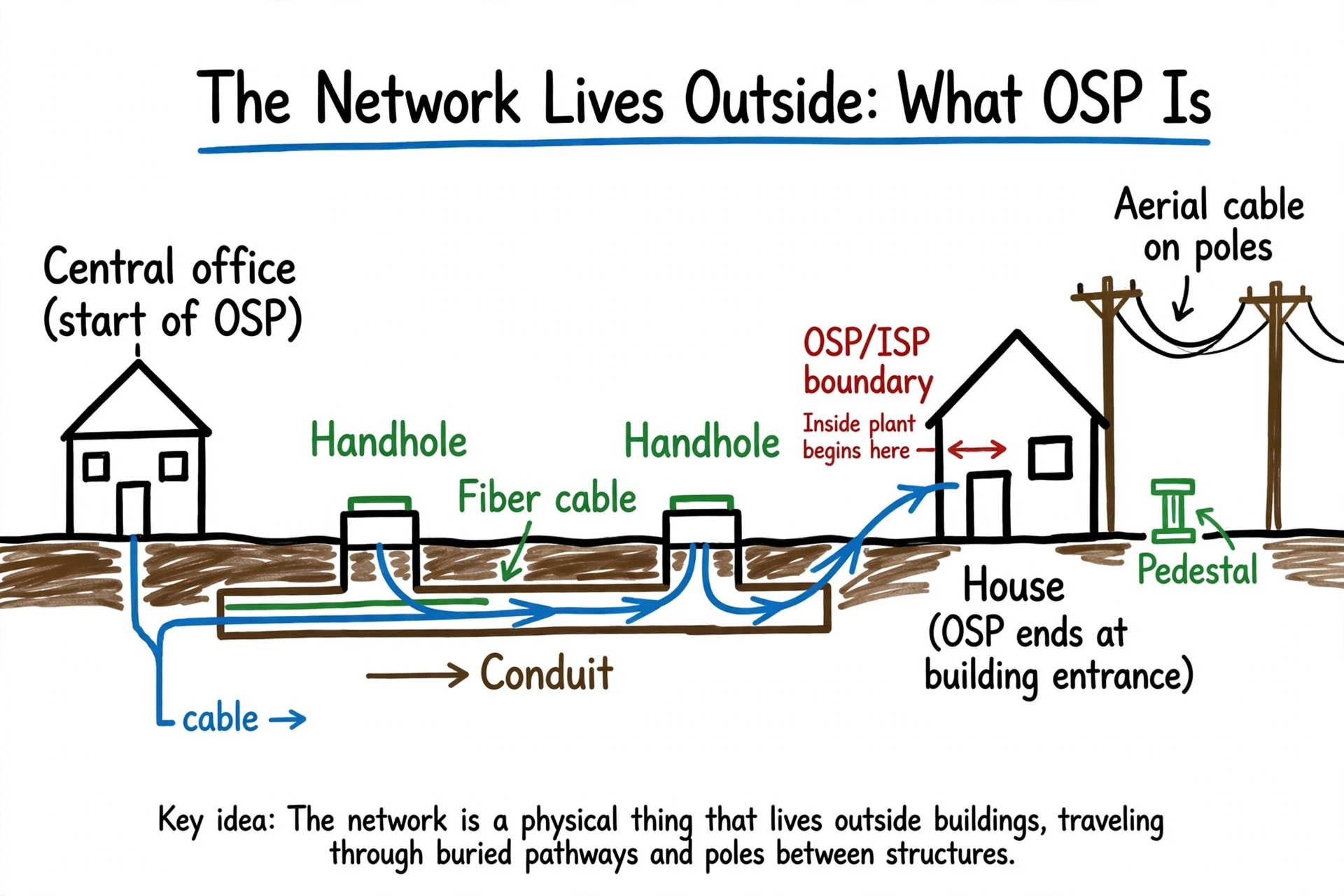
All of that housing, protection, and path is called outside plant. The word “plant” here is an old telephone-industry word meaning the physical equipment of the network. “Outside” means outside buildings. So outside plant, shortened to OSP, means everything in the network that lives outside buildings: the cables, the tubes they run through, the poles they hang from, the boxes buried at street level where workers can open them, and everything that holds it all together. Lesson 2 will go deeper into underground versus aerial construction, and lessons 3 through 5 will cover pathways, conduit, and handholes in detail. This lesson stays at the big picture.
What Is It?
Outside plant (OSP) is all of the physical network infrastructure installed outside of buildings. It is the part of a communications network that connects buildings, neighborhoods, towns, and equipment sites to each other across open ground.
Let us unpack that definition carefully, because every word does work.
Physical network infrastructure means the actual objects you could touch, not software or settings. The main pieces are:
- Fiber optic cables, the manufactured assemblies that carry the light from place to place.
- Conduit, the tubes buried underground that give cable a protected pathway.
- Handholes and manholes, buried boxes and chambers with lids at ground level, where workers can reach the cable.
- Utility poles, which carry cable through the air where burying it is not practical.
- Pedestals, small above-ground cabinets where cables terminate or connect.
- Splice closures, sealed housings where two cable ends are joined and protected.
Installed outside of buildings is the boundary line that gives the term its meaning. The network world is split in two. Everything outside buildings is outside plant. Everything inside buildings (the wiring inside an office, the equipment room where servers sit, the cable in your wall) is called inside plant (ISP). When an OSP cable reaches a building, it enters through a point called the building entrance. You will also hear it called the building entry, the entrance facility, or the point of entrance. They all mean the same thing. From there inward, it becomes ISP. As a working rule, think of the building wall as the dividing line. In real projects the handoff can sit a short distance inside the building, but for this library, outside the building is OSP and inside is ISP. Understanding this split matters because the two halves are built differently, handled by different crews, and designed to survive different conditions. OSP has to survive weather, soil, traffic, and digging equipment. Inside plant lives in climate-controlled rooms.
Connects buildings, neighborhoods, towns, and equipment sites to each other describes its job: it is the between-places network. The internet inside a building is useless if it cannot reach the next building, the next town, and the wider world. OSP is that reach.
A final note on the term itself: OSP comes from the telephone industry, where plant meant all the physical equipment of the system. You will also hear people say “OSP” when they really mean just the cable, or just the construction work. Strictly, it means the whole outside infrastructure. In this library, we use it in the strict sense.
What Does It Look Like?
This is the section that changes how you drive to work. Once you know what to look for, OSP is everywhere, and it is mostly hiding in plain sight.
The bulk of OSP is buried and invisible. What you see on the surface are the access points and the structures:
- Handhole lids: small rectangular lids flush with the ground in grass, sidewalks, or dirt. They cover handholes, the buried boxes where cables pass through and where workers can reach them. Lesson 5 covers handholes fully.
- Manholes: the larger cousins of handholes. Round or rectangular heavy lids in streets and parking lots, big enough for a person to climb down into a concrete chamber below, where large cables pass through and splices live.
- Pedestals: short square or round green or gray boxes sticking up a foot or two in yards and easements. These are small outdoor cabinets where cables terminate or connect.
- Pole lines: utility poles carrying thick black cables strung between them. Those cables may belong to the power company, the telephone company, or a fiber network, and sometimes to more than one. Fiber cable is often lashed, tied with wire, to a steel support wire on poles, appearing as a thick black bundle.
Some OSP is underwater. Submarine cable, meaning cable laid across lakes, rivers, or oceans, is also OSP. You will probably never see it, but it counts.
Materials are chosen for survival. An OSP fiber cable is built in layers, and each layer has a job:
- Glass fibers in the middle carry the light.
- Buffer tubes surround the fibers and protect them inside the cable.
- Strength members, cords or rods, carry the pulling tension during installation so the glass does not have to.
- An outer jacket of rugged plastic resists water, sunlight, and abrasion.
- Some cables add a metal armor layer under the jacket for extra protection against crushing and rodents.
The enclosures, handholes, and cabinets are made of concrete, polymer concrete, plastic, or metal, and they are sealed or covered to keep water and dirt out.
How does OSP differ from similar things? It is not the power grid, though fiber often shares poles with power lines; the systems are separate. It is not the water or gas lines buried in the same street; those carry fluids, not signals. And it is not the cable inside your office walls. The telltale signs of OSP are the access lids at ground level, the pedestals in easements, the cables on poles, and the fact that all of it forms routes between buildings rather than serving a single building.
We will not give universal dimensions here, because there are none. The size of a handhole, the diameter of a cable, and the height of a pole all depend on the design of that particular network and what the local permits and contracts require. If you ever hear a specific number for something like burial depth, treat it as a project requirement, not a law of nature. Depth and clearance rules come from the contract, the local authority, or the utility whose easement is involved, and they differ from place to place. That distinction, contract requirement versus universal rule, will come up again and again in this library, and it matters.
What Does It Do?
The function of OSP is straightforward to state and remarkable to think about: it carries signals between places.
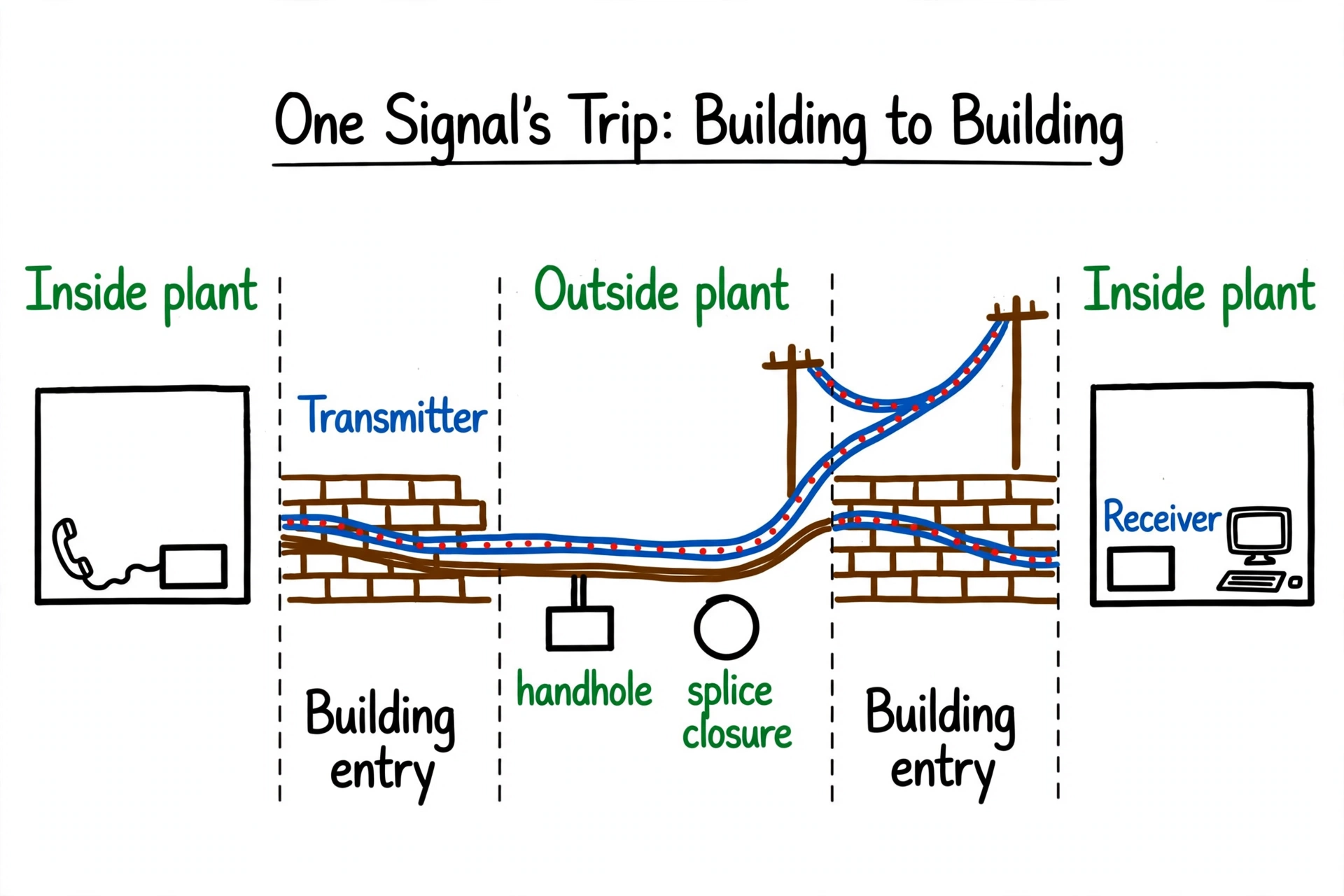
Here is how it works. Inside the fiber cables are glass fibers, each about as thin as a human hair. At one end of the fiber, equipment called a transmitter converts information (your voice, a video, a file) into pulses of light. That light travels down the glass fiber to the other end, where a receiver converts the light pulses back into information. The picture to hold in your mind is a flashlight flashed down a long hallway in Morse code, except the hallway is glass, the flashing happens billions of times per second, and almost no light escapes along the way. The fiber traps the light through a property called total internal reflection. The fiber is built as a glass core wrapped in a glass cladding layer, and where the two layers meet, light arriving at a shallow angle bounces back into the core instead of passing out through the wall. Bounce after bounce, the light stays inside for miles.
OSP’s job is to give those glass fibers a safe home for the whole trip. The network between places can run for hundreds of miles, so the cable must be protected from water, from being crushed, from freezing and heat, and from being cut by accident. Each component plays a part. The cable jacket and armor keep water and damage out. Conduit adds a second layer of protection and makes it possible to replace or add cable later without digging again. Handholes and manholes provide places to open the system: to join cable segments together, to branch off toward a new customer, or to test and repair the fiber. Joining two fiber ends together is called splicing, and the splice closures are the protective housings where splices live. Poles carry the cable through the air where burying it is not practical.
So when you look at a handhole lid or a pole line, what you are really looking at is a segment of a light highway. The light inside is carrying phone calls, internet traffic, business data, video, cell tower traffic, and emergency communications, all at once, on different fibers or different wavelengths of light in the same fiber. The wired connection from a cell tower back to the main network is called backhaul, and it is usually OSP fiber.
The great majority of OSP fiber is a type called singlemode fiber, which is designed for long distances and high capacity. The reason is simple: OSP runs are long, from a few hundred feet to hundreds of miles, and singlemode handles long distances far better than the other common type, multimode. You do not need to memorize fiber types yet. Just know that OSP cable is engineered for distance and for the outdoors, which is why it looks different from the thin patch cords inside a building.
Where Does It Fit?
OSP sits in the middle of two different sequences: the construction sequence (how it gets built) and the signal sequence (how information flows). Both are worth seeing.
In the signal sequence, the trip looks like this:
- Information starts inside a building: a home, a business, a data center, or a cell tower site.
- It leaves the building through the building entry and enters the OSP.
- The OSP carries it across town or across the country.
- It enters another building, becomes inside plant again, and reaches its destination.
A central office (an older telephone term for the building where a carrier’s switching and transmission equipment lives) or a headend (the cable industry’s equivalent) is often where long OSP routes begin. Think of OSP as the roads and ISP as the driveways and parking lots. The roads do the long-haul work; the driveways finish the trip. The analogy holds because it matches the mechanism: capacity and distance live in the road system, while the final short connection to each building is a separate, simpler piece of work.
In the construction sequence, OSP is typically built in this order:
- Design and permitting. Engineers plan the route, and the builder gets permission from whoever controls the land: a city, a county, a state highway department, a railroad, or a private landowner granting an easement, a legal right to use part of their land for the line.
- Pathway construction. Crews trench or bore to place conduit underground, or set poles and string cable for aerial routes.
- Cable placement. Cable is placed into the pathway.
- Splicing. Fibers are spliced at handholes, manholes, and cabinets.
- Testing and acceptance. The owner verifies the build meets the contract before the network is accepted.
Testing and acceptance is a major theme of later lessons, and inspection of the work at each stage is what makes the network reliable for decades.
OSP also interacts with a crowded underground and overhead world. A buried route shares the ground with power lines, gas lines, water mains, and sewers. An aerial route shares poles with electric utilities. That is why route planning, permits, and locating existing utilities before digging are such a large part of OSP work. Cutting someone else’s line is expensive and dangerous, and avoiding it is a core skill of the trade.
What Is at Stake
OSP matters because it is the foundation everything else stands on, and foundations are unforgiving. A software bug can be patched overnight. A poorly built buried cable route causes problems for thirty years.
Construction quality decides the next thirty years. OSP is built once and expected to last for decades, much of it buried where nobody can see it. If the cable is kinked or crushed during installation, if water gets into a splice closure, if a handhole is set where it floods every spring, the damage often does not show up immediately. It shows up years later as intermittent outages, degraded signals, and emergency repairs that cost far more than doing it right the first time. This is why inspection during construction, the subject of much of this library, exists: to catch problems while they are still cheap to fix.
Operations depend on records and access. Network operators need to know exactly where every cable runs, how deep it is, and where the access points are. When a new customer needs service, the operator extends from the nearest access point. When a fiber breaks, crews need to find the break fast. Good records (maps of the route, called as-builts because they show what was actually built rather than what was planned) and well-placed, well-marked access points are what make a network operable. A network nobody can find on a map is a network nobody can fix quickly.
Reliability is the quiet payoff. The internet feels instant and always-on because OSP is engineered with margin: extra protection, redundant routes in important corridors, and sealed components that keep water out for decades. When OSP is built well, nobody thinks about it. When it is built poorly, whole neighborhoods lose service, and the repair involves digging up a street.
Cost runs in both directions. Building OSP is expensive. Trenching, boring, poles, permits, and crews add up fast, which is why route design tries to be efficient. Repairing OSP is also expensive, and emergency repair is the most expensive of all: overtime crews, traffic control, digging in the wrong season, angry customers. The economics of OSP consistently favor building it right the first time and maintaining it on a plan rather than waiting for failures. This is arithmetic that drives every serious network owner’s decisions, not motivational advice.
The plant is shared, public-facing, and long-lived. OSP runs through public rights-of-way (the strips of land along roads reserved for utilities and public use), it shares poles with electric service, and it crosses property the builder does not own. Sloppy work inconveniences the public and damages the builder’s reputation with the very cities and utilities whose permission is needed for the next project. In a small industry, reputation travels.
What Does Good Look Like?
Good OSP is mostly invisible and boring, and that is the point. At a general level, a properly built plant shows these observable conditions:
- The route follows the planned path, stays within the permitted easement or right-of-way, and avoids unnecessary crossings and sharp turns.
- Cables enter and exit handholes and buildings in an orderly way, with enough slack (extra coiled cable) left at access points so future splicing and repair are possible without stretching the fiber.
- Buried cable and conduit sit below the disturbance zone, at whatever depth the project requires, and are marked with warning tape or tracer wire (a thin wire buried alongside non-metallic conduit so the route can be found later with locating equipment) where the design calls for it.
- Splice closures are sealed. Handhole lids sit flush and are not broken or missing.
- Aerial cable has proper sag (not guitar-string tight, not dragging) and proper clearance above roads and driveways per the applicable codes and agreements.
- Records exist: as-built drawings show the real route, and access points are labeled or at least locatable, so someone who was not on the original crew can find the plant and work on it.
- The plant is maintainable: handholes are accessible (not paved over, not buried under landscaping), closures can be opened and resealed, and there is capacity (spare conduit space or spare fibers) for growth where the design intended it.
Now the distinction this library will repeat often: general good practice is not the same as contract acceptance criteria. Everything above describes what good OSP looks like in general. Whether a particular build is accepted is decided by the contract documents for that project: the specifications, the drawings, the permit conditions, and the owner’s standards. A contract might require a specific burial depth, a specific testing procedure, or a specific brand of closure. Those are binding for that project, but they are not universal laws. Never assume a requirement from one project applies to another. When in doubt, the contract governs.
From the Field
Picture a crew placing handholes on a new buried fiber build along a residential street. The conduit is in, the work is moving at a good pace, and the crew is setting boxes at the locations shown on the design drawing, one after another.
At one location, the open excavation tells a different story. An existing water service line crosses the ground exactly where the handhole belongs, and it was not among the utilities marked on the surface. Setting the box on top of it would crowd both utilities into the same small space and make every future repair on either one harder.
The crew does the right construction work. They shift the handhole a short distance along the run to clear ground, set it level, coil the cable slack inside with room to spare, and seat the lid flush. Anyone walking past would call it a clean installation, because it is one.
Then comes the decision point, and it is a quiet one. The day is ending. The design drawing shows the planned location; the ground now holds a different one. Updating the as-built record takes a tape measure, a notebook, and a few minutes. The crew lead looks at the lid sitting at grade in plain sight and decides the update can wait. It never happens. The drawing goes back to the office showing the plan, and the plan is wrong.
Time does its work. A later street resurfacing passes over that stretch of road, and the lid, sitting a touch low at the pavement edge, disappears under fresh asphalt and a creep of soil. The plant itself is unharmed. The knowledge of where it sits is gone.
Years later, service to the block fails, and a repair crew rolls out with the as-built in hand. They dig where the record says the box is, and they find clean dirt. Every hour spent hunting the real location, potholing along the route until someone exposes the buried lid at the pavement edge, is an hour the customers on that street stay down, and none of that cost came from bad construction. It came from a record that described the plan instead of the ground.
Carry this rule: when the ground changes the plan, the record changes the same day. Buried plant is invisible by design, so the record is the only version of the network the next crew will ever meet.
What Can Go Wrong?
Problems in OSP fall into a few honest categories. None of this is meant to frighten you. It is meant to show you why the details in later lessons exist.
- Damage during construction. Fiber cable can be kinked, crushed, or pulled too hard while it is being placed. A kinked fiber may still pass light, but it leaks signal at the bend, and the damage can worsen over time. Trenching equipment can nick the cable jacket, letting water in. Directional boring can go off course and strike the cable or someone else’s utility. These are installation failures, and they are why handling rules and inspection exist.
- Water intrusion. Water is the slow enemy. It enters through unsealed closures, nicked jackets, cracked handholes, and flooded access points. Water does not usually kill a fiber immediately. It degrades splices, corrodes metal parts, and freezes and thaws, working damage wider over seasons and years. A network can run for years with water inside it and then fail in a storm.
- Third-party damage. Someone digs without locating utilities first and cuts the cable. A car hits a pole. A farmer deep-rips a field over a buried route. Damage reporting collected by the Common Ground Alliance through its DIRT program shows excavation damage as a leading cause of damage to buried utilities. In the Alliance’s 2023 DIRT Report, telecommunications facilities accounted for nearly half of all reported damages, the largest share of any facility type. This is why marking, locating, warning tape, and accurate records matter: they are the plant’s defenses against the rest of the world.
- Design and documentation failures. A route with no slack at access points cannot be repaired without replacing long sections. A handhole paved over by a later road project becomes unreachable. As-builts that were never drawn mean the next crew digs blind. These are failures of planning and follow-through, and they compound over the life of the network.
- Neglect. Closures that are opened for maintenance and not resealed properly. Lids that go missing and are never replaced, letting a handhole fill with soil and trash. Vegetation that grows through an aerial line’s clearance. Small unattended problems become large expensive ones on a timetable measured in years, which is exactly why maintenance is a planned activity rather than a reaction.
The consequence pattern is consistent: OSP failures are expensive to fix relative to what prevention would have cost, they interrupt service for real customers, and emergency repairs are disruptive to the public. That pattern is the business case for everything this library teaches.
What Should Someone Notice in the Field?
You do not need to be a technician to start reading the landscape. None of these checks ask you to touch anything, open anything, or climb anything. Looking is the skill at this stage.
- Notice the lids. As you walk or drive through neighborhoods and commercial areas, look for rectangular lids flush with the ground in grass strips, sidewalks, and dirt areas near roads. Many are marked with a company name or a generic word like “communications” or “fiber.” Each one is an access point to buried OSP. Ask yourself: is the lid intact and sitting level, or is it cracked, tilted, or missing? A missing or broken lid is worth reporting to whoever is responsible, because an open handhole fills with debris and becomes a hazard.
- Notice the pedestals. Short green, gray, or beige boxes on a post or stub in yards and easements, usually a foot or two tall. These are above-ground access points. Notice whether the cover is in place and undamaged.
- Notice the poles. Look up at utility poles and find the cables. Power lines are typically at the very top. Communications cables, including fiber, usually ride lower, often as a thick black bundle lashed to a thinner steel wire. Notice the sag between poles and whether any cable looks abnormally low, especially over driveways and roads. Do not touch poles, guy wires, or anything attached to them. Anything involving poles and overhead lines can involve high voltage nearby, and recognizing a low cable is not the same as being qualified to do anything about it. Report it; do not fix it.
- Notice the markings. Small flags, paint marks on pavement, or small posts with plates often mark buried utility routes. These are left by locating crews. They tell you OSP is nearby underground even when you cannot see it.
- Notice the work zones. When you see a crew trenching, boring, or pulling cable, you are watching OSP being built. Notice the warning tape going into the trench (usually bright orange for communications cable, marked with warnings), the conduit being placed, and the handholes being set. Watching real construction with the vocabulary from this lesson is one of the fastest ways to learn.
- Respect the boundary. Recognizing a condition is not the same as being qualified to perform work. Seeing a damaged lid, a low cable, or an open trench makes you observant, not authorized. Underground work involves struck-utility hazards, trench collapse, and traffic. Overhead work involves electricity. Entering manholes involves confined-space hazards. Never enter a manhole, open a closure, or handle cable because a lesson described it. Those tasks require training, qualification, and authorization. Your job at this stage is eyes, not hands.
Key Terms
Outside plant (OSP): All of the physical network infrastructure installed outside of buildings. The cables, pathways, poles, enclosures, and access points that carry signals between buildings and sites.
Inside plant (ISP): The counterpart to OSP: all network infrastructure inside buildings, such as indoor cabling, equipment rooms, racks, and patch panels. OSP ends and ISP begins at the building entrance.
Plant: An old telephone-industry word for the physical equipment of the network. It survives in “outside plant” and “inside plant.”
Fiber (optical fiber): A thin strand of glass that carries information as pulses of light. Many fibers are bundled together inside a fiber optic cable.
Fiber optic cable: The manufactured assembly that protects glass fibers for real-world use: fibers inside buffer tubes, strength members, and a rugged outer jacket, sometimes with armor.
Transmitter and receiver: The equipment at each end of a fiber. The transmitter converts information into light pulses; the receiver converts light pulses back into information.
Splice (splicing): Joining two fiber ends together to make one continuous light path. Splices live inside protective housings called splice closures.
Splice closure: A sealed protective housing where fiber splices are organized and protected from water, dirt, and damage.
Conduit: A tube, usually plastic, buried underground (or placed in other locations) through which cable is pulled or blown. It protects the cable and allows future cable replacement without digging again. Lesson 4 covers conduit in detail.
Handhole: A small buried box with a removable lid at ground level, providing access to underground cable for splicing, branching, or testing. Lesson 5 covers handholes in detail.
Manhole: A larger underground chamber, big enough for a person to enter, where major cable routes pass through and splices are housed. Entered only by trained, authorized workers under confined-space procedures.
Pedestal: A small above-ground cabinet, usually a foot or two tall, where buried cable comes up for connections and access.
Aerial: Cable installed above ground, typically strung on utility poles. One of the four OSP placement categories.
Underground: Cable placed in conduit buried in the ground. One of the four OSP placement categories. (Lesson 2 covers all four categories in detail.)
Direct buried: Cable placed directly in the ground without conduit. One of the four OSP placement categories.
Submarine: Cable placed underwater, in lakes, rivers, or oceans. One of the four OSP placement categories.
Central office: A building where a carrier houses switching and transmission equipment; often the starting point of OSP routes.
Backhaul: The network connection that carries traffic from a remote site (such as a cell tower) back to the main network. Usually built as OSP fiber.
Right-of-way: A strip of land along roads (or other corridors) reserved for public use, including utilities. Much OSP is built in rights-of-way with permission.
Easement: A legal right to use part of someone else’s land for a specific purpose, such as running a cable across it.
As-built: A drawing or record showing what was actually constructed, as opposed to what was originally planned. The as-builts are what future crews rely on.
Building entry: The point where an OSP cable enters a building. The boundary between outside plant and inside plant.
Check Your Understanding
- A fiber cable runs from a utility pole outside, through the wall of an office building, to a rack of equipment in the server room. Which part of that run is OSP and which part is ISP, and where exactly is the dividing line?
- You are driving through a neighborhood and you see a rectangular lid flush with the grass near the sidewalk, marked with a company’s name. What is that lid most likely covering, and why would a network need such access points every so often along a buried route?
- A project manager says, “The contract requires 36 inches of cover on this route, so that must be the legal minimum everywhere.” What is wrong with that reasoning?
- In From the Field, the handhole was set level, the slack was coiled with room to spare, and the lid sat flush. The construction work itself was good. What actually failed, and what single end-of-day action would have prevented the repair crew’s wasted digging years later?
- You notice a utility pole where a thick black communications cable is hanging noticeably lower than the others, dipping close to a driveway. What should you do, and what should you not do?
Answer Key
- The OSP is everything outside the building: the cable on the pole and the run up to the building wall. The ISP is everything inside: the cable from the wall inward to the server room rack. The dividing line is the building entrance (also called the building entry), the point where the cable enters the building.
- The lid is most likely covering a handhole, a buried access box. Buried cable cannot be reached once the ground is closed over it, so the network needs access points at intervals for splicing cable segments together, branching off to new customers, testing fibers, and making repairs. Without them, any future work would require digging blindly.
- A contract requirement is binding for that project only. It is not a universal legal minimum. Depth requirements come from contracts, permits, local authorities, or the standards of whoever controls the land, and they differ from place to place. Assuming one project’s number applies everywhere is exactly the kind of error this library warns against.
- The record failed. The as-built kept showing the planned handhole location after the crew moved the box to clear an unmarked water service, so the drawing described the plan instead of the ground. The action: measure and record the handhole’s actual location and update the as-built the same day the change was made. Buried plant is invisible by design, so future crews find the network through its records; a few minutes of documentation on build day is what keeps a repair crew from digging empty holes years later.
- Do: report it to the cable owner or the local utility, noting the location. Do not: touch the cable, the pole, or any guy wires, and do not attempt to move or fix it. Recognizing a low cable is not the same as being qualified to work around overhead lines, where high voltage may be present nearby.
Lesson Takeaway
A street will never look empty to you again. The lids in the grass, the pedestals in the easements, and the black bundles on the poles are one connected plant, built once to serve for decades, invisible by design and findable only as well as it was recorded. Two rules now travel with you. A requirement quoted from one project is not a law for the next one. Seeing a problem never makes you the person qualified to fix it. Everything after this lesson is that plant, taken piece by piece.
Sources and Technical References
- Fiber Optic Association (FOA), “OSP Fiber Optics: Basic Overview” (thefoa.org): defines outside plant as fiber optics used in telephone networks, CATV, metropolitan networks, and utilities, most of it outside buildings, hung from poles, buried underground, pulled through conduit, or submerged underwater, running from a few hundred feet to hundreds of miles; notes virtually all of it is singlemode fiber. https://thefoa.org/tech/ref/OSP/basics.html
- Fiber Optic Association (FOA), “Fiber Optic Jargon: Illustrated” (foa.org): lists the four general OSP installation categories: underground (in conduit, often with innerduct), direct buried, aerial (on utility poles), and submarine. https://FOA.org/tech/ref/OSP/jargon.html
- Fiber Optic Association (FOA), “Total Internal Reflection In Optical Fiber” (foa.org): explains that an optical fiber is a light-carrying core surrounded by a cladding, and that the cladding traps light in the core through total internal reflection, a result of the different glass types and indices of refraction in the core and cladding. This backs the core-and-cladding mechanism described in “What Does It Do?” https://www.foa.org/tech/ref/basic/total_internal_reflection.html
- Common Ground Alliance (CGA), 2024 DIRT Report announcement: CGA’s Damage Information Reporting Tool (DIRT) collects damage reports for buried utilities across the U.S. and Canada; the announcement states that excavation work around buried infrastructure is a leading cause of damage to buried power, water, internet, and natural gas lines, and reports failure to notify 811 as the top damage root cause. The facility-share figure in this lesson is from CGA’s 2023 DIRT Report, in which telecommunications facilities accounted for nearly half of all reported damages, the largest share of any facility type. DIRT reports and data: https://dirt.commongroundalliance.com
- IQGeo, “Exploring OSP: A Guide to Outside Plant Fiber Optic Networks”: describes the FTTP network path from central office through distribution cabling and midspan nodes (splitter locations in cabinets or manholes) to drop cables and the optical termination point at the building. https://www.iqgeo.com/blog/exploring-osp-a-guide-to-outside-plant-fiber-optic-networks
- VETRO FiberMap, “OSP Meaning in Business: Definition, Uses & Examples”: defines OSP as the entirety of the external physical infrastructure of a network, everything outside the walls of central offices, data centers, and customer premises. https://vetrofibermap.com/osp-defined-meaning-outside-service-plant
- Project Sports / industry reference on outside plant cable: notes that per BICSI, OSP is any network infrastructure installed external to buildings; that most OSP installations use singlemode fiber; and that loose-tube cable is the most commonly deployed outdoor cable design. https://projectsports.nl/en/what-is-outside-plant-fiber-optic-cable/
← Previous: Level 1: See the OSP Network | Level 1 Hub | Next: Lesson 2: Underground vs. Aerial →