
Introduction
An environmental controls readiness check is a deliberate review, done before ground is disturbed, that confirms the erosion controls, sediment controls, pollution prevention items, and protected area markings required by the permit and the plan are installed, in working condition, and in the places those documents show. The check compares the ground against the paper: the permit, the Stormwater Pollution Prevention Plan where one applies, the erosion control sheet in the plan set, and any protected area boundaries from the project documents.
Level 7 prepares a jobsite before construction starts. Lesson 111 taught environmental constraints, meaning the conditions on a site that limit where, how, or when work can happen. This lesson is the readiness step that follows from those constraints. A crew can have prints, permits, locates, materials, and traffic control ready and still be unready to open ground, because the controls that keep soil, wash water, fuel, and waste out of water were never installed.
What This Lesson Gives You
- Walk a segment before disturbance and confirm each control named in the permit and plan is installed where the plan shows it.
- Judge whether silt fence, inlet protection, a stabilized entrance, and a concrete washout area are in working condition or only present in name.
- Confirm protected areas are flagged or fenced to match the plan, and confirm spoil, staging, fueling, and parking sit outside those areas.
- Check that spill materials, waste containers, and washout arrangements are on site and usable before the work that needs them begins.
- State the hold decision plainly when a required control is missing or failed, and name what must be fixed before ground opens.
Start With the Basics
Think about setting up a paint job in a finished room. The painter tapes the trim, lays drop cloths, and opens a window before the first can opens. The protection goes down first because paint is easy to keep off a floor while the cloth is flat and much harder to remove after a spill has spread. The order is the whole point. Protection installed after the work starts protects nothing during the part that mattered.
Environmental controls work through the same order. Erosion is the loosening and movement of soil by water or wind. Sediment is soil particles carried in runoff. Once a trench or bore pit opens bare soil and rain moves that soil, a control installed later can only catch part of what remains. A control installed before disturbance is already in place when the first loose soil and the first rain meet. The readiness check exists to prove that order happened on this segment, in the field, before equipment opens ground.
What Is It?
An environmental controls readiness check is a comparison with a verdict, run segment by segment against the governing documents for that job. The segment is ready only when each item below has a clear yes backed by something a second person could verify in the field.
The governing documents. The permit is the written authorization for the work, with conditions the project must follow. Where a project is covered by a construction stormwater permit, a Stormwater Pollution Prevention Plan, called a SWPPP, is a site specific written plan that identifies potential sources of pollution and describes the controls, inspections, and maintenance the project will use. The U.S. Environmental Protection Agency, called EPA, issues its Construction General Permit, called the CGP, for stormwater discharges from construction activity in areas where EPA is the permitting authority under the National Pollutant Discharge Elimination System, called NPDES. Authorized states issue their own construction stormwater permits. The permit and plan for the job control the details on any given site.
Erosion controls. An erosion control is a practice that protects bare soil itself, so rain strikes cover instead of loose dirt. Common examples named in SWPPPs and erosion control plans include mulch, temporary seeding, and rolled cover products where the plan calls for them. Stabilization is the act of covering or treating disturbed soil so it resists erosion. Under 40 CFR 450.21 and Part 2.2.14 of the 2022 Construction General Permit, operators initiate stabilization immediately when earth disturbing activity on a portion of the site has permanently ceased, or has temporarily ceased and will be inactive for 14 or more calendar days, and complete it within the deadline the permit sets. The readiness check applies that idea before work starts by confirming how areas that will sit open will be stabilized under the plan for this job.
Sediment controls. A sediment control is a barrier or trap that slows runoff and captures soil particles before runoff leaves the disturbed area or reaches a drain or water body. Sediment controls do a different job from erosion controls. Erosion controls keep soil in place. Sediment controls catch soil that has already moved.
Best management practices. Best management practices, called BMPs, are the scheduled activities, controls, and methods used to prevent or reduce pollution. On a fiber job, the BMPs a readiness check usually covers include:
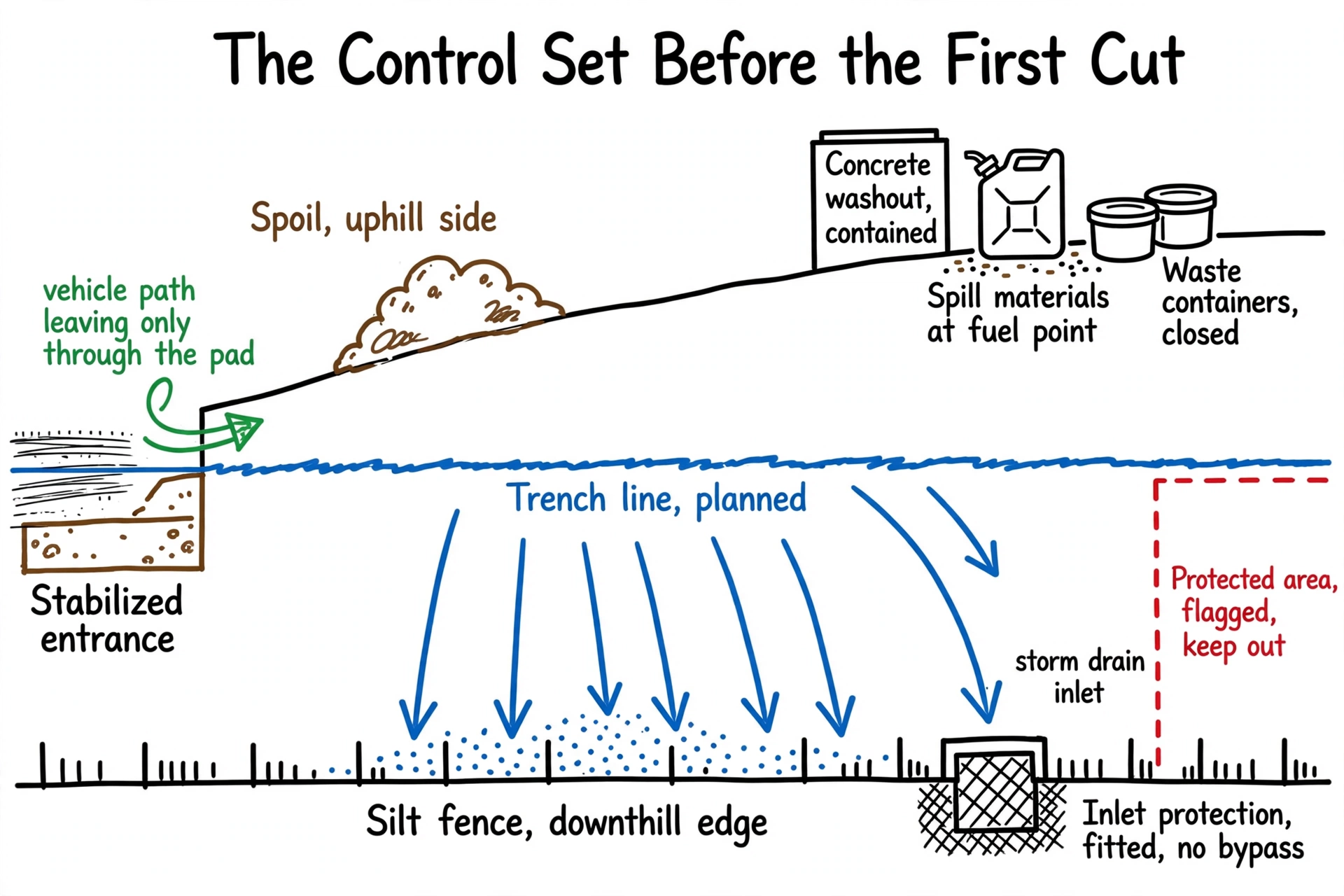
- Silt fence, a temporary barrier of filter fabric supported by posts, installed along the downhill edge of a disturbed area to slow shallow sheet flow, pond runoff briefly, and let sediment settle out before water passes.
- Inlet protection, a filter or barrier placed at a storm drain inlet so sediment laden runoff is filtered before it enters the storm drain system.
- A stabilized construction entrance, a pad of stone or a similar surface at the point where vehicles leave the site, built to knock soil from tires and reduce track out, meaning soil carried by tires onto a public road.
- A concrete washout area or container, a designated contained location where concrete truck chutes and tools are washed so wash water stays in the containment instead of reaching soil, a drain, or water.
- Check dams, wattles, and sediment traps where the plan calls for them in a ditch or swale, to slow concentrated flow and capture sediment.
Pollution prevention items. Controls cover more than soil. The 2022 CGP pollution prevention requirements in Part 2.3 call for minimizing exposure of building materials, construction wastes, trash, and other site materials to precipitation and stormwater, and for minimizing discharges from spills and leaks through spill prevention and response procedures. A readiness check therefore also covers:
- Covered or contained storage for fuel and chemicals, with spill response materials on site, meaning absorbent pads, booms, granular absorbent, and a container for used material, matched to the products the plan requires.
- Waste containers that are present, closed or covered as the plan requires, and placed away from drainage paths and inlets.
- A designated washout arrangement in place before any concrete work that will need it.
Protected area markings. A protected area is ground the plan or permit places off limits or under special conditions, such as a wetland boundary, a water body buffer, habitat, or a no disturbance area from Lesson 111. Flagging is the colored tape, fencing, or signs placed in the field to mark that boundary where the plan shows it. The readiness check confirms the field marking matches the plan before work starts nearby.
The timing rule. The 2022 CGP, Part 2.1.3, requires operators covered by that permit to complete installation of stormwater controls by the time each phase of construction activity begins. The field meaning is direct: controls for a phase go in before that phase disturbs ground. A control scheduled for later in the week does not make today ready.
What Does It Look Like?
A beginner can follow a readiness check by watching for visible parts:
- The permit, the SWPPP or erosion control plan where one applies, and the plan sheet showing control locations sit open, and the checker works from those documents rather than from memory.
- Silt fence runs along the downhill edge of the area to be disturbed, on a level line, with the bottom of the fabric secured in the ground and posts supporting the fabric. The fence stands upright, with no torn sections, no gaps at the ends, and no sediment already filling it to the top.
- Inlet protection sits at each storm drain inlet that receives runoff from the work area, fitted to that inlet type, with no open gap where runoff can bypass the filter and enter the drain directly.
- The stabilized entrance sits at the actual exit vehicles will use, with a clean stone surface that still shakes soil from tires. Stone pressed flat and packed with mud has lost that function.
- The concrete washout area or container sits in its designated place, signed or marked as the plan requires, with capacity remaining and no sign of wash water escaping onto soil.
- Spill materials sit where fueling and equipment work will happen, complete and reachable, with an empty or partly filled disposal container ready for used absorbent.
- Waste containers sit closed, in their designated place, away from inlets and drainage paths.
- Flagging, fencing, or signs mark each protected area boundary to match the plan, continuous enough that a crew member can see where the limit runs without guessing.
- Spoil areas, staging, fueling, and parking sit outside flagged boundaries and uphill controls sit between those areas and any drain, ditch, or water the runoff would reach.
What Does It Do?
Silt fence slows water so soil drops out. Runoff moving as a shallow sheet reaches the fabric, ponds briefly behind it, and loses speed. Sediment settles in the ponded water while filtered water passes through the fabric. Flow around the ends or under the toe is a failure to correct, not a working path. The mechanism fails when flow concentrates. Silt fence is a sheet flow control. A ditch stream aimed at a fence will undermine, overtop, or knock the fence down, which is why plans pair ditches with check dams or other controls suited to concentrated flow.
Inlet protection is the last filter before the drain. Soil that escapes the disturbed area still has to pass the inlet to reach the storm system and the water beyond it. A fitted inlet device filters that runoff at the entry point. A device that is clogged, torn, or bypassed leaves the drain open, and the rest of the control system has no second chance at that water.
A stabilized entrance breaks the tire path. Tires pick up wet soil in the work area and carry it to pavement, where rain later washes it to a drain. A rough stone pad flexes tires and knocks soil loose inside the site, where controls can catch it. The pad works only while the stone stays clean and rough, so readiness includes the condition of the stone.
Washout containment keeps a strong pollutant in one place. Concrete wash water is alkaline and carries fine cement solids. Part 1.3.1 of the 2022 CGP prohibits discharge of wastewater from washout of concrete unless the washout is managed by an appropriate control, and Part 2.3.4 describes that control: a leak-proof container or leak-proof lined pit, with no discharge to soil, drains, or water. A designated contained washout gives the truck a legal place to clean chutes, so wash water never becomes runoff.
Spill materials shorten the path from leak to containment. A hydraulic leak or a fuel spill spreads with time and with rain. Absorbent placed at the work area, with people who know where it sits, lets the crew surround and soak up material before runoff carries it. Materials locked in a distant trailer fail the readiness test in practice, even when an inventory list shows them as purchased.
Flagging turns a paper boundary into a field decision. A delineated wetland edge or a buffer line exists on a drawing. Flagging places that same line on the ground, where an operator choosing a pit location or a spoil spot can see it and stay outside it. Without the field mark, each crew member guesses the boundary from memory, and guesses drift toward convenience.
The check itself moves discovery to the cheapest moment. A missing fence run found during the check costs an installation task before work starts. The same gap found after a storm, with sediment in a ditch and a trench already open, costs cleanup, repair, a possible permit problem, and a record that shows the control was absent when disturbance began.
Where Does It Fit?
The readiness check sits at the end of jobsite preparation and at the start of each new phase or segment:
- During planning, Lesson 111 identified the environmental constraints on the route, and the permit process turned those constraints into written conditions, controls, and boundaries.
- During design, the erosion control plan and the SWPPP where one applies placed each control on a sheet, set the installation order, and named inspection and maintenance duties.
- In Level 7, earlier readiness lessons confirmed prints, permits, locates, verified utilities, materials, and equipment. This lesson confirms the environmental layer of the same preparation.
- Immediately before ground disturbance in a segment, the readiness check walks that segment against the documents and returns a verdict: ready, or held until a named control is installed or repaired.
- During construction, controls get inspected and maintained under the permit and plan. For sites covered by the 2022 CGP, Part 4.2 requires inspection at least once every seven calendar days, or once every fourteen calendar days and within twenty four hours of a storm event that produces 0.25 inches or more of rain within a twenty four hour period, or of a discharge caused by snowmelt from a storm producing 3.25 inches or more of snow within twenty four hours. Part 4.3 raises the frequency for portions of a site discharging to certain sensitive waters, and Part 4.4 allows defined reductions. State permits set their own schedules, and the schedule in the permit for the job controls.
- At restoration, disturbed areas are stabilized as the permit and contract require, and temporary controls are removed only when the plan allows that step. Level 23 covers restoration in depth.
What Is at Stake
Water quality. Sediment is a pollutant in stormwater. Uncontrolled runoff from a fiber segment can carry soil, wash water, fuel, and waste to a ditch, a storm drain, a stream, or a wetland in a single rain. Controls installed before disturbance are the barrier that keeps a routine rain from becoming a discharge.
Permit compliance and enforcement. Working without required controls, or starting a phase before its controls are complete, can violate the stormwater permit for the project. Consequences can include corrective action orders, stop work direction in the affected area, enforcement by the permitting authority, and a compliance record that follows the operator to later jobs. The permit for the job states the duties and the authority that enforces them.
Schedule. A hold before disturbance costs hours. A failure after disturbance can cost days, because cleanup, control repair, agency communication, and reinspection all have to happen before the same ground can be worked again with confidence. Starting without controls trades a short delay now for a longer and less predictable delay later.
Cost. Installing fence, inlet devices, entrance stone, and a washout before work starts is planned work at planned prices. Emergency installation after a rain, sediment cleanup in a ditch or drain, and replacement of a contaminated spoil handling process all arrive as unplanned work, often with the crew and equipment already committed.
Neighbor and landowner trust. Mud tracked onto a public road, cloudy water in a ditch, and trash blowing from an open container are the parts of a fiber job the public sees first. A site that starts with controls in place reads as a controlled job. A site that starts bare reads as a careless one, and that impression shapes complaints, inspections, and access for the rest of the build.
Worker direction. A clear readiness verdict protects the crew as well as the water. Crew members should never have to guess whether starting is allowed, where spoil may go, or where a truck may wash out. The check answers those questions before the first decision is needed under time pressure.
What Does Good Look Like?
- Every control named for the segment in the permit, the SWPPP where one applies, and the erosion control sheet is installed in the location the plan shows, before any ground in that segment is disturbed.
- Silt fence stands upright on its line, with the fabric toe secured, no tears or gaps, and room to capture sediment.
- Each inlet receiving runoff from the work area has fitted protection with no bypass gap, and the device has capacity remaining.
- The stabilized entrance at the working exit has clean, rough stone, and vehicles actually use that exit.
- The concrete washout arrangement is designated, contained, and ready before concrete work begins, with capacity for the planned pours.
- Spill materials matched to the plan are staged where fueling and equipment work will occur, and the disposal container for used material is in place.
- Waste containers are present, closed or covered as the plan requires, and placed away from inlets and drainage paths.
- Protected area flagging or fencing matches the plan boundary, reads clearly along its full length, and spoil, staging, fueling, and parking all sit outside it.
- The person who ran the check can name any item that failed, the fix required, and who owns that fix, and the verdict is recorded for the segment.
From the Field
Picture a trench crew ready to open a short run beside a paved road, with a storm drain inlet at the low corner of the segment and a flagged wet area beyond the far end of the run. The plan shows silt fence along the downhill side, inlet protection at the drain, and spoil placed on the uphill side, outside the flagged area.
During the readiness walk, the foreman finds the silt fence installed and sound. The inlet at the low corner has no protection device fitted. A supply run for the device was planned, and the device sits at the yard instead of at the inlet. The washout question does not apply to this segment, spill materials are staged with the fuel point, and the flagging at the wet area matches the plan.
The operator proposes starting the trench at the far end, away from the inlet, while a crew member drives to the yard for the device. The trench would still open bare soil across the segment, and the drainage path from that soil runs toward the unprotected inlet. A rain during the drive, or even water used on site, would have an open path to the drain.
The foreman holds the segment. The crew uses the time to set the spoil area on the uphill side, confirm the flagging line with the plan, and stage hand tools. The inlet device arrives, gets fitted with no bypass gap, and the checker verifies the fit against the plan. The trench opens after the full control set for the segment is in place.
The delay was short, and the crew lost no trench production to cleanup or rework. The segment record shows controls complete before disturbance, which is the order the permit and the plan require.
The rule to carry is simple: a segment is environmentally ready only when the full control set named for that segment is installed and working, and a missing control holds the disturbance, even when the missing item looks small and the work could start at the far end.
What Can Go Wrong?
Starting before controls are complete. Ground opens with a fence run, an inlet device, or a washout still missing. The first rain or wash water reaches soil, a drain, or water with no barrier in place, and the project owns a discharge that a short hold would have prevented.
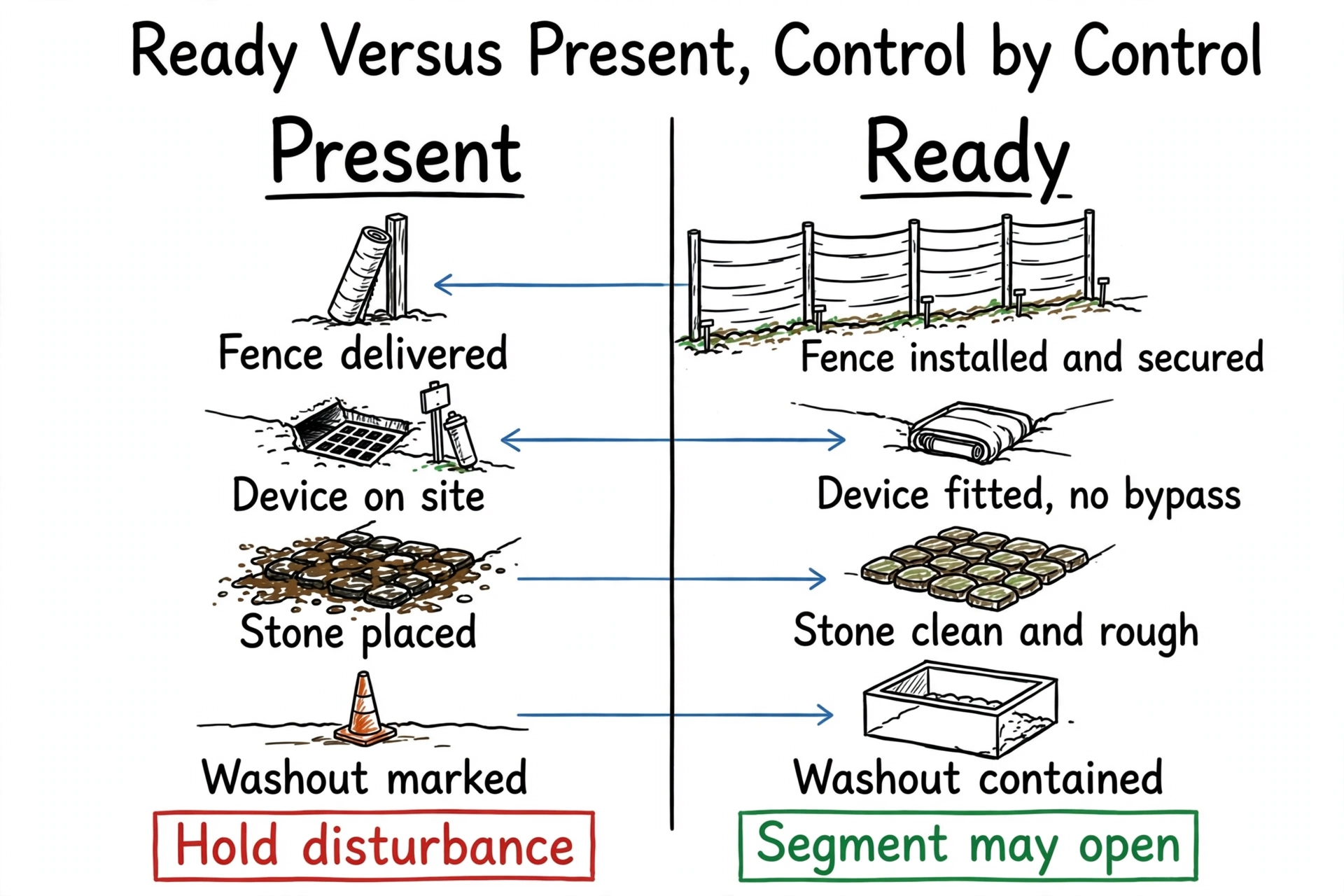
Treating presence as function. Fence is on site in a roll, an inlet device leans against a sign post, and spill pads sit in a locked trailer. Each item counts as delivered and none of them controls anything. Readiness requires installed and working condition, in place.
Installing silt fence where concentrated flow hits it. A fence placed across a ditch or a swale outlet takes a stream instead of a sheet. The flow undermines the toe, overtops the fabric, or flattens the run, and sediment passes with the failed fence material added to it.
Leaving a bypass at an inlet. A device covers part of an inlet grate while an open side channel carries runoff straight into the drain. The site shows protection in a photograph and provides very little filtration in a rain.
Letting the entrance go dead. Stone packs with mud and the surface turns smooth. Tires carry soil to the road as if no entrance existed, and street sediment becomes a visible permit and neighbor problem.
Washing out without containment. A concrete truck washes chutes onto soil or toward a drain because the designated washout was never set or has filled. Wash water discharge without an appropriate control is a prohibited discharge under the CGP framework, and state permits carry parallel prohibitions.
Placing spoil, fuel, or waste inside a protected area or above a drain. Convenient flat ground often sits in exactly the wrong place. Material staged inside a flagged boundary disturbs the area the boundary protects, and fuel or waste placed above a drainage path turns a small leak or spill into a water problem.
Flagging that drifts from the plan. Flagging placed from memory, moved for access, or left from an earlier segment marks a boundary that exists nowhere in the documents. Crews honor the wrong line with confidence, which is worse than an honest question before work starts.
What Should Someone Notice in the Field?
- Hold the permit, the SWPPP or erosion control plan where one applies, and the plan sheet for the segment, and name each required control out loud before judging any of them.
- Walk the downhill edge of the area to be disturbed and confirm silt fence or the planned perimeter control is installed, upright, secured at the toe, and free of tears, gaps, and heavy sediment loading.
- Check every storm drain inlet that receives runoff from the segment for fitted protection with no bypass, and note any device that is clogged, torn, or displaced.
- Stand at the vehicle exit the crew will actually use and judge the entrance surface: clean, rough stone that will shake soil from tires, in the place the plan shows.
- Confirm the concrete washout arrangement is designated and contained before concrete work is scheduled, and check that capacity remains.
- Confirm spill materials are staged where fueling and equipment work will happen, complete and reachable, with a container ready for used absorbent.
- Confirm waste containers are present, closed or covered as the plan requires, and placed away from inlets and drainage paths.
- Walk each protected area boundary and compare the flagging, fencing, or signs against the plan, then confirm spoil, staging, fueling, and parking sit outside the boundary.
- Photograph the installed controls and any gap found, and record the verdict for the segment with each failed item, its required fix, and its owner.
- Know the boundary: checking that controls are installed and reporting a gap are observer and crew tasks covered by this lesson. Designing a SWPPP, selecting controls for a site, delineating a wetland, judging permit compliance, and directing spill cleanup belong to qualified people and the responsible permitting authority. Reading this lesson qualifies no one to perform that work, and no one should enter water, handle spilled chemicals beyond the immediate containment steps in the site plan and their training, or work in traffic to repair a control without the proper training, equipment, and authorization.
Key Terms
Environmental controls readiness check: A review before ground disturbance that confirms the controls, pollution prevention items, and protected area markings required by the permit and plan are installed and working in the places those documents show.
Erosion control: A practice that protects bare soil itself so rain strikes cover instead of loose dirt, such as mulch or temporary seeding where the plan calls for it.
Sediment control: A barrier or trap that slows runoff and captures soil particles before runoff leaves the disturbed area or reaches a drain or water body.
Silt fence: A temporary barrier of filter fabric supported by posts, installed along the downhill edge of a disturbed area to slow shallow sheet flow, pond runoff briefly, and let sediment settle out.
Inlet protection: A filter or barrier placed at a storm drain inlet so sediment laden runoff is filtered before it enters the storm drain system.
Stabilized construction entrance: A pad of stone or a similar surface at the point where vehicles leave a site, built to knock soil from tires and reduce track out onto a public road.
Concrete washout: A designated contained area or container where concrete truck chutes and tools are washed so wash water stays in containment instead of reaching soil, a drain, or water.
SWPPP: A Stormwater Pollution Prevention Plan, a site specific written plan that identifies potential sources of pollution and describes the controls, inspections, and maintenance a project will use.
BMP: A best management practice, a scheduled activity, control, or method used to prevent or reduce pollution.
Track out: Soil carried by vehicle tires from a work area onto a public road, where rain can later wash it toward a drain.
Check Your Understanding
- What is the timing rule for stormwater controls under the 2022 CGP, and how should a reader apply that rule on a site covered by a state permit instead?
Answer: Part 2.1.3 of the 2022 CGP requires operators covered by that permit to complete installation of stormwater controls by the time each phase of construction activity begins. On a state permit site, the reader follows the installation order in the permit and plan for that job, and treats a control scheduled for later as a reason the phase is not yet ready.
- How do an erosion control and a sediment control differ in mechanism?
Answer: An erosion control protects bare soil itself so rain strikes cover instead of loose dirt, keeping soil in place. A sediment control slows runoff and captures soil particles that have already moved, before runoff leaves the disturbed area or reaches a drain or water body.
- A silt fence run is installed, upright, and sound, and the segment also drains to one storm inlet. The inlet device is still at the yard. Is the segment ready, and why?
Answer: No. Readiness requires the full control set named for the segment, installed and working. The inlet is the last filter before the storm drain, and an unprotected inlet leaves an open path for sediment laden runoff even when the perimeter control is sound.
- In the From the Field scenario, why did the foreman refuse to start trenching at the far end of the segment while the inlet device was fetched?
Answer: The trench would still open bare soil across the segment, and the drainage path from that soil runs toward the unprotected inlet. Starting at the far end would disturb ground before the full control set for the phase was complete, which reverses the order the permit and plan require. The foreman held the disturbance, used the time for spoil area setup and flagging confirmation, and opened the trench after the device was fitted and verified.
- Name four pollution prevention items a readiness check covers beyond soil controls, and state where each should be before work starts.
Answer: Any four of the following count. Spill response materials staged where fueling and equipment work will happen, complete and reachable, with a container for used absorbent. Waste containers present, closed or covered as the plan requires, and away from inlets and drainage paths. A designated contained concrete washout ready before concrete work begins. Covered or contained storage for fuel and chemicals as the plan requires. Protected area flagging or fencing matched to the plan boundary, with spoil, staging, fueling, and parking outside it.
Lesson Takeaway
Ready has an order. Controls first, disturbance second. After this lesson, a segment reads as a control set to be verified item by item against the permit and the plan: fence on its line, inlet fitted with no bypass, entrance stone still working, washout contained, spill materials within reach, waste contained, and protected ground flagged where the plan puts it. A single missing item reads as a hold, and the hold is the professional decision that keeps rain, soil, and the record on the right side of the job.
Sources and Technical References
U.S. Environmental Protection Agency, 2022 Construction General Permit (CGP), National Pollutant Discharge Elimination System permit for stormwater discharges from construction activities, effective February 17, 2022. Part 2.1.3 requires completion of stormwater control installation by the time each phase of construction activity begins. Part 2.3 covers pollution prevention, including minimizing exposure of materials and wastes. Part 1.3.1 prohibits discharge of wastewater from washout of concrete unless the washout is managed by an appropriate control, and Part 2.3.4 describes that control. Part 4.2 sets inspection frequency for covered sites. EPA issues the CGP only where EPA is the NPDES permitting authority. Authorized states issue their own permits, and the permit for the project controls: https://yosemite.epa.gov/oa/eab_web_docket.nsf/Attachments%20By%20ParentFilingId/933D378326E7F2DB85258A850050315C/%24FILE/Attachment%20F%20-%20Construction%20General%20Permit.pdf
U.S. Environmental Protection Agency, Stormwater Discharges from Construction Activities, program overview. Covers the Clean Water Act permit requirement for stormwater discharges from construction activity, the construction and development rule at 40 CFR 450.21 requiring effective erosion and sediment controls and pollution prevention measures, stabilization of disturbed areas when activity has ceased, and prohibited discharges including wastewater from concrete washout unless managed by an appropriate control: https://19january2025snapshot.epa.gov:443/npdes/stormwater-discharges-construction-activities/index.html
U.S. Environmental Protection Agency, Proposed 2022 Construction General Permit Fact Sheet. Covers Part 2.1.2 on designing and installing stormwater controls in accordance with good engineering practices and manufacturer specifications, Part 2.1.3 on completing installation prior to commencement of construction, and Part 2.2.3 on perimeter controls: https://epa.gov/sites/default/files/2021-05/documents/proposed_2022_cgp_-_fact_sheet.pdf
U.S. Environmental Protection Agency, Region 10, Erosion and Sediment Control brochure, EPA-910-F-03-004. Covers installing sediment controls before grading begins, burying the bottom of silt fence in the ground, supporting silt fence with stakes, keeping stormwater from flowing around or under silt fence, avoiding silt fence placement in the middle of a waterway or as a check dam, and inspecting and maintaining fence after storms: https://nepis.epa.gov/Exe/ZyPDF.cgi?Dockey=P1004IWB.PDF
Federal Register, Volume 87, January 24, 2022, National Pollutant Discharge Elimination System 2022 Issuance of General Permit for Stormwater Discharges From Construction Activities. Covers the scope of the 2022 CGP for operators disturbing one or more acres, or less than one acre as part of a larger common plan, in areas where EPA is the permitting authority, pollution prevention measures including minimizing exposure of building materials, construction wastes, and trash to precipitation and stormwater, and spill and leak prevention and response procedures: https://www.govinfo.gov/content/pkg/FR-2022-01-24/html/2022-01258.htm
Previous lesson: Lesson 139: Is Traffic Control Ready? |
Back to Level 7 hub |
Next lesson: Lesson 141: What Are the Work Limits?