
Introduction
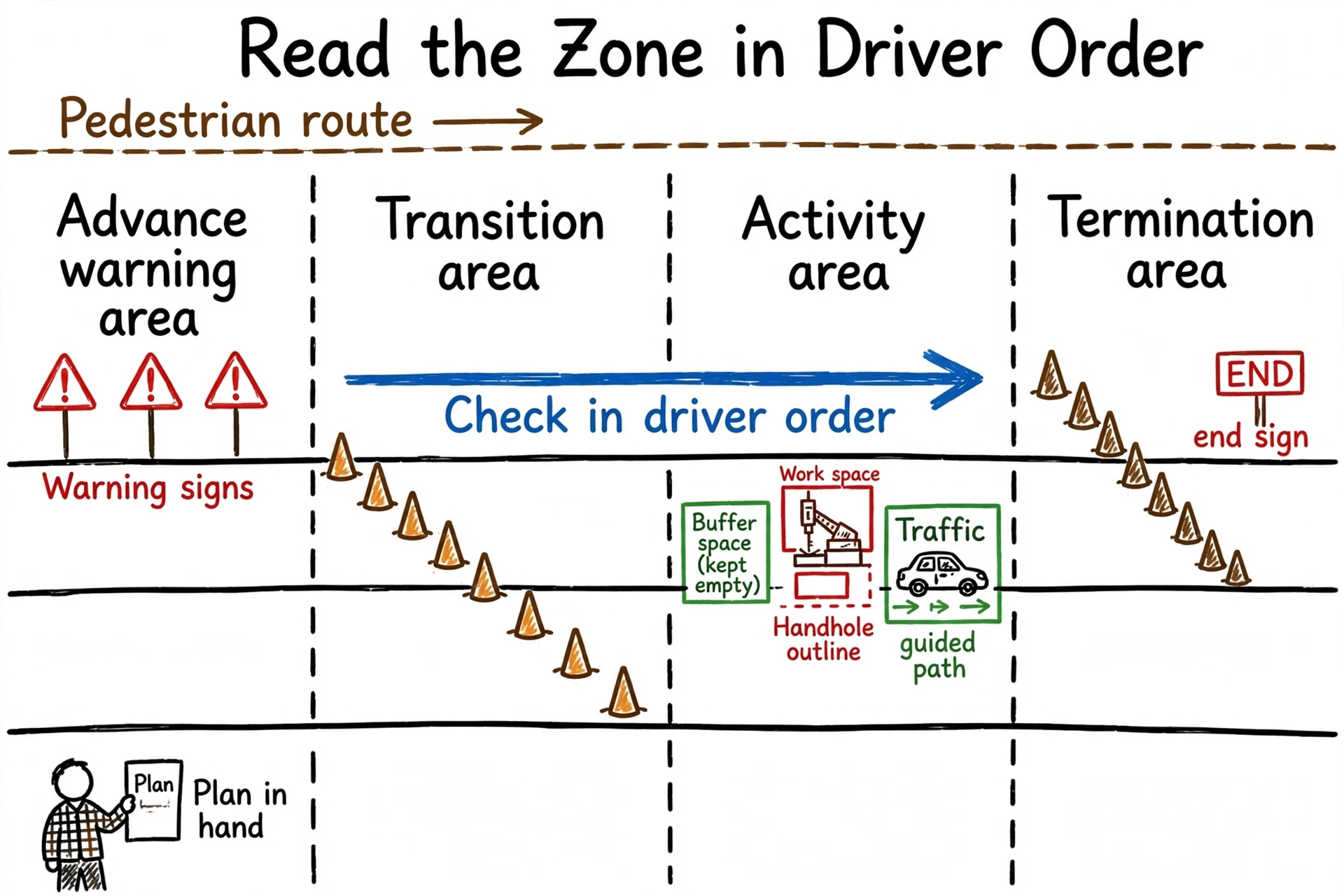
A traffic control readiness check is a field comparison, done after devices are placed and before work starts, that confirms the setup in the street matches the approved traffic-control plan for that location and phase. The checker walks the zone in the order a driver meets it, confirms each sign, device, taper, buffer, flagger station, and pedestrian route against the plan, and gives a clear verdict: ready, or held until a named gap is corrected through the person in charge.
Level 7 prepares a jobsite before ground opens. Lesson 87 covered the traffic-control plan as a document. This lesson covers the next step in the same preparation: proving that the plan on paper became the setup in the street, in working condition, before a crew occupies the work space.
What This Lesson Gives You
- Walk a temporary traffic control zone in driver order and compare each of its four areas against the approved plan, naming any mismatch by location.
- Check signs and channelizing devices for presence, position, legibility, and condition, and tell a failed device from a serviceable one at a glance.
- Confirm flagger readiness: trained flaggers present where the plan calls for them, correct apparel and signaling device in hand, station visible, and a working way to communicate with the crew and the other flagger.
- Verify the pedestrian route the plan promises: continuous, firm, clearly marked, and free of devices, material, and parked vehicles narrowing it.
- Give a ready or hold verdict before work starts and route every correction through the designated person in charge, with the gap recorded in plain words.
Start With the Basics
Think about a pilot walking around an aircraft before takeoff. The flight plan was filed earlier, the aircraft was fueled earlier, and the checklist still gets worked item by item at the airplane itself. The pilot looks at the actual control surfaces, tires, and lights because a correct plan and a fueled aircraft can still hide one flat tire. The walk finds the tire while the fix still costs minutes at the gate.
A traffic control readiness check works through the same mechanism. The traffic-control plan is the flight plan. The signs, cones, drums, arrow boards, and flaggers in the street are the aircraft. The check happens at the street, with the plan in hand, while a correction still costs a moved sign or a replaced drum. Once traffic is flowing past an open excavation and a crew is working, the same gap costs exposure that cannot be taken back.
One difference matters. A driver gets no briefing before meeting your work zone. A pilot chose to fly that day and trained for it. Drivers, cyclists, and pedestrians meet the setup cold, at speed, and they read it in seconds. The readiness check is the last chance to read the zone the way a stranger will read it, before the stranger arrives.
What Is It?
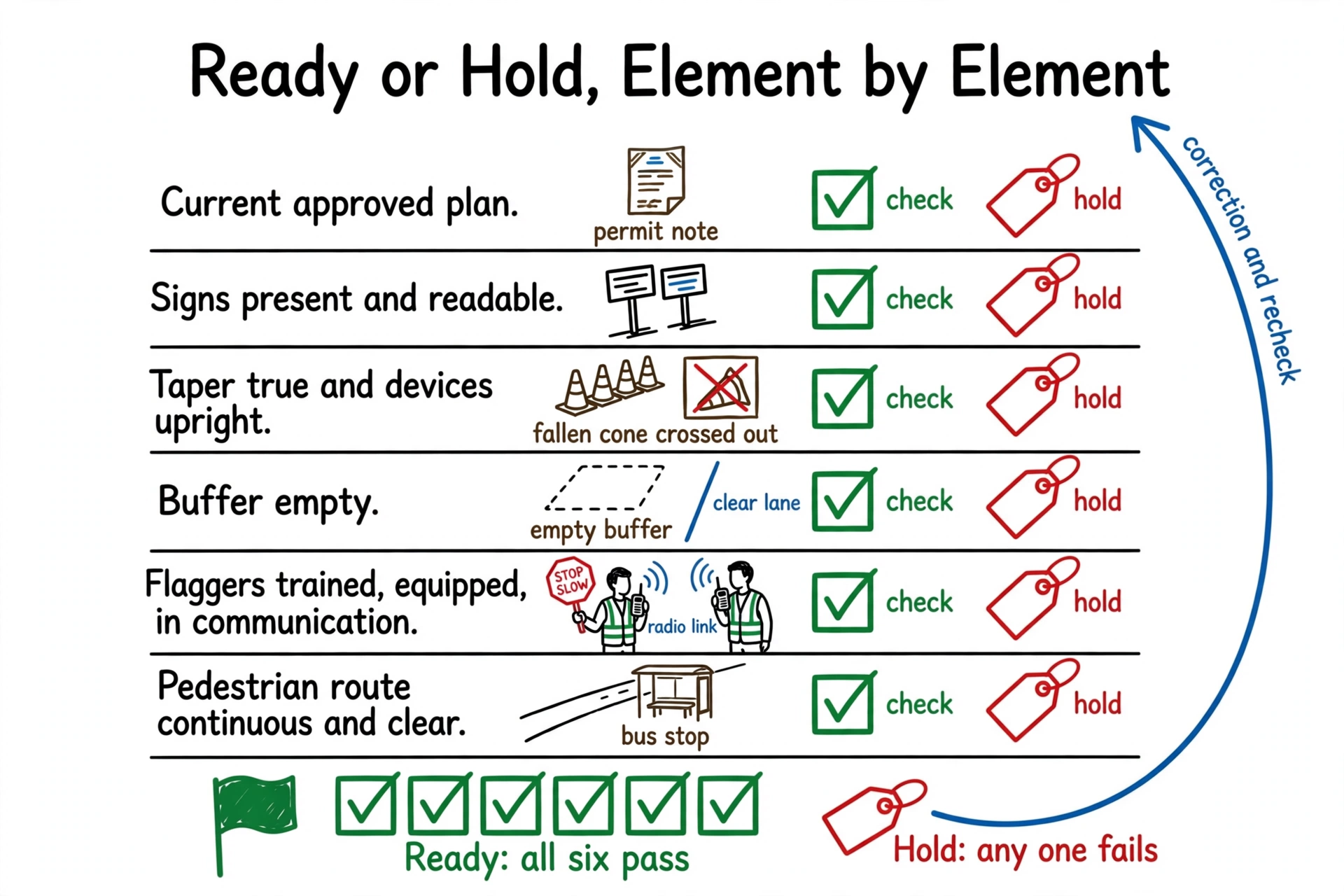
A traffic control readiness check is a comparison with a verdict. The standard of comparison is the approved traffic-control plan for this location, this phase, and this shift, read together with the permit conditions for the road. The field side of the comparison is the placed setup itself. Ready means every element the plan requires is present, in its planned position, in serviceable condition, and working as a system. Any single failed element holds the affected work until the gap is corrected and rechecked.
The check covers six groups:
- Documents on site. The current approved plan, including any approved revision for this phase, plus the permit or road owner conditions that limit hours, lane use, or access.
- Advance warning signs. The warning signs the plan shows for each approach, in sequence, facing the traffic they serve.
- Channelizing devices and tapers. The cones, tubular markers, drums, barricades, and panels that guide road users along the planned path, including each taper, meaning the angled line of devices that moves traffic out of its normal path or back into it.
- The activity area. The work space, meaning the area set aside for workers, equipment, and material, plus the buffer space, meaning clear space kept empty between moving traffic and the work space, and the traffic space, meaning the lane area road users travel through inside the zone.
- Flaggers. Where the plan uses flagger control, the people, apparel, signaling devices, stations, and communications the plan assumes.
- Pedestrian and access routes. The temporary pedestrian path where sidewalks or crossings are affected, plus driveway, business, transit, and emergency access the plan notes protect.
Three terms frame the whole check. Temporary traffic control, shortened to TTC, is the system of signs, devices, markings, and procedures used for a limited time to guide road users where work disrupts normal travel. A temporary traffic control zone is the stretch of road that system covers, from the first warning sign to the END ROAD WORK sign or the last temporary traffic control device, including the termination area beyond the work area. The Manual on Uniform Traffic Control Devices, shortened to MUTCD, is the national standard published by the Federal Highway Administration, shortened to FHWA, for traffic control devices on roads open to public travel. Part 6 of the MUTCD covers temporary traffic control. In the 11th Edition, published in December 2023, Chapter 6A states the general principles, Chapter 6B covers TTC plans and the components of a zone, Chapter 6C covers pedestrian and worker safety, and Chapter 6D covers flagger control. Device requirements for signs and channelizing devices sit in the device chapters of Part 6. States adopt the MUTCD with a state supplement in many cases, and the edition and supplement adopted for the job govern alongside the plan.
Federal workplace rules point at the same standard. OSHA construction rules in Subpart G of 29 CFR Part 1926 cover signs, signals, and barricades. Section 1926.200(g)(1) states: “At points of hazard, construction areas shall be posted with legible traffic control signs and protected by traffic control devices.” Section 1926.200(g)(2) states: “The design and use of all traffic control devices, including signs, signals, markings, barricades, and other devices, for protection of construction workers shall conform to Part 6 of the MUTCD.” In plain terms, hazard points get posted signs and the area is protected by traffic control devices, and the design and use of all traffic control devices follow Part 6. Section 1926.201 covers flagger signaling and warning garments, and Section 1926.202 covers barricades, with both sections also tied to the MUTCD. The readiness check is where those layered requirements become one practical question at one street: does the placed setup match the approved plan, and does the plan follow the adopted standard?
A readiness check has a named owner. The person in charge of traffic control for the shift is the designated person the project names to direct setup, corrections, and changes. The term is a project role defined by the project documents, not a MUTCD title. The MUTCD assigns responsibility to a knowledgeable individual under Section 6A.02 Fundamental Principles. The checker reports gaps to that person. Corrections and any change to the approved layout move through that person and through the approval path the road owner requires. The check itself grants no authority to redesign the layout.
What Does It Look Like?
A readiness check has visible parts. A beginner can watch one happen and follow each step:
- The checker holds the current approved plan, confirms the plan title, location, and phase match the street in front of the crew, and confirms the person in charge for the shift by name.
- The checker drives or walks each approach in the direction traffic travels, reading the warning signs in the order a driver reads them, and confirms each sign the plan shows is present, upright, facing traffic, and readable.
- Tapers get viewed from the driver seat line. The line of devices angles smoothly, the spacing looks even, and no gap invites a driver into the closed area.
- The activity area gets checked against the drawing: work space where the plan puts it, buffer space empty, traffic space clear of parked trucks, spools, spoil, and stored devices.
- Each device gets a condition look as the checker passes: signs clean and legible, cones and drums upright and stable, retroreflective bands or sheeting present where night or low light work requires them. Retroreflective material returns vehicle headlight light back toward the driver, which keeps a device visible after dark.
- Flagger stations get checked in person where the plan uses flaggers: the flagger is present before traffic is stopped, apparel and paddle are correct, the station sits where approaching drivers can see the flagger, and an escape path exists behind the station.
- The pedestrian route gets walked end to end at walking pace, including any crossing point, ramp, or detour leg the plan shows.
- The end of the zone gets checked last: traffic returns to its normal path, termination signing the plan shows is in place, and conflicting permanent signs or markings inside the zone are covered or removed as the plan directs.
- Every gap gets written down at the check with its location in the zone, the plan requirement, and the correction made, so the next shift and the inspector read the same record.
What Does It Do?
It proves the plan survived contact with the street. A plan is drawn for a road as the designer understood it. The street adds parked cars, a curve that shortens sight distance, a driveway the drawing shows in the wrong place, and a bus stop inside the taper. Placement crews work fast and can transpose two signs or set a taper short. The check compares the drawing and the street while both can still be reconciled through the approval path.
It reads the zone the way a driver reads it. A driver meets the zone as a sequence: warning, lane change, guided path, return to normal. A setup can contain every device on the list and still fail as a sequence, with a sign hidden behind a truck, a taper that starts before the warning ends, or two messages that contradict each other. The readiness check travels the sequence in order, which is the only way sequence failures show themselves.
It confirms devices can still do their job. A sign delivers its message only while a driver can read it in time. A cone guides only while it stands where drivers expect it. MUTCD Part 6 treats device condition as part of function, and federal work zone rules at 23 CFR 630.1110 require agencies to maintain the quality and adequacy of temporary traffic control devices for the duration of a project, with inspection at a level that keeps devices in ongoing compliance. Guidance developed by the American Traffic Safety Services Association, shortened to ATSSA, rates work zone device quality so damaged, faded, or dirty devices get cleaned, repaired, or replaced. The readiness check applies that idea at shift scale: a device that fails the condition look fails the check.
It confirms people are ready, alongside hardware. Where the plan depends on flaggers, the system depends on trained people standing in the right places with the right equipment and a shared way to communicate. A perfect line of cones cannot alternate traffic through one open lane. The check treats flagger presence, qualification, apparel, paddle, station position, and communication as readiness items with the same weight as any sign.
It creates the record that work started from a verified setup. The dated check record, with gaps and corrections noted, shows what was in place when work began. If a device is struck, a complaint arrives, or an incident is reviewed later, that record separates a setup that was verified from a setup that was assumed.
Where Does It Fit?
The readiness check sits between setup and work, and it repeats whenever the setup changes:
- During planning, the traffic-control plan is prepared and approved for the location and phase, as Lesson 87 covers. Planning decides the layout. The readiness check decides nothing about the layout.
- During setup, the crew places signs and devices following the plan, in the sequence the plan and the adopted standard direct, with traffic handled during placement itself.
- Immediately after setup and before work starts, the readiness check runs the full comparison in driver order for each approach, plus the pedestrian walk. Work waits for the ready verdict.
- During the shift, the setup gets rechecked after any change: a phase change, a moved device, a delivery through the zone, weather that knocks devices down, or a complaint from the road owner or the public. Night work adds a darkness check of retroreflectivity and any lighting the plan requires.
- At breaks, pauses, and the end of work, devices that no longer apply get removed or covered promptly. OSHA Section 1926.200 states that signs and symbols required by this subpart shall be visible at all times when work is being performed and shall be removed or covered promptly when the hazards no longer exist. A zone warning about work that has ended fails readiness for the next period.
- Lesson 143 closes this level by asking whether the site as a whole is ready for construction. Traffic control readiness is one verdict inside that larger question, and a hold here holds any work that needs the road.
What Is at Stake
Life safety. A work zone removes the margins drivers rely on: a lane disappears, a shoulder closes, workers stand near moving vehicles. MUTCD Section 6A.01 states the primary function of temporary traffic control plainly: “The primary function of temporary traffic control is to facilitate movement of road users through or around temporary traffic control zones while protecting road users, workers, responders to traffic incidents, and equipment.” A setup that starts work with a missing sign, a broken taper, or an absent flagger spends that protection before the first task begins.
Pedestrian safety and access. A lane plan can work for cars and still strand a person on foot. MUTCD Section 6A.01 requires the needs and control of all road users, including pedestrians and persons with disabilities, through a temporary traffic control zone to be an essential part of highway construction, utility work, maintenance operations, and incident management. MUTCD Section 6C.03 states: “When existing pedestrian facilities are disrupted, closed, or relocated in a temporary traffic control zone, the temporary facilities shall be detectable and include accessibility features consistent with the features present in the existing pedestrian facility.” A readiness check that skips the pedestrian walk can pass a zone that fails the people with the fewest options.
Legal and permit exposure. Work in a public right of way runs under a permit or contract that requires traffic control following the adopted MUTCD and the approved plan. A field setup that differs from the approved plan, with no approved revision, puts the crew outside the permission the work relies on. After any incident in a work zone, investigators compare the placed setup against the plan and the standard. The readiness record is the project evidence that the comparison happened before work started.
Schedule and cost. A gap found at the check costs a correction inside the setup window. The same gap found by a road owner inspector an hour later can cost a stop work direction until the zone is rebuilt, with the crew, the excavation, and the traffic all waiting. A gap found after an incident costs more than any schedule can absorb.
Public trust. Drivers and neighbors form their judgment of the whole fiber project from the work zone, because the zone is the part they travel through. A clean sequence of readable signs, a smooth taper, and a clear walking path read as a professional operation. Fallen cones, contradictory signs, and a blocked sidewalk read as carelessness, and complaints travel to the road owner and the customer quickly.
What Does Good Look Like?
- The current approved plan for this location and phase is on site, the revision matches the permit, and the person in charge of traffic control for the shift is named and present or reachable.
- Every approach shows the warning signs the plan requires, in order, upright, facing traffic, clean, legible, and clear of vegetation, parked vehicles, and other signs.
- Each taper follows the plan, with devices evenly spaced, upright, and stable, and the guided path is obvious from the driver position with no conflicting markings or uncovered signs inside the zone.
- Buffer space is empty. Under MUTCD Guidance, no work activity or storage of equipment, vehicles, or material should occur in buffer space; the approved plan for the job treats the space as kept empty. No parked vehicles, no stored material, and no workers crossing or standing in it, and the work space holds only the work the plan places there.
- Channelizing devices are in serviceable condition, with retroreflective elements present and effective where the plan or the light conditions require them, and damaged or faded devices have been replaced rather than reset.
- Flaggers the plan requires are on station before traffic is controlled, trained for the assignment, wearing high-visibility apparel that meets the adopted standard, holding the correct signaling device, visible to approaching drivers, and in communication with each other and the crew.
- The pedestrian route is continuous, firm, clearly delineated, and detectable, with its usable width kept clear of devices, signs, material, and parked vehicles, and access to driveways, businesses, and transit stops matches the plan notes.
- The termination area returns traffic to the normal path cleanly, end signing the plan shows is in place, and devices from a finished phase have been removed or covered.
- The check is recorded with the date, time, checker, gaps found, and corrections made, and the ready verdict is given before work starts.
From the Field
Picture a two-lane road where a bore crew will work from the shoulder and cross one lane with a handhole set near the edge of pavement. The approved plan uses flagger control for short periods when equipment crosses the lane, advance warning signs on both approaches, a taper closing the shoulder and part of the lane at the work area, and a temporary pedestrian path on the opposite shoulder because the sidewalk on the work side is inside the zone.
The setup crew places the signs and devices in the morning and calls the setup done. The foreman runs the readiness check with the plan in hand before the bore rig starts. The east approach reads correctly: signs in order, taper smooth, buffer empty. The flagger for the west station has arrived, apparel and paddle correct, radio check complete with the east flagger.
The pedestrian walk finds the failure. The temporary path on the opposite shoulder is marked at both ends, and its middle section passes the point where the supply truck parked to unload conduit. The truck sits inside the path width, and the remaining gap between the truck and the live lane is too narrow for a wheelchair and awkward for any person on foot. A pedestrian meeting the truck has two choices, both bad: squeeze past the truck mirror or step into the travel lane.
The foreman faces the decision. The rig is spotted, the locate window is open, and the crossing work that needs the flaggers is scheduled inside the hour. Moving the truck means re-spotting it on a side street and carrying conduit farther by hand. Starting work means accepting a pedestrian route that exists on the drawing and fails on the ground, on a street where residents walk to a bus stop inside the zone.
The foreman holds the start. The truck moves to the side street, the path is walked again end to end and confirmed clear, and the correction goes into the check record with the time. The bore starts late by the length of one truck move, with the full setup the plan promised actually in place.
The decision rule is plain: traffic control is ready when every element the plan requires, vehicles and pedestrians included, works in the street at the same time. A route that passes for cars and fails for a person on foot is a failed check. Hold the start, correct the gap through the person in charge, recheck the corrected element, and record the correction.
What Can Go Wrong?
The wrong plan in hand. The crew works from a plan for a different phase, a different street, or an earlier revision. Devices get placed faithfully to a drawing that never applied to this setup, and the check, if run against the same wrong sheet, passes a zone the permit never approved.
Signs present and unreadable. A sign stands at its planned position twisted away from traffic, dirty, faded, or hidden behind a parked truck or vegetation. The inventory count passes. The message never reaches the driver, which is the only function the sign has.
A taper that misleads. Devices in a taper sit unevenly spaced, knocked flat, or drifted out of line after a passing vehicle clips them. The line stops guiding and starts confusing, and drivers choose their own path, sometimes into the work space.
Buffer space treated as parking. The clear space in front of the work area fills with a pickup, a spool, or a spoil pile because the space looks unused. The buffer exists to give an errant vehicle room to stop and to separate traffic from workers. Under MUTCD Guidance, no work activity or storage of equipment, vehicles, or material should occur in buffer space; the approved plan for the job treats the space as kept empty. Filling it removes the protection the plan counted on.
Flaggers assumed rather than confirmed. The plan calls for two flaggers and one arrives, or a willing crew member without flagger training takes a paddle. MUTCD Section 6D.01 in the 11th Edition ties flagger work to training and to demonstrated abilities. Flagger training covers proper traffic control practices and public contact techniques. A flagger shall be able to receive and communicate specific instructions clearly, firmly, and courteously; move and maneuver quickly to avoid danger from errant vehicles; control signaling devices to provide clear and positive guidance in frequently changing situations; understand and apply proper traffic control practices, sometimes in stressful or emergency situations; and recognize dangerous traffic situations and warn workers in sufficient time to avoid injury. An untrained substitute fails the check even with the correct paddle in hand.
The pedestrian route that ends. The temporary path starts well and stops at a parked vehicle, a device storage pile, or an open excavation edge, or the route crosses the work area with no delineation. Pedestrians improvise, usually through the live lane or the work space.
Devices left after the hazard ends. Work finishes or pauses and the signs stay up. Drivers learn that warnings on this street mean nothing, and they carry that lesson into the next zone. OSHA Section 1926.200 requires signs and symbols required by this subpart to be removed or covered promptly when the hazard no longer exists, and the MUTCD directs the same discipline.
A check done from the truck. The checker confirms the setup from the work area looking outward, in the reverse of driver order, and never walks the pedestrian route. Sequence failures, hidden signs, and path blockages stay invisible because the check never traveled the paths road users travel.
What Should Someone Notice in the Field?
- Confirm the plan on site is the current approved plan for this location and phase, and name the person in charge of traffic control for the shift before checking anything else.
- Travel each approach in driver order and read every warning sign as a driver reads it: present, in sequence, upright, facing traffic, clean, and legible in time to act.
- Read each taper from the driver position: smooth angle, even spacing, upright devices, and one obvious path with no gaps inviting entry into the closed area.
- Check the activity area against the drawing: work space as planned, traffic space clear, and buffer space completely empty of vehicles, material, and people.
- Look at device condition up close: sign faces readable, cones and drums stable and undamaged, retroreflective bands and sheeting present and effective for the light conditions of the shift.
- Confirm flaggers where the plan requires them: on station before control begins, trained for flagging, correct high-visibility apparel, correct signaling device, station visible to approaching drivers with an escape path, and communication tested with the crew and the other flagger.
- Walk the pedestrian route end to end: continuous, firm, delineated, detectable, clear width, safe crossing points, and access to driveways, businesses, and transit stops as the plan notes require.
- Check the end of the zone: smooth return to the normal path, termination signing in place, conflicting permanent signs or markings covered as the plan directs, and finished phase devices removed or covered.
- Write every gap down with its location, the plan requirement, and the correction, and recheck each corrected element before the ready verdict.
- Know the boundary: recognizing a bad setup, naming the gap, and reporting it to the person in charge are tasks this lesson teaches. Redesigning a traffic control layout, directing traffic as a flagger, and moving devices inside live traffic are tasks for trained, qualified, and authorized people under the adopted standard and the project plan. Reading this lesson qualifies no one to perform flagger duties or to set or redesign traffic control.
Key Terms
Traffic control readiness check: A field comparison after setup and before work starts that confirms the placed signs, devices, tapers, buffers, flaggers, and pedestrian routes match the approved traffic-control plan, ending in a ready or hold verdict.
Traffic-control plan: The written and drawn instructions, approved before work starts, that describe how road users will be guided through or around a specific work zone at a specific location and phase.
Temporary traffic control (TTC): The system of signs, devices, markings, and procedures used for a limited time to guide road users where work or an incident disrupts normal travel.
Temporary traffic control zone: The stretch of road covered by a TTC system, from the first warning sign to the END ROAD WORK sign or the last temporary traffic control device, including the termination area beyond the work area, divided as needed into an advance warning area, a transition area, an activity area, and a termination area.
Taper: An angled line of channelizing devices that moves road users out of a normal path or returns them to it, with length and device spacing set by the adopted MUTCD tables, the state supplement, and the approved plan for the job.
Channelizing device: A cone, tubular marker, drum, barricade, or panel used to warn road users of work conditions and guide them along a desired path or away from a closed area.
Buffer space: Clear space inside the activity area that separates moving traffic from the work space. Under MUTCD Guidance, no work activity or storage of equipment, vehicles, or material should occur in buffer space; the approved plan for the job treats the space as kept empty.
Work space: The part of the activity area set aside for workers, equipment, and material storage for the work in progress.
Flagger: A person trained in proper traffic control practices who directs road users through a TTC zone where the plan calls for flagger control. The STOP/SLOW paddle is the primary and preferred device; flag use is limited to emergency situations; an AFAD is another approved device, per MUTCD Chapter 6D.
High-visibility safety apparel: Clothing meeting the Performance Class 2 or 3 requirements of ANSI/ISEA 107-2015, or an equivalent revision, referenced in MUTCD Section 6C.05, worn by flaggers and workers exposed to traffic so drivers can identify a person at distance, day and night.
Retroreflective: A material property that returns light from vehicle headlights back toward the driver, keeping signs and devices visible at night and in low light.
Person in charge of traffic control: A project role defined by the project documents. The designated person for the project or shift who directs setup, corrections, and changes to traffic control and carries changes through the required approval path. The term is not a MUTCD title; the MUTCD assigns responsibility to a knowledgeable individual under Section 6A.02 Fundamental Principles.
Check Your Understanding
- Name the six groups a traffic control readiness check compares against the approved plan.
Answer: Documents on site; advance warning signs; channelizing devices and tapers; the activity area, covering work space, buffer space, and traffic space; flaggers where the plan uses them; and pedestrian and access routes.
- A setup contains every sign and cone the plan lists, and one warning sign is twisted away from traffic behind a parked truck. Does the setup pass the readiness check? Explain the mechanism.
Answer: No. A sign performs its function only when a driver can read it in time to act. Presence on an inventory count is separate from performance in the sequence. The sign fails the condition and position check, the gap is corrected through the person in charge, and the corrected approach is rechecked before a ready verdict.
- The plan calls for two trained flaggers. One flagger arrives on time. A crew member with no flagger training offers to take the second paddle so work can start. What does the readiness check require?
Answer: The check requires the flaggers the plan assumes: trained people, on station, with correct apparel and signaling devices and tested communication. MUTCD Section 6D.01 ties flagger work to training and demonstrated abilities. Flagger training covers proper traffic control practices and public contact techniques. A flagger shall be able to receive and communicate specific instructions clearly, firmly, and courteously; move and maneuver quickly to avoid danger from errant vehicles; control signaling devices to provide clear and positive guidance in frequently changing situations; understand and apply proper traffic control practices, sometimes in stressful or emergency situations; and recognize dangerous traffic situations and warn workers in sufficient time to avoid injury. The second station fails readiness until a trained flagger fills it, and work that needs two flagger control waits.
- In the From the Field scenario, the vehicle and pedestrian checks disagreed. Which verdict governed, and what did the foreman do?
Answer: The failed pedestrian check governed, because readiness requires every element the plan requires to work at the same time. The foreman held the start, moved the supply truck out of the temporary pedestrian path through the normal chain of command, walked the path again end to end, recorded the correction, and started the bore only after the full setup matched the plan.
- Work ends for the day and the road is fully clear, and the crew wants to leave all signs standing for the morning. Which rule answers the question, and what does the rule require?
Answer: OSHA 29 CFR 1926.200(a) requires signs and symbols required by this subpart to be visible at all times when work is being performed and removed or covered promptly when the hazards no longer exist, and MUTCD Part 6 directs the same discipline. Signs warning about a hazard that has ended come down or get covered, and the morning setup gets its own readiness check.
Lesson Takeaway
Ready is a verdict earned in the street: the approved plan in one hand, the placed setup read in driver order, the pedestrian route walked on foot, and every gap corrected and rechecked before work starts. After this lesson, a line of cones reads as a claim that still needs proof, and proof means signs a stranger can read, a taper that guides, an empty buffer, flaggers who are trained and in communication, and a walking path that works for the person with the fewest options.
Sources and Technical References
FHWA, Manual on Uniform Traffic Control Devices, 11th Edition, December 2023, Part 6, Temporary Traffic Control. Chapter 6A, General, including Section 6A.01, with the statement of the primary function of temporary traffic control and the requirement on the needs and control of all road users, and Section 6A.02, Fundamental Principles of Temporary Traffic Control. Chapter 6B, including Section 6B.01 on TTC plans and Section 6B.03, Components of Temporary Traffic Control Zones, with the four areas described in Sections 6B.04 through 6B.07: advance warning area, transition area, activity area, and termination area. Chapter 6C, Pedestrian and Worker Safety, including Section 6C.02, Pedestrian Considerations, Section 6C.03 on disrupted pedestrian facilities, and Section 6C.05 on high-visibility safety apparel. Chapter 6D, Flagger Control, including Section 6D.01, Qualifications for Flaggers, and Section 6D.02 on the STOP/SLOW paddle as the primary hand-signaling device. Device requirements appear in the device chapters of Part 6, and typical applications appear in Chapter 6P: https://mutcd.fhwa.dot.gov/pdfs/11th_edition/part6.pdf
OSHA, 29 CFR 1926.200, Accident Prevention Signs and Tags, Subpart G, Signs, Signals, and Barricades. Paragraph (a) requires signs and symbols required by this subpart to be visible at all times when work is being performed and removed or covered promptly when hazards no longer exist. Paragraph (g)(1) states: “At points of hazard, construction areas shall be posted with legible traffic control signs and protected by traffic control devices.” Paragraph (g)(2) states: “The design and use of all traffic control devices, including signs, signals, markings, barricades, and other devices, for protection of construction workers shall conform to Part 6 of the MUTCD.”: https://www.law.cornell.edu/cfr/text/29/1926.200
OSHA, 29 CFR Part 1926, Subpart G, Sections 1926.201, Signaling, and 1926.202, Barricades. Section 1926.201(a) ties flagger signaling, the use of flaggers, and flagger warning garments to Part 6 of the MUTCD. Section 1926.202 ties barricades for protection of employees to Part 6 of the MUTCD: https://www.labor.nc.gov/subpart-g-signs-signals-and-barricades
FHWA, 23 CFR 630.1110, Maintenance of Temporary Traffic Control Devices. Requires each agency to develop and implement quality guidelines to help maintain the quality and adequacy of temporary traffic control devices for the duration of the project, with a level of inspection that provides ongoing compliance, and names the ATSSA quality guidelines as an existing set an agency may adopt: https://ecfr.io/Title-23/Section-630.1110
Montana Department of Transportation, Temporary Traffic Control Device Quality, Construction Guidance, revised April 26, 2018. Applies the ATSSA Quality Guidelines for Work Zone Traffic Control Devices in practice: acceptable, marginal, and unacceptable device categories, physical maintenance to retain legibility and visibility, and functional checks for devices that have moved or been damaged: https://www.mdt.mt.gov/other/webdata/external/const/wzsm/temporary-traffic-control-device-quality-guidance.pdf
FHWA, MUTCD 2009 Edition, Chapter 6D, Pedestrian and Worker Safety, Section 6D.01, Pedestrian Considerations. Cited for the pedestrian principles carried forward into Chapter 6C of the 11th Edition: pedestrians need a clearly delineated and usable travel path, adequate access and walkways are provided when a TTC zone affects pedestrian movement, accessibility and detectability are maintained along an alternate route, pedestrians are kept clear of conflicts with vehicles and operations, and a pedestrian route is kept free of severance for nonconstruction uses such as parking: https://mutcd-dr.fhwa.dot.gov/htm/2009/part6/part6d.htm
Previous lesson: Lesson 138: What Is Material Staging? |
Back to Level 7 hub |
Next lesson: Lesson 140: Are Environmental Controls Ready?