
Introduction
Material staging is the planned placement of material on or near a jobsite in advance of installation, in a location and arrangement that keeps the material protected, reachable in the order the work needs it, and clear of traffic, drainage, and areas where the crew has no right to work. Staging decides where material waits. Lesson 135 decided whether material was ready to wait at all.
Level 7 prepares a jobsite before ground opens. A readiness check can pass in the yard and still fail in the field when a reel, a conduit bundle, or a handhole gets set down in the wrong place. This lesson teaches placement as a field decision with legal, safety, and quality consequences.
What This Lesson Gives You
- Pick a staging location that sits inside the permitted work limits and clear of travel lanes, buffer space, and drainage paths.
- Lay out material in installation sequence so the crew pulls what it needs next without moving what it needs later.
- Separate material by type, size, and rating, and keep incompatible or unapproved material apart from material cleared for installation.
- Protect staged reels, conduit, and enclosures from ground contact, rolling, weather, and vehicle strikes until installation.
- Recognize a staging layout that has drifted into a hazard, a permit problem, or a housekeeping failure, and correct the layout before work starts.
Start With the Basics
Think about a kitchen during a large meal. Ingredients for the first course sit near the stove in the order they go into the pan. Ingredients for a later course stay in the refrigerator or on a back counter, labeled and apart. Nothing sits in the doorway, nothing blocks the sink drain, and raw items stay separated from finished food. The cook moves in a short loop, reaches each item once, and never climbs over supplies to get to work.
Staging on a jobsite follows the same mechanism. Material placed close to its point of installation, in sequence, shortens handling and reduces damage. Material placed wherever the delivery truck stopped creates extra moves, extra handling, and extra chances for a reel to roll, a conduit wall to gouge, or a vehicle to strike a stack. Placement is handling done once on purpose, instead of handling repeated by accident all day.
What Is It?
Material staging is a placement plan carried out in the field. The plan answers four questions before the first delivery arrives: where material will sit, how it will sit, in what order it will be used, and how long it will sit there.
A staging area is a designated area, on the jobsite or at a nearby offsite location, where material waits under control before installation. The Fiber Optic Association receiving guide directs that fiber deliveries be scheduled as close to the time of use as possible to reduce damage from other construction, weather, and theft, and that an offsite staging area or a locked storage container on site be arranged when deliveries cannot match the time of use. Short time on site is part of the protection.
A laydown area is the ground area within a staging area where bulk material rests: reels, conduit bundles or coils, handholes, and pallets. Laydown is the physical footprint. Staging is the larger decision that chooses the footprint, the layout inside it, and the sequence of use.
Key terms inside the layout include the following:
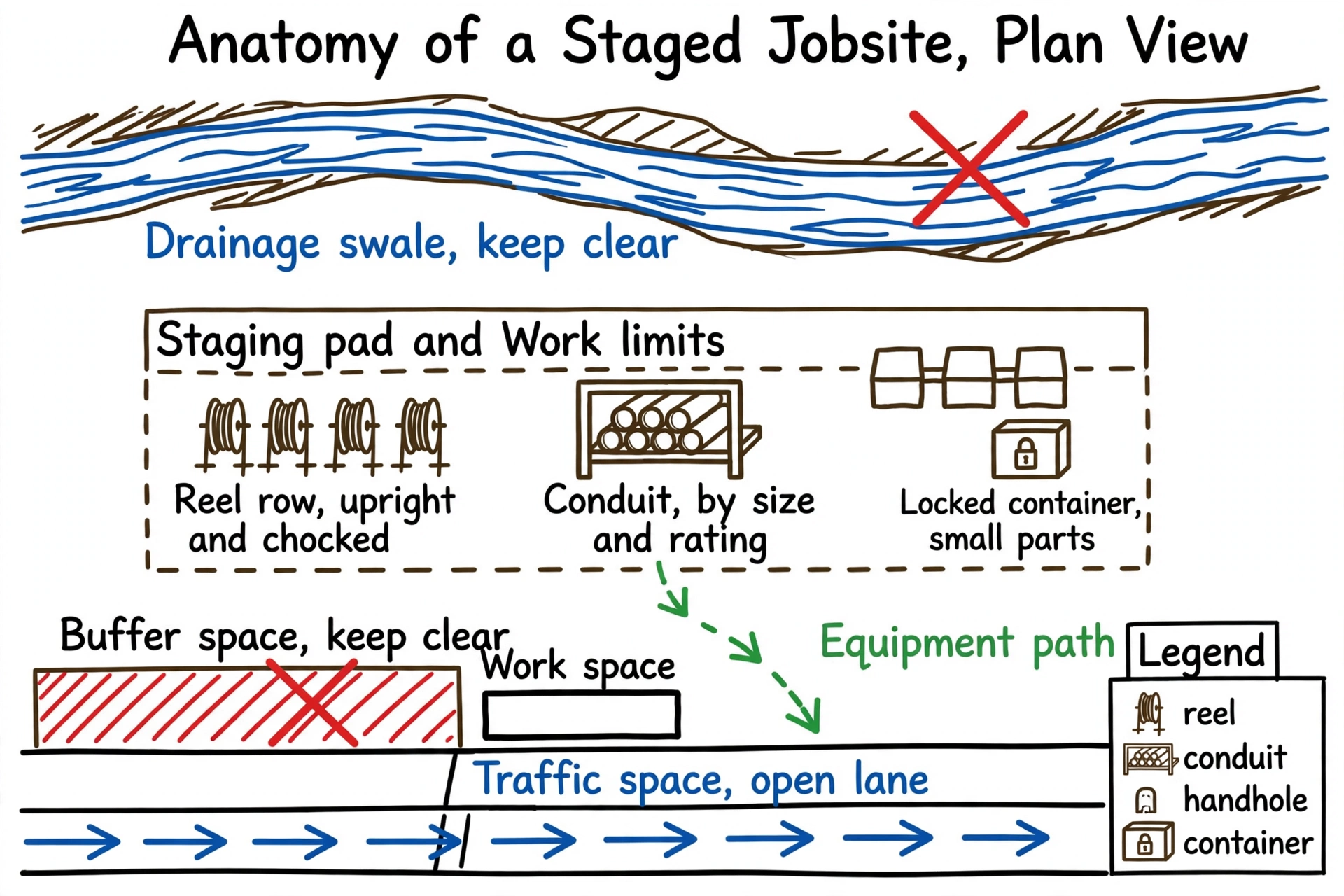
- Work limits are the boundaries in the project documents and permits inside which construction activity, including storage, is allowed. Ground outside the work limits belongs to someone else, to a protected area, or to the traveling public.
- Right-of-way is the land corridor, owned or controlled for road and utility use, inside which permitted road and utility work takes place. A permit for work in a right-of-way sets conditions for that work, and storage is allowed only as those conditions provide.
- Travel lane is a lane open to moving traffic. Material never belongs in a travel lane outside a properly closed and controlled work space.
- Work space is the portion of a highway closed to road users and set aside for workers, equipment, and material, as the Manual on Uniform Traffic Control Devices defines the term for temporary traffic control zones.
- Buffer space is the lateral or longitudinal area in a temporary traffic control zone that separates traffic flow from the work space and can provide recovery room for an errant vehicle. Guidance in the Manual states that neither work activity nor storage of equipment, vehicles, or material should occur within a buffer space.
- Housekeeping in federal construction rules means keeping storage areas free from accumulations of material that create tripping, fire, explosion, or pest hazards, under 29 CFR 1926.250(c).
Staging also has a time rule. The sequence is the order in which segments and materials will be installed. Material staged in sequence comes off the pile in installation order. Material staged out of sequence gets handled twice, and each extra handling is a new chance for damage.
What Does It Look Like?
A staged jobsite reads clearly to a beginner standing at the edge of it:
- One defined area holds the bulk material, with a visible boundary such as cones, fence, or the edge of a graveled pad, instead of material scattered along the whole segment.
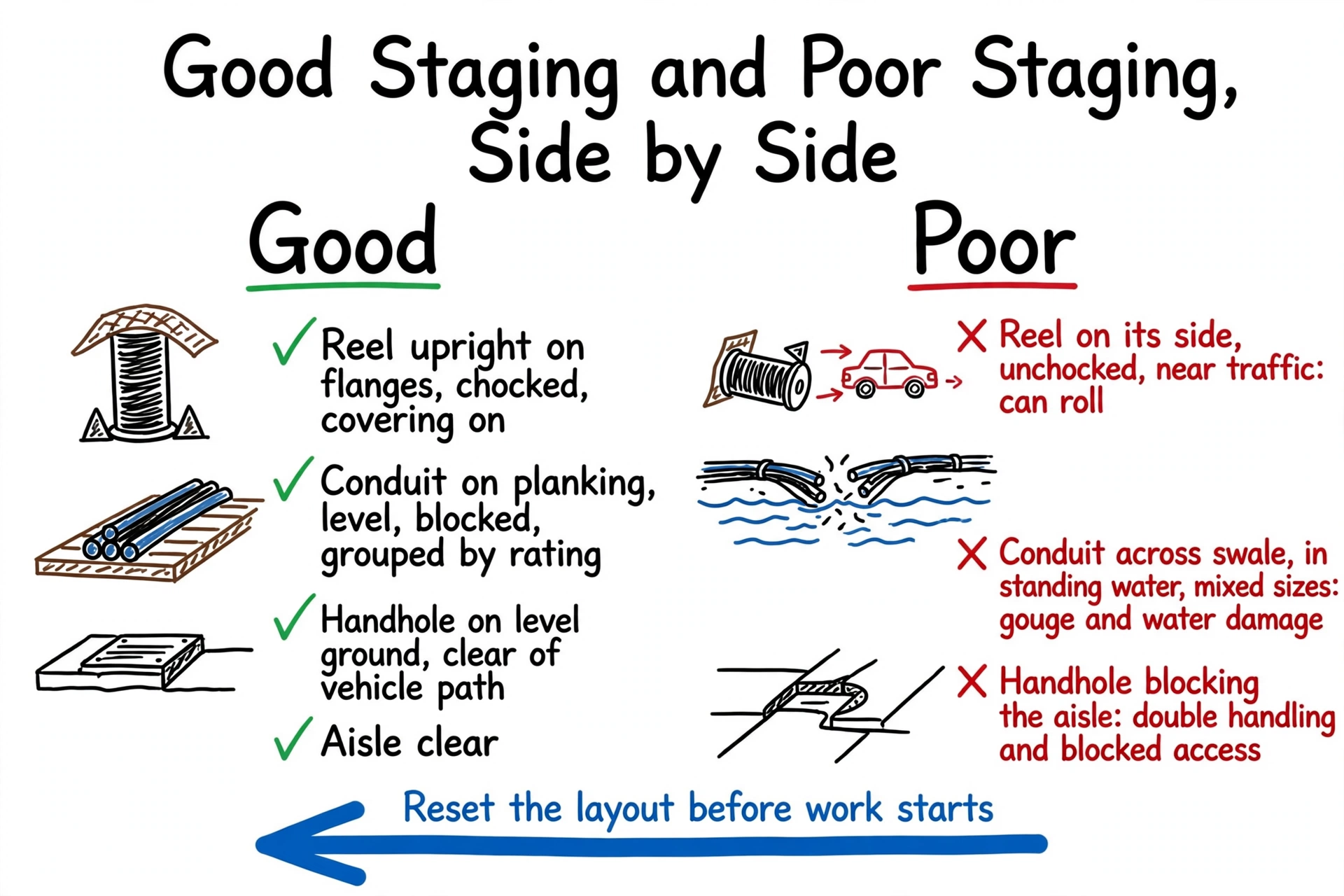
- Reels stand upright on both flanges, in rows, chocked against rolling, with protective covering intact where the maker shipped it that way.
- Conduit rests on a smooth, level surface free of stones and debris, or on planking spaced along its length where the ground cannot be prepared, grouped by size and pressure rating.
- Handholes and covers sit on level ground, apart from the travel path of site vehicles, with no other material stacked on top of them.
- Small components, closures, and hardware sit in a locked container or other secure, clean, and dry storage, grouped by segment.
- A clear aisle or access path runs to each material group, wide enough in practice for the equipment that will retrieve it, and no group blocks the path to another group.
- The next segment material sits at the front of the layout, closest to the work. Later segment material sits behind it or in a separate bay.
- Nothing sits in the ditch line, in a drainage swale, in front of a storm inlet, in a driveway entrance the permit requires to stay open, or in the buffer space beside live traffic.
- Waste, cutoffs, and packaging sit in a separate spot or container, apart from installable material, ready for removal as work progresses.
What Does It Do?
It shortens the path between storage and installation. Each material moves from delivery to laydown once, then from laydown to its installed position once. A layout that matches the work sequence removes the third and fourth moves that happen when crews dig through a mixed pile. Fewer moves mean less lifting, less dragging, and less impact damage.
It protects material by controlling what touches it. Ground contact, point loads from stones, standing water, and vehicle contact damage material while it waits. Plastics Pipe Institute jobsite storage guidance calls for a relatively smooth, level surface free of stones, debris, or other material that could damage pipe or fittings, with planking where a proper bed cannot be prepared. Corning guidance for fiber cable calls for reels stored vertically on their flanges, end to end in rows, and chocked to prevent rolling, with protective covering left intact until the reel reaches the installation site. Staging applies those storage rules at the point of use.
It keeps the public way public. A staging layout decides whether material stays inside the closed work space or drifts into traffic space, a sidewalk, a driveway, or a buffer. The Manual on Uniform Traffic Control Devices treats the work space as the place set aside for workers, equipment, and material, and it treats buffer space as space that stays clear. A layout that honors that split keeps a recovery area open for a driver who leaves the lane, and it keeps the permit conditions intact.
It keeps drainage working. Water follows the low path whether material sits in it or not. A bundle placed in a swale dams runoff, ponds water against staged material, and can carry sediment and site pollutants toward a watercourse. Federal highway erosion rules at 23 CFR 650.209 provide that pollutants used during construction and material from sediment traps shall not be stockpiled or disposed of in a manner that makes them susceptible to being washed into a watercourse by runoff or high water. The Stormwater Pollution Prevention Plan, called a SWPPP, is the site plan required under construction stormwater permits that shows erosion controls, sediment controls, and material management for the site. Staging locations belong on that plan, inside its controls.
It makes the count visible. Grouped, labeled, sequenced material can be counted at a glance. A missing handhole or a short conduit bundle shows up during the morning walk instead of at the open excavation. Separation also prevents a costly substitution error: pipe segregated by size and pressure rating, as Plastics Pipe Institute guidance recommends, reduces the chance a crew pulls the wrong rating for a segment.
Where Does It Fit?
Staging sits between receiving and installation, and it connects several earlier Level 7 subjects:
- The preconstruction meeting and the job briefing settle where staging will occur, who approves changes to the location, and which permit conditions limit storage.
- Permits and locates set the hard boundaries. A staging area must sit inside permitted work limits, clear of marked utilities at the surface, and clear of any area the permit closes to storage.
- Lesson 135, the materials readiness check, clears material for staging. Material that failed receiving inspection, lacks required approval, or sits in a recorded hold stays out of the staged layout for installation.
- Traffic control sets the roadside geometry. Inside a temporary traffic control zone, staged material belongs in the work space. It never belongs in traffic space or buffer space.
- Daily work draws from the front of the layout in sequence. As segments complete, the layout shrinks, waste leaves the site, and the staging area is restored or moved forward under the same permit conditions.
- At closeout, leftover material is counted, returned or transferred under project records, and the staging ground is left clean, with drainage restored to its prior path.
Offsite staging follows the same rules at a yard or leased area. The Fiber Optic Association guide names an offsite staging area as a planned alternative when delivery timing cannot match use. Distance changes the haul plan. It does not change the duties for protection, separation, security, and sequence.
What Is at Stake
Safety. Federal construction storage rules at 29 CFR 1926.250(a)(1) require that material stored in tiers be stacked, racked, blocked, interlocked, or otherwise secured against sliding, falling, or collapse, and that aisles and passageways stay clear for the free and safe movement of material handling equipment and employees. A separate rule at 29 CFR 1926.250(b)(9) requires that structural steel, poles, pipe, bar stock, and other cylindrical material, unless racked, be stacked and blocked to prevent spreading or tilting. A reel that rolls, a coil pile that spreads, or a blocked aisle turns stored material into the hazard.
Traffic safety. MUTCD guidance states that work equipment, workers’ private vehicles, materials, and debris should be stored in a manner that reduces the probability of being impacted by run-off-the-road vehicles, and that unencumbered roadside recovery areas or clear zones should be provided where practical. Material staged close to live traffic, outside the protected work space, raises the severity of a routine lane departure.
Permit compliance and the right to keep working. Permits authorize work, including storage, inside stated limits and conditions. Material placed outside work limits, in a closed lane that was not approved for storage, on a sidewalk or driveway that must stay open, or in an environmental area the SWPPP protects can lead the project permit to require the material to be moved, and the cost and schedule consequences land on the project. The governing limit comes from the project permit and documents for that site. No general rule in this lesson replaces that document.
Water quality. A staging area in a drainage path or without the controls the SWPPP shows can send sediment, fuel residue, and packaging into inlets and watercourses during one rain event. The Environmental Protection Agency Construction General Permit framework requires operators of covered construction sites to develop a SWPPP and use controls that minimize sediment and other pollutants in stormwater discharge. Where the project permit adopts a setback or a containment rule for a material, that project rule governs the layout.
Cost and schedule. Poor staging taxes every day that follows it. Crews lose time searching, recounting, and rehandling. Damaged staged material must be replaced before it can be installed. A layout that blocks equipment access can idle the very machine the segment depends on. Good staging costs planning time once. Poor staging charges handling time daily.
Theft and vandalism. The Fiber Optic Association guide directs that equipment and cabling be stored in a clean and dry location, protected from harsh environments, and held in secure storage because of value and theft risk. Material spread along an open roadside segment overnight is harder to secure than material gathered in one controlled area or container.
What Does Good Look Like?
- The staging area location appears in the job briefing, sits inside permitted work limits, and matches the location the SWPPP and traffic control plan show.
- Reels stand upright on both flanges, chocked, in rows, with covering intact.
- Conduit and pipe rest on smooth, level, stone free ground or on planking, blocked against rolling or spreading, and separated by size and pressure rating.
- Tiered material is stacked, racked, blocked, or interlocked so it cannot slide, fall, or collapse, per 29 CFR 1926.250(a)(1).
- Aisles, passageways, equipment paths, driveways that must stay open, and pedestrian routes the plan protects stay clear and in good repair.
- Material for the next segment sits at the front in installation order, and later material sits behind it or in its own bay, labeled by segment.
- Unapproved, damaged, or held material sits in a separate marked area, apart from material cleared for installation.
- Fuels, solvents, and other incompatible or regulated materials sit apart from general material, in the containment and containers the project rules and the safety data for those products require. Federal rules at 29 CFR 1926.252(e) require solvent waste, oily rags, and flammable liquids to be kept in fire resistant covered containers until removal from the worksite.
- No material, waste, or packaging sits in buffer space, in a travel lane, in a drainage swale or ditch, in front of an inlet, or outside work limits.
- Scrap, waste material, and rubbish leave the immediate work area as work progresses, per 29 CFR 1926.252(c), and the staging area is walked and corrected daily.
From the Field
Picture a two crew underground job placing conduit and handholes along a two lane county road under a lane closure. The traffic control plan shows a work space in the closed lane, a longitudinal buffer ahead of it, and traffic passing in the open lane. Deliveries for three segments arrive on one truck on the first morning to save a second delivery charge.
The driver sets the reels, conduit bundles, and handholes where the truck can reach easily. Part of the load lands in the buffer ahead of the work space. One conduit bundle sits across a shallow roadside swale. Handholes for the third segment sit in front, blocking the path to the first segment conduit behind them. The layout looks full and ready, and the crew starts work.
By midmorning the problems compound. The inspector points out that storage in the buffer removes the recovery space the plan depends on, and the load in the buffer must move before work continues in that area. Rain from the night before has ponded against the bundle in the swale, and the lower conduit rests in standing water and mud. The crew spends its next hour rehandling the third segment handholes to reach the first segment material, moving heavy enclosures twice with the machine that should have been digging.
The foreman stops and resets the layout. All material moves inside the work space and onto the graveled shoulder area inside the work limits. The buffer goes back to empty. Conduit moves onto planking on level ground outside the swale, grouped by segment. Handholes line up in installation order at the back of the layout, with the first segment material at the front and a clear equipment path down the middle. The remaining segments run without another rehandling delay.
The decision rule is plain: stage material only where the plan allows storage, in the order the work will use it, on ground that protects it, with traffic space, buffer space, and drainage left clear. A delivery convenience never outranks the plan.
What Can Go Wrong?
Storage in the buffer or traffic space. Material placed ahead of the work space or beside live traffic removes recovery room and exposes the material and the public to a strike. The Manual guidance is direct: no work activity or storage in buffer space.
A rolling or spreading stack. An unchocked reel, an unblocked pipe pile, or an unstable tier can move under its own weight or after a light contact. Federal storage rules require securing in tiers and blocking for cylindrical material for this reason.
Ground damage while waiting. Conduit on stones picks up gouges. A reel laid on its side is stored against the manufacturer instruction to store reels vertically on their flanges, and it has to be handled again to stand it up before use. An enclosure set in mud takes on water and debris before it ever reaches the excavation. Damage during staging becomes installed damage when nobody reinspects at issue.
Blocked access and double handling. Material for later segments buries material for the current segment. Equipment cannot reach the pile without moving other material first. Each extra move costs time and adds impact and lifting risk.
Drainage blocked and controls bypassed. A pile in a swale, in front of an inlet, or outside the SWPPP controls ponds water, floods staged material, and carries sediment off site. One storm can turn a layout shortcut into a permit violation and a cleanup.
Mixing and mistaken identity. Unseparated sizes, ratings, and segment groups invite a wrong pull. Unapproved or damaged material mixed into cleared stock invites installation of material that Lesson 135 held out of the work.
Housekeeping drift. Packaging, banding, cutoffs, and scrap accumulate inside the staging area until aisles narrow and tripping hazards grow. Federal housekeeping rules for storage areas and the waste rule that scrap and rubbish be removed as work progresses both target this slow drift.
Storage outside work limits. A convenient field, shoulder, or lot outside the permitted limits can look empty and harmless. Use without a right to use it is a trespass and permit problem, and it can force an emergency relocation in the middle of a segment.
What Should Someone Notice in the Field?
- Confirm the staging location against the briefing, the permit work limits, the traffic control plan, and the SWPPP before material arrives, and again after the first delivery sets the real footprint.
- Walk the boundary: nothing in a travel lane, nothing in buffer space, nothing outside work limits, nothing blocking a driveway, sidewalk, or access the plan keeps open.
- Check reels: upright on both flanges, chocked, covering intact, clear of vehicle paths.
- Check conduit and pipe: smooth level support or planking, blocked against rolling or spreading, separated by size and pressure rating, clear of standing water.
- Check the sequence: next segment material at the front and reachable, later material behind it or in its own bay, no group blocking another group.
- Check separation: damaged, unapproved, and held material in its own marked area, waste and packaging apart from installable material, solvent waste, oily rags, and flammable liquids kept in fire resistant covered containers until removed from the worksite where the federal waste rule applies.
- Check drainage: swales, ditches, inlets, and low paths clear, with staged material inside the controls the SWPPP shows.
- Check aisles and housekeeping: passageways clear and in good repair, tiers secured, scrap and rubbish leaving the work area as work progresses.
- Know the boundary: judging a layout, reading a plan, and flagging a bad placement are observation tasks. Moving reels, restacking pipe, operating lifting equipment, and working beside live traffic are tasks for qualified people under the site traffic control and handling plans. Reading this lesson qualifies no one to perform that work.
Key Terms
Material staging: The planned placement of material on or near a jobsite in advance of installation, arranged for protection, sequence, access, and compliance with work limits.
Staging area: A designated area, on site or off site, where material waits under control before installation.
Laydown area: The ground footprint inside a staging area where bulk material rests before installation.
Work limits: The boundaries in the project documents and permits inside which construction activity, including storage, is allowed.
Work space: The portion of a highway closed to road users and set aside for workers, equipment, and material in a temporary traffic control zone.
Buffer space: The lateral or longitudinal area in a temporary traffic control zone that separates traffic from the work space and stays clear of work and storage.
SWPPP: A Stormwater Pollution Prevention Plan, the site plan under construction stormwater permits that shows erosion controls, sediment controls, and material management.
Housekeeping: The federal construction duty to keep storage areas free from accumulations of material that create tripping, fire, explosion, or pest hazards.
Sequence: The order in which segments and materials will be installed, used to arrange staged material for single handling.
Check Your Understanding
- A delivery truck can reach the buffer space ahead of the work space more easily than the work space itself. Can material be staged in the buffer to save a carry?
Answer: No. Manual on Uniform Traffic Control Devices guidance states that neither work activity nor storage of equipment, vehicles, or material should occur within a buffer space. Material belongs in the work space or another approved staging area inside work limits.
- Name four placement checks that decide whether a staging location is acceptable before material arrives.
Answer: Any four grounded in the lesson: inside permitted work limits; clear of travel lanes and buffer space; clear of drainage paths, swales, and inlets and inside SWPPP controls; ground smooth and level enough to protect material, or planked; access for retrieval equipment without blocking other material; and security for overnight storage where material will remain.
- Why does staging in installation sequence matter beyond saving time?
Answer: Sequence removes extra handling. Each extra move of a reel, bundle, or enclosure adds lifting, impact, and gouging risk, and a mixed layout raises the chance of pulling the wrong size or rating. Single handling protects both schedule and material condition.
- In the From the Field scenario, what three layout errors did the foreman correct, and what rule did the correction follow?
Answer: Material stored in the buffer space, a conduit bundle placed across a drainage swale in standing water, and later segment handholes blocking access to first segment material. The correction followed the rule to stage only where the plan allows storage, in installation order, on ground that protects the material, with traffic space, buffer space, and drainage left clear.
- A staged pipe pile begins to spread at the bottom layer. Which federal rule speaks to the condition, and what does it require?
Answer: 29 CFR 1926.250(a)(1) requires material stored in tiers to be stacked, racked, blocked, interlocked, or otherwise secured against sliding, falling, or collapse. 29 CFR 1926.250(b)(9) requires structural steel, poles, pipe, bar stock, and other cylindrical material, unless racked, to be stacked and blocked to prevent spreading or tilting. Correction is handling work for qualified people with proper equipment.
Lesson Takeaway
A staged jobsite shows its plan at a glance: material inside its limits, in its order, on ground that protects it, with traffic, buffer, drainage, and access left clear. After this lesson, a pile placed for the convenience of a delivery truck reads as a warning, and a layout matched to the plan, the permit, and the sequence reads as work that is ready to run.
Sources and Technical References
Occupational Safety and Health Administration, 29 CFR 1926.250, General Requirements for Storage. Covers securing material stored in tiers against sliding, falling, or collapse, keeping aisles and passageways clear and in good repair, separating noncompatible materials, blocking cylindrical material such as pipe, poles, and bar stock against spreading or tilting, and keeping storage areas free from accumulations that create tripping, fire, explosion, or pest hazards: http://www.osha.gov/laws-regs/regulations/standardnumber/1926/1926.250
Occupational Safety and Health Administration, 29 CFR 1926.252, Disposal of Waste Materials. Covers removal of scrap lumber, waste material, and rubbish from the immediate work area as work progresses, compliance with local fire regulations for burning, and keeping solvent waste, oily rags, and flammable liquids in fire resistant covered containers until removal: https://www.osha.gov/laws-regs/regulations/standardnumber/1926/1926.252
Federal Highway Administration, Manual on Uniform Traffic Control Devices, 11th Edition, Part 6, Chapter 6B, Section 6B.06, Activity Area. Defines the work space as the portion of highway closed to road users and set aside for workers, equipment, and material, defines traffic space and buffer space, and gives Guidance that neither work activity nor storage of equipment, vehicles, or material should occur within a buffer space: https://mutcd.fhwa.dot.gov/pdfs/11th_edition/part6.pdf
Federal Highway Administration, Manual on Uniform Traffic Control Devices, Part 6, Fundamental Principles. Covers providing unencumbered roadside recovery areas or clear zones where practical, and Guidance that work equipment, workers’ private vehicles, materials, and debris should be stored in a manner that reduces the probability of being impacted by run-off-the-road vehicles: https://mutcd.fhwa.dot.gov/pdfs/millennium/12.18.00/6A-6G.pdf
Fiber Optic Association, The FOA Reference for Fiber Optics, Receiving Fiber Optic Cabling and Equipment on Site. Covers scheduling delivery close to time of use to reduce damage from construction, weather, and theft, arranging an offsite staging area or a locked storage container on site, inspecting components on receipt, and storing equipment and cabling in a clean and dry location protected from harsh environments and held in secure storage: https://www.thefoa.org/tech/ref/install/receipt.html
Corning Optical Communications, Standard Recommended Procedure 005-014, Indoor Installation of Fiber Optic Cable, Section 2, Cable and Connector Handling. Covers leaving protective covering on the reel intact until the installation site, storing reels vertically on their flanges, end to end in rows, and chocked to prevent rolling: https://www.corning.com/catalog/coc/documents/standard-recommended-procedures/005-014.pdf
Plastics Pipe Institute, Storing PE Pipe, Municipal and Industrial Division advisory guidance. Covers inspection before storage, jobsite storage on a relatively smooth, level surface free of stones, debris, or other material that could damage pipe or fittings, use of planking where a proper bed cannot be prepared, bracing the bottom layer against movement, storing coils upright on skids on a level surface, and segregating pipe by size and pressure rating to reduce confusion: https://conduitcalc.plasticpipe.org/municipal_pipe/advisory/hdpe/handling-storing.html
United States Environmental Protection Agency, Construction General Permit Frequent Questions. Covers the NPDES Construction General Permit for sites disturbing one acre or more, the requirement to develop a Stormwater Pollution Prevention Plan and use controls that minimize sediment and other pollutants in stormwater discharge, and the treatment of stockpiling, placement of raw materials, and equipment staging yards as construction and construction support activities: https://www.epa.gov/npdes/construction-general-permit-cgp-frequent-questions
Federal Highway Administration, Erosion and Sediment Control on Highway Construction Projects, 23 CFR Part 650, Subpart B, including Section 650.209. Covers the policy to minimize erosion and sediment damage and abate pollution of surface and ground water, and the rule that pollutants used during construction and material from sediment traps shall not be stockpiled or disposed of in a manner susceptible to being washed into a watercourse: https://www.ecfr.gov/api/renderer/v1/content/enhanced/2024-08-22/title-23?chapter=I&subchapter=G&part=650&subpart=B
Previous lesson: Lesson 137: Where Will Equipment Be Set Up? |
Back to Level 7 hub |
Next lesson: Lesson 139: Is Traffic Control Ready?