
Introduction
A storm sewer system is the network of surface openings, underground pipes, and discharge points that collects rainwater and snowmelt runoff from streets, parking lots, roofs, and other hard surfaces and carries it away to a creek, river, lake, or storage basin. It is open at the surface, through grates, curb openings, and ditches a crew can stand next to, and in a separate system its water usually reaches local waters with no treatment on the way.
This lesson sits in Level 3, where each existing utility system is taken one at a time, and it is the second half of a pair. Lesson 50 covered the sanitary sewer, a closed system carrying wastewater to treatment. The storm system shares the same streets and the same green locate color, so this lesson teaches recognition: naming each storm feature, sorting storm features from sanitary features, and holding the boundary that a fiber crew protects this system and never opens or enters any part of it.
What This Lesson Gives You
- Walk a street, parking lot, or roadside and name the storm features in view: inlets, grates, catch basins, storm manholes, culverts, ditches, basins, and outfalls.
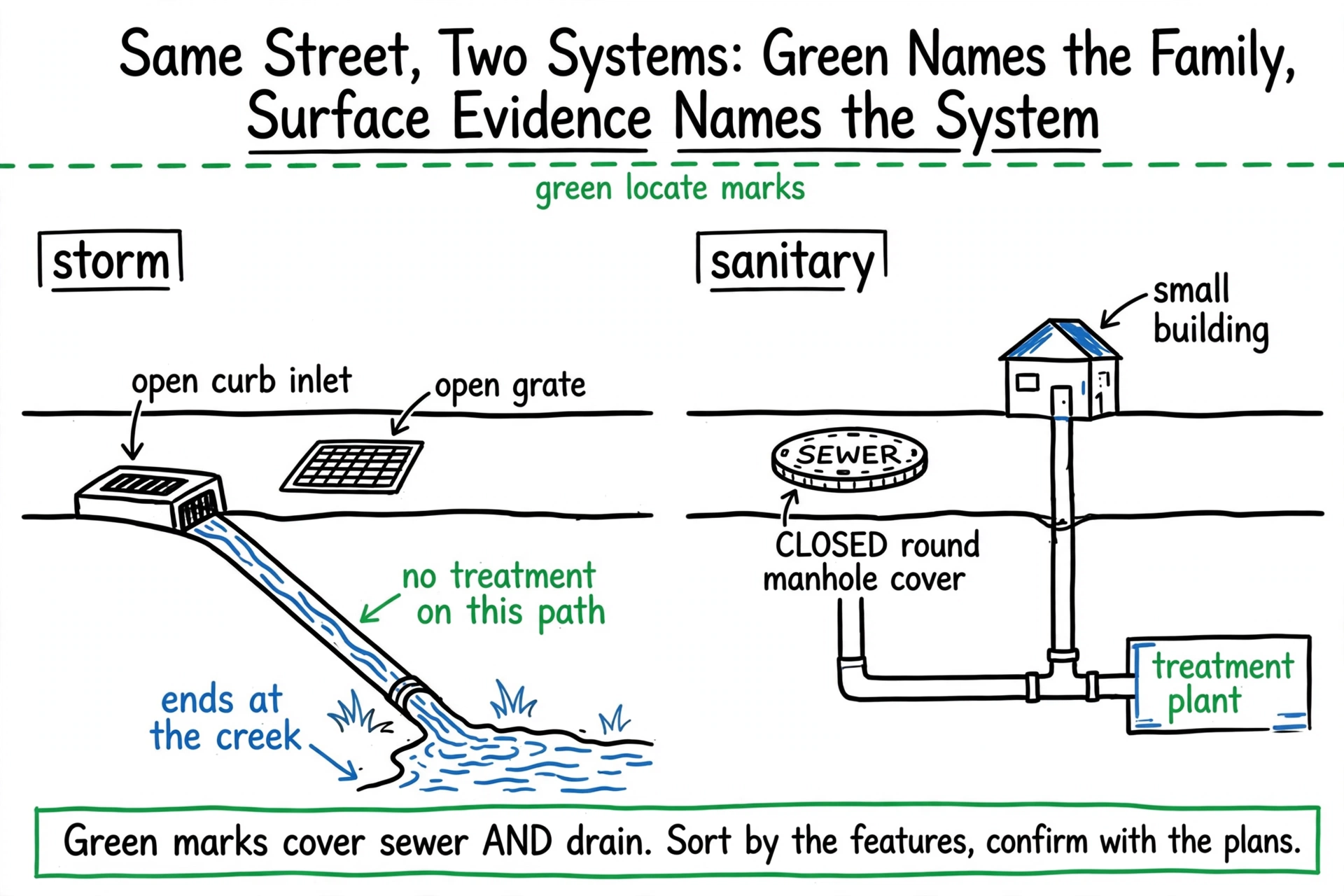
- Sort a green locate mark into the storm system or the sanitary system using surface evidence and the plans, and say why the color alone cannot do it.
- Trace where water entering an inlet ends up, and what that path means for sediment, spoil, and wash water from your own work.
- Set up a work area so your material cannot reach an inlet, ditch, or basin, and run the end of day check that proves the system is as you found it.
- State the hard boundary around storm structures: recognize, protect, and report, and never open or enter a storm manhole, catch basin, culvert, or pipe.
Start With the Basics
Start with rain. When rain falls on grass or open soil, much of it soaks into the ground. When rain falls on a roof, a road, a sidewalk, or a parking lot, it cannot soak in. Those hard surfaces are called impervious surfaces. Impervious means water cannot pass through. Rain that lands on an impervious surface stays on top and starts to move. Moving surface water is called runoff. Runoff flows downhill, following the slope of the pavement or the ground, and it picks up speed as more water joins it.
Runoff has to go somewhere. If nothing collected it, water would pool in low spots, flood streets and yards, erode soil, and damage pavement and buildings. So communities build a second drainage network alongside the sanitary sewer covered in Lesson 50. The sanitary system is a closed network of pipes that carries used water from inside buildings to a treatment plant. The storm system differs in one way you can see with your own eyes: it is open at the surface. It collects runoff through openings you can stand next to:
- Metal grates set in the pavement
- Openings cut through the curb
- Open inlets in parking lots and yards
- Open ditches along roads
The roof of a house shows the same pattern at small scale. A roof is an impervious surface. Gutters at the roof edge collect the runoff before it sheets off, downspouts carry it down, and it lands on the ground exactly as it fell, with whatever it picked up on the way. Nobody routes a roof gutter through a filter, and nobody would pour paint into one, because everyone understands it lands in the yard unchanged. The street system runs the same pattern at neighborhood scale: surfaces shed water, openings collect it, pipes carry it, and a waterway receives it. Nothing cleans it in between.
That leads to the second basic fact, and it shapes everything else in this lesson. In a separate storm sewer system, the water that enters those openings travels through underground pipes and is usually discharged to a nearby creek, river, lake, or other local waterway without going through a treatment plant first. The United States Environmental Protection Agency, usually shortened to EPA, describes this plainly: polluted stormwater runoff is commonly transported through municipal separate storm sewer systems and then often discharged, untreated, into local water bodies. Whatever washes into an inlet, including oil from a parking lot, loose soil from a construction site, trash, and chemicals, can travel the same path to the waterway. Nothing in the pipe cleans it on the way.
The third basic fact is about names. The same system goes by several names in the field and in documents:
- Storm sewer
- Storm drain
- Stormwater system
- Drainage system
The federal regulatory name for a publicly owned separate system is municipal separate storm sewer system, shortened to MS4. An MS4 is a conveyance, or system of conveyances, owned or operated by a public body that meets all of these tests:
- It is designed or used to collect or convey stormwater, through pipes, ditches, catch basins, curbs, gutters, and channels.
- It discharges to waters of the United States.
- It is not a combined sewer.
- It is not part of a sewage treatment plant.
You do not need to memorize that definition. You do need to recognize the term MS4 in a permit, a plan note, or a city document, because it tells you the storm system on that job is regulated and that keeping pollutants out of it is a legal requirement written into permits.
Finally, a word you will use constantly in this lesson is gravity. Storm sewers move water by gravity, which means the pipes are laid on a slope and water flows downhill from higher pipes to lower pipes without pumps doing the everyday work. Some systems use pumps in special places, but the normal picture is simple: water enters at a high point at the surface, flows downhill through pipes, and leaves at a lower point at an outfall. When something blocks that path, water backs up, and the backup shows itself at the lowest nearby opening, which is often the street in front of your work area.
What Is It?
A storm sewer system is a network of surface openings, underground pipes, and discharge points built to collect rainwater and snowmelt runoff from streets, parking lots, roofs, and other surfaces and carry it away to a receiving water or a managed storage area. Receiving water is the term for the creek, river, lake, pond, or wetland that receives the discharge at the end of the system.
The system has three jobs:
- Collection: gathering runoff quickly from the surfaces where people drive, walk, and park, before it pools deeply enough to become a hazard or cause damage.
- Conveyance: moving that collected water through pipes, culverts, and channels to a safe discharge point. Conveyance is the formal word for carrying something from one place to another, and engineers use it for the pipe network itself.
- Discharge: releasing the water at an outfall, the point where a storm pipe or channel ends and the water flows out into a ditch, a basin, or a receiving water.
Ownership matters for a field crew. Storm sewer systems in cities and towns are usually owned by a public body, such as a city, county, township, or drainage district, or by a state transportation department along its highways. Storm features on private property, such as inlets inside a large parking lot or a detention basin behind a shopping center, may be owned by the property owner or a homeowners association instead. You do not need to memorize which body owns the system on a given street. You do need the rule that follows from ownership: the system is never yours. No matter whose name is on it, a fiber crew does not own it, does not maintain it, and does not modify it. Your role is to recognize it, avoid damaging it, keep your work out of it, and report problems to your supervisor so the owner can be notified.
It also helps to understand what the storm system is not. It is not a trash container. It is not a place to wash tools, rinse out a bucket, or dispose of drilling fluid, concrete wash water, paint, or fuel. A discharge to a municipal separate storm sewer system that is not composed entirely of stormwater is called an illicit discharge in the federal MS4 program, except for discharges allowed under a separate NPDES permit and discharges resulting from firefighting activities. Certain other non-stormwater flows named in a permit, such as water line flushing or uncontaminated groundwater, are handled under permit conditions. None of those exceptions covers dumping or washing job materials into an inlet. Illicit means not allowed. Municipalities that operate under an MS4 permit are required to run a program to detect and eliminate illicit discharges, often shortened to IDDE. When a plan, a permit, or a city inspector uses the phrase illicit discharge, they are talking about exactly the kind of dumping this lesson tells you never to do.
One more distinction belongs here because it confuses many new field workers. A separate system and a combined system are two different designs. In a separate system, which is what communities have today in the main, sanitary sewage and stormwater travel in two different pipe networks. The EPA explains that in a separate arrangement, one set of pipes collects wastewater from homes and businesses and carries it to a treatment plant, while a separate set of pipes collects stormwater and carries it to a local waterway through the MS4. In a combined system, found mostly in older cities, wastewater and stormwater share the same pipes. In dry weather the combined flow goes to the treatment plant. In heavy rain the combined flow can exceed capacity, and the system is designed to relieve itself at permitted overflow points called combined sewer overflows, shortened to CSOs, discharging a mixture of stormwater and untreated wastewater to nearby waters. You will not sort out which design a city uses by looking at one grate. Plans, city records, and the utility owner tell you that. What you can do in the field is recognize the surface features in this lesson and remember that in a combined area, what enters an inlet follows a path that also carries sewage, which is one more reason to keep your hands off covers and out of structures.
What Does It Look Like?
This section walks the system from the street surface down to the discharge point, in the order water travels. Learn each feature by shape, location, and context, because no single clue is reliable on its own.
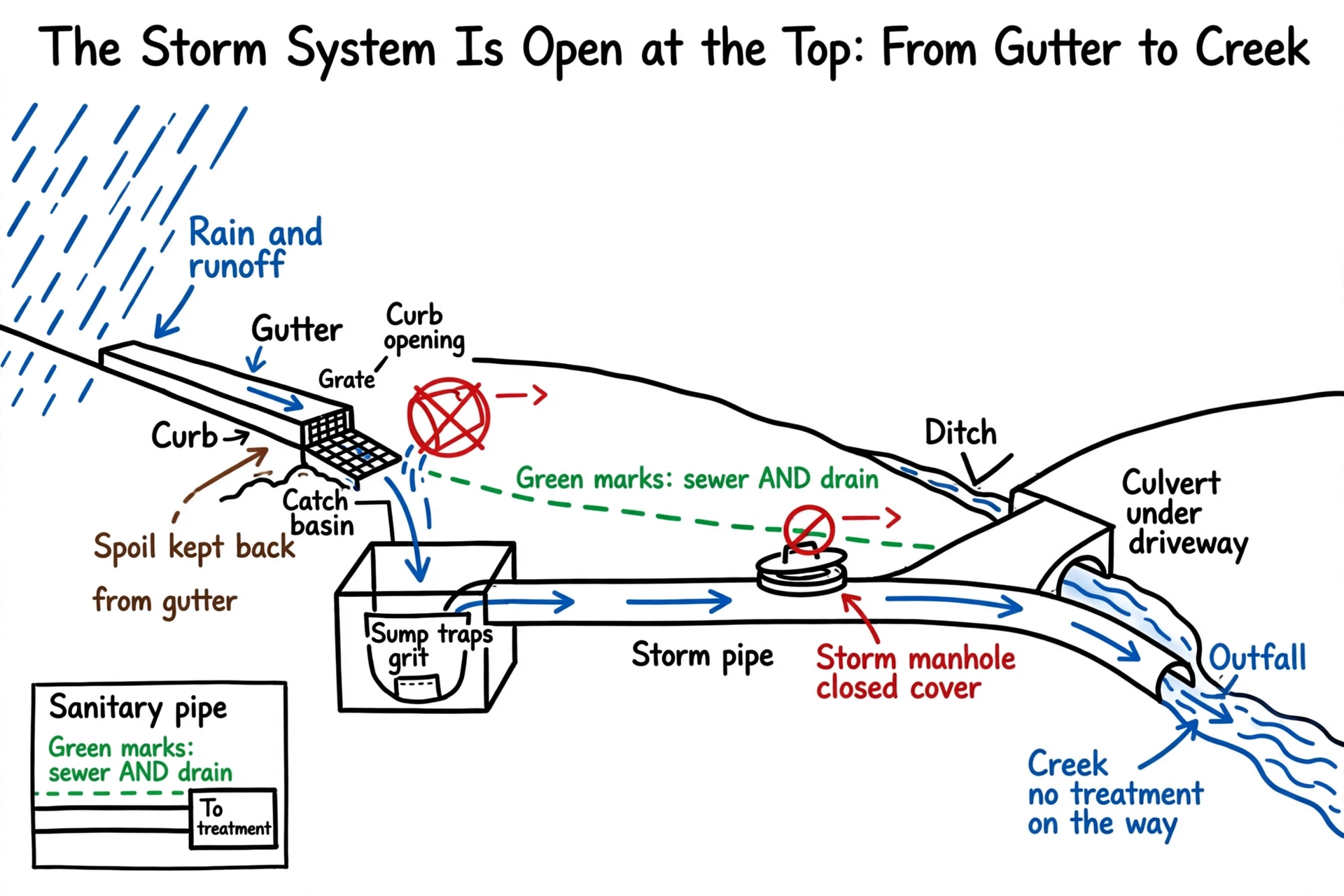
The gutter and the curb. A gutter is the shallow channel formed along the edge of a street, usually where the pavement meets the curb. The curb is the raised concrete or stone edge that separates the street from the sidewalk or shoulder. Gutters collect sheet flow from the road surface and carry it along the street to an inlet. When you see water moving along a curb line during rain, you are looking at the first working part of the storm system. A gutter full of leaves, sediment, or construction spoil is a system already losing capacity before the water reaches any pipe.
Curb inlets, also called curb openings. A curb inlet is a rectangular opening cut through the curb face, usually at the gutter line, that lets water flow sideways off the street into a structure below. From the sidewalk it looks like a dark slot or mouth in the curb, sometimes with a concrete lintel across the top. Curb openings resist clogging by large flat debris better than a flat grate does, which is one reason they are common on streets. A combination inlet pairs a curb opening with a grate in the gutter right next to it, so water has two ways in. If the grate mats over with leaves, the curb opening can still take water. Combination inlets are often found at low points where water collects, which engineers call sag locations.
Grated inlets. A grated inlet is a metal grate set into the pavement or gutter so water falls vertically through it. Grates are usually cast iron or steel, rectangular, with slots or openings patterned across the surface, and they sit in a frame at pavement level strong enough to carry vehicle loads where traffic drives over them. Grates keep large objects, and people, out of the structure below, but the openings are wide enough that small debris and sediment pass through easily. That trade-off is intentional, and it is why the structure below the grate exists. In parking lots the same idea appears as an area drain: a grate set in the pavement away from any curb, collecting runoff from the surrounding slab. In grassed areas you may see a raised or domed grate, sometimes called a beehive grate because of its rounded shape, sitting in a lawn or swale. Specific grate patterns, sizes, and load ratings are set by owner standards and the manufacturer and vary by jurisdiction, so treat any exact dimension you hear as something to verify against the project documents.
The catch basin. Below many inlets sits a catch basin. A catch basin is an underground box structure, usually concrete, that receives water from the inlet at the top and connects to a storm pipe on its side. Below the level where the pipe leaves, the basin extends into a deeper pocket called a sump. The sump is a settling space. Heavy material that washes in, such as sand, grit, and small debris, drops into the sump instead of traveling on into the pipe. Bentley Communities documentation for storm and sanitary design software describes the same arrangement in plain terms: a catch basin is an inlet to the storm drain system that typically includes a grate or curb inlet where stormwater enters and a sump to capture sediment, debris, and associated pollutants. The sump only works if it is cleaned periodically, because a full sump has no room left to trap more. From the surface you cannot see the sump. Sediment or debris piled at the inlet above it is a sign the structure below may be full or blocked. In the field, people often use the words inlet, storm drain, and catch basin loosely for the whole assembly. That is fine for conversation as long as you understand the parts: the inlet is the opening, the catch basin is the box below it, and the pipe carries the water away.
Storm manholes. A storm manhole is a vertical underground access structure, usually a round concrete shaft with a heavy round cast iron frame and cover set flush with the pavement or ground. Manholes give the owner access to inspect and maintain the pipes, and they are placed where pipes change direction, size, or slope, join other pipes, and at intervals along straight runs. The cover is the main surface clue. Many owners cast words into their covers, and a municipal specification example shows the pattern clearly: in sanitary sewer systems the word SEWER is cast onto the cover, and in storm sewer systems the word STORM is cast onto the cover. Other covers read DRAIN, STORM DRAIN, or STORM SEWER. Do not treat the lettering as a guarantee. Covers get swapped during repairs, older covers may carry no words, and a cover tells you what was intended, not always what is below. Use the cover as one clue alongside location, nearby inlets, plans, and locate marks. A storm manhole cover is solid on many systems, because that access structure is not the collection point. Some owners do use perforated or grate type covers on drainage structures, so solidity varies by owner standard. The useful contrast still holds as a starting clue: inlets are open collection points by design, and a manhole is an access point by design, whatever its cover pattern. Do not use the cover pattern alone to identify the system or to judge what is below. A small hole pattern in a cover can be a pick hole used to lift it with a hook, which is normal. A cover that sits crooked, rocks, is cracked, or sits below the pavement surface is a defect and a hazard, and it belongs in a report.
Pipes. Storm pipes run underground between structures, from inlets and manholes toward the outfall. You rarely see them except where they are exposed in a ditch, at an outfall, or during someone else’s excavation. They are commonly made of reinforced concrete, corrugated metal, or plastic such as high density polyethylene. Storm pipes are sized to move a large volume of water in a short time during a storm, while a sanitary system moves a smaller, steadier flow, so a storm pipe can be larger than a nearby sanitary pipe. Size varies too much by location to identify a pipe by size, and size alone never identifies the system. Do not rely on size alone to identify a pipe, and never state a pipe diameter, depth, or slope as fact unless plans or the owner confirm it. Pipe sizes and depths vary widely by design, location, and era, and this lesson deliberately gives no standard numbers because there is no single standard number to give. If you expose or encounter a pipe during fiber work, stop, protect it, and let your supervisor and the locate process do their jobs.
Ditches, swales, and channels. Not all storm conveyance is in pipes. A ditch is an open channel, usually along a road, that collects and carries runoff. A swale is a shallow, wide, gently sloped channel, often grassed, that moves water more slowly and lets some of it soak in and some sediment settle out. Along rural and suburban roads, ditches and the culverts beneath driveways may be the entire visible storm system, with no inlets or underground pipes at all. A ditch filled with spoil, flattened by equipment crossings, or blocked by a stockpile no longer does its job, and the water it carried will find its own path, often across the road or through a yard.
Culverts. A culvert is a pipe or box structure that carries water under a road, driveway, railroad, or embankment. It is open at both ends. The National Academies summary of Federal Highway Administration research defines culverts as buried drainage structures underneath roadways or embankments that are open at both ends and are used to convey and transport water. Field clues are the two open ends: an inlet end where water enters, often finished with a headwall or a flared end section, and an outlet end where water leaves. A headwall is a vertical wall of concrete or other material built around the end of the pipe to hold back the embankment soil and protect the pipe end. You will commonly see culverts where driveways cross a roadside ditch and where the road itself crosses a low drainage path. A fiber bore crossing a road or driveway can conflict with a culvert, because the culvert occupies the same crossing zone under the pavement or embankment. Culvert depth and cover vary by design and location, so do not assume a culvert is shallow or deep. Recognizing both ends of a culvert before work starts tells you a drainage path crosses your route even where no marks appear on the pavement.
Outfalls. An outfall is the end of the line, the place where collected stormwater leaves the pipe system and discharges to a ditch, a basin, a creek, or another receiving water. At an outfall you may see the open end of a large pipe, a headwall, stone placed to slow the water and protect the bank from erosion, and sometimes a grate or screen across the opening. An outfall proves the system is live and connected: everything upstream drains to this spot. The area around an outfall is often wet, soft, and eroded, and it may be protected as part of the waterway. Staging equipment, stockpiling spoil, or parking on an outfall structure can damage it and can put sediment directly into the receiving water. Treat any open pipe end discharging toward a creek as an outfall until the owner confirms otherwise.
Detention and retention basins, at recognition level. Larger developments often include a basin, a constructed low area that holds stormwater. A detention basin temporarily stores runoff and releases it gradually through an outlet structure until the basin empties, so it is usually dry between storms and looks like a wide grassed depression with an outlet structure at the low end. A retention basin is designed to permanently hold water, so it looks like a pond. It keeps a permanent pool. Storm storage above that pool is commonly released in a controlled way through a riser or outlet structure set above the pool level, with an emergency spillway for large events, and in some designs water also leaves by infiltration or evaporation. Some local definitions describe retention basins with no outlet structure, so terminology and design vary by region and the owner or project records control for a specific basin. Terminology varies by region, and some wet ponds combine both functions, so use appearance as a clue and owner or project records as the authority. Either way, a basin is a working part of the storm system, its banks and outlet structure can be damaged by equipment, its bottom may be soft even when it looks dry, and it is not a place to stockpile material or park.
Stamps, markers, and paint. Many communities stamp or mark their inlets with messages such as Dump No Waste or Drains to Waterway, sometimes with a fish symbol. These markers exist because the inlet connects directly to local waters. Take them literally. Green locate paint and green flags mark the buried pipes between these surface features. Put together, the surface features, the markers, and the paint give you a connected picture: follow the inlets along a street and you are tracing the top of the buried system.
What Does It Do?
The storm sewer system moves large amounts of rainwater away from the places people use, quickly enough to keep streets passable and property dry, and delivers that water to a discharge point. Each part you learned to recognize does a piece of that job:
- The gutter gathers thin sheet flow off the pavement and concentrates it into a shallow stream along the curb.
- The inlet interrupts that stream and drops the water underground.
- The catch basin slows the water for a moment, lets the heaviest grit settle into the sump, and passes the water into a pipe.
- The pipes and manholes convey the combined flow from many inlets downhill toward the low end of the system.
- Culverts carry the flow under roads and driveways so the drainage path is not cut off by the very pavement that creates the runoff.
- Ditches and swales do the same conveying job in the open air where pipes were never installed.
- Basins, where they exist, hold back the peak of a storm and release it slowly, which reduces flooding and erosion downstream.
- The outfall delivers the water to the receiving water.
Notice what is missing from that list: treatment. In a separate system, the pipe and inlet network itself does not screen, filter, or disinfect the water, and there is no treatment plant on the storm path. Catch basin sumps trap some grit by design, and wet basins can settle some sediment and pollutants by design, but that limited settling ends well short of treatment plant treatment, and it stops helping when the sump or basin is not maintained. The EPA makes the same point when it describes polluted runoff being transported through MS4s and discharged, untreated, into local water bodies. The honest summary is this: the storm system is a transport system. Its job is to move water. Protecting water quality is done mostly by controlling what reaches the inlets in the first place, which is why municipal permits focus on street sweeping, catch basin cleaning, construction site controls, and stopping illicit discharges.
The system also protects the road itself. Pavement fails faster when water stands on it or soaks the base beneath it. By removing water quickly, the storm system reduces hydroplaning risk for drivers, limits icing from standing water in cold weather, protects the roadbed, and keeps intersections and crosswalks usable during rain. When residents say a street drains well or drains poorly, they are grading this system.
It helps to contrast the daily rhythm of the two sewer systems. The sanitary system works hardest in the morning and evening, when people shower, cook, and wash, and its flow is fairly steady and predictable. The storm system may sit almost empty for weeks and then be asked to move a huge volume in an hour during a heavy storm. That rhythm explains three field facts:
- Storm pipes and structures are sized for events rather than average days.
- A single blocked inlet can flood an intersection while the rest of the system is fine.
- An inlet buried under spoil in dry weather is still an urgent problem, because the system will be tested without warning, on the next storm, and not on a schedule.
Where Does It Fit?
The storm system sits inside two larger pictures. The first is the physical picture of the street corridor, where your fiber work happens. In a typical curb and gutter street, the storm pipes run under the street or just behind the curb, with inlets at the curb line and manholes in the pavement. Sanitary sewers, water lines, and electric, gas, and communications facilities share the same corridor. Depths and exact positions vary by city, by era, and by design, and no honest lesson can give you a standard depth for a storm pipe on your street. That variability is the reason the locate process exists, and it is why this level of the curriculum teaches recognition of every utility family in the corridor rather than a memorized map of where each one supposedly lies.
The second picture is the regulatory picture. At the federal level, stormwater discharges from MS4s are regulated under the Clean Water Act through the National Pollutant Discharge Elimination System, shortened to NPDES, the federal permit program that controls discharges of pollutants to waters of the United States. The EPA NPDES stormwater program covers three broad sources:
- Municipal separate storm sewer systems
- Construction activities
- Industrial activities
EPA authorizes most states to run the NPDES program within their borders, so on a given job the operative permit may be a state issued permit that carries out the federal requirements. That layering is a distinction this curriculum asks you to keep straight: the requirement to control stormwater pollution is federal in origin, the permit you work under is often state issued, the storm system you work around is usually owned locally, and the day to day rules on your site come from the contract documents and the owner standards. When someone says a practice is required, ask which of those levels requires it.
Construction work connects to the storm system in a specific way. A fiber project that disturbs soil can put sediment into runoff, and sediment is one of the most common pollutants in stormwater. That is why jobs carry erosion and sediment controls, such as silt fence, inlet protection, stabilized entrances, and prompt cleanup of tracked mud, and why inspectors check them. Inlet protection is any approved barrier or device placed at or inside an inlet to keep sediment out while still letting water in. The exact control required, its product, and its placement come from the project stormwater plan and local rules, not from this lesson. Your recognition skill is what makes those controls meaningful: you cannot protect an inlet you did not notice, and you cannot keep spoil out of a basin you mistook for an empty lot.
The storm system also fits into Level 3 of this curriculum as the second half of a pair. Lesson 50 covered the sanitary sewer, a closed system carrying wastewater to treatment. This lesson covers the storm sewer, an open system carrying runoff, usually without treatment, to local waters. The next time you stand at an intersection you will likely be looking at both systems at once: manholes in the pavement, inlets at the corners, and green paint on the ground tying them together. The professional skill goes one step past recognizing each feature: sorting the features into the right system, every time, because the rules for working around them differ.
That sorting problem is built into the locate marks. The APWA uniform color code, maintained by the American Public Works Association, assigns green to sewers and drain lines. One color covers sanitary sewers, storm sewers, and other drain lines together. Hawaii’s published summary of the APWA code states it directly: green means sewers, drainage facilities, or other drain lines. So a green line on the pavement tells you a gravity pipe carrying wastewater or drainage is below, and it cannot tell you which system the pipe belongs to. You sort that out with surface evidence: inlets and open features point to storm, building connections and closed manholes with SEWER lettering point to sanitary, and plans settle what the surface cannot. Anyone who treats green as if it meant only one system will eventually damage the other one or keep the wrong controls in place.
What Is at Stake
Flooding. The storm system is the only engineered path for runoff on a paved street. When inlets are blocked by leaves, trash, sediment, or construction material, or buried under spoil and paving debris, the water that should have entered the system stays on the surface. The result is ponded intersections, flooded lanes, water against building entrances, and in heavier events, property damage. Blockage does not require a broken pipe. A mat of leaves over a grate or a windrow of spoil across a gutter can do it. Construction crews are in a position to cause this harm without ever touching a pipe, simply by where they place material and where their runoff carries sediment. They are also in a position to prevent it, which is why this lesson exists.
Water quality. Because separate storm systems usually discharge without treatment, anything your work allows into an inlet goes toward a local waterway. Sediment clouds water and settles over the habitat on the bottom of creeks. Drilling fluid, fuel, concrete wash water, and paint carry pollutants that are far worse than sediment. Municipalities carry permit obligations to keep those materials out, and a contractor whose work causes an illicit discharge can create enforcement, cleanup costs, and stop work consequences for the whole project, with the specific penalties set by the applicable federal, state, and local rules and the contract. The cheapest stormwater control on any job is a crew that recognizes inlets and keeps everything else out of them.
Damage and cost. Storm structures are expensive to repair and disruptive to replace. A grate or frame cracked by equipment, a catch basin wall broken by an excavator bucket, a culvert end crushed by a loaded truck crossing a ditch, or a pipe damaged by a bore can each turn into a repair the project pays for, plus traffic disruption while the street is opened. Storm pipes are also a classic conflict for directional drilling, because they cross streets and driveways at exactly the places fiber laterals and crossings are installed, and because a drill head cannot feel the difference between soil and a thin walled pipe until it has already damaged it. Locates, potholing where the plan requires it, and the recognition skills in this lesson are how that damage gets prevented.
Safety. Storm manholes and other drainage structures can be confined spaces. A confined space is a space that is large enough for a person to enter, has limited means of entry and exit, and is not designed for continuous occupancy. Federal OSHA’s construction standard for confined spaces, 29 CFR 1926 Subpart AA, lists manholes, including sewer and storm drain manholes, and storm drains themselves among the places where confined spaces occur. The North Carolina Department of Labor summary of Subpart AA gives the same examples, including sewer and storm drain manholes, tanks, sewers, and storm drains. A storm structure can contain a hazardous atmosphere, can fill with water rapidly during rain, and can collect debris and sharp material. A permit required confined space is a confined space with additional serious hazards, and entry into one requires a written program, trained and authorized entrants, atmospheric testing, an attendant, and rescue arrangements under the standard. None of that is part of a fiber crew’s normal work. The rule that follows is absolute and has no field exceptions: never open a storm manhole cover and never enter a storm manhole, catch basin, large culvert, or storm pipe, for any reason, including retrieving a tool, a phone, or material. If something falls in, report it. If a job appears to require entry, stop and escalate. Recognizing a confined space is your job. Entering one is not.
Assumption. A quieter hazard runs through the rest: the wrong assumption. A frequent storm sewer mistake on a fiber job comes from treating a drain as if it were a sewer that goes to treatment, treating a green mark as if it named a single system, treating a dry basin as vacant land, or treating a grate covered with leaves as the city’s problem when your own spoil created it. Every one of those assumptions is prevented by the recognition habits in this lesson, which is why the lesson spends so much of its length on what things look like.
What Does Good Look Like?
Good, for a storm system you are working around, means the system can still do its job exactly as it did before your crew arrived, and it looks that way at a glance.
- Inlets are open and visible. Grates are clear of leaves, sediment, trash, and material, and curb openings are unobstructed from the gutter to the back of the curb. Where the project requires inlet protection, the protection is in place, intact, and installed so water can still enter while sediment cannot. A protected inlet that ponds water across a lane because the device is clogged or wrong for the location is not good work; protection that defeats drainage trades one problem for another. The balance to aim for is simple to state: sediment stays out, water gets in.
- Gutters and pavement around the work area are clean. There is no windrow of spoil along the curb, no tracked mud drying in the gutter, no stockpile where runoff will carry it to an inlet, and no material staged on top of a grate or in front of a curb opening. Spoil piles that must sit near drainage are placed and protected according to the project plan, set back from inlets and ditches rather than beside them. Ditches keep their shape and their flow line, with no spoil, mats, or crossings flattening them without the owner’s approval.
- Covers and frames are sound. Manhole covers sit flush and stable in their frames, with lettering legible, no cracks, and no rocking when traffic passes. Grates sit level in their frames without broken bars. Nothing about your work has changed how a cover or grate sits, because your work never moved one.
- Outfalls and basins are untouched and unobstructed. No equipment is parked on an outfall structure, no spoil is placed where it can wash into a basin, and basin banks and outlet structures show no new ruts, cracks, or displaced stone. If your route passes near a basin, it follows the plan and the access the owner allows, and not the shortest line across the bank.
- Locates are respected and the record is clear. Green marks are visible and preserved where they cross your work, potholes and exposures are documented when the plan requires them, and any storm feature your crew found that was not on the plans is reported the same day, with its location described well enough for the next crew to find it. The owner or the city contact hears about preexisting damage from you, with photos, before your work begins near it, so your crew is not blamed for a cracked grate you inherited and so the defect is on record for repair.
- The end of day test passes. Before leaving, a crew member walks the work front and looks at every inlet, grate, cover, ditch, and outfall the work touched or approached, confirms each one is clear, uncovered, and undamaged, and confirms no wash water, fluid, or debris from the day’s work is sitting where rain will carry it into the system. That two minute walk is what good looks like in practice.
From the Field
Picture a three-person fiber crew arriving to place a short underground crossing on a residential street with curb and gutter on both sides. The locate paint is fresh. Orange marks show the planned communications path, and green marks run along both curb lines and across the street at the crossing point. Before unloading, the crew leader walks the front. She counts four inlets: a combination inlet at the low corner on the near side, a grate inlet across the street, and two curb openings farther down the slope. The near corner inlet has leaves matted over its grate, and the curb opening next to it is clear. She photographs the leaf mat so the preexisting condition is on record.
At the crossing point, the green marks cross the planned bore. The crew checks the plan, which shows a storm pipe crossing at that location, separate from the sanitary main that runs down the center of the street. The STORM lettering on the manhole cover in the intersection supports that reading, while a second cover lettered SEWER sits in line with the center main. The crew treats the green crossing as storm, confirms the required clearance and potholing steps from the plan and the supervisor’s direction, and adjusts the bore profile rather than assuming the pipe is deep enough to ignore. No one states a depth for the pipe, because no document on site gives one, and the plan note controls the work instead.
Spoil handling is where the lesson pays off a second time. The first convenient spot for the spoil pile is the gutter, directly uphill of the combination inlet. The crew leader moves the pile onto the pavement away from the gutter line, and the crew places the inlet protection the project plan requires at the corner inlet before any soil is disturbed. Midday, cuttings and fluid are handled inside the contained work area, and at cleanup nothing is rinsed toward the street.
Because the project plan calls for surface housekeeping at that inlet and the crew leader directs it, the crew rakes the leaf mat off the grate from the surface, without opening or reaching into anything, leaves the curb opening as they found it, and does not lift any cover at any point in the day.
At the end of the shift the walk-off check finds all four inlets clear, the covers untouched, the green marks still visible, and no sediment track leading toward the corner. The crew leader notes in the daily record that the crossing was completed per plan, that one inlet had a preexisting leaf blockage that the crew cleared from the surface, and that no storm structure was opened or entered. A storm two nights later floods nothing on that street. Nobody outside the crew notices anything, which is exactly what success looks like around storm infrastructure.
Carry the order of operations as the decision rule: recognize first, sort the systems second, set up so your own material cannot reach the inlets third, do the planned work fourth, and verify at the end. Each step is cheap. Skipping any one of them is how the failures in the next section begin.
What Can Go Wrong?
- Blocked and buried inlets. A frequent failure is also the easiest to cause. Leaves and trash mat over a grate. Sediment from an unprotected work area builds a delta in the gutter. A spoil pile or a pallet covers a grate entirely. A paving or restoration crew leaves debris over a curb opening. The pipe system below may be in perfect condition, but water cannot reach it, so the street floods at that corner. During a heavy storm the ponded water can enter buildings, stall vehicles, and create a hazard the city will trace back to the blocked inlet and to whoever blocked it.
- Sediment and spoil reaching the system. Even when inlets stay open, fine material passes through them. Sediment loads fill catch basin sumps, then begin filling pipes, reducing capacity storm by storm until a rain that the system once handled now floods the street. Sediment that passes all the way through discharges at the outfall and clouds the receiving water. For a construction project this is both an environmental violation risk and a maintenance debt handed to the owner. It is also cumulative and quiet, which is why plans require controls before soil is disturbed rather than cleanup after damage is visible downstream.
- Dumping and washing into inlets. A worker rinses drilling equipment, a bucket, or a saw toward the gutter because it is convenient. Another empties wash water into an inlet because it looks like a drain that goes somewhere safe. In a separate system that material goes to a waterway, which makes the act an illicit discharge under the MS4 program and, depending on the material and the jurisdiction, a violation of local ordinance and state or federal law. Concrete wash water, fuels, solvents, and drilling fluids are all on the wrong side of this line. For a fiber crew the field rule has no small amount exception: if it is not stormwater, meaning rain runoff or snowmelt, it does not go in the inlet. Wash water, drilling fluid, concrete wash water, fuel, and paint from your work never go in, in any amount.
- Structural damage. Equipment strikes and excavation damage take several forms: a cracked or displaced grate or frame, a broken catch basin wall, a crushed culvert end, a pipe cracked by an excavator or pierced by a drill, and a manhole frame knocked out of grade. A damaged pipe may not fail on the spot. It can leak soil into the pipe with each storm, slowly forming a void under the pavement that appears months later as a dip or a sinkhole. That delayed failure pattern is one reason any contact with a storm pipe or structure, even contact that looks harmless, must be reported the day it happens rather than watched.
- Crossing and connection mistakes. Crews occasionally encounter old or undocumented drainage: a yard drain tied into the storm pipe, a ditch connection, a pipe shown on no plan. The failure mode is assuming such a feature is abandoned and cutting, capping, or filling it. An undocumented drain may be carrying a neighbor’s roof and yard drainage, and blocking it moves flooding onto that property. Unknown drainage is treated as live until the owner says otherwise in writing.
- Confined space entry. The worst outcomes in storm work involve people entering structures. A worker opens a manhole to retrieve a dropped tool or to look at a problem, or climbs into a catch basin or large culvert, and encounters bad air, sudden water, or an inability to get out. Subpart AA exists because construction workers were injured and killed in exactly these spaces, and its examples include storm drain manholes and storm drains by name. No schedule pressure and no lost tool justifies entry. The correct response to anything inside a storm structure is to keep people out and call the supervisor, who contacts the owner.
- Misidentification. A crew reads a green mark as sanitary only and relaxes around a storm crossing, or reads a STORM cover as a guarantee and stops checking the plan. A crew treats a combined sewer area as if it were separate and assumes an inlet leads only to a creek. Each misidentification converts a recognition failure into a work decision, and the work decision is where damage and violations happen. Sorting features by multiple clues, and verifying against plans and locates, is the control for this failure.
What Should Someone Notice in the Field?
Run the same short scan every time you arrive at a work location, before equipment is placed. Walk the front and look for the following.
- Count and locate every inlet. Find each grate, curb opening, combination inlet, and area drain on your side of the street and across it if your work or your runoff reaches that far. Note which ones are already blocked, buried, damaged, or full of standing debris, and photograph preexisting problems before you disturb anything.
- Read the covers. Look at every manhole cover in and near the work area. Read the cast lettering if there is any, and sort the covers into storm, sanitary, and unknown. Treat unknown covers as live utility structures of an unconfirmed system. Note covers that are cracked, rocking, sunken, raised, or missing, and keep equipment off damaged covers.
- Follow the green. Find the green paint and flags and trace where they run relative to your bore path, trench, or excavation. Remember that green means sewer or drain without saying which, so match each green run to a surface feature or a plan note before you rely on it. Where green runs toward an inlet or a storm manhole, you are looking at storm. Where it runs building to building with no inlets, suspect sanitary and confirm.
- Check the low ground. Water collects at low points, and so do storm features. Sag locations in the street, the bottom of a slope, the low corner of a parking lot, and the far side of a driveway crossing are the places to look hardest for inlets, culverts, and outfalls. If the ground falls toward your work area, assume runoff from above will cross your work and plan where it will go.
- Look for ditches, culvert ends, and outfalls. Along any road without curb and gutter, walk the ditch line. Find each culvert end, note crushed or blocked ends, and mark mentally where drainage crosses under driveways and under the road itself. At the downhill end of the job, look for the outfall and the receiving water it feeds. If you can see a creek, pond, or wetland from the work area, assume a short path connects your work to it.
- Notice water evidence even on a dry day. Sediment fans below inlets, stained pavement, debris lines along curbs, algae or damp soil at an outfall, and erosion channels in a ditch all tell you where water actually travels, which is sometimes different from where a plan suggests it should. A dry basin with a visible high water line and an outlet structure tells you it fills in storms and is not spare land.
- Notice what your own setup threatens. Before work starts, look at where spoil will sit, where the drill fluid and cuttings will be handled, where trucks will track mud, and where wash water would flow if anything were rinsed. If any of those paths lead to an inlet, a ditch, or a basin, change the setup first. Recognition that does not change the setup is only trivia.
- Report, do not fix. If you find a missing or broken cover, a collapsed grate, a blocked inlet that is flooding property, a damaged outfall, or an unknown pipe, your job is to make the area safe from a distance if you can do so without opening or entering anything, notify your supervisor promptly, and document the location. Do not assume clearing an inlet is your crew’s job. If the project plan and your supervisor direct surface housekeeping at an inlet, it is limited to loose material on top of the grate, cleared from the surface without opening anything, reaching into anything, or entering anything. Opening structures, reaching into them, or entering them is never part of that housekeeping. When in doubt about which side of the line an action falls on, stop and ask.
- Hold the safety boundary. Recognizing storm structures and reading their condition is your job, and this lesson teaches exactly that. Opening a cover or entering a storm manhole, catch basin, culvert, or pipe is never your job, and no part of this lesson qualifies you for it.
Key Terms
Storm sewer system: The network of inlets, pipes, structures, channels, and outfalls that collects runoff from surfaces and conveys it to a receiving water or storage basin.
Runoff: Rainwater or snowmelt that flows over the surface of the ground or pavement instead of soaking in.
Impervious surface: A surface such as pavement, concrete, or a roof that water cannot pass through, so rain on it becomes runoff.
Storm inlet: Any surface opening designed to admit runoff into the storm system, including curb openings, grated inlets, and combination inlets.
Catch basin: The underground box structure below an inlet that receives water, traps heavy sediment in a sump, and connects to a storm pipe.
Sump: The deeper pocket at the bottom of a catch basin where sediment and grit settle out of the water.
Curb inlet: An inlet formed by an opening in the curb face at the gutter line.
Grated inlet: An inlet covered by a metal grate set in the pavement through which water falls into the structure below.
Storm manhole: A closed, covered access structure over storm pipes, used by the owner for inspection and maintenance.
Culvert: A pipe or box structure, open at both ends, that carries water under a road, driveway, or embankment.
Headwall: A wall built around the end of a culvert or outfall pipe to retain the surrounding soil and protect the pipe end.
Outfall: The point where a storm system discharges its flow to a ditch, basin, or receiving water.
Receiving water: The creek, river, lake, pond, or wetland that receives a storm system discharge.
Ditch: An open channel, usually along a road, that collects and conveys runoff.
Swale: A shallow, wide, gently sloped channel, often grassed, that conveys runoff slowly.
Detention basin: A basin that temporarily stores runoff and releases it gradually through an outlet until it empties, so it is usually dry between storms.
Retention basin: A basin designed to permanently hold a pool of water. Excess storm storage above the permanent pool is commonly released through an outlet structure set above the pool level, and in some designs water also leaves by infiltration or evaporation.
MS4: Municipal separate storm sewer system, the federal term for a publicly owned separate storm system that discharges to waters of the United States and is regulated under the NPDES permit program.
NPDES: National Pollutant Discharge Elimination System, the federal permit program under the Clean Water Act that controls discharges of pollutants to waters of the United States.
Illicit discharge: Any discharge into a storm system that is not composed entirely of stormwater, such as dumped wash water, fuel, or paint.
Separate system: A design in which sanitary sewage and stormwater travel in two different pipe networks.
Combined system: A design, mostly in older cities, in which sewage and stormwater share the same pipes and can overflow at permitted points during heavy rain.
Confined space: A space large enough for a person to enter, with limited entry and exit, that is not designed for continuous occupancy. Storm manholes and storm drains can be confined spaces.
Check Your Understanding
Answer each question in your own words before reading the answer key.
- A coworker says the grate in the parking lot and the manhole cover in the street are the same kind of feature because both are metal and both connect to pipes underground. What is wrong with that statement, and what is the functional difference between the two features?
- Green paint runs across your bore path. Your coworker says green means sanitary sewer, so the crossing has nothing to do with this lesson. Correct the mistake and describe two other clues you would use to sort out which system the green line belongs to.
- Why does it matter so much that a separate storm system usually discharges without treatment? Answer in terms of what happens to sediment, drilling fluid, and wash water that enter an inlet on your job.
- During setup you find that the most convenient spoil location sits in the gutter just uphill of a combination inlet, and rain is forecast overnight. What do you do, and why?
- Your lead drops a tool and it falls through a grate opening into the catch basin below. A crew member offers to lift the nearest manhole cover and climb down to get it. What is the correct response, and what rule and regulation support it?
Answer key
- A grate is an inlet, which is open by design so surface water can enter the storm system. A manhole cover is a closed access lid over a structure, closed by design so surface water and people stay out. They serve different functions, collection versus access, and they are treated differently in the field: inlets are kept clear, covers are never opened by a fiber crew.
- Green in the APWA uniform color code covers sewers and drain lines together, meaning sanitary sewers, storm sewers, and other drain lines share one color. The color alone cannot identify the system. Useful sorting clues include surface features connected to the line, such as inlets and STORM lettered covers pointing to storm and building connections pointing to sanitary, and the project plans and locate documentation, which are the authority when surface clues conflict.
- Because there is no treatment plant on the storm path, material that enters an inlet travels through pipes and out the outfall to a local waterway essentially as it entered. Sediment fills sumps and pipes and clouds the receiving water, drilling fluid and wash water become illicit discharges, and the project can face cleanup and enforcement consequences. Prevention at the inlet is the only real control, since nothing downstream cleans the water.
- Move the spoil away from the gutter and away from the flow path to the inlet, place it where the project plan directs, and install or confirm the inlet protection the plan requires before disturbing soil. Spoil in a gutter is already in the system’s collection path, and overnight rain will carry its sediment into the inlet and downstream even if no one is on site.
- Nobody opens the cover and nobody enters. Storm manholes and storm drains can be confined spaces under OSHA 29 CFR 1926 Subpart AA, and entry requires a program, training, testing, and authorization that a fiber crew does not have. The tool is reported to the supervisor, the structure stays closed, and retrieval, if it happens at all, is arranged through the supervisor and the utility owner.
Lesson Takeaway
The storm sewer system is the open half of the drainage world. You recognize it by its openings: grates and curb openings in the gutter, area drains in pavement, beehive grates in grass, ditches and culvert ends along roads, STORM lettered manhole covers in the street, and an outfall where the collected water leaves for a creek or basin. It carries rain and runoff, usually without treatment, to local waters, which makes every inlet on your job a direct doorway to the environment. Green marks tell you a sewer or drain is below, and only surface evidence and plans tell you which system it is. A fiber crew’s whole duty around this infrastructure fits in one sentence: recognize it, protect it, keep sediment, spoil, and every other material out of it, report damage and defects, and never open or enter any part of it.
Sources and Technical References
The following sources were consulted for this lesson. Claims about federal programs follow the EPA sources. Claims about marking colors follow the APWA code as published by the sources below. Confined space claims follow the OSHA standard as summarized by the North Carolina Department of Labor, an OSHA state plan agency. Feature definitions follow the design and municipal sources listed.
- United States Environmental Protection Agency, NPDES Stormwater Program. Overview of stormwater runoff, the three regulated sources (MS4s, construction activities, and industrial activities), and the role of NPDES permits. https://www.epa.gov/NPDES/stormwater
- United States Environmental Protection Agency, Combined Sewer Overflow Basics. Definitions of separate sanitary sewer systems, MS4s, combined sewer systems, and combined sewer overflows. https://www.epa.gov/npdes/combined-sewer-overflow-basics
- Stormwater Solutions summary of EPA MS4 definitions, What is an MS4? MS4 as a publicly owned conveyance system designed to collect or convey stormwater, not a combined sewer and not part of a treatment plant. https://www.stormwater.com/stormwater-management/sewers-drainage-systems/article/53076757/what-is-an-ms4
- C and S Companies, A Closer Look at the MS4 Program. MS4 components including pipes, ditches, catch basins, and detention ponds, direct discharge to receiving waters, and the Clean Water Act and NPDES framework. https://www.cscos.com/the-ms4-program/
- APWA Uniform Color Code as published by Dig Safely Hawaii. Green for sewers, drainage facilities, or other drain lines, with the full color list. https://digsafelyhawaii.com/ticketing-tools/apwa-color-code/
- Bentley Communities, Catch Basins (SewerGEMS documentation). Catch basin as an inlet to the storm drain system including a grate or curb inlet and a sump to capture sediment, debris, and associated pollutants. https://docs.bentley.com/LiveContent/web/Bentley%20SewerGEMS%20SS5-v2/en/GUID-689B704BA4064162B2EE6FD879FFC8AB.html
- Mt. View Sanitary District, Did You Know? Field level contrast between open storm drains in gutters and covered sanitary manholes in the street, and treated versus untreated discharge paths. https://www.mvsd.org/did-you-know-d09ea98
- EngineerFix, What Is a Curb Inlet and How Does It Work? Curb opening, grated, and combination inlet types, their clogging behavior, and placement at sag locations and upstream of intersections. https://engineerfix.com/what-is-a-curb-inlet-and-how-does-it-work/
- Municipal specification excerpt for sewer manholes (02725), hosted at SlideShare. Cover lettering practice: SEWER cast on sanitary covers and STORM cast on storm covers. https://www.slideshare.net/slideshow/02725-sewer-manholes/16627705
- North Carolina Department of Labor, Does Subpart AA Confined Spaces in Construction Apply to You? Scope of OSHA 29 CFR 1926 Subpart AA and its listed examples, including sewer and storm drain manholes and storm drains. https://www.labor.nc.gov/does-subpart-aa-confined-spaces-construction-apply-you
- National Academies Press, Practices to Enhance Resiliency of Existing Roadway and Embankment Culverts, summary chapter. Definition of culverts as buried drainage structures under roadways or embankments, open at both ends, used to convey water, citing FHWA research. https://www.nationalacademies.org/read/29134/chapter/2
- Federal Highway Administration, Correcting Unsafe Drainage Features. Headwalls, raised and drop inlets, and drainage features at the roadside. https://highways.dot.gov/safety/local-rural/maintenance-drainage-features-safety/iv-correcting-unsafe-drainage-features
- Manheim Township, Pennsylvania, Detention vs Retention Basin. Detention basins temporarily store and gradually release runoff until drained, retention basins permanently hold water that infiltrates or evaporates. https://www.manheimtownship.org/1173/Detention-vs-Retention-Basin
Previous lesson: Lesson 50: What Does Sanitary Sewer Infrastructure Look Like? |
Back to Level 3 hub |
Next lesson: Lesson 52: What Does Existing Telecom Look Like?