
Introduction
Existing telecom is the telecommunications outside plant that is already built and in service before new construction arrives: the cables, poles, conduit, closures, pedestals, handholes, and terminals that carry telephone, television, internet, alarm, and data signals between network buildings and the customers they serve. It can be copper, coaxial, or fiber plant, it can belong to any of several owners, and it can occupy the same poles, the same conduit routes, and the same easements as the new build.
This lesson sits in Level 3, the level that teaches reading existing utilities one system at a time, and it covers the system a fiber crew’s own work belongs to. That sameness is the hazard the lesson answers: existing telecom is the plant a crew can most readily confuse with its own new fiber, and it is never opened, moved, or cut by a crew that does not own that work. The lesson teaches recognition only: what the plant looks like from the street, what each part does, and where a construction crew’s authority stops.
What This Lesson Gives You
- Walk an orange locate run end to end and state what the paint proves and what it cannot prove.
- Read a pole from the ground: count the bundles, closures, slack loops, terminals, drops, and risers, and record each one without naming a cable by sight alone.
- Tell copper, coax, and fiber plant apart by their recognition clues, and say plainly when the clues are not enough and the records have to decide.
- Match every pedestal, handhole lid, and cabinet on a route to marks or to a written explanation, and record every mismatch as a finding before equipment moves.
- State the crew boundary on plant owned by others: locate it, protect it, photograph it, report it, and leave every enclosure closed and every cable intact.
Start With the Basics
Walk down almost any street in a town that has telephone, television, or internet service and you are walking past a working telecommunications network, even if you have never noticed it. Look up and you may see black cables running pole to pole below the power lines. Look down at the edge of the lawns and you may see short green or tan boxes standing in a row. Look at the pavement and you may see rectangular lids set flush with the ground. Look at the paint on the street after a locate request and you may see orange lines running the length of the block. All of that is existing telecom.
Existing in this lesson means already built, already in the ground or on the poles, and in most cases already serving customers before your crew arrives. Telecom is short for telecommunications, which means communication at a distance: voice, video, and data carried from one place to another over a network. Outside plant, shortened to OSP in this curriculum, means the part of that network that lives outdoors: the cables, poles, conduit, closures, pedestals, handholes, and terminals between a central building and the homes and businesses it serves.
A beginner looks at a pole and sees wires. A trained reader sees layers. At the top is the power space, where electric conductors and equipment sit. Below it, separated by space required under the rules that govern that pole, is the communications space, sometimes called the telecom space, where telephone, cable television, and fiber cables are attached. On the ground, a trained reader sees a second network that mirrors the aerial one: conduit and duct underground, handholes where that conduit can be reached, pedestals where underground cables come up to be connected, and markers and paint that try to say where the buried parts run.
Think of being hired to add one new circuit inside an occupied house. The walls already carry plumbing and wiring placed by earlier trades over many years, some of it generations old, and those lines are still serving the family that lives there. The house drawings may show some of what is in the walls and miss the line a later owner added. Your job is to run your new circuit and leave every existing line carrying what it carried when you arrived. Existing telecom on a street works the same way at neighborhood scale: layers of working plant from different eras, records that may not match the ground, and a new crew whose job is to build beside all of it without breaking any of it.
Three facts make existing telecom harder to read than the other systems in this level:
- It has been built in layers over many decades. A street may carry copper telephone cable placed generations ago, coaxial cable placed for television, and fiber placed last year, all on the same poles or in the same trench line, each still in service for different customers.
- The records for the older layers are often poor. A cable may be shown on a map in one place and found in the field in another, or it may not be shown at all.
- It is easy to overlook because it is familiar. Crews notice a gas valve or a transformer because those look like hazards. A quiet black cable lashed to a strand, or a low pedestal at the lot line, can look like background, right up to the moment a bore, a trench, or a truck hits it.
The habit this lesson builds is simple to state and takes practice to hold: treat every cable, closure, pedestal, handhole, and cabinet you did not place as live, owned, and serving someone until the owner of that plant and the project records prove otherwise, and read its surface evidence the same careful way you read every other utility in this level.
What Is It?
Existing telecom is the already built outside plant that carries telephone, television, internet, alarm, and data signals between network buildings and customers. It includes aerial plant on poles, underground plant in conduit and duct, buried plant placed directly in the ground, and the enclosures and connection points that join those parts together and connect them to individual homes and businesses.
The working words below carry the meanings given here through the rest of the lesson.
- Telecommunications, or telecom, is the sending of voice, video, and data over distance by electrical signals in metal cable or by light in glass fiber. In this level, telecom means the wired outside plant you can see or locate in the field. Wireless towers and antennas are a different subject and are not covered here except where a cabinet or a cable serves them.
- Outside plant, or OSP, is all of the telecom construction that sits outdoors between buildings. It is the opposite of inside plant, which is the equipment and cabling inside a central office, a data center, or a customer building.
- A central office is a building where a telephone or internet provider houses switching and network equipment and where outside plant cables converge. An equivalent building for a cable television system is often called a headend or a hub. You do not need to enter either building for this lesson. You need to know they exist because every cable you see is going somewhere, and most are going toward one of these buildings in one direction and toward customers in the other.
- Copper twisted pair is a cable made of pairs of insulated copper wires twisted together. Twisted means the two wires of each pair are wound around each other along their length, which helps reduce interference between pairs. A small drop to a house may contain only a few pairs. A large feeder cable on poles or in conduit may contain hundreds of pairs in one jacket. Twisted pair has carried telephone service for a very long time and still carries telephone and some internet services today. At recognition level, remember it as the older telephone cable family: copper inside, electrical signals, often in large black cables aerially and in pedestals on the ground.
- Coaxial cable, usually shortened to coax, is a cable built around a single center conductor, surrounded by insulation, then by a metal shield, then by an outer jacket. Coaxial means the parts share the same center axis. Coax was built widely for cable television and now also carries internet service for many providers. Lesson 53 covers cable television plant in detail, so this lesson keeps coax brief: recognize it as the television and broadband cable family, generally a single round black cable, often aerial on the same poles as telephone cable and often with its own closures, amplifiers, and taps that Lesson 53 will teach you to read.
- Fiber optic cable, shortened to fiber in this curriculum, is a cable that carries signals as pulses of light through thin strands of glass. Each strand is called a fiber. A cable may contain a few fibers or hundreds of fibers in one jacket. Fiber carries internet, telephone, television, and data services, and it is the cable your crews are most often building new. At recognition level, the hard truth is that a fiber cable in the field can look almost identical to a copper or coax cable of similar size: a black jacketed round cable on a strand or in a duct. Jacket printing, tags, closures, and terminals are often better clues than size or color alone, and even those clues must be confirmed against records.
- Aerial plant is plant placed above ground on poles or other structures. Buried plant is plant placed below ground, either inside conduit or duct or, for cables built for that purpose, directly in the soil. Underground plant is a term crews often use loosely for anything below ground. In careful writing, buried and in conduit describe two different conditions, and the difference matters because a cable in conduit can sometimes be replaced by pulling, while a direct buried cable cannot.
- Strand, also called messenger strand or messenger wire, is a steel wire rope strung between poles under tension to support aerial cables. The strand itself carries no signal. It is the support. Cables are attached to it as described below.
- Lashing is the method of attaching an aerial cable to a strand by wrapping a thin wire, called lashing wire, in a spiral around both the cable and the strand along the span. A lashed cable therefore rides tight against its strand from pole to pole. When you look up and see a steel line with one or more black cables bound tightly beneath it in a continuous spiral wrap, you are looking at lashed plant.
- A splice is a permanent joint where two cables, or fibers or pairs inside cables, are connected to each other. A splice closure is the sealed protective housing that covers a splice outdoors. Closures protect splices from water, dirt, insects, and handling. They are designed to be opened only by the technicians who own and maintain that plant, using the methods for that closure.
- A service loop, also called a slack loop or slack storage, is extra cable intentionally left coiled or looped near a closure or terminal so the closure can be lowered or reached for future work and so there is cable available for repair. Loops on poles are often held in flat supports sometimes called snowshoes, which hold the loop at a bend the cable can tolerate. The exact bend limits come from the cable manufacturer instructions for that cable.
- A riser is a cable that runs vertically, most often up or down a pole, to connect aerial plant to underground plant or to equipment on the pole. A riser is usually protected where it runs on the pole by a guard or by conduit, described below.
- Conduit is a pipe or tube that provides a protected pathway for cables underground or on a structure. Duct is used in this curriculum in the same general sense for the larger pathway placed in a trench or bore. Innerduct is a smaller tube placed inside a larger conduit to divide it into separate pathways, so different cables can be pulled separately and future cables can be added. Colors, sizes, and materials for conduit, duct, and innerduct vary by owner, by era, and by project specification. Orange duct is common for communications work, but color alone never proves what is inside a duct or whether it is occupied, empty, or abandoned. Verify contents from records and the project process.
- A pedestal is a ground level housing, usually a short box or rounded enclosure standing above grade at a lot line, in an easement, or along a street, that encloses a connection point for underground cables. Cables enter it from below. Inside, which a fiber crew does not open to inspect, distribution cables are terminated and individual service cables are connected toward customers. Pedestals serve copper, coax, and fiber plant.
- A handhole is a below grade enclosure with a lid set flush with the ground surface that gives access to underground conduit, cable, slack, and small closures. A vault is a larger below grade enclosure of the same family, big enough for larger closures and more conduit entries. The word vault is used less consistently than handhole or manhole, and some vaults are built for a person to enter while others are not, so never judge entry or safety from the name alone and never lift a vault lid to find out. A manhole, covered in Lesson 43, is a larger underground chamber a person can enter through a heavy round cover, and it is a confined space subject to strict entry rules. Telecom uses all three, so a flush lid in the ground on a telecom route may be a handhole, a vault lid, or a manhole cover, and the lettering on the lid, the prints, and the owner records are how you tell which. Never lift any of them to find out.
- A terminal is a connection point where individual customer drops connect to the distribution network. A drop is the final cable run from the network to one home or business. Terminals appear aerially on strand or poles, in pedestals, and in handholes.
- A multiport service terminal, shortened to MST, is a factory sealed fiber terminal with a row of hardened connector ports on its outside. Hardened in this sense means the connectors are built and sealed for outdoor use. A drop cable with a matching hardened connector plugs into a port without opening the terminal. MSTs are mounted on strand, on poles, in pedestals, and in handholes, and they are a strong recognition clue that the plant they serve is fiber.
- A cross connect cabinet is a larger ground level cabinet where a feeder cable from a central office is cross connected to many distribution cables going out to neighborhoods. Cross connected means connections are arranged on termination blocks inside so any feeder pair or fiber can be connected to the distribution side serving a given address. A related fiber cabinet is often called a fiber distribution hub, where splitters divide one feeder signal among many distribution fibers. At recognition level, treat any large telecom cabinet on a pad as a major live facility: do not open it, do not block it, and plan work to protect it.
- Warning tape, also called marker tape, is a plastic tape buried above a buried line or duct so a future excavator meets the tape as a warning before reaching the line. Some tape is detectable, meaning it contains metal so a locator can find it. Route markers are above ground posts, signs, or small markers placed along a buried route, often at road crossings and changes in direction, that warn that a buried cable is present and usually name the owner and a number to call before digging. A tracer wire is a wire buried with a nonmetallic duct or fiber cable so the route can be located with electronic equipment, because glass fiber and plastic duct alone cannot be located that way.
- A locate mark is temporary paint, a flag, or both, placed by a locator to show the approximate location of a buried facility. Under the APWA Uniform Color Code, APWA being the American Public Works Association, orange means communication, alarm, or signal lines, cables, or conduit. Orange therefore covers telephone, cable television, fiber, alarm, and signal plant together. An orange mark tells you the family. It does not tell you which owner, which cable type, or whether the facility is copper, coax, or fiber.
- Abandoned plant is plant that the owner has taken out of service and left in place, on poles or in the ground. It can look identical to live plant. Lesson 55 covers abandoned utilities in full. In this lesson, the rule is short: never assume a cable or duct is abandoned because it looks old, hangs loose, or is not on a current map. Only the owner can declare its own plant abandoned, in the project record.
What Does It Look Like?
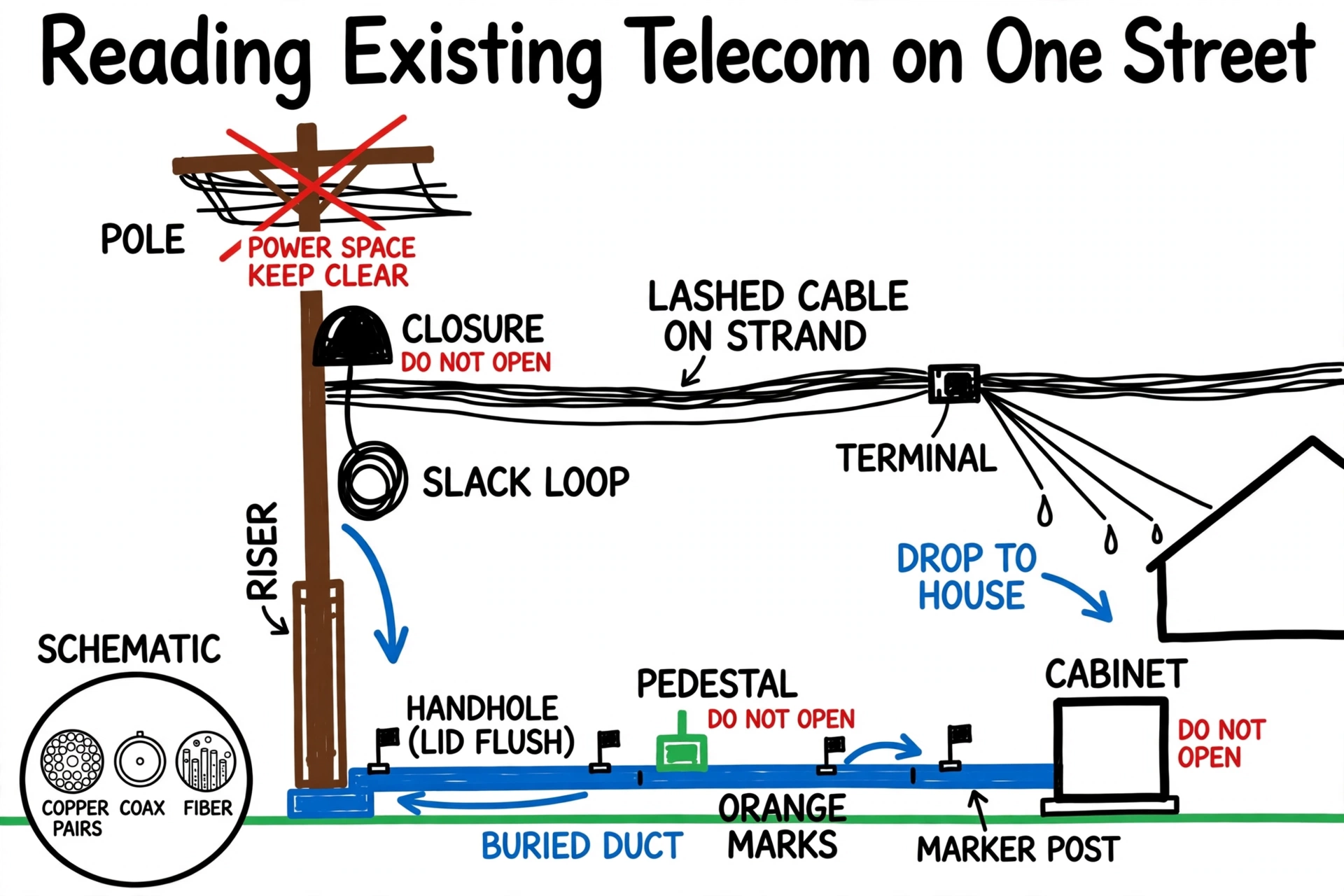
Work through the field picture in the order you meet it on a walk: paint and markers first, then poles and aerial plant, then the pole to ground transition, then ground level and below grade enclosures, then cabinets, then the buried route between them. Each feature below is described as you would see it without opening anything.
- Orange locate marks. After a locate ticket has been worked, expect orange paint lines, orange flags, or both, running along streets, easements, and lot lines, and running from the street toward buildings where service lines go. Follow an orange run end to end. Note where it starts and ends, where it crosses your planned bore, trench, or pit, where it turns, and where it lines up with a pedestal, a handhole lid, a pole riser, or a marker post. Orange is approximate. It shows where the locator believes the center of a buried communications facility to be. It does not show depth, it does not show how many cables or ducts are there, and it does not separate telephone from television from fiber. If orange marks are missing where a pedestal, a riser, or a marker says telecom must be buried, that gap is a finding to record and report, not proof that the ground is clear. Remember also that locates arranged through the public one call system, reached in the United States by calling 811 before digging, generally cover member utility facilities. Facilities on private property beyond the service point, and some private lines, may not be marked by that process. The exact coverage, notice period, and tolerance zone rules are set by state law and vary by state, so verify them for the state and the job in hand instead of carrying numbers from another state. Unmarked telecom on private property is common, and Lesson 46 and Lesson 45 teach the same caution for services in general: assume a service line to every served building until the project process shows otherwise.
- Poles and lashed aerial cable. Look up at a typical shared pole. The top carries power. Below the power, in the communications space, you will usually see one or more horizontal steel strands running pole to pole, each with black cable lashed tight beneath it. A pole that has served a neighborhood for years may carry two or three such bundles at slightly different heights: for example, an older larger copper telephone cable, a coax cable for television, and a newer fiber cable, each lashed to its own strand or, in a practice called overlashing, lashed together to an existing strand and cable bundle. Overlashing means an added cable is lashed to a strand that already carries cable. From the ground, an overlashed bundle simply looks thicker. Count bundles, note their relative positions, and photograph the pole, but do not try to name each cable by sight alone. Jacket printing is rarely readable from the ground, cables of the three families overlap in size, and a thick bundle may be one large copper cable or several smaller cables together. Record what you can see honestly: number of bundles, approximate position on the pole, closures and terminals present, and any tags you can read without climbing. Identifying which bundle belongs to which owner is a records task, confirmed through the project process and the pole owner, not a guessing task at the base of the pole.
- ADSS and other self supporting cable. The aerial cable described above is lashed to a separate steel strand. You may also meet a black cable strung on its own with no separate strand and no lashing, supported by its own hardware. That may be ADSS, which stands for all dielectric self supporting cable, a fiber cable built strong enough to support itself and made without metal. It may also be another self supporting construction, such as a figure 8 cable with its messenger built into the cable form, so record it as self supported aerial plant and confirm the type from records. In some designs ADSS can be placed higher on the pole by qualified personnel. At recognition level, note a self supported cable as aerial fiber plant to protect, record its position, and leave placement rules and any work near the power space to the qualified crews and the governing code and owner standards for that pole. Never use the presence of ADSS as a reason to get closer to power conductors.
- Aerial splice closures. Where two aerial cables are spliced, look for a closure attached to the strand or mounted on the pole nearby. Two common shapes cover most of what you will see. An inline closure is a long, roughly cylindrical or box shaped housing aligned with the cable run, with cables entering its ends, often suspended from the strand with slack loops beside it. A dome closure is a housing with a rounded dome on one end and a flat base where cables enter, often mounted vertically on a pole or on the strand. Closures are usually black or dark colored, though weathered and other colored examples exist, so shape, position, and cable entries are better clues than color. Beside many closures you will see the service loops: neat coils or flattened loops of extra cable held on snowshoe supports lashed to the strand, or a loop stored in an enclosure on the pole. Treat a closure plus its loops as a single live facility. The loops are not spare cable you can borrow, move, or straighten. They are the working slack the owner needs to repair that splice, and damaging or displacing them damages the owner repair options even if the cable itself is not cut.
- Aerial terminals and drops. At intervals along an aerial run, look for a smaller box or housing attached to the strand or the pole, with thin cables leaving it and running through the air to individual houses. That housing is an aerial terminal. On older copper plant it may be a simple terminal box with drop wires leaving it. On coax plant it may be a tap, which is the small device that splits a portion of the television signal toward a home, covered in Lesson 53. On fiber plant it is often an MST, recognizable by its row of round hardened ports, some with drop cables plugged in and some capped. Drops are the thinnest cables in the aerial picture and the easiest to snag with equipment, because they leave the main run at an angle, cross yards and driveways, and attach to buildings at heights that vary. On a preconstruction walk, count the drops crossing your work area and note any that hang low, are damaged, or cross a planned equipment path.
- Risers and conduit on poles. Where aerial plant goes underground, or underground plant comes up to go aerial, the cable runs vertically on the pole. That vertical run is the riser. Look for a U shaped guard, a half round cover, or a conduit pipe strapped to the pole from the ground up to the cable level, with the cable inside it. The guard protects the cable from handling, tools, and vehicles near the ground. A pole may carry one riser or several, for different owners and different directions of underground route. At the base of the pole, the riser connects to buried conduit or duct that runs away from the pole underground. That junction, pole base plus the first length of buried duct leaving it, is a vulnerable point in fiber construction, because bores and pits are often planned near poles. Record every riser, note which direction its underground route appears to leave by checking marks, markers, handholes, and prints, and treat the ground around a riser pole as occupied until the project process proves the exact route.
- Pedestals. In neighborhoods with buried plant, look along rear lot lines, side lot lines, and easements for a neat row of short enclosures, each roughly at the lot boundary it serves. A pedestal is usually a vertical box or a rounded housing standing a short distance above the ground, commonly green, tan, brown, gray, or black, with a removable cover and a locking feature. Many carry an owner name, a number, or a small warning label, though labels fade and older pedestals may carry nothing readable. Newer fiber pedestals may be larger and may house a terminal or a small closure inside. Older copper pedestals are often narrower metal or plastic housings. Coax pedestals for television plant often sit in the same easement line, which is one reason easements confuse beginners: two or three pedestals of different owners can stand within a short distance of each other, each serving the same houses with a different service. Do not open a pedestal to sort out which is which. Photograph the row, record positions and any readable markings, and sort ownership from records. Also note condition: a pedestal that is leaning, cracked, missing its cover, or struck by a mower is a finding to report, because its cables may already be exposed or damaged inside, and that is the owner repair to make, not yours.
- Handholes and vaults. Where buried plant needs access below ground without a surface box, look for a lid set flush with the soil, sidewalk, or pavement. Telecom handhole lids are commonly rectangular, made of polymer concrete, plastic, metal, or concrete, and many are lettered with words such as TELEPHONE, COMMUNICATIONS, FIBER, CATV, or the owner name. Vault lids are larger versions of the same idea and may be in sections. In grass, a handhole can disappear under turf and soil if it has not been opened in years, so a gap in an otherwise regular pattern of lids along a route is worth a second look and a note. Spacing of handholes along a route varies by design, owner, and era, so this lesson gives no standard spacing: read the actual lids on the actual route and the prints for that route. Never lift a handhole or vault lid to confirm what is inside. The lid lettering, the marks, and the records are your recognition tools, and any lid that is cracked, rocking, sunken, or raised is reported as found.
- Cabinets. At some street corners and along larger roads, look for a cabinet much larger than a pedestal, often about the size of a small refrigerator or larger, mounted on a concrete pad, sometimes with a power meter, a small generator connection, vents, or a nearby battery cabinet beside it. That is a cross connect cabinet, a fiber distribution hub, or an active equipment cabinet, depending on the owner and the network. A cross connect cabinet and a fiber distribution hub are passive, so expect cables and splitters or termination fields to be the story and no power meter of their own. An active equipment cabinet contains powered electronics, and it is the active type that may have a power meter, vents, a generator connection, or a nearby battery cabinet beside it. Active means it contains powered electronics, as opposed to passive plant, which contains only cables, splices, and splitters that need no power. You do not need to decide which kind a given cabinet is from outside. You need to recognize it as a major node where many customers connections converge, to keep equipment, spoil, and vehicles clear of its doors and access, and to understand that damage at a cabinet or to the large feeder cables entering it can affect far more customers than damage to a single drop.
- Buried conduit, duct, and direct buried cable between structures. Between poles, pedestals, and handholes, the buried plant itself is invisible, so you read it from its evidence. You do not open handholes to look for duct ends, so in practice your surface evidence is:
– the orange marks already described; – marker posts; – warning signs; – the riser bases and structure positions that imply the straight lines between them; – the prints.
Where a trench or bore by another crew has exposed telecom duct, with permission and from a safe position you may see orange, black, or other colored plastic duct, bundles of smaller innerducts in different colors, or a direct buried cable with an armored or heavy jacket. Do not reach into an excavation to handle or move exposed telecom plant, and do not assume an empty looking duct is spare or abandoned: empty duct is often placed deliberately for future use, and it belongs to its owner whether or not a cable is in it today. Government dig once policies use the same idea at road project scale, by requiring conduit to be installed while the ground is already open.
- Warning tape and route markers. Along a buried route you may find, during authorized excavation by the responsible crew, a plastic warning tape in the soil above the line, printed with a warning that a buried cable or line is below. Finding tape means a facility is below it, close enough to stop mechanical digging and follow the project excavation process. Do not treat the absence of tape as proof that no line is present: older plant was often buried without tape, tape can be displaced by later digging, and not every owner and era used it. Above ground, look for route marker posts: slender posts, often orange, white, or yellow depending on the owner, with a sign naming the buried cable, the owner, and a call before you dig message. Markers are usually placed at crossings, at changes in direction, and along long runs, not over every point of the line, so a marker shows a route in the area, not an exact line to dig by. The marks from a current locate ticket remain the working guide for excavation, with markers and prints as supporting evidence.
- Copper, coax, and fiber at a glance, with honest limits. In an open pedestal you will not be working, so this comparison is for the moments when cable is legitimately visible: on the strand from the ground, in a damaged facility you are reporting, or in training material. A large copper feeder cable tends to be the largest black cable on an older pole and often ends in large closures and in pedestals with many small service wires. A coax trunk or distribution cable tends to be a single round cable of moderate size, often with rigid aluminum shield construction in older trunk plant that feels stiff compared with other cables, and with its own distinctive taps and housings that Lesson 53 details. A fiber cable tends to be smaller for the amount of service it carries, often carries printed legends and colored tags that name it as fiber, and ends in closures, MSTs, and terminals with hardened connectors. Those are tendencies, not rules. Fiber cables can be large when they hold many fibers, copper drops are thin, and coax and fiber drops to a house can look nearly alike. The field rule follows from those limits: describe what you see, use tags, printing, closures, and records together, and never cut, move, or open a cable on the strength of a visual guess about what family it belongs to.
What Does It Do?
Existing telecom does one job in many forms: it carries working services to people who are already depending on them, every hour of the day. A telephone line in copper plant may carry a voice call, an alarm signal, or an internet connection. A coax network carries television and internet to a street of subscribers. A fiber network carries internet, voice, and video with capacity far beyond the older families, including service to homes, businesses, schools, cell sites, and other networks. When you stand in front of a pedestal or under a lashed cable, you are standing in front of somebody’s working service.
Work through the parts by the role each one plays.
- The feeder and distribution cables do the carrying. A feeder cable is the larger cable that brings many circuits or fibers from a central office or hub toward a neighborhood. Distribution cables branch from the feeder system and run along streets and easements, passing the homes they can serve. The distinction is one of role, not of family: feeder and distribution exist in copper, coax, and fiber plant alike. Damage to a feeder generally affects more customers than damage to a single distribution cable, and damage to a distribution cable generally affects more customers than damage to one drop, which is why size and position in the pattern are worth recording accurately even when you cannot name the exact cable.
- The splices and closures do the joining and the protecting. Networks are not built in one continuous length. Cables are joined to cables at splices, fibers or pairs are rearranged there as the network branches, and closures keep those joints sealed against the weather and the soil for years. A closure is a planned access point where the owner can return to repair, rearrange, or extend the network, and its slack loops are sized and stored for that return visit.
- The terminals and MSTs do the connecting of individual customers. Inside the distribution run, capacity passes every house. The terminal is where one house share of that capacity is made available as a port or a connection point, and the drop does the last short run to the building. On fiber plant built with MSTs, that connection is plug in work for the owner service technician: the terminal is factory sealed, the ports wait capped until a customer orders service, and a hardened drop cable connects a port to the house. On copper plant, the connection inside a pedestal or aerial terminal is made pair by pair by the owner technician. Either way, an unused looking port or pair is not unused capacity for your crew. It is the owner service inventory, waiting for the next customer order.
- The cross connect cabinets and fiber hubs do the organizing at neighborhood scale. They are where the owner decides which feeder capacity serves which street, and where records are kept that tie an address to a pair, a port, or a fiber. That organizing role is why cabinet areas deserve extra care in your planning: cables converge there in numbers, records disagreements are common there because decades of rearrangements meet in one box, and a single excavation mistake at a cabinet pad can damage several large cables at once.
- The conduit, duct, and innerduct do the protecting and the future proofing underground. A duct gives a cable a replaceable pathway: a damaged cable can in many cases be pulled out and a new one pulled in without digging the whole route again, and an empty duct gives the owner a route for growth without new excavation. That future value is exactly why an empty duct must never be treated as free space for another crew cable, a ground rod, or spoil water. Occupying or crushing another owner duct destroys an asset you cannot see the value of from the surface.
- The strand, lashing, risers, and guards do the supporting and the transitioning in aerial plant. The strand carries the weight, the lashing binds cable to strand, the riser guards protect the vulnerable vertical run where aerial and buried plant meet, and each of those support parts is sized and installed under the pole owner and national safety code framework that governs that pole. A construction crew that leans equipment against a riser guard, attaches anything to another owner strand, or moves a closure to make room for its own work has changed a loaded support system it does not own. The recognition lesson is to see supports as part of the live facility, not as convenient hardware.
Put together, existing telecom is a working system with no spare parts visible from the street. Every cable, closure, port, and duct has an owner, a record, however imperfect, and in most cases customers beyond it. That is what it does, and that is the system your new build must join without breaking.
Where Does It Fit?
Level 3 teaches you to recognize existing utilities one system at a time. Lesson 46 introduced existing utilities as a whole. Lessons 47 through 51 covered electric, gas, water, sanitary sewer, and stormwater in turn. This lesson covers the system your own work belongs to, which is why it comes with a special warning the earlier lessons did not need: familiarity breeds carelessness, and telecom is the system a fiber crew is most tempted to treat casually because it looks like their own work.
In the street picture, telecom shares both of its worlds with your construction. In the air, your new cable will often be lashed to a new strand or overlashed near existing bundles on the same poles, in the same communications space, below the same power space. On the ground, your new duct will often be bored or trenched along the same easements and right of way lines where buried telephone, coax, and fiber already run, crossing their laterals and drops at lot after lot. Few other utilities in this level share your workspace so completely.
In the sequence of lessons, this lesson sets up the two that follow it most directly. Lesson 53 takes one family, cable television plant, and teaches its parts in detail, because coax networks have their own amplifiers, taps, and powering that a general lesson can only preview. Lesson 54, on existing fiber plant specifically, goes deeper on reading fiber routes, closures, and records when the existing plant and the new plant are the same technology. Lesson 55 then covers the abandoned and unknown plant that this lesson keeps flagging: facilities that are still physically present after their service life ends. Use this lesson as the general map, and those lessons as the detailed charts for their subjects.
In the project picture, recognizing existing telecom feeds five decisions:
- First, the locate decision: whether the ticket, the marks, and the positive responses account for every telecom owner on the route, including owners whose plant is visible on poles or in pedestals but whose buried marks have not appeared.
- Second, the pole plan: which existing bundles, closures, and terminals occupy the space where new attachments are designed, a question answered from the pole owner process and the design, never by moving existing plant in the field.
- Third, the bore and trench plan: where existing buried telecom will be crossed, and which crossings the project process requires to be exposed or otherwise verified before a bore passes, under state law and contract specification as they apply to that job.
- Fourth, the protection plan: how pedestals, handholes, cabinets, risers, and markers in the work area will be flagged, guarded, and kept accessible during construction.
- Fifth, the damage response plan: which owner is called, in what order, through the supervisor and the project process, the moment any existing telecom facility is contacted, exposed unexpectedly, or found already damaged.
In the ownership picture, telecom is a highly mixed system in this level. A single street can hold plant owned by a telephone company, a cable company, the fiber provider your crew is building for, a municipality, a school district, and private owners whose lines run between their own buildings. Same owner does not mean same job: the fact that your crew is building new fiber for a provider does not give your crew any authority over that same provider existing fiber, copper, or coax on the same street. Authority over existing plant belongs to the owner operations and maintenance organization for that plant, reached through the project process. That line holds on every job, without exception for schedule, convenience, or good intentions.
What Is at Stake
- A cut is an outage, and an outage is never only a repair bill. When a crew severs a working feeder or distribution cable, customers lose telephone, internet, television, and in some cases alarm monitoring and the ability to reach emergency services, until the owner restores service. Businesses lose transactions and communications. People working from home lose their workday. The owner must dispatch its own splicers, often under emergency conditions, and the restoration of a high count fiber or copper cable is painstaking work that takes far longer than the moment that caused the damage. The construction project that caused it absorbs delay, cost, claims, and reputational harm out of all proportion to the seconds the contact took. Legacy copper and coax deserve the same respect in this calculation as fiber. Old does not mean unimportant. A copper cable that has been in the ground for decades may be the only telephone and internet service a street has, and a coax cable may be carrying internet service to hundreds of homes. Judge importance by whether customers are served, not by how modern the plant looks.
- Telecom damage is easy to cause precisely where fiber construction works. Bores run parallel to buried telecom for long distances and cross service drops at every lot. Trenches for handholes and pits open the same shallow ground where older direct buried drops and distribution cables lie, sometimes with records so poor that no mark appears for a cable that is physically there. Aerial work places lashers, reels, and bucket trucks in the same span space as existing bundles and drops. Telecom strikes are often ordinary events: a bore that drifted, a pit that was dug one lot too early, a drop snagged by a reel, a pedestal crushed by a backing truck. Recognition, the slow reading of marks, structures, and patterns before equipment moves, is the control that prevents each of those ordinary failures.
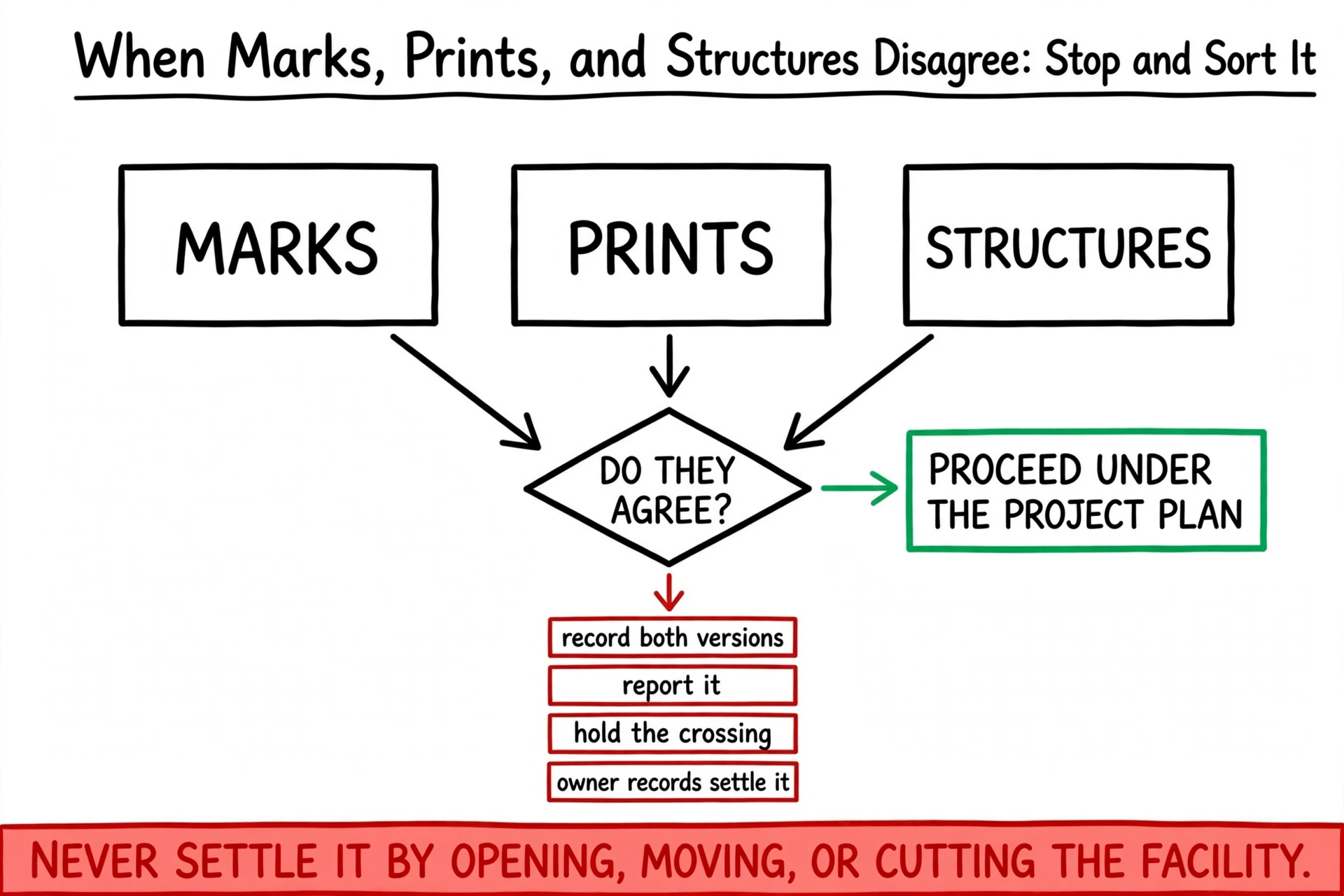
- The records problem is severe in telecom. Telecom plant has been built, bought, sold, rearranged, and partially abandoned by successive owners for over a century in some areas. Maps disagree with each other and with the ground. A duct shown as empty can hold a cable. A cable shown as abandoned can be live, and a live cable can be missing from every map the project was given. Private telecom lines between buildings, to barns and shops, and across large lots may appear in no public record and receive no public locate marks at all. The professional response to that uncertainty is not suspicion of every shovelful and it is not blind trust in the prints. It is the layered reading this level teaches: marks plus structures plus markers plus prints plus the pattern of served buildings, with every disagreement treated as a question for the project process before digging, never as a question answered by opening, moving, or cutting the facility itself.
- Some telecom plant carries electrical hazards a beginner would not expect from a communications cable. Telecom plant is generally low voltage signal plant, and this lesson does not exaggerate it into power plant. But three cautions are real and belong at recognition level.
– Aerial telecom plant shares poles with power, and the power space above it is lethal: recognition of telecom never authorizes climbing, reaching into, or working near the power space, which is reserved for qualified personnel under the governing rules. – Some coax networks use powered equipment, and some telecom cables and strands can carry fault voltage or induced voltage when damaged or when power plant faults nearby, which is one reason a damaged cable or strand is reported and left alone rather than handled. – Metallic strand, lashing, and cable shields are bonded and grounded under the owner standards for safety reasons, and a crew that cuts or disconnects another owner bonding has altered a safety system.
The safe summary for a fiber crew is short: look, photograph, record, report, and keep hands and tools off existing telecom plant, especially when it is damaged.
- Your new network becomes existing telecom the day it is placed. The care you take reading the last crew plant is the care the next crew will need to take reading yours. Accurate records of what you built, honest marks, intact markers, and plant left in the condition you found it are the professional standard that connects this lesson to the whole purpose of Level 3: many owners share the same ground and the same poles, and the system works only when each crew protects what it finds.
What Does Good Look Like?
Good recognition of existing telecom on a fiber job looks like this:
- The preconstruction walk covers aerial and buried telecom together: pole by pole, bundle by bundle, closure by closure above ground, and mark by mark, pedestal by pedestal, and lid by lid below ground, with photographs and notes that a second person could follow back to the same facilities.
- Orange marks are walked end to end and checked against visible structures. Every pedestal, riser, handhole, cabinet, and marker post on the route is matched to marks or to a recorded explanation, and every mismatch is reported before excavation or boring, not discovered by equipment.
- Aerial drops crossing the work area are counted and noted, low or damaged drops are flagged for the supervisor, and equipment paths are planned to clear them.
- Risers are recorded with the direction their buried routes leave the pole, and pits and bores near riser poles are planned around those routes through the project process.
- Pedestals, handholes, vaults, and cabinets in the work area are protected in place, kept accessible to their owners, and left closed, with no material stored against them and no spoil placed on lids or covers.
- No existing closure, pedestal, terminal, cabinet, or lid is opened at any point by the construction crew, and no existing cable, strand, lashing, or slack loop is moved, cut, or used for support, storage, or access.
- Facilities found damaged on arrival, such as a struck pedestal, a hanging closure, a cut drop, or an exposed cable, are photographed, recorded by location, and reported to the supervisor the same day, so the owner can be notified before the project work is blamed for damage it did not cause and before the damaged plant hurts someone or fails completely.
- Where records, marks, and field evidence disagree, the disagreement is written down in plain words and carried into the bore and excavation plan as an open question, with the verification steps the project process and state law require completed before the work crosses the facility in question.
Good means the crew read it accurately, planned around all of it, including the unmarked and the poorly recorded parts, and left every part of it closed, supported, intact, and serving its customers.
From the Field
Picture a crew assigned to build new buried fiber along both sides of a residential street of 24 homes, boring duct in the right of way and setting handholes at intervals. The design shows the new duct crossing two side streets and passing in front of every home. Existing telecom on the street includes aerial coax on poles at the rear lot lines, buried copper telephone plant in pedestals along the front easements, and a fiber route built several years earlier by another provider along the north side street.
On the preconstruction walk, the crew leader works the read in order. The orange marks from the current ticket run along the front easements and match the pedestal row on the south side, but on the north side the orange line stops at a corner pedestal and does not continue past four homes that clearly have pedestals of their own. That gap is written down as a finding and reported before any boring. The project process produces a second locate visit, and the missing section is marked two days later. Without the walk, the bore plan would have treated the most confusing section of the street as the clearest.
At the poles, the crew counts two aerial bundles in the communications space, one coax and one older copper, with a dome closure and slack loops on the third pole and aerial drops crossing the rear yard where a bore pit is planned. The pit is shifted in the plan through the project process so equipment and spoil stay clear of the drop path, and the drops are noted on the daily briefing for the days when rear yard work happens.
At one riser pole, the marks leaving the pole run toward the south side street, while the prints in the crew packet show the underground route leaving toward the north. The crew does not choose the version it likes better. It records both, photographs the riser and the marks, and reports the disagreement. The supervisor holds the bore past that pole until the owner records are checked and the crossing is verified by the method the project process directs. The bore crosses two days later than first planned, with the route confirmed, and nothing is struck.
In front of the twelfth home, the crew finds a pedestal with its cover cracked and partly open, with visible moisture inside, before any project excavation has reached that lot. The crew photographs it in place, records the location and the pedestal number, does not reach inside, does not attempt to dry or close the damaged cover beyond leaving it as found, and reports it the same morning. The owner is notified through the project process and repairs its own pedestal. When service trouble is reported on that street a week later, the dated photographs establish that the damage predated the project work, and the owner repair, not the project, addresses it.
The job finishes with no telecom strikes. Nothing in the work is heroic. The crew read marks against structures, refused to guess at a records disagreement, assumed every home was served, and reported damage it did not cause on the day it found it.
Carry the decision rule: read marks against structures before equipment moves, treat every disagreement between marks, prints, and the field as an open question for the project process until the owner records settle it, assume every occupied building is served, and report damage you did not cause on the day you find it.
What Can Go Wrong?
- A bore crosses a buried fiber feeder that was marked a short distance from its actual position, or not marked at all because the route on the owner record was wrong. The bore severs fibers serving a neighborhood and possibly a cell site or a business district. The owner emergency splicing crew works for hours to restore service, the project stops while the damage is investigated, and the cost and claims process follows the project for far longer than the bore took. The recognition failure happened earlier, when marks were accepted without being checked against structures, markers, and prints, and when a disagreement in the evidence was not raised.
- A pit is dug for a new handhole on a lot line and cuts a direct buried copper drop and a coax drop that no public locate marked, because both were private side or older plant with poor records. Two homes lose service. The crew did nothing exotic: it dug exactly where pits are normally dug, on a street where every occupied home should have been assumed to have service lines crossing the pit area. Lesson 45 teaches that assumption for all services, and this lesson repeats it for telecom specifically: on private property and at lot lines, unmarked telecom is common, and the project process for verifying private facilities must be followed instead of treating no marks as no plant.
- An overlashing or lashing operation, or a reel set up carelessly, snags an existing aerial drop or presses a new bundle against an existing closure and its slack loops. The drop pulls loose from a house or from its terminal, or the closure is displaced and its fibers are stressed until they fail days later. Delayed failures are a special telecom hazard: a cable bent, crushed, or pulled during construction may keep working until weather, vibration, or the owner next service visit finishes the damage, which makes honest same day reporting of any contact with existing plant essential even when service appears unaffected.
- A truck backs over a pedestal or a handhole lid at grade. The pedestal cover shatters and rain enters a splice case that was sealed against a dry enclosure, or the lid cracks and becomes a trip and vehicle hazard. The damage looks minor from the cab. Reported and protected at once, it is an owner repair. Left unreported, it becomes water damage, corrosion, and intermittent service failures that are hard to trace, billed back to the project that caused them when the evidence is found.
- A crew member opens a pedestal or lifts a handhole lid to check whether a cable is the one the prints show, or to be helpful by moving a slack loop out of the way of new work. In doing so they disturb connections serving customers, expose splices to dirt and moisture, break a seal that was keeping a closure dry, or touch plant that is damaged and carrying unexpected voltage. None of those outcomes requires bad intent. They require only that someone treated recognition as permission. This lesson exists to close that gap: the crew that owns the work is the crew that opens the enclosure, and every other crew reports and waits.
- An old cable is assumed abandoned because it is not on the current map, hangs slack, or looks weathered, and the crew cuts it to clear a path. The cable was live, serving customers the map had assigned to a different route, or serving as a spare the owner was about to place in service. The mirror image failure also happens: a genuinely abandoned cable is carefully protected while a live cable beside it, newer and neater, is treated as the construction crew own new plant and damaged. Appearance and paperwork both fail as sole tests. Only the owner, through the project record, can settle whether plant is abandoned, which is the subject Lesson 55 develops in full.
- A cabinet area excavation damages one of several large cables entering a cross connect cabinet or fiber hub because the crew read the marks for one owner and missed a second owner duct bank entering the same pad from another direction. The outage is neighborhood wide, the repair involves multiple owners, and the investigation finds that the cabinet was photographed on the walk but its full set of entering routes was never traced in the records. Major nodes deserve major reading effort, in proportion to the customers behind them.
What Should Someone Notice in the Field?
Carry this read in order on every walk where existing telecom may be present.
- Start with the marks. Walk the orange paint and flags end to end before you look at anything else. Ask: does orange run everywhere the structures say telecom runs? Does it cross your planned bore, trench, and pit locations, and at each crossing, do you know which structures it connects? Where orange stops at a property line, ask what serves the building beyond that point, because private side telecom often continues unmarked from there.
- Read the poles from the ground. For each pole, note the number of cable bundles in the communications space, the closures and terminals attached to strand or pole, the slack loops and snowshoes, the drops leaving toward buildings, and every riser guard or conduit on the pole. Photograph each pole face you will work on. Note any bundle, closure, or drop that is hanging, damaged, or unusually low, and report it as found.
- Read the ground line. Walk the easement and lot line pattern. Find and photograph every pedestal, note its position against the lots it likely serves, and note rows where pedestals of more than one owner stand together. Find every flush lid, read its lettering word for word where it exists, and note lids that are cracked, buried, or missing from an otherwise regular pattern. Find every cabinet, note its pad, its doors, its signs, and the directions its buried routes appear to leave, using marks and prints.
- Read the connections between what you found. A riser should have a buried route leaving it. A pedestal row should have a distribution route running through it and drops or laterals toward buildings. A handhole pattern should line up with the conduit route on the prints. A marker post should have marks or structures in its area that explain it. Where a connection is missing, a riser with no marks leaving it, a pedestal with no route to it, a marker with no facility anyone can account for, write the gap down as a finding. Gaps in the pattern are where strikes live.
- Check the buildings. Every occupied building is served by telecom in most built areas, by drop from a terminal aerially or by a buried service from a pedestal or handhole. If you cannot account for how a building is served, you have not finished reading that lot, and any excavation on it carries an unlocated service line risk that the project process must address.
- Notice condition and change. A fresh trench scar, a new pedestal among old ones, a closure that was not on last week photographs, or marks that have faded since the ticket was worked are all information. Construction corridors change while you work in them, because other owners work in them too. A walk is a snapshot, and on a long job the read must be refreshed, with locate tickets renewed as state law and the project process require, rather than treated as settled on the first day.
At every step, the discipline is the same as in the rest of this level: observe from where you are allowed to stand, photograph, record location and markings exactly, compare with prints and marks, and report disagreements and damage through the supervisor and the project process. Notice everything. Open nothing. And hold the boundary this lesson ends on: reading existing telecom never qualifies anyone to climb a pole, open an enclosure, or work in or near the power space. Recognizing is the construction crew’s job. Work on the plant belongs to its owner, and work near power belongs to qualified personnel under the governing rules.
Key Terms
- Existing telecom: Telecommunications outside plant that is already built and in the ground or on poles before new construction arrives, in most cases already serving customers.
- Outside plant (OSP): All telecom construction that lives outdoors between network buildings and customers, including cables, poles, conduit, closures, pedestals, handholes, and terminals.
- Copper twisted pair: A cable of paired insulated copper wires twisted together, the traditional telephone cable family, carrying signals as electricity.
- Coaxial cable (coax): A cable with a center conductor, insulation, a metal shield, and a jacket sharing one axis, built widely for cable television and broadband internet.
- Fiber optic cable: A cable carrying signals as light through thin glass strands called fibers, used for high capacity internet, voice, and video services.
- Strand (messenger): A steel wire rope strung between poles to support aerial cables. It carries weight, not signals.
- Lashing: Attaching a cable to a strand by spiral wrapping lashing wire around both along the span, so the cable rides tight against the strand.
- Splice closure: A sealed protective housing covering a permanent joint between cables, designed to be opened only by the technicians who own that plant.
- Service loop (slack loop): Extra cable stored in a loop near a closure or terminal so the closure can be reached for future work and cable is available for repair.
- Riser: A vertical cable run on a pole connecting aerial plant to underground plant, usually protected by a guard or conduit on the pole.
- Conduit, duct, and innerduct: Tubes that provide protected pathways for cables. Innerduct divides a larger conduit into separate smaller pathways.
- Pedestal: A ground level housing standing above grade that encloses a connection point for underground cables, with cables entering from below.
- Handhole and vault: Below grade enclosures with flush lids that give the owner access to underground conduit, cable, slack, and small closures. A vault is the larger form, and the name alone does not tell you whether it is built for entry.
- Terminal and drop: A terminal is where individual customer connections are made to the distribution network. A drop is the final cable run from the network to one building.
- Multiport service terminal (MST): A factory sealed fiber terminal with hardened outdoor connector ports on its outside, so drops plug in without opening the terminal.
- Cross connect cabinet and fiber distribution hub: Larger pad mounted cabinets where feeder capacity is organized and connected to the distribution cables serving a neighborhood.
- Orange locate marks: Temporary paint or flags in the APWA Uniform Color Code color for communication, alarm, or signal lines, cables, or conduit.
- Route marker and warning tape: Above ground posts or signs naming a buried cable route and its owner, and buried plastic tape placed above a line to warn future excavators.
- Abandoned plant: Plant the owner has taken out of service and left in place. Only the owner can declare it abandoned in the project record.
Check Your Understanding
Answer each question in your own words before reading the answer key.
- A street shows orange paint along the front easements, a row of pedestals, and two black cable bundles lashed on poles behind the homes. A crew member says the orange marks prove the buried plant is fiber, because the project is a fiber project. What is wrong with that statement, and what does orange actually prove?
- Your bore plan passes the base of a pole that carries a riser guard. The locate marks leave the pole toward the south, but the prints show the underground route leaving toward the north. What do you do, and what do you not do, before the bore passes that pole?
- Name four surface features, other than locate marks, that tell you existing buried telecom serves a row of homes, and explain what each one indicates.
- A pedestal on your route has a cracked cover and moisture inside, found before your crew has dug anywhere near it. State the correct crew actions and the actions the crew must not take.
- Why does this lesson say that legacy copper and coax plant deserves the same protection as fiber plant, even though the new build is fiber?
Answer key:
- Orange proves only the family: under the APWA Uniform Color Code, orange means communication, alarm, or signal lines, cables, or conduit. It covers telephone copper, cable television coax, fiber, and alarm and signal plant together, for any owner. It does not identify the cable type, the owner, the depth, or the number of facilities. The pedestals, closures, terminals, tags, and owner records, checked together through the project process, are how type and ownership are established, never the paint color alone and never the nature of your own project.
- You record both versions, photograph the riser and the marks, and report the disagreement to the supervisor before the bore passes. The bore past that pole waits until the owner records are checked and the crossing is verified by the method the project process and applicable state law direct. You do not choose the version you prefer, you do not average the two routes and bore between them, you do not expose or move the riser or its cable to investigate, and you do not treat either the marks or the prints as proof on their own when they disagree.
- Any four of these, correctly explained: Pedestals in a row at lot lines indicate underground distribution cables rising to connection points serving the lots beside them. Flush handhole or vault lids, lettered for telephone, communications, fiber, or an owner, indicate access points on an underground conduit route. A riser guard or conduit on a pole indicates plant transitioning between aerial and buried at that pole, with a buried route leaving its base. Route marker posts indicate a buried cable route in the area and name its owner. A cross connect cabinet or fiber hub on a pad indicates a neighborhood node with large cables entering it from the routes that serve the area. Buried service evidence at each building, such as a drop or a wall mounted connection box fed from underground, indicates a service line crossing the lot even where no marks appear.
- Correct actions: photograph the pedestal as found, record its location and any readable number or markings, leave it as found, and report it to the supervisor the same day so the owner can be notified through the project process, and note it in the job record so preexisting damage is not later attributed to the project. The crew must not open it further, reach inside, move or dry its contents, attempt a repair, or use the opening to identify cables for the bore plan. It is another owner live facility, and its repair belongs to that owner.
- Because protection follows service, not technology. Legacy copper still carries telephone and internet service, and in some areas alarm and emergency communications, for customers who have no other service. Coax still carries television and internet, often to hundreds of homes on one network. Cutting either causes a real outage, a real emergency restoration by the owner, and real cost and claims for the project, exactly as a fiber cut does. Old appearance also proves nothing about status: only the owner can declare plant abandoned, so age is never a reason to treat a cable as safe to cut.
Lesson Takeaway
Existing telecom is a working network hiding in plain sight: orange marks on the pavement, lashed black cables and sealed closures on the strand, risers guarded on the poles, quiet rows of pedestals, flush lids in the grass, and cabinets where whole neighborhoods converge. It can be copper, coax, or fiber, it can belong to any of several owners, its records can be wrong, and its private lines can be unmarked, but in almost every case it is serving someone today. Read it in layers, marks against structures against prints against the pattern of served buildings. Report every gap and every disagreement before equipment answers the question for you. Open nothing, move nothing, cut nothing that your crew did not place. The crew that protects the network it finds is the crew whose own new network deserves, and usually gets, the same protection in return.
Sources and Technical References
The Fiber Optic Association (FOA), Outside Plant Fiber Optic Network Design. Reference on OSP design including where splices are placed, including underground in a manhole or vault, above ground in a pedestal, buried, or mounted on a pole, and on closures being sealed and re-enterable by the owner technicians. https://www.foa.org/tech/ref/OSP/design.html
The Fiber Optic Association (FOA), Outside Plant Construction, Aerial Cable Installation. Reference on lashed aerial construction, splice closures and service loops, overlashing, and grounding and bonding of messenger and lashing wire. http://www.foa.org/tech/ref/OSP_Construction/Aerial%20Cable%20Installation.html
The Fiber Optic Association (FOA), Outside Plant Aerial Construction Workmanship. Guidelines for strand and lash plant in the communications space, separation from power cables, sag and tension analysis in general terms, and secure lashing with no loose hanging cable. https://www.thefoa.org/tech/ref/OSP_Construction/Aerial_Workmanship.html
The Fiber Optic Association (FOA), Outside Plant Construction, Underground Construction. Reference on conduit buried underground, innerduct, directional boring to avoid surface excavation, and conductive marker tape buried above conduit to assist future location and warn excavators. https://www.thefoa.org/tech/ref/OSP_Construction/Underground_Construction.html
American Public Works Association (APWA) Uniform Color Code, as published in the APWA color code summary used for this lesson. Orange: Communication, alarm or signal lines, cables or conduits, and fiber. Full code includes red for electric, yellow for gas and similar materials, blue for potable water, green for sewers and drain lines, purple for reclaimed water and irrigation, white for proposed excavation, and pink for temporary survey markings. https://digsafelyhawaii.com/ticketing-tools/apwa-color-code/
CommScope, Multiport Service Terminal (MST) series. Manufacturer reference confirming MSTs are factory terminated and environmentally sealed, use hardened connector technology, require no splicing or re-entry in the terminal, and offer pole, pedestal, handhole, or strand mounting. https://www.commscope.com/network-type/fttx-access/outside-plant-fiber-connectivity/fiber-access-terminals/mst/?showallresults=True&page=1&pageSize=8
CommScope, FOSC 450 fiber optic splice closure. Manufacturer reference used for closure forms and environments: single ended dome to base design, mounting on pole, strand, or wall, and use in aerial, pedestal, and underground environments. Specific capacities and dimensions on that page are model specific and were not carried into this lesson as general requirements. https://www.commscope.com:443/network-type/data-centers/building-entrance-solutions/fiber-optic-splice-closures-fosc/fosc-450/
Telecommunications pedestal, encyclopedia summary used for the basic pedestal definition: a ground level housing for a passive connection point for underground cables, preferred over a vault where acceptable, used for CATV, telephone, passive optical networks, and other systems, with distribution cables rising from below into the housing and circuits terminated inside. Height and size figures in that summary are described as general and vary in the field, so this lesson states no standard pedestal size. https://en.wikipedia.org/wiki/Telecommunications_pedestal
Multilink, Fiber and Telecom Pedestal Enclosures. Manufacturer reference confirming pedestals house and protect fiber slack storage and splice points, termination hardware, and coax and fiber interface points in OSP environments including FTTx and CATV systems. https://www.gomultilink.com/categories/pedestals-vaults/pedestal
Electrical Construction and Maintenance (ECMag), Guidelines for Aerial Fiber Optic Cable Installation, summarizing FOA guidance. Used for the communications space placement, the ADSS exception for the power space by qualified personnel, closures attached to poles with service loops, snowshoe turnarounds respecting cable bend limits, and the rule that no service loops or cables awaiting installation may be left hanging from the span. https://www.ecmag.com/magazine/articles/article-detail/guidelines-for-aerial-fiber-optic-cable-installation
Electrical Construction and Maintenance (ECMag), Know What Is Below: Buried fiber optic cable safety. Used for the general practices of labeling fiber cables, marking underground locations, burying marker tape above underground plant as a warning and location aid, and placing above ground signs indicating an underground fiber route. Depth figures in that article are presented there as general guidelines, vary by design and jurisdiction, and are not stated in this lesson as requirements. https://www.ecmag.com/magazine/articles/article-detail/integrated-systems-know-whats-below-buried-fiber-optic-cable-safety
Detectable warning tape meeting the APWA Uniform Color Code, LH Dottie product reference. Used only to confirm that detectable tape for buried CATV and communication lines is manufactured in orange under the APWA code with a printed caution legend, and that detectable types use a foil core located with suitable detection equipment. https://lhdottie.com/detectable-tape/du608
Previous lesson: Lesson 51: What Does Storm Sewer Infrastructure Look Like? |
Back to Level 3 hub |
Next lesson: Lesson 53: What Does Cable TV Infrastructure Look Like?