
Introduction
A water meter is a measuring device set in the water service line to a property. It records the volume of water that passes from the street main to the building, and in most systems it sits at or near the property line, inside a ground level box whose lid often reads Water.
This lesson sits in Level 2, where you learn to read the physical environment before work starts. The meter matters to a fiber crew because of where it sits and what it announces. A pressurized water service runs from the main to that box and onward to the building, and the box is the only point of that buried line you can fix with certainty from the surface. Read it correctly and it plans your crossings. Walk past it and the first notice of the line may be water in your bore pit. This lesson teaches recognition only. It does not qualify you to operate a curb stop or any other water utility valve, open or repair a meter, or cut or reconnect a service line.
What This Lesson Gives You
- Name the parts of a meter setting in order, from the water main in the street to the customer line at the building, and say which side of the meter each part belongs to.
- Read a meter box lid, the locate marks, and the ground conditions around them as one picture, and state what that picture proves and what it leaves approximate.
- Read the face of a common analog meter at the recognition level: the register, the sweep hand, and the leak indicator, and say what a turning leak indicator proves and what it only suggests.
- State the utility and customer boundary at the meter the way the local system defines it, and name what a fiber crew protects, what it never operates, and what it reports.
- Decide, at a lot where the lid cannot be found or the marks and the box disagree, what gets recorded, what gets reported, and what proof a crossing needs before a bore passes it.
Start With the Basics
Picture a fiber crew planning a short bore across the front yard of a house. The prints show the road, the curb, and the house. Near the curb, set flush in the grass, is a flat lid. The lid is marked with one word, Water. Nothing is moving. Nothing is making noise. It is easy to walk past it.
That quiet lid is one of the most useful surface clues on the whole lot. It tells you that this building has a drinking water service. Somewhere under the street is a water main, the larger pipe that carries drinking water along the street to serve many properties. A smaller pipe, called a service line, branches from that main, crosses under the road edge and the front yard, and ends at the meter under that lid. Past the meter, another section of line continues to the house. When the occupants open a tap, water flows through that whole chain under pressure. Pressurized means the water is pushed through the pipes by pressure in the system, so a cut line does not just drip. It can spray, flood a bore pit, wash out soil, and turn a small mistake into an emergency and a repair bill.
So the meter is both a measuring device and a warning sign. As a measuring device, it records how much water the property uses so the utility can bill for it. As a warning sign for a fiber crew, it marks the near end of a buried pressurized line that your bore or trench must cross or avoid. The box tells you a crossing exists. It does not tell you exactly where the buried line runs between the main and the box, and guessing that line straight is one of the classic ways crews strike water services.
Three ideas carry the whole lesson:
- The meter sits at a boundary. On the street side is the utility side of the system. On the house side is the customer side.
- What you see at the surface is only the endpoint. The buried line between the main and the meter can curve, change depth, or have been replaced along a different path than the original.
- The meter belongs to someone else. In most systems the water utility owns the meter and the street side shutoff, and only the utility, or people it authorizes under local rules, may operate or work on them. A fiber crew protects the meter. It does not use it.
What Is It?
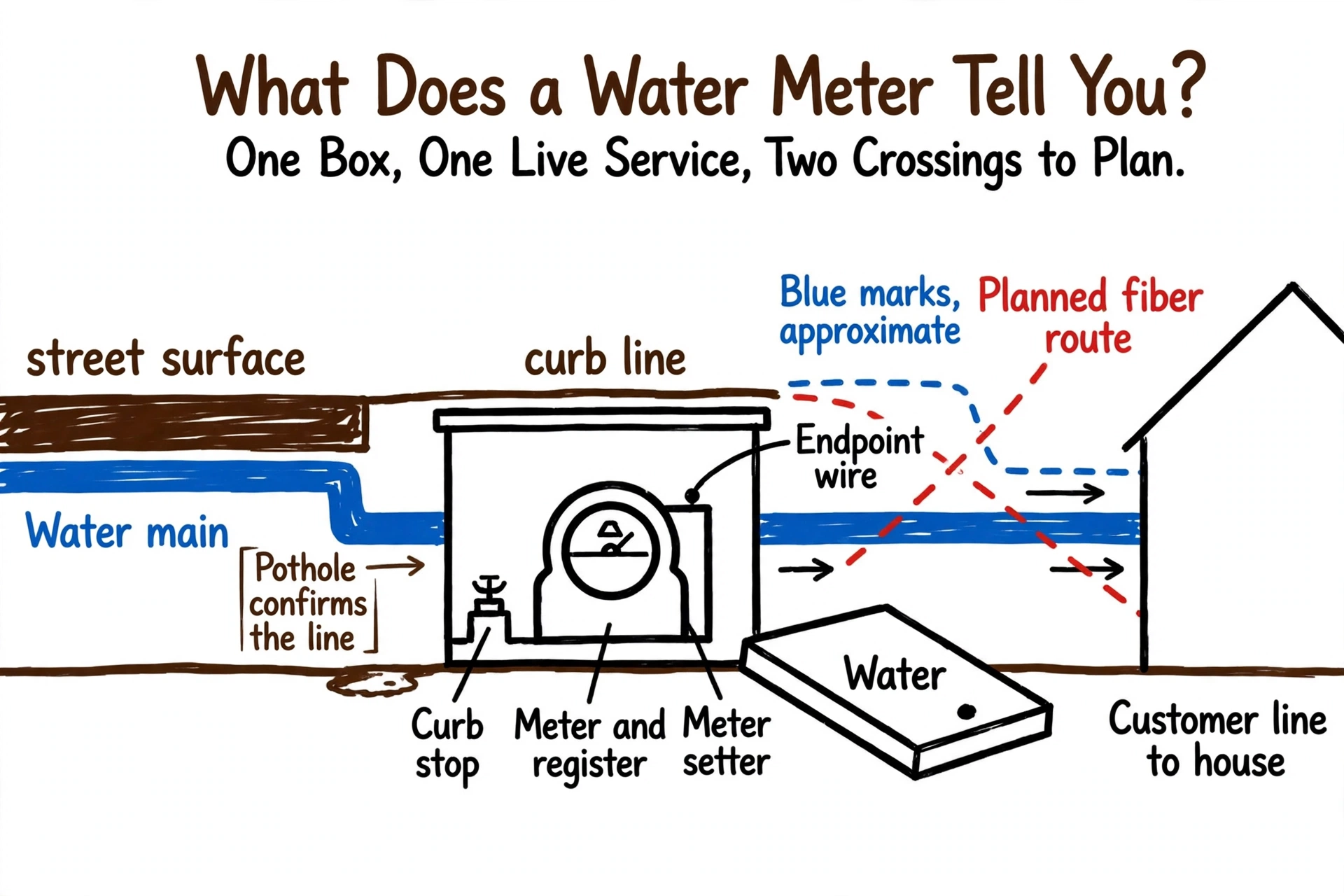
A water meter is a measuring device installed in the water service line to a property that records the volume of water that passes through it. Volume means the amount of water, counted over time. The utility uses that record to bill the customer and to watch for abnormal use, such as a leak. The meter is one part of a larger assembly. To read the ground correctly, you need the whole assembly in order, from the street to the house:
- Water main. The larger pipe that runs along or under the street and carries drinking water past many properties. Every property service branches from it.
- Corporation stop. The valve at the main itself, where the service line connects to the main. You will almost never see it, because it is buried at the main, but it is the true start of the service.
- Service line. The smaller pipe that runs from the main toward the property. On or near the property line, usually in the public right of way, the strip of land reserved for roads and utilities along a street, the line reaches the meter setting.
- Meter setting. The group of fittings that holds the meter in the line so it can be read, tested, and replaced. A common holding device is a meter setter, also called a meter yoke in some catalogs and local standards. A meter setter is a shaped frame of pipe and fittings that holds the meter at a set spacing and height, often includes shutoff valves on one or both ends, and connects the street side pipe to the house side pipe. Not every setting uses a factory setter. Some older settings are built up from individual fittings in the ground. The function is the same either way.
- Curb stop. The shutoff valve on the street side of the meter, also called the meter stop in some areas. Its job is to let the utility stop all water to the property at the meter. In most systems it belongs to the utility and is for utility use. In some places it sits inside the meter box with the meter. In colder climates it may sit in a separate small access tube nearby, reached from the surface with a long key.
- The meter and its register. The meter sits between the street side and the house side. Water enters from the street side, passes through the measuring chamber inside the meter body, and leaves toward the house. On top of the meter body is the register, the display head of the meter. It shows the total volume that has passed through the meter since it was installed or last reset, the way the odometer in a car shows total miles rather than the speed you are driving now. That total is called the read. Utilities bill from the change between reads, not from the total alone.
- Customer valve. A shutoff valve on the house side of the meter, where one is present. Its job is to let the property owner or a plumber shut off water to the building without touching the utility side. Not every property has a customer valve in the box. Some have their main shutoff inside the building instead. Never assume which valves a given box holds until you have identified that system, and never assume you have permission to operate any of them. Operating rules vary by utility and by local code, and this lesson teaches recognition of the valves, not operation of them.
- Endpoint. A small radio transmitter connected to the register, often mounted in or under the meter box lid, that sends the read out by radio. Two system names cover most remote reading. AMR stands for Automatic Meter Reading. In an AMR system the endpoint broadcasts the read and a vehicle or a person walking nearby collects it with a receiver. AMI stands for Advanced Metering Infrastructure. In an AMI system the endpoint sends the read through a fixed network of collectors to the utility, and the utility can often receive data from the meter without visiting, and in some systems send information back. For a fiber crew, the practical point of AMR and AMI is simple. The lid or the box may hold a small antenna, a transmitter, and a thin wire you must not cut, crush, or bury. A box that looks empty of people is still active equipment.
- Meter box. The ground level enclosure, also called a meter pit in some regions, that holds the whole setting. It is commonly plastic, concrete, or metal, and it protects the meter and gives access to it. Its lid sits at or near the finished ground surface, called grade. The lid is often marked Water or Water Meter. That marked lid is the surface feature a fiber crew will actually see and must protect.
One boundary matters for responsibility. In most systems the utility owns the meter, the meter box, and the curb stop, and maintains the service up to a point the local rules define, often at or near the meter. The property owner owns and maintains the line from the meter outlet to the building, along with the building plumbing. That dividing point is not the same everywhere. Some utilities own the whole service to the building. Some owners own more of the buried line. State the general pattern, then check the local utility rules for the job in front of you. Do not state one ownership line as universal.
What Does It Look Like?
From the surface, a water meter usually looks like almost nothing. That is the problem. Learn the small signs.
The most common outdoor setting in warm and moderate climates is a rectangular or round lid set flush with the grass, soil, sidewalk, or driveway edge near the curb or near the property line at the front of the lot. The lid is often metal or heavy plastic. Many lids carry raised letters reading Water or Water Meter. Some lids have a small separate reader lid or a small round antenna cover in the center for the AMR or AMI endpoint. A lid that sits tilted, sunk below grade, raised above grade as a trip edge, cracked, or covered over with soil, mulch, or pavement is a finding to report, because the utility needs that lid accessible and flush, and because a buried lid means the next crew may not see the warning at all.
Location varies, and the variation is part of the lesson:
- In many areas the box is in the right of way between the curb and the property line, roughly on a line between the street and the front of the building it serves.
- In dense or older areas the meter may be in the sidewalk or at the edge of the pavement.
- In cold climates the meter is often inside the building, commonly in a basement or utility space, to protect it from freezing, and only the curb stop access and a remote reader or endpoint are outside near the property line.
- In some rural settings the meter may sit near the road at the end of a long driveway, far from the house.
- In commercial settings there may be several meters, larger boxes or vaults, and separate meters for irrigation or fire service.
Treat the front yard box near the curb as the usual case, not as a rule. If you do not find a box where you expect one, that absence proves nothing. The service still exists if the building has water. Ask, check the records, and let the locate process do its work.
If you are authorized to look inside a box as part of your project process, and only then, this is what you may see. Expect dirt, water, insects, or a coiled wire. Standing water or mud in the box is common after rain and does not by itself prove a leak. The meter body is usually a short metal or plastic chamber set horizontally in the line, with the register on top, sometimes under a small hinged cover. The register face on a common analog meter, meaning a meter with a mechanical dial display rather than an electronic screen, has three features worth naming:
- The numbered register. A row of digits like a car odometer, showing total volume. The unit is printed on the face. Some utilities measure in gallons. Others measure in cubic feet. Both are in normal use in the United States, and the face of the meter in front of you is the only safe source for which unit that meter uses. One cubic foot of water is about 7.48 gallons, which is why a read in cubic feet converts to a much larger number in gallons, but a fiber crew does not need to convert reads. It needs to know the unit varies so it never quotes a read in the wrong unit.
- The sweep hand. A single long hand that turns around a circular dial as water flows. On many cubic foot meters one full turn of the sweep hand equals one cubic foot. On many gallon meters one full turn equals ten gallons. The dial markings on the face state the value for that meter. Do not carry the value from one meter to the next.
- The leak indicator. Also called a low flow indicator on many meters, a small triangle, star, or small dial, often in a contrasting color, that turns with very small flow. Not every meter has one, and digital registers show flow and leak information differently, often as icons or a flow rate display. Where an analog leak indicator is present, it is the most sensitive movement on the face. It can turn when no tap in the building is knowingly open.
Digital and electronic registers are now common, especially with AMI. They may show a blank screen until light or a tap wakes them, then display the read, a flow rate, and small icons for conditions such as continuous flow. A fiber crew does not need to interpret a utility alarm icon beyond this. If a display or indicator suggests water is moving when the building should be idle, or the box is flooding, report it. Do not diagnose the plumbing.
Meter sizes vary. Small residential services use small meters. Larger buildings, irrigation, and fire related services use larger meters, larger boxes or vaults, and larger service lines. This lesson states no single meter size or service size as standard, because the size is chosen by the utility for the demand of that property and recorded in its records. For field recognition, size matters in one way only. A larger box or vault means a larger service, and a larger pressurized line to protect.
Paint and flags tell the same story in color. Under the APWA Uniform Color Code, APWA being the American Public Works Association, blue paint and blue flags mark potable water. Potable means safe to drink. Blue marks near a meter box are the located path of the water line as marked by the locator. Orange marks are communications, which includes your fiber. Where blue and orange cross on the ground, the drawing in paint is the crossing your work must handle with care.
What Does It Do?
The meter does three jobs. It measures, it marks a boundary, and it warns.
It measures. The meter records volume so water can be billed and managed. The register total only moves one way under normal flow, upward as water passes toward the building. The utility reads the register, in person, by AMR drive by or walk by collection, or by AMI fixed network delivery, subtracts the previous read, and bills for the difference in the unit that utility uses, gallons in some systems and cubic feet or hundred cubic feet in others. The sweep hand and leak indicator give the same information at a finer scale. The sweep hand shows flow happening now in larger steps. The leak indicator shows very small flow happening now. That is why a leak indicator that keeps turning when all known use in the building is off can signal a leak on the customer side, such as a running toilet, a failed water heater valve, or a break in the customer line. It can also move for other small legitimate uses, such as an ice maker or a water softener cycle, and some movement patterns need utility or plumber investigation to explain. For a fiber crew the meaning is narrower and more urgent. Movement means the line is live and water is passing. Flooding in the box, a hissing sound, soggy ground along the service path, or a spinning indicator together with wet soil where it should be dry can mean the service is already damaged or leaking. Stop, protect the area, and report through your project process and to the utility as the project plan directs. Do not try to stop the flow by operating the curb stop unless your role, your training, and the local utility rules clearly authorize you to do so. For a fiber crew, in almost every case, they do not.
It marks a boundary. The meter shows where utility responsibility and customer responsibility usually divide, where billing starts, and where the service changes from the street side segment to the house side segment. That boundary helps a crew describe a problem precisely. Water spraying on the street side of the meter, inside the box, and on the house side of the meter are three different location reports. The exact location helps route the response to the party responsible for that part of the setting. Precise location words save time in an emergency.
It warns. As a warning for construction, the meter does the most important work of all for this course. It indicates a water service reaches that property and is treated as live and pressurized until the utility confirms its status, it fixes the surface endpoint of that service at the box, and it tells you the buried line must run from the main to that endpoint and onward to the building. Any bore, trench, or handhole on that lot must account for both segments. The street side segment is commonly covered by the locate ticket, because the ticket covers utility facilities. The house side segment can be a private facility in some systems once it passes the ownership point, and private facilities are not always marked by the public locate ticket. Rules for who marks what vary by state and by utility. Never assume the house side line is marked just because the street side line is. Confirm what your ticket covered and use a private locator or potholing where the project process requires it. Potholing means digging a small careful hole by hand or with vacuum equipment to confirm the exact position of a buried line.
Where Does It Fit?
Level 2 teaches you to read the physical environment before you touch it. Earlier lessons read the right of way, curbs, sidewalks, ditches, drainage, soil, and rock. The water meter belongs in that same surface survey. It is one of a family of small surface features, along with sewer cleanouts, gas meter sets, electric meters, valves, and handholes, that each announce a buried system underneath.
In the water system picture, the order from source to tap is this:
- A supply source and treatment plant make water potable.
- Large transmission and distribution mains carry it through the community.
- The local water main in the street carries it past each property.
- The corporation stop taps the main.
- The service line carries it to the curb stop and the meter at the property edge.
- The meter measures it.
- The customer line carries it the rest of the way to the building, where building plumbing distributes it to fixtures.
A fiber route along that street crosses that chain at the service line, over and over, lot after lot. Each meter on the street means one more crossing to plan.
In the planning picture, the meter helps in three stages:
- At the desk stage, utility records, as built drawings, and prior locate tickets may show meter and service locations, but records can be old, services get replaced, and a replaced service may not follow the original trench. Treat records as a lead, not as proof.
- At the locate stage, the 811 or one call ticket, the free notification system that asks member utilities to mark their buried facilities before digging, should produce blue marks for the potable water facilities that ticket covers. The meter box is your surface check on that locate. If blue marks end at a box, the picture makes sense. If a box is present and no blue marks serve it, or blue marks run to a place with no box, that mismatch is a finding to resolve before digging, not a detail to work around.
- At the construction stage, potholing at the planned crossing confirms the actual line position and depth at that crossing before a bore passes it. The meter told you to expect the line. The locate approximated it. The pothole proves it at the point that matters.
In the damage prevention picture, the meter box itself is a facility to protect. Equipment must not drive over a box that is not rated for that load, spoil and backfill must not bury it, a bore pit must not undermine it, and restoration must leave its lid at grade and accessible. A box buried under your backfill or paved under your restoration is a problem you created for the utility, the customer, and the next crew, even if the pipe below was never touched.
What Is at Stake
Damage prevention. A water service strike is rarely dramatic at the first second, and it gets worse fast. A nicked line can leak underground, wash out the soil that supports your new duct, a sidewalk, or the road edge, and appear hours later as a sink area or a flooded excavation. A fully cut pressurized service can fill a bore pit, erode a trench wall, undermine pavement, and interrupt drinking water to a home or business. Repairs require the utility, excavation in ground you just restored, and documentation that follows the project for a long time. The meter gave you advance warning of that line for free, at the surface, before any of it happened.
Locating honesty. The meter teaches the limits of a surface clue. Beginners want a lid to mean the line runs straight from the curb to the house at a steady depth. Real services bend around obstacles, were sometimes installed before the current driveway or tree existed, and may have been repaired in sections along new paths. Depth changes with grading, road work, and frost protection practice in the area. The meter fixes one point with certainty, the endpoint at the box. Everything between the main and that point is approximate until it is located and, where needed, exposed. Respecting that difference is the core habit this lesson is building.
The customer and the utility. The meter is the utility billing point and often its property. Damage to the register, a cut endpoint wire, a crushed box, or a lid left buried or tilted creates billing errors, lost remote reads, and a service visit the utility did not plan. Flooding inside a box after your work, a spinning leak indicator reported by the customer the week after your bore passed, or a lid that now rocks underfoot will all be traced back to the work that was just done on that street, whether or not your crew caused the underlying condition. Photographing meter boxes along your route before work, noting lids already damaged, boxes already flooded, and ground already wet, and photographing them again after restoration, protects the customer, the utility, and your project record at the same time.
The water itself. Potable water is treated drinking water. A break wastes treated water, can let soil and contaminants be drawn toward the opening when pressure drops, and can trigger utility flushing, sampling, or advisory steps under its own rules. A fiber crew does not manage any of that response. Its contribution is to not create the break, and, if a break or leak is found, to report it promptly and precisely so the utility can.
What Does Good Look Like?
- Every meter box on the route is found before work starts. Each box is recorded by address and by position relative to the curb, the sidewalk, and the property line, and lots where a meter was expected but not found are raised as questions, never treated as proof that no service exists.
- Blue potable water marks are checked on the street side of each box and, where they exist, on the house side. Any house side segment with no marks is noted, what the ticket covered is confirmed rather than assumed, and any mismatch between the lids, the marks, and the records is reported before digging rather than explained after a strike.
- The buried service is treated as approximate until it is located and, where the project process requires it, exposed at the crossing. No one plans a bore or a trench from a straight line imagined between the main and the box.
- Boxes are protected while work passes. Wheels, tracks, spoil, and backfill stay off them, lids are left flush and fully accessible at finished grade, and endpoint wires are handled as part of the meter, not as stray cable in the way.
- Condition is photographed before and after work. Lids already cracked, boxes already flooded, and ground already wet along the service path are in the record before disturbance, so a preexisting leak is not charged to the crew and a new leak is not hidden by the crew.
- No crew member operates the curb stop, opens a sealed register, or repairs any part of the meter set. Leaks, damage, and water appearing where it should not be go to the utility and through the project process at once, described by location relative to the meter.
A route full of water services is normal work. Good means every service the meter announced was located, crossed with proof where proof was required, and left working, readable, and accessible when the crew moved on.
From the Field
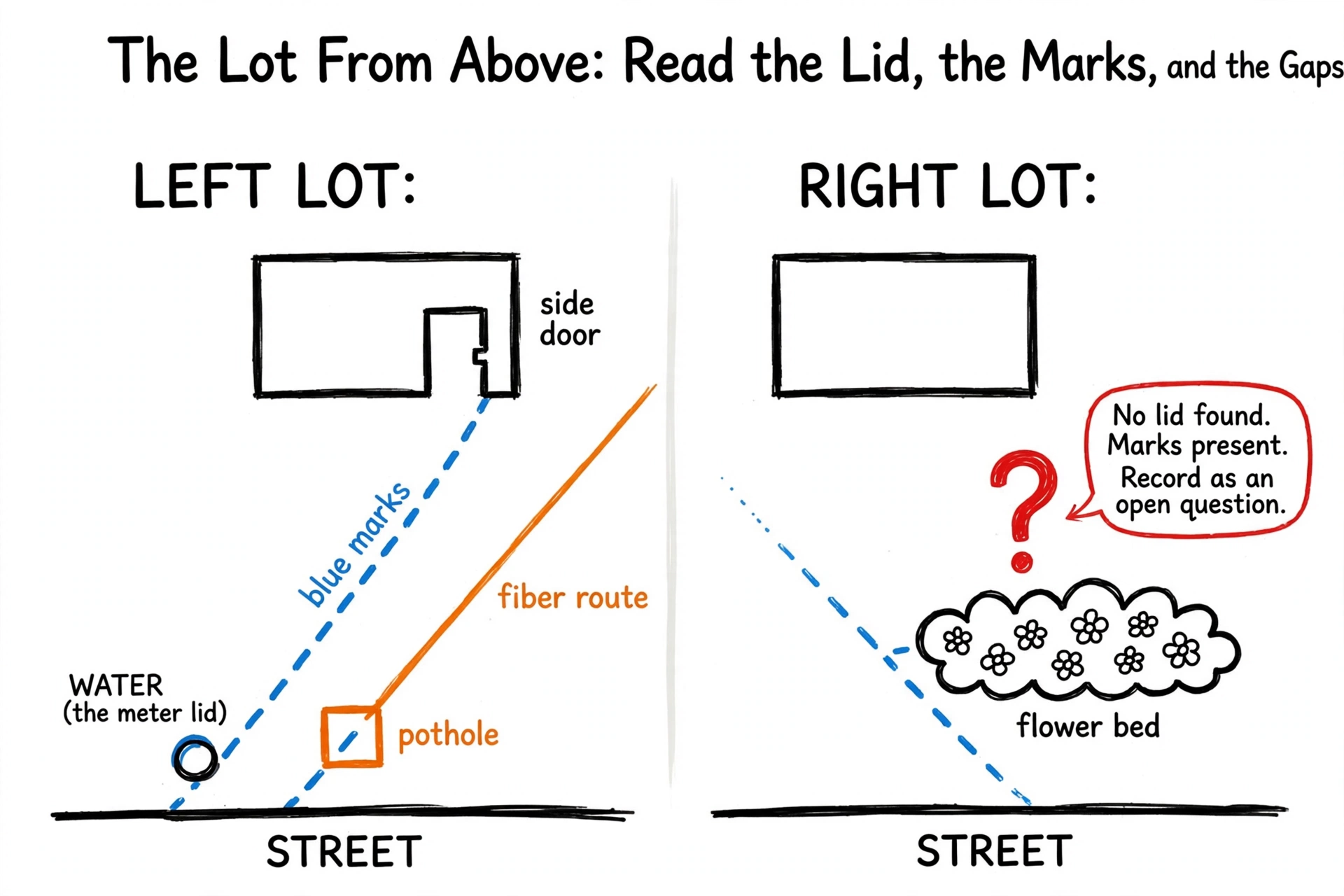
Picture a fiber crew placing buried fiber along a residential street, boring from handhole to handhole in the right of way and crossing each lot frontage. Before the bore starts, the crew lead walks the block with the prints and the locate marks. Every house has a meter box near the curb except one. At that lot the grass is thick, no lid shows, and blue paint runs from the main toward the house and fades near a flower bed.
The lead does not record the lot as having no meter. The lead records a question: blue marks with no visible box. An occupied house has water arriving somehow, and the paint says a located water facility runs across that lot. The missing lid closes nothing.
The crew hand digs carefully at the flower bed edge, inside the project process and clear of the marked line, and finds the lid buried under mulch and soil, sunk and tilted, with the letters Water just visible once the cover is cleared. The box is photographed as found, before anyone adjusts it, and the condition is reported through the project process, so the preexisting buried and tilted lid is on record as found, not as damage the crew caused. The utility is notified through the project channel, because raising or resetting a meter box is utility work in that system, not fiber crew work.
With the endpoint now known, the planned bore path is checked against the full picture. Blue marks run from the main to the newly found box on a slight diagonal, not on the straight line the crew would have guessed from the curb to the house. The house side line leaves the box toward a side door, not toward the front wall closest to the street. The bore crossing point sits within the tolerance zone of the street side segment, so under the project plan the crew potholes at the crossing before the bore. The pothole finds the service a short distance to the side of the paint center line, which is normal, because locate marks are approximate, and at a depth the bore plan can now cross with the clearance the project specifies, by the method the plan directs.
During the bore, the operator watches the pit for water that does not belong there. None appears. At the next lot, where the box was visible from the start, the authorized prework photo shows the box already holding clear standing water on a dry morning, and the grass along the service path is greener than the rest of the yard. The crew does not open the curb stop, does not try to pump and diagnose the box, and does not bore through and hope. It reports the condition with its photos before disturbing the ground, the project contacts the utility, and the utility finds a small leak on a street side fitting that predated the fiber work. The bore is rescheduled past that lot until the utility repair is done, rather than through ground softened by a leak.
At restoration, both boxes are left with lids flush at grade and clear of spoil and sod, the endpoint wire in the second box is confirmed uncut by visual check from the surface as the lid is reset by the party authorized to do it, and the closeout photos show each box as found or better. The daily record names, for each lot, the box location, its condition before and after, where the service was potholed, and the two findings, a buried lid and a preexisting leak, with the times they were reported.
The meter did not slow the job down. It told the crew where the live lines were, where the marks could not be trusted alone, and where someone else needed to work first. Carry the rule out of this story: a missing lid goes into the record as an open question; a box gets photographed before you disturb it and after you restore it; and a leak sign gets reported before the bore passes it.
What Can Go Wrong?
- Assuming the service runs straight. A crew draws a straight line in its head from the main to the meter box, bores across the front yard a few feet to the side of that imagined line, and cuts a service that jogged around an old tree pit. The box was real. The straight line was invented.
- Assuming no box means no service. A lid is buried under mulch or sod, the crew concludes the lot has no water service crossing, and no one asks why a house with occupants would have no water. The service was there. The warning was covered.
- Driving or parking on the box. A truck, a mini excavator, or a loaded trailer crosses a residential meter box that was never built for wheel loads. The box cracks, the lid breaks, the setter shifts, a joint begins to leak inside the box, and the damage is charged as construction damage.
- Burying the box in restoration. Spoil, backfill, sod, or a pavement patch covers the lid or leaves it well below or above grade. The utility cannot read or service the meter, the lid becomes a mower strike or a trip hazard, and the project is called back to uncover its own work.
- Cutting the endpoint wire. An AMR or AMI wire runs from the register to the lid antenna in many settings. A shovel, a lid pried carelessly, or spoil dragged through the box cuts or pulls that wire. The meter still measures, but remote reads stop, and the utility must revisit a box that was working before your work.
- Treating the curb stop as a crew valve. A leak starts, a well meaning worker reaches for the street side stop without utility authorization, uses the wrong tool, forces a corroded valve, and makes the leak worse or breaks the stop. In most systems that valve is utility property, and local rules, not urgency, decide who may operate it.
- Misreading a leak indicator. A crew sees a still indicator at one glance and reports the line as dead, or sees it turning and reports a confirmed break. A single glance proves neither. The indicator shows flow at that moment on meters that have one. A line with no flow at noon is still pressurized and live. A turning indicator shows movement that needs context, not a diagnosis.
- Ignoring a flooded box or wet corridor. A box full of clear water on a dry day, a green strip of grass along the service path in a dry yard, or soggy soil at a bore crossing can each be a leaking service announcing itself. Boring through without reporting it turns a small existing leak into a disputed strike.
- Confusing water with another utility. A round lid is assumed to be water when it is a sewer cleanout, a gas valve, or an irrigation box, or a water box is assumed to be an irrigation box with no pressure behind it. Lids, marks, and records must agree before the feature is named in the plan. Irrigation and reclaimed water systems use purple in the APWA code, not blue, and they are separate systems with their own controls.
- Striking the house side line that no ticket marked. The public locate marked the utility segment to the meter. The crew assumed the marks covered the line all the way to the house and trenched through the customer segment, which in that system was a private facility outside the ticket. The meter boundary, ignored, was the whole lesson.
These failures share one root. The meter was treated as a billing device that belongs to office work, instead of as field information that belongs to the crew. It is field information. It marks a live line, a boundary, and a piece of utility property, all in one small box.
What Should Someone Notice in the Field?
Notice the meter the way a locator and the utility will need it described, from the surface, without operating anything. You are observing, describing, and reporting. You are not shutting off water, repairing a meter, or certifying a crossing as clear.
- Find and name every box on the route. Walk the frontage of each lot your work crosses. Note each lid marked Water or Water Meter, its location by address and by position relative to the curb, the sidewalk, and the property line, and whether an endpoint antenna or reader lid is present. Note lots where you expected a meter and found none, and say so as a question, not as a conclusion that no service exists.
- Record the condition of the box and lid before work. Lid present and flush, sunk, raised, cracked, tilted, or missing. Box buried, covered by soil or pavement, or clear and accessible. Photograph each box on your path before disturbance, with the address or location tied to the photo by your project method.
- Read the marks against the box. Confirm blue potable water marks serve the box and note where they run on both sides of it, toward the main and toward the building. Note orange communications marks where your route will cross the blue. Flag any mismatch, a box with no blue marks, blue marks with no box, or marks that stop at the property line while your work continues past it.
- Look for leak signs without opening anything you are not authorized to open. Clear water standing in a box on a dry day where you are authorized to look, water flowing from a box, soggy or sunken ground along the likely service path, an unusually green strip in dry grass, the sound of running water at a quiet box, or erosion at the curb. Describe what you saw, where, and when. Do not name it a confirmed leak unless the utility confirms it.
- Note movement only if you are authorized to view the register. If your project process includes viewing the register and the meter has a leak indicator, note whether the indicator is still or turning, and whether the sweep hand is moving, at the time you looked. Record the unit printed on the face, gallons or cubic feet, with any read you are asked to record, exactly as displayed. Never report a line as not live because an indicator was still at one moment.
- Protect the box during work. Keep wheels, tracks, spoil, and backfill off the box. Do not set a handhole, vault, or bore pit so it undermines or covers the box. If a box must be worked around closely, follow the project plan for supporting and restoring it, and leave the lid at finished grade and fully accessible.
- Watch the crossing, not just the box. Where your bore or trench will cross the service between the main and the meter, and again between the meter and the building if your work goes there, confirm the locate is current, respect the tolerance zone the governing state rules set around the marks, and pothole where the project process requires proof before the bore passes.
- Report damage and surprises at once. A cracked lid, a shifted box, a cut endpoint wire, water appearing in a pit, a strike or nick on any water line, or a box found buried or destroyed before your work each goes through the project process immediately. A pressurized water strike also goes to the utility and to 811 or the local emergency process as your project plan and state rules direct. Describe the location relative to the meter, street side, in the box, or house side, because that wording routes the repair.
Safety and limits, plainly. Recognizing a water meter does not qualify you to operate a curb stop or corporation stop, open a sealed register, repair or replace a meter or setter, cut, tap, or reconnect a pressurized water line, or judge that a service is abandoned. Abandoned services exist, but only the utility records and the utility can confirm that a given service is abandoned and safe to treat as dead. A meter that has been removed, a box that is empty, or a line that shows no flow can each still connect to a pressurized system. Treat every water service as live until the utility, in its own records and words, says otherwise.
Key Terms
- Water meter. A measuring device in the service line to a property that records the volume of water passing through it, used by the utility for billing and for watching for abnormal use.
- Register. The display head on top of the meter that shows the total volume recorded. On an analog meter it includes numbered digits, and often a sweep hand and a leak indicator.
- Sweep hand. A single hand on an analog register that turns around a dial as water flows. The volume in one full turn is printed on the dial and varies by meter, commonly one cubic foot or ten gallons.
- Leak indicator, or low flow indicator. A small triangle, star, or dial on many analog registers that turns with very small flow. Steady turning when all known use is off can signal a leak and always means water is moving at that moment. Not every meter has one.
- Water main. The larger pipe in or near the street that carries potable water past many properties. Each property service branches from it.
- Service line. The smaller pipe that carries water from the main to the meter and, in common usage, onward toward the building. Local rules divide its ownership and naming at points that vary.
- Corporation stop. The valve at the connection between the service line and the main. It is buried at the main and is utility equipment.
- Curb stop, or meter stop. The shutoff valve on the street side of the meter that lets the utility stop all water to the property at the meter. In most systems it is utility owned and utility operated, under local rules.
- Customer valve. A shutoff valve on the house side of the meter, where one is present, for shutting off water to the building. Some properties have their main shutoff inside the building instead.
- Meter setter, or meter yoke. The frame of pipe and fittings that holds the meter at a set spacing and height in the line, often including shutoff valves, so the meter can be serviced and replaced.
- Meter box, or meter pit. The ground level enclosure that protects the meter setting and gives access to it. Its lid sits at grade and is often marked Water or Water Meter.
- Endpoint. A small radio transmitter connected to the register, often mounted in or under the box lid, that sends the meter read out by radio for AMR or AMI collection. Its wire must not be cut.
- AMR and AMI. AMR is Automatic Meter Reading, where an endpoint broadcasts the read for walk by or drive by collection. AMI is Advanced Metering Infrastructure, where endpoints send reads through a fixed network to the utility, often without a site visit.
- Potable water. Water that is safe to drink. In the APWA Uniform Color Code, potable water facilities are marked in blue.
- Right of way. The strip of land reserved for roads and utilities along a street. Many meter boxes sit in the right of way near the property line.
- Potholing. Digging a small careful hole, by hand or with vacuum equipment, to expose a buried line and confirm its exact position and depth at a specific point.
Check Your Understanding
- A meter box sits near the curb of an occupied house. List three separate facts that box tells a fiber crew before any digging, and one important fact it does not tell them.
- Put these in order from the street to the house and name the job of each: water main, corporation stop, curb stop, meter, customer line. Then state who, in most systems, owns the meter and the curb stop, and why a fiber crew does not operate the curb stop on its own judgment.
- An analog register has a small triangle that keeps turning while the building is empty and all known fixtures are off. What is that part called, what does its turning prove, what does it suggest, and what should a fiber crew do and not do in response?
- Blue marks run across a lot but no meter lid can be found, and the house is clearly occupied. A trainee says the lot has no water service to worry about. Identify the errors in that conclusion and the correct next steps.
- Your bore must cross a water service between the main and the meter, and again the prints show a line from the meter to the house that your work will also cross. Why can the second crossing need separate confirmation even when the first was located on the public ticket?
Answer key
- The box proves an active water service exists for that property, it fixes the surface endpoint of that service where the street side segment ends and the house side segment begins, and it shows a piece of utility equipment at grade that must be protected and left accessible and flush. It does not show the exact buried path of the service between the main and the box, its depth, or its condition. That path is approximate until located and, where required, potholed.
- Order: water main in the street, corporation stop at the tap on the main, service line to the curb stop on the street side of the meter, the meter in its setter inside the box, then the customer line to the building. The main carries water past many properties. The corporation stop connects and can isolate the service at the main. The curb stop can stop all water to the property at the meter. The meter records volume for billing. The customer line carries water from the meter to the building. In most systems the water utility owns the meter and the curb stop. A fiber crew does not operate the curb stop on its own judgment because operating rules belong to the utility and local code, the valve is utility property, and forcing or misusing it can worsen a leak or break the stop. Exceptions, if any exist, come from the utility authorization for that system, not from this lesson.
- The part is the leak indicator, also called a low flow indicator, found on many analog registers. Its turning proves water is moving through the meter at that moment. It suggests a leak or other small continuous use on the customer side, such as a running toilet or a line break, but it does not by itself diagnose which one, and small legitimate uses can also move it. The crew should note the time and the observation, photograph as its process allows, protect the area, and report promptly through the project process so the utility or the customer and a plumber can investigate. The crew should not operate the curb stop without clear authorization, should not attempt to find or repair the plumbing leak, and should not report the line as a confirmed break on the strength of the indicator alone.
- First error, treating a missing lid as a missing service. Lids get buried under soil, mulch, sod, and pavement, and an occupied house has a water supply arriving somehow. Second error, ignoring evidence that contradicts the conclusion. Blue marks running toward the house are a located water facility, not a decoration. Third error, treating the question as closed by a surface glance. The correct steps are to record the mismatch as a finding, search carefully at the surface without digging into the marked line, check project records and ask through the project process, notify the utility through the project channel if a box may be buried or damaged, and resolve the endpoint location and complete the locate and potholing the plan requires before any bore or trench crosses that lot.
- Because the ownership and locate boundary often sits at or near the meter. The public 811 ticket covers member utility facilities, which commonly include the water main and the utility side service to the meter. The line from the meter to the building is a private, customer owned facility in many systems, and private facilities are not always marked on the public ticket. Rules vary by state and utility, so the crew must confirm what its ticket actually covered, and use records, a private locator, or potholing as the project process requires for the house side segment, instead of assuming the blue marks to the meter prove the rest of the path.
Lesson Takeaway
A water meter is a small billing device that carries a large field message. It indicates that a water service reaches that property, and that service is treated as live and pressurized until the utility confirms its status in its own records. Its box near the curb or property line, with a lid often marked Water, fixes the surface endpoint of that service, where the street side segment from the main, through the corporation stop and the curb stop, meets the house side line to the building. Inside the box, the meter in its setter records volume on a register that may read in gallons or in cubic feet depending on the utility, with a sweep hand for flow and, on many analog meters, a leak indicator whose steady turning means water is moving and can signal a leak. An AMR or AMI endpoint may send that read by radio from the lid, on a wire a crew must not cut. The box tells you a crossing exists. It does not tell you the exact buried path or depth, which stay approximate until located in blue under the APWA code and, where the work requires it, confirmed by potholing. In most systems the utility owns the meter and the curb stop, and local rules decide who may operate or reset anything in that box. So the fiber crew habit is simple. Find every box, photograph it before and after, match it to its blue marks, protect it from wheels, spoil, and burial, leave its lid flush and accessible, report flooding, damage, and leak signs at once, and never treat a quiet lid as an empty lot.
Sources and Technical References
- Alderwood Water and Wastewater District, My Water Meter. States that most water meters are in the right of way at the edge of the road near the property line, in a ground level box with a lid, that the register shows total use with the last digits often in a different color, that one turn of the sweep hand equals one cubic foot or 7.48 gallons, that the leak indicator rotates with very little flow so even small leaks register, and that the odometer style register records total use in cubic feet on the meter shown. Used for box location, register, sweep hand, and leak indicator recognition. https://awwd.com/explore/my-water-meter/
- City of Bothell, Washington, Understanding Your Water Meter. States that the meter is usually near the edge of the road in a concrete or plastic box with a lid, that the box may be full of dirt or water, that the red sweep hand rotates when water passes and one turn equals 7.48 gallons or one cubic foot, and that the leak indicator, shown as a blue star in that guide, rotates even with very small amounts of water moving through the system. Used for box contents and indicator variation by system. https://www.bothellwa.gov/DocumentCenter/View/11257/Understanding-your-Water-Meter
- Lakeside Water District, Reading Your Water Meter. States that the leak detector triangle or star rotates even with very small amounts of water, and turns when all water is off suggests a leak, that each full rotation of the sweep hand indicates one cubic foot or 7.48 gallons, that the register keeps a running total like a car odometer, and that billing there is in increments of 100 cubic feet, with one unit equal to 748 gallons. Used for indicator meaning and for cubic foot billing as one utility practice, not as a universal unit. https://lakesidewater.org/customer-service/reading-your-water-meter/
- California Water Service, How To Read a Water Meter. States that most meters are located near the curb under a concrete lid, that Cal Water uses 100 cubic feet as a billing unit, and that leak checking is done by observing the sweep or test hand for movement with all water turned off. Used for curb location and billing unit variation. https://www.calwater.com/video/reading-your-water-meter/
- Outdoor Watering Nerds, University extension linked guide, Read Your Meter. States that the meter is generally in the ground near the curb, that the box lid often says Water Meter, that a meter may measure in cubic feet or in gallons depending on the provider, that the flow indicator triangle rotates whenever water flows, and that sweep hand value differs between cubic foot and gallon meters. Used for unit variation by provider. https://outdoorwateringnerds.org/outdoor-leak-detection/read-your-meter/
- Moapa Valley Water District, Where To Find My Main Water Valve. States that there is a curb valve in the meter box near the street on the street side of the meter, that the meter and all its parts are the property of the district, that the box holds sensitive metering equipment, and that damage to valves or meter equipment requires district crews to repair. Used for utility ownership of the meter and street side valve in that system, stated in this lesson as the common pattern with local variation, not as a universal rule. https://moapawater.com/where-to-find-my-main-water-valve/
- Consolidated Mutual Water Company, Specifications for 1 Inch Water Service Meter Pit Setting. States that the meter pit center is set inside the public right of way or easement in that system, that the curb stop is set near the meter pit at a stated distance in that specification, and that the roadway box lid is marked Water. Used as an example of one utility written standard for pit location and lid marking. Distances in that specification are that utility rules for its system and are not stated in this lesson as general requirements. https://www.cmwc.net/wp-content/uploads/2026/09/1.0-2024-Commercial-Specification_flat_rem.pdf
- WaterOne, Standards and Specifications, meter setting pages. States that the meter setter or branch piece must be centered in the meter pit so the shutoff valve is accessible and in line with the corporation stop, that the meter pit cover shall be flush with the ground at final grade, and that the applicant furnishes the customer service line from the property line to the building in that system. Used for meter setter function, flush lid at grade, and one system division of customer line responsibility. https://www.waterone.org/218/Standards-Specifications
- Phillips 66, Safe Digging, APWA color summary, drawing on the Common Ground Alliance and APWA Uniform Color Code. States the APWA colors including blue for potable drinking water, orange for telecommunication and fiber, purple for reclaimed water and irrigation, white for proposed excavation, and pink for temporary survey markings. Used for the blue potable water mark in this lesson. https://www.phillips66.com/pipeline-safety/safe-digging/
- Missouri 811, How the Process Works. States that locating is not an exact science, that each mark should be considered an approximate locate, that caution is required within the tolerance zone on either side of the markings, and that hand digging is highly recommended in that zone. Used for approximate marks and tolerance zone caution. The width of the tolerance zone is set by state rules and varies, so this lesson names no single width as universal. https://blog.missouri-811.org/missouri-811-how-the-process-works?hs_amp=true
- Newport Beach, California, Advanced Water Metering Infrastructure FAQs. States that AMI systems consist of a small low powered radio transmitter connected to an individual digital meter that sends readings to a network of receivers and repeaters, that an antenna is installed in the lid above the meter and connected to the meter, and that the system transmits the meter reading, the meter identification number, and diagnostic information, with no personal customer information transmitted. Used for AMI endpoint, lid antenna, and transmitted content. https://www.newportbeachca.gov/government/departments/utilities/advanced-metering-infrastructure-project/advanced-water-metering-infrastructure-faq-s?NavID=20286
- Hixson Utility District, AMR Project. States that AMR is Automated Meter Reading using communication technology to read meters located in a meter box in the ground near the residence or business without opening every box, with a small battery powered radio transmitter connected to the meter by a cable that sends the reading and a unique identification number to a receiver in a vehicle driven near the property, and that the system can flag a leak indicated on the customer side of the meter. Used for AMR drive by collection and endpoint wire recognition. https://www.hixsonutility.com/services/amr-project-2/
- Ford Meter Box Company, Water Meter Yoke catalog. States that yoke settings can include a variety of valve styles at either the inlet or outlet, close coupled to the yoke so the valves are easily inspected, and that setters and yokes hold the meter in its setting for service. Used for meter setter and yoke function only. Sizes and models in that catalog are manufacturer offerings, not field requirements. https://assets.fordmeterbox.com/catalog/e/Water-Meter-Yoke-Catalog.pdf?v=1761068369
Previous lesson: Lesson 39: What Does a Gas Meter Tell You? |
Back to Level 2 hub |
Next lesson: Lesson 41: What Is a Utility Pedestal?