
Introduction
A gas meter set is the above ground assembly at the end of a natural gas service line. It is the place where buried gas comes up at a building, has its pressure reduced to a level the building can use, and gets measured before it passes into the building piping. For a fiber crew, the set matters most for what it signals: a pressurized buried line ends at that wall, and the route of that line across the yard is unknown until it is located.
Level 2 teaches you to read the physical environment a route passes through before work starts. This lesson reads a small assembly on a building wall and connects it to the buried network, to the locate process, to the crossing plan, and to the emergency response that govern any crew working near gas. The lesson teaches recognition only. Reading a meter set never qualifies anyone to operate, move, or repair gas equipment.
What This Lesson Gives You
- Read a gas meter set in flow order and name each part without touching any of it
- Explain why a meter marks the endpoint of a buried service and why the path of that service stays unknown until a locate marks it
- Spot a blocked regulator vent, a buried riser, a leaning set, and crowding around a set, and route each one to a report
- State the leave and call response to a gas smell, a hissing sound, or a damaged line, and name who decides when an area is safe to reenter
Start With the Basics
Picture the side of a house where a fiber route needs to place a handhole, bore past the building, or trench toward a new service location. On the wall you see a gray metal meter with a glass or plastic cover over dials or a digital display, pipes coming out of the ground beside it, and a round, disk shaped device in the piping. Many crews walk past that assembly and think only about keeping a machine clear of it.
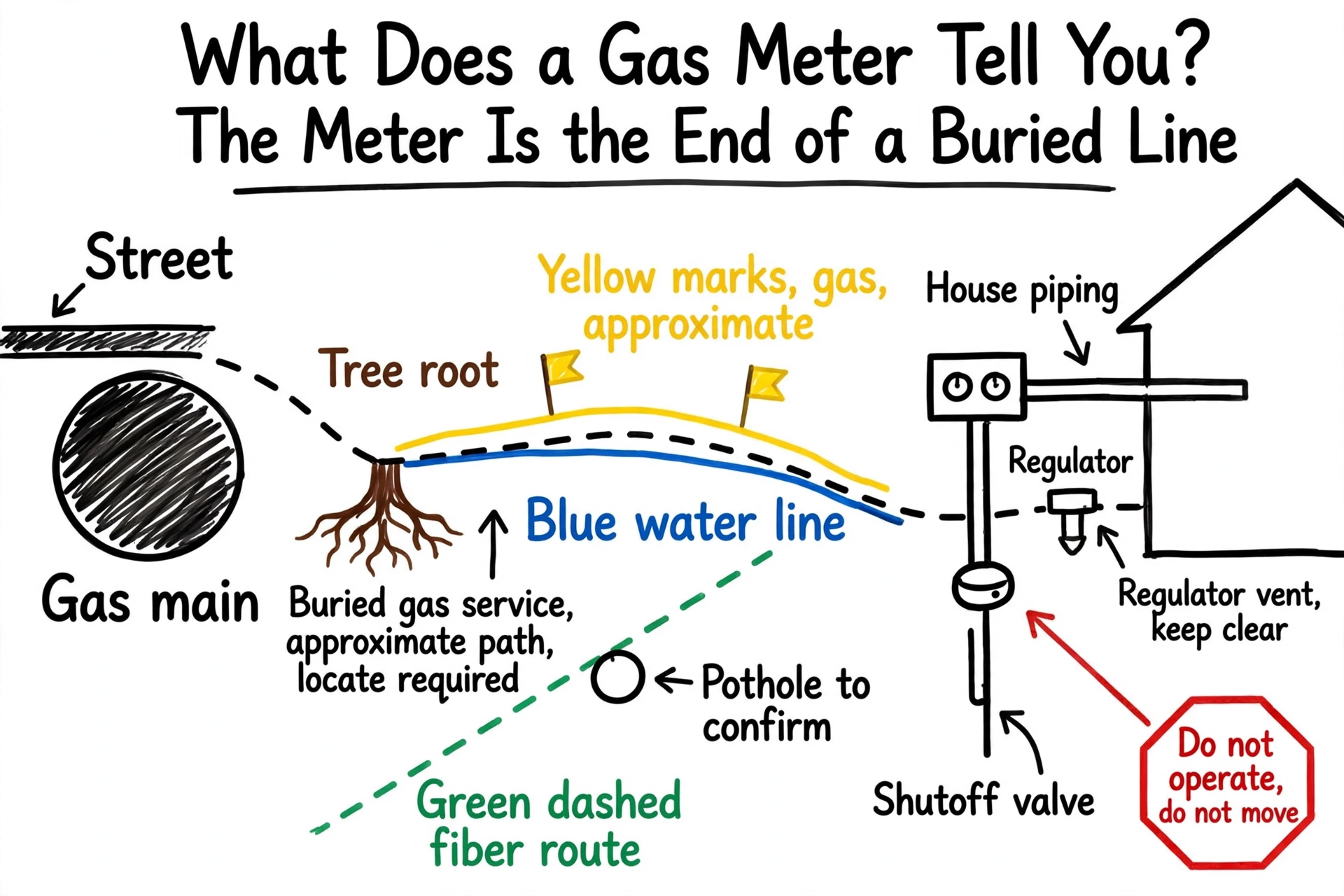
That assembly tells a bigger story. It is the visible end of a buried pipe. Somewhere out at the street or in an easement there is a larger gas pipe called a main. A smaller buried pipe branches from that main, crosses the yard or the right of way, and rises out of the ground at this building. That smaller pipe is the service line. The meter set is where the buried system comes above ground, drops its pressure to a level the building can use, measures how much gas the building uses, and hands the gas off to the piping inside the building.
A plain analogy helps. Think of a building water system fed from a city main: a smaller pipe runs to the building, a pressure reducing valve steps the pressure down so fixtures are not blasted, and a meter counts use for billing. A gas meter set follows the same shape. A buried line delivers, a regulator steps pressure down and holds it steady, and a meter counts what passes. The contents differ, and the hazard differs with them, which is why the gas version carries stricter hands off rules.
So a gas meter does two jobs at once. It measures gas for billing. It also works as a map clue. It marks the building entry point for gas service, which means it marks one end of a buried utility that your excavation must find through a proper locate. Read the meter that way, as an endpoint with a buried line behind it, and the rest of this lesson follows.
Three ideas carry the lesson:
- Follow the gas in order and each part makes sense.
- What is above ground is only the end of the story, and the buried part is the part that matters most to a digging crew.
- Recognition and permission are different things. Learning to name the parts gives nobody permission to operate them.
What Is It?
A gas meter set, also called a meter set assembly in utility and supplier material, is the group of above ground parts at the end of a natural gas service line. In a typical arrangement, in the order gas flows, the parts are:
- The buried service line
- The riser
- The shutoff valve
- The regulator, with its vent
- The meter
- The house piping
Some installations vary in layout, in which side of the meter a part sits on, and in added parts such as a meter bar that supports the meter, swivels that connect it, or a second shutoff on the building side. The flow order above is the teaching order for a common residential set. Field sets can differ in visible arrangement.
Define each term before using it further.
The gas main is the larger buried distribution pipe, usually in the street, alley, or easement, that carries gas through the neighborhood. Distribution is the local network that delivers gas to many buildings, as distinct from large transmission pipelines that move gas over long distances.
The service line is the smaller buried pipe that branches from the main and runs to one building or to a small group of buildings. It is buried, it is pressurized, and in many modern systems it is plastic. Plastic pipe cannot be found with a metal detector signal from the pipe itself, which is why a tracer wire is commonly buried with it, as explained below.
The riser is the vertical pipe that brings the service line out of the ground at the building. Where a plastic service line comes up, the riser protects the transition from buried to above ground and connects the buried pipe to the metal piping of the meter set.
The shutoff valve, also called the meter valve or service valve in some sources, is the valve on the riser or at the meter set that can stop gas flow from the service line. In many sets it is a lockable valve operated with a wrench by the utility or by emergency responders. It is rarely a simple hand handle for occupants or for other crews. Naming it in this lesson authorizes nobody to touch it. For a fiber crew, it is a part to recognize and leave alone.
The regulator is the device that reduces higher distribution pressure in the service line to the lower pressure the building piping and appliances are built to use, and holds that lower pressure steady as demand changes. It is often disk shaped because it contains a diaphragm and a spring that work against gas pressure.
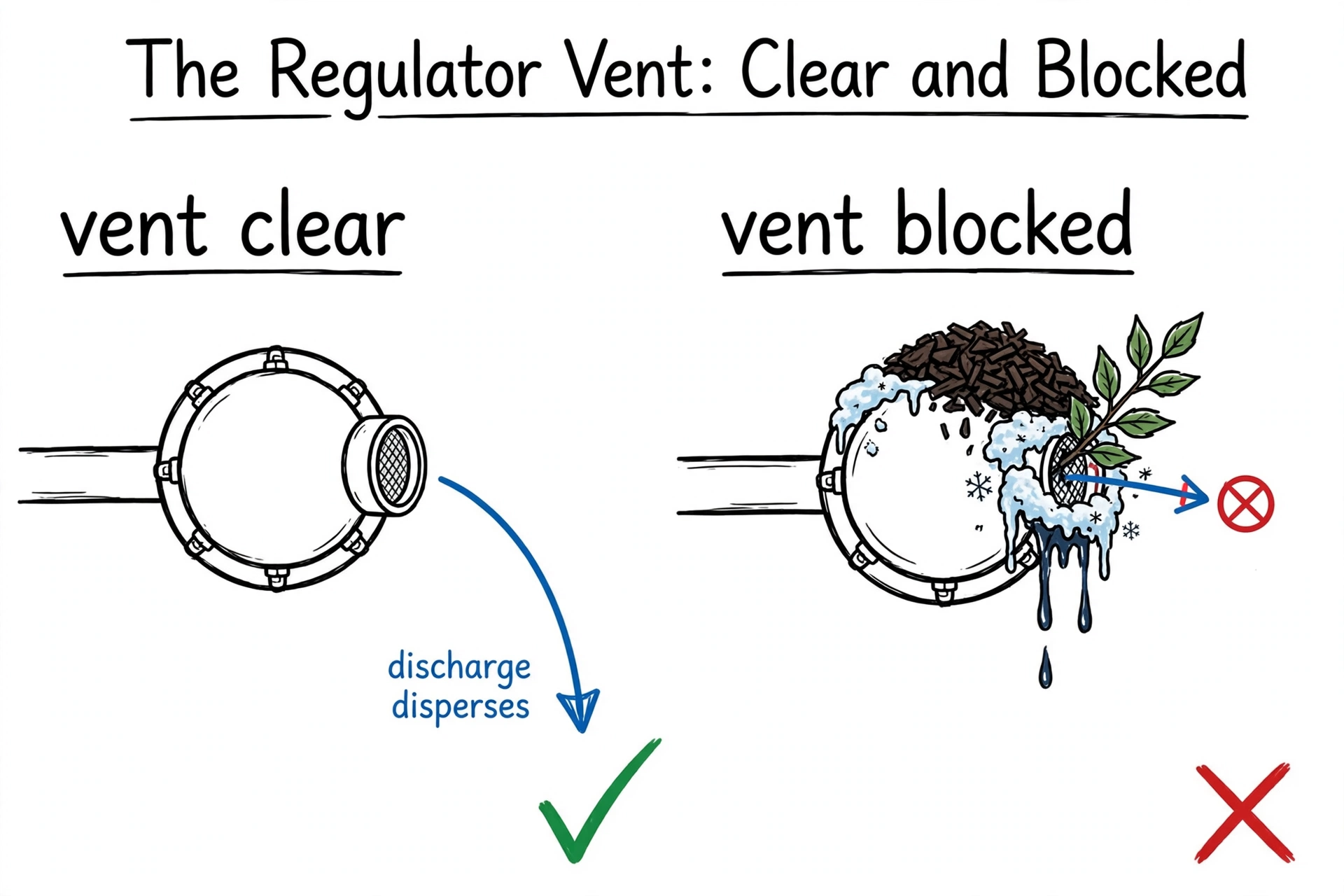
The vent is a small screened opening on the regulator. It lets the space above the diaphragm breathe to outside air so the regulator can work, and it can release gas if the regulator or its diaphragm fails or pressure rises beyond its control. The vent is a working safety part. It is never a place to hang, plug, paint over, or cover.
The meter is the measuring device. A common residential meter measures the volume of gas passing through it, traditionally with internal diaphragms that fill and empty in a repeating cycle and drive dials or an index on the face. Newer sets may carry electronic reading equipment. The meter measures use for billing. For a fiber crew, its reading is not useful field information, and there is no reason to touch, lean on, or work from the meter face.
House piping, also called customer piping or fuel gas piping in code language, is the piping on the outlet side of the meter that carries gas into the building to appliances such as a furnace, water heater, or stove. Utility material commonly describes utility responsibility ending at or near the meter outlet and property owner responsibility covering house piping. The exact dividing point varies by utility and by place. Never state a dividing point for a specific address from this lesson. Ask the utility or read the project and utility records for that service.
Pressure needs careful framing, because numbers travel badly. Inspection and general information sources describe household gas after regulation at about 7 inches of water column, about one quarter of a pound per square inch, often shortened to psi. Inches of water column, shortened to in. w.c., name a way of measuring low pressure by how high that pressure would push a column of water. The same general sources describe the pressure in the line leading toward a home as varying widely by system, ranging in one widely repeated summary from about one quarter psi up to about 60 psi, depending on how many homes or businesses the line serves. Other inspection material describes gas supplied to a commercial building as typically between 5 and 7 inches of water column. Treat all of those figures as sourced examples that show the range and the regulator job. Pressures vary by system, by utility, and by building. This lesson states no distribution pressure, delivery pressure, or test pressure as a rule for any specific site, and a fiber crew never needs to measure or verify gas pressure.
A tracer wire is a conductive wire buried with a plastic service line so a locator can put a signal on the wire and follow the buried line with locating equipment. Utility and inspection sources describe the buried gas pipe as typically plastic and surrounded by or accompanied by a tracing or tracer wire for that purpose. The wire helps a qualified locator mark the line. It makes the line findable through the locate process only. It gives no crew a line they can find by eye or by a straight line guess, and it never replaces a locate ticket.
What Does It Look Like?
Look for a meter set on an outside wall of the building, near the ground, often on a side wall, sometimes at the back, and occasionally in other utility approved locations. Commercial buildings may have a larger meter, several meters grouped together for separate units, or a meter in a protected area. Start by identifying the set as a whole, then read its parts in flow order without touching any of them.
- At the ground line, the riser. Look for a vertical metal pipe rising out of the soil, pavement, or a sleeve beside the building. Soil, mulch, or landscaping piled against the riser is a condition to notice, because utility guidance says no portion of the meter set or its shutoff should be buried under dirt or mulch. A short painted line on some risers marks the point that must stay above ground in that utility system. Never dig around a riser to check what is below it. The buried service line leaves the bottom of that riser underground, out of sight.
- Just above the ground, the shutoff valve. On many residential sets it appears as a valve body with a flat tang or ear with a hole in it, meant for a wrench and for a lock, rather than a round handle or a lever you would turn by hand. If the tang is in line with the pipe the valve is generally open, and if it is crosswise the valve is generally closed. A fiber crew confirms nothing about service status from valve position and changes nothing about that position. Report what you see if a set looks shut off, damaged, or locked, and leave the valve exactly as found.
- Next, the regulator. It is commonly a round or disk shaped metal housing, wider than the pipe, mounted in the piping before the meter or as part of the assembly at the riser. Look for its vent, a small downward facing or screened opening, sometimes on a short neck or cap on the regulator body. The vent opening may point down to shed rain and snow. Keep that picture in mind. A vent buried in mulch, packed with snow or ice, blocked by a nest, covered in paint, or pointed into a wall covering is a blocked working part. Report it to the property contact and the utility through the project process. Clear it with nothing, and poke it with nothing.
- The meter itself. It is usually a rectangular metal case, often gray, with a face that shows dials, a digital index, or both behind a cover. Pipes connect at the top or sides through fittings and, on many sets, a horizontal meter bar supports the meter and holds the spacing between inlet and outlet. The meter may carry a utility tag, seal, or electronic reading module. A broken seal, cracked cover, bent case, leaning meter, or piping that has pulled out of line after ground movement, a vehicle strike, or excavation nearby is a report at once condition.
- On the outlet side, the house piping. It leaves the meter and enters the building through the wall, or runs along the wall to its entry point. That wall entry is the building entry point the meter marks. Note its exact location in your field notes by wall, by distance from a corner or other fixed feature the project uses, and by a photograph from a safe position. That entry point, plus the street main location, frames the corridor in which the buried service should be expected. It draws no line of that service on the ground.
Also notice what is not part of the set but affects it:
- Electric meters, outlets, air conditioning units, appliance vents, windows, doors, crawl space openings, and other building openings near the regulator vent
- Grills, generators, stored fuel, and other ignition sources nearby
- Fences, shrubs, stored materials, parked equipment, and enclosures that block access to the set
Utility workers and emergency responders need clear access, and vented gas needs room to disperse away from openings and ignition sources instead of collecting or entering the building. The required distances for those clearances vary, as the next sections explain, so notice and report crowding. Measuring a distance and declaring a set compliant or noncompliant is outside a fiber crew role.
What Does It Do?
Each part does one job in a chain, and the chain has a digging lesson inside it.
The main and the service line deliver gas. They carry pressurized gas from the neighborhood distribution system across public and private ground to this building. That is why the buried service is the central concern for a fiber crew. A pipe that is small, buried, pressurized, and flammable in content crosses the same ground a bore or trench wants to cross. Its job continues during every hour of a fiber project schedule.
The riser brings that buried line safely above ground and into the metal assembly. It also marks, at the surface, the point where the buried line ends. When you see a riser, you are seeing the top of a buried route.
The shutoff valve gives the utility and emergency responders a way to isolate the building from the service line for service work or in an emergency. Its presence transfers that job to nobody else who happens to be working nearby. A fiber crew that damages a gas line fixes nothing about the emergency by operating the valve. It leaves, calls 911 and the utility from a safe place, and keeps people away, following utility and project emergency guidance.
The regulator lowers and stabilizes pressure. Gas arrives in the service line at distribution pressure for that system, which varies. Building appliances are built for a much lower and steadier pressure. The regulator diaphragm and spring respond to outlet pressure and open or close to hold delivery steady as appliances start and stop. The vent makes that control possible by letting the diaphragm move against outside air, and it provides a path out if the diaphragm fails. That is why the vent must stay open, screened, and clear of snow, ice, water, nests, paint, soil, and coverings, and why its discharge must be able to disperse outdoors rather than into a building opening. Manufacturer and code material on regulator location also warns against placing regulators where they can be buried by snow, covered in ice, or submerged in water.
The meter measures how much gas passes to the building so the utility can bill for use and keep its records of service at that address. For a locate picture, the meter record matters in a second way. A meter at an address is evidence that the utility has, or had, gas service to that building. A removed meter with a capped riser may mean service was retired, altered, or is temporarily off. Decide none of those from the surface. Treat a capped or meterless riser as a possible live or formerly live service until the utility locate and the utility records say otherwise through the project process.
House piping distributes the measured, regulated gas inside the building to appliances. It begins where the utility delivery ends. Its route inside the building is no guide to the buried service route outside the building, and its entry point is a surface fact to record. Extending that point by eye across the yard draws a line nobody located.
Together, the set conditions the whole delivery. It can be shut off when the utility needs it shut off, it reduces pressure, it measures use, and it hands gas to the building at its entry point. For the fiber crew, it also performs one unofficial job. It warns you, before you dig, that a buried pressurized line ends here.
Where Does It Fit?
Level 2 teaches you to read the physical environment before work starts. Earlier lessons read the right of way, easements, curbs, sidewalks, ditches, drainage, and soil and rock. This lesson reads a small piece of equipment on a building wall and connects it to the buried network those earlier lessons described, to the locate process, and to the emergency rules that govern any crew working near gas.
In the utility network picture, the meter set sits at the boundary between public distribution and private use. Upstream of it, meaning on the supply side, are the transmission and distribution systems, the main in the street, and the service line across the yard, all owned and operated under the gas utility system in most arrangements. Downstream of it, meaning on the building side, is house piping and the appliances. The meter is the measuring point near that boundary, and the regulator just before it is the pressure boundary between the distribution system and the building system.
In the excavation picture, the meter belongs in the preconstruction walk and in the locate ticket, beyond a photograph of the building. When a route passes a building with gas service, the design and the field walk should record:
- The meter location
- The likely service corridor between the main and the meter, recorded as a question for the locate
- Any visible riser or vent condition
- Any access or clearance problem around the set
The locate request through 811, the national call before you dig number in the United States, is how utility locators are notified to mark their buried facilities. Wait for the required notice period and for responses under the state or local one call rules for the job, confirm the gas facility is marked or cleared through that process, and only then excavate under the project plan.
The marks you should expect for gas are yellow. The American Public Works Association, shortened to APWA, uniform color code uses yellow for gas, oil, steam, petroleum, or gaseous materials. Orange, by contrast, marks communication lines, including fiber. So on a fiber job the two colors most likely to cross are your own orange and the gas yellow. Yellow paint or flags show the approximate horizontal location of the buried gas facility as marked by the locator. They state no depth, no pressure, and no exact edge. State and local rules set the tolerance zone and the hand digging or soft digging requirements around a mark. This lesson states no tolerance zone width as a universal rule, because that width is set by the governing state or local requirement and the project plan.
Plastic gas services add one more link. A locator can often follow a plastic service because a tracer wire was buried with it and can carry a locate signal. That is a locating method for trained locators with proper equipment and access to the wire or to a connection point. It gives nobody a reason to skip the ticket, shorten the wait, or trust a line drawn between the meter and the main. Services bend around trees, old foundations, other utilities, property features, and past repairs. Services can run deeper or shallower along their run, and older services may differ from newer records. The likely path is a planning clue. The locate, followed where the project requires it by careful exposure of the line, often called potholing or daylighting by qualified crews under the project plan, is the evidence.
In the regulatory picture, gas piping and meter work sit under fuel gas codes, utility standards, manufacturer instructions, and pipeline safety rules that a fiber lesson never replaces. Examples named in the sources for this lesson include the National Fuel Gas Code, known as NFPA 54, for fuel gas piping installations, federal pipeline safety rules in 49 CFR Part 192 for gas pipeline transportation, and the gas code and utility standards adopted where the work is. Which code edition, which utility standard, and which clearance table governs a given meter set is a question for the utility, the authority having jurisdiction, and the manufacturer instructions for that regulator and meter. That is especially true for regulator vent clearances. Technical safety material shows that required clearances from a regulator vent or relief opening to building openings, air intakes, appliance vents, and sources of ignition change with the code, the device, whether overpressure protection is present, and the fuel. This lesson therefore states no single universal vent clearance distance. It teaches the rule behind the numbers: keep the vent clear, keep its discharge away from openings and ignition sources, and let the governing code and the utility decide the distance.
What Is at Stake
Safety. A gas service strike can release flammable gas, cause fire or explosion if the gas finds an ignition source, injure the crew and the public, and empty a building or a neighborhood. A damaged line does not have to be cut in half to be dangerous. A scrape, dent, pulled riser, cracked coating, or a meter set struck and left leaning can fail later. Utility guidance is consistent on the response to escaping gas. Leave the area, avoid anything that could make a spark, and call 911 and the gas utility from a safe location. Nobody on a fiber crew tries to find the leak, operates valves, starts vehicles or equipment in the area, or goes back until emergency responders or the utility say the area is safe.
The bore and trench plan. A meter tells the planner where a buried service must end, which changes bore entry and exit placement, handhole location, trench alignment, and crossing method before the crew arrives. A bore that crosses the service corridor at a shallow angle runs beside the gas line for a long distance. A handhole placed over an unlocated service creates a conflict that digging will find. Finding the meter in the walk, naming the service as a locate item, and planning the crossing from marked facilities, exposed where required, is cheaper and safer than finding the line with a drill head.
The building and its occupants. Blocking a regulator vent, burying a riser in mulch, building a solid enclosure around a set, parking a generator or grill against it, or planting and storing material so the utility cannot reach it can each turn ordinary equipment into a hazard or delay emergency shutoff. Vented gas that cannot disperse can collect or enter through a nearby window, door, crawl space vent, or air intake. A fiber crew creates none of those conditions and leaves none of its own material, spoil, conduit, or restoration in a way that creates them. Keep the set visible, accessible, and clear when you arrive and when you leave.
Records and the next crew. A meter photograph, a measured location for the riser and wall entry, a note of grouped meters at a multi unit building, and a note of a capped riser with no meter all become part of the as built and project record. The next project on that street then starts with the knowledge that gas service ends at that wall. Good records also protect the fiber provider if a preexisting condition, such as a leaning meter, corrosion, a blocked vent, or damaged piping, is later claimed as new damage. Photograph the condition as found, before your work starts nearby, from a safe position, and report preexisting damage through the project process without touching it.
Honesty about limits. A meter can mislead a confident beginner. It proves no service is active today, and an absent meter proves no buried gas line is absent. It shows no services to other buildings behind this one, and it shows no main, stub, or abandoned line elsewhere on the lot. Abandoned and retired facilities are handled under utility records and utility practice, and a line earns no dead status from a missing meter, a capped pipe, or a neighbor account of what was removed years ago. Only the utility process for that facility settles its status for excavation.
What Does Good Look Like?
- The preconstruction walk records every meter set on or near the route, with its wall, its riser, its wall entry point, grouped meters at multi unit buildings, and any capped or meterless riser, photographed from a safe position before work starts.
- An 811 locate ticket covers the excavation area, the required wait and positive responses are complete under the governing one call rules, and yellow gas marks are present and readable before digging starts, or the gas utility has cleared the area through that process.
- The plan treats the straight line between main and meter as a clue only. Crossings are planned from the marks and, where the project plan and governing rules require it, from careful exposure of the actual line by the crew qualified and authorized to do that exposure.
- The meter set is never used as a work platform, tie off point, material support, or step. Nothing is hung on it, chained to it, leaned against it, or stored in front of it, and access for the utility and emergency responders stays clear.
- The regulator vent is visibly clear and unobstructed when the crew arrives and when it leaves. No spoil, mulch, soil, snow pushed by the crew, conduit, restoration material, paint, tape, or equipment covers the vent, the riser, or the shutoff.
- Restoration respects the set. Finished grade buries no part of the set, pavement and landscaping block no access and no vent discharge, and the crew checks the set area at the end of the day against its arrival photographs.
- Damage and suspect conditions are reported at once and honestly. A nicked line, a pulled tracer wire, a struck riser, a new lean, a gas smell, or a hissing sound triggers the project emergency process. Nobody pushes soil back over a strike, tapes a pipe, straightens a meter, or finishes the bore first.
- Records match the field. As built notes show the meter and entry location, the marked gas line as found, any exposed crossing location as the project records it, and any condition reported to the utility, so the next crew starts from evidence.
A good outcome leaves the set untouched, accessible, and exactly as found, with the buried line located before digging and every condition the crew could not leave as found reported through the project process.
From the Field
Picture a fiber crew placing a short bore and a handhole to serve a row of houses on a residential street. During the preconstruction walk, the crew leader photographs the gas meter on the side wall of the middle house. The riser rises beside a crawl space vent, the regulator vent points down and is clear, and a shrub crowds one side of the set without covering it. The leader records the meter location from the front corner of the house, notes the crawl space vent and the shrub as conditions near the set, and adds a note that the planned handhole sits in the yard between the street and that wall.
The design had assumed the gas service ran straight from the main at the curb to the meter. The project 811 ticket goes in for the full work area, the required wait passes, and the gas locator marks the service in yellow. The yellow line does not run straight. It leaves the main, runs along the front of the lot, then bends toward the side wall to avoid an old tree and the water service, crossing the planned bore path at an angle and passing close to the first handhole location.
The marks show approximate horizontal location only, so the plan changes before digging. The handhole moves to the clear side of the marked corridor, and the bore crossing is planned under the project requirements for work near a marked gas facility, including careful exposure of the gas line at the crossing where the project plan requires it, by the crew authorized for that work.
During the work, no machine, spoil, or material is placed against the meter set, and the fiber crew cuts no shrub back, because the set belongs to the utility and the property. The crowding goes into the daily record for the property contact to handle with the utility if the utility wants it cleared. At the crossing, the exposed gas service is found offset from the paint line by a distance within what the crew was told to expect from an approximate mark, which confirms in the record why the handhole moved rather than staying on the original straight line assumption.
The bore passes under the project plan, the crossing is documented with location and photographs as the project requires, and backfill and restoration are kept from piling soil or mulch against the riser. At the end of the day the leader compares the meter set with the arrival photographs. The set is unchanged, the vent is still clear, access is as open as it was on arrival, and finished grade at the riser matches the grade in the morning photograph. The daily record lists the meter location, the yellow marks as found, the revised handhole position, the exposed crossing, and the unchanged condition of the set.
The crew learned nothing about the depth, pressure, or exact path of the whole gas service from the meter. It learned the one thing the meter reliably teaches, and it acted on that thing before digging.
The decision rule: when a meter is on the wall, treat a buried gas service as ending at that wall. Locate it, plan the crossing from the locate, expose it where the project requires exposure, keep hands and material off the set, and let the marks and the record, never a straight line guess, settle where the work goes.
What Can Go Wrong?
Gas meter failures for a fiber crew usually come from treating a warning sign as scenery.
- Guessing the service path. A crew draws a straight line from the street to the meter and bores beside it with confidence. The real service bends around an old tree stump and a water line, crosses the bore path, and is struck where nobody expected it. The meter gave the endpoint correctly. The crew invented the path.
- Skipping or rushing the locate. Work starts before the gas mark is made, after marks were destroyed by earlier grading, or on a ticket that does not cover the actual digging area. The endpoint stayed visible the whole time, and visibility of an endpoint locates no buried line.
- Trusting depth that was never given. A mark is read as a depth, or a neighbor statement about how deep gas lines usually are is treated as a fact for this service. Marks show approximate horizontal location. Depth varies with original installation, grading, erosion, and later work, and proper exposure confirms it where required.
- Operating the shutoff after a strike. A worker tries to help by turning the meter valve with a wrench, pliers, or a machine, in a cloud of escaping gas, near running equipment. Utility and public safety guidance for escaping gas is to leave, avoid sparks, and call 911 and the utility from a safe place. Valve operation by an untrained person in the hazard area adds risk and can add delay.
- Moving, straightening, or supporting a struck set. A riser is bumped, the meter leans, and the crew pushes it back upright and buries the base to hold it. A damaged joint below ground or inside the set can now leak unseen. Any strike or movement of the set is utility work to report, never field repair to hide.
- Painting, taping, or covering the set. Paint over a vent screen, tape over a crack, a sock or cap placed on a vent to stop an odor, or a decorative box built tight around the set each blocks venting, hides corrosion or damage, or traps gas. Utility guidance in the sources for this lesson includes specific warnings against burying the set and, in at least one utility system, against painting the meter or related equipment at all. Rules on painting vary by utility, which is another reason a fiber crew paints nothing on a meter set, ever.
- Burying the set in restoration. Spoil is graded against the riser, mulch is piled deep around the base for a neat finish, a new sidewalk or pad is poured tight around the piping, or a handhole lid ends up crowding the set. Access is lost, the vent can be obstructed, and corrosion and damage are hidden below the new surface.
- Blocking vent discharge with the project itself. A cabinet, generator pad, enclosure, stored reel, or spoil pile is placed so regulator vent discharge is directed toward a window, door, crawl space opening, air intake, or ignition source, or so gas cannot disperse. A fiber item can meet its own requirements and still create a gas problem by where it sits in relation to the vent.
- Missing the second service. A duplex or a house with a detached garage apartment has two meters, a second riser at the back, or a service that continues past the first building. The crew locates to the front meter only and digs into the unconsidered run.
- Deciding a line is dead. A missing meter, a capped riser, a vacant building, or an old mark is taken as proof that the buried pipe is abandoned and safe to cut. Status is a utility record question. Until the utility process confirms it for excavation, a possible gas pipe is treated as live.
What Should Someone Notice in the Field?
Notice the meter set as an endpoint, a pressure boundary, and an access point, from a safe position and without touching any part of it. You are observing, recording, and reporting. Operating, testing, and judging the gas installation belong to other people.
- Locate and record the set. Building wall, side of the building, distance from a corner or fixed feature the project uses, number of meters at the building, and which unit each grouped meter appears to serve, stated as appearance only. Photograph the whole set and then the riser base, regulator and vent, meter face area, and wall entry, without moving anything to get the picture.
- Read the parts in order and note what is missing or different. Riser at the ground, shutoff valve, regulator, vent position and direction, meter and any meter bar, and house piping into the wall. Note a capped riser with no meter, a regulator with no visible vent, added piping, or a layout that differs from the typical order, as a question for the utility. Diagnosing a defect from that layout is outside your role.
- Check the vent with your eyes only. Is the vent opening visible, screened, pointing in a direction where discharge can disperse outdoors, and clear of soil, mulch, snow, ice, nests, webs, paint, tape, caps, wall coverings, and stored material? If you cannot see the vent clearly, record that fact. Poke nothing into it, blow nothing into it, unscrew nothing, and clear nothing from it.
- Note access and crowding. Shrubs, fences, enclosures, stored material, vehicles, grills, generators, air conditioners, electric service equipment, and your own planned plant near the set. Note building openings, appliance vents, and air intakes near the regulator vent, with no clearance distance stated and no compliance judgment made.
- Note condition as found. Leaning or bent piping, a meter out of plumb, fresh scrape marks, cracked meter cover, corrosion, a damaged or missing cap, disturbed soil at the riser, a pulled or cut tracer wire exposed in your excavation, yellow marks that are faded or destroyed, and any sign that a vehicle or another crew struck the set. Photograph preexisting conditions before your work starts nearby.
- Use your senses for emergency signs only, and act on them by leaving. A rotten egg or sulfur like smell, because odorant is added to distributed natural gas so leaks can be smelled. A hissing, blowing, or roaring sound near a line or the set. Dirt or dust blowing from the ground, bubbling in standing water, a white cloud or mist, or dead vegetation in an otherwise green area over a line. Any one of those signs, or a known strike, means stop, move people away, avoid switches, phones, vehicles, and equipment in the area that could make a spark, and call 911 and the gas utility from a safe location, following the project emergency plan and utility guidance. Staying to investigate which sign is strongest is the wrong move.
- Read the yellow marks against the meter. Do the yellow paint or flags run to this riser, do they bend, do they continue past the building to another structure, and are there yellow marks with no meter you have found yet? A mismatch between marks and meters is a finding to resolve through the locate and project process before digging.
- Confirm the basics before any digging. Current 811 ticket for the actual area, required wait complete, gas marked or cleared through positive response as the governing rules provide, marks protected and refreshed if faded, and a crossing plan that follows the project requirements for working inside the tolerance zone around a gas mark. If any item is missing, the job is not ready to dig.
- Watch the set during and after work nearby. Keep machines, spoil, and material clear of it, keep the vent and access clear at every stage, and compare the set at the end of work with the arrival photographs. Report any change, however small it looks.
Safety and limits, plainly. Recognizing a gas meter set qualifies you for none of the following: operating its shutoff valve, turning gas on or off, moving, removing, painting, repairing, pressure testing, or burying any part of it, clearing or modifying a regulator vent, working on house piping, classifying a gas facility as live or abandoned, or declaring a leak small enough to keep working near. Those tasks belong to the gas utility, emergency responders, and qualified gas workers under the governing code, utility standards, and manufacturer instructions. Your job is to notice, keep clear, locate before digging, and, on any sign of escaping gas, leave and call.
Key Terms
- Gas meter set. The above ground assembly at the end of a gas service line, typically including a riser, a shutoff valve, a regulator with a vent, a meter, and the connection to house piping.
- Gas main. The larger buried distribution pipe, usually in the street, alley, or easement, that carries gas through an area to many services.
- Service line. The smaller buried pipe that branches from the main and carries gas to a building. It is pressurized, often plastic in modern systems, and out of sight for most of its run.
- Riser. The vertical pipe that brings the buried service line above ground at the building and connects it to the meter set.
- Shutoff valve. The valve at the riser or meter set that can isolate the building from the service line. It is for the utility and emergency responders, and a fiber crew never operates it.
- Regulator. The device, often disk shaped, that reduces distribution pressure to the lower pressure the building uses and holds that pressure steady. It works with a diaphragm and a spring.
- Regulator vent. The small screened opening that lets the regulator diaphragm breathe to outside air and provides a path out if the regulator fails. It must stay clear and must be able to discharge where gas can disperse away from openings and ignition sources.
- Meter. The device that measures the volume of gas passing to the building, shown on dials or an index, so the utility can bill for use and keep service records.
- House piping. The piping on the outlet side of the meter that carries gas into the building to appliances. The exact point where utility responsibility ends and owner responsibility begins varies by utility and place.
- Tracer wire. A conductive wire buried with a plastic service line so a locator can apply a signal to it and follow the buried line with locating equipment.
- 811 and one call. The United States call before you dig system, reached at 811, that notifies member utilities to mark their buried facilities before excavation, under state or local one call rules.
- APWA yellow. In the American Public Works Association uniform color code, yellow marks gas, oil, steam, petroleum, or gaseous materials. Orange marks communication lines, including fiber.
- Inches of water column. A low pressure measurement, shortened to in. w.c., based on how high a pressure would push a column of water. About 7 in. w.c. is about one quarter psi and is a commonly described household pressure after regulation in general sources, never a universal requirement.
- Building entry point. The place where house piping enters the building at or near the meter set. For excavation planning it marks the surface endpoint of the buried gas service.
Check Your Understanding
- List the parts of a typical gas meter set in the order gas flows through them, and state the job of the regulator and its vent in one sentence each.
- A new crew member says the gas service must run in a straight line from the curb to the meter, so the bore can safely pass two feet to the side of that line without a locate. Explain every error in that statement.
- Why does a plastic gas service often have a tracer wire buried with it, and why does that wire still leave the 811 ticket fully necessary?
- In the From the Field story, the yellow marks bent across the planned bore path and passed close to the first handhole location. What did the crew change before digging, and why did the design straight line settle nothing?
- While potholing near a yellow mark, a worker hears a hissing sound and smells a rotten egg odor. State exactly what the crew should do, what it should avoid doing, and who decides when the area is safe to reenter.
Answer key
- In flow order: buried service line, riser, shutoff valve, regulator with its vent, meter, and house piping. Layout can vary in the field, and that order is the teaching order for a common set. The regulator reduces higher distribution pressure to the lower pressure the building uses and holds it steady as demand changes. Its vent lets the regulator diaphragm breathe to outside air so regulation can work, and provides a path out if the regulator or diaphragm fails, so it must stay clear and able to disperse gas outdoors.
- Three errors. First, a meter marks only the surface endpoint of the buried service. Its path can bend around trees, other utilities, foundations, and repairs. Second, a straight line guess is no locate. The service must be marked through the 811 process and, where the project requires it, carefully exposed before a crossing is trusted. Third, yellow marks themselves show approximate horizontal location only, with no depth and no exact safe offset, and work near a gas mark follows the governing tolerance zone and project plan. A crew member invents no protective distance of his own.
- Plastic pipe carries no locating signal by itself, so a conductive tracer wire buried with the line lets a trained locator apply a signal and follow the buried service with locating equipment. The wire is a tool for the locate process. The crew still needs a current ticket for the actual dig area, the required wait and responses, and readable marks, and even a good mark is approximate and must be treated under the tolerance zone and exposure rules for the job.
- The crew moved the handhole to the clear side of the marked corridor and planned the bore crossing under the project requirements for work near a marked gas facility, including careful exposure of the gas line at the crossing where the project plan required it, by the crew authorized for that work. The design straight line was an assumption about an unseen path. The marks showed the actual service bending to avoid an old tree and the water service, and even the marks gave approximate horizontal location only, so the crossing earned its trust from the locate and the exposure, with the handhole placed clear of the corridor the evidence supported.
- The crew should stop work, move everyone away from the area at once, avoid anything that could make a spark, including switches, phones used in the area, vehicles, and running equipment, and, from a safe location, call 911 and the gas utility and follow the project emergency plan. The crew should avoid trying to find or stop the leak, avoid operating the shutoff valve or any other gas valve, avoid repairing, taping, burying, or straightening any pipe or meter, avoid restarting equipment in the area, and avoid sending anyone back for tools or material. Emergency responders or the gas utility decide when the area is safe to reenter, and gas work after that belongs to the utility and qualified gas workers.
Lesson Takeaway
A gas meter is a measuring device, a pressure boundary, and a warning sign in one small assembly. Read it in flow order: buried service line, riser, shutoff valve, regulator with a vent that must stay clear, meter, and house piping into the building. Its strongest message for a fiber crew is that a pressurized buried gas service runs from the main to this exact wall, while its path, depth, and pressure remain unknown from the surface. Yellow APWA marks through a current 811 locate are the starting evidence, and careful exposure under the project plan is the confirmation where required. Keep hands, machines, spoil, paint, and restoration off the set, keep the vent and access clear, and treat any gas smell, hissing, or strike as leave and call 911 and the utility. Recognizing a gas service is field awareness. Gas equipment work belongs to qualified people, and keeping those two ideas separate is the whole lesson.
Sources and Technical References
- GROEBNER, Gas Meter Set Components: What Goes Above Ground. Describes the meter set above ground, meter valves that provide a shutoff point near the meter set to isolate supply for service, maintenance, or emergency, the regulator that reduces and modulates pressure to the meter, and the meter that measures flow into the building. https://www.groebner.com/blog/gas-meter-set-components-what-goes-above-ground
- Engineer Fix, How a Gas Meter Connection Works and Who Is Responsible. Describes the service line from the main terminating at the service riser, gas entering at higher pressure, sometimes up to 60 psi depending on the local distribution grid, the regulator reducing pressure to approximately 7 inches of water column (about 0.25 psi) for household use, the diaphragm meter measuring volume, and a main shutoff valve on the utility side of the assembly. Used in this lesson for the flow order and for framed example pressures only, with pressures stated as varying by system. https://engineerfix.com/how-a-gas-meter-connection-works-and-who-is-responsible/
- Commercial Property Inspectors Association, Inspecting Gas Meters at Commercial Buildings. States that gas meters connect to a buried pipe supplying service from the underground utility, typically plastic and surrounded by a tracing wire used to locate the buried pipe, that a lockable shutoff valve sits just above the soil and inspectors should never operate it, that natural gas supplied is described as typically between 5 and 7 inches of water column in that material, and describes the regulator, its diaphragm and spring, and its small screened outlet. Used for tracer wire, shutoff, and pressure framing, as general information rather than a code. https://ccpia.org/inspecting-gas-meters/
- Linc Energy Systems, Regulator Vent Line Mastery. States that natural gas meter sets contain a meter that measures flow, a regulator that reduces and modulates pressure, and a shutoff valve on the riser just below the regulator, and gives vent practice including minimizing fittings, keeping vent pipe size unreduced, turning the outlet down, keeping it above snow and water lines, using a bug screen and keeping paint off the screen, and discharging away from people, fresh air intakes, and windows. https://www.lincenergysystems.com/blog/natural-gas-regulator-vent-tips-and-vent-line-protector/
- Technical Safety BC, Information Bulletin: Clearances to gas regulator or over pressure relief device. States that clearance requirements in CSA B149.1 Table 5.3 apply from a regulator or over pressure relief device to sources of ignition, air conditioning units, vents, building openings, appliance exhausts, and intakes, that requirements can change when an overpressure protection device is used or the fuel is propane, and that a building opening includes opening doors and windows and features on adjacent buildings. Used to support the lesson statement that vent clearances vary by code, device, and fuel and that no single universal distance is stated. https://www.technicalsafetybc.ca/regulatory-resources/regulatory-notices/information-bulletin-clearance-meter-regulator-vents
- Maxitrol, Gas Pressure Regulator Location and Inclement Weather. States that regulators installed where they can be buried by snow, covered in ice, or submerged in water are at risk, that the entire regulator must be visible, and that vent protectors limit entry of rain, ice, snow, dust, and insects but extreme conditions still require a protected location allowed by the manufacturer. Used for the keep the vent and regulator clear and visible point. https://www.maxitrol.com/2021/09/14/gas-pressure-regulator-location-and-inclement-weather/
- City of Richmond, Virginia, Natural Gas Safety brochure, Precautions Around Gas Meters. States: do not scratch or damage the protective coating on the meter and piping, do not bury any portion of the meter or its shutoff valve under dirt or mulch, do not hang things or anchor lines or supports to the meter or piping, do not chain anything to it, and maintain clearance to allow access to the meter and meter shutoff valve. Used for the do not bury, hang, chain, or block access points. The specific clearance figure in that local brochure is not stated in this lesson as a universal rule. http://www.rva.gov/sites/default/files/2021-07/NG safety brochure.PDF
- Knoxville Utilities Board, Maintaining Natural Gas Pipes. States that the utility owns and maintains the gas main at the road, the piping to the outlet of the meter, and the meter, that customer owned piping is downstream of the meter, that 811 should be contacted for locates in advance of excavation near buried pipe, that mulch should never be placed around the service riser, and that customers should never paint the meter or related equipment and should not block access with vegetation or barriers. Used for ownership framing as an example that varies by utility, and for the mulch and paint warnings. https://www.kub.org/safety/natural-gas-safety/maintaining-natural-gas-pipes/
- Cedar Falls Utilities, Maintain Safe Natural Gas Meter Access. States that the meter should be off the ground, the shutoff must be accessible at all times, many setups have a red line on the riser marking the point that must be above ground, bushes and plants should be trimmed back for reader and service access, and quick access in an emergency can be critical. Used for riser above ground and access points. https://www.cfu.net/community/newsletter/june-2022-maintain-safe-natural-gas-meter-access
- Engineer Fix, What Color Is a Gas Line? Identifying Utility Markings. States that the APWA and Common Ground Alliance color system designates yellow for gaseous materials including natural gas, that yellow paint or flags indicate approximate location and show horizontal position only, with no accurate measure of depth, and describes a tolerance zone around the marked line in general terms. Used for APWA yellow and approximate marks. Tolerance zone width is not stated in this lesson as a universal rule because governing state or local rules set it. https://engineerfix.com/what-color-is-a-gas-line-identifying-utility-markings/
- Gopher State One Call, Locator Language: Decoding Utility Markings. States the APWA color code with yellow for natural gas, oil, steam, petroleum, or other flammable material and orange for telecommunication, alarm, or signal lines, and that the Common Ground Alliance maintains facility field delineation guidelines. Used for the APWA yellow and orange contrast. https://gopherstateonecall.org/locator-language-decoding-utility-markings/
- Kansas Corporation Commission, Natural Gas Safety. States that if you smell gas you should stop, leave the area immediately, use no electrical device that could ignite gas including light switches, telephones or cell phones, or garage door openers, try to locate no leak and shut off no gas valves to appliances, start no vehicles, and, once in a safe location, call the utility company or 911, and reenter only when a gas company employee says it is okay. Also states that odorant mercaptan gives distributed gas its rotten egg smell. Used as the primary emergency response source in this lesson. https://www.kcc.ks.gov/natural-gas-pipeline-safety-liquid-pipeline/natural-gas-safety
- National Grid, Gas Emergencies. States that smelling sulfur or rotten egg odor, or hearing roaring, hissing, or whistling from gas pipes, dead vegetation without a cause, or a white cloud, mist, fog, or bubbles in standing water are gas emergencies, and instructs people to leave the premises immediately, leave windows and doors as they are, touch no electrical or light switches or anything that could cause a spark, use no smoking or flames, and report to 911 or the utility emergency center. Used for leak signs and the leave and call response. https://www.nationalgridus.com/Report-Gas-Emergency
- Wyoming Gas Company, Call Before You Dig 811. States that gas distribution lines run under streets, sidewalks, and private property, may be just a few inches deep due to erosion, prior landscaping, or other activities, that there is no way to know where a line is buried unless it is marked by a professional, that Wyoming Gas marks gas lines in yellow, that a marking indicates presence with no pressure or depth, and that if escaping gas results from damage you should immediately leave the area and call 911 and then the gas company. Used for depth variability and mark limits. https://www.wyogas.com/?page_id=199
Previous lesson: Lesson 38: What Does a Fire Hydrant Tell You? |
Back to Level 2 hub |
Next lesson: Lesson 40: What Does a Water Meter Tell You?