
Introduction
A fire hydrant is an above-ground outlet assembly connected to a buried pressurized water main. Fire crews connect hoses to it to obtain water for firefighting, and the water utility uses it to flush and test the main. For a fiber crew, which never operates a hydrant, the hydrant is a sign posted at the curb: a live pressurized water main is connected nearby, in the same street corridor where the fiber work will trench, bore, and set structures.
This lesson sits in Level 2, which teaches reading the physical environment before building in it. A hydrant reports a buried system the way a ditch reports drainage. The lesson teaches recognition and protection: what a hydrant proves about the buried system, what it cannot prove, how to read its parts and its colors without overreading them, and how to keep it usable and report what you find. Operating, testing, and judging a hydrant belong to authorized water utility and fire personnel, never to a fiber crew.
What This Lesson Gives You
- Read a hydrant at the curb and state what its presence proves about the buried water system, and what it does not prove.
- Name the visible parts of a hydrant, from the bonnet down to the breakaway flange, and describe each part’s condition in words a water utility can act on.
- Record hydrant colors exactly as seen, without turning paint into a flow figure, an ownership call, or an excavation decision.
- Check a hydrant against blue APWA locate marks, and raise the question through the project process when a hydrant in the work area has no water marks.
- Keep a hydrant’s working clearance and base grade protected during the work and at closeout, and report any contact or found damage the same day it is found.
Start With the Basics
Think of the spigot on the side of a house, the outdoor faucet a garden hose connects to. That spigot is a small metal outlet on a plumbing system hidden inside the walls. Seeing it tells you the house has pressurized plumbing and roughly where that plumbing reaches the outside. It tells you nothing about where the pipes run inside the walls, how large they are, or what pressure they carry. A fire hydrant is the water system’s version of that spigot, built far larger for fire flow: a visible outlet on a buried pressurized system. The outlet is real evidence about the system behind it, and it is the only part of that system you can see.
Stand on a street corner and look at the hydrant by the curb. It looks like street furniture, something that has always been there. For a fiber crew it is a sign posted by the water system, and the sign says several things at once.
First, the sign says water is here under pressure. A hydrant is not a decoration and it is not a vent. It is a controlled outlet on a buried water main that stays pressurized so fire crews can connect hoses and draft large volumes of water quickly. If there is a hydrant on this corner, there is a water main feeding it, a branch pipe connecting it, and a valve arrangement that lets the water utility isolate it for repair. That buried system is in the same general corridor where you plan to trench, bore, set a handhole, or drive equipment.
Second, the sign says this street was planned. Hydrants sit where the water system designer placed them, often near intersections, along the line of the water main, and on the same side of the street as that main in many layouts. Their pattern can hint at which side of the street the water main runs on, where intersections of water lines may occur, and where other utilities were likely routed to serve the same lots. Treat the hint as a reason to expect buried plant and to make sure locates cover it. The locate itself is what excavation follows.
Third, the sign says someone else needs this spot clear, at any hour, without warning. A fire crew arriving at night needs to see the hydrant, reach it, remove its caps, connect hoses, and turn its operating nut with a wrench that swings in a full circle. Spoil piles, parked equipment, stored conduit, silt fence, or restored grade placed over or against a hydrant can turn a routine fiber job into a life safety problem. The hydrant was there before your job, and it must be fully usable after your job leaves.
Hold those three ideas, water under pressure nearby, a planned street with more buried utilities to expect, and access that must stay clear, and the rest of this lesson is detail that makes each one usable in the field.
What Is It?
A fire hydrant is an above ground outlet assembly connected to a buried pressurized water main that gives fire crews a place to connect hoses and obtain water for firefighting, and gives the water utility a place to flush and test the main under controlled procedures. The water in the system that a public hydrant serves is potable water in most community systems. Potable means treated and intended for drinking and household use. That is why contamination, damage, and unauthorized use are treated so seriously. A hydrant is not a source of construction water for a fiber crew unless the water utility has issued a specific permit and a metered or otherwise authorized arrangement for that use. This lesson assumes no such arrangement. Do not open a hydrant to fill a tank, wash equipment, control dust, or test anything.
Work through the parts from the top down, using the names manufacturers, water utilities, and fire crews use, because those are the names you need when you describe a hydrant or report damage.
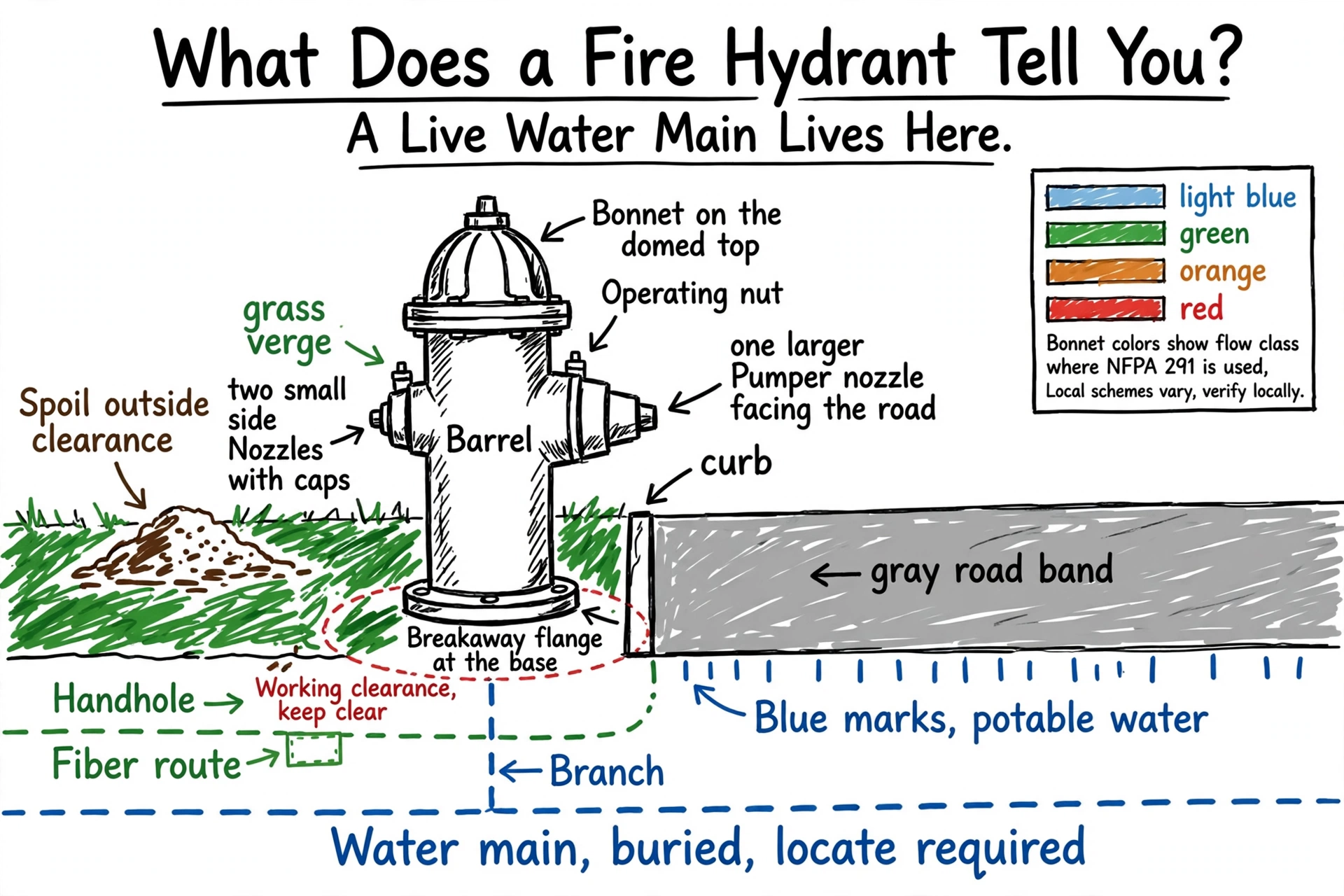
- Bonnet. The domed or rounded cap at the very top of the hydrant. It covers and protects the top of the operating mechanism and can be removed by utility personnel for service. In many color schemes the bonnet carries the flow class color discussed below, because it is visible from a distance and from a fire truck.
- Operating nut. The nut at the top center, usually five sided, or pentagon shaped, so it needs a dedicated hydrant wrench rather than a common socket. That shape is intentional. It discourages casual or unauthorized operation. Turning the operating nut with the correct wrench turns a long stem inside the barrel. In a dry barrel hydrant that stem movement opens or closes the main valve at the base. A fiber crew never turns this nut, for any reason, including to check whether the hydrant works.
- Barrel. The main vertical body of the hydrant, the upright cylindrical section between the bonnet area and the base. When people say a hydrant barrel color, they mean the paint on this body. Inside the barrel is the passage water travels through when the hydrant is opened by authorized personnel.
- Nozzles and caps. Nozzles, also called outlets, are the threaded connection points on the side of the upper barrel where hoses connect. Caps cover the nozzles when the hydrant is not in use. Caps protect the threads, keep debris and animals out, and keep the outlet sealed. A conventional dry barrel hydrant in the United States commonly has two smaller hose nozzles and one larger pumper nozzle, also called a steamer connection. Manufacturer and industry sources describe the smaller hose nozzles as commonly 2.5 inch and the pumper nozzle as commonly 4 inch or 4.5 inch, but exact sizes and thread standards vary by community and by hydrant model, so a beginner should describe what is present on the hydrant in front of them rather than assume a size from this lesson. Never remove a cap. A missing, cracked, or dangling cap is a report item, because it may mean damage, vandalism, or a thread that will fail a fire crew when they need it.
- Breakaway flange. Also called a breakable flange or traffic flange, this is the bolted joint near ground level on many modern hydrants. It is designed so that if a vehicle strikes the hydrant, the upper assembly breaks away at that flange in a controlled way rather than tearing the buried connection apart and causing an uncontrolled release of water. Seeing bolts and a flange at the base is normal. Seeing the flange tilted, separated, cracked, or leaking after a strike is damage to report at once, even if no water is flowing.
Below ground, parts you cannot see complete the assembly:
- Main valve. The valve at the base of the hydrant that controls water entering the barrel.
- Stem. The long rod connecting the operating nut at the top to that main valve.
- Branch pipe, or hydrant lead. The buried pipe connecting the hydrant shoe at its base to the water main.
- Gate valve on the branch. Many installations also have a separate gate valve on that branch, accessible through a valve box, so the utility can shut off just that hydrant for repair without shutting down the whole main.
- Thrust blocking or mechanical restraint. Fitted at the buried connection, it resists the force that pressurized water exerts when flow changes.
You will not see these buried parts on a normal surface walk. Name them to understand why a hydrant is not a shallow post you can grade around lightly. Its buried connection is part of a pressurized system, and excavation near it needs the same care as excavation near the main itself.
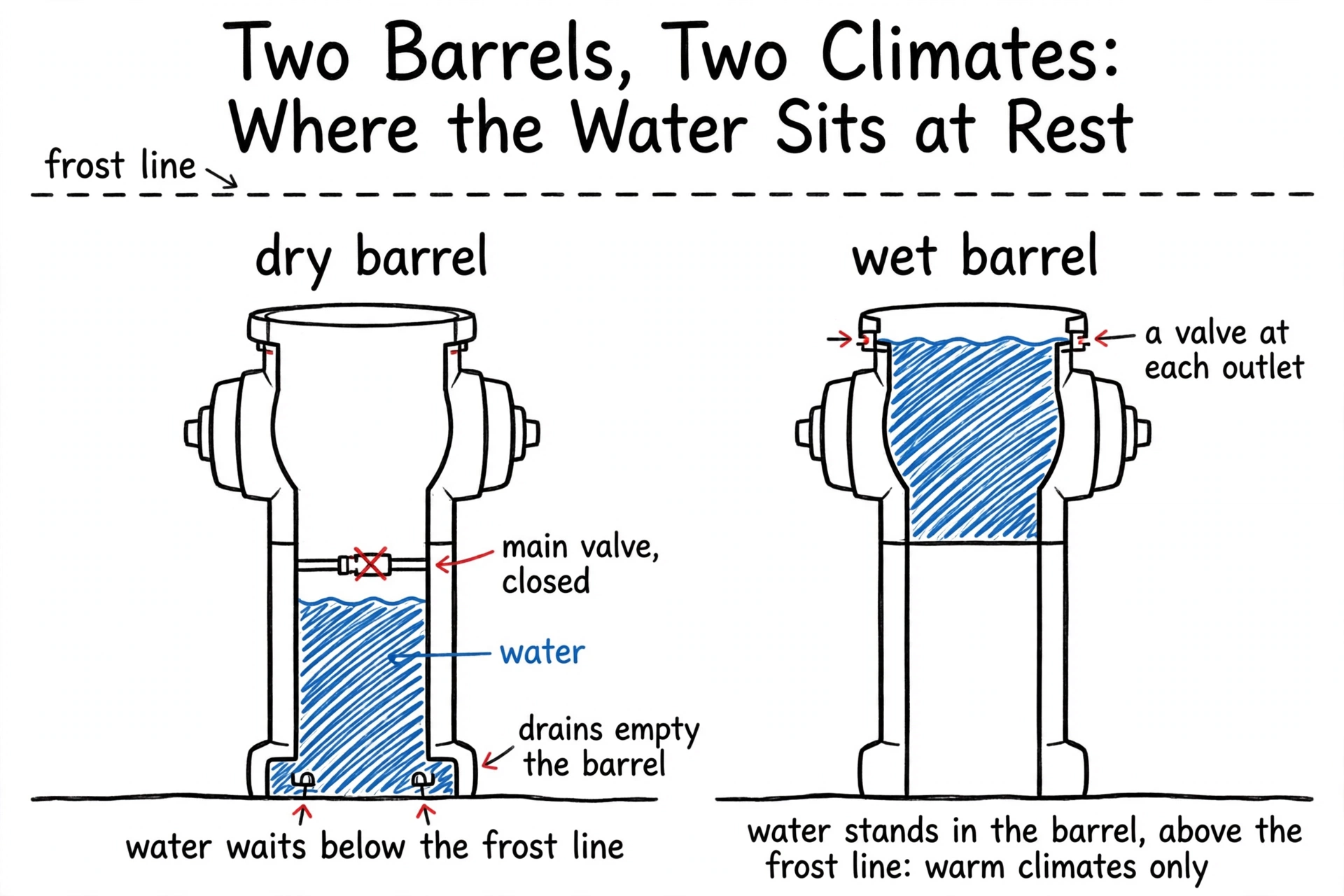
Two barrel designs divide the hydrant world, and the difference is where the water sits when the hydrant is at rest.
- Dry barrel hydrant. This design keeps its barrel empty, or dry, when it is closed. Its main valve sits below ground, below the frost line. The frost line is the depth to which ground typically freezes in winter in that place. When authorized personnel close the main valve, drain openings at the base let water drain out of the barrel so standing water does not freeze, expand, and crack the barrel. This is the common design in climates with freezing winters. The barrel only fills when the main valve is opened. A frost-proof outdoor faucet on a house works on the same principle: its working valve sits deep inside the building, past the cold, and the short pipe out to the spigot drains after shutoff, so no standing water is left where it can freeze.
- Wet barrel hydrant. This design keeps its barrel full of pressurized water at all times, right up to the outlets. Each outlet has its own valve at the outlet, so one outlet can be opened without opening the others. That simpler arrangement works where freezing does not occur, because there is no standing water problem to solve. In a freezing climate a wet barrel would risk freeze damage.
From the street, a beginner cannot always tell the type with certainty from shape alone, and does not need to. The field point is the same for both types: the hydrant connects to a live pressurized main, and only authorized personnel operate it.
A hydrant also tells you about ownership by its context, though paint alone does not prove it. A public hydrant is supplied by a public water main and maintained by the water utility or fire authority under local arrangements. A private hydrant sits on a private system, for example on a campus, industrial site, or large commercial property, and is maintained by the property owner or their contractor under local fire code requirements. Yard and site hydrants follow the same recognition rule. Private status does not make a hydrant less important, less pressurized, or available for construction use.
What Does It Look Like?
You recognize a hydrant first as a short, stout, cast metal post at the edge of the street corridor, built to be found quickly and operated with gloves, in the dark, under stress. Learn its silhouette and then its details.
The typical above ground hydrant stands roughly knee to waist high, with a domed top, a central operating nut on top, two smaller caps facing roughly opposite directions on the sides, and one larger cap usually facing the street so a pumper truck can connect without bending the large hose sharply. Chains or cables often connect each cap to the body so a removed cap is not lost. The base widens into a flange at or just above ground level. Many hydrants carry a manufacturer name cast into the bonnet or barrel, a year, and sometimes a small marker or reflective band. Some streets add a reflective road marker in the pavement or a small sign or flag on a nearby pole to help crews find a hydrant in snow or at night. Those markers help fire crews. They are not locate marks for excavation, and a fiber crew must not treat them as utility locates.
Color is the detail beginners notice first and must handle with the most care, because color carries two separate messages that are easy to confuse.
The first message is flow, carried on the bonnet and often on the nozzle caps. Under NFPA 291, Recommended Practice for Fire Flow Testing and Marking of Hydrants, hydrants are classified by the flow they can deliver on an individual flow test at 20 pounds per square inch residual pressure. Residual pressure is the pressure remaining in the system while water is flowing during the test. Gallons per minute, shortened to gpm, is a flow rate, the volume of water delivered in one minute. NFPA 291 recommends painting the bonnet and caps in a capacity indicating color for the class:
- Light blue, Class AA: rated 1,500 gpm or more.
- Green, Class A: rated 1,000 to 1,499 gpm.
- Orange, Class B: rated 500 to 999 gpm.
- Red, Class C: rated under 500 gpm.
Where a community follows NFPA 291, a fire officer can read that color at arrival and judge whether that hydrant can supply the fire or whether a second hydrant or a different supply plan is needed. Note the exact status of those numbers. They come from a recommended practice and from flow testing. They do not promise what a particular hydrant delivers today, and no federal law makes every hydrant follow them. Paint can be faded, repainted incorrectly, or out of date after main work, and a hydrant that has not been maintained may not deliver what its color claims.
The second message is barrel color, which in the NFPA 291 scheme addresses the body rather than the flow. NFPA 291 recommends that public hydrant barrels be painted chrome yellow, unless another color has already been adopted locally. Industry summaries of the scheme describe red as commonly used for private hydrants and violet, also called purple, for hydrants carrying nonpotable water, meaning water not treated for drinking, such as an effluent, pond, or raw water supply. Treat that sentence as a description of a commonly described scheme only. Real streets follow whatever scheme their own utility or fire department adopted, as the next paragraph shows. In real streets you will see all red hydrants, all yellow hydrants, silver, white, green, and community color schemes that match no national chart, because a local utility or fire department adopted its own scheme or adopted NFPA 291 only in part. The only accurate field rule is this: note the colors you see, do not decode ownership, potability, or flow from barrel color alone, and verify the local scheme with the water utility or fire authority if a project decision depends on it. No fiber decision should depend on hydrant paint alone in any case, because locates, plans, and the utility owner govern excavation, not paint.
Look also at condition and setting, because those tell a fiber crew what to protect:
- Whether the hydrant stands plumb or leans.
- Whether caps are present and chained.
- Whether the operating nut looks damaged or painted shut, a condition you report rather than touch.
- Whether paint is blistered over rust.
- Whether the ground around the base is eroded, settled, or newly paved over the flange.
- Whether vegetation, a fence, a sign, or stored material crowds the hydrant.
- Whether the hydrant faces the street in a way a truck can reach.
- Whether blue locate paint or flags are nearby, when locates have been done.
That last item carries weight. In the American Public Works Association uniform color code for temporary marking of underground facilities, shortened to APWA, blue means potable water. A line of blue marks running down the street and turning toward the hydrant is the locator showing you the water main and its branch. That is far more useful to excavation planning than the hydrant paint color, and it still comes with tolerance and verification rules from the locate process covered in other lessons.
What a hydrant does not look like matters too. A hydrant is not a water meter, not a valve box, and not a backflow preventer. A valve box is a small covered access point at ground level for turning a buried valve with a key, with no above ground outlets. A flushing or blow off assembly on a dead end main may look smaller and plainer and may lack the full nozzle arrangement. If you are unsure what an assembly is, describe it, photograph it, and ask through the project process. Do not label it from a guess on a daily report.
What Does It Do?
A hydrant does three jobs for the community, and each job explains a rule a fiber crew follows.
- Fire protection water supply. This is its main job. When fire crews arrive, they connect a hose or a pumper to a nozzle, remove the cap, and have authorized fire personnel open the hydrant so pressurized water from the main fills the barrel and flows to the hose. Flow testing sources stress that the available flow depends on the main, its pressure, its size, the branch, and the condition of the hydrant together. That is why flow is tested and marked as a system result, not guessed from the hydrant body alone. A hydrant that is blocked, buried by grade changes, struck, or corroded shut fails that job at the worst possible moment. Fiber work that changes grade, places spoil, parks equipment, or restores pavement around a hydrant is therefore fire protection work whether the crew thinks of it that way or not.
- Water system maintenance access. Authorized utility personnel use hydrants to flush mains, to release air, to take pressure readings, and to perform flow tests under NFPA 291 procedures where the utility follows them. Flushing moves water at velocity to clear sediment and maintain water quality. Those operations are planned, with discharge controlled so it does not flood property, erode soil, or enter storm systems in a way local rules prohibit. A fiber crew does none of this. If you see a hydrant discharging water on its own, leaking from a cap or from the bonnet, or running at the base, that is not a flushing operation you should assume is planned unless utility personnel and their equipment are present and in control of it. An unattended leaking or discharging hydrant is a report item.
- Information. For your purposes, a hydrant is a visible, mapped point on a buried pressurized system. It tells a planner where the water corridor is, it tells a locator where to expect a main and a branch, it tells a designer that street layout and lot service in this area include public water, and it tells a crew that excavation in this corridor will cross or parallel a water line that can flood an excavation, undermine a trench, and create a contamination and repair problem far larger than the fiber cut if it is struck. Information is only useful if it is recorded. A hydrant that appears on your route walk, your photographs, and your daily notes, with its location, condition, and clearance, does its third job. A hydrant nobody noted until the bore crossed its branch has been wasted as a warning.
A hydrant does not do several things beginners sometimes assume. It does not mark the exact line of the water main. The main may run on either side of the hydrant row, may cross the street between hydrants, and connects to each hydrant by a branch that leaves the main at an angle you cannot see. It does not state the depth of the main. Depth varies with climate, frost protection, local practice, main size, and later grade changes, and this lesson states no depth for any water main or branch, because no universal depth exists to state. It does not guarantee that other utilities follow the water line, though streets often carry several utilities in a shared corridor. And it does not give anyone except authorized utility and fire personnel the right to operate it, take water from it, or attach anything to it.
Where Does It Fit?
Level 2 teaches you to read the physical environment before you build in it. Earlier lessons read the right of way, easements, curbs, sidewalks, ditches, culverts, drainage, waterways, bridges, railroads, intersections, driveways, terrain, and soil and rock. A hydrant belongs in that same reading, because it is a surface feature that reports a buried system, just as a ditch reports drainage and a culvert reports a crossing under the road.
In the street layout picture, hydrants cluster where water mains and fire access meet. You will often find them near intersections, at intervals along residential streets, near the ends of dead end mains where a hydrant or flushing point helps the utility maintain the line, and around larger buildings, schools, and commercial sites where fire flow demand is higher. Their spacing and placement are set by the local fire code, the water utility standards, and the authority having jurisdiction for that place, not by a single national spacing rule this lesson can state. What a beginner can use is the pattern. Hydrants on one side of the street only suggest the main may run on that side, with services crossing to the far lots. Hydrants on both sides or at a corner suggest a larger main, an intersecting main, or a looped system. A looped system feeds an area from more than one direction, which affects pressure and flow and also means more buried pipe to expect. All of those readings are hypotheses for the designer and the locator to confirm from water system records and locates, not field facts a crew can excavate on.
In the utility corridor picture, a hydrant warns that the corridor is occupied. A street that has public water usually also has sewer or septic considerations, storm drainage, power, gas in many areas, and existing communications plant, each in its own position under its own rules. The APWA color code helps you sort locate marks when they arrive:
- Blue: potable water.
- Green: sewers and drain lines.
- Yellow: gas, oil, steam, petroleum, or gaseous materials.
- Red: electric power lines, cables, and conduits.
- Orange: communications, alarm or signal lines, cables or conduit, and fiber.
- Purple: reclaimed water, irrigation, and slurry lines.
- White: proposed excavation.
- Pink: temporary survey markings.
When blue marks and a hydrant line up, you have a consistent story. When blue marks appear with no hydrant nearby, the main may be present without a hydrant in that block, which is common. When a hydrant stands with no blue marks, the usual explanation is simply that locates have not been done yet for your work, not that no main exists.
In the project sequence, the hydrant appears at every stage. At the walkout, it is photographed and noted for location, side of street, condition, and clearance. At design, it helps confirm the water corridor and may affect handhole, vault, and bore pit placement, because structures should not be set where they will crowd hydrant access or sit directly over a hydrant branch without the utility owner agreement the project requires. Before excavation, it is covered by the locate ticket as part of the water system in the work area, and the locator marks for water are checked against the hydrant positions for obvious misses. During construction, it is protected from strikes, spoil, and grade changes, and its clearance is kept open. At restoration and closeout, grade around it is returned so the base flange and drainage work as installed, clearance is verified clear, photographs confirm its final condition, and any damage, however small it looked in the field, is already reported and documented rather than discovered later by the utility.
In the safety and authority picture, the hydrant sits firmly on the other utility side of the line. Fiber personnel observe and protect. Water utility and fire personnel operate, test, repair, and judge condition for service. If a project needs a hydrant moved, raised, lowered, or temporarily taken out of service for construction, that need goes through the water utility and the fire authority by the project process, with notice and approval they require. A crew never moves, buries, raises, or disables a hydrant on its own judgment to make a fiber alignment easier.
What Is at Stake
- Life safety. Fire flow is time. A fire crew that cannot find a hydrant, cannot reach it because a fiber spoil pile or a parked trailer blocks it, cannot remove a damaged cap, or finds the hydrant buried to its nozzles by a grade change loses minutes that decide outcomes for people inside a building. Fire codes and local clearance rules exist to prevent exactly those delays. That is why this lesson treats a blocked or buried hydrant as a serious finding, not as housekeeping.
- Excavation safety and damage prevention. A pressurized water main or hydrant branch struck by a trencher, a bore, or a bucket does not behave like a nicked communications duct. Water under pressure can flood a trench rapidly, erode its walls, undermine pavement, wash out bedding and backfill, create a sink area, and endanger anyone in or near the excavation. It can also force an emergency shutdown that leaves a neighborhood without water and without fire protection until the utility repairs it. Expecting the main where a hydrant promises it, insisting on locates, and respecting the marked tolerance zone are how a fiber crew avoids causing that event.
- Water quality and public trust. A public main carries drinking water. Damage, cross contamination through an unauthorized connection, or discharge handled badly can create a public health problem and a boil water response that affects far more people than the job site. Unauthorized hydrant use is treated as theft of water and as a contamination risk in many systems, because an uncontrolled connection can allow backflow, meaning water or contaminants flowing backward into the main. The fiber rule is simple and absolute. No connection, no opening, no use, without the utility authorization and equipment the utility itself issues.
- Cost and schedule. Water damage is expensive in every direction: emergency repair, pavement and landscape restoration, claims from flooded property, rework of washed out fiber plant, and delay while the utility controls its system. A hydrant noted early costs a photograph and a line in a report. A hydrant branch found by a bore costs a claim file. Hydrant damage also follows a paper trail. Utilities inspect their systems, fire crews test hydrants, and residents report problems. A crew that reports its own contact with a hydrant at once, with location and photographs, gives its company the only defensible position available.
- The corridor after you leave. Good fiber restoration leaves the street corridor as usable as it was found. Hydrant clearance kept clear, grade restored without covering the flange or the nozzles, locate marks understood rather than paved over as a puzzle for the next crew, and records that show hydrant locations and conditions all serve the next utility, the next fire crew, and the next fiber crew on the same street, which may be yours.
What Does Good Look Like?
Good hydrant awareness on a fiber project looks planned, protected, and documented from walkout to closeout:
- Every hydrant in or near the work area is found on the walkout, photographed from the street side and from the work side, and recorded by location, side of street, visible condition, cap presence, and existing clearance or existing obstruction.
- Design and field layout keep handholes, bore pits, spoil areas, and stored materials out of the hydrant working area and off the expected line of its branch, using water system records and locates rather than paint color or guesswork.
- The locate ticket covers the full work area, blue marks for potable water are received and checked against hydrant positions before excavation, and any hydrant with no corresponding water marks is raised as a question through the project process before digging, not after.
- During construction the hydrant stays visible and reachable. No spoil, equipment, vehicles, materials, erosion control, or temporary fencing blocks it, and no backfill, pavement, or landscaping raises grade against it or covers its base.
- Equipment operators working near a hydrant know its position and the position of the marked water line, use the excavation methods the project and the locate rules require near marked facilities, and stop and report on any contact, scrape, or unexpected water, however minor it appears.
- Any damage, leak, missing cap, leaning or struck hydrant, or hydrant found already damaged is reported through the project process and to the water utility as the project directs, on the day it is found, with photographs and location, and the area is protected until the utility responds.
- At closeout, final photographs show each affected hydrant standing plumb, caps in place, clearance clear, and grade restored to its prior condition around the base, and the project records list every hydrant in the work area with its final condition.
Testing a hydrant to prove it works belongs to the utility and the fire authority, never to the fiber crew. Good means the fiber project never made the hydrant harder to use, never damaged it in silence, and left a record that shows both points.
From the Field
Picture a fiber crew building down both sides of a short residential street to serve a new cluster of homes, with open trenching on the east side, one directional bore crossing under the street near the middle, and a handhole planned near the corner. On the walkout, the field lead photographs three hydrants. Two stand on the east side in line with the planned trench. One stands on the west side near the bore crossing. All three have their caps present. One east side hydrant has a green bonnet and caps and a yellow barrel. The lead records the colors exactly as seen and writes local scheme not verified on the walkout form, because the project has not confirmed whether this town follows NFPA 291 marking. No flow value is written anywhere.
The pattern still does useful work as a hypothesis. Hydrants mainly on the east side suggest the water main likely runs on the east side, under or near the trench line, with the west hydrant fed by a crossing near the bore. The designer flags both points as questions for records and locates, not as answers. The locate ticket is placed for the full corridor. When the marks arrive, blue APWA paint for potable water runs down the east side, turns at each east hydrant, and crosses the street on a line that passes within the planned bore path, serving the west hydrant by a branch the walkout pattern had only suggested.
Here the job reaches its decision point. The bore as drawn would cross that marked water line, and the corner handhole as drawn would crowd the corner hydrant and sit over its branch. The crew does not solve either problem at the machine or with a shovel. The bore profile is adjusted under the project design process, by the methods and clearances the project and the utility owner require, and the handhole is shifted in layout through the same process. Field invention is how branches get struck; the paperwork is slower and cheaper.
During trenching on the east side, the crew keeps spoil on the street side of the trench, away from the hydrants, after the foreman points out that the natural spoil side would have buried the first hydrant to its lower nozzle by midday. At the second hydrant, the operator notices fresh standing water at the base on a dry morning and a cap that is weeping slowly. Work near that hydrant pauses in the immediate area. The foreman photographs the hydrant from the street and from the work side, records it as found leaking with no crew contact, and reports it through the project process, which notifies the water utility the same day. The utility crew that responds confirms the hydrant is theirs to repair and thanks the foreman for the photographs, because the report separates found damage from job damage without argument.
At restoration, the crew checks each hydrant before leaving the street. Grade around both east hydrants matches the photographs taken on the walkout, no sod or mulch touches the barrels, clearance is open, and final photographs show the hydrants in the condition they were found, with the west hydrant untouched by the adjusted bore. The daily records list all three hydrants by location with their found and final conditions. Nobody on the fiber crew opened a cap, turned a nut, or took a gallon of water.
The rule to carry off this street: read the hydrant as a warning and a record, never as a locate and never as a tool. Prove lines with locates, route conflicts through the design process, keep the access clear, document condition before and after, and report what you find the same day you find it.
What Can Go Wrong?
Hydrant problems on fiber jobs are usually ordinary corridor habits meeting a pressurized system that does not forgive them.
- Excavating on the hydrant hint instead of on locates. A crew assumes the main runs straight between two hydrants at a comfortable depth, bores on that assumption, and crosses the actual main or a branch that angles to a hydrant behind the bore line. The hydrant proved a main was nearby. It never proved where the main was.
- Burying a hydrant with grade or restoration. Backfill, pavement buildup, sod, mulch, or a landscape bed raises the ground around the base until nozzles sit low, drainage fails, and fire crews lose working room. The job looked finished and left the hydrant partly disabled.
- Blocking access for a shift that becomes a week. Spoil, a conduit reel, a trailer, or a roll off container is set in front of a hydrant for convenience. A fire during that window turns a parking choice into the story of the job.
- Striking a hydrant or its branch and saying nothing. A bucket clips the barrel, a vehicle backs into it, or a bore grazes the branch. No water appears, so nobody reports it. The breakaway flange, a cap thread, or the branch joint fails later, or the next flow test finds the damage with no record of when it happened.
- Operating a hydrant without authority. A crew member opens a hydrant to fill a water tank, wash a bore pit, or settle dust. The act risks backflow contamination, uncontrolled discharge and erosion, a pressure event in the main, fines, and theft of water claims, and it can damage the hydrant if it is opened or closed incorrectly. There is no field exception to the rule. Only authorized utility and fire personnel operate hydrants.
- Reading paint as proof. A trainee announces that a red barrel means private and low flow, or that a light blue bonnet guarantees high flow for a decision, in a town whose scheme the project never verified. Paint misread is worse than paint ignored, because it creates false confidence in place of a locate, a record, or a utility call.
- Ignoring a leaking or damaged hydrant found on the route. A cap leaks, the bonnet weeps, water stands at the base in dry weather, or the hydrant leans with a cracked flange. A crew that walks past it may be blamed for it later, and a community keeps a hydrant that may not work. Found damage is reported the same day it is found, clearly labeled as found in that condition, with photographs.
- Damaging the branch while working on something else. A handhole excavation, a sign post, a fence post, or a ground rod placed without checking the water marks severs or cracks the hydrant lead. The hydrant itself was never touched, and it is out of service all the same.
- Letting discharge or flood water from any source undermine the hydrant. Bore fluid, trench dewatering, or a broken line on another utility washes out soil around the base, leaving the hydrant standing in a void that settles or tilts. Support around a pressurized connection is part of the installation.
- Covering or removing hydrant markers and flags that help fire crews find it, or painting over a hydrant during street work. Visibility is part of the hydrant function, and overspray, tar, or a removed reflective marker degrades it.
These failures share one root: the hydrant was treated as scenery. It is a live outlet on a pressurized drinking water system that another crew may need tonight.
What Should Someone Notice in the Field?
Notice the hydrant as the locator, the designer, and the fire crew will need it described, from a safe and public position. You are observing, describing, protecting, and reporting. You are not operating, testing, or repairing.
- Record every hydrant in the work area. Location by address, intersection, or station the project uses, side of street, distance relationship to curb and to your planned work in descriptive terms, and whether it sits in grass, sidewalk area, pavement edge, or a landscaped bed.
- Name the visible parts and their condition. Bonnet present and intact, operating nut present and undamaged to the eye, each nozzle cap present, chained, and seated, barrel straight or leaning, paint condition, cast markings if legible, and the base flange at grade, buried, tilted, or cracked. Photograph the hydrant from the street so its facing is clear, then from the work side.
- Read color as a note, not a verdict. Write down bonnet and cap color and barrel color exactly as seen. If the project has verified the local scheme, you may add what that scheme says the color means, naming the source. If it has not been verified, write scheme not verified and stop there. Never write a flow in gallons per minute on a field report from paint alone.
- Note clearance and access as found and as you leave it. Is the hydrant visible from the street in both directions? Can a person walk up to it and work around it without moving anything? What, if anything, crowds it now: vegetation, fence, sign, parked vehicle, stored material, spoil, snow, or grade buildup? Record obstructions you did not create as found conditions, and remove obstructions your work created at once.
- Connect the hydrant to the locates. When blue APWA marks for potable water are present, check that a marked line serves the hydrant and that the main marks and your excavation plan agree. When they do not agree, or when a hydrant in the excavation area has no water marks, stop and raise it through the project process before mechanical excavation in that area.
- Watch for water where it should not be. Leaking caps, a wet bonnet joint, water weeping at the base flange, standing water around the base in dry weather, a soggy or settled area over the expected branch line, or the sound of running water. Any of these is a same day report to the project process and, as the project directs, to the water utility.
- Watch for strike and change during work. Fresh paint scrapes, a new lean, a shifted cap, a cracked flange, soil washed from the base, or any equipment contact at all. Contact is reported even when nothing leaks, with photographs taken before anything is moved or repaired by anyone.
- Notice hydrant related surface clues. Valve boxes near the hydrant that likely serve its branch, water meter covers for nearby services, blue topped markers where the utility uses them, and reflective hydrant markers in the pavement or on poles. Note them as clues that support the water corridor reading, not as locates.
- Protect the hydrant in your daily plan. Brief operators and drivers on its position, keep spoil and materials out of its working area, keep grade off its base during backfill and restoration, and recheck it at the end of each shift in the work area and at closeout.
Safety and limits, plainly. Observing a hydrant does not qualify you to operate it, remove a cap, turn the operating nut, flow test it, judge it in service or out of service, tap, connect to, move, raise, lower, repair, or take water from the water system. Those acts belong to authorized water utility and fire personnel only, using their tools, their permits, and their procedures. Never use a hydrant for construction water, dust control, washing, or filling without a utility issued authorization and metering arrangement that this lesson does not grant. If a hydrant is discharging uncontrollably, is struck and leaking, or has flooded an excavation, keep people clear, protect the area as the project emergency plan requires, and notify the project process and the water utility and, where the project plan or local rule requires, emergency services, at once. Do not attempt to close, cap, or repair it yourself.
Key Terms
- Fire hydrant. An above ground outlet assembly connected to a buried pressurized water main that lets authorized fire and utility personnel connect hoses, obtain firefighting water, flush the main, and test flow. Fiber crews observe and protect it and never operate it.
- Potable water. Water treated and intended for drinking and household use. In the APWA marking code, potable water facilities are marked in blue.
- Bonnet. The domed cap at the top of a hydrant that covers the top of the operating mechanism. In NFPA 291 marking, the bonnet commonly carries the flow class color.
- Operating nut. The usually five sided, or pentagon, nut at the top center of a hydrant. Turned with a dedicated hydrant wrench by authorized personnel, it drives the stem that opens or closes the main valve in a dry barrel hydrant.
- Barrel. The main vertical body of the hydrant through which water passes when the hydrant is opened. Barrel paint color is a separate message from bonnet and cap flow color, and local schemes vary.
- Nozzle or outlet, and cap. A nozzle is a threaded side connection point for a hose. Common arrangements have two smaller hose nozzles and one larger pumper nozzle, with sizes varying by community and model. A cap covers and protects a nozzle when not in use.
- Breakaway flange. The bolted joint near ground level on many modern hydrants designed to break in a controlled way if a vehicle strikes the hydrant, limiting damage to the buried connection. Also called a breakable or traffic flange.
- Main valve and stem. The main valve at the base of a dry barrel hydrant controls water entering the barrel from the supply. The stem is the long rod connecting the operating nut to that valve.
- Branch pipe or hydrant lead. The buried pipe connecting the base of a hydrant to the water main. It often has its own gate valve so the utility can isolate one hydrant for repair.
- Dry barrel hydrant. A hydrant whose barrel is empty when closed. Its main valve sits below ground below the frost line, and drain openings empty the barrel after closing so water does not freeze in it. Common in freezing climates.
- Wet barrel hydrant. A hydrant whose barrel stays full of pressurized water up to its outlets, with a separate valve at each outlet. Used where freezing does not occur.
- Frost line. The depth to which ground typically freezes in winter in a given place. Dry barrel main valves and water mains are placed with frost protection in mind under local practice.
- Residual pressure and gallons per minute. Residual pressure is the pressure remaining in a water system while water is flowing during a flow test. Gallons per minute, or gpm, is the flow rate from that test. NFPA 291 classes are rated at 20 pounds per square inch residual pressure.
- NFPA 291. Recommended Practice for Fire Flow Testing and Marking of Hydrants, published by the National Fire Protection Association. A recommended practice carries no force of law by itself; each community decides whether to adopt it. Its bonnet and cap flow colors are light blue for 1,500 gpm or more, green for 1,000 to 1,499 gpm, orange for 500 to 999 gpm, and red for under 500 gpm, all at 20 pounds per square inch residual pressure. Local adoption and local schemes vary.
- APWA uniform color code. The American Public Works Association code for temporary marking of underground facilities. Blue means potable water and orange means communications and fiber, with other colors for other utilities. It governs locate marks, not hydrant paint.
- Working clearance. The open space around a hydrant that fire crews need to see it, reach it, remove caps, connect hoses, and swing a wrench. The exact clearance a given hydrant requires is set by the local fire code and the authority having jurisdiction for that place, not by a single universal federal distance.
Check Your Understanding
- A hydrant stands on your route with all caps present. List three things its presence proves, and three things it does not prove, about the buried water system near your work.
- Name the visible parts of a hydrant from the top down, and state the one action a fiber crew must never take with the part at the very top center.
- Explain the difference between a dry barrel hydrant and a wet barrel hydrant, including where the water sits at rest, where the controlling valve or valves sit, and which climate each type suits.
- A hydrant has a light blue bonnet, green caps in faded paint, and a red barrel. A trainee announces it is a private hydrant rated over 1,500 gpm and writes that flow on the daily report. Identify every error in that announcement and in that report entry.
- During trenching, spoil placement will block a hydrant by noon and the operator notices a cap weeping at the next hydrant. State what the crew should do about each condition, and who alone may operate or repair the hydrants.
Answer key
- It proves that a pressurized water main is connected to serve that hydrant, and on a public system that main normally carries potable water, but potability for a specific hydrant is verified with the water utility and is not proved by the hydrant alone. It proves that a branch pipe connects the hydrant to that main, and that the street corridor at that point is occupied by a live water system that needs locates and protection. It also proves fire access must be kept clear at that point. It does not prove the exact line of the main, because the main may run on either side and connects by an angled branch you cannot see. It does not prove the depth of the main or the branch, which varies with local practice and grade history and is stated in no universal figure. It does not prove the flow the hydrant can deliver today, because flow depends on the main, pressure, branch, and hydrant condition together and is known from utility flow testing, not from a surface look.
- From the top down: the bonnet, the domed cover at the top; the operating nut at the top center, usually pentagon shaped; the barrel, the main vertical body; the nozzles or outlets on the sides with their protective caps, commonly two smaller hose nozzles and one larger pumper nozzle; and the breakaway flange at the base near ground level. Below ground, not visible, are the stem, the main valve at the base, and the branch pipe to the main. The action a fiber crew must never take is turning the operating nut, or operating the hydrant in any way, including removing a cap to check it. Only authorized water utility and fire personnel operate hydrants.
- In a dry barrel hydrant the barrel is empty at rest. The single main valve sits below ground, below the frost line, and a stem from the operating nut opens and closes it. When it closes, drain openings empty the barrel so standing water cannot freeze and crack it. That design suits climates with freezing winters and is the common design there. In a wet barrel hydrant the barrel stays full of pressurized water up to the outlets at all times, and each outlet has its own valve at the outlet, so outlets can be opened one at a time. With no freeze protection for standing water, that design suits climates where freezing does not occur. A beginner does not need to classify a street hydrant by type to do the fiber job. Both types connect to a live pressurized main and both are operated only by authorized personnel.
- First, mixed and faded colors cannot be decoded as a clean class. NFPA 291 recommends one capacity color on the bonnet and caps: light blue for Class AA at 1,500 gpm or more, green for Class A at 1,000 to 1,499 gpm, orange for Class B at 500 to 999 gpm, and red for Class C under 500 gpm, at 20 pounds per square inch residual pressure. A light blue bonnet with green caps is inconsistent marking, which is itself a note item, not a rating. Second, barrel color does not prove ownership in the field. Red for private and chrome yellow for public appear in commonly described NFPA 291 scheme summaries, and violet for nonpotable, but local schemes differ widely and many towns paint all hydrants one color. Ownership is verified with the utility, not read from paint. Third, NFPA 291 is a recommended practice. It carries no force of law by itself, and a town may adopt it, modify it, or ignore it, so no rating applies until the local scheme is verified. Fourth, no flow figure belongs on a fiber daily report from paint alone in any case. Flow comes from utility flow testing of the main, pressure, branch, and hydrant together, and paint can be faded, wrong, or out of date. The correct report entry records the colors as seen, notes the inconsistency and fading, and states local scheme not verified.
- For the spoil, the crew changes the plan before the hydrant is blocked. Spoil, materials, and equipment are placed so the hydrant stays visible and reachable with its working clearance open, because a fire during the shift would need that hydrant without delay, and local fire code clearance rules govern the space. Blocking it for convenience and clearing it later is not acceptable, since the block exists for the whole interval. For the weeping cap, the crew does not touch, tighten, open, or test it. The foreman photographs it from a safe public position, records its location and condition as found, keeps the work from making it worse, and reports it through the project process the same day so the water utility is notified as the project directs, clearly separating found condition from any crew contact, of which there was none. Operation, testing, and repair of both hydrants belong to authorized water utility and fire personnel alone.
Lesson Takeaway
A fire hydrant is a message from a buried pressurized water system, posted at the curb where a fiber crew cannot miss it if it has learned to read it. Its parts have names you can use in a report: bonnet and operating nut on top, barrel in the middle, hose and pumper nozzles with their caps on the sides, breakaway flange at the base, and below ground a stem, a main valve, and a branch pipe to the main. Its barrel is dry at rest where winters freeze and wet at rest where they do not, and in both designs the main behind it is live. Its presence proves water is near in this corridor and proves nothing about exact line, depth, or flow, which come from records, locates, and utility testing. Its bonnet and cap colors may carry the NFPA 291 recommended flow classes, light blue at 1,500 gallons per minute or more, green at 1,000 to 1,499, orange at 500 to 999, and red under 500, all at 20 pounds per square inch residual pressure, but NFPA 291 is a recommended practice, barrel colors such as chrome yellow for public, red for private, and violet for nonpotable belong to a scheme that varies locally, and paint is noted, never decoded into a field decision. Blue APWA marks show the potable water line for excavation; hydrant paint never does that job. The fiber crew duties are short and complete: find every hydrant, photograph and record it, keep its clearance clear, keep grade and spoil off it, excavate only on locates, report any contact or found damage the same day, and never operate, open, move, or take water from it. Do those things and the hydrant does its job for the fire crew tonight and its warning job for your crew today.
Sources and Technical References
- ANSI Blog, NFPA 291-2019: Fire Hydrant Flow Testing and Marking. States that NFPA 291-2019 is a voluntary consensus standard and a recommended practice, that it classifies hydrants as Class AA at 1,500 gpm, Class A at 1,000 to 1,499 gpm, Class B at 500 to 999 gpm, and Class C at less than 500 gpm, that public hydrant barrels are to be chrome yellow unless another color has already been adopted, and that tops and nozzle caps use light blue, green, orange, and red in that class order. Used in this lesson for the NFPA 291 status, classes, and barrel recommendation, with local variation stressed throughout. https://blog.ansi.org/ansi/nfpa-291-2019-fire-hydrant-flow-testing-marking/
- National Fire Sprinkler Association, Why aren’t all Fire Hydrants Red? States that NFPA 291 is the Recommended Practice for Fire Flow Testing and Marking of Hydrants, that the bonnet or top and the caps should be painted with capacity indicating colors designating class and flow, lists Class AA light blue over 1,500 gpm, Class A green 1,000 to 1,499 gpm, Class B orange 500 to 999 gpm, and Class C red under 500 gpm, states the barrel recommendation of reflective chrome yellow unless other colors have been locally adopted, and states that a public hydrant flow rating is at 20 pounds per square inch residual pressure. https://nfsa.org/2021/02/12/why-arent-all-fire-hydrants-red/
- Seadmok Water Construction, Fire Hydrant Color Codes Explained. States in summary that bonnet and cap color shows flow class under NFPA 291 with the same four classes and colors, that barrel color usually tells ownership or water source with chrome yellow recommended for public hydrants, red for private hydrants, and purple or violet for nonpotable water, that NFPA 291 is a recommended practice and not a law so a utility or fire department can adopt, modify, or replace it, and that color reflects the water main behind the hydrant rather than the hydrant alone. Used for the barrel color scheme as commonly described, always with the local variation warning in the lesson text. https://seadmokwater.com/fire-hydrant-color-codes/
- Seadmok Water Construction, How Do Fire Hydrants Work? Parts, Types and Water Supply. States that a dry barrel hydrant keeps water below ground until opened while a wet barrel hydrant is full of water up to the nozzles, that the dry barrel main valve is at the base underground with drainage after use under AWWA C502 for dry barrel hydrants, that a wet barrel has a valve at each nozzle under AWWA C503, and that dry barrel suits freezing climates while wet barrel suits frost free climates. Used for the dry and wet barrel comparison. https://seadmokwater.com/how-do-fire-hydrants-work/
- HSE Blog, Fire Hydrant: Types, Working and NFPA Color Coding. States that in a dry barrel hydrant the main valve sits below ground below the frost line, the barrel is empty when closed, and a drain valve drains residual water to prevent freezing and cracking, and that in a wet barrel hydrant each outlet has its own valve and the barrel is permanently filled with pressurized water, viable only where freezing does not occur. Also describes operating nut engagement driving the stem to the main valve. Used for valve and drain detail. https://www.hseblog.com/fire-hydrant/
- Water Main Supply, Fire Hydrants and Valves, Hydrant Components and Anatomy. Defines the bonnet as the rounded cap at the top protecting the operating stem nut, the branch as the underground pipe connecting the city water main to the hydrant, the breakaway flange as the connection between the above ground assembly and the rest of the barrel, conventional outlets as one pumper outlet and two hose outlets, and the stem nut as the typically pentagon shaped operating nut whose rotation raises or lowers the main valve. Used for part names and functions. http://watermainsupply.com/pages/fire-hydrants-and-valves
- Dig Safely Hawaii, APWA Color Code. States the APWA Uniform Color Code for marking underground facilities: blue for potable water, orange for communication, alarm or signal lines, cables or conduits and fiber, green for sewers and drain lines, yellow for gas, oil, steam, petroleum or gaseous materials, red for electric power, purple for reclaimed water, irrigation and slurry, white for proposed excavation, and pink for temporary survey markings. Used for the APWA blue for potable water point and the corridor color list. https://digsafelyhawaii.com/ticketing-tools/apwa-color-code/
- Mocbo, Frequencies APWA Guide. Restates the APWA Uniform Color Code for the United States with blue for potable drinking water, orange for communications and fiber, and the other utility colors, consistent with the Dig Safely Hawaii listing. Used as a second listing of the same code. https://www.mocbo.com/blog/frequencies-apwa-guide.html
- Newberry Springs Fire Department, Fire Hydrant Requirements summary of the California Fire Code. States an example of a locally adopted fire code clearance: a clear space of at least 3 feet maintained around the entire circumference of a hydrant, kept free of vegetation, fences, storage, vehicles, snow, soil, and other material, with unobstructed access required at all times, citing 2025 California Fire Code sections 507.5.4 and 507.5.5. Used in this lesson only as an example of how one adopted code words clearance, not as a universal or federal distance. Clearance for a given hydrant is set by its local fire code and authority having jurisdiction, and figures differ between jurisdictions, including larger elliptical and parking distances in some local codes found in research. https://newberryspringsfd.specialdistrict.org/files/1ee3b7d19/Fire%2520Hydrant%2520Requirements.pdf
Previous lesson: Lesson 37: Why Does Vegetation Matter? |
Back to Level 2 hub |
Next lesson: Lesson 39: What Does a Gas Meter Tell You?