
Introduction
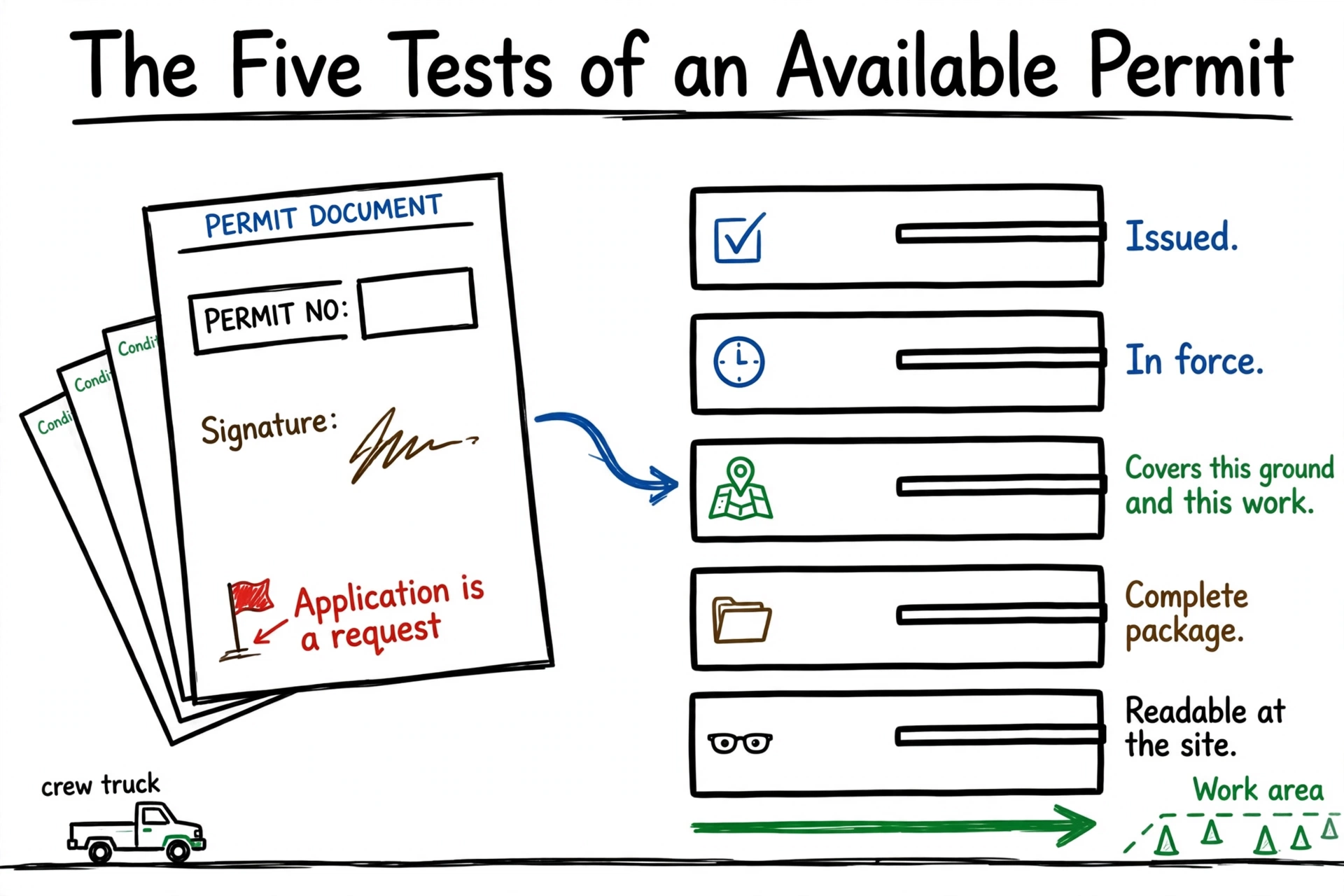
A permit availability check is the readiness check a project runs before mobilization to confirm that every permit the planned work requires has actually been issued, is still in force, covers the ground and the work in front of the crew, arrives as a complete package, and can be read at the work site. A permit that exists somewhere in an office file and a permit that is available to the crew are two different states, and this lesson teaches the check that tells them apart.
Level 6 built permission one authority at a time, from the municipal permit in Lesson 119 through permit conditions in Lesson 125 and work limits in Lesson 126. Level 7 prepares a jobsite for the first day of work. This lesson sits in that preparation sequence as the permit gate: before equipment moves, someone answers the title question segment by segment, from documents, and the answer decides which ground the crew may enter.
What This Lesson Gives You
- Run a five part availability check on any permit: issued, in force, covering this ground and this work, complete as a package, and readable at the site.
- Tell an issued permit apart from an application, a receipt, an approval email with no permit attached, and a permit for a different segment, and state why each substitute fails the check.
- Build a segment by segment permit list for a route, so every stretch of ground names the instrument that covers it and every gap shows before mobilization.
- Catch the preconditions hidden inside permits, including notice steps, verification steps, and companion approvals, and place each one on the schedule before the work it gates.
- State the source of each availability rule accurately, separating federal regulation, state rule, the conditions of the issued permit itself, and company practice.
Start With the Basics
Think about a driver stopped at the roadside. The officer asks for a license. A license that was applied for last week, a license that expired last month, a license held by a different driver, and a license sitting in a drawer at home all fail in the same moment, each for a different reason. The license helps only when the driver carries it, the license is current, and the license covers the driving the driver is doing. The officer reads the document in hand. The officer gives no credit for a document that exists somewhere else.
A permit check works through the same mechanism. Permission helps a crew only when the issued document is in hand, the permission is current on the day of work, and the permission covers the ground and the work the crew is about to do. An application in an inbox, an expired permit in a folder, a permit naming a different segment, and a permit copy missing its conditions pages each fail the check for a distinct reason, and the fix for each failure is different. Naming the exact failure is the skill. A vague report that permits are handled sends a crew out on a document nobody actually read.
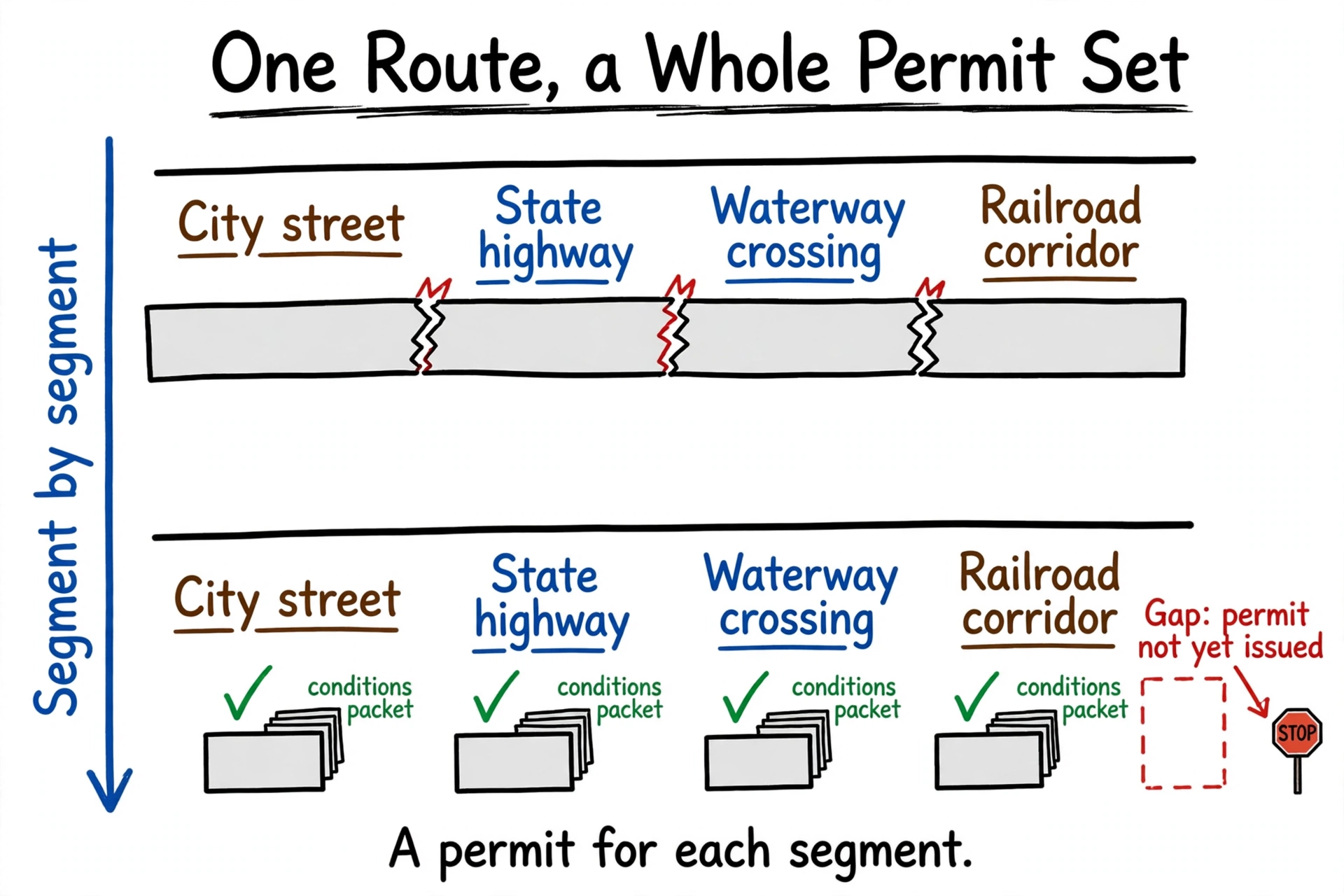
One more piece of the picture matters from the start. A route crosses ground controlled by different authorities, and each authority answers for its own ground. The check in this lesson runs per segment, because availability on one segment says nothing about the next segment. A project holds a permit set, meaning the full collection of issued instruments that together cover the whole route, and the check passes only when the set is complete.
What Is It?
A permit availability check is a document review performed before work starts, and repeated whenever the work, the ground, or the calendar changes. The reviewer works from issued documents and compares each document against the segment about to be built. The check has five tests, and a permit passes the check only when a permit passes all five.
Test one: issued. An issued permit is a permit the issuer has granted, shown by the approval the issuer places on the document: a signature, a stamp, an electronic approval, or an issued permit number tied to an approval record, depending on the system that issued it. The issuer is the agency, owner, or authority that grants the permission and sets its terms. An application is a request for permission. A submitted application, a filing receipt, a fee payment record, and a message saying an application is under review each prove that a request exists. None of them is permission. Illinois states the baseline for its highway system at Section 530.40(a) of 92 Ill. Adm. Code Part 530: only a permit issued by the Department satisfies the written consent requirement of Section 9-113 of the Illinois Highway Code. Virginia states the same baseline in its land use permit terms: no work, occupancy, or non-transportation use may be performed on state highway property until written permission has been obtained, and written permission is granted through issuance of a land use permit. The first test asks one question: did the issuer grant this permission, in a form the crew can point to?
Test two: in force. A permit is in force when its term is running on the day of work, no suspension or revocation has taken it away, and every precondition has been met. A precondition is a step the permission requires before work may start under it, such as a notice to the issuer, a verification from the issuer, a companion approval from another agency, or a bond or insurance document the permit requires to be in place first. Term language varies by issuer and by permit. One permit states a calendar expiration date. Another permit ties its end to completion of the work. The Illinois Department of Transportation permit form reproduced in its District 7 customer information packet states the pattern plainly: the work authorized shall be completed by the date filled in on the form, or within the calendar days filled in on the form after approval, otherwise the permit will be considered null and void. That completion language and its day count belong to that Illinois form. The general rule travels: the dates printed on the issued permit for the job govern that job, and a crew reads them from the document rather than from habit. Suspension and revocation sit inside the same test. The Virginia land use permit terms state that any permit may be denied, revoked, or suspended when the safety, use, or maintenance of the highway requires it, and that failure to give the required notice before work requiring inspection may result in permit revocation. A permit that was issued in the spring can be unavailable in the fall for reasons that never appear on the permit face, so the check confirms current standing with the project record, and with the issuer where the record leaves doubt.
Test three: covering this ground and this work. A permit authorizes the work it describes, at the place it describes, for the party it names. The permittee is the person, company, or agency named on the permit as the party who receives the permission and accepts its conditions. Federal regulation fixes the content that makes coverage readable. Section 645.213 of Title 23 of the Code of Federal Regulations provides that the written arrangements for a utility to cross or otherwise occupy highway right of way, generally in the form of use and occupancy agreements or permits, must include or incorporate by reference the transportation department standards for accommodating utilities, a general description of the size, type, nature, and extent of the facilities, and adequate drawings or sketches showing the facility location against the traveled way, the right of way lines, and, where applicable, the control of access lines and approved access points. The agreement must also describe, at a minimum, the requirements for location, construction, protection of traffic, maintenance, access restriction, and any special conditions applicable to each installation. Coverage is therefore a comparison the reviewer can perform: the location description and drawings in the permit, held against the segment limits on the print; the work description in the permit, held against the method and facilities the crew plans to build; the permittee name, held against the party directing the work. A mismatch on any leg means the permit covers different ground, different work, or a different party, and the segment waits for written coverage from the issuer.
Test four: complete as a package. A permit package is the full set of documents that together carry the permission: the permit face, the general conditions or general provisions, any special conditions written for the segment, the approved drawings or plans, and every document the permit incorporates by reference. Incorporation by reference means a permit makes another document part of the permit by naming it, without reprinting the full text inside the permit. Section 645.213 builds federal highway permits exactly this way: the standards enter the agreement by reference, and the agreement describes the installation specific requirements on top of them. A folder holding a permit face with no conditions packet, no approved drawings, and a referenced accommodation policy nobody retrieved holds a partial permission. The crew cannot state the hours, the notice steps, the inspection hold points, or the restoration standard from a partial package, and a partial package fails the check even when the face itself is genuine and current.
Test five: readable at the site. A site copy is the copy of the permit package held at the work site, in the form the permit requires, where the crew and an inspector can read it during the work. Whether a site copy is required, and in which form, comes from the permit and the issuer rules for that job. The rule is common enough that a reviewer meets it in system after system, always as a term of that system. The Virginia land use permit terms require a copy of the permit to be maintained at the work site and made readily available for inspection when authorized Virginia Department of Transportation personnel request it. The Bartow County, Georgia utility permit procedures require the permit to be posted with any required placards and a copy to be kept available at all times on the job site when work is underway. The Illinois permit form language states that a copy of the permit must be present when crews or equipment occupy highway right of way. The City of Lubbock, Texas code shows that form varies inside one system: small utility projects may keep a digital or paper copy at the site, available for inspection, while medium and large projects keep a paper copy displayed in a waterproof manner at the site. Three lessons sit inside those examples. A site copy duty is real where the permit states one. The required form follows the permit, so a phone photo may satisfy one job and fail the next. And a copy that is present with pages missing or text too degraded to read fails the purpose of the duty, which is a readable permission at the point of work.
The sources sort into four levels, and the check names the level for each rule. Careful labeling keeps the crew from treating a company habit as a law and from treating a law as a habit:
- Federal regulation. Title 23, Part 645, Subpart B governs accommodation of utilities on federal aid and direct federal highway projects. Section 645.211(d) provides that compliance with applicable state laws and approved state accommodation policies must be assured, that the state transportation department file must contain evidence of the written arrangements, and that all utility installations on highway right of way are subject to written approval by the state transportation department, with stated exceptions the agreement itself may provide for matters such as maintenance, service connections on highways other than freeways, or emergency operations. Section 645.213 sets the required content of the use and occupancy agreement or permit described above. Federal environmental authorizations carry their own availability logic, covered under preconditions below.
- State rule and state permit terms. Each state department of transportation runs its own accommodation rules and its own permit forms. Illinois Part 530 is one complete example: Section 530.100 lists the information an application must provide, Section 530.200 requires every permittee to comply with the terms and conditions of the permit unless authorized in writing by the Department to do otherwise, and Section 530.40(b) states that a permit grants a license only and creates no property right. Virginia land use permit terms are another example, carrying the site copy, notice, revocation, and change approval terms quoted in this lesson. A term from one state system governs work under that system and serves elsewhere only as a pattern to look for.
- The conditions of the issued permit. For the segment in front of the crew, the issued package is the controlling document: its dates, its limits, its notice steps, its hold points, and its site copy term. Lesson 125 taught how to read conditions as a subject. This lesson adds the timing: the conditions get read before mobilization, as an availability question, rather than discovered during the work as a surprise.
- Company practice. A permit register is a project list that names, for each segment, the instrument that covers it, the permit number, the expiration or completion term, the preconditions, and the status of each item. No federal or state source cited in this lesson requires a register in that exact form. The register is a company tool that makes the five tests repeatable across a route and across a season. Practice tools earn their place by catching gaps early, and a crew describes them accurately as practice, so nobody confuses a missing register entry with a missing permit, or a completed register row with an issued permit.
Environmental preconditions show why test two carries real weight. A Nationwide Permit, shortened to NWP, is a general authorization from the U.S. Army Corps of Engineers for a category of activities in waters of the United States. Corps guidance states the availability rule for the program: an activity may be authorized under a Nationwide Permit only if the activity and the applicant satisfy all of the permit terms and conditions, including the national general conditions, any regional conditions, and any special conditions added for the project. Some Nationwide Permits and some project situations require a pre-construction notification, shortened to PCN, meaning a notice the prospective permittee submits to the Corps district before construction. Corps guidance for the review process states that where a PCN is required, the applicant waits for written word from the Corps that the activity may proceed, or for the review period the guidance describes to pass, and that where notification was required for endangered species or historic properties review, the applicant cannot begin until written notification arrives that consultation is complete. The Corps issues a verification letter when review completes, confirming the activity may proceed under the Nationwide Permit with any special conditions the Corps imposed. Corps guidance also directs prospective permittees to check the status of Clean Water Act Section 401 water quality certification and coastal zone consistency for a Nationwide Permit, because a needed certification or consistency decision must be in hand before construction under the authorization. The availability lesson is direct: for an environmental authorization, an issued category and a filed notice can still leave the segment unavailable until a verification, a certification, or a consultation step completes. The check treats each pending step as a closed gate with a name and an owner.
What Does It Look Like?
Availability has a visible shape in a well run job file and at a well run site. A beginner can learn to recognize both the ready state and the warning signs.
Signs the permit set is available and ready:
- A permit register or segment list on the job file cover, with one row per segment, each row naming the issuer, the permit number, the term, the preconditions, and the status, and each row marked from documents someone read that week.
- The issued permit package for the active segment in one place: face, conditions, special conditions, approved drawings, and every referenced document the package names, with no referenced item missing.
- Approval evidence on the face of each permit: a signature, a stamp, an electronic approval, or an issued number the project can match to the issuer record.
- Dates that survive a calendar check: the term covers the planned work window with room for the restoration and inspection steps the package requires at the end.
- Preconditions shown as completed steps with evidence: the notice given and logged with a name and a date, the verification letter filed for an environmental authorization, the companion approvals filed beside the permit they support.
- A readable site copy at the work location in the form the permit requires, held by a named crew member who can produce it when an inspector asks.
- A foreman who can state, for the segment under construction, the permit number, the location limits, the allowed work, the next notice or inspection step, and the expiration or completion term, without leaving the site to find out.
Warning signs that availability is assumed rather than checked:
- A folder labeled permits that holds applications, receipts, and correspondence, with no issued document inside.
- A permit face with blank approval fields, a draft watermark, or a sample stamp.
- A conditions packet that ends mid list, a drawings attachment named in the permit and missing from the folder, or a referenced policy nobody on the project has opened.
- A site copy that is a partial print, a photo of one page, or a file on a computer back at the office, where the permit requires a copy at the site.
- A register row marked complete in a color, with no permit number and no date entered beside the mark.
- A crew answer that names the project or the company when asked which permit covers the segment, instead of naming the issuer and the permit number.
What Does It Do?
It converts permission from a project assumption into a segment fact. Design, scheduling, and bidding all proceed as if permission will exist. The availability check is the step where the project stops assuming and reads. Each segment leaves the check with one of two answers, available or unavailable, and the answer rests on documents a second person could read and reach the same answer. That conversion matters because every later decision, from mobilization to the daily briefing in Lesson 130, inherits the answer.
It sequences the remaining permission work while resequencing is still cheap. A failed test names its own repair path. An unissued permit goes back to the permitting lead with the application record attached. A precondition goes on the calendar with an owner and a due date. An expiring permit gets an extension request through the issuer process before the term ends. A missing conditions packet gets retrieved from the issuer or the project file. Each repair is office work. The same gap discovered after mobilization becomes field delay, with a crew and equipment standing on ground the paperwork never covered.
It protects the work already built. Work performed under a permit that later turns out to have been expired, suspended, or issued for different ground carries the exposure Lesson 127 described: the issuer remedies written into the system, which Section 645.213(e) requires the agreement itself to state as the action to be taken in case of noncompliance. Illinois Section 530.200 states the matching duty from the permittee side: comply with the terms and conditions unless the Department authorizes otherwise in writing. A check run before work starts keeps finished construction attached to a live permission. A check skipped leaves finished construction attached to a hope.
It gives the field a document worth briefing from. The job briefing in Lesson 130 works from the print, the locates, and the conditions at the site that morning. Permit conditions belong in that picture: the hours, the limits, the hold points, and the notice steps for the segment. A crew can brief conditions only when the complete package reached the field in readable form. Availability at the site is therefore a safety input as well as a legal one, because the conditions a crew never saw cannot shape the setup the crew builds.
It creates the record that answers later questions. Months after construction, a question about a segment usually reduces to a document question: which permission covered this ground, under which conditions, during which dates. The register rows, the filed verification letters, the notice logs, and the closed permit packages answer that question in minutes. A project that ran the check holds the answer. A project that assumed holds a search.
Where Does It Fit?
The availability check sits late in preparation and early in every work cycle:
- During permitting, covered across Lessons 119 to 127, applications go out segment by segment and issued packages come back. The check begins as each package arrives: read it, register it, file the complete package, and log its preconditions.
- At the preconstruction meeting in Lesson 128, the permit set gets reviewed as a whole. Gaps found there still have schedule room: unissued segments, pending verifications, and terms that end before the planned finish each get an owner and a date.
- Before mobilization for each segment, the check runs again in short form: issued, in force, covering, complete, readable. The calendar moved since the last check, and in force is a claim about today.
- Inside the job briefing in Lesson 130, the foreman briefs the conditions of the covering permit for the segment, and the site copy sits where the permit requires it.
- During construction, the check repeats at three triggers: a new segment starts, a design or method change is proposed, or a term boundary approaches. The Virginia terms show why the change trigger exists: design changes, specified material changes, and field changes from the approved plans go to the issuer designee for review and approval before the changed work proceeds. A change can move work outside the coverage an earlier check confirmed.
- Illinois Section 530.40(f) adds the cross check that belongs on every register: issuance of a utility permit by the Department does not excuse the permittee from complying with the requirements of other agencies the section lists. Virginia General Requirement 6 in its land use permit terms states the same allocation from the permittee side: obtaining all necessary permits required by other government agencies is the permittee responsibility. One issued permit never completes the set by itself. The check asks, for each segment, whether any companion instrument is still missing.
- At closeout, the completed packages, inspection records, and closed permits join the segment file, and the register becomes part of the project record described in Lesson 127.
Neighboring readiness checks in Level 7 run on the same pattern and stay separate subjects: Lesson 131 covers correct prints, Lesson 133 covers locates, and Lesson 143 asks whether the site is actually ready for construction across every input. The permit check answers one input completely rather than every input partly.
What Is at Stake
The right to occupy the ground that day. The written approval system exists so highway and street ground gets occupied under terms the controlling authority set. Section 645.211(d) makes written approval by the state transportation department the default for utility installations on highway right of way. Work that starts on an application, on an expired permit, or on a permit for the next segment starts without that approval for the ground under the crew, whatever the crew believed at the gate.
Stop work, revocation, and removal exposure. Issuer systems carry remedies, and availability failures invite them. The Virginia terms reserve the right to stop work at any time for safety problems or noncompliance with permit terms, allow denial, revocation, or suspension where highway safety, use, or maintenance requires, and state that the department may complete the permitted work or restore the right of way to department standards and invoice the permittee for the actual cost. Section 645.213(e) requires every federal aid use and occupancy agreement to state the action for noncompliance in advance, so the remedy on a given segment is readable in the package before any failure occurs. A crew that read the package knows the exposure. A crew that filed the package unread learns the exposure from the inspector.
Schedule built on sand. A segment scheduled against a pending permit has no real start date. The date belongs to the issuer review, the verification step, or the certification step, and none of those steps answers to the project schedule. Availability checking moves that truth into the planning meeting, where the crew can be resequenced onto covered ground. Skipping the check moves the same truth to the jobsite gate, where the only remaining move is standing down.
Money tied to terms. Bonds, insurance, restoration duties, and liability for future adjustment ride inside permit packages, and Section 645.213(d) requires the agreement to state the extent of that liability. A permit that lapses mid segment can strand restoration duties under a permission that no longer runs, and a precondition bond or certificate that was never confirmed can leave the permittee exposed at the moment a claim arrives. The check confirms the financial terms stand in force alongside the permission itself.
Environmental authorization lost by starting early. Nationwide Permit coverage depends on satisfying every applicable term and condition. Starting a regulated activity before a required verification or certification completes places the work outside the authorization the project counted on, and Corps provisions at 33 CFR 330.5, noted in the general conditions, allow modification, suspension, or revocation of a Nationwide Permit authorization. The stake is the authorization itself, and the failure mode is a calendar error rather than a construction error.
What Does Good Look Like?
- Every segment on the route has a register row naming the issuer, the permit number, the location limits, the term, and the status, and the row was filled from the issued package rather than from the application record.
- The complete package for each issued permit sits in the job file: face with approval evidence, general conditions, special conditions, approved drawings, and every document incorporated by reference, retrieved and filed.
- Each precondition is listed with an owner and a completion record: notices given and logged, verification letters filed, companion approvals filed, bonds and insurance confirmed where the permit requires them.
- The term for every active permit covers the remaining work plus the restoration and inspection steps at the end, and any extension request went to the issuer in writing before expiration, through the process the permit describes.
- The site copy for the active segment is complete, legible, and held at the work site in the form the permit requires, by a crew member who can produce it on request.
- The foreman can state the covering permit number, its location limits, its allowed work, its next notice or inspection step, and its term, for the segment under construction.
- Any segment that fails a test is marked unavailable in plain words, the crew is scheduled on covered ground, and the gap carries a named owner and a next step.
- When the work, the ground, or the method changes, the coverage test runs again before the changed work starts, and issuer approval for the change is in writing where the permit terms require it.
From the Field
Picture a fiber crew scheduled to build two segments in one week. The first segment runs along a city street. The second segment crosses a state highway shoulder and continues along the far side. The job folder carries a section labeled permits, and the schedule treats both segments as cleared.
On the morning the crew stages material, the foreman runs the availability check segment by segment before any truck rolls. The city segment passes cleanly. The issued municipal permit sits in the folder with its conditions packet and approved drawings, the permittee name matches the company directing the work, the term covers the week with room for restoration, and a complete copy is ready for the site in the form the permit requires.
The state segment fails at the first test. The folder holds a copy of the permit application, a submission receipt, and email correspondence about the application. No issued permit sits in the folder: no approval signature, no issued permit number, no conditions packet from the state. Beside that gap, a second gap appears. The environmental authorization for a small waterway crossing inside the state segment rests on a filed pre-construction notification. The notification went in two weeks earlier, the review period the Corps guidance describes has not run, and no written word from the district has arrived. No verification letter from the Corps district sits in the file. Two gates stand closed, each with a different owner and a different repair path.
The foreman faces the decision. The schedule favors staging both segments and starting the state crossing on the strength of the application, since review has been pending and the work itself is routine. The documents point the other way: the state segment has an application where a permit belongs and a notification where a verification belongs, and neither document grants permission to occupy the ground or to start the regulated crossing.
The foreman holds the state segment. The crew builds the city segment that week, on ground the issued permit covers, with the complete package at the site. The foreman sends the permitting lead a written note naming both gaps exactly: issued state permit missing, application and receipt on file only; Corps verification letter missing, notification on file only. The permitting lead works both gaps through the issuer processes while production continues on covered ground, and the state segment enters the schedule again when the issued permit and the verification letter are in the folder and the complete package has been read.
The decision rule is plain: a permit counts as available only when the issued document is in hand, in force, covering the segment and the work, complete as a package, and readable at the site. An application, a receipt, a pending review, and a filed notification each count as unavailable for the ground they were meant to cover, and the crew works the covered ground while the gaps close.
What Can Go Wrong?
The application that reads as approval. A stamped received copy, a portal status of submitted, or a cheerful email from a reviewer gets filed in the permits section and read by the schedule as a grant. The document grants nothing. Issuance evidence is the test, and correspondence about a future grant fails it.
The expired permit that still looks official. An expired permit keeps its signatures, its number, and its conditions, and a folder check that stops at appearance passes it. The term test compares dates against the calendar and the remaining work, including restoration and final inspection, and an extension is a written grant from the issuer rather than a hope that nobody will check.
The right permit for the wrong segment. Route work crosses jurisdiction lines quietly. A city limit, a highway boundary, or a railroad corridor edge can sit mid block, and a permit that fully covers the morning segment covers none of the afternoon segment. Segment by segment checking exists because coverage ends where the described location ends.
The package with the middle missing. The face is present and genuine, and the conditions packet, the special conditions sheet, or the approved drawings never made the folder. The crew then builds from the print alone and discovers the hold point, the hour limit, or the restoration standard from an inspector, at the moment correction costs the most.
The precondition nobody calendared. A notice step, a verification letter, a companion certification, or a bond confirmation sits inside the package as a start gate, and the schedule never carried it. The permit was issued and the segment was still unavailable, because availability includes the steps the permission demands before work begins.
The site copy that fails at the roadside. An inspector asks for the permit and the crew produces a partial print, a photo of the face with the conditions missing, or a promise that the office can send the file. Where the permit requires a copy at the site, the roadside is the test location, and a copy that cannot be produced and read there fails the condition the permit set.
The change that outran the coverage. Field conditions push the crew to a different alignment, a different method, or an added crossing, and the work proceeds under the original description. Permit terms such as the Virginia change provision require issuer review and approval of design and field changes before the changed work proceeds. Changed work built first and approved later spent the interval outside the described permission.
The one permit that was asked to cover everything. A state highway permit gets carried onto private ground, a municipal permit gets carried across a railroad corridor, or an environmental authorization gets treated as permission to occupy the road. Each instrument answers for its own ground and its own subject. Illinois Section 530.40(b) states the limit for its system: the permit grants a license for the activities the part allows on state right of way and grants no authority over the rights of others in that right of way. The set completes the route. No single member of the set replaces the rest.
What Should Someone Notice in the Field?
- Name the issuer and the permit number covering the exact ground under your feet, and point to the issued document that carries them.
- Confirm approval evidence on the permit face, and treat any application, receipt, draft, or correspondence in the permits folder as a request record rather than permission.
- Compare the permit location description and its approved drawings against the segment limits in front of you, including any jurisdiction boundary inside the segment.
- Compare the permit work description against the method and facilities the crew is about to build, and flag any added crossing, added facility, or changed method.
- Read the term on the permit and compare it against today and against the planned finish, including restoration and final inspection, and flag any finish that lands past the term.
- Confirm every precondition for the segment shows a completion record: notices logged, verification letters filed, companion approvals in hand, bonds and insurance confirmed where required.
- Check that the complete package is present: face, general conditions, special conditions, approved drawings, and every document incorporated by reference.
- Check the site copy at the work location: complete, legible, in the form the permit requires, and held by a named person who can produce it when an inspector asks.
- At any point where the route changes authority, from city street to state highway, from road to railroad corridor, from public ground to private parcel, confirm the next instrument in the set before work crosses the line.
- Know the boundary: running the availability check, reading a permit package, and reporting a gap are observation and support tasks. Issuing, amending, extending, and interpreting permits belong to the issuer and to the qualified people the project assigns to permitting. The work permits authorize can involve excavation, boring, work near traffic, and work in waterways, each under its own laws, qualifications, and safety processes. Reading this lesson qualifies no one to perform that work or to make permitting decisions for a project.
Key Terms
Permit availability check: A document review, run before work starts and repeated when the work, the ground, or the calendar changes, that confirms each required permit is issued, in force, covering the segment and the work, complete as a package, and readable at the site.
Issued permit: A permit the issuer has granted, shown by approval evidence on the document or in the issuer record, such as a signature, a stamp, an electronic approval, or an issued permit number.
Application: A request for permission submitted to an issuer. An application, a filing receipt, and a review notice prove a request exists and grant no permission by themselves.
Issuer: The agency, owner, or authority that grants a permission and sets its terms, such as a city public works office, a state department of transportation, a railroad, or the U.S. Army Corps of Engineers.
Permittee: The person, company, or agency named on a permit as the party who receives the permission and accepts its conditions.
In force: The state of a permit whose term is running on the day of work, with no suspension or revocation in effect and every precondition met.
Precondition: A step a permission requires before work may start under it, such as a notice to the issuer, a verification from the issuer, a companion approval, or a bond or insurance document in place.
Permit package: The full set of documents carrying a permission: the permit face, general conditions, special conditions, approved drawings or plans, and every document incorporated by reference.
Incorporation by reference: The mechanism by which a permit makes another document part of the permit by naming it, without reprinting the full text inside the permit.
Site copy: The copy of the permit package held at the work site, in the form the permit requires, where the crew and an inspector can read it during the work.
Permit set: The full collection of issued instruments that together cover a whole route, segment by segment, across every authority the route crosses.
Permit register: A company practice list naming, for each segment, the covering instrument, the permit number, the term, the preconditions, and the status, used to run the availability check across a route.
Pre-construction notification (PCN): A notice a prospective permittee submits to the U.S. Army Corps of Engineers district before construction, where the terms of a Nationwide Permit or the project situation require one.
Verification letter: The written confirmation a Corps district issues after review, stating that an activity may proceed under a Nationwide Permit, with any special conditions the district imposed.
Check Your Understanding
- State the five tests of the permit availability check, in order.
Answer: Issued, in force, covering this ground and this work, complete as a package, and readable at the site. A permit passes the check only when the permit passes all five tests.
- A job folder holds a submitted application, a filing receipt, and an email stating the application is under review. The schedule marks the segment cleared. Evaluate the segment under the availability check, using the Illinois baseline.
Answer: The segment is unavailable. The folder holds request records, and none of them is an issued permit. Section 530.40(a) of 92 Ill. Adm. Code Part 530 states the baseline for the Illinois highway system: only a permit issued by the Department satisfies the written consent requirement of Section 9-113 of the Illinois Highway Code. The segment enters the schedule again when the issued permit is in hand and the remaining four tests pass.
- A permit incorporates the state accommodation standards by reference and attaches special conditions for one crossing. The folder holds the permit face and the special conditions sheet. The standards document was never retrieved. Which test fails, and why does the failure matter in the field?
Answer: The complete package test fails. Incorporation by reference makes the standards part of the permit, and Section 645.213 requires the use and occupancy agreement to include or incorporate by reference the transportation department standards, with the installation requirements described at a minimum for location, construction, protection of traffic, maintenance, access restriction, and special conditions. A crew working without the standards holds a partial permission and can miss the location, traffic, and maintenance requirements that govern the segment.
- In the From the Field scenario, which two gaps closed the state highway segment, and what did the foreman do with the crew and with each gap?
Answer: The folder held an application, a receipt, and correspondence where an issued state permit belonged, so the segment failed the issued test. The environmental crossing rested on a filed pre-construction notification with no Corps verification letter in the file, so a precondition gate also stood closed. The foreman held the state segment, built the city segment that week on ground the issued permit covered with the complete package at the site, and sent the permitting lead a written note naming both gaps exactly, so each gap could close through its issuer process while production continued on covered ground.
- A foreman says the state permit for the project is in the truck, so the crew can start the segment that crosses into the railroad corridor after lunch. Evaluate the claim.
Answer: The claim fails the coverage test and the permit set principle. A state highway permit authorizes work on the ground and the subject that permit describes. A railroad corridor answers to the railroad under its own agreement and permit process, and the state permit travels no farther than its described location. The corridor segment is unavailable until the railroad instrument covering it is issued, in force, complete, and readable at the site, and the crew works covered ground in the interval.
Lesson Takeaway
Availability is a reading, not a rumor. After this lesson, a permits folder reads as a set of testable claims, one per segment: issued, in force, covering, complete, and readable where the work happens. A segment with all five claims proven is ground a crew can enter with confidence. A segment with any claim unproven is a named gap with an owner, and the crew builds somewhere the paperwork already covers.
Sources and Technical References
Federal regulation, 23 CFR 645.213, Use and occupancy agreements (permits), providing that the written arrangements for a utility to cross or otherwise occupy highway right of way must include or incorporate by reference the transportation department standards for accommodating utilities, a description of the size, type, nature, and extent of the facilities, adequate drawings or sketches against the traveled way, the right of way lines, and control of access lines where applicable, the extent of liability for future adjustment, the action to be taken in case of noncompliance, and other provisions needed to comply with laws and regulations, and that the agreement must describe at a minimum the requirements for location, construction, protection of traffic, maintenance, access restriction, and any special conditions applicable to each installation. Cornell Law Institute Legal Information Institute text: https://www.law.cornell.edu/cfr/text/23/645.213
Federal regulation, 23 CFR 645.211, State transportation department accommodation policies, paragraph (d), providing that compliance with applicable state laws and approved state accommodation policies must be assured, that the responsible state transportation department file must contain evidence of the written arrangements, and that all utility installations made on highway right of way shall be subject to written approval by the state transportation department, with approval not required where the use and occupancy agreement so provides for matters such as utility facility maintenance, installation of service connections on highways other than freeways, or emergency operations. GovInfo text of 23 CFR 645.211, 2024 edition: https://www.govinfo.gov/content/pkg/CFR-2024-title23-vol1/pdf/CFR-2024-title23-vol1-sec645-211.pdf
State rule, 92 Ill. Adm. Code Part 530, Accommodation of Utilities on Right-of-Way, Illinois Department of Transportation, including Section 530.40 on legal obligations (only a permit issued by the Department satisfies the written consent requirement of Section 9-113 of the Illinois Highway Code; a permit grants a license only and creates no property right; issuance does not excuse compliance with other agency requirements), Section 530.100 on permit application contents, and Subpart C general permit conditions beginning at Section 530.200. Illinois General Assembly, Joint Committee on Administrative Rules text of the full part: https://ilga.gov/agencies/JCAR/EntirePart?titlepart=09200530
State rule, 92 Ill. Adm. Code Section 530.200, Obligation to Comply, providing that every permittee shall comply with the terms and conditions of the permit unless authorized, in writing, by the Department, to do otherwise, and that the terms and conditions include the requirements set forth in Part 530. Cornell Law Institute text: https://www.law.cornell.edu/regulations/illinois/Ill-Admin-Code-tit-92-SS-530.200
State permit form and district guidance, Illinois Department of Transportation, District 7 Utility Permit Customer Information Packet, reproducing the state utility permit form language that a copy of the permit must be present when crews or equipment occupy highway right of way, that the permit is subject to the conditions and restrictions of 92 Ill. Adm. Code Part 530, and that the work authorized shall be completed by the date stated or within the calendar days stated after approval, 180 days maximum on that form, otherwise the permit will be considered null and void. The completion language and day count belong to that Illinois form. Packet: https://idot.illinois.gov/content/dam/soi/en/web/idot/documents/doing-business/memorandums-and-letters/permits/d7-utility-permit-customer-information-packet.pdf
State permit terms, Virginia Department of Transportation, Land Use Permit Application for Utility Installations, Form LUP-UT, providing that no work or occupancy may be performed on state highway property until written permission has been obtained through issuance of a land use permit; General Requirement 6, permittee responsibility for obtaining all necessary permits from other government agencies; General Requirement 7, a copy of the permit maintained at the work site and made readily available for inspection when requested by authorized VDOT personnel; General Requirement 8, notice to the local district permit office at least 48 hours prior to commencement of work requiring inspection or testing, with failure stated as grounds for permit revocation under those terms; General Requirement 9, any permit may be denied, revoked, or suspended when highway safety, use, or maintenance requires; General Requirement 10, VDOT reserves the right to stop work for safety problems or noncompliance and may complete the work or restore the right of way and invoice the permittee; and General Requirement 12, design changes, material changes, and field changes from the approved plans submitted for review and approval before the changed work proceeds. The 48 hour notice period belongs to these Virginia terms. Form: https://ris.dls.virginia.gov/uploads/24VAC30/forms/40Land Use Permit Application for Utility Installations, LUP-UT-20251002115647.pdf
Federal program guidance, U.S. Army Corps of Engineers, Seattle District, Nationwide Permits guidebook page, stating that an activity may be authorized under a Nationwide Permit only if the activity and the applicant satisfy all of the permit terms and conditions, including national and regional conditions and any special conditions added for the project; that a pre-construction notification is required in the cases the permits specify, submitted as early as possible; that the applicant waits for written word from the Corps that the activity may proceed, or for the review period the guidance describes, and cannot begin where endangered species or historic properties notification was required until written notification arrives that consultation is complete; that the Corps issues a verification letter when review completes; and that a Section 401 water quality certification or coastal zone consistency decision may need to be obtained before project construction, depending on the status the guidance directs applicants to check. Guidebook page: https://www.nws.usace.army.mil/Missions/Civil-Works/Regulatory/Permit-Guidebook/NWPs/
Federal program conditions, U.S. Army Corps of Engineers, Nationwide Permit General Conditions, stating that to qualify for Nationwide Permit authorization the prospective permittee must comply with the general conditions as applicable, in addition to any regional or case specific conditions imposed by the division engineer or district engineer; directing prospective permittees to contact the district office to determine the status of Clean Water Act Section 401 water quality certification and coastal zone management consistency for a Nationwide Permit; noting that the provisions of 33 CFR 330.1 through 330.6 apply to every Nationwide Permit authorization, with 33 CFR 330.5 covering modification, suspension, or revocation; and General Condition 32 on pre-construction notification timing and completeness review. Honolulu District copy of the general conditions: https://www.poh.usace.army.mil/Portals/10/2017NationwidePermitGeneralConditions_1.pdf
Local permit procedures, Bartow County, Georgia, Utility Permit Procedures, Field Requirements for Installation, providing that the permit shall be posted with any placards the department requires and that a copy of the permit shall also be kept available at all times on the job site when work is underway, and that the department reserves the right to inspect the work to check compliance with the terms of the permit. Procedures document: https://cms2.revize.com/revize/bartowga/Utility_Permit_Procedures.pdf
Local code, City of Lubbock, Texas, Division 3, Standards for Excavation, Backfill, and ROW Restoration, providing that a permit holder for a small utility project shall maintain a digital or paper copy of the construction permit and approved plans at the construction site, displayed and made available for inspection at all times when construction work is occurring, and that a permit holder for a medium or large utility project shall maintain a paper copy at the site, displayed in a waterproof manner and made available for inspection while the holder occupies the right of way. Code text: https://ecode360.com/38866568
Previous lesson: Lesson 131: Are the Correct Prints Available? |
Back to Level 7 hub |
Next lesson: Lesson 133: Are the Locates Ready?