
Introduction
Locate readiness is the check that confirms a locate ticket covers the work the crew is about to do, in the place the crew is about to do it, on the dates the crew plans to do it, with a complete positive response and with locate marks present, legible, and in agreement with that response. The check happens on site, before excavation starts. A ticket on file in an office, marks on the ground with no ticket check behind them, and a response record with one operator still open each fail the check in a different way.
Level 7 prepares a jobsite before ground opens. Lessons 57 through 71 taught the locate system itself: the 811 request, the colors, white lining, positive response, the tolerance zone, and the response when the field disagrees with the locate. This lesson teaches the gate that uses that system at the start of work. Lesson 134 covers field verification of existing utilities after this gate clears.
What This Lesson Gives You
- Compare a locate ticket line by line against the work area, the work type, and the planned dates, and name any part of the work the ticket leaves outside its coverage.
- Read a positive response record and confirm every operator notified on the ticket has answered with a marked, clear, or no conflict status before excavation starts.
- Walk the work area and confirm marks are present, legible, in the colors the response record predicts, and matched to the white lining and the print for the segment.
- Hold work in an affected area, re-notify the 811 center, and request a re-mark when a response is missing, marks are gone or unreadable, or the field shows a facility the record leaves unaccounted for.
- State the boundary plainly: checking readiness is a verification task, and the check qualifies no one to locate facilities or to excavate.
Start With the Basics
Think about a boarding pass at an airport gate. The pass names one passenger, one flight, one date, and one destination. A traveler holding a valid pass for a different flight on a different day still cannot board the plane at the gate, and a traveler whose name matches the flight while the date has passed gets stopped at the scanner. The gate agent checks the document against the trip in front of the agent, and each field on the document has to match that trip.
A locate ticket works through the same mechanism. The ticket names an excavator, a work area, a type of work, and a window of dates. Marks on the ground work the same way: paint from a completed locate for a neighboring segment, or paint left over from an earlier ticket, can look convincing and still belong to different work. The readiness check is the gate scan. The crew compares the ticket, the response record, and the marks against this job, in this place, starting on this date, and work proceeds only when all three records describe the same ground.
Excavation in this lesson means digging, boring, trenching, augering, drilling, grading, and similar ground disturbance performed with mechanized equipment or blasting, following the general scope state damage prevention laws give the word. Oklahoma’s definition at 63 O.S. Section 142.2 lists augering, boring, drilling, grading, trenching, and similar mechanized work, and then carves out exclusions, including earth moved by hand tools outside an easement or right-of-way, agricultural cultivation, and routine maintenance. The governing state law for the job controls which work counts. A bore entry pit, a handhole excavation made with mechanized equipment, and a trench all count, and the readiness check applies before any of them opens.
What Is It?
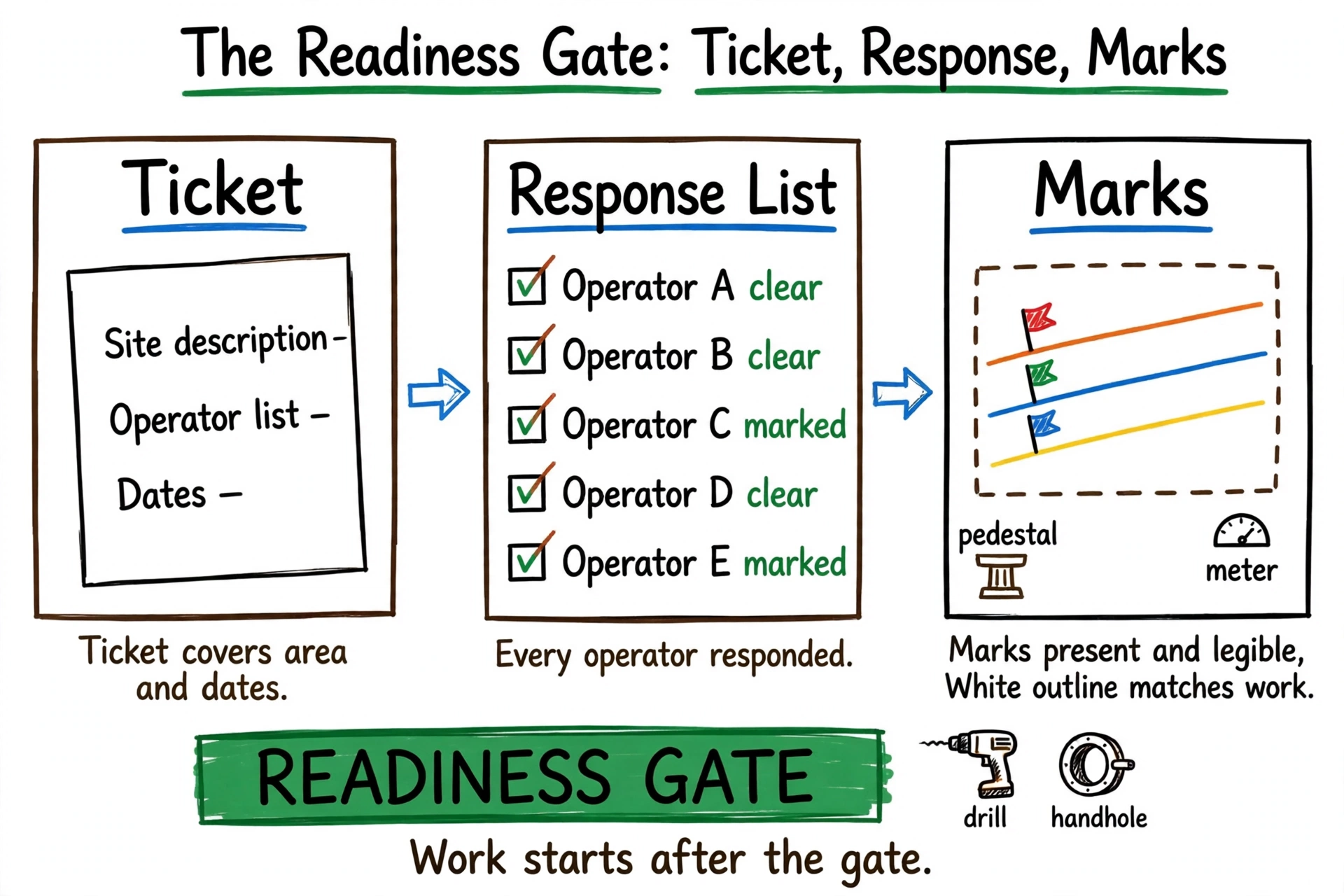
Locate readiness is a pre-excavation verification with six parts. Each part answers a separate question, and a pass on five parts leaves the sixth question open.
The ticket itself. A locate ticket, also called a locate request or a notice, is the record the 811 center creates when an excavator reports planned excavation. The 811 center is the state notification center that receives the notice and sends the notice to the facility operators listed for the area. CGA Best Practice 5-3 states that the excavator receives and maintains a reference number from the 811 center that verifies the locate was requested, and that the number identifies the date, time, and sequence of the request. CGA Best Practice 5-13 states that, except in an emergency, the excavator at each job site has available a complete description of the dig site, a list of the facility owner members impacted at that dig site as identified by the 811 center, and the 811 center ticket number. A readiness check starts with the ticket in hand at the site. Memory of a ticket, or a ticket number with no ticket detail behind it, gives the crew nothing to compare against the ground.
Coverage of the work area and the work type. The ticket describes a defined area and a defined type and extent of work. The first check compares that description against the print and the planned work for the day:
- The area on the ticket includes every place the planned work will disturb ground, including entry and exit pits, handhole locations, trench lines, bore paths, and access work that cuts the surface.
- The work type on the ticket matches the work planned, so a ticket written for one method and one segment is carrying the work actually scheduled.
- Work that has grown since the ticket was written, such as an added handhole, an extended bore, or a shifted alignment, gets measured against the ticket description. Ground outside the ticket description sits outside the locate that the ticket produced.
Coverage of the dates. A ticket carries a start date and a life set by state law. The second check confirms the planned work falls inside that window:
- The required waiting period under the governing state law has ended before work starts. CGA Best Practice 5-10 directs the excavator to verify that the waiting period has ended as defined by state or provincial law.
- The ticket has not expired. CGA Best Practice 5-23 directs the excavator to contact the 811 center to refresh the ticket when excavation continues past the life of the ticket, and describes ticket life as set by state or provincial law in many places.
- Work that will run past the ticket life gets an update or a new notice with enough lead time that coverage never lapses mid-job.
Waiting periods and ticket life vary by state, and this lesson states no universal number for either. One named example shows the shape. Under the Oklahoma Underground Facilities Damage Prevention Act, at 63 O.S. Section 142.6(A), notice shall be given no less than 48 hours, excluding the date of notification, Saturdays, Sundays, and legal holidays, prior to commencement of the excavation, and notice shall expire 14 calendar days from the excavation start date, with no excavation continuing after expiration unless subsequent notice has been submitted. The OKIE811 Excavator Guide states the same life in field terms: a ticket expires 14 calendar days after the excavation start date, and no excavation should take place after the 14th day unless an update has been made with sufficient notice. Oklahoma numbers govern Oklahoma work. A crew working in another state reads that state law and that state ticket for the numbers that govern the job.
Positive response, complete. Positive response is the communication from each facility operator back through the 811 center stating the status of its part of the ticket: facilities marked, or no facility in conflict with the proposed work. CGA Best Practice 4-9 states that all facility locate requests result in a positive response from the facility owner or operator to the excavator, delivered through markings or documentation left at the job site, a callback, or an automated response system, and that positive response allows the excavator to know whether all facility owners and operators have marked the requested area before excavation begins. CGA Best Practice 5-8 adds the excavator side of the exchange:
- The excavator reviews positive response from each notified operator on the ticket before beginning excavation.
- The excavator compares all positive responses against the full list of operators notified on the ticket.
- The excavator notifies the 811 center of any discrepancy between the positive responses and the field conditions.
Oklahoma law states the same duty directly. Section 142.6(A) provides that an excavator must check for positive response at the notification center prior to excavating or demolishing to ensure that all operators have responded and that all facilities that may be affected by the proposed excavation or demolition have been marked, and Section 142.6(B) provides that each operator shall provide a positive response to the notification center prior to the expiration of the required notice period. A response record with one operator still showing no response is an incomplete record, and paint on the ground from other operators does nothing to close that gap.
CGA Best Practice 5-9 covers the operator who still fails to respond: the excavator re-notifies the 811 center, and the practice allows excavation to proceed once positive response is received from all operators or the waiting period set by state or provincial law has lapsed, provided the excavator exercises due care. That pathway belongs to the governing law and the employer’s program for the job. The readiness gate in this lesson does not treat a lapsed waiting period, standing alone, as a closed response.
Marks present, legible, and in agreement. Locate marks are the paint, flags, stakes, whiskers, or a combination of these that a locator places on the surface to show the approximate horizontal location of an underground facility. CGA Best Practice 5-10 directs the excavator, on arrival and before excavation, to verify the dig site matches the 811 request, verify all facility markings agree with the positive responses, check for visible signs of underground facilities such as pedestals, risers, meters, and new trench lines, and check for facilities whose owners are outside the 811 center membership and contact the responsible parties for locates. Approximate location means the marks show where a facility runs on the surface within the accuracy the governing law and the locate method support. Marks show horizontal position. Marks carry no depth information.
White lining in place where the ticket needs it. White lining, also called delineation or pre-marking, is the excavator marking the proposed excavation area in white paint, flags, stakes, or whiskers, or defining the area electronically through the 811 center where that option exists. CGA Best Practice 5-2 states that the excavator delineates the area of proposed excavation by electronic white lining where available, by on-site pre-marking in white, by a clear description of the proposed excavation site on the locate ticket, or by a combination of these methods. Appendix B, Practice Statement 5-2, adds the trigger: when the excavation site cannot be clearly and adequately identified on the locate ticket, the excavator designates the route or area to be excavated using white pre-marking, on site or electronically, prior to or during the request for the locate ticket. The readiness check confirms the delineation the ticket relied on is still visible and still matches the work. A locator marked facilities against a white outline. Work that has moved outside that outline has moved outside the area the locator was asked to clear.
Conflicts resolved before work. A conflict in this lesson is any disagreement among the ticket, the response record, the marks, the print, and visible field evidence. Examples include a response that says marked with no marks found, marks found with no matching response, a pedestal or meter inside the work area with no corresponding mark or clear response, and a mark line that ends before the work area ends. CGA Best Practice 5-21 directs the excavator to notify the facility owner or operator directly or through the 811 center when an underground facility is not found where one has been marked, or when an unmarked facility is found. Its practice description states that excavation stops in the vicinity of the facility while notification takes place, and its practice statement adds that, following notification, work may continue only where the excavation can be performed without damaging the facility, unless state or provincial law specifies otherwise. The readiness gate in this lesson holds the stricter line at the start of work: a conflict gets reported and resolved before excavation enters the ground the conflict covers.
The federal floor underneath the state system. Federal excavation law at 29 CFR 1926.651(b) states four duties for employers in construction excavation work:
- Section 1926.651(b)(1): the estimated location of utility installations, such as sewer, telephone, fuel, electric, and water lines, or any other underground installations reasonably expected during excavation work, shall be determined prior to opening an excavation.
- Section 1926.651(b)(2): utility companies or owners shall be contacted within established or customary local response times, advised of the proposed work, and asked to establish the location of the utility underground installations prior to the start of actual excavation. The same paragraph adds that when utility companies or owners cannot respond within 24 hours (unless a longer period is required by state or local law), or cannot establish the exact location, the employer may proceed, provided the employer does so with caution, and provided detection equipment or other acceptable means to locate utility installations are used.
- Section 1926.651(b)(3): when excavation operations approach the estimated location of underground installations, the exact location of the installations shall be determined by safe and acceptable means.
- Section 1926.651(b)(4): while the excavation is open, underground installations shall be protected, supported, or removed as necessary to safeguard employees.
The locate ticket system is the mechanism state law provides for meeting the first two duties on typical work. The readiness check is how a crew proves to itself, at the site, that the mechanism actually ran for this job. Paragraph (b)(3) points forward to Lesson 134: marks give an estimated location, and exact location gets determined by safe means as the work approaches the facility.
What Does It Look Like?
A ready jobsite has a recognizable shape before any equipment starts:
- The ticket is on site, in paper form or on a device the crew can read, with the ticket number, the dig site description, the list of operators notified, the valid start time, and the expiration the governing state law sets.
- The positive response record sits with the ticket, showing a closed status for every operator on the notified list: marked, clear, or no conflict, with any special status such as a watch and protect response named and planned for.
- White delineation of the proposed excavation is visible where the ticket relied on it, and the outline on the ground matches the segment on the print.
- Paint and flags run through the full work area in the colors the response record predicts, following the APWA Uniform Color Code, the color system the American Public Works Association publishes for temporary marking of underground facilities: white for proposed excavation, pink for temporary survey markings, red for electric power, yellow for gas, oil, steam, petroleum, or gaseous materials, orange for communication, alarm, or signal lines, blue for potable water, purple for reclaimed water, irrigation, and slurry lines, and green for sewers and drain lines.
- Marks carry the locator information the marking guidelines call for where conditions allow: the appropriate color for the facility type, the operator identifier when other companies use the same color, the number and width of facilities, and a short facility description.
- Flags stand upright and paint lines stay continuous and readable, with no stretch of the work area where grading, traffic, weather, or mowing has erased the marks since the locate.
- Visible surface evidence agrees with the record: each pedestal, riser, meter, handhole, valve cover, and existing trench line inside or beside the work area has a mark, a clear response, or a documented explanation the crew can state.
- The crew can point at the ground the ticket does not cover, such as the segment scheduled for a later ticket, and can show the physical point where covered work stops.
What Does It Do?
The check converts a request into a verified condition. A submitted ticket proves a request was made. Readiness proves the request produced a complete result for the ground the crew is about to open: every notified operator answered, the answers match the marks, and the marks cover the planned work inside the valid dates. The difference between a request and a result is the whole lesson.
The check catches mismatches while the correction costs a phone call. Each part of the check guards against a specific failure that paperwork alone hides. Ticket scope review catches work that outgrew its notice. Date review catches work scheduled against an expired ticket. Response review catches the operator who never answered, a gap paint from five other operators conceals. Mark review catches the locate that faded, got paved over, or never reached the far end of the segment. Field evidence review catches the facility that no system listed. Every one of these corrections is a re-notification, an update, or a re-mark request before ground opens. After ground opens, the same gap surfaces as an exposed unmarked facility, a damaged line, or a stopped job with an open excavation.
The check fixes the work area for the whole crew. CGA Best Practice 5-12 directs the excavator to review the location of underground facilities with site personnel before starting work, and CGA Best Practice 5-11 describes documenting marks with dated pictures, videos, or sketches with distances from markings to fixed objects recorded. Walking the readiness check together gives the operator, the spotter, and the ground crew one shared picture of where facilities run, where the ticket coverage ends, and which areas stay closed until a conflict clears. A crew that walked the marks together works from the locate. A crew that received a verbal summary works from a summary.
The check preserves the record that protects the crew and the company. The ticket, the response record, photographs of the marks, and a note of any discrepancy reported to the 811 center form the job record for the locate. CGA Best Practice 5-17 states that the excavator protects and preserves the staking, marking, or other designation of underground facilities until the marks are no longer required for proper and safe excavation, and stops excavating and notifies the 811 center for re-marks when a facility mark is removed or no longer visible. The readiness check starts that preservation duty at the beginning of the job, with the marks documented in the condition the locator left them.
Where Does It Fit?
The readiness check sits at the end of the locate process and at the head of excavation, with defined neighbors on each side:
- Lessons 57 and 58 covered 811 and the locate request. The request starts the clock and creates the ticket.
- Lessons 59 through 64 covered marks, colors, paint and flags, white lining, the tolerance zone, and positive response. Each of those lessons taught one input to this check.
- Lesson 129 covered what the crew needs to know before starting, and Lesson 130 covered the job briefing. The readiness result belongs inside the briefing for any job that opens ground: the crew hears which facilities are marked, which responses are clear, and which areas stay closed.
- Lesson 132 confirmed the required permits are available. Permits and locates are separate gates. A valid permit grants permission to work in a place. A ready locate describes the underground facilities in that place. Passing one gate says nothing about the other.
- Lesson 134 covers verification of existing utilities in the field, including exposure by safe means as excavation approaches a facility, under the duty at 1926.651(b)(3). Readiness comes first: verification work itself disturbs ground in careful ways, and the ticket, response, and marks define where that careful work concentrates.
- During the job, the check repeats in short form whenever conditions change: marks destroyed, work extended, ticket nearing expiration, or a new segment opening. CGA Best Practice 5-23 covers the ticket refresh when work continues past the life of the ticket.
What Is at Stake
Safety around energized and pressurized facilities. The facilities a locate exists to find include electric lines and gas lines. Excavation into a facility whose operator never responded, or whose marks faded before the job started, exposes the crew and the public to the hazard the entire system was built to prevent. Federal law places the location determination before the excavation opens, at 1926.651(b)(1), precisely because the determination loses protective value after equipment is already in the ground.
Service damage and repair cost. A strike on a fiber, water, or sewer facility interrupts service to customers who had no part in the job, and repair cost, restoration cost, and delay cost land on the project. Damage investigation turns on the locate record: the ticket scope, the response record, and the condition of the marks at the start of work. A crew that checked readiness and documented the check holds a record that matches the field. A crew that assumed readiness holds a ticket and a hope.
Schedule. A readiness failure found at the gate costs the time a re-notification or re-mark takes, with the crew free to work covered ground or other tasks meanwhile. A readiness failure found by a bucket costs the investigation, the repair wait, the operator response, and the re-locate, with an open excavation sitting idle. The gate is the cheaper place to discover every one of these problems.
Legal compliance under state damage prevention law. State law, rather than a single federal ticket rule, sets the notice, waiting period, positive response, and ticket life duties for a job, and the duties differ by state. Oklahoma law, as one example, makes the positive response check an excavator duty in the statute text and bars excavation after notice expiration without subsequent notice. A crew that treats another state numbers as universal, or treats paint alone as proof of compliance, can violate the governing law while believing the job was ready.
The tolerance zone work that follows. Marks establish the estimated location. Careful excavation duties near a facility, including determining exact location by safe and acceptable means under 1926.651(b)(3), depend on accurate marks as the starting point. A tolerance zone is the area around a marked facility where extra care duties apply, with the width set by the governing state law or the applicable standard for the job. CGA Best Practice 5-19 describes a tolerance zone practice built from the width of the facility plus 18 inches on either side of the outside edge, and states that the practice is not intended to preempt state requirements that specify a larger zone. Oklahoma law defines approximate location as a strip of land two feet on either side of the underground facility. State definitions and project documents control on a given job. A readiness failure upstream, such as marks that stop short of the work area, leaves the crew applying careful methods in the wrong places and routine methods beside an unmarked line.
What Does Good Look Like?
- The ticket is physically available at the job site with the site description, the notified operator list, and the ticket number, and a crew member can produce the ticket on request.
- The ticket description covers the full planned work area and work type for the day, and any ground outside the description is identified, marked off from the work, and scheduled under its own coverage.
- The planned dates fall inside the ticket window under the governing state law, the waiting period has ended, and any work running past expiration already has an update or new notice submitted.
- Positive response shows a closed status for every operator notified on the ticket, and the crew has compared the response list against the notified list name by name.
- Marks are present through the whole work area, legible at working distance, in APWA colors matching the response record, and verified against the white delineation and the print.
- Surface evidence inside the work area is fully accounted for: every pedestal, riser, meter, and prior trench line traces to a mark, a clear response, or a reported and resolved discrepancy.
- Conflicts found during the check are reported to the 811 center or the operator before work starts, and the affected ground stays closed until the resolution arrives.
- The marks are photographed or sketched with reference points before excavation disturbs them, and the readiness result is stated in the job briefing.
From the Field
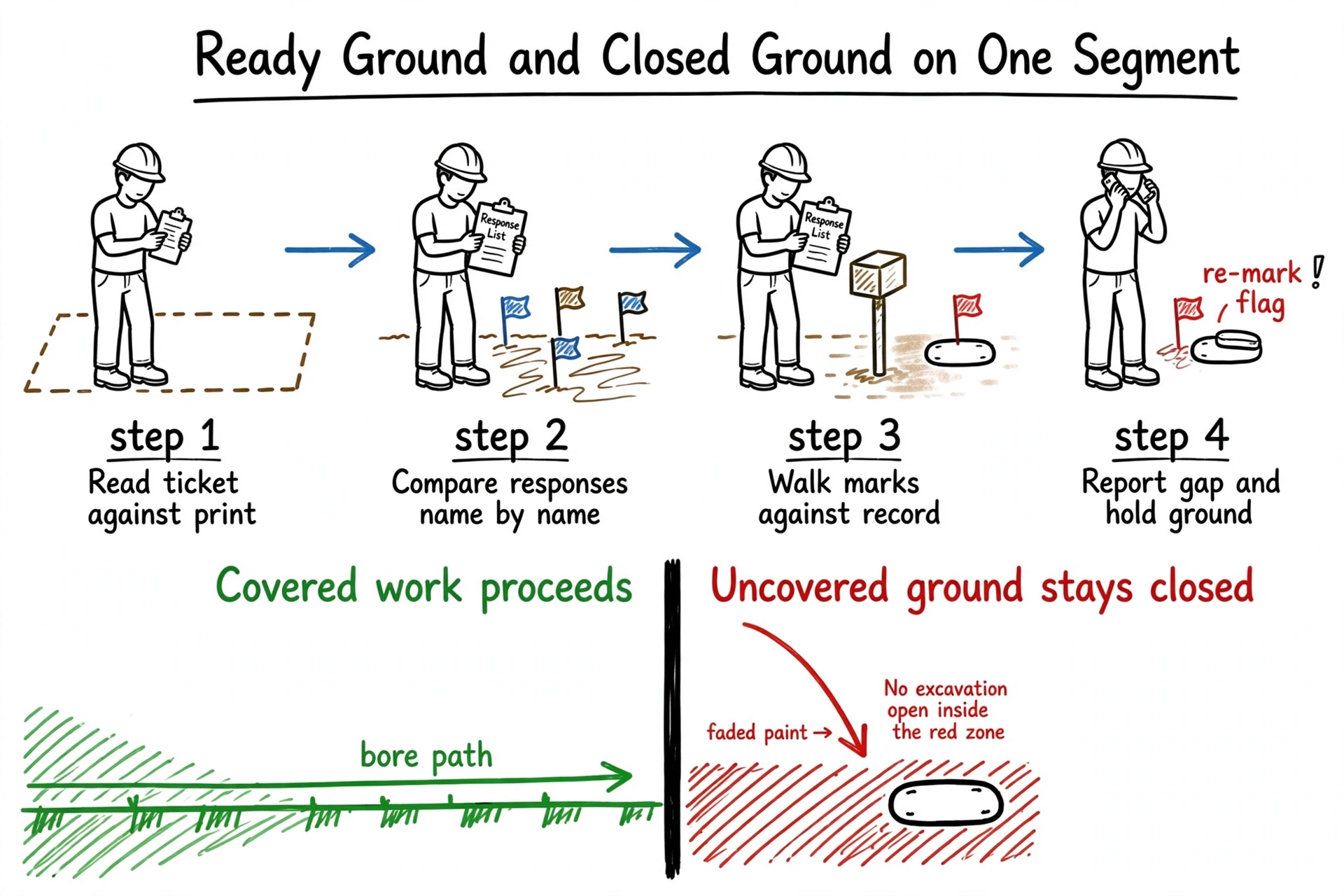
Picture a two person bore crew arriving to drill a short segment and set one handhole at the far end. The ticket for the segment sits in the truck, the waiting period under state law has ended, and paint runs along the planned bore path in orange, blue, and yellow. The foreman walks the readiness check before the drill gets positioned, ticket and response printout in hand.
The area check passes. The ticket description covers the bore path and the handhole excavation, and the white outline at the handhole location matches the print. The date check passes. The work falls inside the ticket window with days to spare.
The response check fails. The notified list names five operators. Four show closed responses, three marked and one clear. The fifth operator, listed for a facility type the surface evidence supports, shows no response at all. Near the handhole location, a riser and a short run of faded paint in a second color suggest a facility crossing the excavation corner, and no closed response on the record accounts for that crossing.
The schedule favors starting the bore. The drill path sits away from the handhole corner, the crew is on site, and the marks along the path look complete. The incomplete record points the other way: one notified operator has not answered, visible evidence inside the work area has no matching response, and the handhole excavation sits exactly where the unexplained evidence stands.
The foreman splits the decision by area. The crew photographs the marks, reports the missing response and the unexplained field evidence to the 811 center as a discrepancy, and requests completion of the locate for the affected area. The bore setup proceeds only after the foreman confirms the drill work area is covered by the closed responses and the marks that match them, and the handhole excavation stays closed, flagged off inside the work area, until the fifth response arrives and any new marks get verified against the ground. The operator response and a re-mark close the gap later, the marks at the handhole change to show a crossing the first record never described, and the excavation opens against a complete record.
The decision rule is direct: readiness is judged area by area against the ticket, the complete response record, and the marks together, and any part of the work that one of the three leaves uncovered stays closed until coverage closes. Paint from other operators never answers for an operator who has not responded, and schedule pressure never converts an incomplete record into a ready one.
What Can Go Wrong?
The ticket for different ground. A crew works from a ticket written for an earlier segment or an earlier alignment. Marks exist, responses are closed, and every document is in order for ground the crew is not digging. The scope comparison at the gate is the only step that catches the mismatch, because each document agrees with the others and disagrees only with the print.
The expired ticket. Work slips, weather or material delays consume the ticket window, and the crew starts under a notice that expired under state law. Oklahoma law states the consequence plainly: no excavation may continue after notice expiration unless subsequent notice has been submitted. Marks surviving on the ground do not revive an expired ticket.
The silent operator. Four of five operators respond, marks look thorough, and the crew reads the paint as proof that everyone came out. The unanswered operator facility sits unmarked exactly because that operator never completed its part. Positive response exists as a system so the excavator can detect this gap from the record instead of detecting the facility with equipment.
The faded or destroyed marks. Traffic, grading by others, irrigation, sun, and mowing degrade paint and scatter flags between the locate and the start of work. CGA Best Practice 5-17 assigns the response: protect and preserve marks while they are needed, stop excavating, and notify the 811 center for re-marks when a mark is removed or no longer visible. A crew that guesses at a half erased line has replaced a locate with an estimate of its own.
The work that outgrew the white lining. The locator cleared the delineated area, and the field plan then shifted the handhole, widened the pit, or extended the bore. The new ground was never described on the ticket and never walked by a locator. Delineation defines the area the locate covers, and work outside the outline stands outside the locate until a new notice covers the ground.
The clear response the field contradicts. An operator reports no conflict, and the crew finds a pedestal, a meter, or a fresh trench line for that facility type inside the work area. CGA Best Practice 5-8 directs the excavator who identifies or has knowledge of an unmarked facility to notify the 811 center that a conflict exists. Field evidence outranks a clear code until the operator resolves the disagreement.
The private facility nobody notified. The 811 system notifies member operators for the area. Facilities owned by a property owner past a meter, and other facilities outside 811 center membership, can cross a work area with no operator on the notified list. CGA Best Practice 5-10 directs the excavator to check for facilities outside the 811 center and contact the responsible parties for locates. A complete member response record closes the member list only.
What Should Someone Notice in the Field?
- Produce the ticket at the site and read the dig site description against the print and the planned work for the day, including pits, handholes, bore paths, and surface cutting access.
- Confirm the waiting period under the governing state law has ended and the work dates fall before ticket expiration, and confirm an update is already submitted for any work that will run past expiration.
- Compare the positive response record against the notified operator list name by name, and count the record complete only when every operator shows marked, clear, or no conflict.
- Walk the full work area and confirm marks are present and legible end to end, in APWA colors that match the responses, with no erased, paved over, or missing stretch.
- Match the white delineation on the ground to the work about to happen, and name any planned ground that sits outside the delineated and ticketed area.
- Account for every visible sign of an underground facility inside the work area, including pedestals, risers, meters, valve covers, handholes, and prior trench lines, with a mark or a response for each one.
- Report any discrepancy among the ticket, the responses, the marks, and the field to the 811 center before excavation, and keep the affected ground closed until the discrepancy resolves.
- Photograph or sketch the marks with distances to fixed objects before excavation disturbs them, and state the readiness result, including any closed areas, in the job briefing.
- Know the boundary: reading a ticket, checking positive response, and recognizing whether marks are present, legible, and matched to the record are verification and recognition tasks. Locating facilities with detection equipment, determining exact location by excavation, and performing excavation work require the training, qualification, authorization, and employer program the governing laws and rules demand. Reading this lesson qualifies no one to locate facilities or to excavate.
Key Terms
Locate readiness: The pre-excavation check confirming the ticket covers the work area, work type, and dates, positive response is complete, marks are present and legible and agree with the response, delineation matches the work, and conflicts are resolved before work starts.
Locate ticket: The record an 811 center creates for a notice of planned excavation, carrying a reference number, the dig site description, the list of operators notified, and the valid dates under state law.
811 center: The state notification center that receives excavation notices and sends each notice to the facility operators listed for the area of the proposed work.
Positive response: Communication from each facility operator through the 811 center stating the status of its part of a ticket, marked, clear, or no conflict, so the excavator can confirm every notified operator has answered before excavation.
White lining: The excavator delineation of the proposed excavation area in white paint, flags, stakes, or whiskers on site, or electronically through the 811 center where available, so locators know the ground the locate must cover.
Locate marks: Paint, flags, stakes, whiskers, or a combination placed by a locator to show the approximate horizontal location of an underground facility, in APWA uniform colors, with no depth information.
APWA Uniform Color Code: The American Public Works Association color system for temporary facility marking: white proposed excavation, pink temporary survey, red electric, yellow gas and similar materials, orange communications, blue potable water, purple reclaimed water and irrigation, green sewer and drain.
Tolerance zone: The area around a marked facility where extra care duties apply when excavation approaches or enters the area, with width set by the governing state law or the applicable standard for the job.
Re-mark: A renewed marking of facilities requested through the 811 center when original marks have been removed, destroyed, or faded past legibility while work still needs them.
Conflict: Any disagreement among the ticket, the positive response record, the marks, the print, and visible field evidence about the facilities inside the work area.
Check Your Understanding
- Name the six parts of the locate readiness check.
Answer: The ticket is available at the site with its reference number and site description. The ticket covers the planned work area and work type. The planned dates fall inside the ticket window under the governing state law, with the waiting period ended and no expiration crossed. Positive response is complete for every operator notified on the ticket. Marks are present, legible, and in agreement with the response record and the delineation. Conflicts among the ticket, responses, marks, print, and field evidence are resolved before work starts.
- A response record shows four operators marked or clear and a fifth operator with no response. Marks in several colors run through the work area. State whether the locates are ready for the full work area, and state the rule that decides the answer.
Answer: The locates are ready only in part, at best. Positive response must be complete: CGA Best Practice 5-8 directs the excavator to review all positive responses and compare the responses against the full list of operators notified on the ticket before beginning excavation, and to notify the 811 center of any discrepancy. Paint from responding operators never answers for an operator who has not responded, and ground tied to the missing response stays closed until the response and any marks arrive and get verified.
- In the From the Field scenario, which checks passed, which check failed, and how did the foreman divide the work in response?
Answer: The area check and the date check passed: the ticket covered the bore path and the handhole excavation, the white outline matched the print, and the dates fell inside the ticket window. The response check failed: a fifth notified operator showed no response, and a riser with faded paint inside the work area had no matching closed response. The foreman photographed the marks, reported the discrepancy to the 811 center, kept the handhole excavation closed and flagged off, and allowed only the work the foreman confirmed as covered by closed responses and matching marks to proceed, with the excavation opening after the fifth response and a re-mark were verified.
- A crew finds that traffic has erased the paint along one stretch of the segment, while the ticket and the response record are complete. State what CGA Best Practice 5-17 requires, and state why the crew estimating the missing line from the surviving marks fails the standard.
Answer: Practice 5-17 requires the excavator to protect and preserve facility markings until the marks are no longer required for proper and safe excavation, and to stop excavating and notify the 811 center for re-marks when a facility mark is removed or no longer visible. An estimated line drawn from surviving marks replaces a locator determination with a crew guess. The readiness check requires marks present and legible across the work area, and a re-mark restores the locator determination the check depends on.
- A supervisor states a universal waiting period and a universal ticket life that apply in every state. Evaluate the claim using the Oklahoma example in this lesson.
Answer: The claim fails. Waiting period and ticket life come from the governing state damage prevention law, and CGA Practices 5-10 and 5-23 both frame the waiting period and ticket life by state or provincial law. Oklahoma law at 63 O.S. Section 142.6(A) sets notice no less than 48 hours, excluding the date of notification, Saturdays, Sundays, and legal holidays, before commencement, and expiration 14 calendar days from the excavation start date. Those numbers bind Oklahoma work because Oklahoma law states them. Another state law controls work in that state, and the crew reads the governing law and the ticket for the job.
Lesson Takeaway
Ready locates read as a matched set: a ticket that covers this work in this area on these dates, a response record with every notified operator closed, and marks on the ground that agree with both records and with the evidence standing in the field. After this lesson, paint alone reads as one third of a check, and any gap among the ticket, the record, and the ground reads as closed ground until the gap closes.
Sources and Technical References
Common Ground Alliance, Best Practices Guide, Version 22.0, Chapter 4, Locating and Marking, Practice 4-9, Positive Response to Locate Request, and Appendix B, Uniform Color Code and Marking Guidelines, including Practice Statement 4-3 adopting the APWA Uniform Color Code (ANSI Z535.1) and the operator facility field delineation guidelines. Chapter 5, Excavation, Practice 5-2, Delineate Area of Proposed Excavation, Practice 5-3, Locate Reference Number, Practice 5-8, Positive Response, Practice 5-9, Facility Owner or Operator Failure to Respond, Practice 5-10, Locate Verification, Practice 5-11, Documentation of Marks, Practice 5-12, Work Site Review with Company Personnel, Practice 5-13, 811 Center Reference at Site, Practice 5-17, Marking Preservation, Practice 5-19, Excavation Tolerance Zone, Practice 5-21, Mismarked Facilities, and Practice 5-23, Locate Request Updates. Full guide text hosted by Pennsylvania 811: https://www.pa1call.org/resourcelibrary/resource/download?id=260
Federal regulation, 29 CFR 1926.651, Specific excavation requirements, paragraph (b), Underground installations, subparagraphs (1) through (4), covering determination of estimated location before opening an excavation, contacting utility companies or owners within established or customary local response times, determining exact location by safe and acceptable means as excavation approaches an installation, and protecting, supporting, or removing installations while the excavation is open. Cornell Law Institute Legal Information Institute text: https://www.law.cornell.edu/cfr/text/29/1926.651
Oklahoma Underground Facilities Damage Prevention Act, 63 O.S. Sections 142.2, 142.5, and 142.6, including the definitions, the excavator duty to check for positive response at the notification center prior to excavating or demolishing, notice no less than 48 hours excluding the date of notification, Saturdays, Sundays, and legal holidays before commencement, notice expiration 14 calendar days from the excavation start date, the operator duty to locate and mark or otherwise provide approximate location prior to the date and time work is scheduled to begin, the operator duty to provide positive response prior to expiration of the required notice period, and the definition of approximate location as a strip of land two feet on either side of the underground facilities. OKIE811 law page: https://okie811.org/law/
OKIE811, Excavator Guide, published May 2025, including the Life of a Ticket summary stating a ticket expires 14 calendar days after the excavation start date and no excavation should take place after the 14th day unless an update has been made with sufficient notice. Guide PDF: https://okie811.org/wp-content/uploads/2025/05/2025-Excavator-Guide-May-Update.pdf
Previous lesson: Lesson 132: Are the Required Permits Available? |
Back to Level 7 hub |
Next lesson: Lesson 134: Have Existing Utilities Been Verified?