
Introduction
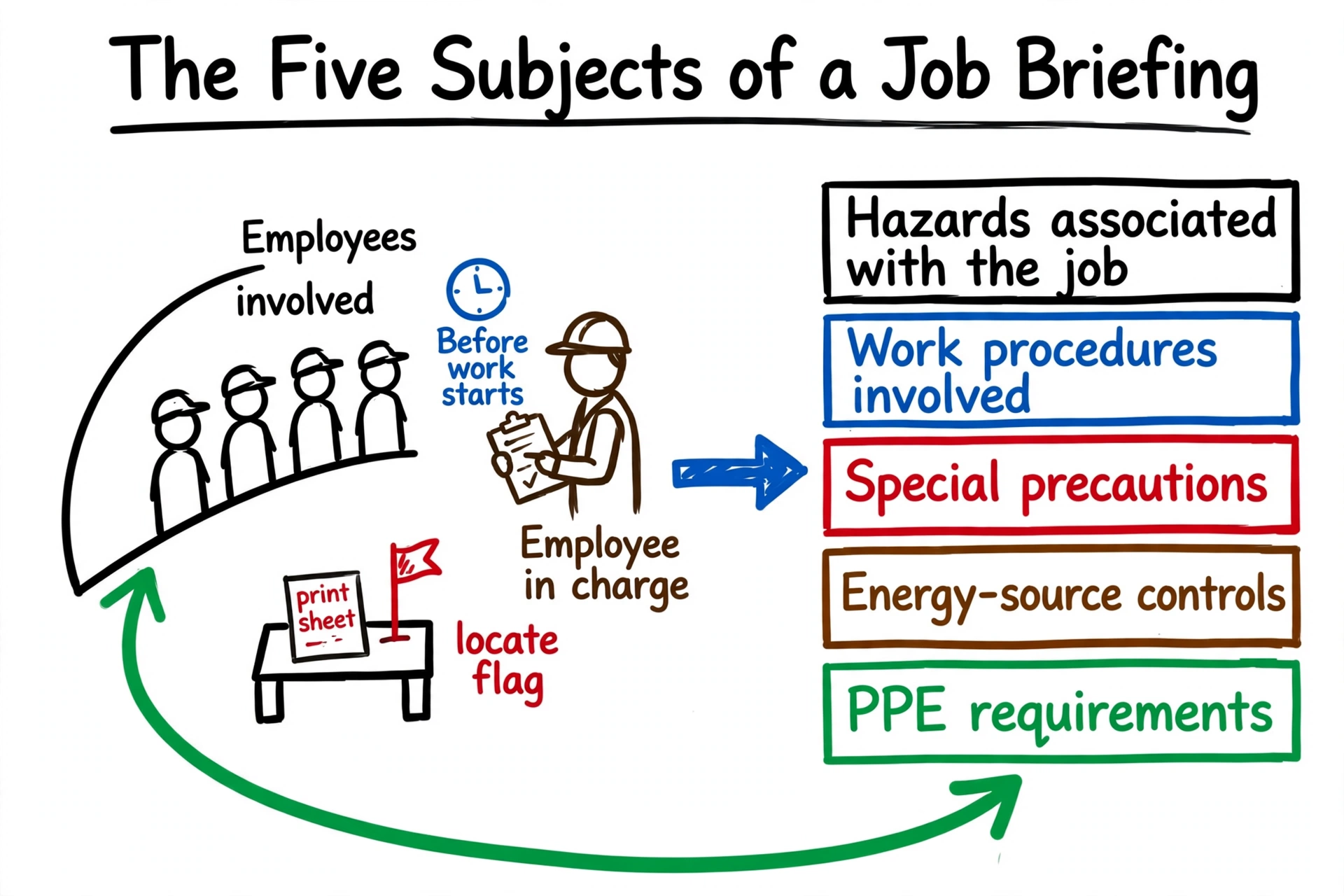
A job briefing is a structured talk the employee in charge holds with the crew members involved in a job before the work starts, covering the hazards of the job, the work procedures, any special precautions, the controls on energy sources, and the personal protective equipment the job requires. The talk is brief for routine work with a crew that can recognize and avoid the hazards, and more extensive when the work is complicated or particularly hazardous. Federal regulation states that core in two parallel rules: 29 CFR 1910.269(c) for operation and maintenance of electric power generation, transmission, and distribution lines and equipment, and 29 CFR 1926.952 for construction of electric power transmission and distribution lines and equipment under Subpart V of the construction rules.
Level 7 prepares a jobsite before ground opens. Lesson 128 covered the preconstruction meeting that aligns the organizations on a project. Lesson 129 covered what the crew needs to know before starting. This lesson covers the talk at the point of work, on the day of work, led by the person in charge of that job, and repeated when significant changes that might affect the safety of the employees occur during the work.
What This Lesson Gives You
- State who leads a job briefing, when it happens, and the five subjects every briefing under 1910.269(c) and 1926.952 covers at a minimum.
- Tell a routine job that allows a brief discussion apart from a complicated or particularly hazardous job that requires a more extensive discussion, and explain why the five subjects stay on the list either way.
- Decide when one briefing covers a day of repetitive and similar work, and when a significant change during the work requires an additional briefing before work continues.
- Explain the scope limit on the federal rules: the 1910.269 briefing rule governs electric power operation and maintenance work, the 1926.952 rule governs electric power construction work, and a daily briefing on general fiber construction is company practice built on the same model rather than a universal federal construction law.
- Recognize a real briefing in the field, with named hazards, assigned procedures, and confirmed protective equipment, and recognize a roll call or a general warning that leaves the five subjects uncovered.
Start With the Basics
Think about a flight crew before takeoff. The captain and the first officer run a departure briefing before the aircraft moves. The talk covers the route for that flight, the weather that matters for that flight, the condition of that aircraft, the roles each pilot holds if something goes wrong, and the point where either pilot calls a stop. The crew may have flown the same route the day before. The briefing still happens, because this flight has its own load, its own weather, and its own crew pairing, and the talk puts one shared picture in both seats before power goes on.
Think about a huddle before a play, as a second picture. The huddle lasts seconds. Its job is narrow: name the play, name each assignment, and name the adjustment if the defense shows a different look. Nobody learns football in a huddle. The huddle works because trained players use it to align on one specific, immediate task and on the change they already see in front of them.
A job briefing works through the same mechanism. Trained crew members hold a short, specific talk about this job, in this place, with these hazards and these procedures, before work starts. The briefing assumes training already happened. The briefing aligns the crew on the job in front of them, assigns the work, surfaces the hazard that is easy to miss, and gives every member the same stop point. The flight briefing maps to the job briefing in one more way: a change in conditions after departure, such as weather building on the route, triggers a new plan talk in the cockpit. A significant change during a job triggers an additional briefing on the ground.
What Is It?
A job briefing is a pre-work talk with a defined leader, a defined audience, a defined time, and a defined subject list. Each element comes from the regulation text, and each element does work.
The leader is the employee in charge. The employee in charge is the person the employer has placed in charge of the job at hand. OSHA guidance for the 1910.269 rule describes the range plainly: when work gets assigned at the start of a shift, the person in charge is typically a supervisor or foreperson; when the briefing happens on arrival at a work site, the person in charge can be the lead person on the crew; at a substation, the person in charge can be the operator in charge of that substation. The title matters less than the assignment. One named person owns the talk.
The audience is the employees involved. Section 1910.269(c)(1)(ii) states that the employer shall ensure the employee in charge conducts the briefing with the employees involved before they start each job. Section 1926.952(a)(2) carries the same sentence for construction work. A briefing delivered to a crew that then swaps members leaves the new members unbriefed. A person who joins the job joins the briefing first.
The time is before the job starts. Both rules place the briefing before the employees start each job. A talk held after work begins, covering hazards the crew has already spent an hour beside, arrives after the exposure it was meant to prevent.
The employer feeds the briefing. Before the talk, a step sits behind it. Section 1910.269(c)(1)(i) states that, in assigning an employee or a group of employees to perform a job, the employer shall provide the employee in charge with all available information that relates to the determination of existing characteristics and conditions required by paragraph (a)(4). Existing characteristics and conditions are the facts about the electric lines and equipment that bear on the safety of the work, determined before work on or near the lines or equipment starts. Paragraph (a)(4) lists them, including:
- The nominal voltages of lines and equipment.
- The maximum switching-transient voltages.
- The presence of hazardous induced voltages.
- The presence of protective grounds and equipment grounding conductors.
- The locations of circuits and equipment, including electric supply lines, communication lines, and fire-protective signaling circuits.
- The condition of protective grounds and equipment grounding conductors.
- The condition of poles.
- Environmental conditions relating to safety.
Section 1926.952(a)(1) places the same duty on the construction employer, tied to the existing characteristics and conditions determination at Section 1926.950(d). The briefing leader speaks from information the employer supplied, rather than from memory of a similar job.
The subject list has five entries, and the list is a floor. Section 1910.269(c)(2) states the briefing shall cover at least the following subjects: hazards associated with the job, work procedures involved, special precautions, energy-source controls, and personal protective equipment requirements, shortened to PPE. Section 1926.952(b) lists the same five subjects in the same words. Each subject carries a distinct load:
- Hazards associated with the job. A hazard is a condition, object, or activity with the potential to cause injury, illness, or damage. In the briefing, hazards get named for this job in this place: the energized facility in the work area, the open excavation, the traffic lane beside the setup, the overhead line above the work, the weather building over the segment.
- Work procedures involved. A work procedure is the planned sequence of steps and methods the crew will use to perform the job. The briefing walks the sequence in order, names who holds each step, and names the hold points where work pauses.
- Special precautions. A special precaution is an added protective measure the job requires beyond routine practice, because of a condition this job carries. A precaution belongs in the briefing when leaving it unsaid could leave a crew member working from routine habit on a job where routine habit falls short.
- Energy-source controls. Energy-source controls are the measures that keep hazardous energy from reaching the crew, such as deenergizing, isolating, grounding, locking, and tagging, as the job and the governing rule require. The briefing states which energy sources touch the job, which state each source sits in, and which controls hold that state during the work.
- PPE requirements. The briefing names the protective equipment this job requires, so each member can confirm the equipment is on hand, in serviceable condition, and worn where the job requires it.
Scope discipline belongs inside the definition. Section 1910.269(a)(1)(i) states that the section covers the operation and maintenance of electric power generation, control, transformation, transmission, and distribution lines and equipment. Section 1910.269(a)(1)(ii)(A) states that the section does not apply to construction work, as defined in 29 CFR 1910.12, except for line-clearance tree trimming and work involving electric power generation installations as specified in 1926.950(a)(3). Construction of electric power transmission and distribution lines and equipment sits under 29 CFR 1926 Subpart V, and its briefing rule is 1926.952. Fiber construction crews meet the 1910.269 and 1926.952 briefing model directly when the work falls inside those scopes, such as work on or near electric power lines and equipment. A briefing at the start of every fiber job, including work outside those scopes, is company practice and contract practice in this industry, built on the same five-subject model. The practice is sound. The practice should still be labeled accurately: daily briefing as a habit is practice, and the two federal rules quoted in this lesson bind the electric power work inside their stated scopes.
Crews also hear the names tailgate talk and toolbox talk for short pre-work safety talks at the site. The names describe the setting, a tailgate or a toolbox at the start of work. Names vary by company. The content test stays the same: a talk earns the name job briefing when a named person in charge leads it, before the job, with the employees involved, across the subjects the job requires.
What Does It Look Like?
A briefing is a small event with visible parts. A beginner standing nearby can recognize one by its shape:
- The crew stands together at the work location, or at the point where the job will start, before tools come out and before ground opens.
- One person leads. The employee in charge does the talking and the assigning, and the crew can name that person.
- The leader works from the job itself: the print or work order for the segment, the locates, and the conditions visible at the site that morning. A leader reading a generic topic sheet with no reference to the segment in front of the crew is holding a safety talk of a different kind.
- Hazards get named out loud, one by one, tied to places the crew can point at: this duct bank, that lane, this pole, that trench wall.
- The procedure gets walked in sequence, with names attached to steps, so each member hears his or her own assignment inside the whole job.
- Energy sources get stated plainly: which facilities are energized, which are deenergized and grounded where the work requires it, and which controls nobody touches without direction from the employee in charge.
- PPE gets confirmed by sight. The leader names the required items, and members check their own gear as the items get named.
- Questions get asked and answered inside the talk. A briefing where the leader invites a hazard the leader missed, and a member names one, shows the mechanism working.
- A written record often exists. OSHA guidance for the 1910.269 rule states that keeping a written record of job briefings is not specifically covered by the standard, while a written checklist is a best practice: a checklist can carry the hazards, procedures, precautions, and PPE requirements for the job, with a column for employee signatures showing each employee is knowledgeable about the job hazards and safety procedures. Company practice and contract terms decide whether a form gets signed on a given job. The talk itself is the requirement inside the rule scopes. The form is the record of the talk.
A substation entry shows the same shape in a doorway form. Section 1910.269(u)(6)(i) provides that, upon entering an attended substation, each employee other than employees regularly working in the station shall report his or her presence to the employee in charge of substation activities to receive information on special system conditions affecting employee safety. Paragraph (u)(6)(ii) provides that the job briefing for that work shall cover information on special system conditions affecting employee safety, including the location of energized equipment in or adjacent to the work area and the limits of any deenergized work area. The report-in step exists so the briefing can carry site conditions a visiting crew cannot see from the gate.
What Does It Do?
It builds one shared picture before anyone acts alone. Crew members arrive at a job with separate pictures. One member read the print. One member drove the route and saw the traffic. One member worked the adjacent segment yesterday and carries yesterday in his head. The briefing merges the separate pictures into one picture the whole crew works from: same hazards, same sequence, same stop points. Work that starts from one picture produces fewer surprises in the first hour, where a wrong assumption has the least time to get caught.
It converts employer information into crew knowledge. The information transfer step in 1910.269(c)(1)(i) and 1926.952(a)(1) moves existing characteristics and conditions from the employer to the employee in charge. The briefing completes the transfer, moving the safety-relevant part of that information to every employee involved. Voltage, induced voltage, grounds, circuit locations, pole condition, and environmental conditions change how a crew sets up and how close a crew works. Information that stops at the office, or stops with the foreman, protects nobody standing at the trench.
It assigns the procedure while change is still cheap. Walking the sequence out loud exposes a missing step, a missing person, or a missing control while the correction costs a sentence. A crew that discovers at the briefing that traffic control for the second setup has no assigned flagger reassigns the step in the circle. A crew that discovers the same gap with the lane already closed improvises under pressure.
It sets the depth of the talk by the depth of the risk. Section 1910.269(c)(4) and Section 1926.952(d) grade the briefing. A brief discussion is satisfactory if the work involved is routine and if the employees, by virtue of training and experience, can reasonably be expected to recognize and avoid the hazards involved in the job. A more extensive discussion shall be conducted if the work is complicated or particularly hazardous, or if the employee cannot be expected to recognize and avoid the hazards involved in the job. The note to each paragraph adds the guardrail: the briefing must address all the subjects listed in the subjects paragraph. Brief describes length. Brief never describes a shortened subject list. A routine job gets a short talk across five subjects. A complicated job gets a long talk across the same five subjects, with more detail inside each one.
It creates the trigger and the permission to stop and re-brief. Section 1910.269(c)(3)(ii) and Section 1926.952(c)(2) require additional job briefings when significant changes, which might affect the safety of the employees, occur during the course of the work. The rule treats the briefing as a living control rather than a morning ritual. A new hazard found, a procedure changed, an energy state changed: each one can be the significant change that reopens the talk. A crew change is judged by the same test, and it carries a second, separate duty: an employee who joins the job is an employee involved, and the employee in charge briefs that employee before the employee starts work. The briefing also gives every member a known moment and a known leader for raising a hazard, which lowers the cost of speaking at the moment speaking matters.
It handles the lone worker case by planning. Section 1910.269(c)(5) and Section 1926.952(e) provide that an employee working alone need not conduct a job briefing, and that the employer shall ensure the tasks to be performed are planned as if a briefing were required. The exception removes the audience. The exception keeps the planning. A solo worker still owes the job the same hazard identification, procedure, precaution, energy control, and PPE thinking, performed alone before work starts.
Where Does It Fit?
The briefing sits at the end of job preparation and at the head of the work itself, and the rule text fixes its neighbors:
- At assignment, the employer provides the employee in charge with all available information tied to the existing characteristics and conditions determination, under 1910.269(c)(1)(i) or 1926.952(a)(1).
- Before the job starts, the employee in charge conducts the briefing with the employees involved, covering the five subjects, under 1910.269(c)(1)(ii) and (c)(2), or 1926.952(a)(2) and (b).
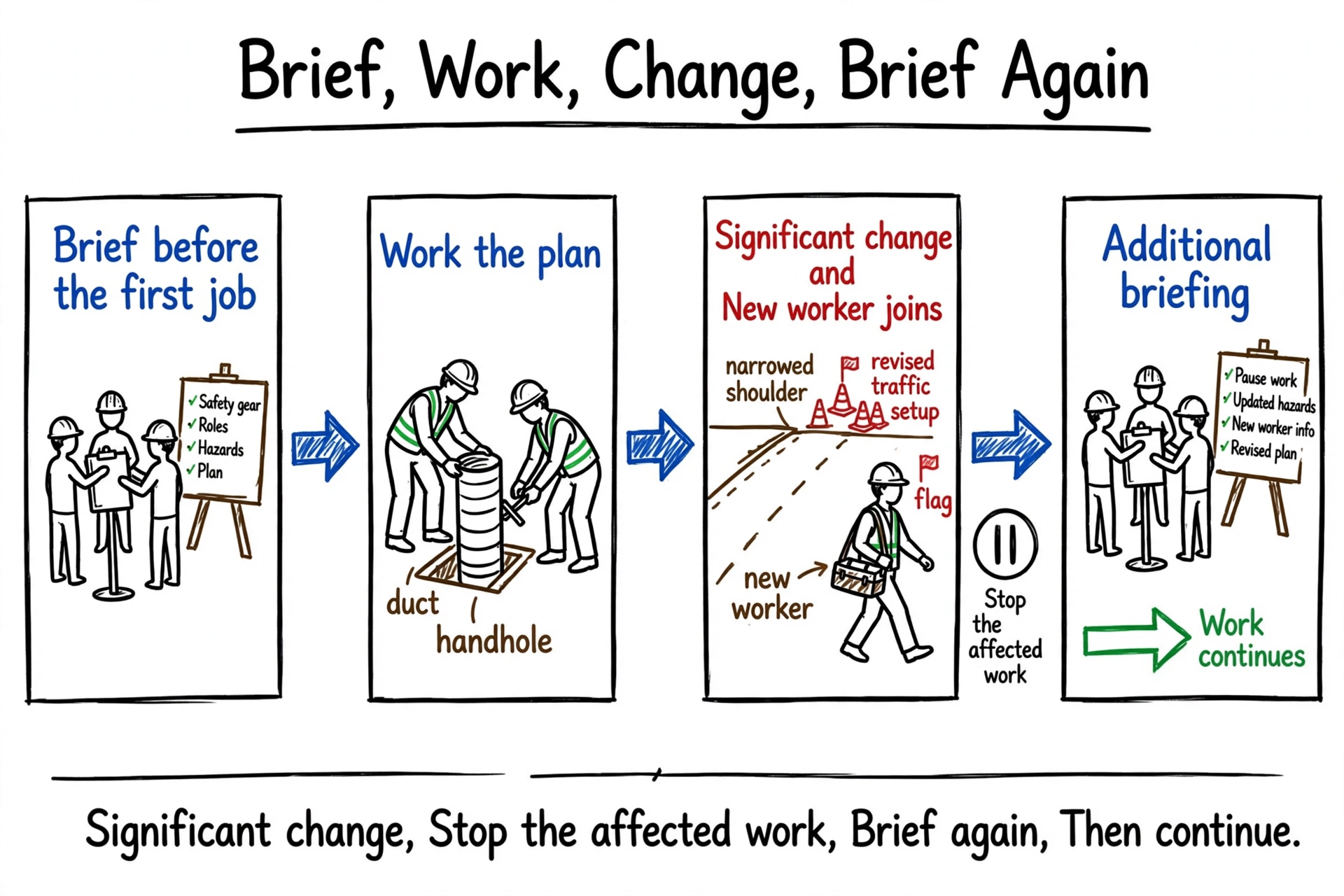
- For repetitive and similar work during one work day or shift, at least one briefing before the start of the first job of the day or shift satisfies the number rule, under 1910.269(c)(3)(i) or 1926.952(c)(1). Repetitive and similar is a condition the job must actually meet. A day of varied jobs, varied ground, and varied energy exposure carries varied hazards, and the single-briefing allowance was written for the repetitive case.
- During the work, a significant change that might affect employee safety triggers an additional briefing, under 1910.269(c)(3)(ii) or 1926.952(c)(2).
- Across the project, the briefing sits downstream of the preconstruction meeting in Lesson 128 and the crew knowledge check in Lesson 129. The preconstruction meeting aligns organizations, schedules, and responsibilities at project scale. The briefing aligns one crew, on one job, on one day, at task scale. A strong preconstruction meeting never replaces a briefing, because conditions at the point of work on the day of work exist at a level of detail a project meeting cannot carry.
- Inside a company safety program, the daily briefing habit extends the model beyond the two rule scopes as practice. Program documents, client contracts, and project specifications can also require a documented pre-task briefing on fiber work. Where one does, that document is the source of the duty for that job. The requirement source for a given job is the document that governs that job, and the crew reads that source rather than assuming a federal rule covers every site.
What Is at Stake
The first hour of the job. Hazards cause harm early when a crew starts from separate pictures: a member steps into a setup role nobody assigned, a piece of equipment moves along a path nobody cleared, a worker treats an energized facility as deenergized because yesterday the sister facility was deenergized. The briefing exists to close those gaps before exposure starts. Skipping the talk saves minutes and spends the savings on risk carried by every member.
Change during the work. Jobs change after the morning talk: ground behaves differently than the locate suggested, weather closes in, a second crew arrives in the same work area, the procedure gets revised to reach the facility. Each change can retire the assumptions the morning briefing rested on. The additional briefing rule exists because a stale briefing can be worse than none: the crew believes the hazards were covered, while the hazard that matters arrived at midday.
The least experienced member. The extent rule turns on whether the employee can be expected to recognize and avoid the hazards involved. A briefing pitched to the senior hand leaves the new hand to guess at the parts experience would have filled in silently. The more extensive discussion exists for that member. A crew is briefed to the level of the member who needs the fullest picture, and every member benefits from hearing it stated whole.
The record. Where company practice or a contract requires a briefing form, the form becomes part of the job record. After an incident or a near miss, investigators and the employer reconstruct what the crew was told. A specific record, naming this job and these hazards, supports the crew. A generic form, or a missing form where one was required, leaves the briefing itself in dispute at the moment the crew can least afford the dispute. OSHA guidance treats the written checklist as best practice under the 1910.269 rule rather than a requirement of that rule, so the record duty on a given job comes from the employer program, the contract, or another governing rule, and the crew follows the duty that applies to the job.
Compliance inside the rule scopes. Inside electric power operation and maintenance work, failure to conduct the briefing the rule describes is a failure to meet 1910.269(c). Inside electric power construction work, the same failure meets 1926.952. Citations, client audits, and qualification reviews all read the briefing the same way: a required control with a named leader, a named audience, and a named subject list, either performed or skipped.
What Does Good Look Like?
- The employee in charge is named for the job, holds the employer information for the segment, and leads the talk personally before work starts.
- Every employee involved in the job stands in the briefing, including members who arrived with a second truck and members assigned for only part of the job.
- All five subjects get covered out loud: hazards associated with the job, work procedures involved, special precautions, energy-source controls, and PPE requirements.
- Hazards are named for this job and this place, tied to visible features the crew can point at, rather than recited as a general list.
- The procedure is walked in sequence with a name on each step, and each member can state his or her own assignment and the hold points.
- The depth of the talk matches the job: brief for routine work with an experienced crew, extensive for complicated or particularly hazardous work or for any member who cannot be expected to recognize and avoid the hazards.
- A significant change during the work stops the affected task, and an additional briefing covers the change before work continues.
- PPE named in the briefing is on site, serviceable, and worn, and any missing item gets resolved in the circle rather than discovered at the task.
- Members ask questions and raise hazards inside the talk, and the leader answers or resolves each one before the crew disperses.
- Where the employer program or the contract requires a briefing record, the record names the job, the date, the subjects covered, and the employees who attended.
From the Field
Picture a three person underground crew assigned to set two handholes and a short duct run along a road shoulder, in three similar placements across one shift. The work is repetitive and similar. The employee in charge holds one briefing before the first placement, covering the hazards of the shoulder work, the setting procedure, the precautions for the traffic lane beside the setup, the energy-source controls for the existing facilities in the work area, and the PPE the placements require. The crew completes the first placement and moves to the second with the morning picture intact.
At the second placement, the setup changes. The shoulder narrows, the traffic control setup the procedure assumed no longer fits the space, and a fourth worker arrives from another task to help with the setting work. The new worker heard no briefing. The traffic change alters the hazard picture the morning talk described.
The employee in charge faces the decision. The schedule favors rolling straight into the set, since the placements are similar and the day is moving. The change on the ground points the other way: a significant change has occurred during the course of the work, affecting the traffic hazard and the procedure, and one employee involved in the job now stands outside the morning briefing entirely.
The employee in charge stops the setup before the lane gets touched. The whole crew, including the new worker, gathers at the truck. The additional briefing covers the changed traffic hazard, the revised procedure for the narrower shoulder, the precautions for the tighter setup, the energy-source controls already in place, and the PPE requirements, stated whole for the benefit of the worker who missed the morning talk. The crew resets traffic control to the revised procedure and completes the placement with every member working from the same picture.
The decision rule is direct: one briefing can cover repetitive and similar work, and a significant change during the work ends the coverage of the earlier talk for the changed work. Stop, brief the job as the job now stands, with everyone involved in the circle, and only then continue. An employee who joins the job gets briefed before starting work, and when the joining also changes the hazard or procedure picture, the additional briefing covers the whole crew.
What Can Go Wrong?
The general warning that covers nothing. A leader closes the morning huddle with a reminder to stay alert and wear PPE. Hazards stay unnamed, the procedure stays unwalked, precautions and energy-source controls never get stated. The crew heard a talk. The crew received no briefing, because the subjects that make a briefing a briefing never appeared.
The briefing pitched over the new member. The leader keeps the talk brief because the senior hands know the work. The extent rule asks a different question: whether the employee, each employee, can be expected to recognize and avoid the hazards involved. A member new to the task, new to the site, or new to the crew defeats the condition for a brief discussion, and the job owes that member the extensive version.
The stale briefing after a change. The morning talk was complete and the record is clean. A changed condition arrives at midday and work rolls on under the morning picture. The additional briefing rule exists for exactly this hour. A change that might affect safety and gets no briefing leaves the crew defended against the job they planned and exposed to the job they have.
The briefing without the employer information. The employee in charge leads from memory because the existing characteristics and conditions information never reached the field. Voltages, grounds, circuit locations, and pole condition stay in a file the crew cannot see. The information transfer step exists so the briefing speaks from determined facts. A briefing built on recollection can be delivered with full confidence and still be wrong on the fact that matters.
The audience that drifts. Members arrive late, leave early, or join from another task mid-job, and nobody re-briefs them. The rule names the audience as the employees involved. A person doing the work outside the briefing carries a partial picture into a whole hazard set.
The form signed without the talk. A checklist gets completed in the truck because the program requires a form. The record says a briefing happened. The crew heard nothing. Paper compliance of that kind fails the crew in the field and fails the employer in the investigation that follows an incident, because the record and the event disagree.
The practice mislabeled as law, and the law misread as practice. A supervisor tells a fiber crew that federal law requires this exact talk on every job of any kind, or tells an electric power crew that the briefing is only a company custom that a tight schedule can waive. Each error corrupts a decision. The first overstates the reach of 1910.269(c) and 1926.952. The second understates a binding rule inside its scope. Accurate labels produce accurate decisions about when a briefing can be brief, when one talk covers a shift, and when nobody holds the authority to skip the talk at all.
What Should Someone Notice in the Field?
- Name the employee in charge for the job, and confirm that person holds the print, the locates, and the employer information for the segment.
- Confirm the briefing happened before work started, with every employee involved in the job present, and confirm any member who joined later got briefed on joining.
- Listen for all five subjects stated out loud: hazards, work procedures, special precautions, energy-source controls, and PPE requirements.
- Check that hazards named in the talk match the ground in front of the crew: the facilities, the excavation, the traffic, the overhead plant, and the weather of that day.
- Check that the depth of the talk matched the job: brief only where work was routine and every member could be expected to recognize and avoid the hazards, extensive where work was complicated, particularly hazardous, or new to any member.
- Watch for a significant change during the work, such as a changed procedure, a changed energy state, or a new hazard found, and confirm work paused for an additional briefing.
- Confirm PPE named in the briefing is present, serviceable, and in use at the task.
- Confirm the briefing record exists where the employer program or the contract requires one, and that the record names this job and its actual hazards.
- Know the boundary: attending a briefing, leading a routine briefing as the assigned employee in charge, and reporting a missing briefing are recognition and support tasks within a crew role. Performing energized electric work, establishing energy controls, and making existing conditions determinations require the training, qualification, and authorization the governing rules demand. Reading this lesson qualifies no one to perform regulated or hazardous work.
Key Terms
Job briefing: A pre-work talk the employee in charge holds with the employees involved before they start each job, covering at least hazards, work procedures, special precautions, energy-source controls, and PPE requirements.
Employee in charge: The person the employer has placed in charge of the job at hand, who receives the employer information for the job and conducts the briefing.
Existing characteristics and conditions: The facts about electric lines and equipment that bear on the safety of the work, determined before work starts, including voltages, induced voltages, grounds, circuit locations, pole condition, and environmental conditions.
Hazard: A condition, object, or activity with the potential to cause injury, illness, or damage.
Work procedure: The planned sequence of steps and methods the crew will use to perform the job, including assignments and hold points.
Special precaution: An added protective measure a specific job requires beyond routine practice, because of a condition that job carries.
Energy-source controls: The measures that keep hazardous energy from reaching the crew, such as deenergizing, isolating, grounding, locking, and tagging, as the job and the governing rule require.
Personal protective equipment (PPE): Protective clothing and equipment a job requires the crew to wear or use, named for the job during the briefing and confirmed before work starts.
Tailgate talk: A common field name for a short pre-work safety talk held at the work site, often at the start of a shift. Toolbox talk carries the same general meaning. Content, leader, timing, and audience decide whether the talk meets the job briefing standard.
Check Your Understanding
- State the five subjects a job briefing under 29 CFR 1910.269(c)(2) must cover at a minimum.
Answer: Hazards associated with the job, work procedures involved, special precautions, energy-source controls, and personal protective equipment requirements. Section 1926.952(b) lists the same five subjects for electric power construction work.
- A crew will perform repetitive and similar work across one shift. When must the briefing happen, and what event during the shift requires another one?
Answer: At least one job briefing before the start of the first job of the day or shift satisfies the number rule for repetitive and similar work, under 1910.269(c)(3)(i) and 1926.952(c)(1). An additional briefing must be held if significant changes, which might affect the safety of the employees, occur during the course of the work, under 1910.269(c)(3)(ii) and 1926.952(c)(2).
- A foreman keeps a briefing to one minute because the job is routine. Two conditions in the regulation decide whether a brief discussion is satisfactory. State them, and state the guardrail that still applies to a brief briefing.
Answer: A brief discussion is satisfactory if the work involved is routine and if the employees, by virtue of training and experience, can reasonably be expected to recognize and avoid the hazards involved in the job, under 1910.269(c)(4)(i) and 1926.952(d)(1). The guardrail: even a brief briefing must address all five subjects listed in the subjects paragraph. Brief controls length. The subject list stays whole.
- In the From the Field scenario, which two changes ended the coverage of the morning briefing, and what did the employee in charge do before work continued?
Answer: The traffic control setup no longer fit the narrowed shoulder at the second placement, changing the hazard and the procedure, and a fourth worker joined the job without having heard the morning briefing. The employee in charge stopped the setup before the lane was touched, gathered the whole crew including the new worker, held an additional briefing covering the changed hazard, the revised procedure, precautions, energy-source controls, and PPE, and reset traffic control to the revised procedure before the placement continued.
- A supervisor tells a general fiber crew, with no electric power work in scope, that 29 CFR 1910.269(c) legally requires the crew briefing that morning. Evaluate the claim, and state how the briefing should be described instead.
Answer: The claim overstates the rule. Section 1910.269 covers the operation and maintenance of electric power generation, transmission, and distribution lines and equipment, and paragraph (a)(1)(ii)(A) excludes construction work as defined in 1910.12, with stated exceptions. Electric power construction briefing sits at 1926.952. A briefing on general fiber work outside those scopes is sound company practice, and commonly a contract or program requirement, built on the same five-subject model. The briefing should be described as practice or as a program or contract requirement, with the source named, rather than as a universal federal construction law.
Lesson Takeaway
A job briefing is a small talk with a strict shape: a named leader, the employees involved, before the job, across five subjects, at a depth the job and the crew require, and repeated when the job changes. After this lesson, a morning talk reads as either a briefing that meets that shape or a gathering that merely happened near one, and the difference is visible before the first tool comes out.
Sources and Technical References
Federal regulation, 29 CFR 1910.269, Electric power generation, transmission, and distribution, paragraph (a) for scope and application, including the statement that the section covers the operation and maintenance of electric power generation, control, transformation, transmission, and distribution lines and equipment and the exclusion of construction work at paragraph (a)(1)(ii)(A), paragraph (a)(4) for the existing characteristics and conditions determination, paragraph (c) for the job briefing rule covering information provided to the employee in charge, subjects to be covered, number of briefings, extent of briefing, and working alone, and paragraph (u)(6) for substation entry briefings. Electronic Code of Federal Regulations text: https://www.ecfr.gov/api/renderer/v1/content/enhanced/2024-04-03/title-29?subtitle=B&chapter=XVII&part=1910&subpart=R§ion=1910.269
Federal regulation, 29 CFR 1910.269, Cornell Law Institute Legal Information Institute text of the same section, used to cross-check the paragraph (c) wording on subjects, number, and extent of briefings: https://www.law.cornell.edu/cfr/text/29/1910.269
Federal regulation, 29 CFR 1926.952, Job briefing, Safety and Health Regulations for Construction, Subpart V, Electric Power Transmission and Distribution, the construction counterpart to 1910.269(c), covering information provided by the employer, briefing by the employee in charge, subjects to be covered, number of briefings, extent of briefing, and working alone, in wording parallel to the 1910.269 rule. OSHA standards page: https://www.osha.gov/laws-regs/regulations/standardnumber/1926/1926.952
Federal regulation, 29 CFR 1926.950, General, Subpart V, covering the scope of the construction subpart at paragraph (a)(1)(i), construction of electric power transmission and distribution lines and equipment, the note that an employer complying with 1910.269 will be considered in compliance with subpart requirements that do not reference other subparts, and the existing characteristics and conditions determination cross-referenced by 1926.952(a)(1). OSHA standards page: https://www.osha.gov/laws-regs/regulations/standardnumber/1926/1926.950
Occupational Safety and Health Administration, eTool for Electric Power Generation, Transmission, and Distribution, Hazard Assessment and Job Briefing, Job Briefings and Best Practices page, describing who the person in charge can be at shift assignment, at a work site, and at a substation, the number and extent of briefings in practice, planning for employees who work alone, and the written checklist as best practice with a reference to the Job Briefing and Planning Checklist in Annex I of NFPA 70E: https://www.osha.Gov/etools/electric-power/hazard-assessment-job-briefing/job-briefing-best-practices
Incident Prevention magazine, OSHA Job Briefing Basics, a trade summary of 1910.269(c) practice, noting that the federal standard requires the employer to ensure a job briefing is done while the standard itself does not require a written job briefing, and that an additional briefing is required when significant changes occur during the work: https://incident-prevention.com/blog/osha-job-briefing-basics/
Previous lesson: Lesson 129: What Should the Crew Know Before Starting? |
Back to Level 7 hub |
Next lesson: Lesson 131: Are the Correct Prints Available?