
Introduction
A culvert is a structure that lets water flow under a road, a driveway, a railroad, or an embankment, while supporting the surface and the loads above it. You will meet culverts wherever a ditch or channel has to cross under a traveled surface, and most of them announce themselves only by two openings and a line in the ditch.
This lesson sits in Level 2, where you are learning to read the physical environment before any fiber work is planned in it. A culvert matters to a fiber crew because it shares the corridor: it occupies underground space across the full width of a road or driveway, exactly where a bore often needs to cross, and its openings sit in the ditch line where crews like to work. Read the culvert first, and the crossing plan starts from facts.
What This Lesson Gives You
- Find a culvert in the field by following the water, even in dry weather when no water is moving.
- Name the parts of a culvert in the order water meets them: inlet, barrel, outlet, plus the end treatments around them.
- Read a culvert’s shape, material, and barrel count from its open ends and report them in words a project can use.
- Spot the conditions that break a culvert’s two jobs: blockage at either end, a damaged barrel, failing end treatments, and erosion at the outlet.
- Connect a culvert to planned fiber work and name the conflicts, bore path, pits, spoil, and equipment crossings, before equipment arrives.
Start With the Basics
Picture a road crossing low ground. Rain falls. Water collects in a ditch along one side of the road and needs to get to the other side. The road itself is in the way. If the water has nowhere to go, it ponds against the road, rises, and eventually flows over the top or soaks into the ground that holds the road up.
Now picture a driveway crossing that same ditch to reach a house. The driveway is also in the way. Without an opening under it, the ditch stops at the driveway, water backs up on one side, and the low side stays dry until the water finds another path, often over the driveway or through its base.
A culvert solves both versions of that problem. It is an opening that passes under the road, the driveway, or the raised ground, called an embankment, and lets the water keep moving while the surface above stays in place and carries people, vehicles, and equipment. Embankment means built up earth that raises a road or driveway above the surrounding ground.
The closest household picture is a doorway cut through a thick wall. The opening lets passage continue through the wall, and the wall around and above the opening still carries the weight of the building. A culvert works the same way at ground scale: the passage stays open for water, and the structure plus the earth around it carry the load above.
Three ideas explain most of what follows:
- A culvert has two jobs at once. It carries water below, and it helps support the load above.
- A culvert is a system, not just a pipe. Its ends, its barrel, and the ground around it all affect whether water gets through and whether the surface above stays sound.
- A blocked or damaged culvert does not fail quietly. Water backs up, ground washes away, and the road or driveway above can settle, crack, or wash out.
That chain, from a ditch problem to a road problem, is why a drainage feature belongs in a fiber curriculum.
What Is It?
A culvert is a structure that lets water flow under a road, a driveway, a railroad, or an embankment, while supporting the surface and the loads above it.
Federal Highway Administration material, shortened to FHWA, describes a culvert in its Hydraulic Design of Highway Culverts, known as HDS-5, as a conduit that conveys flow through a roadway embankment or past another type of flow obstruction. A conduit is an enclosed channel or pipe that carries water. Conveys flow simply means it moves water from one side to the other. That FHWA description is a highway design context, and it fits the driveway and road crossings a fiber crew commonly meets. Culverts also appear under trails, parking areas, and other raised ground, where the same basic idea applies.
A culvert is usually a pipe or a box, but pipe is not part of the definition. The shapes you will meet:
- Round pipes.
- Rectangular boxes.
- Arches with an open bottom that sit on footings, so the natural channel bed continues through the structure. Footings are the supporting bases under a structure.
What makes it a culvert is the job and the position: an enclosed or partly enclosed passage for water, buried under fill or under a traveled surface, with both ends open so water can enter one side and leave the other. Fill is earth placed and compacted to build up ground. Cover, in culvert language, is the material between the top of the culvert and the surface above it. This lesson does not state how much cover any culvert needs. That comes from the design, the culvert material and shape, and the project documents for that structure.
A culvert differs from a bridge, although the line between them needs careful wording. A bridge is a structure that carries a road over a gap, a waterway, or another road, usually on visible supports, with the road deck forming part of the structure itself. A culvert is usually buried in or under an embankment, with earth around and above it helping to carry the load. FHWA and federal bridge inventory rules use a bridge length threshold as a classification tool. In that specific federal inventory context, a structure measured along the roadway centerline at more than 20 feet is generally classed as a bridge length structure, and some large culverts that meet that measure are inventoried and inspected as bridges. Treat that figure only as an FHWA definition and inventory context, not as a universal construction rule that decides in the field what a given structure is called. State agencies, local agencies, and project documents may classify and name structures by their own rules. For a fiber crew, the practical point does not depend on the label. A large buried water structure under a road is not a place to guess, bore through, or stage equipment, whatever the plan calls it.
A culvert also differs from a storm drain system, although the two connect. A storm drain is a network of pipes, inlets, and manholes that collects runoff from streets and carries it away, usually in a built area. Runoff is water that flows over the surface after rain or melting snow instead of soaking in. A single culvert is one crossing structure at one place. It may take water from a ditch on one side of a driveway or road and release it to a ditch, a channel, or a storm system on the other side. A culvert is also different from a ditch. A ditch, covered in Lesson 26, is an open channel. A culvert is the closed passage that carries that open channel flow under an obstruction and back out again.
Ownership and responsibility vary by place, in the same way sidewalk responsibility varied in Lesson 25. A culvert under a state highway belongs to a different maintenance world than a culvert under a private driveway or a county road. Who owns it, who maintains it, and who approves work on it depend on the road, the right-of-way, any easement, and local and state rules. Do not assume the adjacent homeowner owns a driveway culvert in every case, and do not assume a road agency owns it either. For construction, the controlling questions are narrower: what do the plans show, what does the permit require, and which agency or owner controls that crossing? Those documents answer the question, not habit.
What Does It Look Like?
You recognize a culvert by following the water. Find the ditch or channel on one side of a road or driveway, find where it disappears under the surface, and find where it comes out on the other side. The structure between those two ends is the culvert. In dry weather there may be no water at all. The ditch line, the low ground, and the two openings still tell the story.
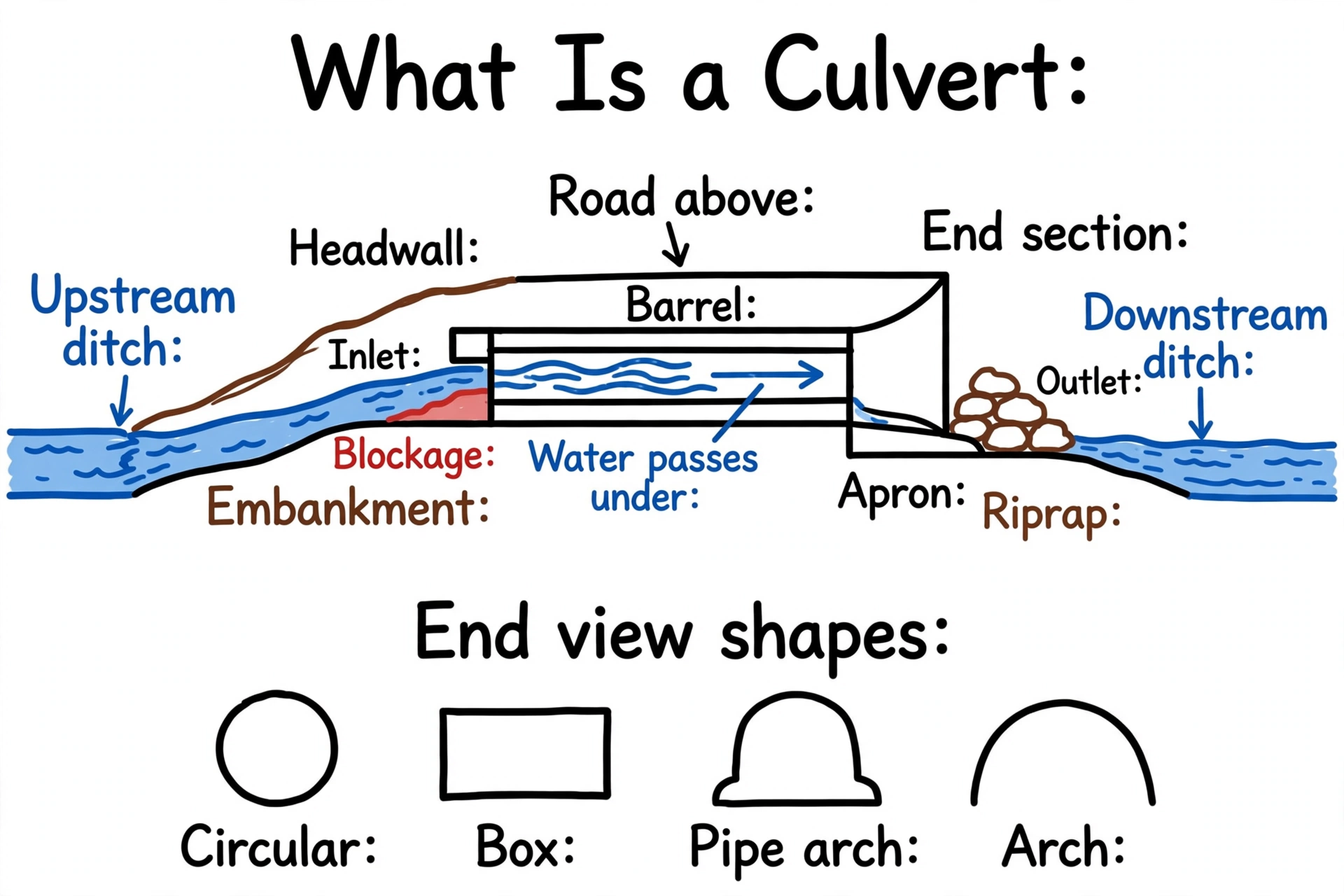
The three main parts, in the order water meets them:
- The inlet is the upstream end where water enters. Upstream means the side water comes from. The inlet may be a plain open pipe end sticking slightly out of the embankment slope, called a projecting end. It may be cut at an angle to match the slope, called a mitered end. Or it may sit in a wall or a shaped end treatment, covered below. The condition of the inlet decides how easily water and debris can get in. Debris is loose material carried or left by water, such as branches, leaves, trash, and sediment. Sediment is sand, silt, and soil that settle out of moving water.
- The barrel is the closed passage itself, the pipe or box that runs under the road, driveway, or embankment. The barrel is the part you mostly cannot see. From either end you may see into the first section, showing the material, the shape, and whether the inside is open, partly blocked, deformed, or damaged. The inside bottom of the barrel is called the invert. The top inside is called the crown. Those two words let a field report say where damage or sediment sits instead of just saying inside the pipe.
- The outlet is the downstream end where water leaves. Downstream means the side water flows toward. The outlet is where fast water meets the open channel again, so it is a common place for erosion. Erosion is wearing away of soil by water. A scour hole is a hole dug by moving water, often just beyond an outlet where the flow drops and swirls.
End treatments. Many culverts have end treatments that protect and support the ends of the barrel:
- A headwall is a vertical wall, often concrete, built across the end of a culvert around its opening. It holds back the embankment earth, supports the edge of the barrel, and helps guide water into or out of the opening.
- Wingwalls are angled walls extending from a headwall or from the barrel end, guiding the channel into the opening and holding the slope on each side.
- An end section is a manufactured piece attached to the barrel end, often flared, meaning wider at the outer edge, to improve the entrance, protect the end, and blend the barrel into the slope.
A driveway culvert may have a simple flared end section and no headwall at all. A larger road culvert may have a full concrete headwall with wingwalls. Both are culverts. The end treatment varies with the structure and the site.
An apron is a flat protective surface, often concrete or large stone, laid on the channel bed at an inlet or outlet. At an outlet, an apron spreads and slows the leaving water and protects the bed from being dug away. Large loose stone used for erosion protection is often called riprap. You may see riprap placed around an outlet, along the slope near a headwall, or in a scour hole that someone has tried to stabilize. Riprap is a clue that water has energy at that spot and that erosion is a known concern there.
Shapes. You read shape by looking straight into an open end from a safe position outside the barrel:
- A circular culvert has a round opening. It is one of the commonly used shapes in FHWA material, and a beginner is likely to meet it at driveways and small road crossings.
- A box culvert has a flat bottom, vertical sides, and a flat top, giving a rectangular opening. Box culverts are often concrete, and a wide crossing may use two or more box sections side by side, called multiple barrels.
- A pipe-arch culvert has a rounded top and a flatter, wider bottom, like a circle pressed down.
- An arch culvert has a curved top and an open bottom, so water flows over the natural or paved channel bed between its footings.
- Elliptical shapes, wider than they are tall or taller than they are wide, also exist.
This lesson teaches shape names for recognition and reporting only. It does not teach which shape belongs at a given site. Shape selection is a design decision based on the water to be carried, the ground available, the load above, and the standards and documents for that project.
Materials. Materials are the third clue:
- Reinforced concrete is concrete with steel bars or mesh inside it for added strength. Concrete culverts may be round pipe or box sections, gray and heavy looking, often in joined sections with visible seams.
- Corrugated metal means metal sheet formed into a repeating wave pattern for strength. Corrugated metal culverts, in steel or aluminum, show that wavy pattern clearly at an open end and often inside the barrel. They may be coated, and older ones may show rust.
- Plastic culverts used for drainage are commonly made of high density polyethylene, shortened to HDPE, a tough plastic. An HDPE culvert is often black, with a corrugated outside and a smooth inside on many common types, and it is lighter in appearance than concrete or metal.
Other materials exist, including other plastics and masonry on older structures. Do not judge condition or remaining life from material alone. Name the material you can actually see, note visible damage, and leave structural judgment to qualified inspectors.
Surface clues. A culvert also has a relationship to the ground above it that you can read from the surface:
- A dip, a patch, or cracking in the road or driveway directly over the crossing line.
- Embankment slopes on both sides falling toward the ditches.
- Guardrail, posts, signs, or pavement markings that hint at a buried structure at a larger crossing, although many small culverts have none of those clues.
Put the surface clues together with the two openings and the ditch line. That combined picture is how you confirm a culvert instead of guessing from one pipe end alone.
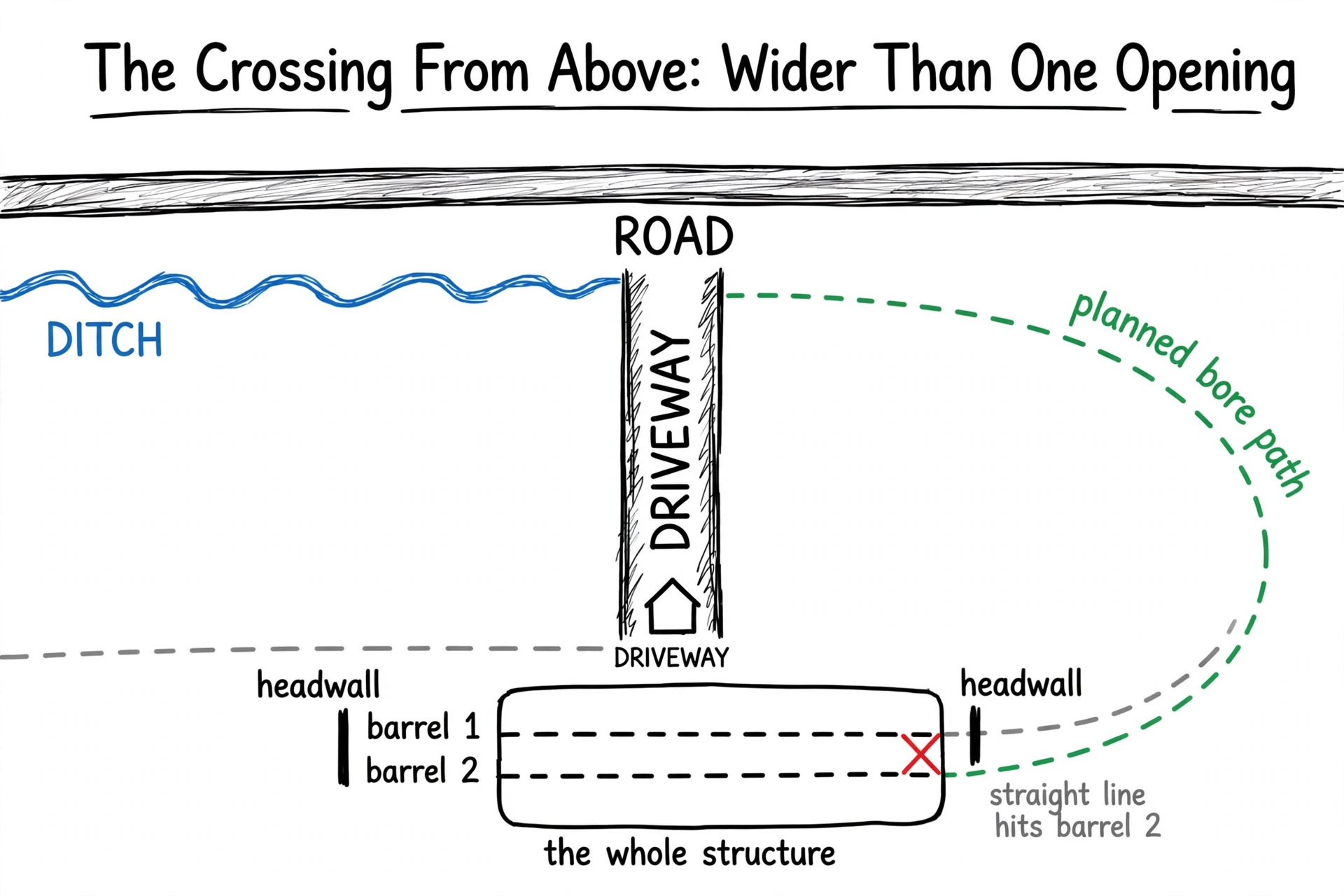
Finally, notice multiple barrels. Two or three pipes or boxes side by side under one road are one culvert crossing with several barrels, not several unrelated culverts. Multiple barrels matter for fiber work because the structure below ground is wider than any single opening suggests. A bore aimed to miss one visible pipe can still strike the barrel next to it.
What Does It Do?
A culvert does three jobs at the same time.
First, it passes water. It takes the flow of a ditch, a small stream, or a drainage channel arriving on one side of a road, driveway, or embankment and carries that flow to the other side, so the drainage path stays continuous. Without that passage, the road or driveway acts as a dam, a barrier that blocks and holds back water. Water held back on the upstream side is called headwater when it is the water depth at a culvert inlet, and water on the downstream side is called tailwater. This lesson uses those words as ideas only. How a culvert performs for a given flow is a hydraulic design question. Hydraulics is the study of how water moves. FHWA HDS-5 is the main federal reference for that design work, and it treats culvert flow as governed at different times by conditions at the inlet or by conditions in the barrel and at the outlet. A beginner does not need the calculations. A beginner does need the plain result: the inlet, the barrel, and the outlet all affect how much water gets through, so damage or blockage at any one of them reduces the whole crossing.
Second, it supports what is above it. The barrel, the bedding under it, the backfill around it, and the cover above it work together with the surrounding earth to carry the road, the driveway, and the vehicles crossing over them. Bedding is the prepared material the barrel rests on. Backfill is material placed back around and over a buried structure. That is why a culvert is called a structure, not just a pipe in the ground. A cracked, crushed, or separated barrel is not only a drainage problem. It can mean lost support, voids in the ground, and settlement of the surface above. A void is an empty space in the ground where supporting material should be.
Third, it protects the road or driveway from the water it carries. By giving water a defined path under the surface, a working culvert keeps that water from flowing over the top, soaking the base, or cutting along the side of the embankment. Overtopping is water flowing over the top of a road or embankment. Overtopping is not a harmless overflow. Moving water over an earth embankment can cut it quickly, and water soaking the ground that supports a paved surface weakens that support.
A culvert does not create drainage where none existed, does not treat or clean water, and does not carry fiber, vehicles, or people as its normal job. Some large structures are designed for other or additional uses in specific projects, but a beginner should not assume any culvert is a walkway, a storage space, a utility tunnel, or a safe place to enter. Its job is water below and support above, at one crossing.
Where Does It Fit?
Level 2 teaches you to read the physical environment. Lesson 21 placed the work in the right-of-way, Lesson 22 added easements, Lesson 23 added property lines, Lesson 24 added curb and gutter, Lesson 25 added sidewalks, and Lesson 26 added ditches and drainage. This lesson adds the structure that carries a ditch under the features that cross it. Later lessons add intersections, driveways in detail, terrain, and the visible utility features sharing the ground.
In the drainage picture, the order along the water path is: upstream ditch or channel, inlet, barrel under the crossing, outlet, downstream ditch or channel. Break any link and the whole path changes. A ditch can be in perfect condition and still flood a yard if the driveway culvert between its two sections is blocked. A culvert can be sound and still perform badly if the downstream ditch is filled, because the tailwater has nowhere to go.
In the road picture, the culvert sits under the traveled surface and its embankment. The road or driveway is on top, the ditches are on the sides, and the culvert connects the ditches through the embankment. A driveway, covered in more detail later in this level, is a common small example a fiber crew meets: a ditch along the road, a driveway crossing it, and a culvert under the driveway apron carrying the ditch flow. Apron, used for a driveway, means the sloped part of the driveway where it crosses toward the street. That driveway apron and a culvert outlet apron share a word and are different things. Read which one a plan or a speaker means from the context.
In the utility picture, culverts share the corridor with buried fiber in two risky ways:
- They occupy underground space across the full width of a road or driveway, exactly where a fiber bore often needs to cross.
- The places fiber crews like to work, the ditch line, the edge of the driveway, the low shoulder, are the same places culvert inlets, outlets, headwalls, and end sections sit.
Records and prints may show a culvert, may show it in the wrong place, or may not show a small driveway culvert at all. Field evidence, the two openings, the ditch line, and locates for the utilities present all belong in the picture before a bore path is chosen. Locating utilities and designing a bore are Level 3 and later skills. This lesson gives you the feature to look for and report.
In the project picture, a culvert appears in drainage plans, road plans, permits, and restoration requirements. Whether an existing culvert may be extended, replaced, worked beside, or left completely alone comes from those documents and from the agency or owner that controls the crossing. A fiber project normally does none of those culvert tasks. Its job is to cross or pass the culvert zone without damaging the structure, blocking its openings, or changing the drainage it serves.
What Is at Stake
Flooding. A culvert is often the narrowest point in a drainage path. Leaves, sediment, a fallen branch, trash, or construction spoil in an inlet or barrel can reduce or stop the flow. Water that cannot get through rises on the upstream side. It can flood yards, enter buildings, cover a road, and cut around the side of the culvert through the embankment, a process sometimes called piping when seepage carries soil away along or through the structure and leaves a cavity. Piping in this drainage sense has nothing to do with installing pipe. It is soil being removed by water moving where it should not move, and it can undermine both the culvert and the surface above it.
The road above it. A culvert that leaks at its joints, corrodes through its invert, cracks, or loses the soil around it can create voids that migrate upward until the pavement dips or collapses. Joint means the connection between two sections of barrel. Separated joints can let water out of the barrel into the surrounding ground and let soil into the barrel, working in both harmful directions at once. Inspection references for culverts return to the same family of problems: blocked openings, deteriorated or deformed barrels, open or displaced joints, damaged end treatments, and erosion or scour at the ends. A fiber crew does not grade those conditions. A fiber crew that can name and locate them reports something useful instead of saying the pipe looks rough.
Erosion at the outlet. Water often leaves a culvert faster and more concentrated than it arrived, because the barrel gathers a wide ditch flow into one opening. That concentrated flow can dig a scour hole, undercut an apron or a headwall, and eat back toward the culvert itself, a failure sometimes described as undermining, the removal of supporting soil from under or behind a structure. Sediment dug out at one outlet becomes a blockage problem farther downstream. Protecting an outlet during fiber work means keeping the apron, riprap, and channel as found, not burying them, pushing them aside, or dumping spoil where the flow will carry it into the next opening.
The fiber work itself. A directional bore that strikes a culvert barrel can crack concrete, tear or deform metal or plastic, open a joint, and create a drainage failure that appears in the next heavy rain, long after the bore crew has left. A trench that removes support beside a barrel, or backfill that is not compacted correctly around a crossing, can let a barrel shift or a joint open. Spoil, drilling fluid, conduit, and equipment staged in a ditch or against an inlet can block flow during the job itself, and a sudden storm during construction turns a blocked ditch into flooded property and a washed out work area. The culvert is also a hard limit on bore geometry. The safe path is planned around the whole structure, all barrels, headwalls, and aprons included, with the clearance the project documents require. This lesson does not state that clearance. The bore plan, the locates, and the project requirements set it for each crossing.
Safety, stated plainly. A culvert opening is not a shelter, a shortcut, or a place to retrieve a tool. The interior of a culvert can be a confined space, meaning a space that is large enough to enter, has limited ways in and out, and is not designed for continuous occupancy, where hazardous air, engulfment by water or material, or other serious hazards may be present. Federal workplace safety rules administered by the Occupational Safety and Health Administration, shortened to OSHA, govern confined space entry in general industry and in construction through separate standards, and entry requires a qualified program, testing, training, and authorization that this lesson does not provide. Water can also rise in a culvert quickly during rain upstream, even when the sky over the opening looks clear. Add traffic above, unstable slopes at the ends, and animals that shelter in openings, and the rule is simple for this course: observe from outside, from safe and authorized ground, and never enter a culvert barrel.
What Does Good Look Like?
A good culvert looks like a drainage path a stranger could follow without guessing:
- Both openings are findable and open. The inlet and outlet are visible, the barrel is not blocked by sediment, debris, vegetation, spoil, or stored material, and water in wet weather can enter and leave freely.
- The barrel reads as one sound structure. From the ends, the material looks continuous, the shape looks true rather than squashed or bulged, joints line up without a visible step or gap, and there is no obvious crack, hole, heavy rust loss, or separated section.
- End treatments are intact and in place. A headwall is not cracked away from the barrel or undermined. Wingwalls hold the slope. An end section is still attached and not crushed, lifted, or pulled away from the barrel.
- Aprons and erosion protection are present and working where they were built. An outlet apron is not broken or undercut, riprap is in place rather than scattered or buried, and there is no fresh scour hole eating back toward the structure.
- The ground and surface above look supported. There is no dip, sinkhole, or new cracking in the road or driveway over the crossing line, no void opening at the slope beside a headwall, and no soil washing out from around the barrel.
- The ditches connect. The upstream ditch leads cleanly to the inlet, the downstream ditch leads away from the outlet, and neither end is dammed by grading, spoil, a parked vehicle, or a stockpile.
- Where a project has worked nearby, the openings, aprons, riprap, ditches, and surface above are as the project found or restored them, to the standard the permit and the controlling agency or owner require, with photographs showing the culvert before, during, and after the nearby work.
Condition is the measure. An older culvert with open ends, a sound barrel, intact end treatments, and no erosion at its outlet is a good culvert. A new culvert with a blocked inlet or an undermined outlet is not.
From the Field
Picture a fiber crew set to bore a new conduit along a rural road, crossing under two driveways to reach handholes behind them. Rain fell two days earlier, the ditches still carry a small flow, and both driveways cross the same ditch. Before any equipment is positioned, the crew leader walks both crossings on foot.
At the first driveway, the leader follows the ditch and finds a circular corrugated metal culvert with a flared end section at each end. Both openings are clear. A small amount of sediment sits at the invert of the inlet without blocking the flow, and the driveway surface above shows no dip. The leader photographs both ends, records one barrel, metal, circular, and notes that the bore crossing will be planned around the whole culvert and its ends, using the clearance and locate information in the project documents, not a guess made at the ditch.
At the second driveway, the upstream ditch holds standing water while the downstream side is nearly dry. The leader finds the inlet almost completely blocked by branches, leaves, and sediment, and the concrete end section cracked and pulled slightly away from the barrel. On the driveway above, a shallow dip runs along the culvert line. The leader does not clear the blockage, does not reach into the barrel, and does not record a cause for the dip as fact. The leader photographs the blocked inlet, the damaged end, and the dip, ties each note to the driveway address, and reports the preexisting condition before any boring begins.
That report changes the job in two useful ways. The bore plan for the second driveway is reviewed against a blocked and possibly damaged structure instead of an assumed sound one, and the project decides through its own process whether the culvert condition affects the crossing plan. And when heavy rain comes a week later and the upstream yard floods at the second driveway, the project record shows the blockage and damage were documented before the fiber work started. The cleanup and repair of that culvert belong to whoever owns or controls that driveway crossing under local rules, not quietly to the fiber crew, and not to guesswork in a report.
During the work at the first driveway, spoil is staged on the high side of the road, away from the ditch. The inlet and outlet stay open for the full job, and no equipment crosses the driveway over the culvert except on the traveled surface the project plan allows. At the final walk, both ends of the first culvert are open and undamaged, the ditch flows through as it did at the start, and the second culvert is unchanged, still documented as a preexisting problem awaiting its owner process.
The crew did not become culvert builders or culvert cleaners. It found the structures, read them, planned around them, and kept the drainage path open. The rule to carry: find both ends and record the condition before work starts, because the record made before the job is the only thing that separates what a project found from what a project caused.
What Can Go Wrong?
Culverts fail by blockage, by deterioration, by water attacking their ends and surrounding soil, and by construction damage. A fiber crew will be blamed for the last kind and will often be first to notice the first three.
- A blocked inlet or barrel. Sediment, branches, leaves, trash, or a collapsed section fills part or all of the opening. Flow drops, headwater rises, and the drainage path backs up toward yards and the road. A blockage that looks minor in dry weather can be the whole story in a storm.
- A blocked or buried outlet. Spoil, grading, a stockpile, or a downstream ditch filled with sediment leaves the water with no exit. The barrel may be sound and still pass almost nothing.
- A crushed or deformed barrel. Loads above, poor support below, construction equipment, or a bore strike can squash a flexible barrel out of shape or crack a rigid one. A deformed shape reduces flow and signals lost support for the surface above.
- A cracked, corroded, or worn barrel. Concrete cracks and can lose pieces around reinforcing steel. Metal can rust through, most often at the invert where water and abrasive sediment run. Plastic can crack, split, or deform. A hole in the barrel lets soil in and water out, and a void can form outside the barrel where nobody can see it.
- Open or separated joints. Sections pull apart or settle unevenly, leaving a step or gap. Water leaks out, soil leaks in, and the ground above can settle along the barrel line.
- Damaged end treatment. A headwall cracks or separates from the barrel, a wingwall tips or loses the slope behind it, an end section is crushed by a vehicle or pulled loose. Water then attacks the exposed embankment at the exact point the treatment was built to protect.
- Outlet scour and undermining. Fast water leaving the barrel digs the bed, undercuts the apron or headwall, and works back until the end of the barrel loses support and can drop or separate.
- Piping and loss of surrounding soil. Seepage along the outside of the barrel, or flow through an open joint or a hole, carries soil particles away and leaves a lengthening cavity. The surface clue may be only a small dip or hole that appears late in the process.
- Overtopping and washout. A blocked culvert, a culvert too small for the flow that arrives, or a damaged culvert cannot pass a heavy flow, water rises over the road or driveway, and moving water cuts the embankment. A washout is a section of road, driveway, or embankment carried away by water. The crossing can be lost in a single storm.
- Construction blockage and damage. Spoil in the ditch, drilling fluid or sediment released into the inlet, a bore through the barrel, a trench that undermines an end, or heavy equipment crossing a shallow buried barrel the project did not identify. This is the failure kind a fiber crew controls directly, by finding the culvert first, planning around the whole structure, and keeping its openings and drainage path open for the whole job.
Culvert failures usually build slowly, through sediment, corrosion, small soil losses, and one storm at a time. Recognition is the defense. A crew that finds both ends, reads the barrel and end treatments, and checks the surface above before work starts will notice change, and will have photographs separating project work from conditions the project did not create.
What Should Someone Notice in the Field?
Notice the culvert as water would meet it, from the upstream ditch to the downstream ditch, from a safe and authorized position outside the barrel. You are observing and reporting, not entering, cleaning, repairing, or judging structural condition.
- Follow the drainage path first. Name it out loud: upstream ditch, inlet, crossing surface above, outlet, downstream ditch. If a part is missing or buried, say what is actually there.
- Find both ends. Record the inlet and outlet locations by address, crossing, road, driveway, or station the crew can find again. One visible end is not a complete find. The second end confirms the direction and the full width of the structure.
- Name the shape and material you can see. Circular, box, pipe-arch, or arch. Concrete, corrugated metal, plastic, or another material you can identify at the opening. Say visible ends only if the barrel interior cannot be seen safely from outside.
- Count the barrels. One, two, or more side by side. Note it plainly, because the underground width of the crossing depends on it.
- Read the end treatments. Headwall, wingwalls, flared end section, mitered end, or projecting end. Note cracks, separation from the barrel, tipping, crushing, or soil lost behind a wall.
- Check openness without entering. From outside the opening, note sediment, debris, vegetation, spoil, or standing water blocking any part of either end, and whether the ditch line is open into the inlet and away from the outlet.
- Look at the outlet bed. Note an apron or riprap if present, whether it is intact, broken, buried, or undercut, and any scour hole beyond the outlet. Do not climb down an unstable slope to get a closer look.
- Read the surface above. Walk the road or driveway line over the culvert where it is safe and authorized to do so and note dips, patches, cracking, or a soft or sunken area along the crossing line. Watch traffic the whole time and stay out of live lanes.
- Connect the culvert to the planned fiber work. Where does the proposed bore or trench cross the culvert line? Where are pits, spoil, conduit staging, and equipment crossings planned in relation to the inlet, barrel, outlet, apron, and ditches? Name the conflicts before equipment arrives.
- Photograph before you disturb. Take overview photographs showing the ditch, both ends, the end treatments, and the surface above, plus detail photographs of barrel damage, joint problems, blockage, and outlet erosion in the work area.
Safety and limits, plainly. Never enter a culvert barrel, for any reason, at this level. Treat every culvert interior as a possible confined space with possible bad air and possible fast rising water. Do not reach deep into an opening, do not clear a blockage inside a barrel, and do not work in a ditch or at an outlet where traffic, an unstable slope, or rising water puts you at risk. Observing a culvert does not qualify you to design, size, install, clean, repair, or replace one, to enter a confined space, to perform roadway work, or to certify a culvert as sound. Those tasks belong to qualified crews, inspectors, and agencies under the project documents and the safety rules for that work. Report what you found through your project process, with location, shape, material, barrel count, and photographs.
Key Terms
- Culvert. A structure that lets water flow under a road, a driveway, a railroad, or an embankment, while supporting the surface and the loads above it.
- Inlet. The upstream end of a culvert, where water enters.
- Outlet. The downstream end of a culvert, where water leaves.
- Barrel. The closed passage of a culvert itself, the pipe or box that runs under the crossing. Multiple barrels means two or more passages side by side at one crossing.
- Invert. The inside bottom of the barrel.
- Crown. The inside top of the barrel.
- Headwall. A vertical wall, often concrete, built across the end of a culvert around its opening, holding back the embankment and supporting and guiding flow at the barrel end.
- Wingwall. An angled wall extending from a headwall or barrel end, guiding the channel into or out of the opening and holding the slope on each side.
- End section. A manufactured piece attached to a barrel end, often flared, that improves the entrance, protects the end, and blends the barrel into the slope.
- Apron. A flat protective surface on the channel bed at an inlet or outlet, often concrete or stone, that spreads flow and protects the bed from erosion. A driveway apron is a different feature, the sloped part of a driveway at the street.
- Embankment. Built up earth that raises a road, driveway, or other surface above the surrounding ground.
- Erosion and scour. Erosion is wearing away of soil by water in general. Scour is erosion dug by moving water at a specific place, such as the hole that forms beyond an outlet.
- Piping. In drainage, removal of soil by seepage or flow along the outside of a barrel, through an open joint, or through a hole, leaving a cavity that can undermine the culvert and the surface above.
- Headwater and tailwater. Headwater is the water on the upstream side at the inlet. Tailwater is the water on the downstream side at the outlet.
- Confined space. A space large enough to enter, with limited ways in and out, not designed for continuous occupancy, where serious hazards such as hazardous air or engulfment may be present. A culvert interior must be treated as a possible confined space and never entered under this lesson.
Check Your Understanding
- In your own words, what is a culvert, and what are its two jobs at the same time?
- Standing at a driveway on a rural road, how do you find and confirm the culvert, and what three main parts do you name in the order water meets them?
- What is the difference between a headwall, an end section, and an apron, and where does each one sit?
- At the second driveway in From the Field, the crew leader found a blocked inlet, a damaged end section, and a dip over the culvert line. Why did the leader photograph and report those conditions instead of clearing the blockage and starting the bore, and what did that record protect a week later?
- A foreman says a trainee should climb into a large dry culvert to photograph a cracked joint, since the culvert is big enough to walk in and no water is flowing. Name the problems with that instruction as stated.
Answer key
- A culvert is a structure that lets water flow under a road, a driveway, a railroad, or an embankment, while supporting the surface and loads above it. Its two jobs are passing water from one side of the crossing to the other, and helping support the embankment and traveled surface above the barrel.
- Follow the drainage path. Find the ditch on one side, find where it disappears under the driveway, and find where it comes out on the other side. Confirming both ends confirms the structure, its direction, and its full width. In the order water meets them, the parts are the inlet, the barrel, and the outlet.
- A headwall is a vertical wall built across the end of the culvert around its opening, holding back the embankment at the barrel end. An end section is a manufactured piece attached to the barrel end itself, often flared, protecting the end and blending it into the slope. An apron is a flat protective surface laid on the channel bed at an inlet or outlet, spreading flow and protecting the bed from erosion. Wall at the end, piece on the barrel end, surface on the bed.
- Clearing a blockage inside a barrel is not the fiber crew’s work, and reaching into or entering the barrel is prohibited at this level because the interior must be treated as a possible confined space. Recording a cause for the dip as fact would also overstate what the leader could see. Photographing and reporting the condition before any boring let the project review the second crossing plan against a damaged structure instead of an assumed sound one. A week later, when heavy rain flooded the upstream yard, the dated record showed the blockage and damage existed before the fiber work started, keeping cleanup and repair with the crossing’s owner or controlling agency and off the fiber crew.
- First, a culvert interior must be treated as a possible confined space. Entry is governed by OSHA confined space standards and requires a qualified program, atmospheric testing, training, and authorization this course does not provide. Size and dry weather do not remove that requirement. Second, water can rise quickly from rain upstream even under a clear sky at the opening, and a person inside a barrel has limited ways out. Third, photographing and reporting a joint from outside the opening, and escalating anything that needs a closer look to qualified inspectors, is the recognition job this lesson teaches. The trainee does not enter.
Lesson Takeaway
A culvert is the structure that carries water under a road, driveway, or embankment while helping support everything above it. Read it by following the water: upstream ditch, inlet, barrel, outlet, downstream ditch. Name its shape, its material, its barrel count, and its end treatments: headwall, wingwalls, end section, and apron. Notice blockage at either end, a cracked, corroded, deformed, or separated barrel, damaged end treatments, outlet scour, and any dip in the surface above. Treat every barrel interior as a possible confined space and never enter one. For fiber work, find both ends before a bore is planned, plan around the whole structure, keep spoil and equipment out of its openings and its ditch, and never block the drainage path a neighborhood depends on in the next storm.
Sources and Technical References
- Federal Highway Administration, Hydraulic Design of Highway Culverts, Hydraulic Design Series Number 5 (HDS-5), Third Edition, FHWA Publication Number HIF-12-026, 2012. The FHWA hydraulics publications listing describes HDS-5 as the comprehensive culvert design publication merging earlier culvert design circulars and adding material on culvert assessment and repair, and describes a culvert as a conduit conveying flow through a roadway embankment or past a flow obstruction. https://www.fhwa.dot.gov/Engineering/hydraulics/library_arc.cfm?pub_number=7&id=13
- Federal Highway Administration, Structural Design of Culverts and related culvert material, FHWA-IP-83-6. States that culverts are conduits which convey drainage across or from the highway right-of-way, and that in addition to that hydraulic function culverts must also carry construction and highway traffic and earth loads, and covers headwall behavior and design context. https://www.fhwa.dot.gov/engineering/hydraulics/pubs/ip83_6.pdf
- U.S. Department of Transportation research record summarizing FHWA drainage design, hosted by ROSA P. Describes a culvert as a conduit conveying flow through a roadway embankment or past an obstruction, states that culverts are typically constructed of concrete, corrugated metal including aluminum or steel, and plastic in a variety of cross sectional shapes, and states that material selection depends on structural strength, hydraulic roughness, durability, and corrosion and abrasion resistance, with design procedures detailed in HDS-5. https://rosap.ntl.bts.gov/view/dot/57304/dot_57304_DS1.pdf
- Federal Aviation Administration, Advisory Circular 150/5320-5C, Surface Drainage Design, Chapter 4. Refers readers to FHWA HDS-5 for detailed culvert design practice, notes that a headwall improves entrance flow over a projecting culvert and acts as a cutoff against saturation, sloughing, and erosion of the embankment, and states that outlets and endwalls must be protected against undermining, bottom scour, and downstream channel erosion. https://www.faa.gov/documentLibrary/media/advisory_circular/150-5320-5C/150_5320_5c_p4.pdf
- Indiana Department of Transportation and FHWA Joint Transportation Research Program, Large Culvert Inspection Procedures, FHWA/IN/JTRP-2022/27, hosted by ROSA P. Describes inlet and outlet components, barrel condition assessment over the full length of a culvert, end treatment types including headwall, wingwalls, aprons, and mitered ends, and separate tracking of scour presence and blockage of the waterway. https://rosap.ntl.bts.gov/view/dot/66803/dot_66803_DS1.pdf
- North American Stream Crossing and culvert condition assessment material, Culvert Condition Assessment Manual, hosted by the Stream Continuity partnership. Rates inlet and outlet blockage by debris, sediment, and vegetation, barrel structural integrity including cracking, corrosion, deformation, joint and seam problems, and invert deterioration, flared end section damage and separation from the barrel, apron cracking, piping, and undermining, and embankment and roadway damage above failing culverts. https://streamcontinuity.org/media/165/download
- California Department of Transportation, Highway Design Manual, Chapter 800 material on culvert definitions, hosted by Caltrans. Defines a culvert as a closed conduit which allows water to pass under a highway and sets out span based culvert conditions measured along the centerline of the road in that state manual context, illustrating that span based classification language is agency and program specific rather than one universal field rule. https://dot.ca.gov/-/media/dot-media/programs/design/documents/chp0800.pdf
Previous lesson: Lesson 26: What Is a Ditch? |
Back to Level 2 hub |
Next lesson: Lesson 28: Why Does Drainage Matter?